
INTRODUCTION TO PEDIATRICS
Dr. Tauhid Iqbali
M.D. Pediatrics
INTRODUCTION
Branch of medicine that deals with the care of children and
adolescents.
What is it?Pediatrics:
Derived from the two Greek words
Pedo pais meaning a child
Iatros meaning healer
Pediatrics covers the age group less than 18 year of age
• Pediatricians are medical doctors who have specialized training
not only in evaluating, diagnosing and treating children but also in
dealing with their nutrition, growth, development and providing
opportunity to achieve full potential as adults.
• Responsibility: To improve children’s physical, mental, behavioral,
psychological and social health; reduce their morbidity & mortality.
AREAS OF IMPORTANCE
• Diagnosing and treating disease
• Growth and development
• Nutrition
• Immunization
• Opportunity to achieve full potential as adults
WHAT’S DIFFERENT?
“child is not a miniature adult”
The principle of adult medicine cannot be directly adapted to
children because, children have
 Unique biology
 Distinct risk factors of pediatric disease
 Clinical manifestation of disease may be different
 Many disorders are unique to children
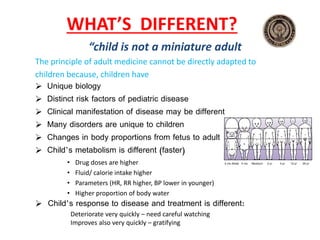
 Changes in body proportions from fetus to adult
 Child’s metabolism is different (faster)
• Drug doses are higher
• Fluid/ calorie intake higher
• Parameters (HR, RR higher, BP lower in younger)
• Higher proportion of body water
 Child’s response to disease and treatment is different:
Deteriorate very quickly – need careful watching
Improves also very quickly – gratifying
HISTORY
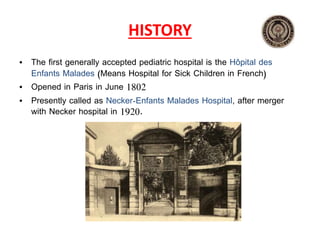
• The first generally accepted pediatric hospital is the Hôpital des
Enfants Malades (Means Hospital for Sick Children in French)
• Opened in Paris in June 1802
• Presently called as Necker‐Enfants Malades Hospital, after merger
with Necker hospital in 1920.
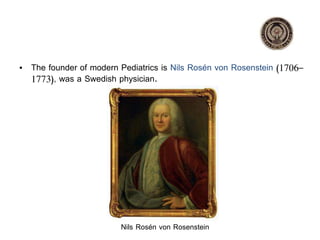
• The founder of modern Pediatrics is Nils Rosén von Rosenstein (1706–
1773), was a Swedish physician.
Nils Rosén von Rosenstein
HISTORY OF PEDIATRICS IN INDIA
• Pediatrics made its beginning in Bombay in 1928.
• When BJ Hospital for children was established.
• Dr George Coelho is considered as “Father of Pediatrics in India” who was the
superintendent of the first independent children hospital, BJ Hospital for
children.
• Postgraduate diploma in pediatrics was started in 1944.
• Postgraduate degree programs began in fifties.
• Pediatrics became an independent subject in MBBS course in mid-nineties.
• The first DM program in neonatology started in 1989 at PGIMER, Chandigarh
and in pediatric neurology at AIIMS in 2004.
PEDIATRICS AS SPECIALTY
• Fascinating specialty.
• Deals with care of premature to adolescents.
• Also covers intensive care management of sick neonates and children
on one hand and providing home care to newborns on the other.
Now the pediatrics has branched well into developed super
specialties ( Neonatology, nephrology, pulmonology, infectious
disease, pediatric critical care, neurology, hematology,
endocrinology and cardiology).
PERIODS OF GROWTH
• Neonate
• Infancy
• Toddler
• Preschool
• School age children
• Early Adolescents
• Middle Adolescents
• Late Adolescents
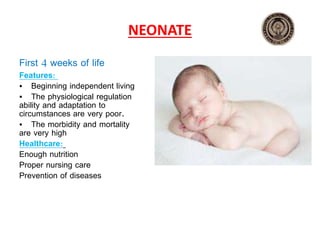
NEONATE
First 4 weeks of life
Features:
• Beginning independent living
• The physiological regulation
ability and adaptation to
circumstances are very poor.
• The morbidity and mortality
are very high
Healthcare:
Enough nutrition
Proper nursing care
Prevention of diseases
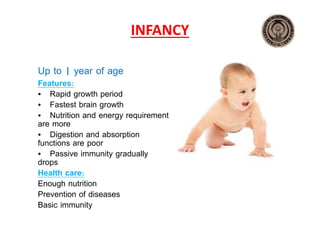
INFANCY
Up to 1 year of age
Features:
• Rapid growth period
• Fastest brain growth
• Nutrition and energy requirement
are more
• Digestion and absorption
functions are poor
• Passive immunity gradually
drops
Health care:
Enough nutrition
Prevention of diseases
Basic immunity
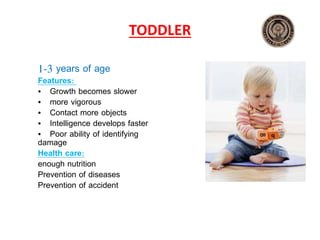
TODDLER
1‐3 years of age
Features:
• Growth becomes slower
• more vigorous
• Contact more objects
• Intelligence develops faster
• Poor ability of identifying
damage
Health care:
enough nutrition
Prevention of diseases
Prevention of accident
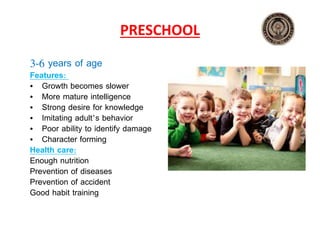
PRESCHOOL
3‐6 years of age
Features:
• Growth becomes slower
• More mature intelligence
• Strong desire for knowledge
• Imitating adult’s behavior
• Poor ability to identify damage
• Character forming
Health care:
Enough nutrition
Prevention of diseases
Prevention of accident
Good habit training
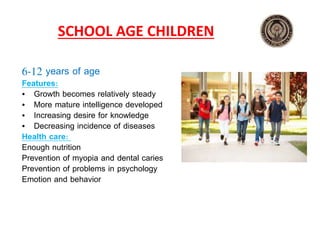
SCHOOL AGE CHILDREN
6‐12 years of age
Features:
• Growth becomes relatively steady
• More mature intelligence developed
• Increasing desire for knowledge
• Decreasing incidence of diseases
Health care:
Enough nutrition
Prevention of myopia and dental caries
Prevention of problems in psychology
Emotion and behavior
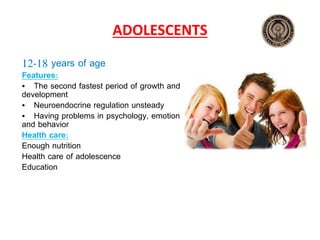
ADOLESCENTS
12‐18 years of age
Features:
• The second fastest period of growth and
development
• Neuroendocrine regulation unsteady
• Having problems in psychology, emotion
and behavior
Health care:
Enough nutrition
Health care of adolescence
Education
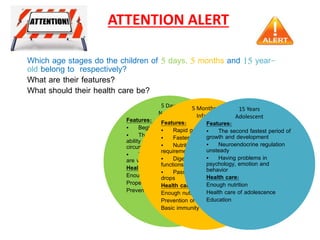
Which age stages do the children of 5 days, 5 months and 15 year-
old belong to respectively?
What are their features?
What should their health care be?
ATTENTION ALERT
5 Days
Neonate
Features:
• Beginning independent living
• The physiological regulation
ability and adaptation to
circumstances are very poor.
• The morbidity and mortality
are very high
Healthcare:
Enough nutrition
Proper nursing care
Prevention of diseases
5 Months
Infant
Features:
• Rapid growth period
• Fastest brain growth
• Nutrition and energy
requirement are more
• Digestion and absorption
functions are poor
• Passive immunity gradually
drops
Health care:
Enough nutrition
Prevention of diseases
Basic immunity
15 Years
Adolescent
Features:
• The second fastest period of
growth and development
• Neuroendocrine regulation
unsteady
• Having problems in
psychology, emotion and
behavior
Health care:
Enough nutrition
Health care of adolescence
Education
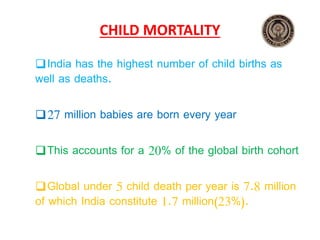
CHILD MORTALITY
India has the highest number of child births as
well as deaths.
27 million babies are born every year
This accounts for a 20% of the global birth cohort
Global under 5 child death per year is 7.8 million
of which India constitute 1.7 million(23%).
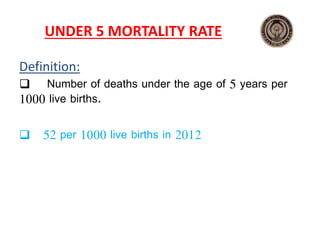
UNDER 5 MORTALITY RATE
Definition:
 Number of deaths under the age of 5 years per
1000 live births.
 52 per 1000 live births in 2012
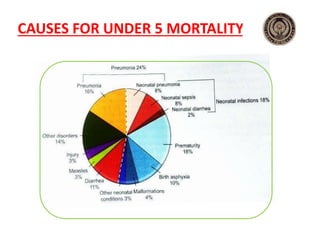
CAUSES FOR UNDER 5 MORTALITY
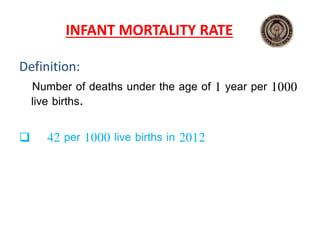
INFANT MORTALITY RATE
Definition:
Number of deaths under the age of 1 year per 1000
live births.
 42 per 1000 live births in 2012
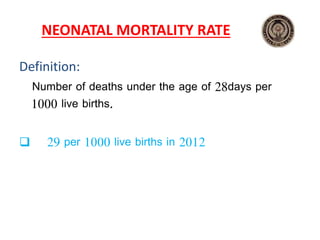
NEONATAL MORTALITY RATE
Definition:
Number of deaths under the age of 28days per
1000 live births.
 29 per 1000 live births in 2012
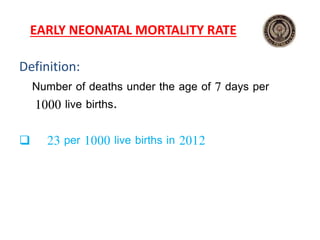
EARLY NEONATAL MORTALITY RATE
Definition:
Number of deaths under the age of 7 days per
1000 live births.
 23 per 1000 live births in 2012
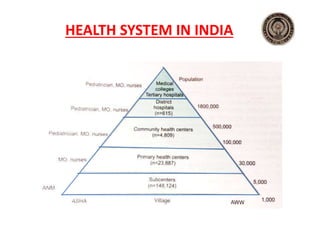
HEALTH SYSTEM IN INDIA
CHILD SURVIVAL STRATEGIES
• Early breast feeds
• Exclusive breast feeds
• Appropriate weaning
• Vaccination
• Antenatal, intrapartum and neonatal care
• Case management of pneumonia and diarrhea
NATIONAL PROGRAMS ON CHILD HEALTH
• Core of the health policy
• Multiple child health programs have been rolled
out.
• The Diarrheal Disease Control Program was
launched in 1981.
• Universal immunization program against 6
diseases was launched in 1985.
NATIONAL PROGRAMS ON CHILD HEALTH CONT..
• ARI control program launched in 1990.
• Child survival and safe motherhood (CSSM)
program launched in 1992 which combined
interventions for child survival and maternal health.
• CSSM and program for family planning was
combined to form reproductive and child health
program in 1997.
NATIONAL PROGRAMS ON CHILD HEALTH CONT..
• National Rural Health Program (NRHM) launched
in 2005.
• The RCH program was combined with NRHM.
• RMNCH+A was launched in 2013 which is an
ongoing child health program
FUTURE OF CHILD HEALTH
• India is addressing child health challenges with
greater dynamism than ever before.
• Investments are being made for health programs and
health system strengthening.
• ICDS is being strengthened, particularly in high
burden districts to address childhood undernutrition.
• India is poised to attain low child mortality rate and
to improve the health and nutrition status of children
in near future.
THANK YOU

Introduction to pediatrics

  • 1.
    INTRODUCTION TO PEDIATRICS Dr.Tauhid Iqbali M.D. Pediatrics
  • 2.
    INTRODUCTION Branch of medicinethat deals with the care of children and adolescents. What is it?Pediatrics: Derived from the two Greek words Pedo pais meaning a child Iatros meaning healer Pediatrics covers the age group less than 18 year of age
  • 3.
    • Pediatricians aremedical doctors who have specialized training not only in evaluating, diagnosing and treating children but also in dealing with their nutrition, growth, development and providing opportunity to achieve full potential as adults. • Responsibility: To improve children’s physical, mental, behavioral, psychological and social health; reduce their morbidity & mortality.
  • 4.
    AREAS OF IMPORTANCE •Diagnosing and treating disease • Growth and development • Nutrition • Immunization • Opportunity to achieve full potential as adults
  • 5.
    WHAT’S DIFFERENT? “child isnot a miniature adult” The principle of adult medicine cannot be directly adapted to children because, children have  Unique biology  Distinct risk factors of pediatric disease  Clinical manifestation of disease may be different  Many disorders are unique to children  Changes in body proportions from fetus to adult  Child’s metabolism is different (faster) • Drug doses are higher • Fluid/ calorie intake higher • Parameters (HR, RR higher, BP lower in younger) • Higher proportion of body water  Child’s response to disease and treatment is different: Deteriorate very quickly – need careful watching Improves also very quickly – gratifying
  • 6.
    HISTORY • The firstgenerally accepted pediatric hospital is the Hôpital des Enfants Malades (Means Hospital for Sick Children in French) • Opened in Paris in June 1802 • Presently called as Necker‐Enfants Malades Hospital, after merger with Necker hospital in 1920.
  • 7.
    • The founderof modern Pediatrics is Nils Rosén von Rosenstein (1706– 1773), was a Swedish physician. Nils Rosén von Rosenstein
  • 8.
    HISTORY OF PEDIATRICSIN INDIA • Pediatrics made its beginning in Bombay in 1928. • When BJ Hospital for children was established. • Dr George Coelho is considered as “Father of Pediatrics in India” who was the superintendent of the first independent children hospital, BJ Hospital for children. • Postgraduate diploma in pediatrics was started in 1944. • Postgraduate degree programs began in fifties. • Pediatrics became an independent subject in MBBS course in mid-nineties. • The first DM program in neonatology started in 1989 at PGIMER, Chandigarh and in pediatric neurology at AIIMS in 2004.
  • 9.
    PEDIATRICS AS SPECIALTY •Fascinating specialty. • Deals with care of premature to adolescents. • Also covers intensive care management of sick neonates and children on one hand and providing home care to newborns on the other. Now the pediatrics has branched well into developed super specialties ( Neonatology, nephrology, pulmonology, infectious disease, pediatric critical care, neurology, hematology, endocrinology and cardiology).
  • 10.
    PERIODS OF GROWTH •Neonate • Infancy • Toddler • Preschool • School age children • Early Adolescents • Middle Adolescents • Late Adolescents
  • 11.
    NEONATE First 4 weeksof life Features: • Beginning independent living • The physiological regulation ability and adaptation to circumstances are very poor. • The morbidity and mortality are very high Healthcare: Enough nutrition Proper nursing care Prevention of diseases
  • 12.
    INFANCY Up to 1year of age Features: • Rapid growth period • Fastest brain growth • Nutrition and energy requirement are more • Digestion and absorption functions are poor • Passive immunity gradually drops Health care: Enough nutrition Prevention of diseases Basic immunity
  • 13.
    TODDLER 1‐3 years ofage Features: • Growth becomes slower • more vigorous • Contact more objects • Intelligence develops faster • Poor ability of identifying damage Health care: enough nutrition Prevention of diseases Prevention of accident
  • 14.
    PRESCHOOL 3‐6 years ofage Features: • Growth becomes slower • More mature intelligence • Strong desire for knowledge • Imitating adult’s behavior • Poor ability to identify damage • Character forming Health care: Enough nutrition Prevention of diseases Prevention of accident Good habit training
  • 15.
    SCHOOL AGE CHILDREN 6‐12years of age Features: • Growth becomes relatively steady • More mature intelligence developed • Increasing desire for knowledge • Decreasing incidence of diseases Health care: Enough nutrition Prevention of myopia and dental caries Prevention of problems in psychology Emotion and behavior
  • 16.
    ADOLESCENTS 12‐18 years ofage Features: • The second fastest period of growth and development • Neuroendocrine regulation unsteady • Having problems in psychology, emotion and behavior Health care: Enough nutrition Health care of adolescence Education
  • 17.
    Which age stagesdo the children of 5 days, 5 months and 15 year- old belong to respectively? What are their features? What should their health care be? ATTENTION ALERT 5 Days Neonate Features: • Beginning independent living • The physiological regulation ability and adaptation to circumstances are very poor. • The morbidity and mortality are very high Healthcare: Enough nutrition Proper nursing care Prevention of diseases 5 Months Infant Features: • Rapid growth period • Fastest brain growth • Nutrition and energy requirement are more • Digestion and absorption functions are poor • Passive immunity gradually drops Health care: Enough nutrition Prevention of diseases Basic immunity 15 Years Adolescent Features: • The second fastest period of growth and development • Neuroendocrine regulation unsteady • Having problems in psychology, emotion and behavior Health care: Enough nutrition Health care of adolescence Education
  • 18.
    CHILD MORTALITY India hasthe highest number of child births as well as deaths. 27 million babies are born every year This accounts for a 20% of the global birth cohort Global under 5 child death per year is 7.8 million of which India constitute 1.7 million(23%).
  • 19.
    UNDER 5 MORTALITYRATE Definition:  Number of deaths under the age of 5 years per 1000 live births.  52 per 1000 live births in 2012
  • 20.
    CAUSES FOR UNDER5 MORTALITY
  • 21.
    INFANT MORTALITY RATE Definition: Numberof deaths under the age of 1 year per 1000 live births.  42 per 1000 live births in 2012
  • 22.
    NEONATAL MORTALITY RATE Definition: Numberof deaths under the age of 28days per 1000 live births.  29 per 1000 live births in 2012
  • 23.
    EARLY NEONATAL MORTALITYRATE Definition: Number of deaths under the age of 7 days per 1000 live births.  23 per 1000 live births in 2012
  • 24.
  • 25.
    CHILD SURVIVAL STRATEGIES •Early breast feeds • Exclusive breast feeds • Appropriate weaning • Vaccination • Antenatal, intrapartum and neonatal care • Case management of pneumonia and diarrhea
  • 26.
    NATIONAL PROGRAMS ONCHILD HEALTH • Core of the health policy • Multiple child health programs have been rolled out. • The Diarrheal Disease Control Program was launched in 1981. • Universal immunization program against 6 diseases was launched in 1985.
  • 27.
    NATIONAL PROGRAMS ONCHILD HEALTH CONT.. • ARI control program launched in 1990. • Child survival and safe motherhood (CSSM) program launched in 1992 which combined interventions for child survival and maternal health. • CSSM and program for family planning was combined to form reproductive and child health program in 1997.
  • 28.
    NATIONAL PROGRAMS ONCHILD HEALTH CONT.. • National Rural Health Program (NRHM) launched in 2005. • The RCH program was combined with NRHM. • RMNCH+A was launched in 2013 which is an ongoing child health program
  • 29.
    FUTURE OF CHILDHEALTH • India is addressing child health challenges with greater dynamism than ever before. • Investments are being made for health programs and health system strengthening. • ICDS is being strengthened, particularly in high burden districts to address childhood undernutrition. • India is poised to attain low child mortality rate and to improve the health and nutrition status of children in near future.
  • 30.