Neonatal Sepsis
An overview
Dr. S. K. Verma
M.B.B.S., M.D.
Mannat Nursing Home Pvt. Ltd.
Nahar Chowk , Dumra Road
Sitamarhi
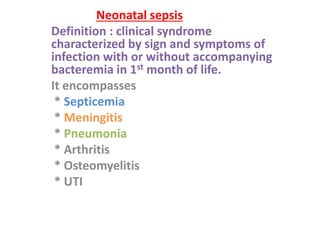
Neonatal sepsis
Definition : clinical syndrome
characterized by sign and symptoms of
infection with or without accompanying
bacteremia in 1st month of life.
It encompasses
* Septicemia
* Meningitis
* Pneumonia
* Arthritis
* Osteomyelitis
* UTI
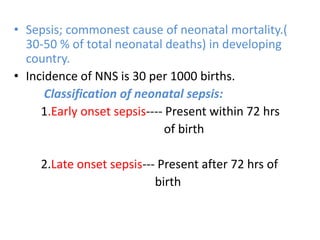
• Sepsis; commonest cause of neonatal mortality.(
30-50 % of total neonatal deaths) in developing
country.
• Incidence of NNS is 30 per 1000 births.
Classification of neonatal sepsis:
1.Early onset sepsis---- Present within 72 hrs
of birth
2.Late onset sepsis--- Present after 72 hrs of
birth
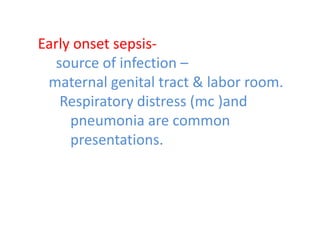
Early onset sepsis-
source of infection –
maternal genital tract & labor room.
Respiratory distress (mc )and
pneumonia are common
presentations.
Risk factors for EOS.
1. LBW ( Less than 2500 gm) or prematurity.
2. ROM for more than 24 hrs.
3. Febrile illness in mother with evidence of bact.
Infection within 2 wks prior delivery.
4. Foul smelling liquor
5. Single unclean or more than 3 sterile vaginal
examinations during labor.
6. Prolonged labor more than 24 hrs( 1 st & 2 nd
stage)
7. Perinatal asphyxia ( Apgar score < 3 at 1 min)
8. Prolonged Intubation > 2 days.
Late onset sepsis-
* Community acquired
* Hospital acquired
Septicemia, pneumonia and
meningitis are usual
presentations.
# 10 -30 % of LOS may have
associated with Meningitis.
Risk Factors for LOS
1. LBW or prematurity.
2. Poor Hygiene
3. Poor chord care
4. Bottle feeding
5. Mechanical ventilation.
6. Invasive procedure
7. Intravenous fluid administration
Endotracheal tube in situ - colonization
ET > 2 days
colonization with Klebsiella /
staph.aureus
ET > 10 days
colonization with candidal infection in
addition to bacteria.
Pathogens ( Indian data)
• E.Coli & Klebsiella pneumoniae – (27- 32 %)
• Staphylococcus aureus – ( 13 – 15 %)
• Pseudomonas spp - rare
As per NNPD Klebsiella and staph.
Commonest pathogen.
* GBS is MC pathogen in developed country.
Clinical features
Nonspecific features:
• Hypothermia or fever
• Lethargy/ irritable
• Poor cry
• Poor feeding / Refusal to suck/ abd.distention
• Poor perfusion , prolonged CRT > 3 sec
• Hypotonia, absent neonatal reflex
• bradycardia/ tachycardia
• Hypo or hyperglycemia
• Respiratory distress, apnea, gasping respiration
• Metabolic acidosis
Specific features related to system
• CNS- Bulged A/F, vacant stare, high pitch cry,
excessive irritability, seizure, stupor, coma, neck
retraction.
• Cardiac- pallor, Hypotension, poor perfusion,
shock
• GIT- feed intolence, vomiting, diarrhea,
abdominal distention, paralytic ileus, NEC.
• Hepatic- Hepatomegaly, direct hyperbilirubinemia
• Skin- multiple pustules, abscess, sclerema,
mottling, umbilical redness and discharge, cutis
marmorata, cyanosis.
• Hematological – bleeding, petechie, purpura
• Renal – acute renal failure
Investigation of NNS--- Summary
1.Sepsis screen.
2.Culture- Blood/ urine/CSF
3. Radiology-
* X- ray – chest and abdomen.
* CT /MRI of brain in CNS infections.
4. Lumber puncture-
5. CBC
6. Prothrombin time, aPTT , FDP in cases of DIC
7. Blood sugar, Blood urea and s. electrolytes.
8. swab culture of Ear. Nose, umbilicus.
9. ABG and Antigen detection assay in serum, CSF,urine.
Investigations:
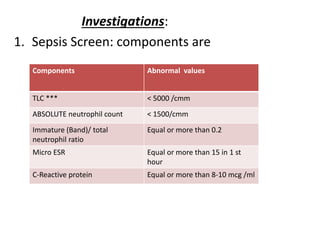
1. Sepsis Screen: components are
Components Abnormal values
TLC *** < 5000 /cmm
ABSOLUTE neutrophil count < 1500/cmm
Immature (Band)/ total
neutrophil ratio
Equal or more than 0.2
Micro ESR Equal or more than 15 in 1 st
hour
C-Reactive protein Equal or more than 8-10 mcg /ml
2 or more abnormal parameter should be
considered as a positive screen and neonate
should be started on antibiotic.
Screen is negative but clinical suspicion persists,
it should be repeated in 24 hrs.
Screen still negative, sepsis can be excluded.
Sepsis screen is less reliable in
• Preterm
• Term infant during initial 48 hrs.
• Decision to start antibiotics need not be
conditional to sepsis screen if a strong clinical
suspicion of sepsis.
• Micro ESR- Least useful, CRP- Most useful
CRP- > 8-10 mg/ l – positive
LEVEL of CRP starts to increase by 6 hrs and
peak in 24 – 48 hrs. Delayed rise in preterm
baby.
* Repeated after 24 hrs if sepsis is suspected
and earlier CRP is negative.
* Elevated CRP also seen in Hypoxia, HMD and
meconium aspiration. It must be correlated
accordingly.
Gastric aspirate: ( included in sepsis screen)
* Recommended in all baby suspected to
be infected in utero.
* Not useful if contaminated with blood or
meconium.
* Thick smear on glass slide - > 5 polymorphs
per HPF is abnormal.
Investigation of NNS continue
2.Blood culture- GOLD standard
1 ml blood needed for blood culture bottle
containing 5 – 10 ml of culture media. At least
incubated for 72 hrs before reported as sterile.
BACTEC and BACT/ALERT blood culture detect
bacterial growth in 12-24 hrs.
Blood culture should be done in all suspected
cases of sepsis prior to starting antibiotics.
investigation continued-
3. Lumber puncture-
Incidence of meningitis in NNS vary from 0.3 to
3 % in various studies. Clinical features of
septicemia and meningitis often overlaps. It
is justified to perform LP in all neonates
suspected to have LOS prior to starting
antibiotics.
In EOS, LP is indicated in +ce of a positive blood
culture or if C/F is consistent with septicemia.
Not performed in critically sick neonate.
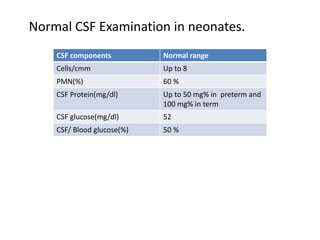
Normal CSF Examination in neonates.
CSF components Normal range
Cells/cmm Up to 8
PMN(%) 60 %
CSF Protein(mg/dl) Up to 50 mg% in preterm and
100 mg% in term
CSF glucose(mg/dl) 52
CSF/ Blood glucose(%) 50 %
CSF finding discussion
> 20-25 WBC/cmm in preterm and > 5-10
WBC/cmm in term baby suggests meningitis.
But any count > 8-10 WBC/cmm is significant in
clinically suggestive case irrespective of maturity.
>60 % of WBC are polymorphs indicative of
meningitis.
Elevated mean CSF protein above 50 mg % in
preterm and 100 mg % in term suggest meningitis
CSF/ Blood glucose- less than 50 % is significant. In
clinically suspected case CSF glucose value < 50
mg is significant.
investigation continued
4. Radiology.
x-ray chest - respiratory distress or apnea.
x- ray abdomen- NEC
5. Urine – not indicated routinely. Done if UTI
suspected.
Term used for initial diagnosis
Presumed sepsis- Unwell baby with initial sepsis
screen is negative.
Probable sepsis- Baby with clinical picture
suggestive of sepsis PLUS 1 or more following
criteria:
1. + ce of risk factors for sepsis.
2. + ve sepsis screen.
3. A source of infection.
4. X-ray evidence of pneumonia.
Proven sepsis- baby with C/F of sepsis with
positive culture ( Blood / urine/ CSF)
Management OF NNS
SUPPORTIVE MANAGEMENT
1. Care of temperature-
Temp. Neonate- 36.5– 37.5 degree centi
Room- 26-28 degree cent
1. Feeding withhold as ileus is common.
2. Oxygen saturation maintained spo2 at 90-93 %
3. Management of coagulopathy with vit. k
4. Maintenance of blood sugar.( Hypoglycemia < 50
mg/dl). T/t with 2 ml/kg D10 bolus, 4 ml/kg if
seizure.
5. Intravenous fluid in hemodynamically unstable
baby( IV bolus 10 ml/kg of NS over 10-15 min
6. Mechanical ventilation if required as in
recurrent apnea/ respiratory failure.
7. Packed cell and fresh frozen plasma given
for anemia or bleeding diathesis.
8. BP/Peripheral perfusion is monitored.
Dopamine/ Dobutamine may be given.
DOSE- I ml of Dopamine( 40 mg/ml) or
Dobutamine( 50 mg/ml) is diluted in 10 ml of
D10. ADD 5ml in whole day fluid in Term
baby and 2.5 ml in preterm baby.
ANTIMICROBIAL THERAPY
Recommendation based upon clinical features and
or positive septic screen.
Indications for starting antimicrobials in neonates
at risk of EOS includes
1. +ce of 3 or more risk factors for EOS.
2. + ce of foul smelling liquor
3. Strong clinical suspicion of sepsis.
Indications for starting antibiotics LOS includes
1. Positive septic screen
2. Strong clinical suspicion of sepsis.
Duration of antibiotics in NNS
DIAGNOSIS DURATION
Culture negative Sepsis ( screen positive and
clinically consistent with sepsis)
7 – 10 days
Blood culture positive but no meningitis 14 days
Meningitis ( with or without positive blood/
CSF)
21 day
Empirical choice of antibiotics in
Neonatal sepsis
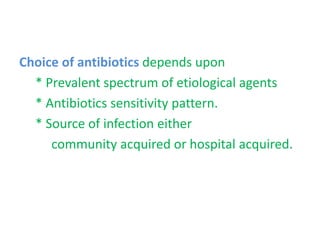
Choice of antibiotics depends upon
* Prevalent spectrum of etiological agents
* Antibiotics sensitivity pattern.
* Source of infection either
community acquired or hospital acquired.
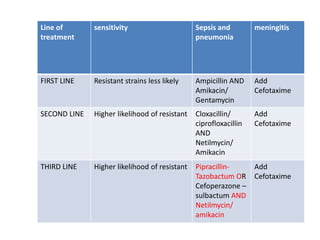
Line of
treatment
sensitivity Sepsis and
pneumonia
meningitis
FIRST LINE Resistant strains less likely Ampicillin AND
Amikacin/
Gentamycin
Add
Cefotaxime
SECOND LINE Higher likelihood of resistant Cloxacillin/
ciprofloxacillin
AND
Netilmycin/
Amikacin
Add
Cefotaxime
THIRD LINE Higher likelihood of resistant Pipracillin-
Tazobactum OR
Cefoperazone –
sulbactum AND
Netilmycin/
amikacin
Add
Cefotaxime
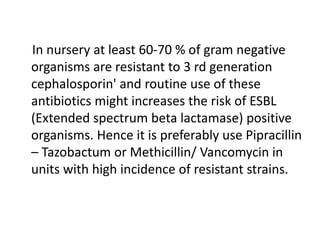
In nursery at least 60-70 % of gram negative
organisms are resistant to 3 rd generation
cephalosporin' and routine use of these
antibiotics might increases the risk of ESBL
(Extended spectrum beta lactamase) positive
organisms. Hence it is preferably use Pipracillin
– Tazobactum or Methicillin/ Vancomycin in
units with high incidence of resistant strains.
Pseudomas sepsis suspected case – Pipracillin-
Tazobactum with Amikacin.
Penicillin resistant staph.aureus - Cloxacillin/
nafcillin/ Methicillin AND amikacin.
Methicillin resistant Staph. aureus ( MRSA)-
cipro / Vancomycin AND Amikacin
RESERVE ANTIBIOTICS
Aztrenam- for Gram negative organisms
Meropenam- Most Bacterial organisms are
sensitive except MRSA and enterococcus.
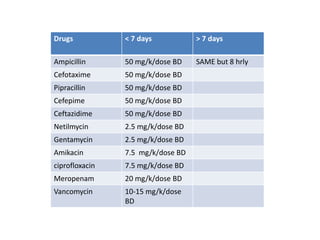
Dosage of ANTIBIOTICS
Drugs < 7 days > 7 days
Ampicillin 50 mg/k/dose BD SAME but 8 hrly
Cefotaxime 50 mg/k/dose BD
Pipracillin 50 mg/k/dose BD
Cefepime 50 mg/k/dose BD
Ceftazidime 50 mg/k/dose BD
Netilmycin 2.5 mg/k/dose BD
Gentamycin 2.5 mg/k/dose BD
Amikacin 7.5 mg/k/dose BD
ciprofloxacin 7.5 mg/k/dose BD
Meropenam 20 mg/k/dose BD
Vancomycin 10-15 mg/k/dose
BD
In Meningitis
Ampicillin- 200 mg/k/day ( < 7 days)
- 300 mg/k/day ( >7 days)
Cefotaxime – 200 mg/k/day
*** ceftrioxone is avoided in newborn for fear
of biliary sludging.
Meropenam- 40 mg /kg/dose BD
Adjunctive Therapy
Exchange transfusion is demonstrated 50 %
reduction in sepsis related mortality in septic
neonates with sclerema, DIC and jaundice.
IVIG- Not useful.
GM-CSF-Still experimental.
Prevention of sepsis
1. Before delivery:
* Diagnosis & T/t of all infections in mother.
* Strict asepsis in labor room.
2. 5 cleans during Delivery.
* clean hands
* clean perineum
* clean delivery surface
* clean Blade
* clean chord care
3. Prevention in NURSERY
* Cleaning of wall, floor and equipments.
*Meticulous hand wash and use of an
antiseptic sol. Before and after handling
each baby.
* aseptic precaution for all procedures.
* minimal handling.
* avoid overcrowding.
* Isolation of infected babies.
* staff harboring infection may be instructed
to stay away from nursery.
Umbilical sepsis
Umbilical sepsis without surrounding erythema/
induration and without systemic sepsis -- T/t
local antiseptic and local antibiotics.
Umbilical sepsis with surrounding erythema < 1cm
and with or without foul smelling but no clinical
evidence of systemic sepsis- T/t local plus oral
antibiotics. ( Ampicillin- cloxa)
Umbilical sepsis with surrounding erythema > 1cm
or evidence of systemic sepsis – investigate and
treatment for sepsis.
THANK YOU.

Neonatal sepsis

  • 1.
    Neonatal Sepsis An overview Dr.S. K. Verma M.B.B.S., M.D. Mannat Nursing Home Pvt. Ltd. Nahar Chowk , Dumra Road Sitamarhi
  • 2.
    Neonatal sepsis Definition :clinical syndrome characterized by sign and symptoms of infection with or without accompanying bacteremia in 1st month of life. It encompasses * Septicemia * Meningitis * Pneumonia * Arthritis * Osteomyelitis * UTI
  • 3.
    • Sepsis; commonestcause of neonatal mortality.( 30-50 % of total neonatal deaths) in developing country. • Incidence of NNS is 30 per 1000 births. Classification of neonatal sepsis: 1.Early onset sepsis---- Present within 72 hrs of birth 2.Late onset sepsis--- Present after 72 hrs of birth
  • 4.
    Early onset sepsis- sourceof infection – maternal genital tract & labor room. Respiratory distress (mc )and pneumonia are common presentations.
  • 5.
    Risk factors forEOS. 1. LBW ( Less than 2500 gm) or prematurity. 2. ROM for more than 24 hrs. 3. Febrile illness in mother with evidence of bact. Infection within 2 wks prior delivery. 4. Foul smelling liquor 5. Single unclean or more than 3 sterile vaginal examinations during labor. 6. Prolonged labor more than 24 hrs( 1 st & 2 nd stage) 7. Perinatal asphyxia ( Apgar score < 3 at 1 min) 8. Prolonged Intubation > 2 days.
  • 6.
    Late onset sepsis- *Community acquired * Hospital acquired Septicemia, pneumonia and meningitis are usual presentations. # 10 -30 % of LOS may have associated with Meningitis.
  • 7.
    Risk Factors forLOS 1. LBW or prematurity. 2. Poor Hygiene 3. Poor chord care 4. Bottle feeding 5. Mechanical ventilation. 6. Invasive procedure 7. Intravenous fluid administration
  • 8.
    Endotracheal tube insitu - colonization ET > 2 days colonization with Klebsiella / staph.aureus ET > 10 days colonization with candidal infection in addition to bacteria.
  • 9.
    Pathogens ( Indiandata) • E.Coli & Klebsiella pneumoniae – (27- 32 %) • Staphylococcus aureus – ( 13 – 15 %) • Pseudomonas spp - rare As per NNPD Klebsiella and staph. Commonest pathogen. * GBS is MC pathogen in developed country.
  • 10.
    Clinical features Nonspecific features: •Hypothermia or fever • Lethargy/ irritable • Poor cry • Poor feeding / Refusal to suck/ abd.distention • Poor perfusion , prolonged CRT > 3 sec • Hypotonia, absent neonatal reflex • bradycardia/ tachycardia • Hypo or hyperglycemia • Respiratory distress, apnea, gasping respiration • Metabolic acidosis
  • 11.
    Specific features relatedto system • CNS- Bulged A/F, vacant stare, high pitch cry, excessive irritability, seizure, stupor, coma, neck retraction. • Cardiac- pallor, Hypotension, poor perfusion, shock • GIT- feed intolence, vomiting, diarrhea, abdominal distention, paralytic ileus, NEC. • Hepatic- Hepatomegaly, direct hyperbilirubinemia • Skin- multiple pustules, abscess, sclerema, mottling, umbilical redness and discharge, cutis marmorata, cyanosis. • Hematological – bleeding, petechie, purpura • Renal – acute renal failure
  • 12.
    Investigation of NNS---Summary 1.Sepsis screen. 2.Culture- Blood/ urine/CSF 3. Radiology- * X- ray – chest and abdomen. * CT /MRI of brain in CNS infections. 4. Lumber puncture- 5. CBC 6. Prothrombin time, aPTT , FDP in cases of DIC 7. Blood sugar, Blood urea and s. electrolytes. 8. swab culture of Ear. Nose, umbilicus. 9. ABG and Antigen detection assay in serum, CSF,urine.
  • 13.
    Investigations: 1. Sepsis Screen:components are Components Abnormal values TLC *** < 5000 /cmm ABSOLUTE neutrophil count < 1500/cmm Immature (Band)/ total neutrophil ratio Equal or more than 0.2 Micro ESR Equal or more than 15 in 1 st hour C-Reactive protein Equal or more than 8-10 mcg /ml
  • 14.
    2 or moreabnormal parameter should be considered as a positive screen and neonate should be started on antibiotic. Screen is negative but clinical suspicion persists, it should be repeated in 24 hrs. Screen still negative, sepsis can be excluded.
  • 15.
    Sepsis screen isless reliable in • Preterm • Term infant during initial 48 hrs. • Decision to start antibiotics need not be conditional to sepsis screen if a strong clinical suspicion of sepsis. • Micro ESR- Least useful, CRP- Most useful
  • 16.
    CRP- > 8-10mg/ l – positive LEVEL of CRP starts to increase by 6 hrs and peak in 24 – 48 hrs. Delayed rise in preterm baby. * Repeated after 24 hrs if sepsis is suspected and earlier CRP is negative. * Elevated CRP also seen in Hypoxia, HMD and meconium aspiration. It must be correlated accordingly.
  • 17.
    Gastric aspirate: (included in sepsis screen) * Recommended in all baby suspected to be infected in utero. * Not useful if contaminated with blood or meconium. * Thick smear on glass slide - > 5 polymorphs per HPF is abnormal.
  • 18.
    Investigation of NNScontinue 2.Blood culture- GOLD standard 1 ml blood needed for blood culture bottle containing 5 – 10 ml of culture media. At least incubated for 72 hrs before reported as sterile. BACTEC and BACT/ALERT blood culture detect bacterial growth in 12-24 hrs. Blood culture should be done in all suspected cases of sepsis prior to starting antibiotics.
  • 19.
    investigation continued- 3. Lumberpuncture- Incidence of meningitis in NNS vary from 0.3 to 3 % in various studies. Clinical features of septicemia and meningitis often overlaps. It is justified to perform LP in all neonates suspected to have LOS prior to starting antibiotics. In EOS, LP is indicated in +ce of a positive blood culture or if C/F is consistent with septicemia. Not performed in critically sick neonate.
  • 20.
    Normal CSF Examinationin neonates. CSF components Normal range Cells/cmm Up to 8 PMN(%) 60 % CSF Protein(mg/dl) Up to 50 mg% in preterm and 100 mg% in term CSF glucose(mg/dl) 52 CSF/ Blood glucose(%) 50 %
  • 21.
    CSF finding discussion >20-25 WBC/cmm in preterm and > 5-10 WBC/cmm in term baby suggests meningitis. But any count > 8-10 WBC/cmm is significant in clinically suggestive case irrespective of maturity. >60 % of WBC are polymorphs indicative of meningitis. Elevated mean CSF protein above 50 mg % in preterm and 100 mg % in term suggest meningitis CSF/ Blood glucose- less than 50 % is significant. In clinically suspected case CSF glucose value < 50 mg is significant.
  • 22.
    investigation continued 4. Radiology. x-raychest - respiratory distress or apnea. x- ray abdomen- NEC 5. Urine – not indicated routinely. Done if UTI suspected.
  • 23.
    Term used forinitial diagnosis Presumed sepsis- Unwell baby with initial sepsis screen is negative. Probable sepsis- Baby with clinical picture suggestive of sepsis PLUS 1 or more following criteria: 1. + ce of risk factors for sepsis. 2. + ve sepsis screen. 3. A source of infection. 4. X-ray evidence of pneumonia. Proven sepsis- baby with C/F of sepsis with positive culture ( Blood / urine/ CSF)
  • 24.
    Management OF NNS SUPPORTIVEMANAGEMENT 1. Care of temperature- Temp. Neonate- 36.5– 37.5 degree centi Room- 26-28 degree cent 1. Feeding withhold as ileus is common. 2. Oxygen saturation maintained spo2 at 90-93 % 3. Management of coagulopathy with vit. k 4. Maintenance of blood sugar.( Hypoglycemia < 50 mg/dl). T/t with 2 ml/kg D10 bolus, 4 ml/kg if seizure. 5. Intravenous fluid in hemodynamically unstable baby( IV bolus 10 ml/kg of NS over 10-15 min
  • 25.
    6. Mechanical ventilationif required as in recurrent apnea/ respiratory failure. 7. Packed cell and fresh frozen plasma given for anemia or bleeding diathesis. 8. BP/Peripheral perfusion is monitored. Dopamine/ Dobutamine may be given. DOSE- I ml of Dopamine( 40 mg/ml) or Dobutamine( 50 mg/ml) is diluted in 10 ml of D10. ADD 5ml in whole day fluid in Term baby and 2.5 ml in preterm baby.
  • 26.
    ANTIMICROBIAL THERAPY Recommendation basedupon clinical features and or positive septic screen. Indications for starting antimicrobials in neonates at risk of EOS includes 1. +ce of 3 or more risk factors for EOS. 2. + ce of foul smelling liquor 3. Strong clinical suspicion of sepsis. Indications for starting antibiotics LOS includes 1. Positive septic screen 2. Strong clinical suspicion of sepsis.
  • 27.
    Duration of antibioticsin NNS DIAGNOSIS DURATION Culture negative Sepsis ( screen positive and clinically consistent with sepsis) 7 – 10 days Blood culture positive but no meningitis 14 days Meningitis ( with or without positive blood/ CSF) 21 day
  • 29.
    Empirical choice ofantibiotics in Neonatal sepsis
  • 30.
    Choice of antibioticsdepends upon * Prevalent spectrum of etiological agents * Antibiotics sensitivity pattern. * Source of infection either community acquired or hospital acquired.
  • 31.
    Line of treatment sensitivity Sepsisand pneumonia meningitis FIRST LINE Resistant strains less likely Ampicillin AND Amikacin/ Gentamycin Add Cefotaxime SECOND LINE Higher likelihood of resistant Cloxacillin/ ciprofloxacillin AND Netilmycin/ Amikacin Add Cefotaxime THIRD LINE Higher likelihood of resistant Pipracillin- Tazobactum OR Cefoperazone – sulbactum AND Netilmycin/ amikacin Add Cefotaxime
  • 32.
    In nursery atleast 60-70 % of gram negative organisms are resistant to 3 rd generation cephalosporin' and routine use of these antibiotics might increases the risk of ESBL (Extended spectrum beta lactamase) positive organisms. Hence it is preferably use Pipracillin – Tazobactum or Methicillin/ Vancomycin in units with high incidence of resistant strains.
  • 33.
    Pseudomas sepsis suspectedcase – Pipracillin- Tazobactum with Amikacin. Penicillin resistant staph.aureus - Cloxacillin/ nafcillin/ Methicillin AND amikacin. Methicillin resistant Staph. aureus ( MRSA)- cipro / Vancomycin AND Amikacin
  • 34.
    RESERVE ANTIBIOTICS Aztrenam- forGram negative organisms Meropenam- Most Bacterial organisms are sensitive except MRSA and enterococcus.
  • 35.
  • 36.
    Drugs < 7days > 7 days Ampicillin 50 mg/k/dose BD SAME but 8 hrly Cefotaxime 50 mg/k/dose BD Pipracillin 50 mg/k/dose BD Cefepime 50 mg/k/dose BD Ceftazidime 50 mg/k/dose BD Netilmycin 2.5 mg/k/dose BD Gentamycin 2.5 mg/k/dose BD Amikacin 7.5 mg/k/dose BD ciprofloxacin 7.5 mg/k/dose BD Meropenam 20 mg/k/dose BD Vancomycin 10-15 mg/k/dose BD
  • 37.
    In Meningitis Ampicillin- 200mg/k/day ( < 7 days) - 300 mg/k/day ( >7 days) Cefotaxime – 200 mg/k/day *** ceftrioxone is avoided in newborn for fear of biliary sludging. Meropenam- 40 mg /kg/dose BD
  • 38.
    Adjunctive Therapy Exchange transfusionis demonstrated 50 % reduction in sepsis related mortality in septic neonates with sclerema, DIC and jaundice. IVIG- Not useful. GM-CSF-Still experimental.
  • 39.
    Prevention of sepsis 1.Before delivery: * Diagnosis & T/t of all infections in mother. * Strict asepsis in labor room. 2. 5 cleans during Delivery. * clean hands * clean perineum * clean delivery surface * clean Blade * clean chord care
  • 40.
    3. Prevention inNURSERY * Cleaning of wall, floor and equipments. *Meticulous hand wash and use of an antiseptic sol. Before and after handling each baby. * aseptic precaution for all procedures. * minimal handling. * avoid overcrowding. * Isolation of infected babies. * staff harboring infection may be instructed to stay away from nursery.
  • 41.
    Umbilical sepsis Umbilical sepsiswithout surrounding erythema/ induration and without systemic sepsis -- T/t local antiseptic and local antibiotics. Umbilical sepsis with surrounding erythema < 1cm and with or without foul smelling but no clinical evidence of systemic sepsis- T/t local plus oral antibiotics. ( Ampicillin- cloxa) Umbilical sepsis with surrounding erythema > 1cm or evidence of systemic sepsis – investigate and treatment for sepsis.
  • 42.