HEPATITIS DONE BY
A.sri sharika .
T.laskshana.
K.gokulapriya.
K.sudharsan.
V.hari priyan.
K.kavya.
INTRODUCTION
“Hepatitis” means inflammation of the liver.
The liver is a vital organ that processes
nutrients,filters the blood, and fights infections.
When the liver is inflamed or damaged, its function
can be affected.
Hepatitis is most often caused by a virus
,so its called as……
VIRAL HEPATITIS
The term viral hepatitis is used to describe infection
of the liver caused by hepatotropic viruses.
5 main varieties of viruses are
1) Hepatitis A
2) Hepatitis B
3) Hepatitis C
4) Hepatitis D
5) Hepatitis E and other immune related hepatitis namely
Autoimmune hepatitis.
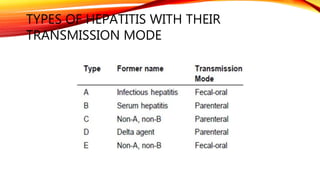
TYPES OF HEPATITIS WITH THEIR
TRANSMISSION MODE
HEPATITIS A
Hepatitis A is a highly contagious liver
infection caused by the Hepatitis A virus.
Its identified in the year 1973.
Viral particle size-27nm.
Morphology-icosahedral non enveloped
virus.
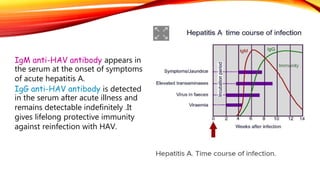
IgM anti-HAV antibody appears in
the serum at the onset of symptoms
of acute hepatitis A.
IgG anti-HAV antibody is detected
in the serum after acute illness and
remains detectable indefinitely .It
gives lifelong protective immunity
against reinfection with HAV.
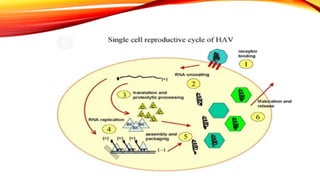
REPRODUCTIVE CYCLE OF HAV
RECEPTOR BINDING .
RNA UNCOATING.
TRANSLATION AND PROTEOLYTIC PROCESSING.
RNA REPLICATION.
VIRION ASSEMBLY.
MATURATION AND RELEASE.
These are the six steps involved in reproductive cycle of HAV .
HEPATITIS A SYMPTOMS
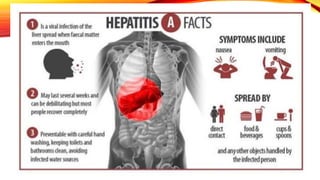
• Develop about 2 weeks after infection.
 nausea
Vomiting
Diarrhea,especially in children
Low grade fever
Loss of appetite
Rash
Tiredness,fatigue
Jaundice-A yellow discoloration of the skin and the whites of the eyes.
Urine is dark brownish in color,like cola or strong tea.
Pain in area of liver-on the right side of the abdomen, just under the rib cage.
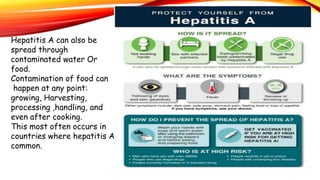
HOW IS HEPATITIS A SPREAD ?
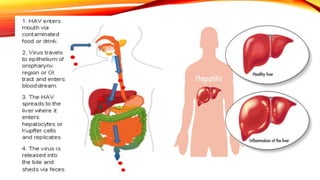
Hepatitis A is usually spread when a person ingests fecal matter
even in microscopic amounts from contact with objects ,food,drinks
contaminated by feces or stool from an infected person.
when
An infected person does not wash his / her hands properly
after going to the bathroom and then touches objects or food
A caregiver doesn’t properly wash his or her hands after
changing diapers or cleaning up the stool of an infected person .
someone engages in sexual activities with an infected person.
Hepatitis A can also be
spread through
contaminated water Or
food.
Contamination of food can
happen at any point:
growing, Harvesting,
processing ,handling, and
even after cooking.
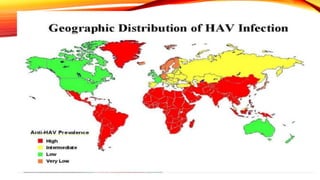
This most often occurs in
countries where hepatitis A
common.
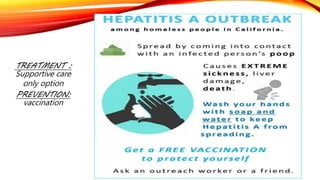
TREATMENT :
Supportive care
only option
PREVENTION:
vaccination
SUPPORTIVE CARE
Acetaminophenmay be cautiously administered but is strictly
limited to a maximum dose of 3-4gm/day in adults.
Other treatment are directed by specific complications or symptoms.
initial therapy often consists of bed rest
Nausea and vomiting are treated with antiemetics.
Dehydration may be managed with hospital admission and
intravenous (IV) fluids.
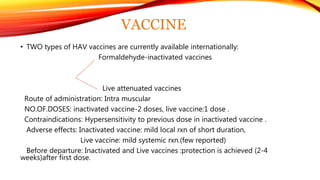
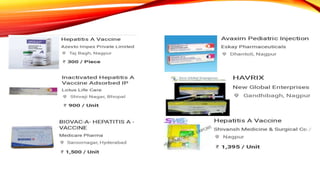
VACCINE
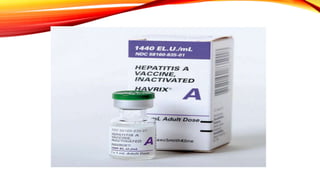
• TWO types of HAV vaccines are currently available internationally:
Formaldehyde-inactivated vaccines
Live attenuated vaccines
Route of administration: Intra muscular
NO.OF.DOSES: inactivated vaccine-2 doses, live vaccine:1 dose .
Contraindications: Hypersensitivity to previous dose in inactivated vaccine .
Adverse effects: Inactivated vaccine: mild local rxn of short duration,
Live vaccine: mild systemic rxn.(few reported)
Before departure: Inactivated and Live vaccines :protection is achieved (2-4
weeks)after first dose.
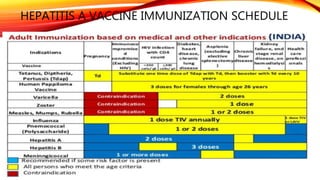
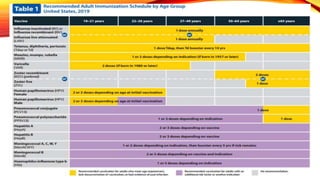
HEPATITIS A VACCINE IMMUNIZATION SCHEDULE
REFERENCE :
• CDC- Centers for disease control and prevention (U.S.Department of health and
human services)
• https://m.indiamart.com (inactivated hepatitis A Vaccine.
• www.soc.ucsb.edu
• Virology-online.com
• Slideplayer.com
• www.slideshare.net
• https://www.google.com vaccines& immunizations
• https://www.cdc.gov
• shopAAP-AAP.org
• TEXT BOOK OF PATHOLOGY:Harsh mohan 6th edition(jaypee publishers).
Google,Wikipedia,slide
share,Medscape,webm
ed.etc…,
Done By:
A.sri sharika

Hepatitis A -microbiological presentation

  • 1.
    HEPATITIS DONE BY A.srisharika . T.laskshana. K.gokulapriya. K.sudharsan. V.hari priyan. K.kavya.
  • 2.
    INTRODUCTION “Hepatitis” means inflammationof the liver. The liver is a vital organ that processes nutrients,filters the blood, and fights infections. When the liver is inflamed or damaged, its function can be affected. Hepatitis is most often caused by a virus ,so its called as……
  • 3.
    VIRAL HEPATITIS The termviral hepatitis is used to describe infection of the liver caused by hepatotropic viruses. 5 main varieties of viruses are 1) Hepatitis A 2) Hepatitis B 3) Hepatitis C 4) Hepatitis D 5) Hepatitis E and other immune related hepatitis namely Autoimmune hepatitis.
  • 4.
    TYPES OF HEPATITISWITH THEIR TRANSMISSION MODE
  • 5.
    HEPATITIS A Hepatitis Ais a highly contagious liver infection caused by the Hepatitis A virus. Its identified in the year 1973. Viral particle size-27nm. Morphology-icosahedral non enveloped virus.
  • 6.
    IgM anti-HAV antibodyappears in the serum at the onset of symptoms of acute hepatitis A. IgG anti-HAV antibody is detected in the serum after acute illness and remains detectable indefinitely .It gives lifelong protective immunity against reinfection with HAV.
  • 9.
    REPRODUCTIVE CYCLE OFHAV RECEPTOR BINDING . RNA UNCOATING. TRANSLATION AND PROTEOLYTIC PROCESSING. RNA REPLICATION. VIRION ASSEMBLY. MATURATION AND RELEASE. These are the six steps involved in reproductive cycle of HAV .
  • 12.
    HEPATITIS A SYMPTOMS •Develop about 2 weeks after infection.  nausea Vomiting Diarrhea,especially in children Low grade fever Loss of appetite Rash Tiredness,fatigue Jaundice-A yellow discoloration of the skin and the whites of the eyes. Urine is dark brownish in color,like cola or strong tea. Pain in area of liver-on the right side of the abdomen, just under the rib cage.
  • 13.
    HOW IS HEPATITISA SPREAD ? Hepatitis A is usually spread when a person ingests fecal matter even in microscopic amounts from contact with objects ,food,drinks contaminated by feces or stool from an infected person. when An infected person does not wash his / her hands properly after going to the bathroom and then touches objects or food A caregiver doesn’t properly wash his or her hands after changing diapers or cleaning up the stool of an infected person . someone engages in sexual activities with an infected person.
  • 14.
    Hepatitis A canalso be spread through contaminated water Or food. Contamination of food can happen at any point: growing, Harvesting, processing ,handling, and even after cooking. This most often occurs in countries where hepatitis A common.
  • 16.
    TREATMENT : Supportive care onlyoption PREVENTION: vaccination
  • 17.
    SUPPORTIVE CARE Acetaminophenmay becautiously administered but is strictly limited to a maximum dose of 3-4gm/day in adults. Other treatment are directed by specific complications or symptoms. initial therapy often consists of bed rest Nausea and vomiting are treated with antiemetics. Dehydration may be managed with hospital admission and intravenous (IV) fluids.
  • 18.
    VACCINE • TWO typesof HAV vaccines are currently available internationally: Formaldehyde-inactivated vaccines Live attenuated vaccines Route of administration: Intra muscular NO.OF.DOSES: inactivated vaccine-2 doses, live vaccine:1 dose . Contraindications: Hypersensitivity to previous dose in inactivated vaccine . Adverse effects: Inactivated vaccine: mild local rxn of short duration, Live vaccine: mild systemic rxn.(few reported) Before departure: Inactivated and Live vaccines :protection is achieved (2-4 weeks)after first dose.
  • 19.
    HEPATITIS A VACCINEIMMUNIZATION SCHEDULE
  • 23.
    REFERENCE : • CDC-Centers for disease control and prevention (U.S.Department of health and human services) • https://m.indiamart.com (inactivated hepatitis A Vaccine. • www.soc.ucsb.edu • Virology-online.com • Slideplayer.com • www.slideshare.net • https://www.google.com vaccines& immunizations • https://www.cdc.gov • shopAAP-AAP.org • TEXT BOOK OF PATHOLOGY:Harsh mohan 6th edition(jaypee publishers).
  • 24.