Introduction to
Derivatives Market
    Khader Shaik


                     1
Derivatives

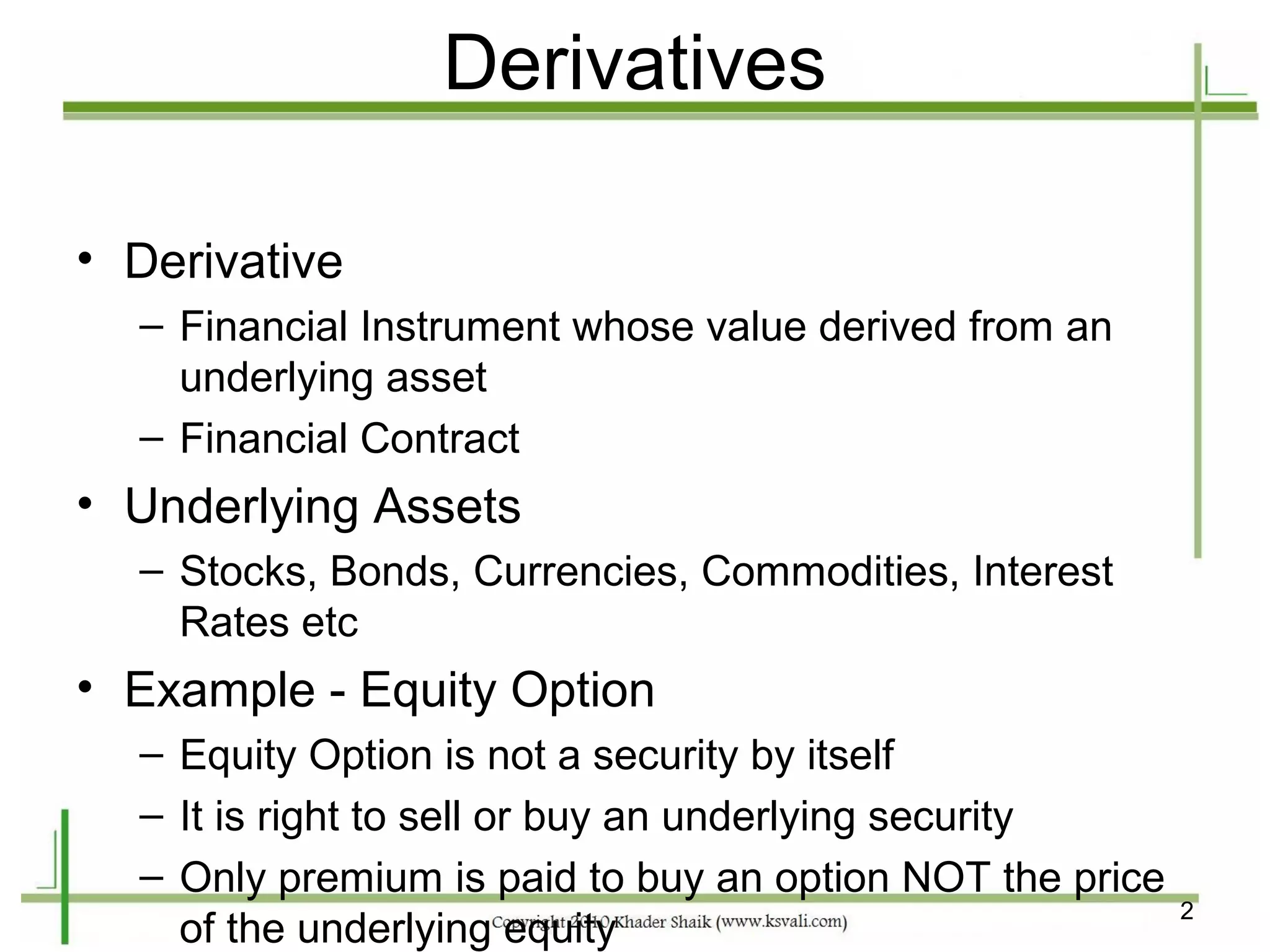
• Derivative
  – Financial Instrument whose value derived from an
    underlying asset
  – Financial Contract
• Underlying Assets
  – Stocks, Bonds, Currencies, Commodities, Interest
    Rates etc
• Example - Equity Option
  – Equity Option is not a security by itself
  – It is right to sell or buy an underlying security
  – Only premium is paid to buy an option NOT the price
                                                          2
    of the underlying equity
Derivative Markets

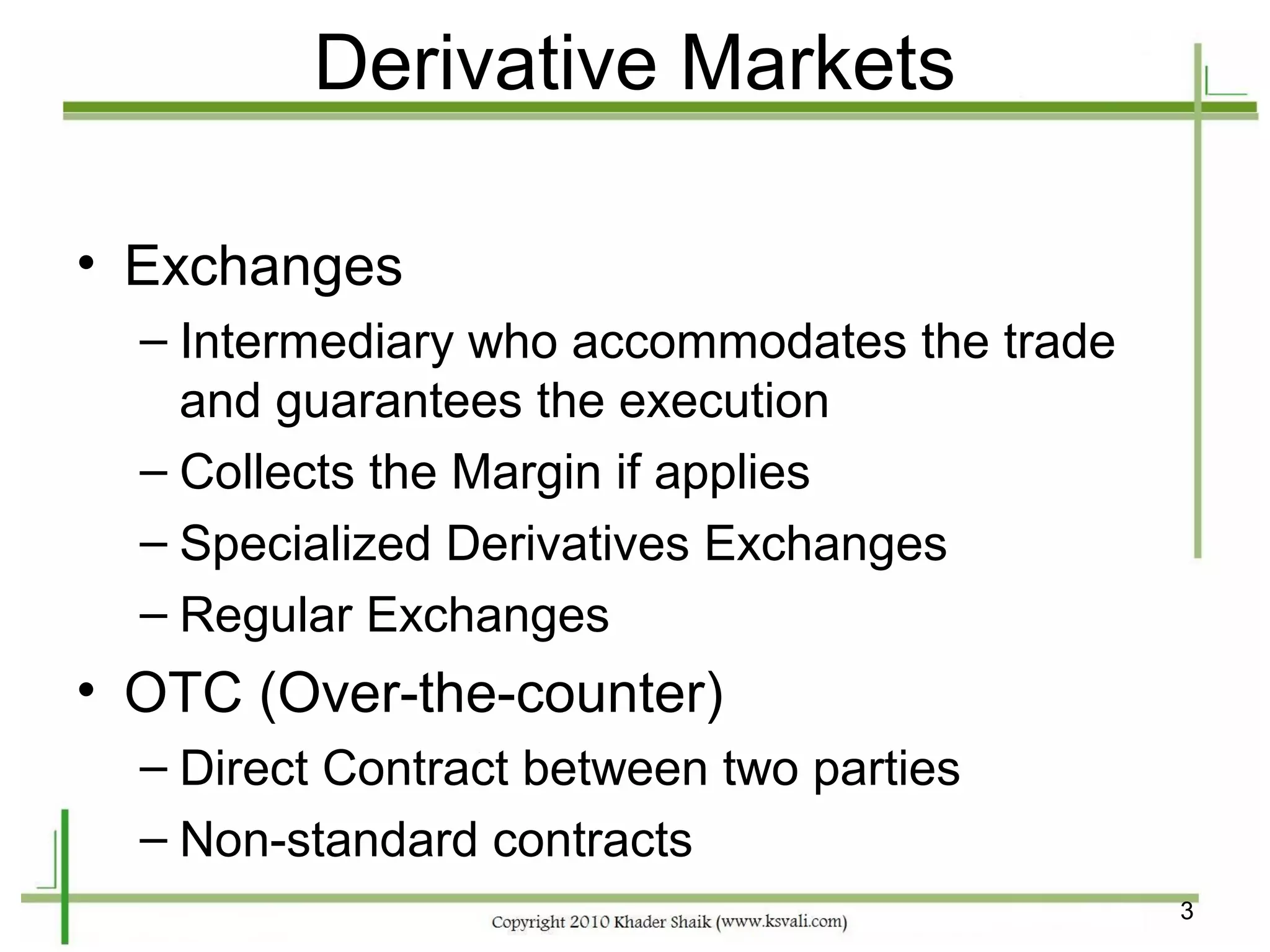
• Exchanges
  – Intermediary who accommodates the trade
    and guarantees the execution
  – Collects the Margin if applies
  – Specialized Derivatives Exchanges
  – Regular Exchanges
• OTC (Over-the-counter)
  – Direct Contract between two parties
  – Non-standard contracts
                                              3
Major Classes of Derivatives

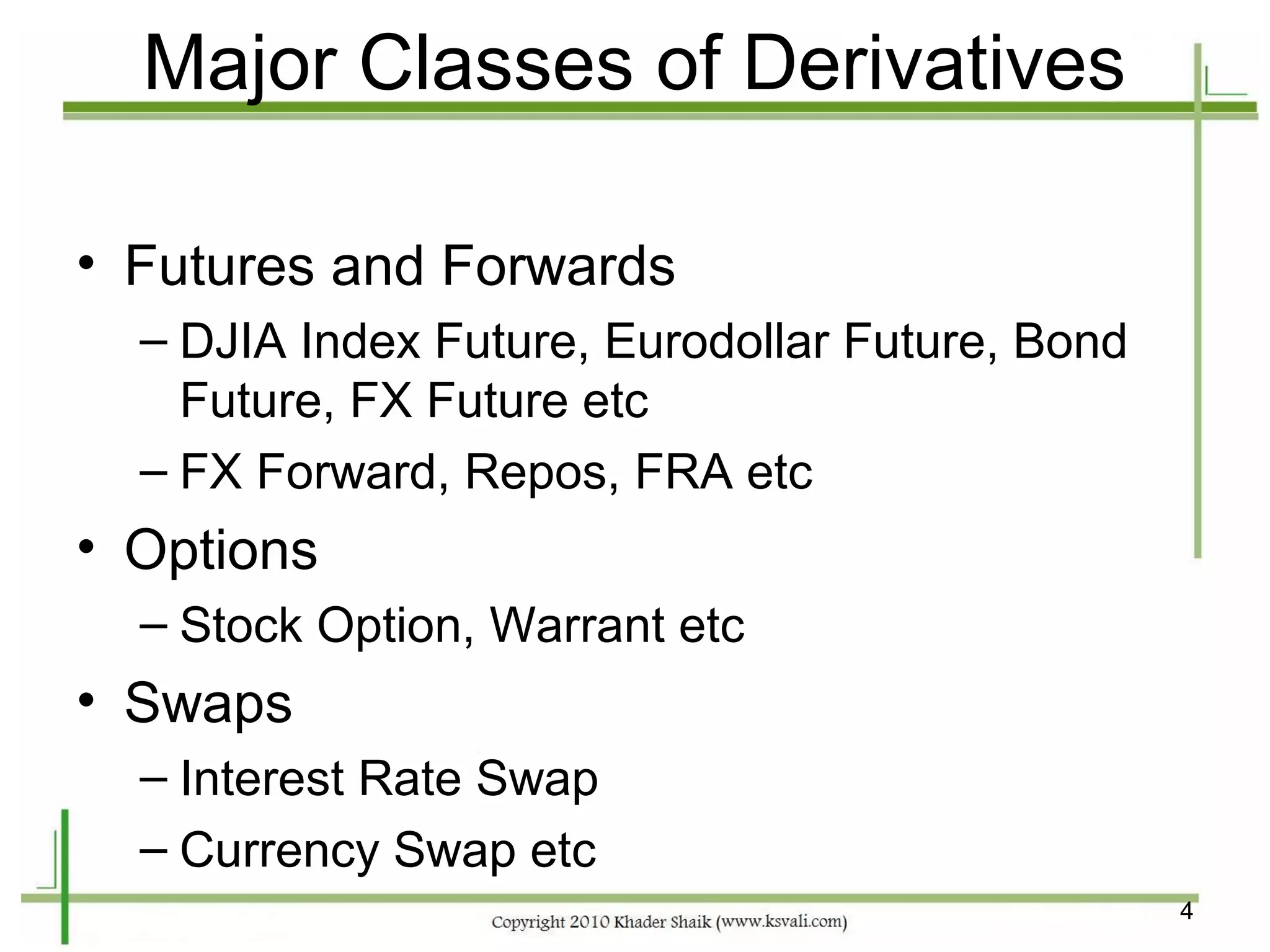
• Futures and Forwards
  – DJIA Index Future, Eurodollar Future, Bond
    Future, FX Future etc
  – FX Forward, Repos, FRA etc
• Options
  – Stock Option, Warrant etc
• Swaps
  – Interest Rate Swap
  – Currency Swap etc
                                                 4
Futures


          5
Futures Contract

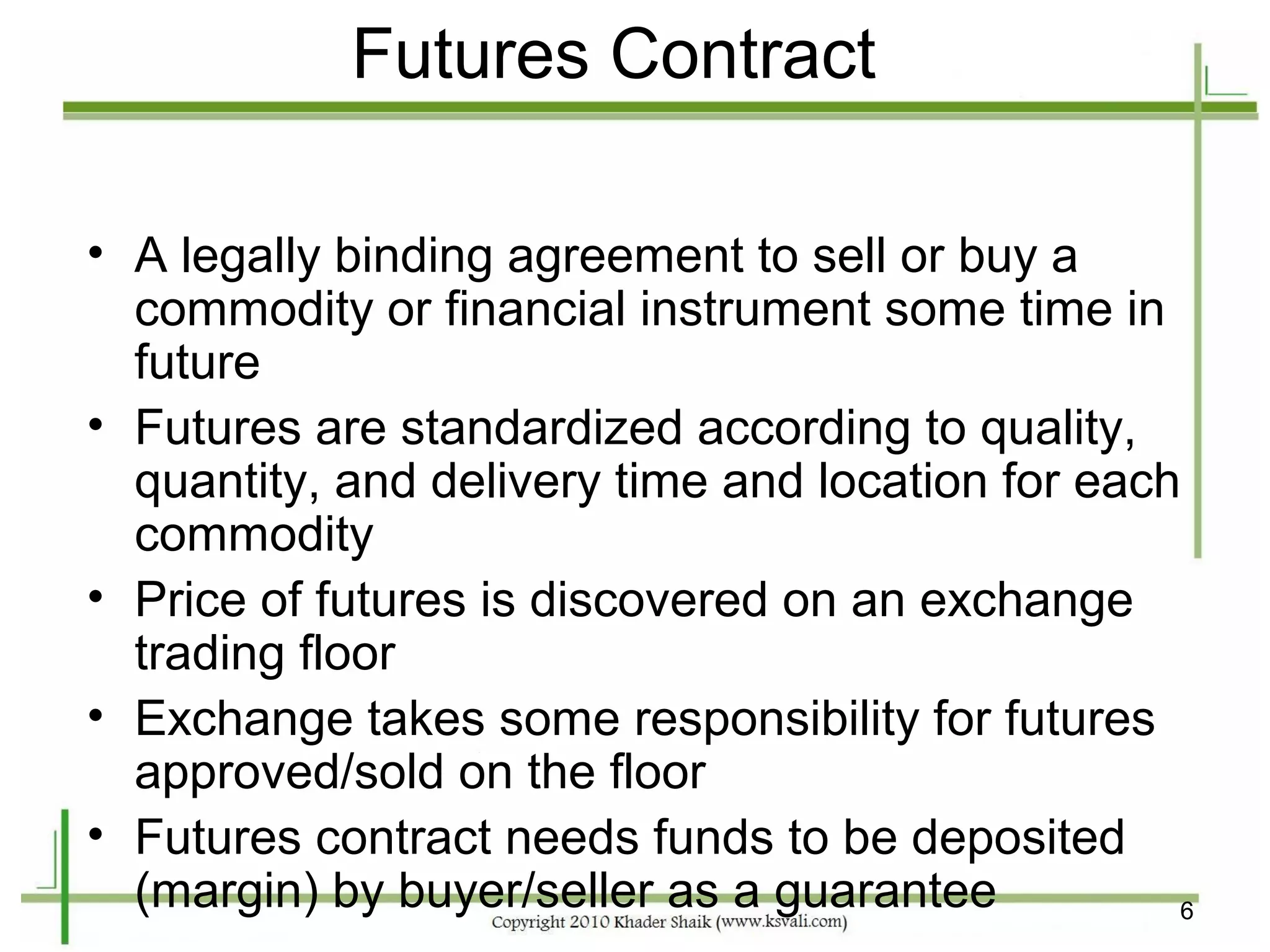
• A legally binding agreement to sell or buy a
  commodity or financial instrument some time in
  future
• Futures are standardized according to quality,
  quantity, and delivery time and location for each
  commodity
• Price of futures is discovered on an exchange
  trading floor
• Exchange takes some responsibility for futures
  approved/sold on the floor
• Futures contract needs funds to be deposited
  (margin) by buyer/seller as a guarantee          6
Futures cont..

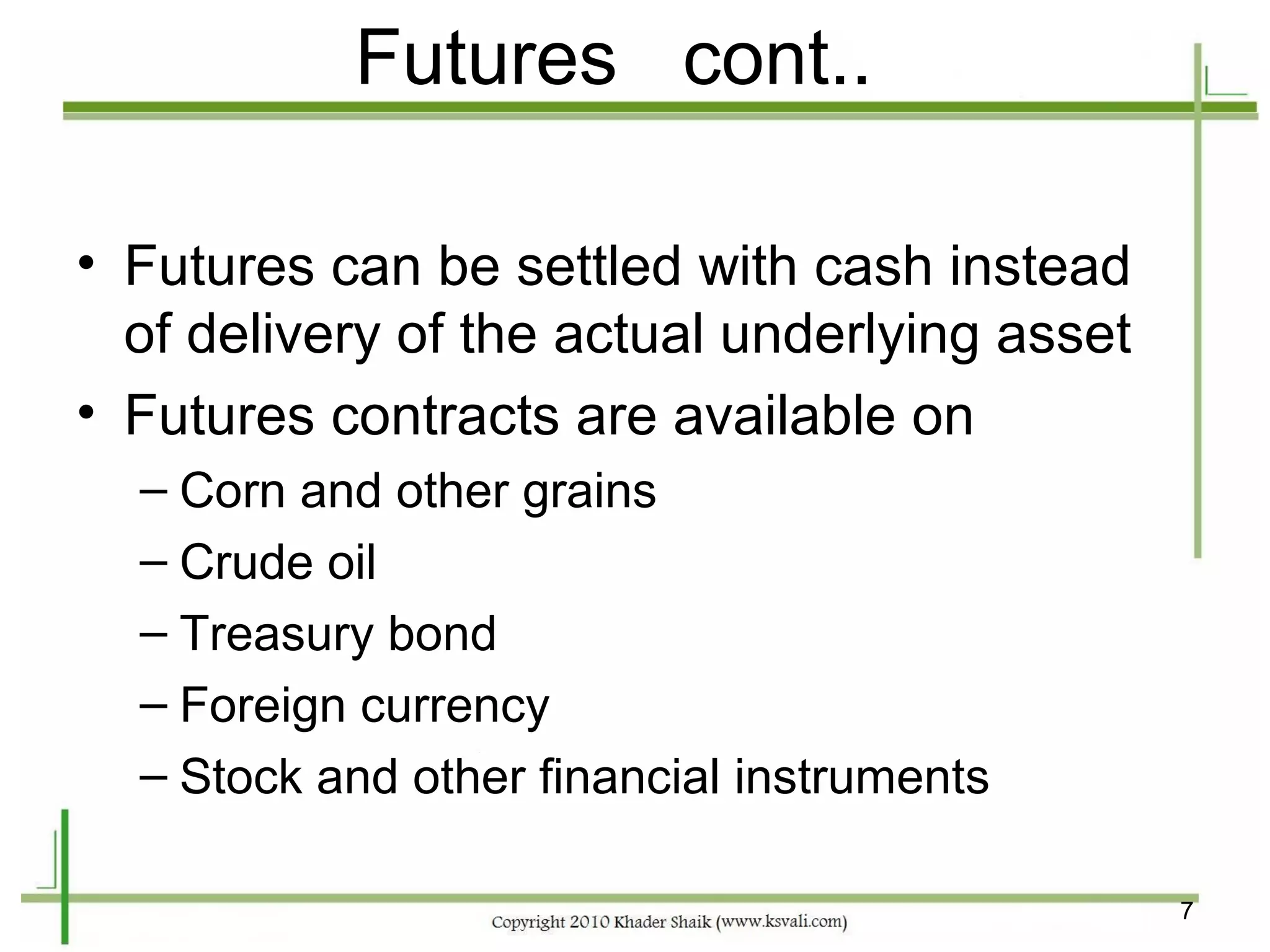
• Futures can be settled with cash instead
  of delivery of the actual underlying asset
• Futures contracts are available on
  – Corn and other grains
  – Crude oil
  – Treasury bond
  – Foreign currency
  – Stock and other financial instruments

                                               7
Futures Positions

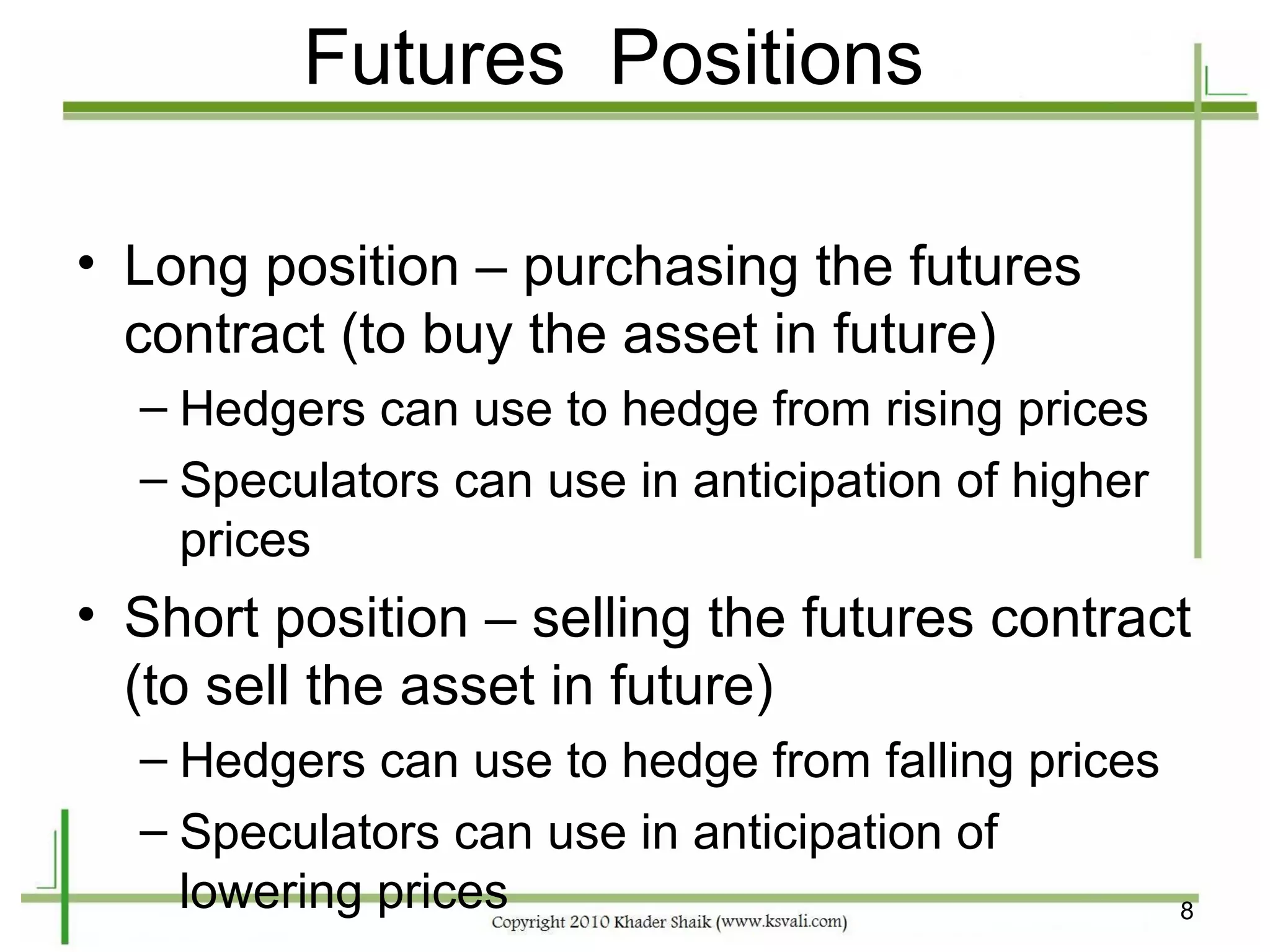
• Long position – purchasing the futures
  contract (to buy the asset in future)
  – Hedgers can use to hedge from rising prices
  – Speculators can use in anticipation of higher
    prices
• Short position – selling the futures contract
  (to sell the asset in future)
  – Hedgers can use to hedge from falling prices
  – Speculators can use in anticipation of
    lowering prices                                 8
Forwards

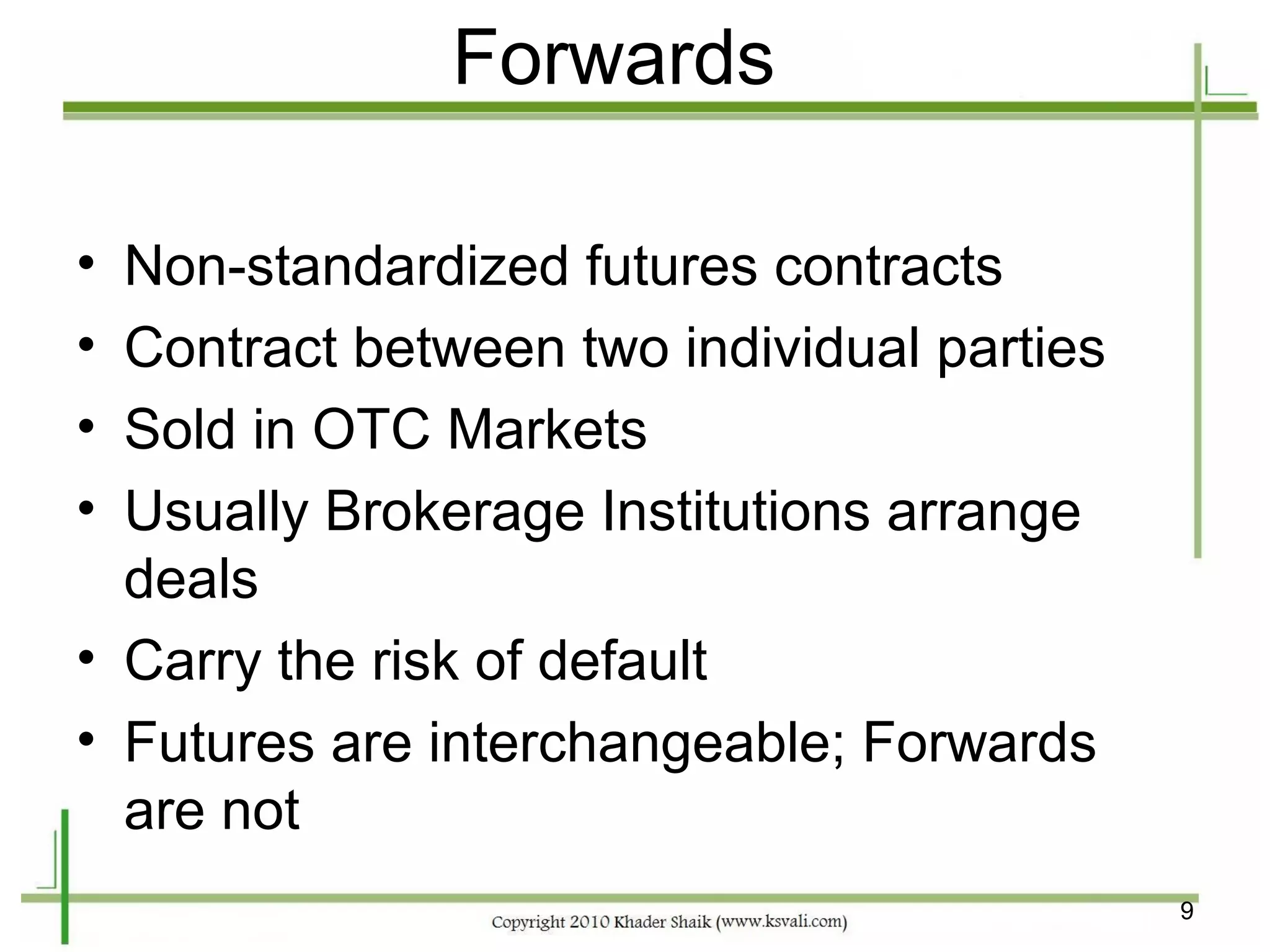
• Non-standardized futures contracts
• Contract between two individual parties
• Sold in OTC Markets
• Usually Brokerage Institutions arrange
  deals
• Carry the risk of default
• Futures are interchangeable; Forwards
  are not
                                            9
Forward

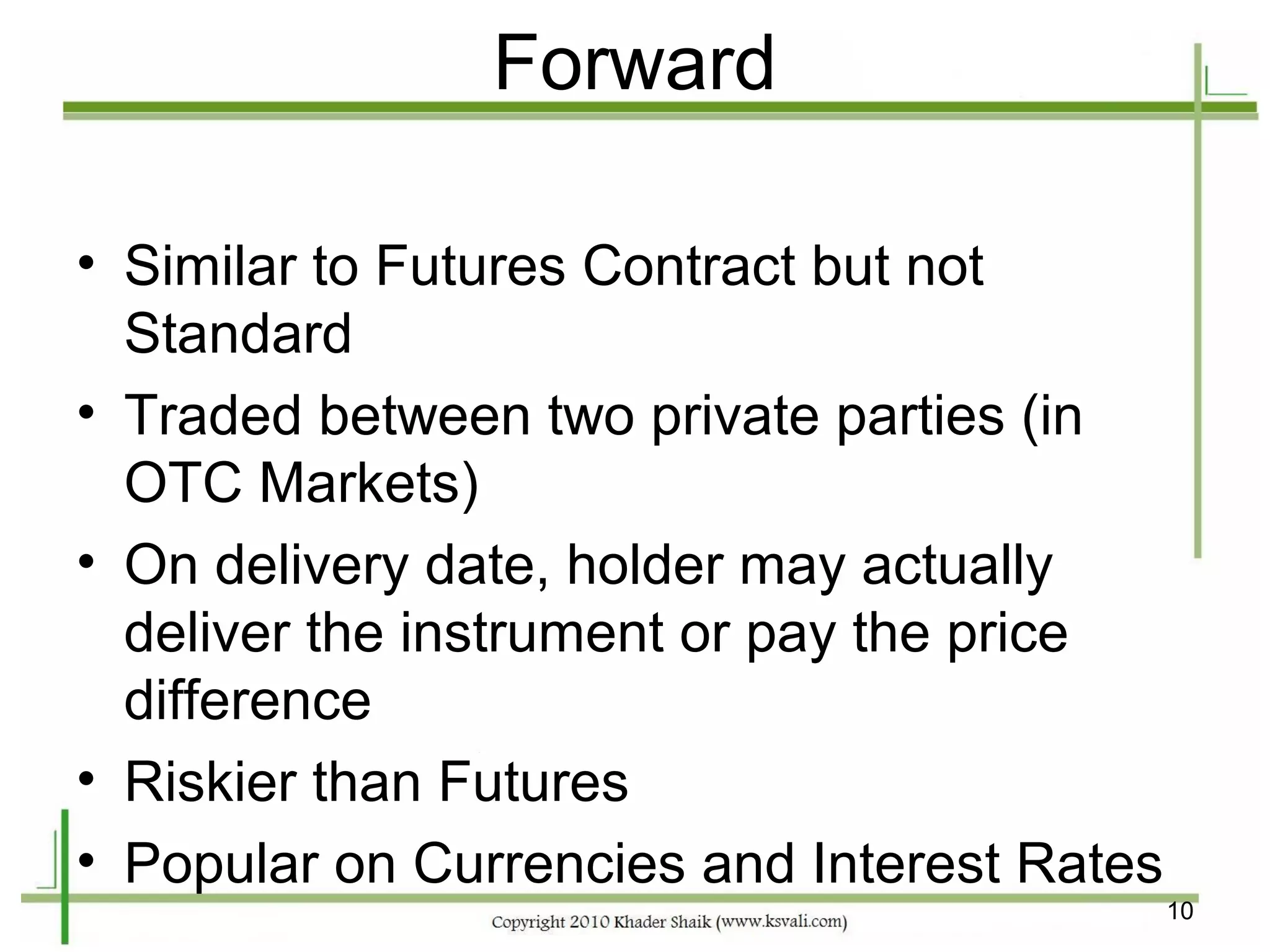
• Similar to Futures Contract but not
  Standard
• Traded between two private parties (in
  OTC Markets)
• On delivery date, holder may actually
  deliver the instrument or pay the price
  difference
• Riskier than Futures
• Popular on Currencies and Interest Rates
                                             10
Futures Vs Forwards
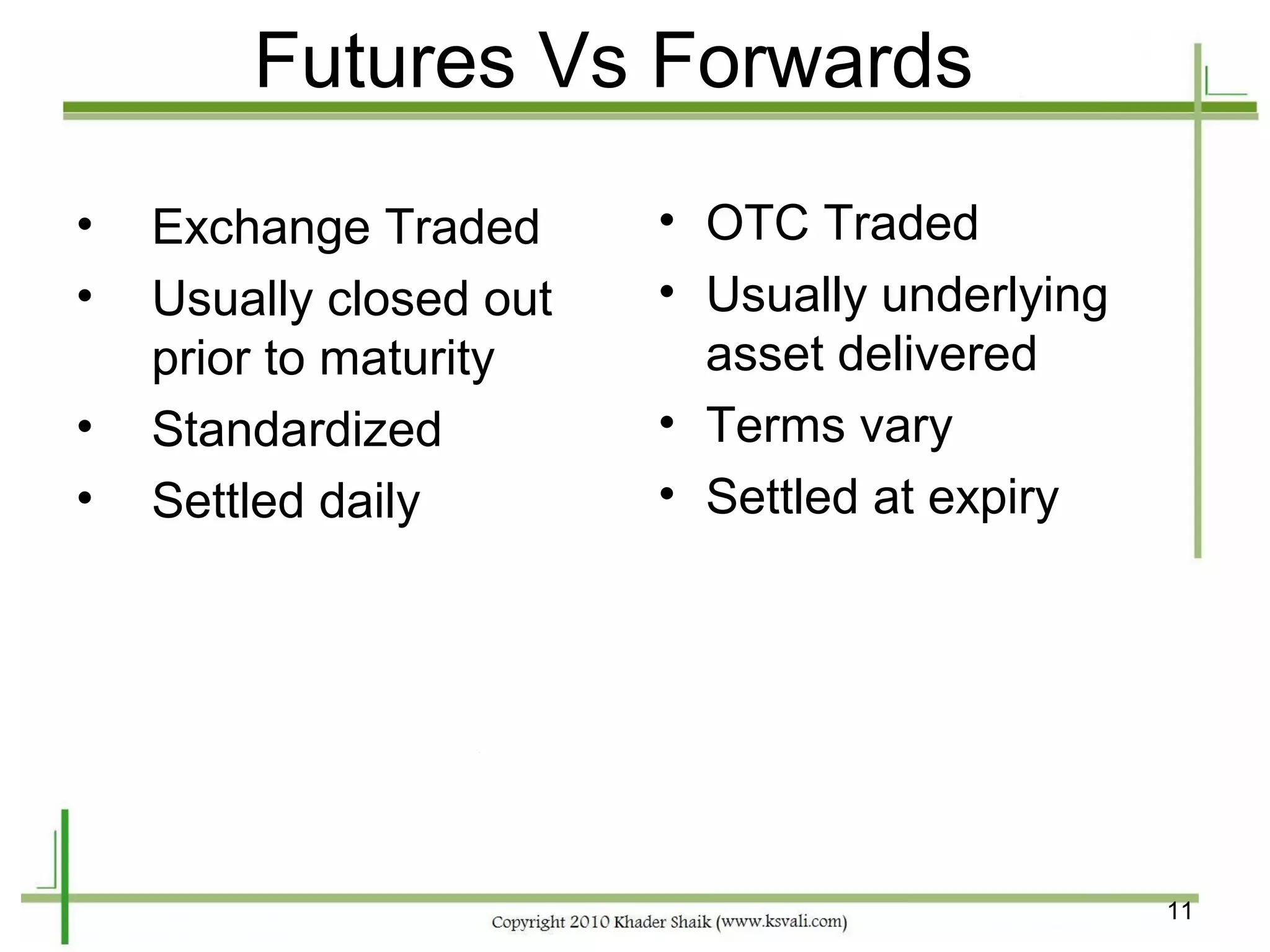
•   Exchange Traded      • OTC Traded
•   Usually closed out   • Usually underlying
    prior to maturity      asset delivered
•   Standardized         • Terms vary
•   Settled daily        • Settled at expiry


                                                11
Options and Futures Exchanges

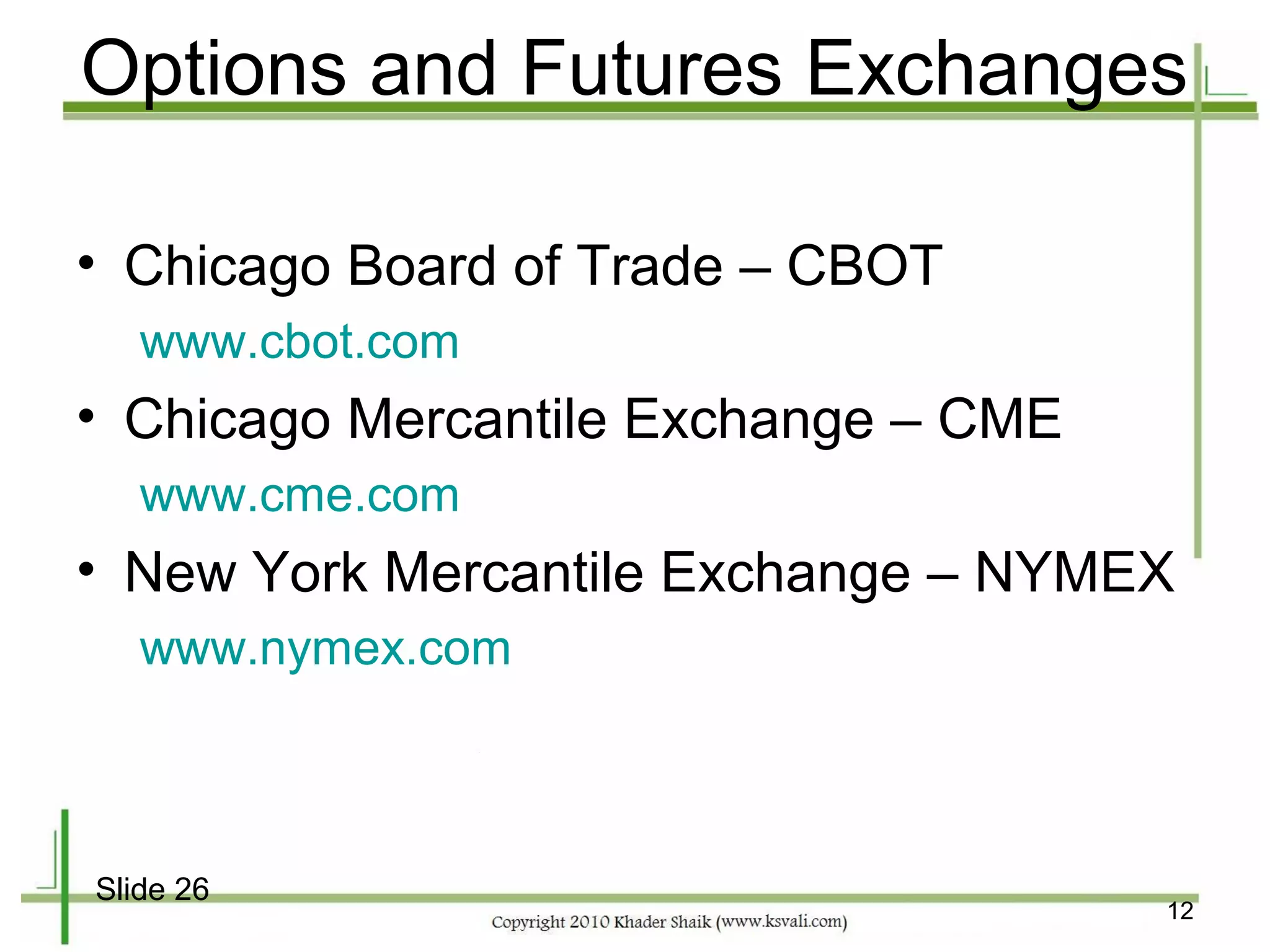
• Chicago Board of Trade – CBOT
   www.cbot.com
• Chicago Mercantile Exchange – CME
   www.cme.com
• New York Mercantile Exchange – NYMEX
   www.nymex.com


Slide 26
                                      12
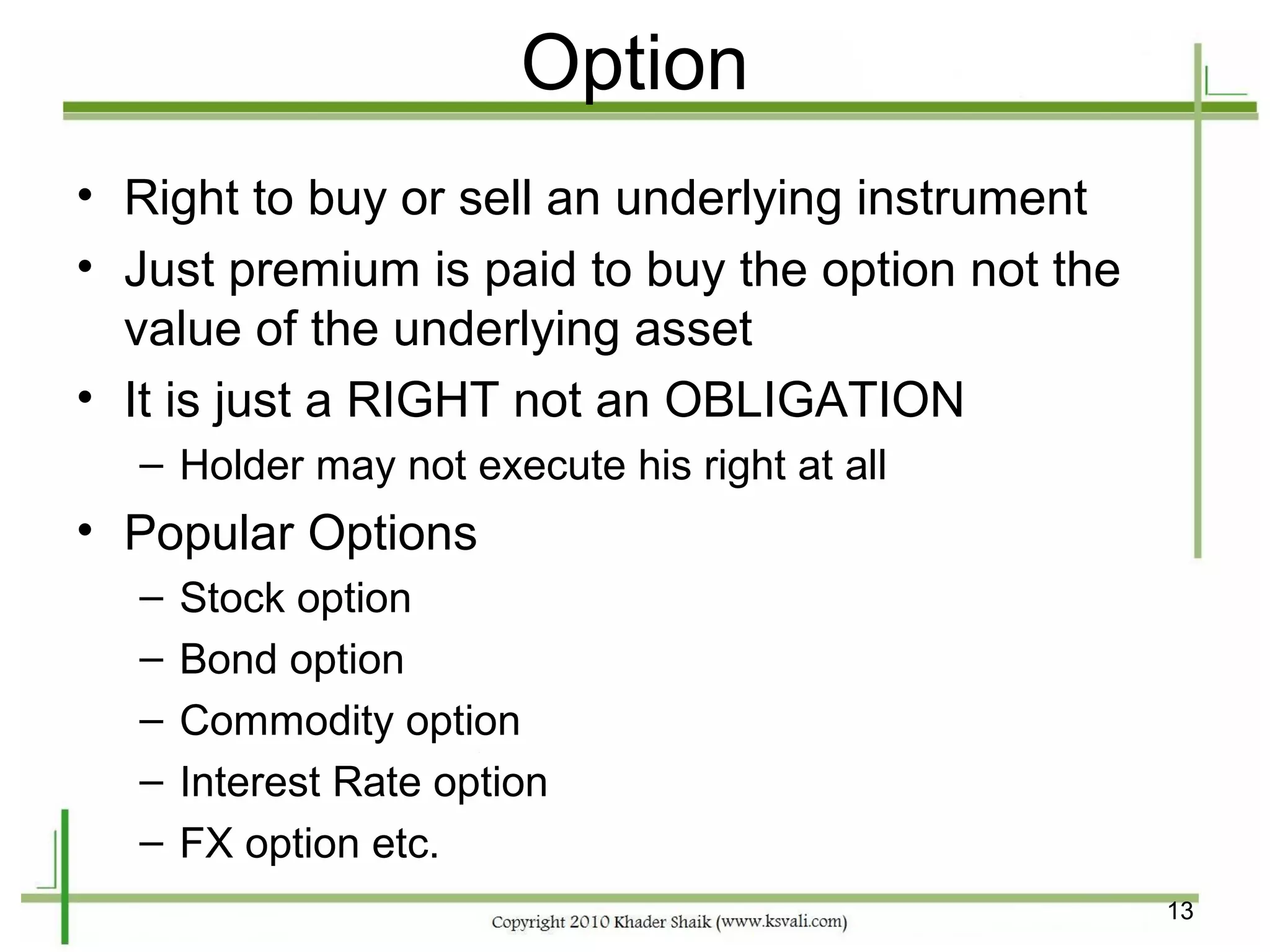
Option
• Right to buy or sell an underlying instrument
• Just premium is paid to buy the option not the
  value of the underlying asset
• It is just a RIGHT not an OBLIGATION
  – Holder may not execute his right at all
• Popular Options
  –   Stock option
  –   Bond option
  –   Commodity option
  –   Interest Rate option
  –   FX option etc.
                                                   13
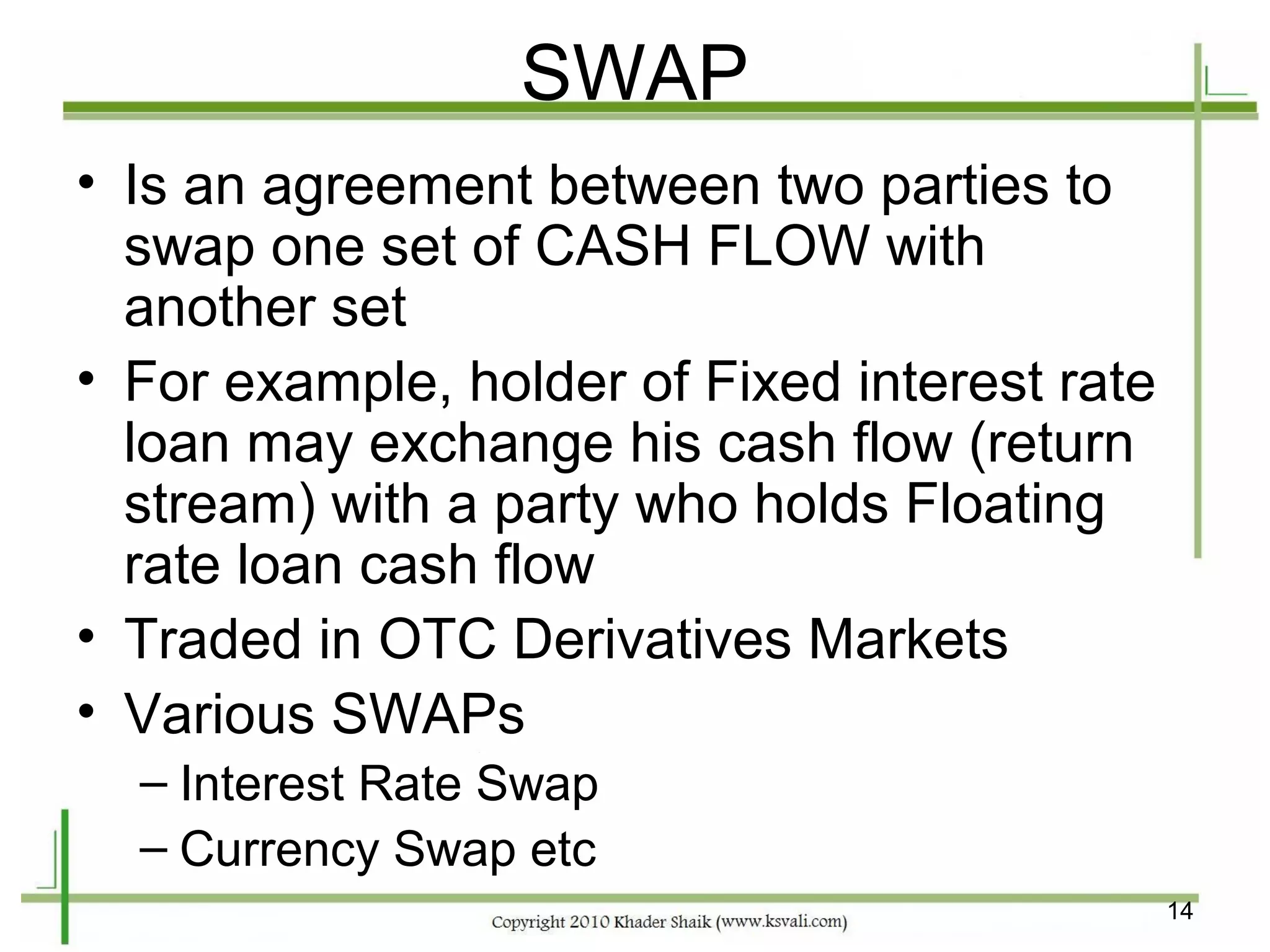
SWAP
• Is an agreement between two parties to
  swap one set of CASH FLOW with
  another set
• For example, holder of Fixed interest rate
  loan may exchange his cash flow (return
  stream) with a party who holds Floating
  rate loan cash flow
• Traded in OTC Derivatives Markets
• Various SWAPs
  – Interest Rate Swap
  – Currency Swap etc
                                               14
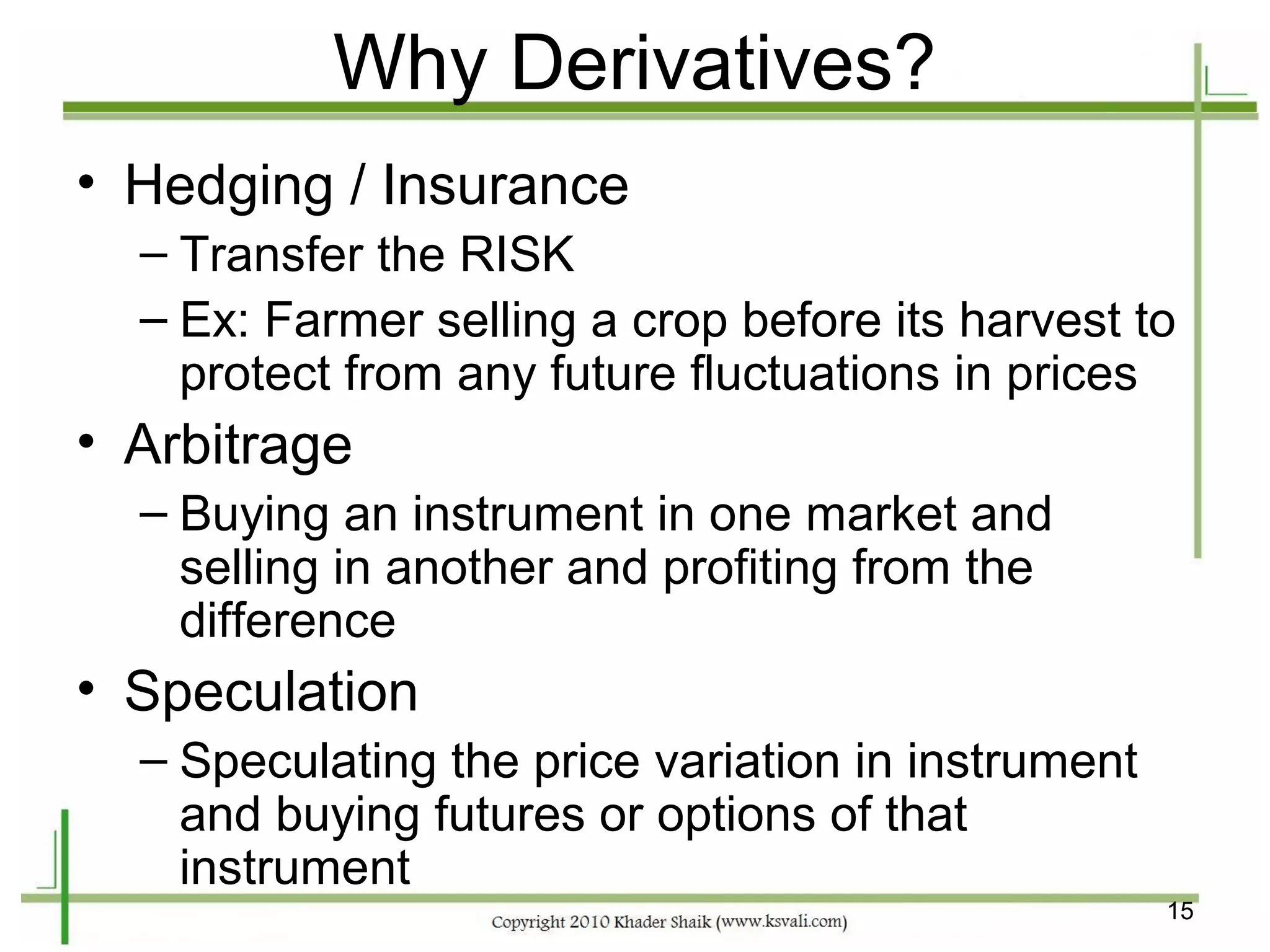
Why Derivatives?
• Hedging / Insurance
  – Transfer the RISK
  – Ex: Farmer selling a crop before its harvest to
    protect from any future fluctuations in prices
• Arbitrage
  – Buying an instrument in one market and
    selling in another and profiting from the
    difference
• Speculation
  – Speculating the price variation in instrument
    and buying futures or options of that
    instrument
                                                    15
Why Derivatives? …cont

• To change the nature of liability
• To change he nature of the investment
  without selling the instrument itself etc.


                                               16
Hedging Example
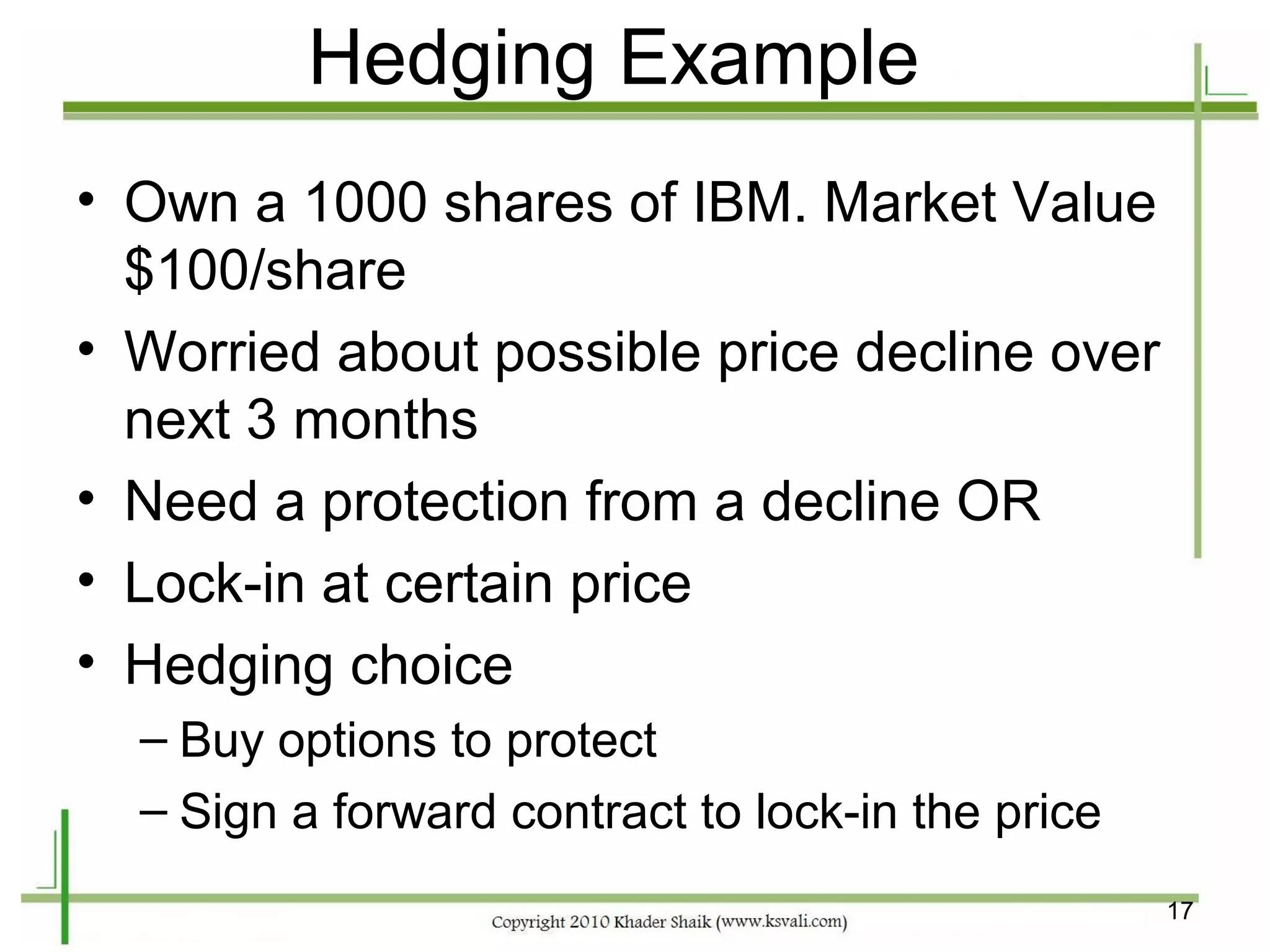
• Own a 1000 shares of IBM. Market Value
  $100/share
• Worried about possible price decline over
  next 3 months
• Need a protection from a decline OR
• Lock-in at certain price
• Hedging choice
  – Buy options to protect
  – Sign a forward contract to lock-in the price
                                                   17
Hedging Example - Options
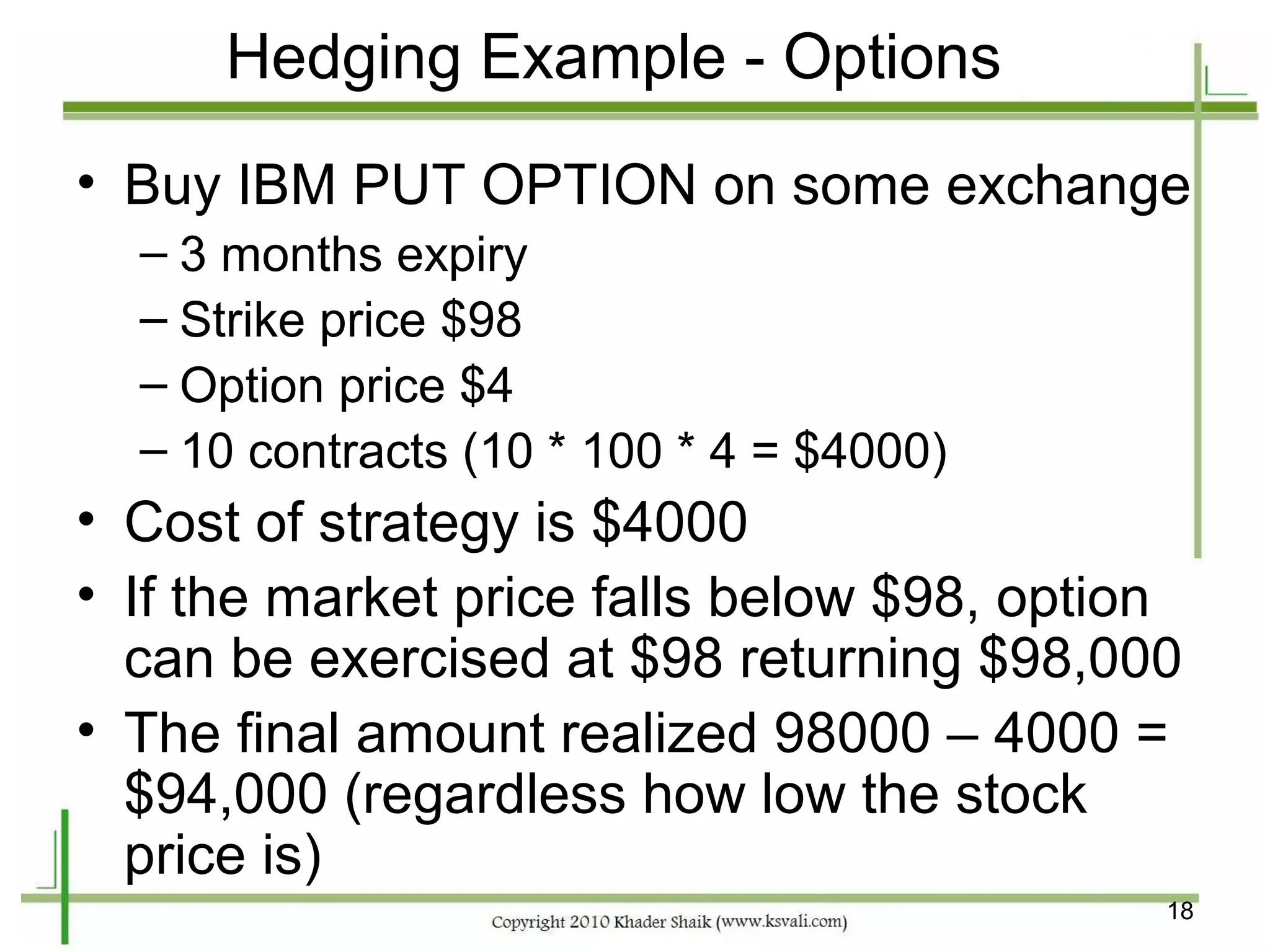
• Buy IBM PUT OPTION on some exchange
  – 3 months expiry
  – Strike price $98
  – Option price $4
  – 10 contracts (10 * 100 * 4 = $4000)
• Cost of strategy is $4000
• If the market price falls below $98, option
  can be exercised at $98 returning $98,000
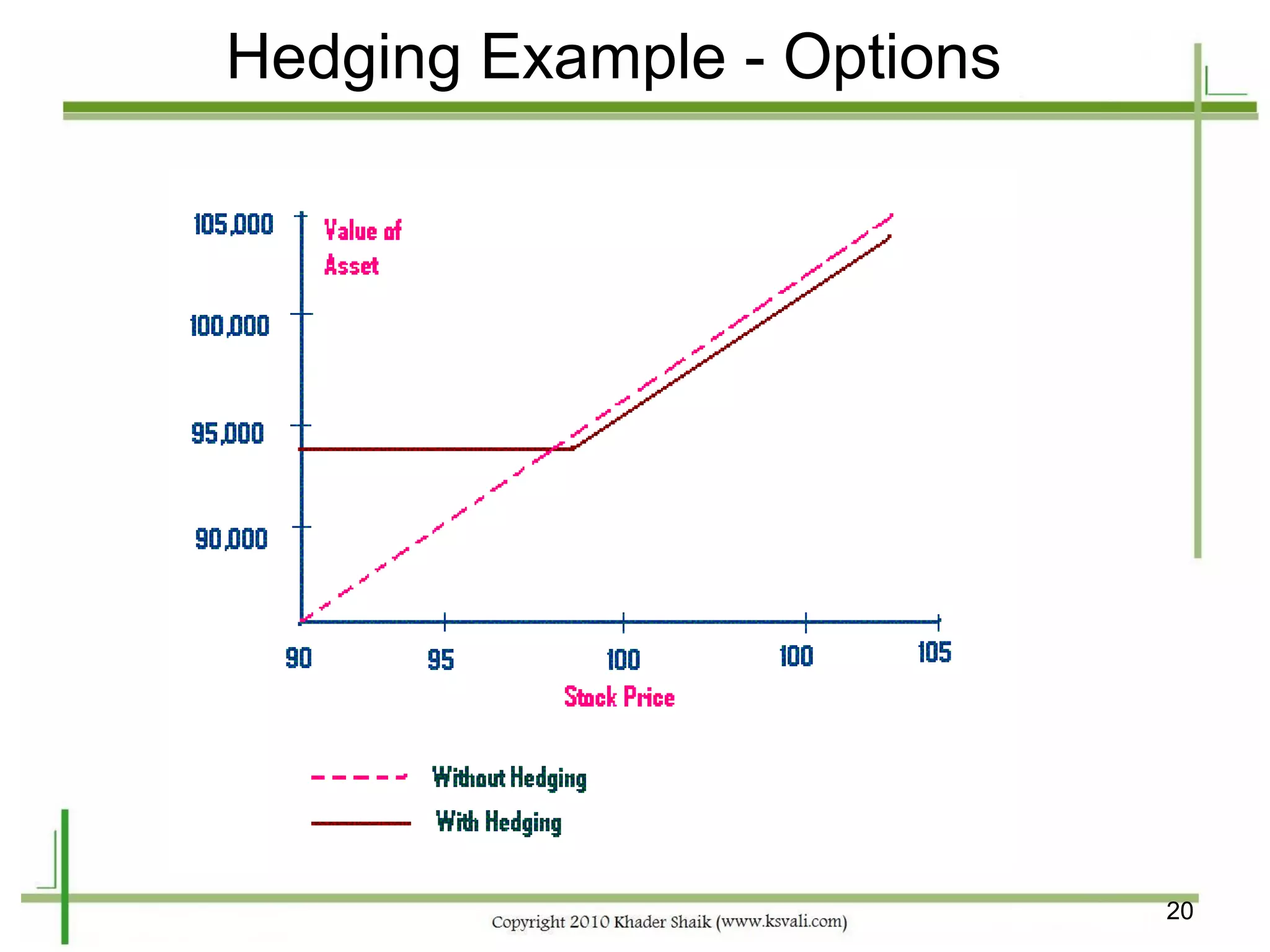
• The final amount realized 98000 – 4000 =
  $94,000 (regardless how low the stock
  price is)
                                            18
Hedging Example - Options


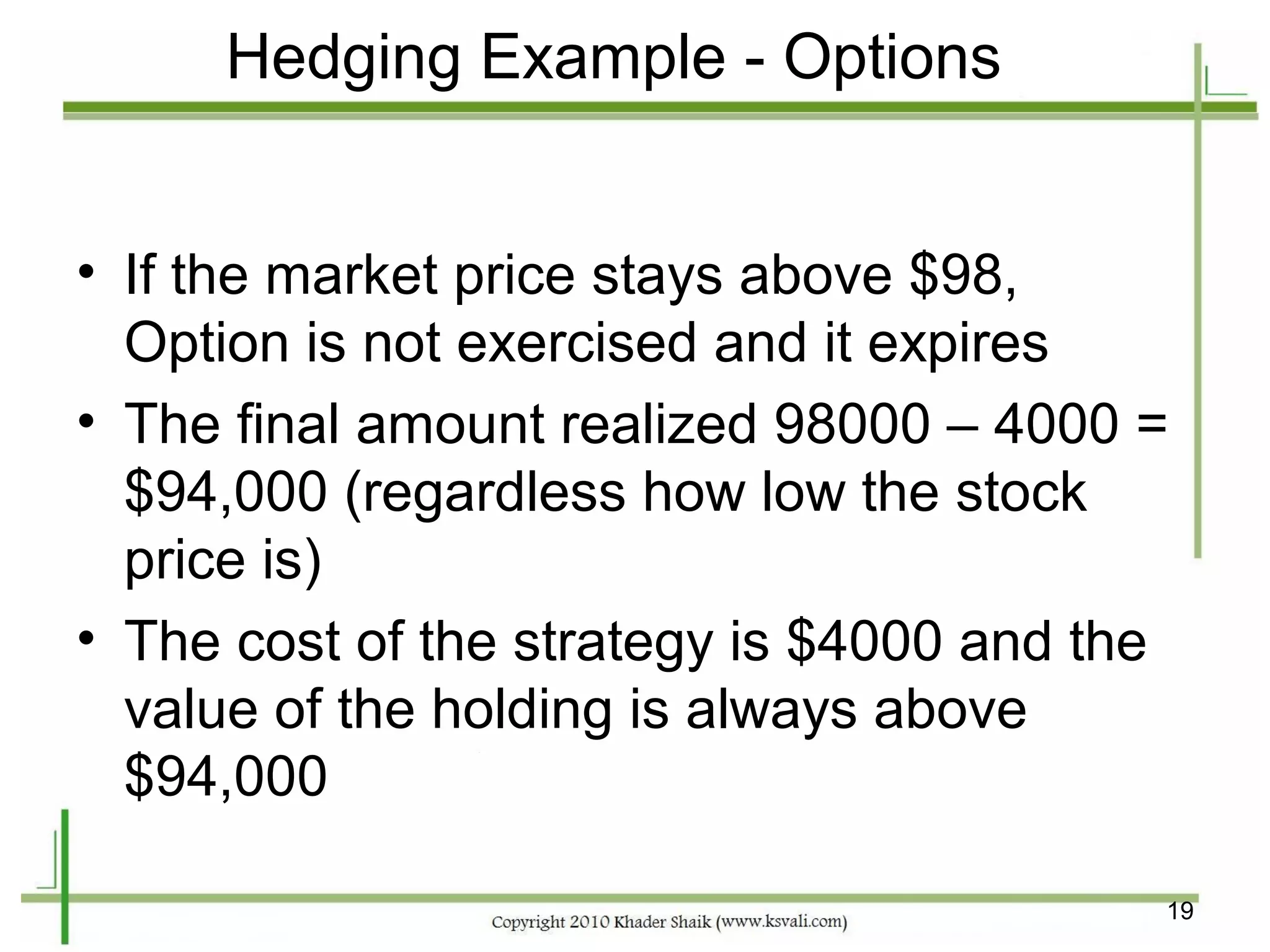
• If the market price stays above $98,
  Option is not exercised and it expires
• The final amount realized 98000 – 4000 =
  $94,000 (regardless how low the stock
  price is)
• The cost of the strategy is $4000 and the
  value of the holding is always above
  $94,000

                                          19
Hedging Example - Options


                            20
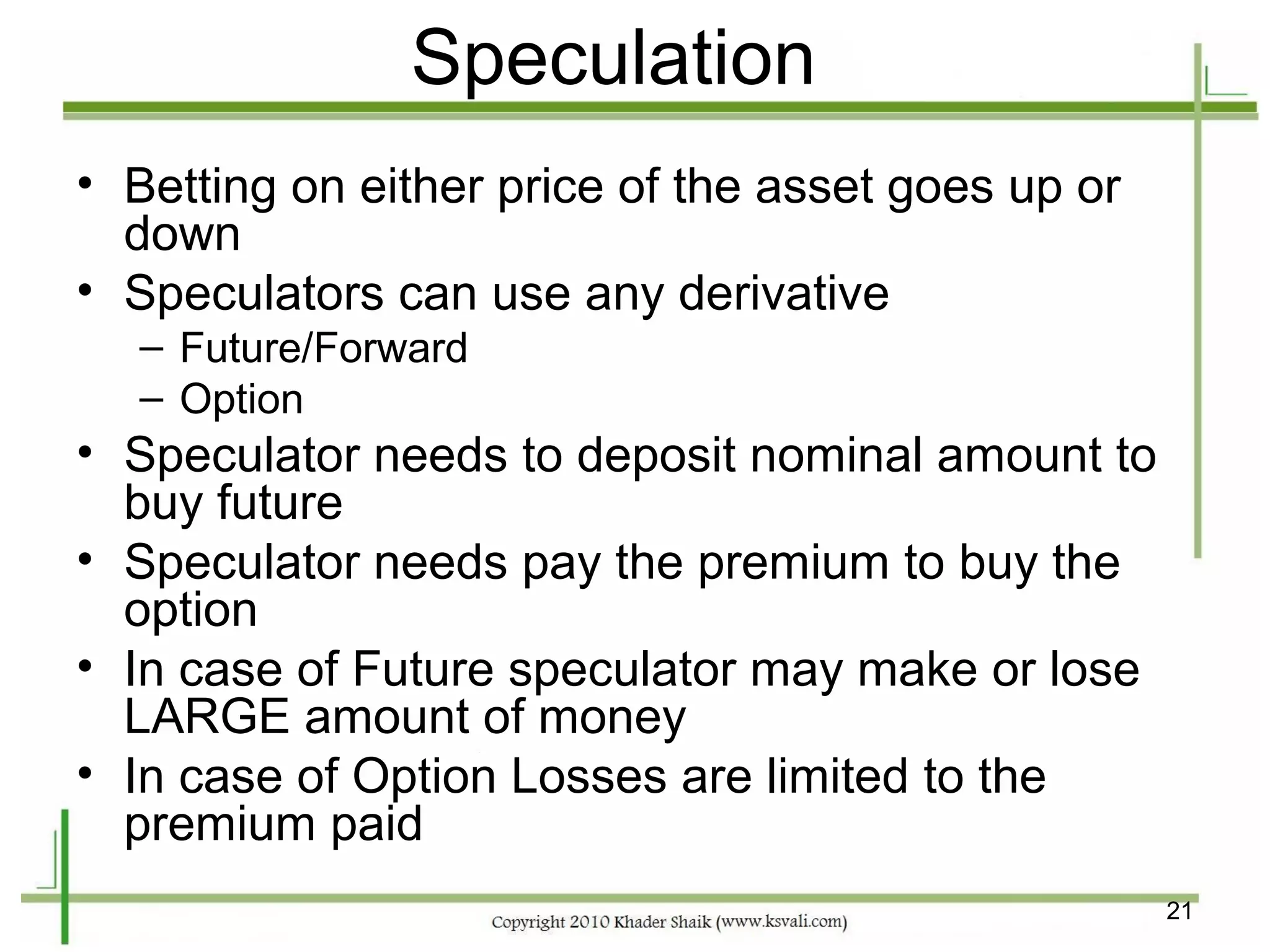
Speculation
• Betting on either price of the asset goes up or
  down
• Speculators can use any derivative
  – Future/Forward
  – Option
• Speculator needs to deposit nominal amount to
  buy future
• Speculator needs pay the premium to buy the
  option
• In case of Future speculator may make or lose
  LARGE amount of money
• In case of Option Losses are limited to the
  premium paid
                                                    21
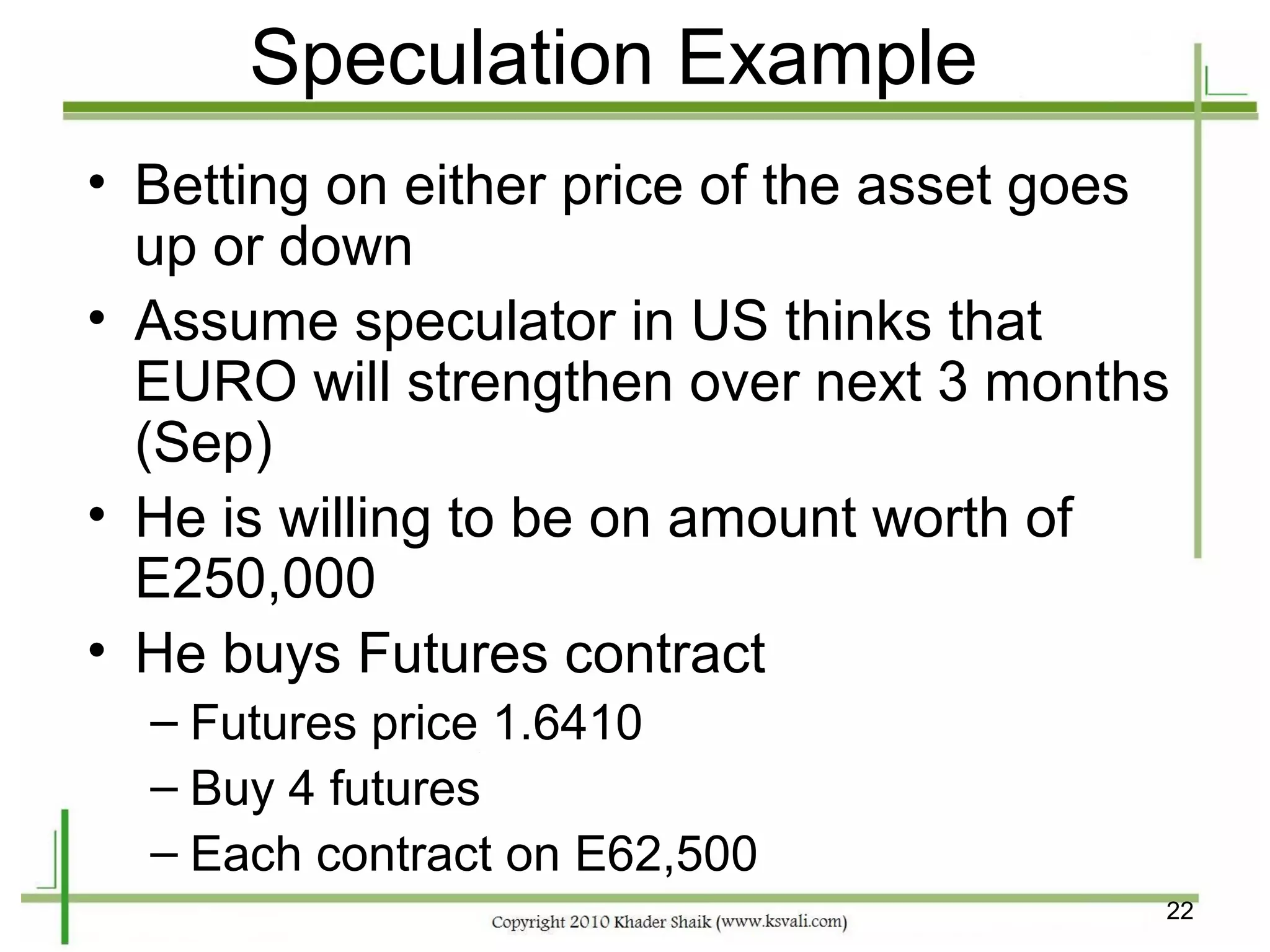
Speculation Example
• Betting on either price of the asset goes
  up or down
• Assume speculator in US thinks that
  EURO will strengthen over next 3 months
  (Sep)
• He is willing to be on amount worth of
  E250,000
• He buys Futures contract
  – Futures price 1.6410
  – Buy 4 futures
  – Each contract on E62,500
                                          22
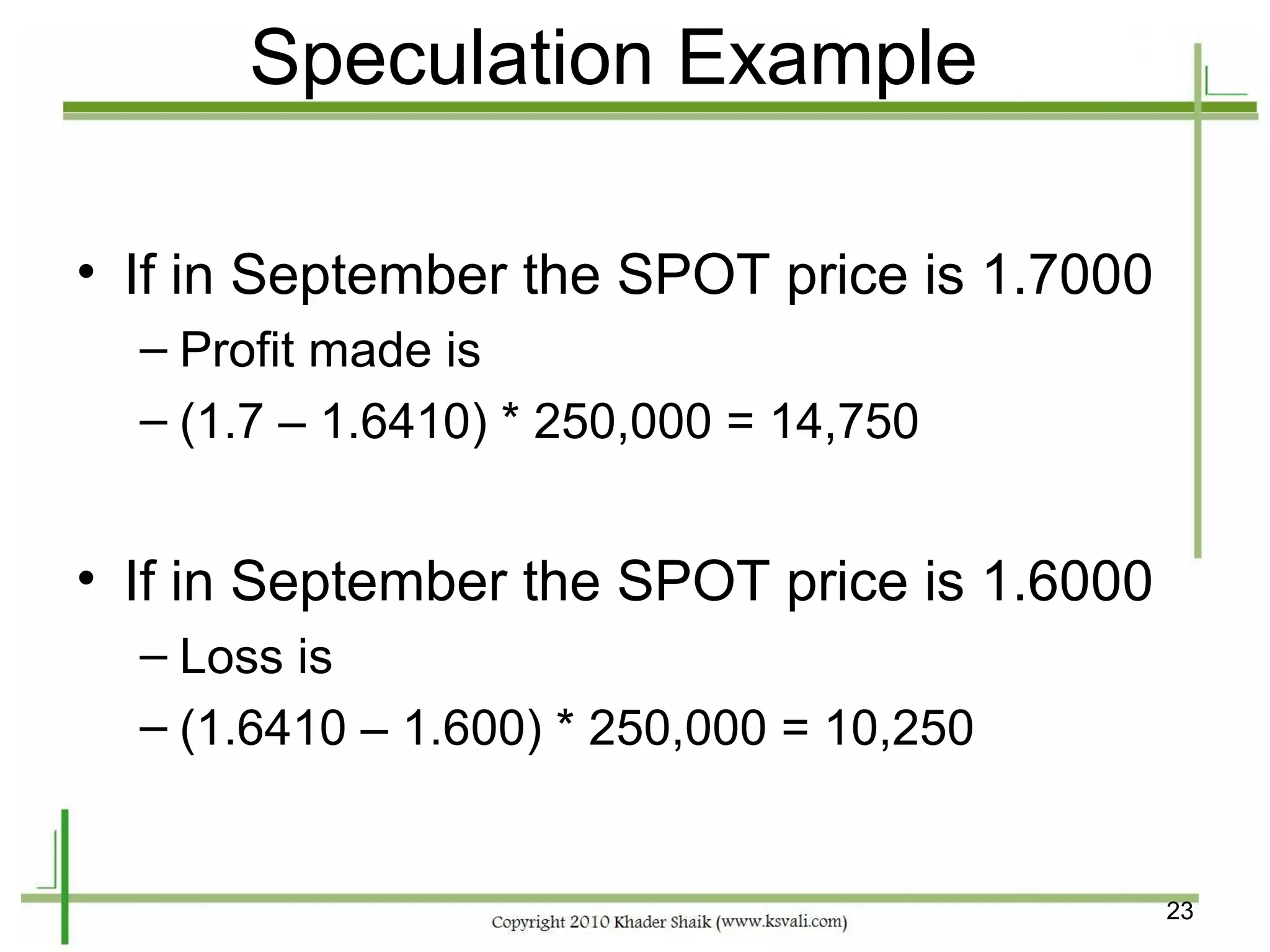
Speculation Example

• If in September the SPOT price is 1.7000
  – Profit made is
  – (1.7 – 1.6410) * 250,000 = 14,750


• If in September the SPOT price is 1.6000
  – Loss is
  – (1.6410 – 1.600) * 250,000 = 10,250


                                             23
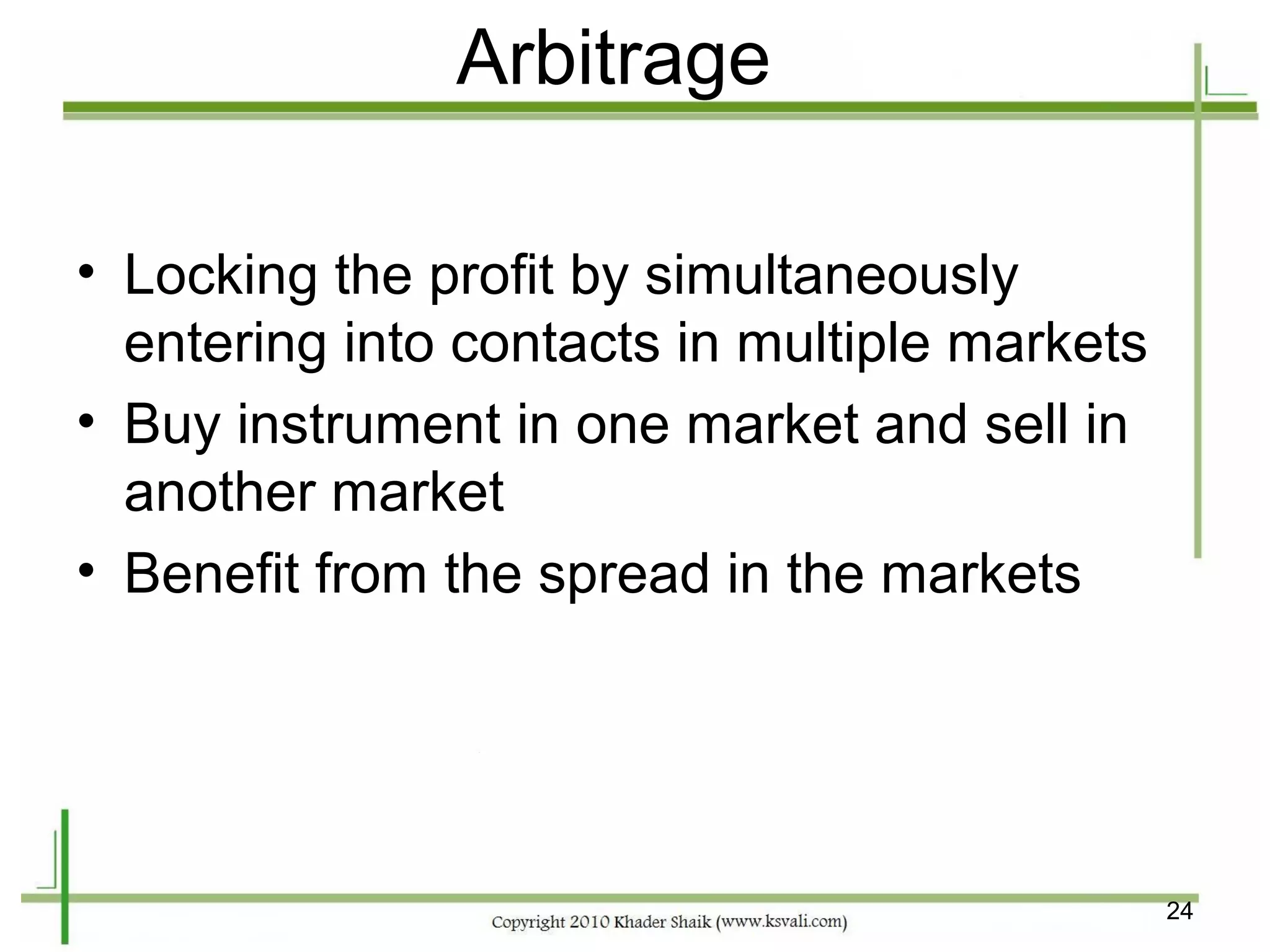
Arbitrage

• Locking the profit by simultaneously
  entering into contacts in multiple markets
• Buy instrument in one market and sell in
  another market
• Benefit from the spread in the markets


                                               24
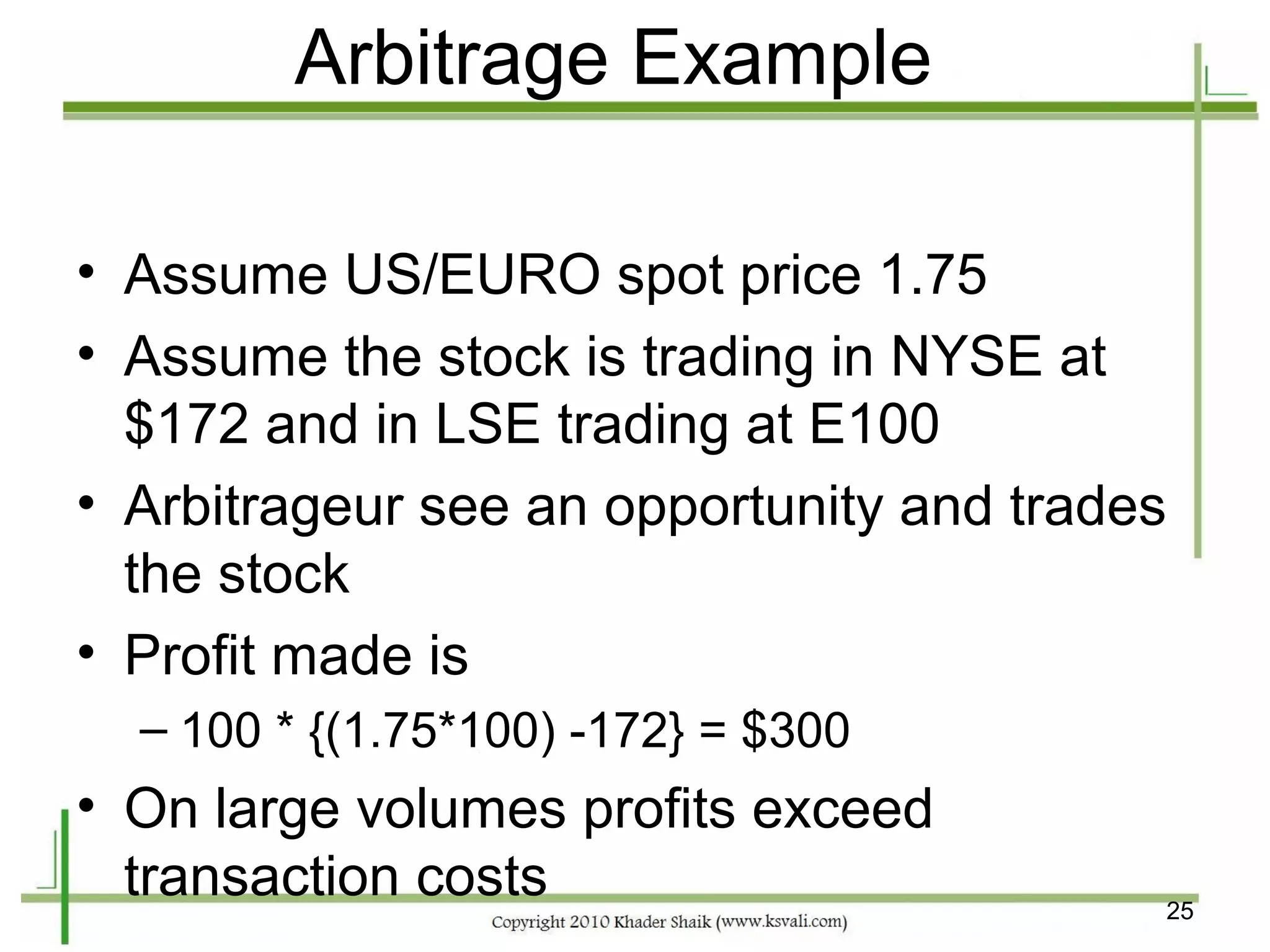
Arbitrage Example

• Assume US/EURO spot price 1.75
• Assume the stock is trading in NYSE at
  $172 and in LSE trading at E100
• Arbitrageur see an opportunity and trades
  the stock
• Profit made is
  – 100 * {(1.75*100) -172} = $300
• On large volumes profits exceed
  transaction costs                       25
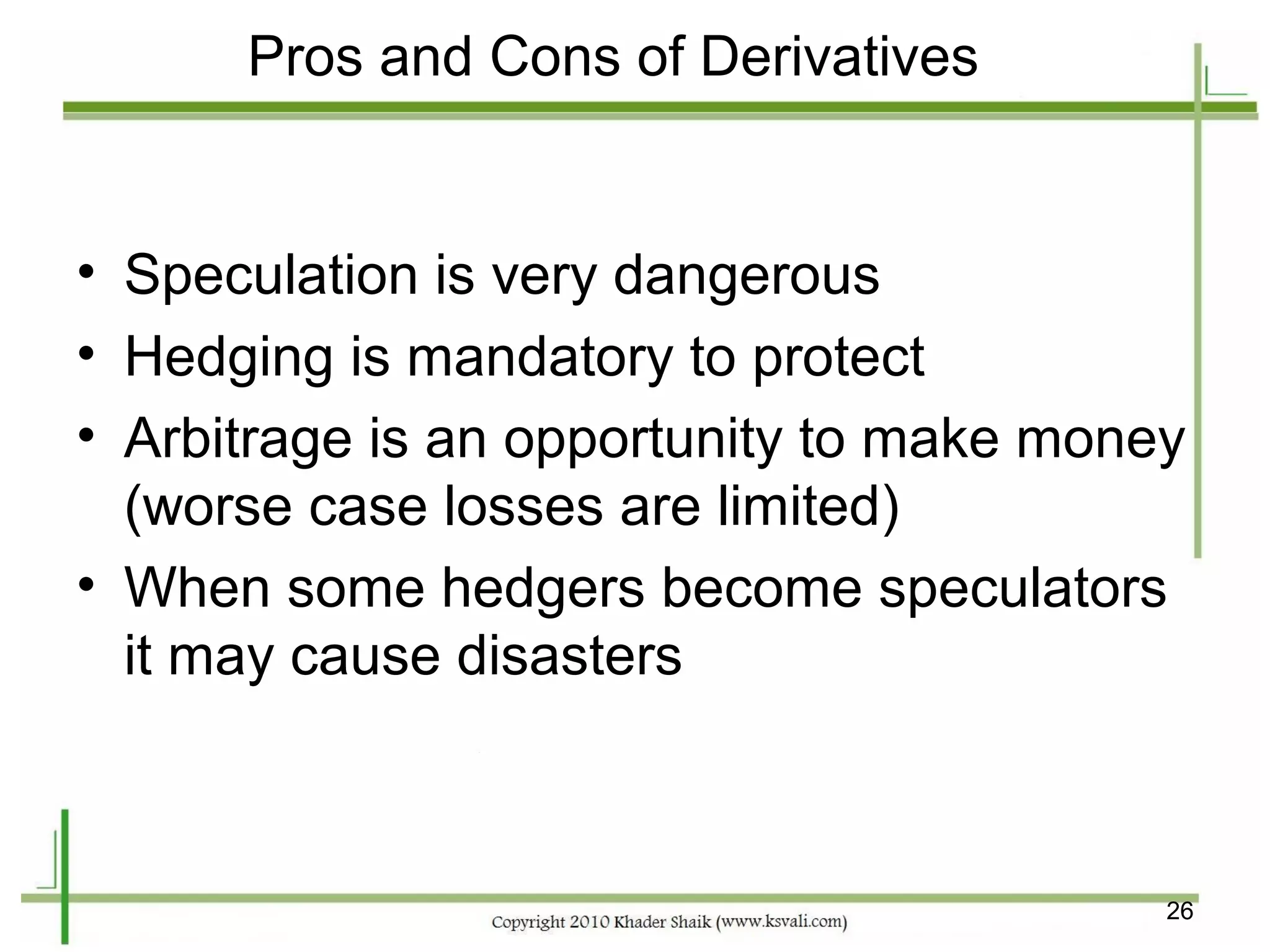
Pros and Cons of Derivatives


• Speculation is very dangerous
• Hedging is mandatory to protect
• Arbitrage is an opportunity to make money
  (worse case losses are limited)
• When some hedgers become speculators
  it may cause disasters


                                          26
More on Derivatives


                      27
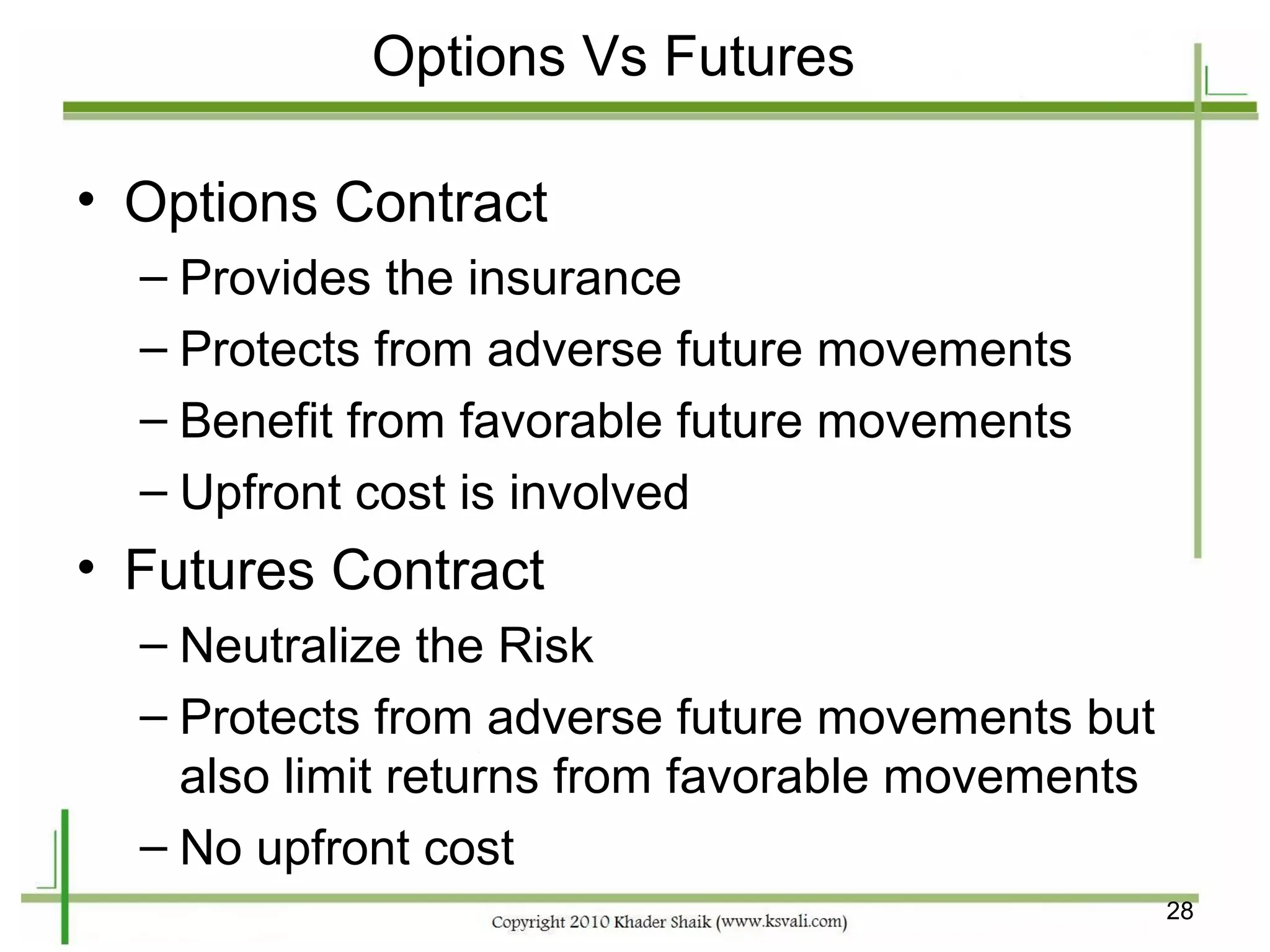
Options Vs Futures

• Options Contract
  – Provides the insurance
  – Protects from adverse future movements
  – Benefit from favorable future movements
  – Upfront cost is involved
• Futures Contract
  – Neutralize the Risk
  – Protects from adverse future movements but
    also limit returns from favorable movements
  – No upfront cost
                                                  28
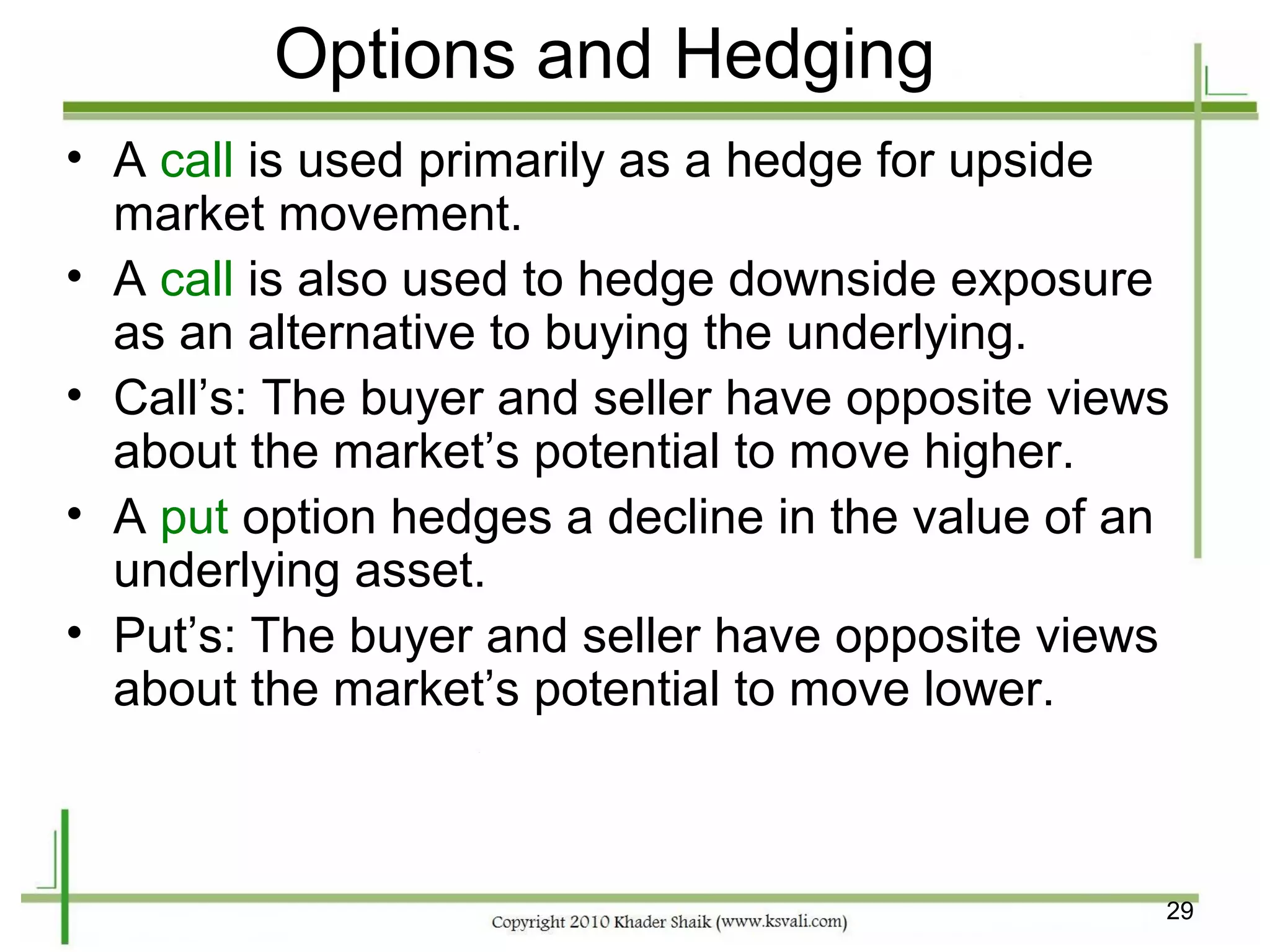
Options and Hedging
• A call is used primarily as a hedge for upside
  market movement.
• A call is also used to hedge downside exposure
  as an alternative to buying the underlying.
• Call’s: The buyer and seller have opposite views
  about the market’s potential to move higher.
• A put option hedges a decline in the value of an
  underlying asset.
• Put’s: The buyer and seller have opposite views
  about the market’s potential to move lower.


                                                 29
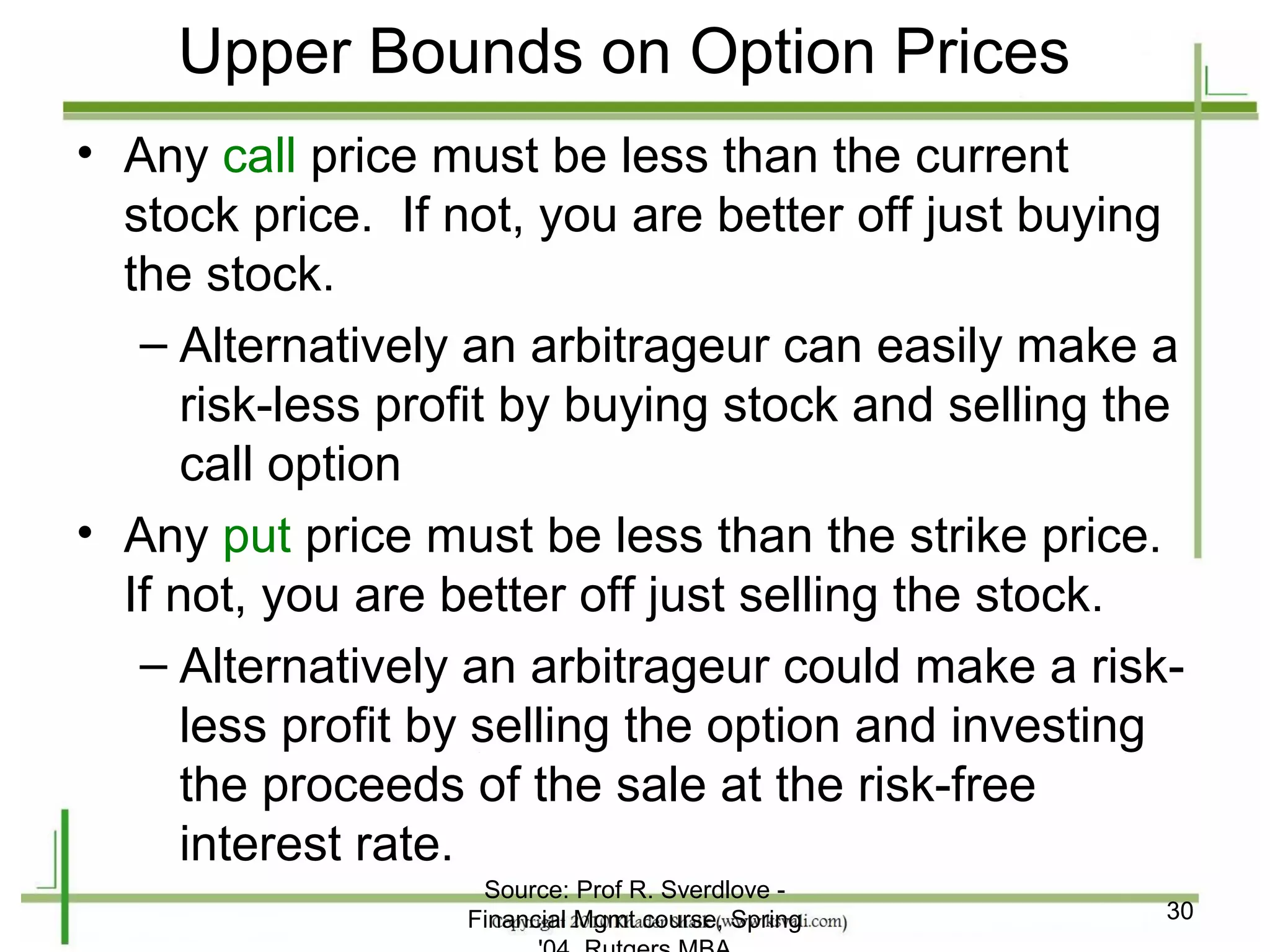
Upper Bounds on Option Prices
• Any call price must be less than the current
  stock price. If not, you are better off just buying
  the stock.
   – Alternatively an arbitrageur can easily make a
      risk-less profit by buying stock and selling the
      call option
• Any put price must be less than the strike price.
  If not, you are better off just selling the stock.
   – Alternatively an arbitrageur could make a risk-
      less profit by selling the option and investing
      the proceeds of the sale at the risk-free
      interest rate.
                    Source: Prof R. Sverdlove -
                   Financial Mgmt course, Spring     30
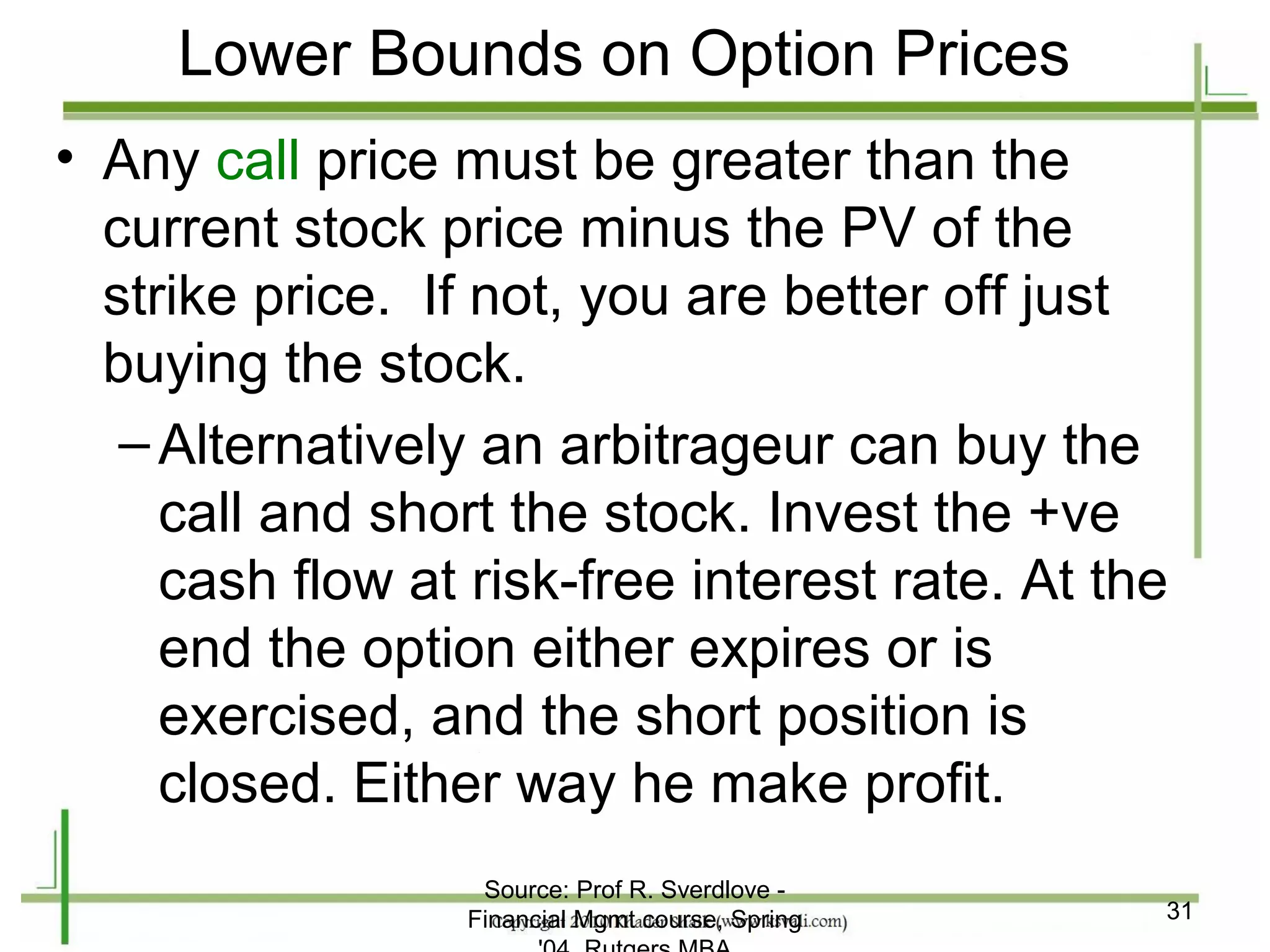
Lower Bounds on Option Prices
• Any call price must be greater than the
  current stock price minus the PV of the
  strike price. If not, you are better off just
  buying the stock.
   – Alternatively an arbitrageur can buy the
     call and short the stock. Invest the +ve
     cash flow at risk-free interest rate. At the
     end the option either expires or is
     exercised, and the short position is
     closed. Either way he make profit.
                   Source: Prof R. Sverdlove -
                  Financial Mgmt course, Spring   31
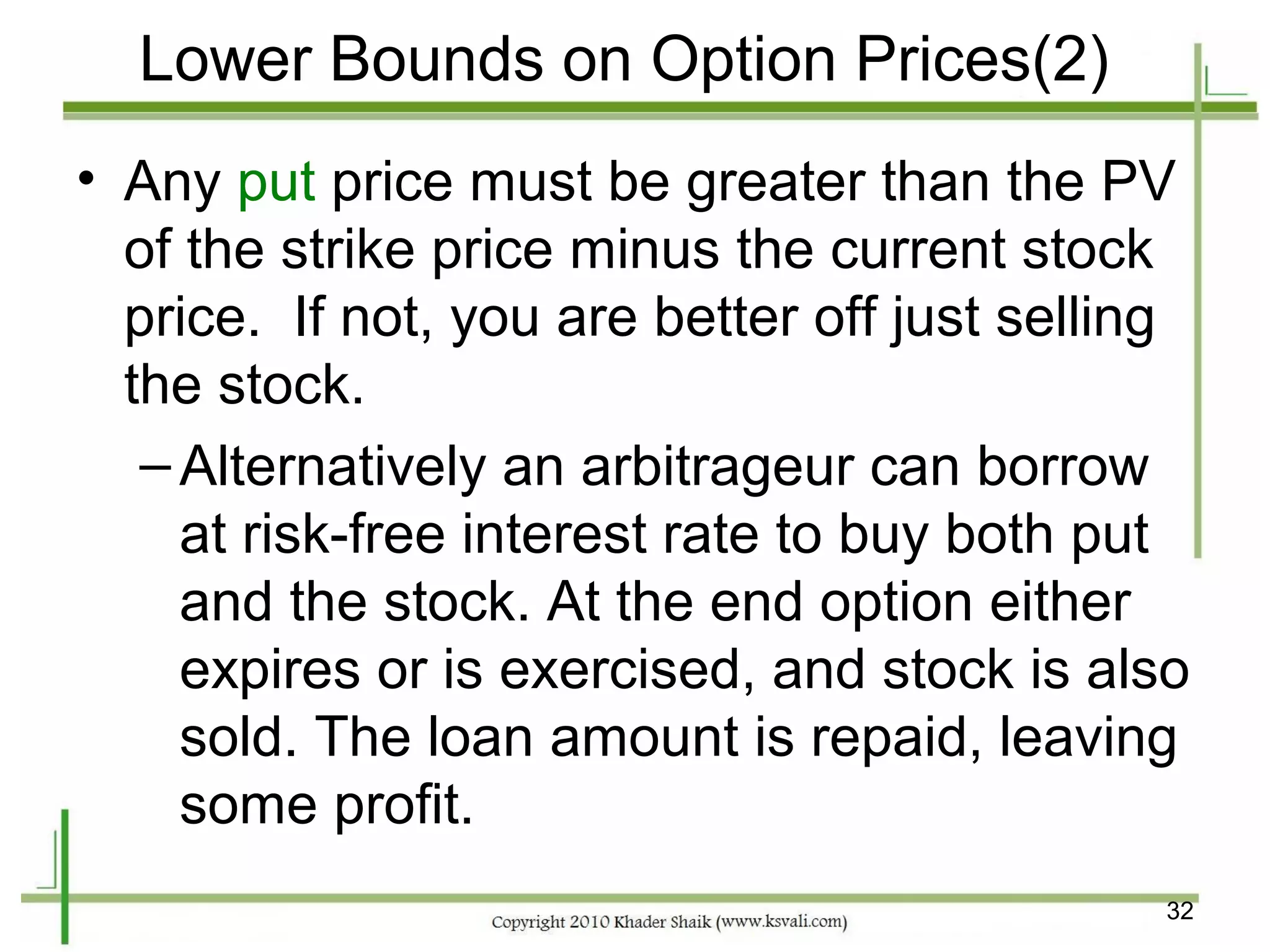
Lower Bounds on Option Prices(2)
• Any put price must be greater than the PV
  of the strike price minus the current stock
  price. If not, you are better off just selling
  the stock.
   – Alternatively an arbitrageur can borrow
     at risk-free interest rate to buy both put
     and the stock. At the end option either
     expires or is exercised, and stock is also
     sold. The loan amount is repaid, leaving
     some profit.
                                              32
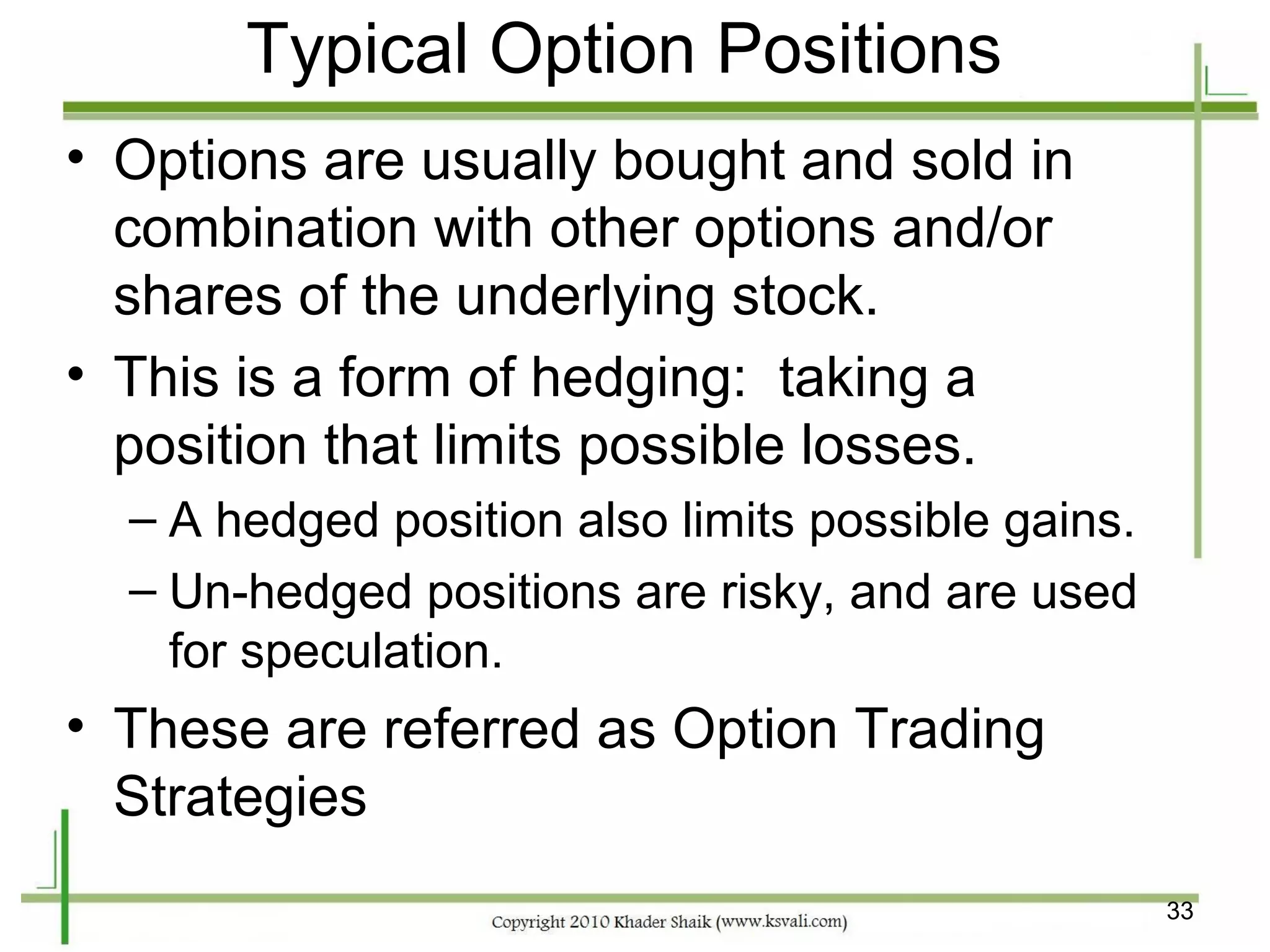
Typical Option Positions
• Options are usually bought and sold in
  combination with other options and/or
  shares of the underlying stock.
• This is a form of hedging: taking a
  position that limits possible losses.
  – A hedged position also limits possible gains.
  – Un-hedged positions are risky, and are used
    for speculation.
• These are referred as Option Trading
  Strategies
                                                    33
Swaps


        34
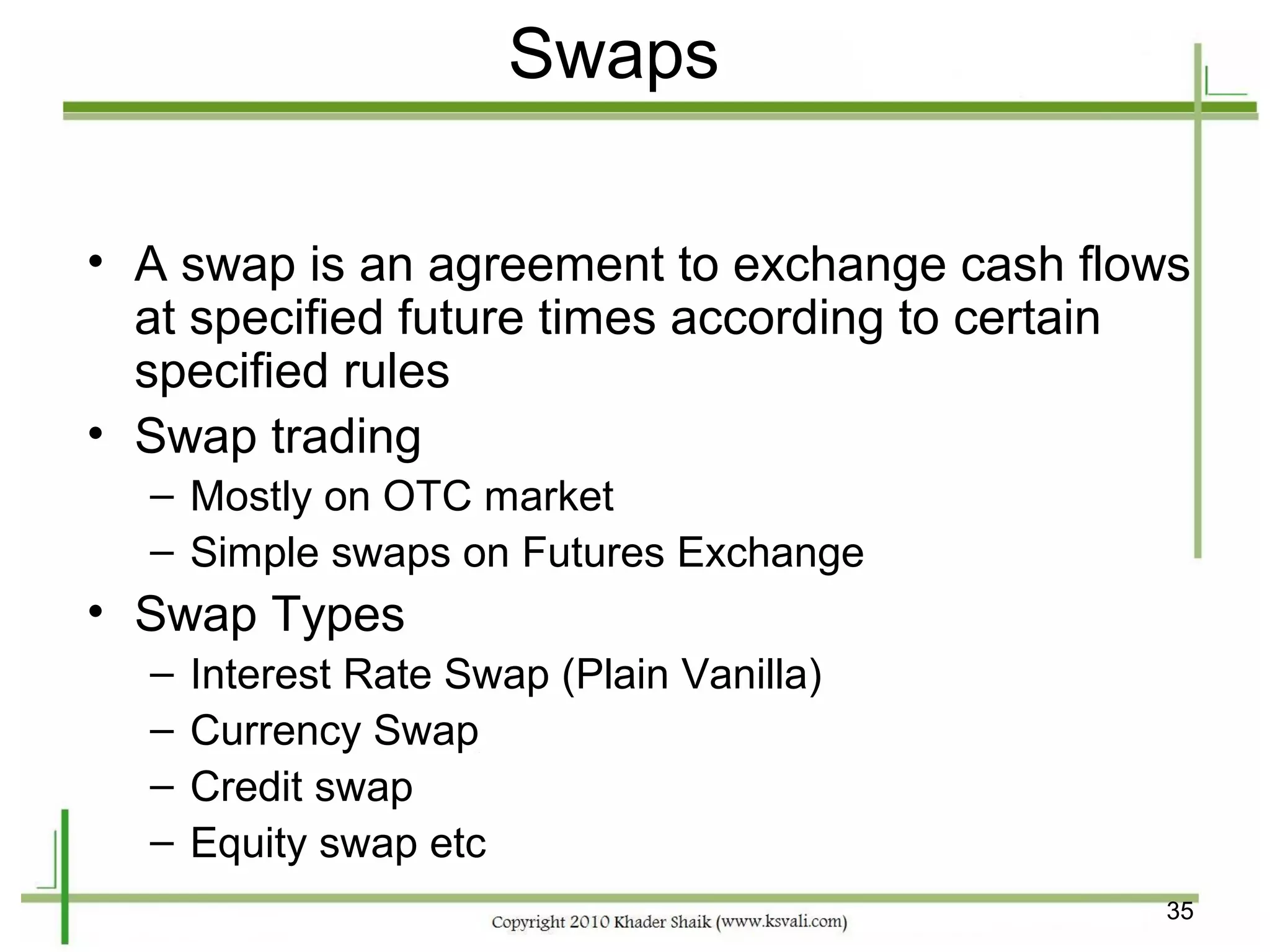
Swaps

• A swap is an agreement to exchange cash flows
  at specified future times according to certain
  specified rules
• Swap trading
  – Mostly on OTC market
  – Simple swaps on Futures Exchange
• Swap Types
  –   Interest Rate Swap (Plain Vanilla)
  –   Currency Swap
  –   Credit swap
  –   Equity swap etc
                                              35
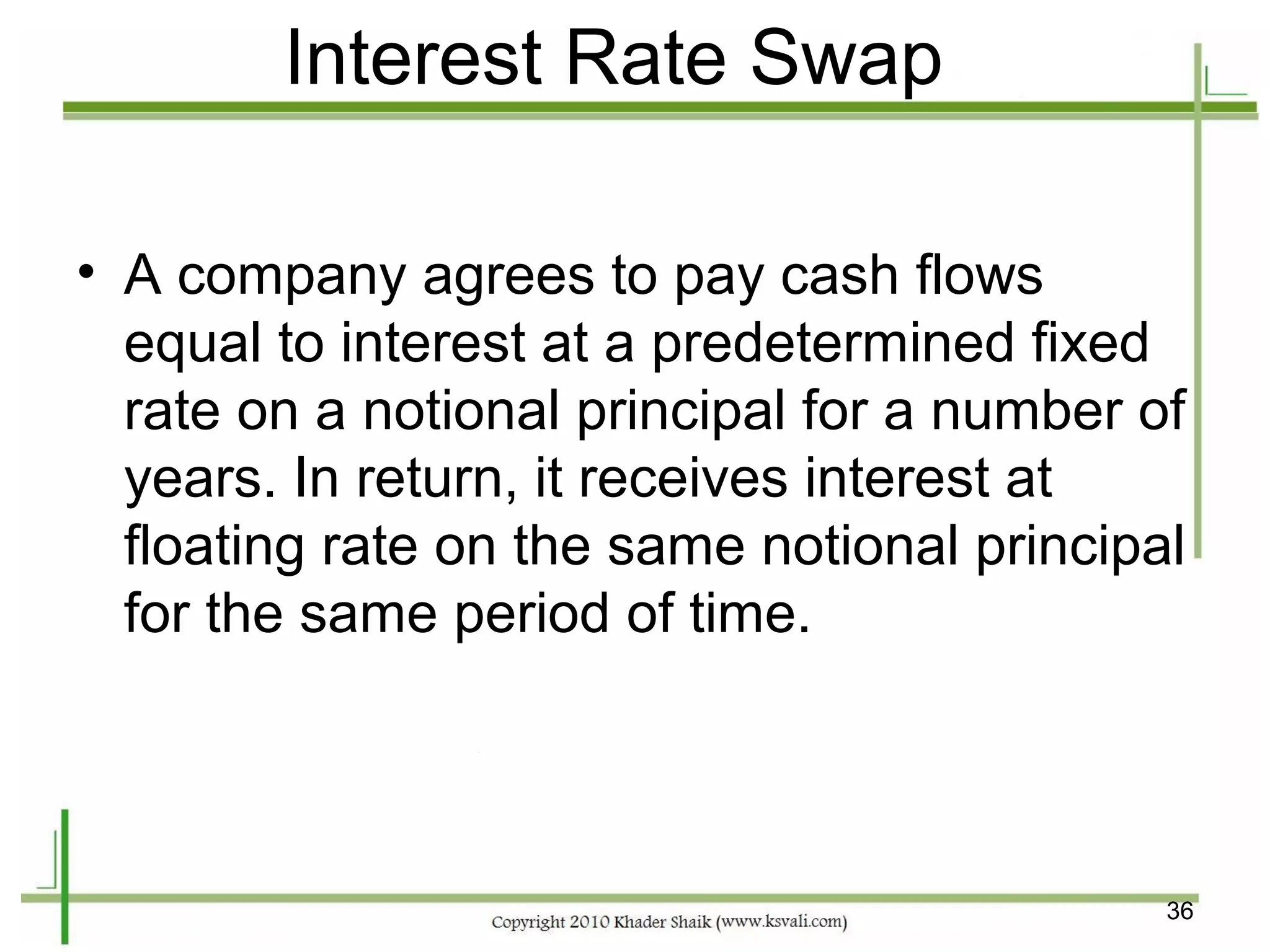
Interest Rate Swap

• A company agrees to pay cash flows
  equal to interest at a predetermined fixed
  rate on a notional principal for a number of
  years. In return, it receives interest at
  floating rate on the same notional principal
  for the same period of time.


                                             36
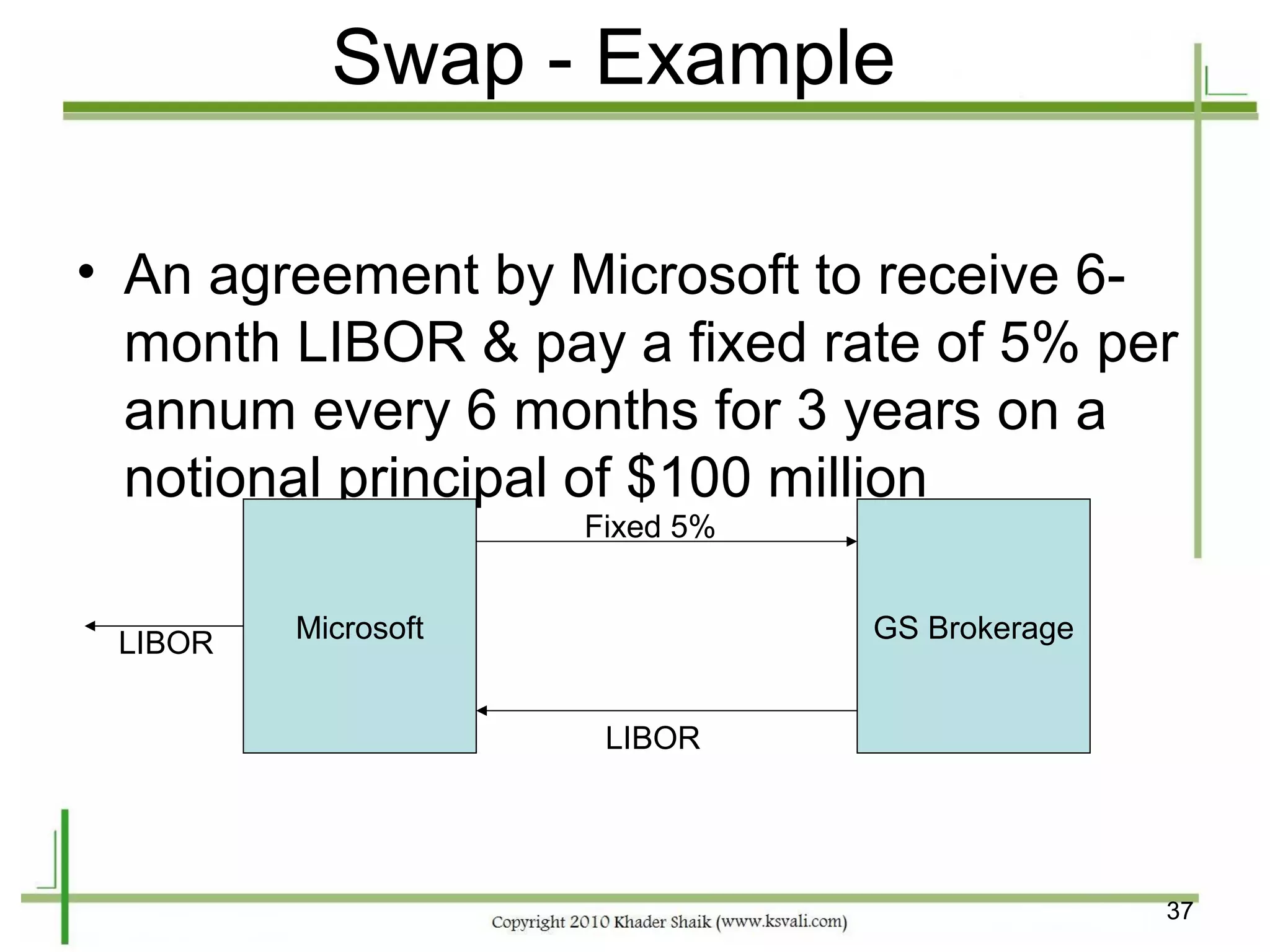
Swap - Example

• An agreement by Microsoft to receive 6-
  month LIBOR & pay a fixed rate of 5% per
  annum every 6 months for 3 years on a
  notional principal of $100 million
                     Fixed 5%


 LIBOR   Microsoft              GS Brokerage


                      LIBOR


                                               37
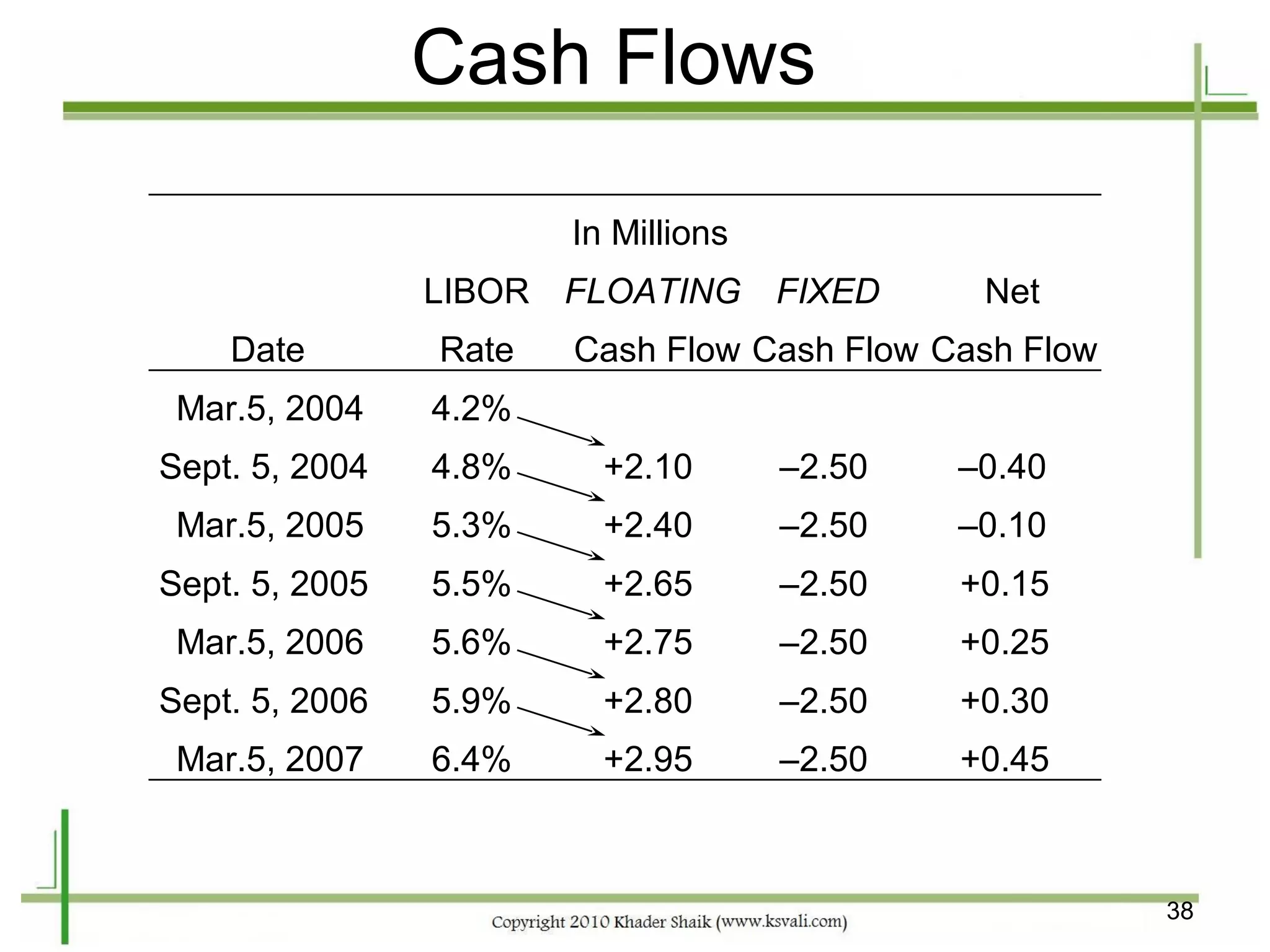
Cash Flows

                       In Millions
                LIBOR FLOATING FIXED          Net
    Date        Rate   Cash Flow Cash Flow Cash Flow
 Mar.5, 2004    4.2%
Sept. 5, 2004   4.8%     +2.10       –2.50   –0.40
 Mar.5, 2005    5.3%     +2.40       –2.50   –0.10
Sept. 5, 2005   5.5%     +2.65       –2.50   +0.15
 Mar.5, 2006    5.6%     +2.75       –2.50   +0.25
Sept. 5, 2006   5.9%     +2.80       –2.50   +0.30
 Mar.5, 2007    6.4%     +2.95       –2.50   +0.45


                                                       38
Use of Swaps
• Converting a liability from
  – fixed rate to floating rate
  – floating rate to fixed rate
• Converting an investment from
  – fixed rate to floating rate
  – floating rate to fixed rate


                                  39
Pricing/Valuation


                    40
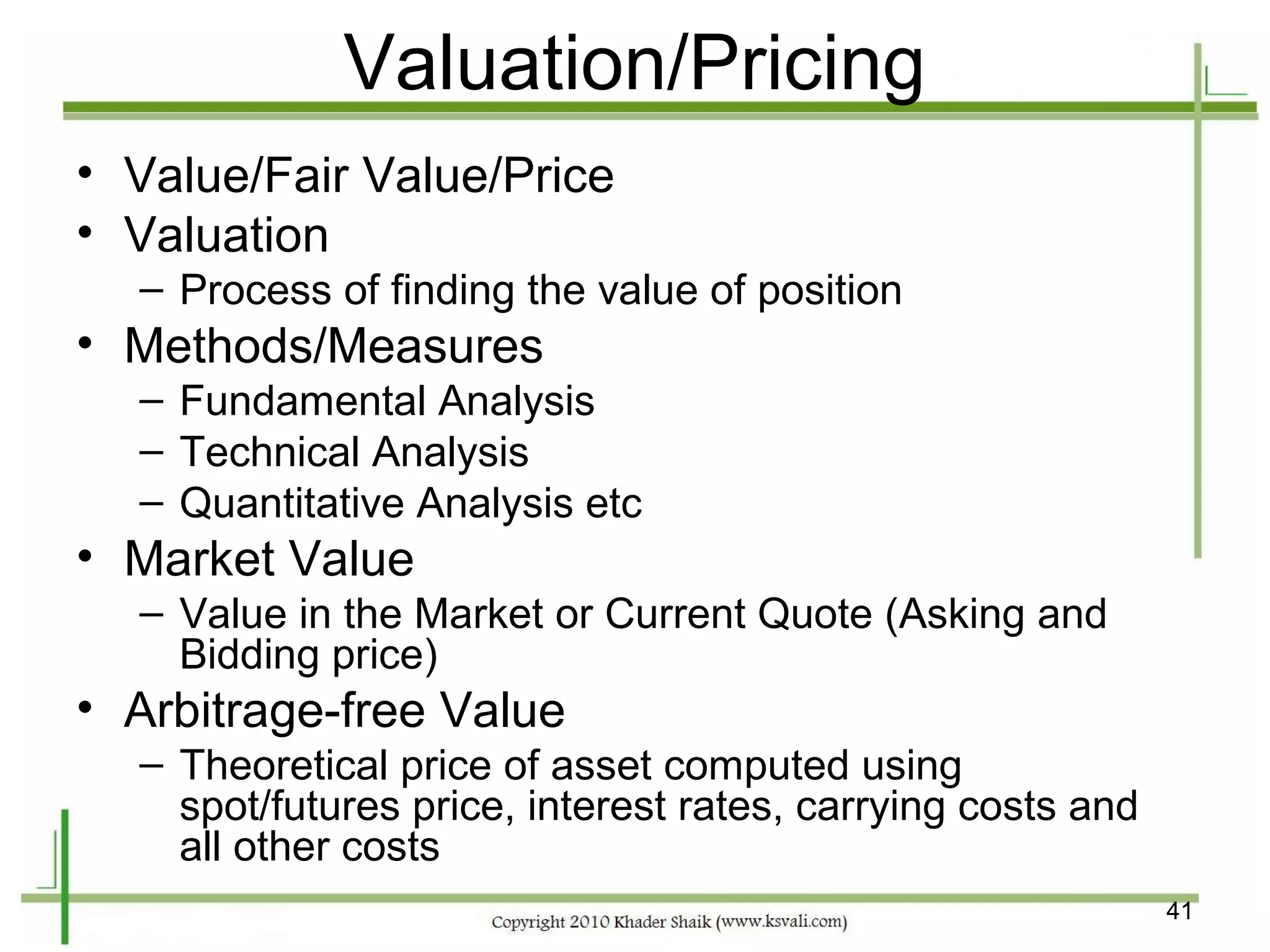
Valuation/Pricing
• Value/Fair Value/Price
• Valuation
  – Process of finding the value of position
• Methods/Measures
  – Fundamental Analysis
  – Technical Analysis
  – Quantitative Analysis etc
• Market Value
  – Value in the Market or Current Quote (Asking and
    Bidding price)
• Arbitrage-free Value
  – Theoretical price of asset computed using
    spot/futures price, interest rates, carrying costs and
    all other costs
                                                             41
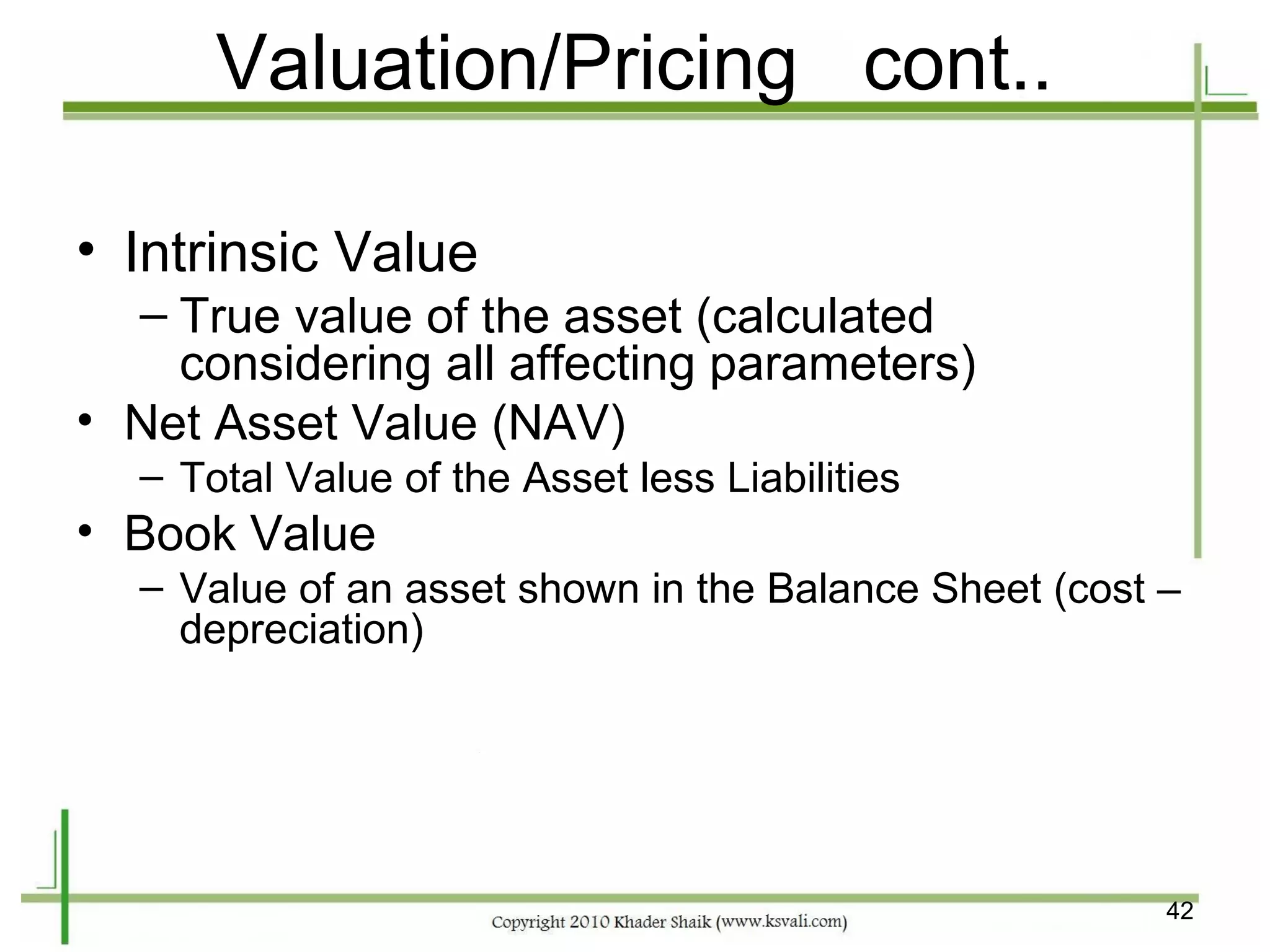
Valuation/Pricing cont..

• Intrinsic Value
  – True value of the asset (calculated
    considering all affecting parameters)
• Net Asset Value (NAV)
  – Total Value of the Asset less Liabilities
• Book Value
  – Value of an asset shown in the Balance Sheet (cost –
    depreciation)


                                                       42
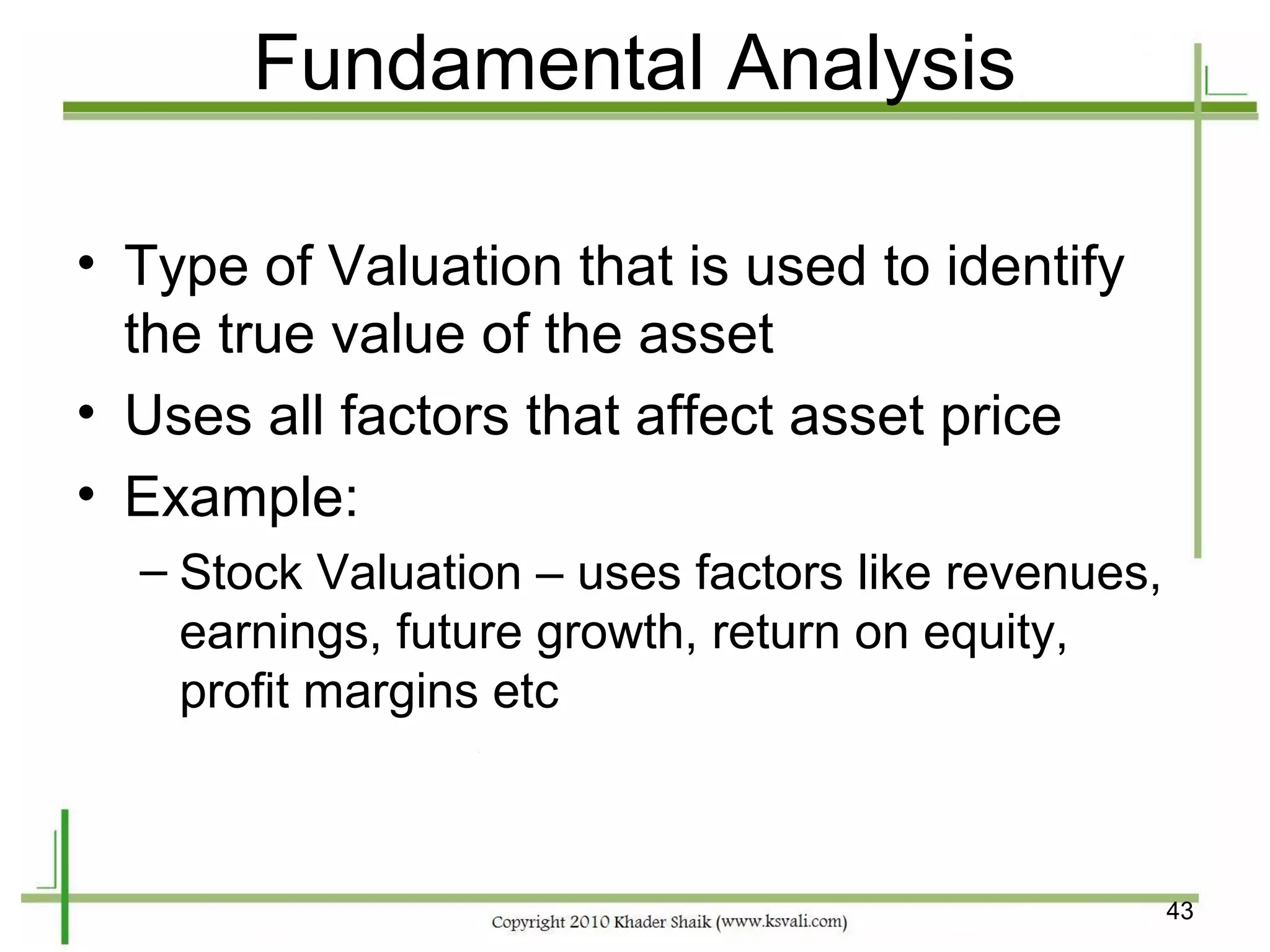
Fundamental Analysis

• Type of Valuation that is used to identify
  the true value of the asset
• Uses all factors that affect asset price
• Example:
  – Stock Valuation – uses factors like revenues,
    earnings, future growth, return on equity,
    profit margins etc


                                                    43
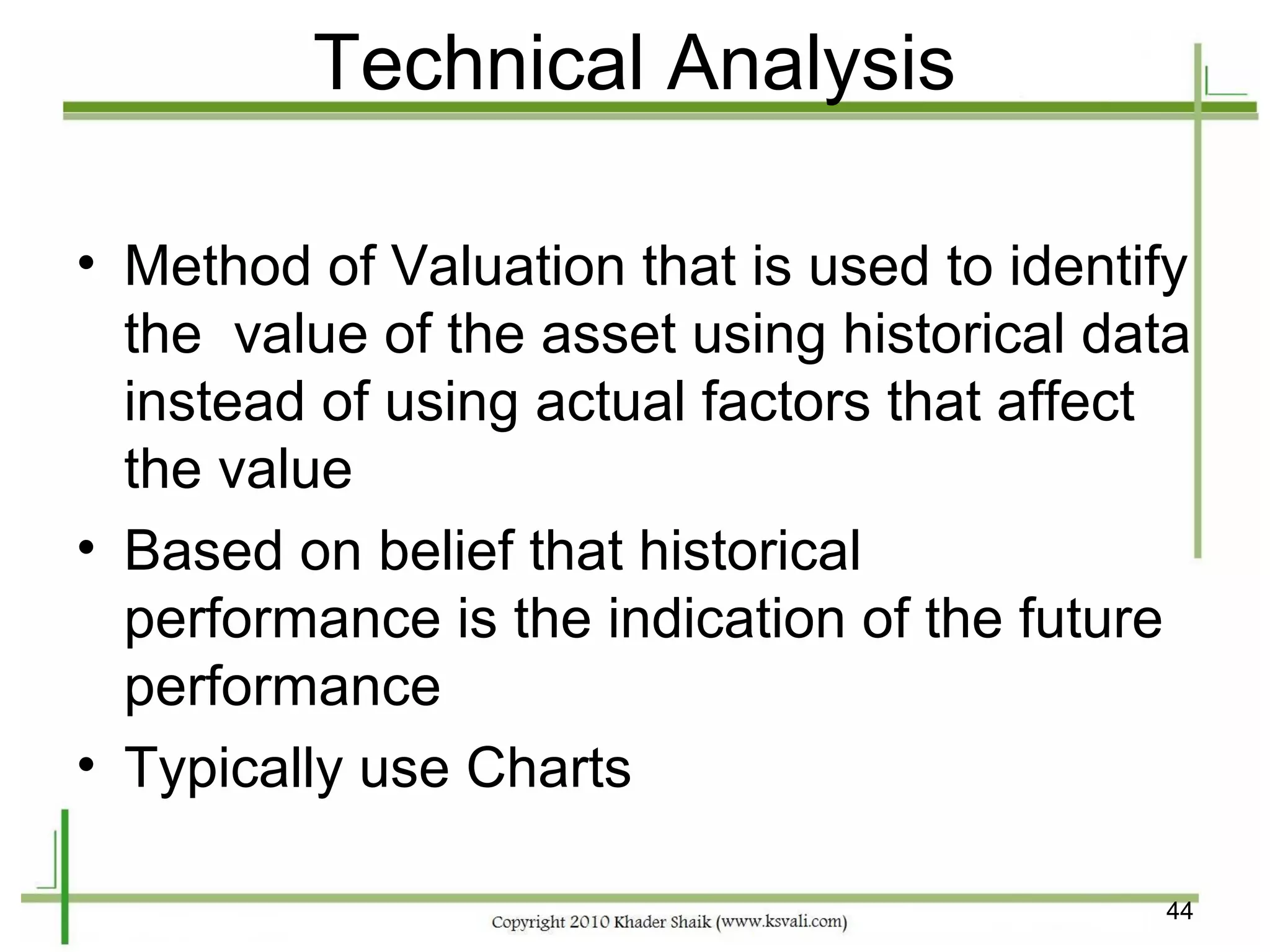
Technical Analysis

• Method of Valuation that is used to identify
  the value of the asset using historical data
  instead of using actual factors that affect
  the value
• Based on belief that historical
  performance is the indication of the future
  performance
• Typically use Charts

                                            44
Quantitative Analysis
• Way of valuating assets using complex
  mathematical and statistical modeling,
  measurement and research
• It assigns numerical value to all variable that
  affect the asset value
• Analysts referred as
   – “Quants” OR “Quant Jockeys”
• Examples of Quantitative Analysis measures
  are, from simple Earnings Per Share to complex
  Option Price
• Involves Mathematical Finance, Numerical
  Methods, Statistics etc.
                                                    45

derivativesmarketarz 100709171035-phpapp01

  • 1.
  • 2.
    Derivatives • Derivative – Financial Instrument whose value derived from an underlying asset – Financial Contract • Underlying Assets – Stocks, Bonds, Currencies, Commodities, Interest Rates etc • Example - Equity Option – Equity Option is not a security by itself – It is right to sell or buy an underlying security – Only premium is paid to buy an option NOT the price 2 of the underlying equity
  • 3.
    Derivative Markets • Exchanges – Intermediary who accommodates the trade and guarantees the execution – Collects the Margin if applies – Specialized Derivatives Exchanges – Regular Exchanges • OTC (Over-the-counter) – Direct Contract between two parties – Non-standard contracts 3
  • 4.
    Major Classes ofDerivatives • Futures and Forwards – DJIA Index Future, Eurodollar Future, Bond Future, FX Future etc – FX Forward, Repos, FRA etc • Options – Stock Option, Warrant etc • Swaps – Interest Rate Swap – Currency Swap etc 4
  • 5.
  • 6.
    Futures Contract • Alegally binding agreement to sell or buy a commodity or financial instrument some time in future • Futures are standardized according to quality, quantity, and delivery time and location for each commodity • Price of futures is discovered on an exchange trading floor • Exchange takes some responsibility for futures approved/sold on the floor • Futures contract needs funds to be deposited (margin) by buyer/seller as a guarantee 6
  • 7.
    Futures cont.. • Futurescan be settled with cash instead of delivery of the actual underlying asset • Futures contracts are available on – Corn and other grains – Crude oil – Treasury bond – Foreign currency – Stock and other financial instruments 7
  • 8.
    Futures Positions • Longposition – purchasing the futures contract (to buy the asset in future) – Hedgers can use to hedge from rising prices – Speculators can use in anticipation of higher prices • Short position – selling the futures contract (to sell the asset in future) – Hedgers can use to hedge from falling prices – Speculators can use in anticipation of lowering prices 8
  • 9.
    Forwards • Non-standardized futurescontracts • Contract between two individual parties • Sold in OTC Markets • Usually Brokerage Institutions arrange deals • Carry the risk of default • Futures are interchangeable; Forwards are not 9
  • 10.
    Forward • Similar toFutures Contract but not Standard • Traded between two private parties (in OTC Markets) • On delivery date, holder may actually deliver the instrument or pay the price difference • Riskier than Futures • Popular on Currencies and Interest Rates 10
  • 11.
    Futures Vs Forwards • Exchange Traded • OTC Traded • Usually closed out • Usually underlying prior to maturity asset delivered • Standardized • Terms vary • Settled daily • Settled at expiry 11
  • 12.
    Options and FuturesExchanges • Chicago Board of Trade – CBOT www.cbot.com • Chicago Mercantile Exchange – CME www.cme.com • New York Mercantile Exchange – NYMEX www.nymex.com Slide 26 12
  • 13.
    Option • Right tobuy or sell an underlying instrument • Just premium is paid to buy the option not the value of the underlying asset • It is just a RIGHT not an OBLIGATION – Holder may not execute his right at all • Popular Options – Stock option – Bond option – Commodity option – Interest Rate option – FX option etc. 13
  • 14.
    SWAP • Is anagreement between two parties to swap one set of CASH FLOW with another set • For example, holder of Fixed interest rate loan may exchange his cash flow (return stream) with a party who holds Floating rate loan cash flow • Traded in OTC Derivatives Markets • Various SWAPs – Interest Rate Swap – Currency Swap etc 14
  • 15.
    Why Derivatives? • Hedging/ Insurance – Transfer the RISK – Ex: Farmer selling a crop before its harvest to protect from any future fluctuations in prices • Arbitrage – Buying an instrument in one market and selling in another and profiting from the difference • Speculation – Speculating the price variation in instrument and buying futures or options of that instrument 15
  • 16.
    Why Derivatives? …cont •To change the nature of liability • To change he nature of the investment without selling the instrument itself etc. 16
  • 17.
    Hedging Example • Owna 1000 shares of IBM. Market Value $100/share • Worried about possible price decline over next 3 months • Need a protection from a decline OR • Lock-in at certain price • Hedging choice – Buy options to protect – Sign a forward contract to lock-in the price 17
  • 18.
    Hedging Example -Options • Buy IBM PUT OPTION on some exchange – 3 months expiry – Strike price $98 – Option price $4 – 10 contracts (10 * 100 * 4 = $4000) • Cost of strategy is $4000 • If the market price falls below $98, option can be exercised at $98 returning $98,000 • The final amount realized 98000 – 4000 = $94,000 (regardless how low the stock price is) 18
  • 19.
    Hedging Example -Options • If the market price stays above $98, Option is not exercised and it expires • The final amount realized 98000 – 4000 = $94,000 (regardless how low the stock price is) • The cost of the strategy is $4000 and the value of the holding is always above $94,000 19
  • 20.
  • 21.
    Speculation • Betting oneither price of the asset goes up or down • Speculators can use any derivative – Future/Forward – Option • Speculator needs to deposit nominal amount to buy future • Speculator needs pay the premium to buy the option • In case of Future speculator may make or lose LARGE amount of money • In case of Option Losses are limited to the premium paid 21
  • 22.
    Speculation Example • Bettingon either price of the asset goes up or down • Assume speculator in US thinks that EURO will strengthen over next 3 months (Sep) • He is willing to be on amount worth of E250,000 • He buys Futures contract – Futures price 1.6410 – Buy 4 futures – Each contract on E62,500 22
  • 23.
    Speculation Example • Ifin September the SPOT price is 1.7000 – Profit made is – (1.7 – 1.6410) * 250,000 = 14,750 • If in September the SPOT price is 1.6000 – Loss is – (1.6410 – 1.600) * 250,000 = 10,250 23
  • 24.
    Arbitrage • Locking theprofit by simultaneously entering into contacts in multiple markets • Buy instrument in one market and sell in another market • Benefit from the spread in the markets 24
  • 25.
    Arbitrage Example • AssumeUS/EURO spot price 1.75 • Assume the stock is trading in NYSE at $172 and in LSE trading at E100 • Arbitrageur see an opportunity and trades the stock • Profit made is – 100 * {(1.75*100) -172} = $300 • On large volumes profits exceed transaction costs 25
  • 26.
    Pros and Consof Derivatives • Speculation is very dangerous • Hedging is mandatory to protect • Arbitrage is an opportunity to make money (worse case losses are limited) • When some hedgers become speculators it may cause disasters 26
  • 27.
  • 28.
    Options Vs Futures •Options Contract – Provides the insurance – Protects from adverse future movements – Benefit from favorable future movements – Upfront cost is involved • Futures Contract – Neutralize the Risk – Protects from adverse future movements but also limit returns from favorable movements – No upfront cost 28
  • 29.
    Options and Hedging •A call is used primarily as a hedge for upside market movement. • A call is also used to hedge downside exposure as an alternative to buying the underlying. • Call’s: The buyer and seller have opposite views about the market’s potential to move higher. • A put option hedges a decline in the value of an underlying asset. • Put’s: The buyer and seller have opposite views about the market’s potential to move lower. 29
  • 30.
    Upper Bounds onOption Prices • Any call price must be less than the current stock price. If not, you are better off just buying the stock. – Alternatively an arbitrageur can easily make a risk-less profit by buying stock and selling the call option • Any put price must be less than the strike price. If not, you are better off just selling the stock. – Alternatively an arbitrageur could make a risk- less profit by selling the option and investing the proceeds of the sale at the risk-free interest rate. Source: Prof R. Sverdlove - Financial Mgmt course, Spring 30
  • 31.
    Lower Bounds onOption Prices • Any call price must be greater than the current stock price minus the PV of the strike price. If not, you are better off just buying the stock. – Alternatively an arbitrageur can buy the call and short the stock. Invest the +ve cash flow at risk-free interest rate. At the end the option either expires or is exercised, and the short position is closed. Either way he make profit. Source: Prof R. Sverdlove - Financial Mgmt course, Spring 31
  • 32.
    Lower Bounds onOption Prices(2) • Any put price must be greater than the PV of the strike price minus the current stock price. If not, you are better off just selling the stock. – Alternatively an arbitrageur can borrow at risk-free interest rate to buy both put and the stock. At the end option either expires or is exercised, and stock is also sold. The loan amount is repaid, leaving some profit. 32
  • 33.
    Typical Option Positions •Options are usually bought and sold in combination with other options and/or shares of the underlying stock. • This is a form of hedging: taking a position that limits possible losses. – A hedged position also limits possible gains. – Un-hedged positions are risky, and are used for speculation. • These are referred as Option Trading Strategies 33
  • 34.
  • 35.
    Swaps • A swapis an agreement to exchange cash flows at specified future times according to certain specified rules • Swap trading – Mostly on OTC market – Simple swaps on Futures Exchange • Swap Types – Interest Rate Swap (Plain Vanilla) – Currency Swap – Credit swap – Equity swap etc 35
  • 36.
    Interest Rate Swap •A company agrees to pay cash flows equal to interest at a predetermined fixed rate on a notional principal for a number of years. In return, it receives interest at floating rate on the same notional principal for the same period of time. 36
  • 37.
    Swap - Example •An agreement by Microsoft to receive 6- month LIBOR & pay a fixed rate of 5% per annum every 6 months for 3 years on a notional principal of $100 million Fixed 5% LIBOR Microsoft GS Brokerage LIBOR 37
  • 38.
    Cash Flows In Millions LIBOR FLOATING FIXED Net Date Rate Cash Flow Cash Flow Cash Flow Mar.5, 2004 4.2% Sept. 5, 2004 4.8% +2.10 –2.50 –0.40 Mar.5, 2005 5.3% +2.40 –2.50 –0.10 Sept. 5, 2005 5.5% +2.65 –2.50 +0.15 Mar.5, 2006 5.6% +2.75 –2.50 +0.25 Sept. 5, 2006 5.9% +2.80 –2.50 +0.30 Mar.5, 2007 6.4% +2.95 –2.50 +0.45 38
  • 39.
    Use of Swaps •Converting a liability from – fixed rate to floating rate – floating rate to fixed rate • Converting an investment from – fixed rate to floating rate – floating rate to fixed rate 39
  • 40.
  • 41.
    Valuation/Pricing • Value/Fair Value/Price •Valuation – Process of finding the value of position • Methods/Measures – Fundamental Analysis – Technical Analysis – Quantitative Analysis etc • Market Value – Value in the Market or Current Quote (Asking and Bidding price) • Arbitrage-free Value – Theoretical price of asset computed using spot/futures price, interest rates, carrying costs and all other costs 41
  • 42.
    Valuation/Pricing cont.. • IntrinsicValue – True value of the asset (calculated considering all affecting parameters) • Net Asset Value (NAV) – Total Value of the Asset less Liabilities • Book Value – Value of an asset shown in the Balance Sheet (cost – depreciation) 42
  • 43.
    Fundamental Analysis • Typeof Valuation that is used to identify the true value of the asset • Uses all factors that affect asset price • Example: – Stock Valuation – uses factors like revenues, earnings, future growth, return on equity, profit margins etc 43
  • 44.
    Technical Analysis • Methodof Valuation that is used to identify the value of the asset using historical data instead of using actual factors that affect the value • Based on belief that historical performance is the indication of the future performance • Typically use Charts 44
  • 45.
    Quantitative Analysis • Wayof valuating assets using complex mathematical and statistical modeling, measurement and research • It assigns numerical value to all variable that affect the asset value • Analysts referred as – “Quants” OR “Quant Jockeys” • Examples of Quantitative Analysis measures are, from simple Earnings Per Share to complex Option Price • Involves Mathematical Finance, Numerical Methods, Statistics etc. 45

Editor's Notes

  • #2 Derivatives Markets Copyright@2007 Orbitra LLC
  • #3 Derivatives Markets Copyright@2007 Orbitra LLC
  • #4 Derivatives Markets Copyright@2007 Orbitra LLC
  • #5 Derivatives Markets Copyright@2007 Orbitra LLC
  • #6 Derivatives Markets Copyright@2007 Orbitra LLC
  • #7 Derivatives Markets Copyright@2007 Orbitra LLC
  • #8 Derivatives Markets Copyright@2007 Orbitra LLC
  • #9 Derivatives Markets Copyright@2007 Orbitra LLC
  • #10 Derivatives Markets Copyright@2007 Orbitra LLC
  • #11 Derivatives Markets Copyright@2007 Orbitra LLC
  • #14 Derivatives Markets Copyright@2007 Orbitra LLC
  • #15 Derivatives Markets Copyright@2007 Orbitra LLC
  • #16 Derivatives Markets Copyright@2007 Orbitra LLC
  • #17 Derivatives Markets Copyright@2007 Orbitra LLC
  • #18 Derivatives Markets Copyright@2007 Orbitra LLC
  • #19 Derivatives Markets Copyright@2007 Orbitra LLC
  • #20 Derivatives Markets Copyright@2007 Orbitra LLC
  • #21 Derivatives Markets Copyright@2007 Orbitra LLC
  • #22 Derivatives Markets Copyright@2007 Orbitra LLC
  • #23 Derivatives Markets Copyright@2007 Orbitra LLC
  • #24 Derivatives Markets Copyright@2007 Orbitra LLC
  • #25 Derivatives Markets Copyright@2007 Orbitra LLC
  • #26 Derivatives Markets Copyright@2007 Orbitra LLC
  • #27 Derivatives Markets Copyright@2007 Orbitra LLC
  • #28 Derivatives Markets Copyright@2007 Orbitra LLC
  • #29 Derivatives Markets Copyright@2007 Orbitra LLC
  • #30 Derivatives Markets Copyright@2007 Orbitra LLC
  • #31 Derivatives Markets Copyright@2007 Orbitra LLC
  • #32 Derivatives Markets Copyright@2007 Orbitra LLC
  • #34 Derivatives Markets Copyright@2007 Orbitra LLC
  • #35 Derivatives Markets Copyright@2007 Orbitra LLC
  • #36 Derivatives Markets Copyright@2007 Orbitra LLC
  • #37 Derivatives Markets Copyright@2007 Orbitra LLC
  • #38 Derivatives Markets Copyright@2007 Orbitra LLC
  • #39 Derivatives Markets Copyright@2007 Orbitra LLC
  • #40 Derivatives Markets Copyright@2007 Orbitra LLC
  • #41 Derivatives Markets Copyright@2007 Orbitra LLC
  • #42 Derivatives Markets Copyright@2007 Orbitra LLC
  • #43 Derivatives Markets Copyright@2007 Orbitra LLC
  • #44 Derivatives Markets Copyright@2007 Orbitra LLC
  • #45 Derivatives Markets Copyright@2007 Orbitra LLC
  • #46 Derivatives Markets Copyright@2007 Orbitra LLC