Option Pricing
• There are 5 determinants of Option pricing or
   premiums:
1. Cash Price of Asset (S )t
2. Strike Price (K)
3. Volatility of the underlying asset’s price (σ)
4. Time to expiration (T)
5. Interest Rates (r)
   These factors affect the premium / price of both
   American & European options in several ways.
Cash Price of Asset
• Keeping all other factors constant, if cash
  price of underlying asset goes up value of the
  call option increases but value of the put
  option diminishes.
Effect of Strike Price
• If all other factors remain constant but the
  strike price of option increases, intrinsic value
  of the call option will decrease and hence its
  value will also begin to decrease.
• On the other hand, with all other factors
  remaining constant, increase in strike price
  will increase the intrinsic value of the put
  option and it will therefore become dearer.
Effect of Volatility
• Volatility in the price of the underlying asset
  affects both call & put options in the same
  way. As higher volatility escalates the chances
  of an option going in-the-money at any point
  in time during the life of the contract. It
  increases the risk to the option seller and
  consequently makes the option, both call &
  put, more expensive.
Effect of time to Expiration
• The effect of time to expiration on both call &
  put options is similar to that of volatility on
  option premiums.
• The longer the maturity of the option the
  greater is the uncertainty and hence the
  prices of both call & put options are higher,
  keeping all other factors constant.
• Therefore, longer maturity options are always
  more expensive than shorter maturity
  options.
Effect of Interest Rates
• Higher interest rates has the same effect as
  lowering the strike price, and therefore as
  seen, higher interest rate will result in an
  increase in the value of a call option and a
  decrease in the value of a put option.
Black-Scholes Model for Options Pricing
• Black-Scholes model for pricing European options
  published by Fischer Black & Myron Scholes in 1973 is by
  far the most popular model to price an option.
• Black-Scholes model start by specifying a simple & well
  known equation that the manner in which stock prices
  fluctuates.
• This equation is called Geometric Brownian Motion
  implies that stock returns will have a lognormal
  distribution i.e., the logarithm of the stock’s return will
  follow the normal (bell shaped) distribution.
Cont…
• Black & Scholes then propose that the price of
  an option is determined by the only two
  variables that are allowed to change – time
  and the underlying stock price.
• While other factors such as volatility, exercise
  price and risk free rate do affect the price of
  the option they are not allowed to change.
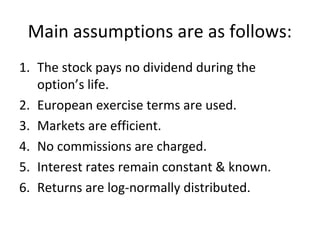
Main assumptions are as follows:
1. The stock pays no dividend during the
   option’s life.
2. European exercise terms are used.
3. Markets are efficient.
4. No commissions are charged.
5. Interest rates remain constant & known.
6. Returns are log-normally distributed.
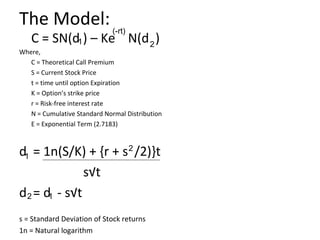
The Model: (-rt)
   C = SN(d1 ) – Ke N(d 2 )
Where,
   C = Theoretical Call Premium
   S = Current Stock Price
   t = time until option Expiration
   K = Option’s strike price
   r = Risk-free interest rate
   N = Cumulative Standard Normal Distribution
   E = Exponential Term (2.7183)


d1 = 1n(S/K) + {r + s 2 /2)}t
               s√t
d 2 = d1 - s√t
s = Standard Deviation of Stock returns
1n = Natural logarithm

Option pricing

  • 1.
    Option Pricing • Thereare 5 determinants of Option pricing or premiums: 1. Cash Price of Asset (S )t 2. Strike Price (K) 3. Volatility of the underlying asset’s price (σ) 4. Time to expiration (T) 5. Interest Rates (r) These factors affect the premium / price of both American & European options in several ways.
  • 2.
    Cash Price ofAsset • Keeping all other factors constant, if cash price of underlying asset goes up value of the call option increases but value of the put option diminishes.
  • 3.
    Effect of StrikePrice • If all other factors remain constant but the strike price of option increases, intrinsic value of the call option will decrease and hence its value will also begin to decrease. • On the other hand, with all other factors remaining constant, increase in strike price will increase the intrinsic value of the put option and it will therefore become dearer.
  • 4.
    Effect of Volatility •Volatility in the price of the underlying asset affects both call & put options in the same way. As higher volatility escalates the chances of an option going in-the-money at any point in time during the life of the contract. It increases the risk to the option seller and consequently makes the option, both call & put, more expensive.
  • 5.
    Effect of timeto Expiration • The effect of time to expiration on both call & put options is similar to that of volatility on option premiums. • The longer the maturity of the option the greater is the uncertainty and hence the prices of both call & put options are higher, keeping all other factors constant. • Therefore, longer maturity options are always more expensive than shorter maturity options.
  • 6.
    Effect of InterestRates • Higher interest rates has the same effect as lowering the strike price, and therefore as seen, higher interest rate will result in an increase in the value of a call option and a decrease in the value of a put option.
  • 7.
    Black-Scholes Model forOptions Pricing • Black-Scholes model for pricing European options published by Fischer Black & Myron Scholes in 1973 is by far the most popular model to price an option. • Black-Scholes model start by specifying a simple & well known equation that the manner in which stock prices fluctuates. • This equation is called Geometric Brownian Motion implies that stock returns will have a lognormal distribution i.e., the logarithm of the stock’s return will follow the normal (bell shaped) distribution.
  • 8.
    Cont… • Black &Scholes then propose that the price of an option is determined by the only two variables that are allowed to change – time and the underlying stock price. • While other factors such as volatility, exercise price and risk free rate do affect the price of the option they are not allowed to change.
  • 9.
    Main assumptions areas follows: 1. The stock pays no dividend during the option’s life. 2. European exercise terms are used. 3. Markets are efficient. 4. No commissions are charged. 5. Interest rates remain constant & known. 6. Returns are log-normally distributed.
  • 10.
    The Model: (-rt) C = SN(d1 ) – Ke N(d 2 ) Where, C = Theoretical Call Premium S = Current Stock Price t = time until option Expiration K = Option’s strike price r = Risk-free interest rate N = Cumulative Standard Normal Distribution E = Exponential Term (2.7183) d1 = 1n(S/K) + {r + s 2 /2)}t s√t d 2 = d1 - s√t s = Standard Deviation of Stock returns 1n = Natural logarithm