Have you heard about heaven 
… TAX HAVEN 
Jaseem Lal.N 
M.Com (A&T) 
Pondicherry University jaseemlal@gmail.com
OVERVIEW 
What is a Tax Haven 
OECD Criteria for a Tax Haven 
Characteristics of a Tax Haven 
Uses of a Tax Haven 
Legal entities in a Tax Haven 
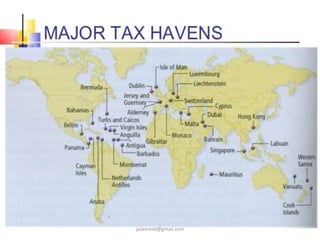
Major Tax Havens around the world 
Types of Tax Havens 
jaseemlal@gmail.com
OVERVIEW (con’t) 
Examples: Types of Tax Havens 
# Cayman Islands 
Effects of Tax Havens 
Four Reasons Of Tax Havens Are Good 
The response of Governments 
OECD objectives 
Is there a future for Tax Havens 
jaseemlal@gmail.com
jaseemlal@gmail.com
WHAT IS A TAX HAVEN 
A tax haven is a state or a country 
or territory where certain taxes are 
levied at a low rate or not at all 
while offering due process, good 
governance and a low corruption 
rate 
-- wikipedia.org 
The term tax haven refers to a jurisdiction that is 
tax advantaged in sjaoseemmlale@gmwail.caomy.
WHAT IS A TAX HAVEN (con’t) 
 "What ... identifies an area as a tax haven is the 
existence of a composite tax structure established 
deliberately to take advantage of, and exploit, a 
worldwide demand for opportunities to engage 
in tax avoidance.“ 
-- The Economist 
 the central feature of a haven is that its laws and 
other measures can be used to evade or avoid the 
tax laws or regulations of other jurisdictions 
jaseemlal@gmail.com
What does OECD mean by a 
tax haven? 
Jurisdictions characterized by: 
No or only nominal taxes 
Lack of transparency 
Lack of effective exchange of information 
No substantial activities 
So a low tax jurisdiction is not necessarily a tax 
haven 
jaseemlal@gmail.com
CHARACTERISTICS OF A TAX HAVEN 
Tax factors 
 Level of taxes 
 Treaty network 
 Tax incentives 
 Stability of tax laws 
Non-tax factors 
 Political and economic stability 
 Availability of professional services 
 Access to capital markets and other sources of finance 
 Exchange control and currency restrictions 
 Initial formation and recurring costs 
jaseemlal@gmail.com
USES OF TAX HAVEN 
Offshore havens guarantee confidentiality of 
business & investment activities 
Minimizing tax liability by having assets and 
business dealings away from home jurisdiction in 
a safe offshore haven 
Offers asset protection against possible litigation 
Inheritance planning can be done more efficiently 
through a tax haven 
The transfer of estate to heirs is cheaper, faster 
and away from public eyes 
jaseemlal@gmail.com
USES OF A TAX HAVEN: AN EXAMPLE 
An MNC may set-up subsidiaries in Tax Havens that Can 
meet the following requirements: 
 A low tax on foreign investment 
 A low tax on sales income earned by resident corporations 
 A low dividend withholding tax on dividends paid to the 
parent firm 
 A stable currency to permit easy conversion of funds into 
and out of the local currency 
 The facilities to support financial services activity 
 A stable government that encourages the establishment 
of foreign-owned financial and services within its borders 
jaseemlal@gmail.com
LEGAL ENTITIES IN A TAX HAVEN 
Offshore International Business Corporation 
Offshore Limited Liability Company 
Offshore Trusts & Foundations 
 Offers asset protection as legal ownership no 
longer vests with settler 
 But settler continuous to enjoy control/ benefits 
 Foundations are legal entities unlike Trusts 
 All types of assets (tangible & intangible) can be 
held including shares in a corporation which in 
turn may undertake commercial activities 
jaseemlal@gmail.com
jaseemlal@gmail.com
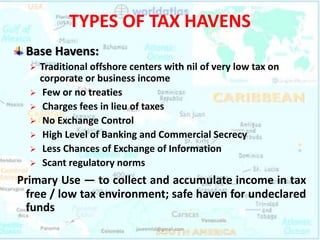
TYPES OF TAX HAVENS 
Base Havens: 
 Traditional offshore centers with nil of very low tax on 
corporate or business income 
 Few or no treaties 
 Charges fees in lieu of taxes 
 No Exchange Control 
 High Level of Banking and Commercial Secrecy 
 Less Chances of Exchange of Information 
 Scant regulatory norms 
Primary Use — to collect and accumulate income in tax 
free / low tax environment; safe haven for undeclared 
funds 
jaseemlal@gmail.com
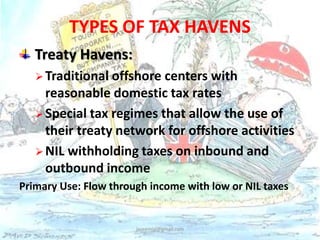
TYPES OF TAX HAVENS 
Treaty Havens: 
Traditional offshore centers with 
reasonable domestic tax rates 
Special tax regimes that allow the use of 
their treaty network for offshore activities 
NIL withholding taxes on inbound and 
outbound income 
Primary Use: Flow through income with low or NIL taxes 
jaseemlal@gmail.com
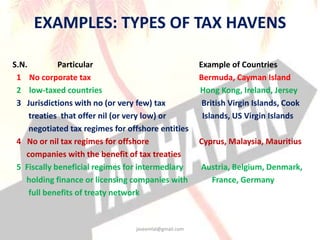
EXAMPLES: TYPES OF TAX HAVENS 
S.N. Particular Example of Countries 
1 No corporate tax Bermuda, Cayman Island 
2 low-taxed countries Hong Kong, Ireland, Jersey 
3 Jurisdictions with no (or very few) tax British Virgin Islands, Cook 
treaties that offer nil (or very low) or Islands, US Virgin Islands 
negotiated tax regimes for offshore entities 
4 No or nil tax regimes for offshore Cyprus, Malaysia, Mauritius 
companies with the benefit of tax treaties 
5 Fiscally beneficial regimes for intermediary Austria, Belgium, Denmark, 
holding finance or licensing companies with France, Germany 
full benefits of treaty network 
jaseemlal@gmail.com
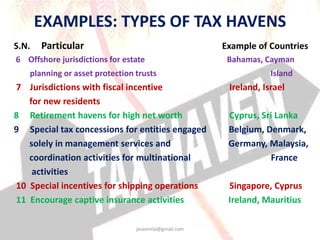
EXAMPLES: TYPES OF TAX HAVENS 
S.N. Particular Example of Countries 
6 Offshore jurisdictions for estate Bahamas, Cayman 
planning or asset protection trusts Island 
7 Jurisdictions with fiscal incentive Ireland, Israel 
for new residents 
8 Retirement havens for high net worth Cyprus, Sri Lanka 
9 Special tax concessions for entities engaged Belgium, Denmark, 
solely in management services and Germany, Malaysia, 
coordination activities for multinational France 
activities 
10 Special incentives for shipping operations Singapore, Cyprus 
11 Encourage captive insurance activities Ireland, Mauritius 
jaseemlal@gmail.com
The Cayman Islands 
jaseemlal@gmail.com
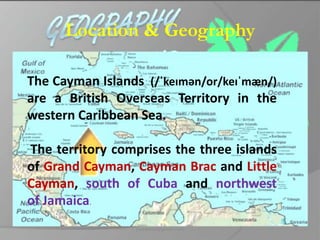
Location & Geography 
The Cayman Islands (/ˈkeɪmən/or/keɪˈmæn/) 
are a British Overseas Territory in the 
western Caribbean Sea. 
The territory comprises the three islands 
of Grand Cayman, Cayman Brac and Little 
Cayman, south of Cuba and northwest 
of Jamaica. 
jaseemlal@gmail.com
The Cayman Islands 
Located about 240 Kilometers South of Cuba 
Total land area: 262 square Kilometers 
About 1.5 times the size of Washington D.C. 
Overseas territory of Great Britain 
Capital is George Town on Grand Cayman 
British Common Law system 
Chief of State: Queen Elizabeth II 
No political parties or pressure groups 
jaseemlal@gmail.com
. 
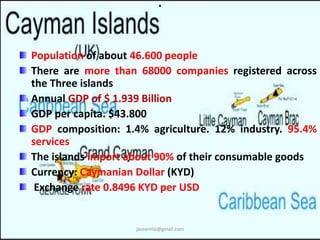
Population of about 46.600 people 
There are more than 68000 companies registered across 
the Three islands 
Annual GDP of $ 1.939 Billion 
GDP per capita. $43.800 
GDP composition: 1.4% agriculture. 12% industry. 95.4% 
services 
The islands import about 90% of their consumable goods 
Currency: Caymanian Dollar (KYD) 
Exchange rate 0.8496 KYD per USD 
jaseemlal@gmail.com
jaseemlal@gmail.com
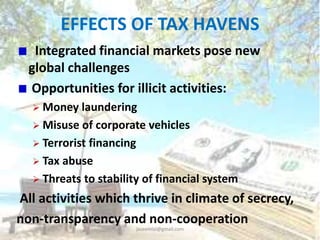
EFFECTS OF TAX HAVENS 
Integrated financial markets pose new 
global challenges 
Opportunities for illicit activities: 
 Money laundering 
 Misuse of corporate vehicles 
 Terrorist financing 
 Tax abuse 
 Threats to stability of financial system 
All activities which thrive in climate of secrecy, 
non-transparency and non-cooperation 
jaseemlal@gmail.com
EFFECTS OF TAX HAVENS 
Treaty shopping: Routing of income arising in one country 
to a person in another country through an intermediary 
country to obtain the tax advantage of tax treaties 
Round Tripping: Flow back of money into the country 
sent out through hawala 
Escaping the regulatory regime of home country 
Revenue implications of the illegitimate use of tax havens 
can be serious; it is estimated that developing countries 
loose as much as US $50 billion per year in tax revenue 
MNCs can defer their taxes indefinitely using transfer 
pricing 
jaseemlal@gmail.com
Four Reasons Of Tax Haven Are Good For 
Global Economy 
1. The tax havens promote Good Tax Policy so the 
other country should also reduce the tax 
2. Tax Havens Boost Living Standards 
3. Tax Haven improve the Quality of Government 
4. Tax Havens increase Prosperity in High-Tax 
Nations 
 Citizen from High Tax nations move their money to 
Neighbor tax heaven and then use the heaven as 
platform and to invest back in their own country. 
jaseemlal@gmail.com
RESPONSE OF GOVERNMENTS TO 
TAX HAVENS 
Launching the FATF 
Creating the FSF 
Creating the OECD Forum on Harmful Tax 
Practices 
Parallel tracks but common goals: 
 To improve transparency 
 To raise governance standards in financial 
centers 
 To encourage cooperation to counter abuse 
jaseemlal@gmail.com
OECD's OBJECTIVES REGARDING 
TAX HAVENS 
What does the OECD seek? 
 improved transparency 
 improved exchange of information 
 a co-operative approach 
What is not sought? 
 harmonization or setting minimum tax rates 
 impinging on national fiscal sovereignty 
 an unfair competitive advantage for OECD financial 
centers 
jaseemlal@gmail.com
IS THERE A FUTURE FOR TAX HAVENS? 
AS CONCEALMENT CENTRES? 
AS SERVICE CENTRES OFFERING REAL 
ECONOMIC BENEFITS? 
jaseemlal@gmail.com
jaseemlal@gmail.com 
For more Information 
jaseemlal@gmail.com 
jaseemlal@yahoo.com 
Mob No: +91 9846622459 
: +91 8508186770

Tax Havens , Major Tax Havens around the world.

  • 1.
    Have you heardabout heaven … TAX HAVEN Jaseem Lal.N M.Com (A&T) Pondicherry University jaseemlal@gmail.com
  • 2.
    OVERVIEW What isa Tax Haven OECD Criteria for a Tax Haven Characteristics of a Tax Haven Uses of a Tax Haven Legal entities in a Tax Haven Major Tax Havens around the world Types of Tax Havens jaseemlal@gmail.com
  • 3.
    OVERVIEW (con’t) Examples:Types of Tax Havens # Cayman Islands Effects of Tax Havens Four Reasons Of Tax Havens Are Good The response of Governments OECD objectives Is there a future for Tax Havens jaseemlal@gmail.com
  • 4.
  • 5.
    WHAT IS ATAX HAVEN A tax haven is a state or a country or territory where certain taxes are levied at a low rate or not at all while offering due process, good governance and a low corruption rate -- wikipedia.org The term tax haven refers to a jurisdiction that is tax advantaged in sjaoseemmlale@gmwail.caomy.
  • 6.
    WHAT IS ATAX HAVEN (con’t)  "What ... identifies an area as a tax haven is the existence of a composite tax structure established deliberately to take advantage of, and exploit, a worldwide demand for opportunities to engage in tax avoidance.“ -- The Economist  the central feature of a haven is that its laws and other measures can be used to evade or avoid the tax laws or regulations of other jurisdictions jaseemlal@gmail.com
  • 7.
    What does OECDmean by a tax haven? Jurisdictions characterized by: No or only nominal taxes Lack of transparency Lack of effective exchange of information No substantial activities So a low tax jurisdiction is not necessarily a tax haven jaseemlal@gmail.com
  • 8.
    CHARACTERISTICS OF ATAX HAVEN Tax factors  Level of taxes  Treaty network  Tax incentives  Stability of tax laws Non-tax factors  Political and economic stability  Availability of professional services  Access to capital markets and other sources of finance  Exchange control and currency restrictions  Initial formation and recurring costs jaseemlal@gmail.com
  • 9.
    USES OF TAXHAVEN Offshore havens guarantee confidentiality of business & investment activities Minimizing tax liability by having assets and business dealings away from home jurisdiction in a safe offshore haven Offers asset protection against possible litigation Inheritance planning can be done more efficiently through a tax haven The transfer of estate to heirs is cheaper, faster and away from public eyes jaseemlal@gmail.com
  • 10.
    USES OF ATAX HAVEN: AN EXAMPLE An MNC may set-up subsidiaries in Tax Havens that Can meet the following requirements:  A low tax on foreign investment  A low tax on sales income earned by resident corporations  A low dividend withholding tax on dividends paid to the parent firm  A stable currency to permit easy conversion of funds into and out of the local currency  The facilities to support financial services activity  A stable government that encourages the establishment of foreign-owned financial and services within its borders jaseemlal@gmail.com
  • 11.
    LEGAL ENTITIES INA TAX HAVEN Offshore International Business Corporation Offshore Limited Liability Company Offshore Trusts & Foundations  Offers asset protection as legal ownership no longer vests with settler  But settler continuous to enjoy control/ benefits  Foundations are legal entities unlike Trusts  All types of assets (tangible & intangible) can be held including shares in a corporation which in turn may undertake commercial activities jaseemlal@gmail.com
  • 12.
  • 13.
    TYPES OF TAXHAVENS Base Havens:  Traditional offshore centers with nil of very low tax on corporate or business income  Few or no treaties  Charges fees in lieu of taxes  No Exchange Control  High Level of Banking and Commercial Secrecy  Less Chances of Exchange of Information  Scant regulatory norms Primary Use — to collect and accumulate income in tax free / low tax environment; safe haven for undeclared funds jaseemlal@gmail.com
  • 14.
    TYPES OF TAXHAVENS Treaty Havens: Traditional offshore centers with reasonable domestic tax rates Special tax regimes that allow the use of their treaty network for offshore activities NIL withholding taxes on inbound and outbound income Primary Use: Flow through income with low or NIL taxes jaseemlal@gmail.com
  • 15.
    EXAMPLES: TYPES OFTAX HAVENS S.N. Particular Example of Countries 1 No corporate tax Bermuda, Cayman Island 2 low-taxed countries Hong Kong, Ireland, Jersey 3 Jurisdictions with no (or very few) tax British Virgin Islands, Cook treaties that offer nil (or very low) or Islands, US Virgin Islands negotiated tax regimes for offshore entities 4 No or nil tax regimes for offshore Cyprus, Malaysia, Mauritius companies with the benefit of tax treaties 5 Fiscally beneficial regimes for intermediary Austria, Belgium, Denmark, holding finance or licensing companies with France, Germany full benefits of treaty network jaseemlal@gmail.com
  • 16.
    EXAMPLES: TYPES OFTAX HAVENS S.N. Particular Example of Countries 6 Offshore jurisdictions for estate Bahamas, Cayman planning or asset protection trusts Island 7 Jurisdictions with fiscal incentive Ireland, Israel for new residents 8 Retirement havens for high net worth Cyprus, Sri Lanka 9 Special tax concessions for entities engaged Belgium, Denmark, solely in management services and Germany, Malaysia, coordination activities for multinational France activities 10 Special incentives for shipping operations Singapore, Cyprus 11 Encourage captive insurance activities Ireland, Mauritius jaseemlal@gmail.com
  • 17.
    The Cayman Islands jaseemlal@gmail.com
  • 18.
    Location & Geography The Cayman Islands (/ˈkeɪmən/or/keɪˈmæn/) are a British Overseas Territory in the western Caribbean Sea. The territory comprises the three islands of Grand Cayman, Cayman Brac and Little Cayman, south of Cuba and northwest of Jamaica. jaseemlal@gmail.com
  • 19.
    The Cayman Islands Located about 240 Kilometers South of Cuba Total land area: 262 square Kilometers About 1.5 times the size of Washington D.C. Overseas territory of Great Britain Capital is George Town on Grand Cayman British Common Law system Chief of State: Queen Elizabeth II No political parties or pressure groups jaseemlal@gmail.com
  • 20.
    . Population ofabout 46.600 people There are more than 68000 companies registered across the Three islands Annual GDP of $ 1.939 Billion GDP per capita. $43.800 GDP composition: 1.4% agriculture. 12% industry. 95.4% services The islands import about 90% of their consumable goods Currency: Caymanian Dollar (KYD) Exchange rate 0.8496 KYD per USD jaseemlal@gmail.com
  • 21.
  • 22.
    EFFECTS OF TAXHAVENS Integrated financial markets pose new global challenges Opportunities for illicit activities:  Money laundering  Misuse of corporate vehicles  Terrorist financing  Tax abuse  Threats to stability of financial system All activities which thrive in climate of secrecy, non-transparency and non-cooperation jaseemlal@gmail.com
  • 23.
    EFFECTS OF TAXHAVENS Treaty shopping: Routing of income arising in one country to a person in another country through an intermediary country to obtain the tax advantage of tax treaties Round Tripping: Flow back of money into the country sent out through hawala Escaping the regulatory regime of home country Revenue implications of the illegitimate use of tax havens can be serious; it is estimated that developing countries loose as much as US $50 billion per year in tax revenue MNCs can defer their taxes indefinitely using transfer pricing jaseemlal@gmail.com
  • 24.
    Four Reasons OfTax Haven Are Good For Global Economy 1. The tax havens promote Good Tax Policy so the other country should also reduce the tax 2. Tax Havens Boost Living Standards 3. Tax Haven improve the Quality of Government 4. Tax Havens increase Prosperity in High-Tax Nations  Citizen from High Tax nations move their money to Neighbor tax heaven and then use the heaven as platform and to invest back in their own country. jaseemlal@gmail.com
  • 25.
    RESPONSE OF GOVERNMENTSTO TAX HAVENS Launching the FATF Creating the FSF Creating the OECD Forum on Harmful Tax Practices Parallel tracks but common goals:  To improve transparency  To raise governance standards in financial centers  To encourage cooperation to counter abuse jaseemlal@gmail.com
  • 26.
    OECD's OBJECTIVES REGARDING TAX HAVENS What does the OECD seek?  improved transparency  improved exchange of information  a co-operative approach What is not sought?  harmonization or setting minimum tax rates  impinging on national fiscal sovereignty  an unfair competitive advantage for OECD financial centers jaseemlal@gmail.com
  • 27.
    IS THERE AFUTURE FOR TAX HAVENS? AS CONCEALMENT CENTRES? AS SERVICE CENTRES OFFERING REAL ECONOMIC BENEFITS? jaseemlal@gmail.com
  • 28.
    jaseemlal@gmail.com For moreInformation jaseemlal@gmail.com jaseemlal@yahoo.com Mob No: +91 9846622459 : +91 8508186770