Derivatives
A financial contract of pre-determined
duration, whose value is derived from
the value of an underlying asset
Securities
 commodities
 bullion
 precious metals
 currency
 livestock
 index such as interest rates, exchange
rates
What do derivatives do?
Derivatives attempt either to minimize
the loss arising from adverse price
movements of the underlying asset
Or maximize the profits arising out of
favorable price fluctuation. Since
derivatives derive their value from the
underlying asset they are called as
derivatives.
Types of Derivatives
(UA: Underlying Asset)
Based on the underlying assets
derivatives are classified into.
Financial Derivatives (UA: Fin asset)
Commodity Derivatives (UA: gold etc)
Index Derivative (BSE sensex)
How are derivatives used?
Derivatives are basically risk shifting
instruments. Hedging is the most
important aspect of derivatives and also
their basic economic purpose
Derivatives can be compared to an
insurance policy. As one pays premium in
advance to an insurance company in
protection against a specific event, the
derivative products have a payoff
contingent upon the occurrence of some
event for which he pays premium in
advance.
What is Risk?
The concept of risk is simple. It is
the potential for change in the price
or value of some asset or
commodity. The meaning of risk is
not restricted just to the potential for
loss. There is upside risk and there is
downside risk as well.
What is a Hedge
To Be cautious or to protect against loss.
In financial parlance, hedging is the act
of reducing uncertainty about future price
movements in a commodity, financial
security or foreign currency .
Thus a hedge is a way of insuring an
investment against risk.
Derivative Instruments.
Forward contracts
Futures
– Commodity
– Financial (Stock index, interest rate &
currency )
Options
– Put
– Call
Swaps.
– Interest Rate
– Currency
Forward Contracts.
A one to one bipartite contract, which is to be
performed in future at the terms decided today.
Eg: Jay and Viru enter into a contract to trade
in one stock on Infosys 3 months from today
the date of the contract @ a price of Rs4675/-
Note: Product ,Price ,Quantity & Time have
been determined in advance by both the
parties.
Delivery and payments will take place as per
the terms of this contract on the designated
date and place. This is a simple example of
forward contract.
Risks in a forward contract
Liquidity risk: these contracts a
biparty and not traded on the
exchange.
Default risk/credit risk/counter party
risk.
Say Jay owned one share of Infosys
and the price went up to 4750/-
three months hence, he profits by
defaulting the contract and selling
the stock at the market.
Futures.
Future contracts are organized/standardized
contracts in terms of quantity, quality, delivery
time and place for settlement on any date in
future. These contracts are traded on
exchanges.
These markets are very liquid
In these markets, clearing corporation/house
becomes the counter-party to all the trades or
provides the unconditional guarantee for the
settlement of trades i.e. assumes the financial
integrity of the whole system. In other words,
we may say that the credit risk of the
transactions is eliminated by the exchange
through the clearing corporation/house.
The key elements of a futures contract
are:
– Futures price
– Settlement or Delivery Date
– Underlying (infosys stock)
Illustration.
Let us once again take the earlier
example where Jay and Viru entered
into a contract to buy and sell Infosys
shares. Now, assume that this contract
is taking place through the exchange,
traded on the exchange and clearing
corporation/house is the counter-party
to this, it would be called a futures
contract.
Positions in a futures contract
Long - this is when a person buys a
futures contract, and agrees to
receive delivery at a future date. Eg:
Viru’s position
Short - this is when a person sells a
futures contract, and agrees to make
delivery. Eg: Jay’s Position
How does one make money in a
futures contract?
The long makes money when the
underlying assets price rises above
the futures price.
The short makes money when the
underlying asset’s price falls below
the futures price.
Concept of initial margin
Degree of Leverage = 1/margin rate.
Options
An option is a contract giving the
buyer the right, but not the
obligation, to buy or sell an
underlying asset at a specific price
on or before a certain date. An option
is a security, just like a stock or bond,
and is a binding contract with strictly
defined terms and properties.
Options Lingo
Underlying: This is the specific
security / asset on which an options
contract is based.
Option Premium: Premium is the
price paid by the buyer to the seller
to acquire the right to buy or sell. It
is the total cost of an option. It is the
difference between the higher price
paid for a security and the security's
face amount at issue. The premium
of an option is basically the sum of
the option's intrinsic and time value.
Strike Price or Exercise Price :price of
an option is the specified/ pre-
determined price of the underlying asset
at which the same can be bought or sold
if the option buyer exercises his right to
buy/ sell on or before the expiration day.
Expiration date: The date on which the
option expires is known as Expiration
Date
Exercise: An action by an option holder
taking advantage of a favourable market
situation .’Trade in’ the option for stock.
Exercise Date: is the date on which the
option is actually exercised.
European style of options: The
European kind of option is the one which
can be exercised by the buyer on the
expiration day only & not anytime before
that.
American style of options: An
American style option is the one which
can be exercised by the buyer on or
before the expiration date, i.e. anytime
between the day of purchase of the
option and the day of its expiry.
Asian style of options: these are in-between
European and American. An Asian option's
payoff depends on the average price of the
underlying asset over a certain period of time.
Option Holder
Option seller/ writer
Call option: An option contract giving the
owner the right to buy a specified amount of
an underlying security at a specified price
within a specified time.
Put Option: An option contract giving the
owner the right to sell a specified amount of an
underlying security at a specified price within a
specified time
In-the-money: For a call option, in-
the-money is when the option's strike
price is below the market price of the
underlying stock. For a put option, in
the money is when the strike price is
above the market price of the
underlying stock. In other words, this is
when the stock option is worth money
and can be turned around and exercised
for a profit.
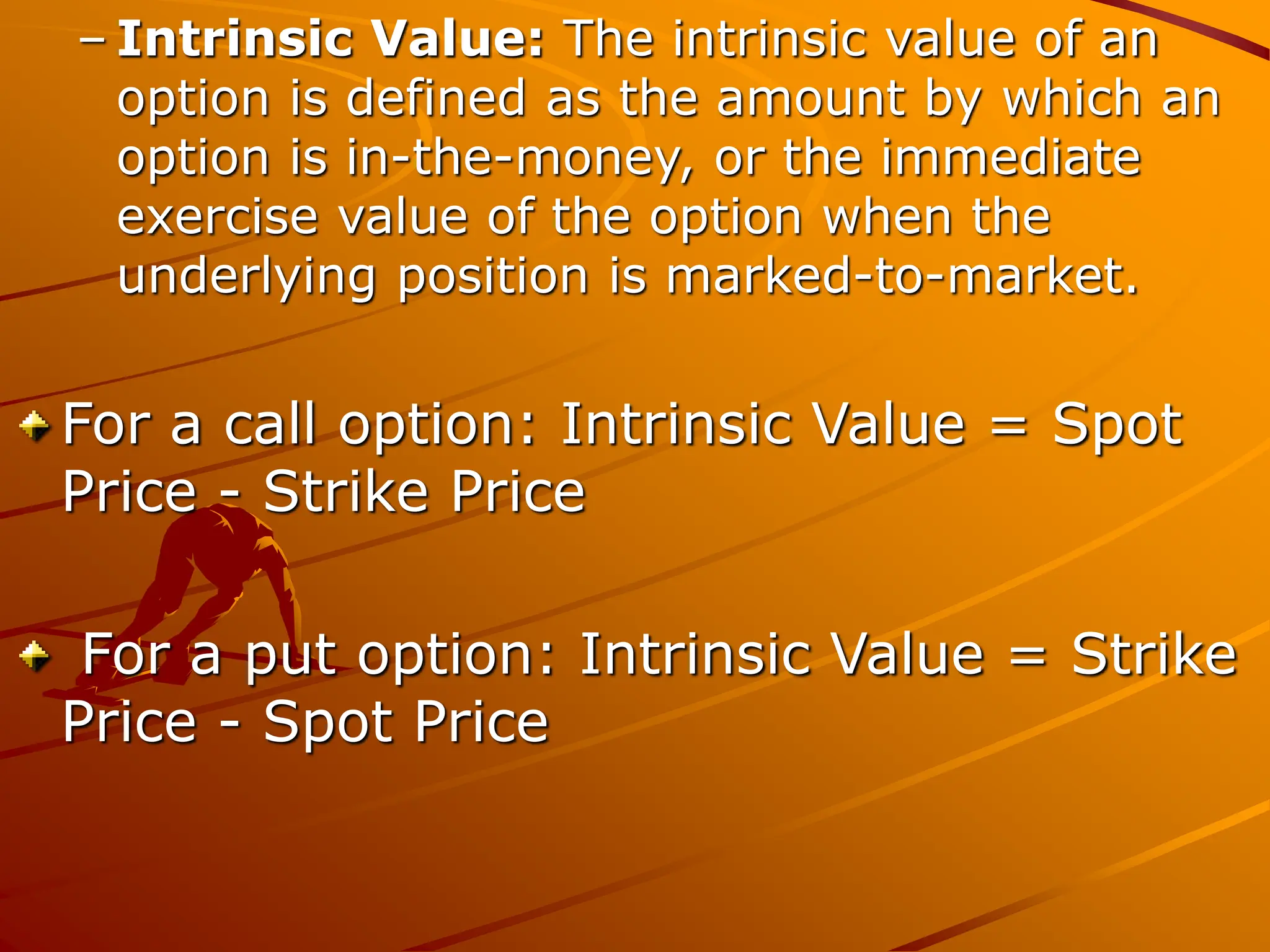
– Intrinsic Value: The intrinsic value of an
option is defined as the amount by which an
option is in-the-money, or the immediate
exercise value of the option when the
underlying position is marked-to-market.
For a call option: Intrinsic Value = Spot
Price - Strike Price
For a put option: Intrinsic Value = Strike
Price - Spot Price
Example of an Option
Elvis and crocodiles.
Positions
Long Position: The term used when a
person owns a security or commodity
and wants to sell. If a person is long in
a security then he wants it to go up in
price.
Short position: The term used to
describe the selling of a security,
commodity, or currency. The investor's
sales exceed holdings because they
believe the price will fall.
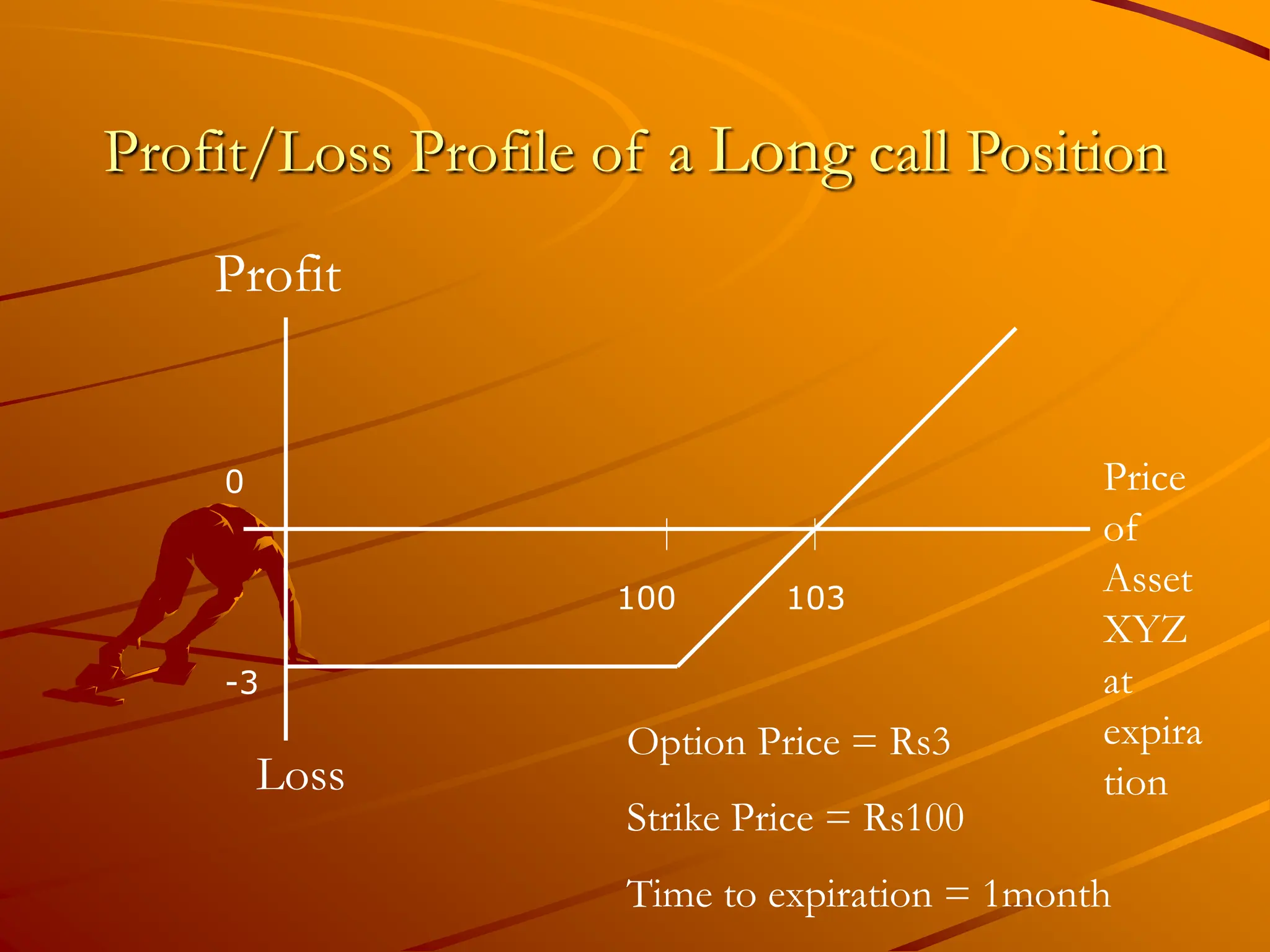
Profit/Loss Profile of a Long call Position
0
-3
100 103
Profit
Loss
Price
of
Asset
XYZ
at
expira
tion
Option Price = Rs3
Strike Price = Rs100
Time to expiration = 1month
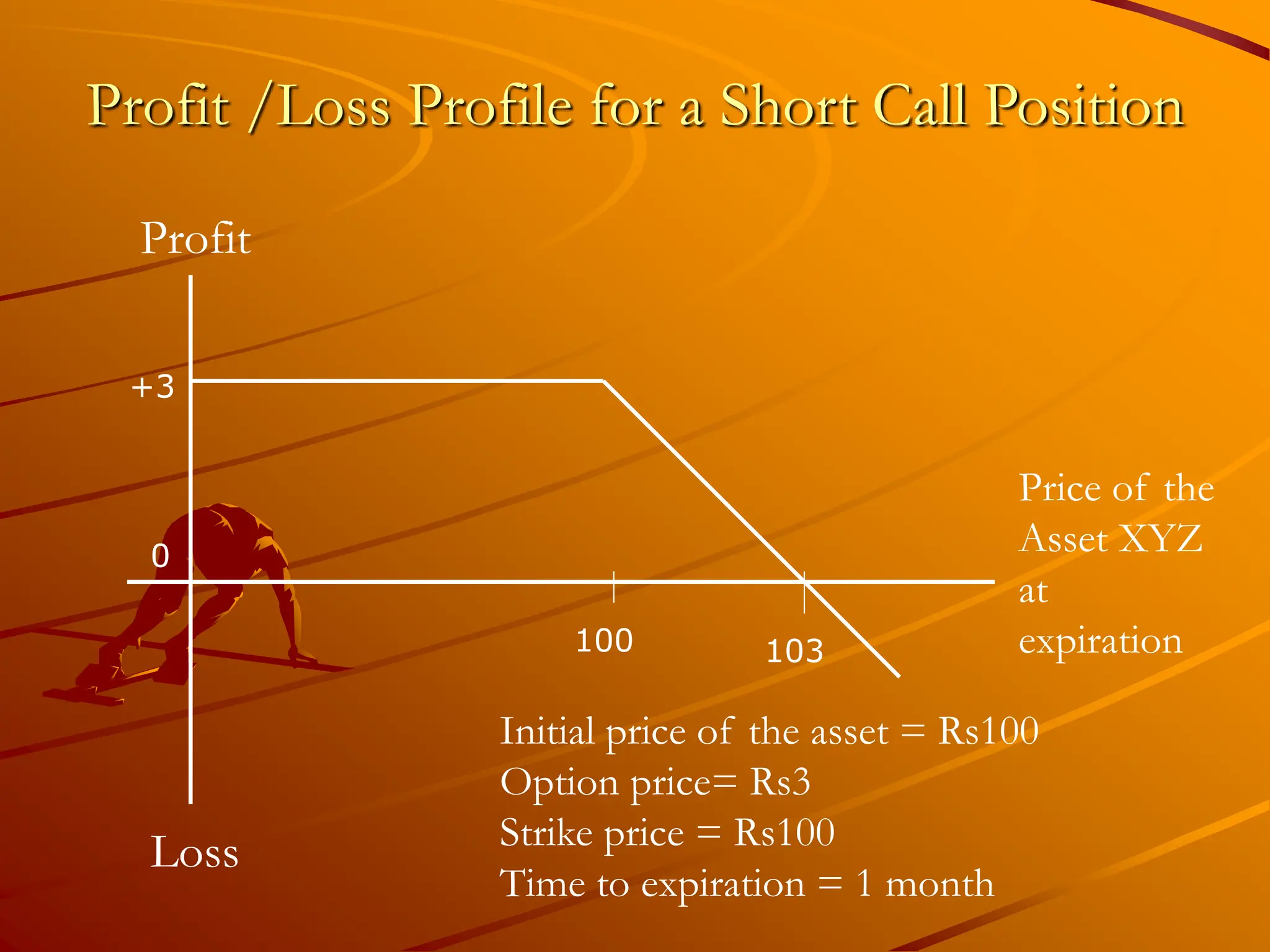
Profit /Loss Profile for a Short Call Position
100 103
0
Profit
Loss
Price of the
Asset XYZ
at
expiration
+3
Initial price of the asset = Rs100
Option price= Rs3
Strike price = Rs100
Time to expiration = 1 month
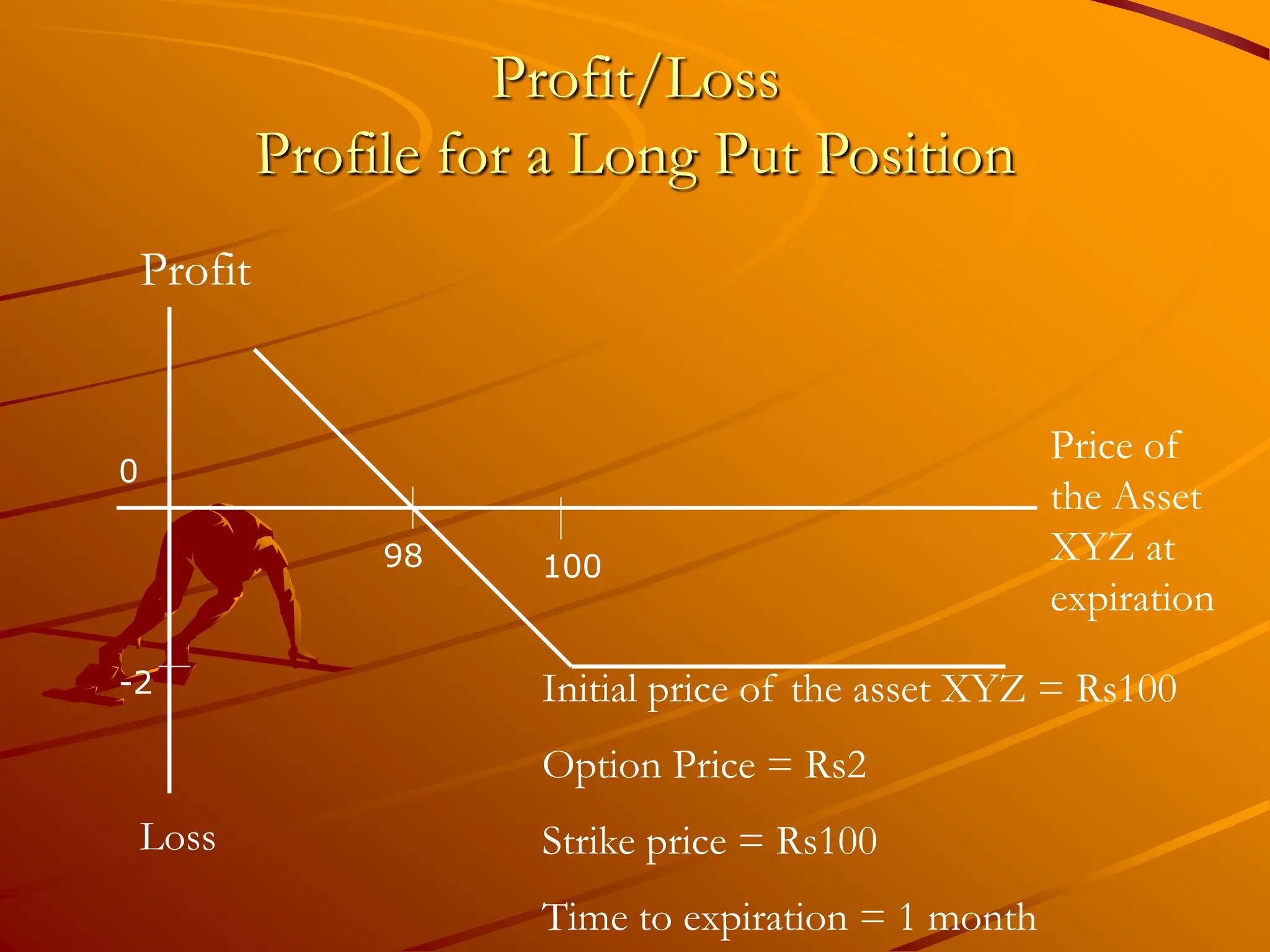
Profit/Loss
Profile for a Long Put Position
0
-2
98 100
Price of
the Asset
XYZ at
expiration
Profit
Loss
Initial price of the asset XYZ = Rs100
Option Price = Rs2
Strike price = Rs100
Time to expiration = 1 month
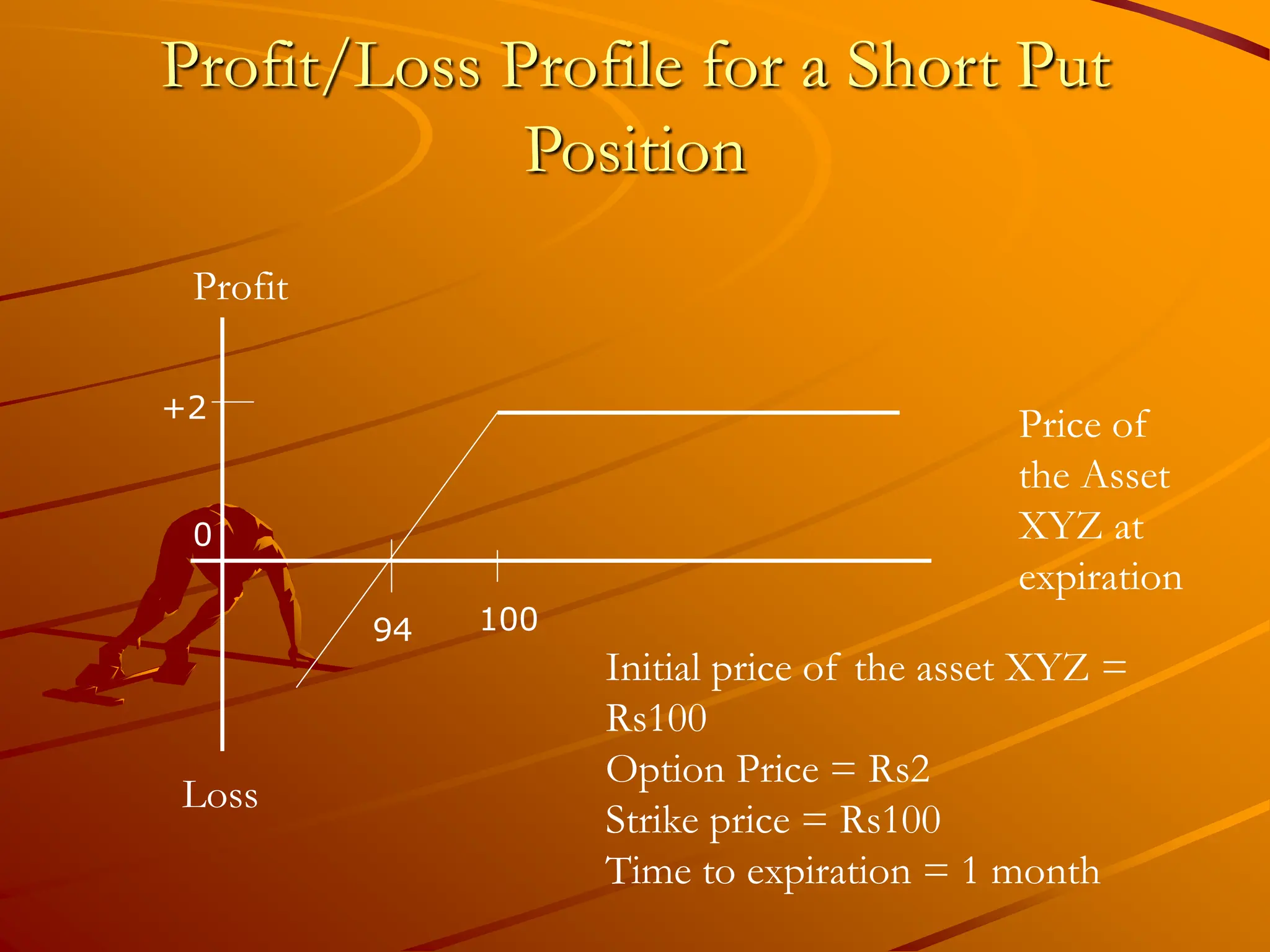
Profit/Loss Profile for a Short Put
Position
0
+2
94 100
Price of
the Asset
XYZ at
expiration
Profit
Loss
Initial price of the asset XYZ =
Rs100
Option Price = Rs2
Strike price = Rs100
Time to expiration = 1 month
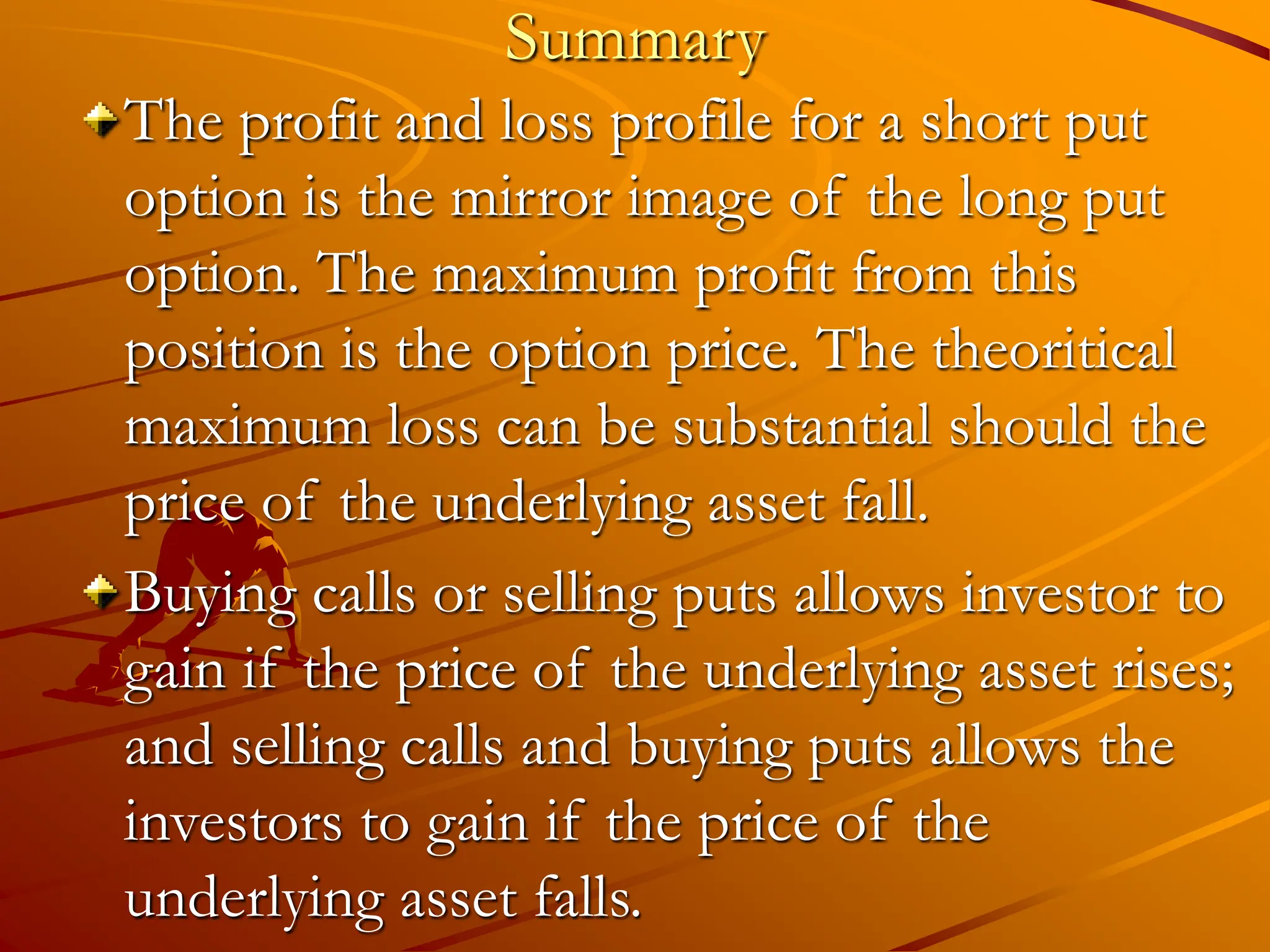
Summary
The profit and loss profile for a short put
option is the mirror image of the long put
option. The maximum profit from this
position is the option price. The theoritical
maximum loss can be substantial should the
price of the underlying asset fall.
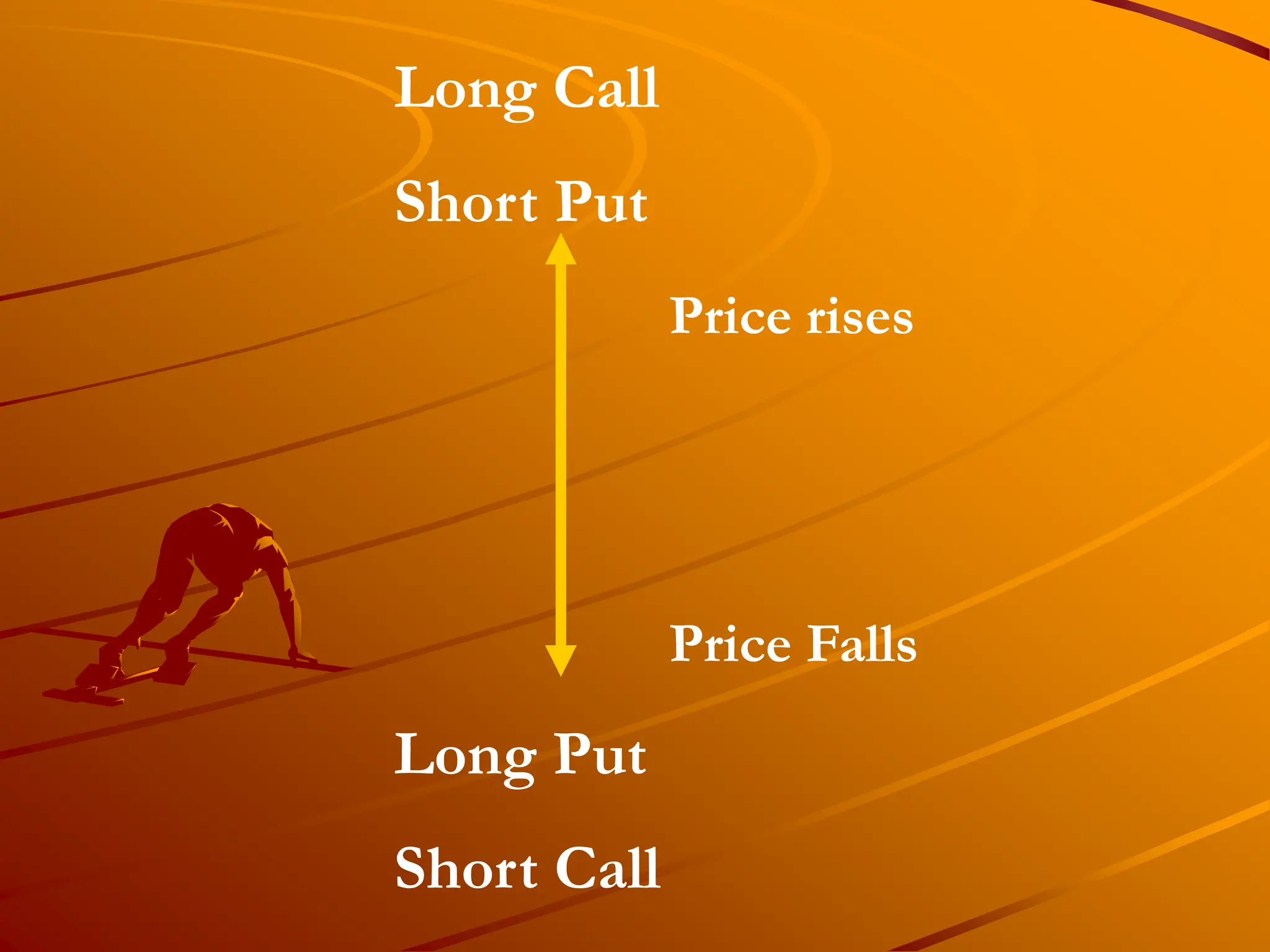
Buying calls or selling puts allows investor to
gain if the price of the underlying asset rises;
and selling calls and buying puts allows the
investors to gain if the price of the
underlying asset falls.
Long Call
Short Put
Long Put
Short Call
Price rises
Price Falls
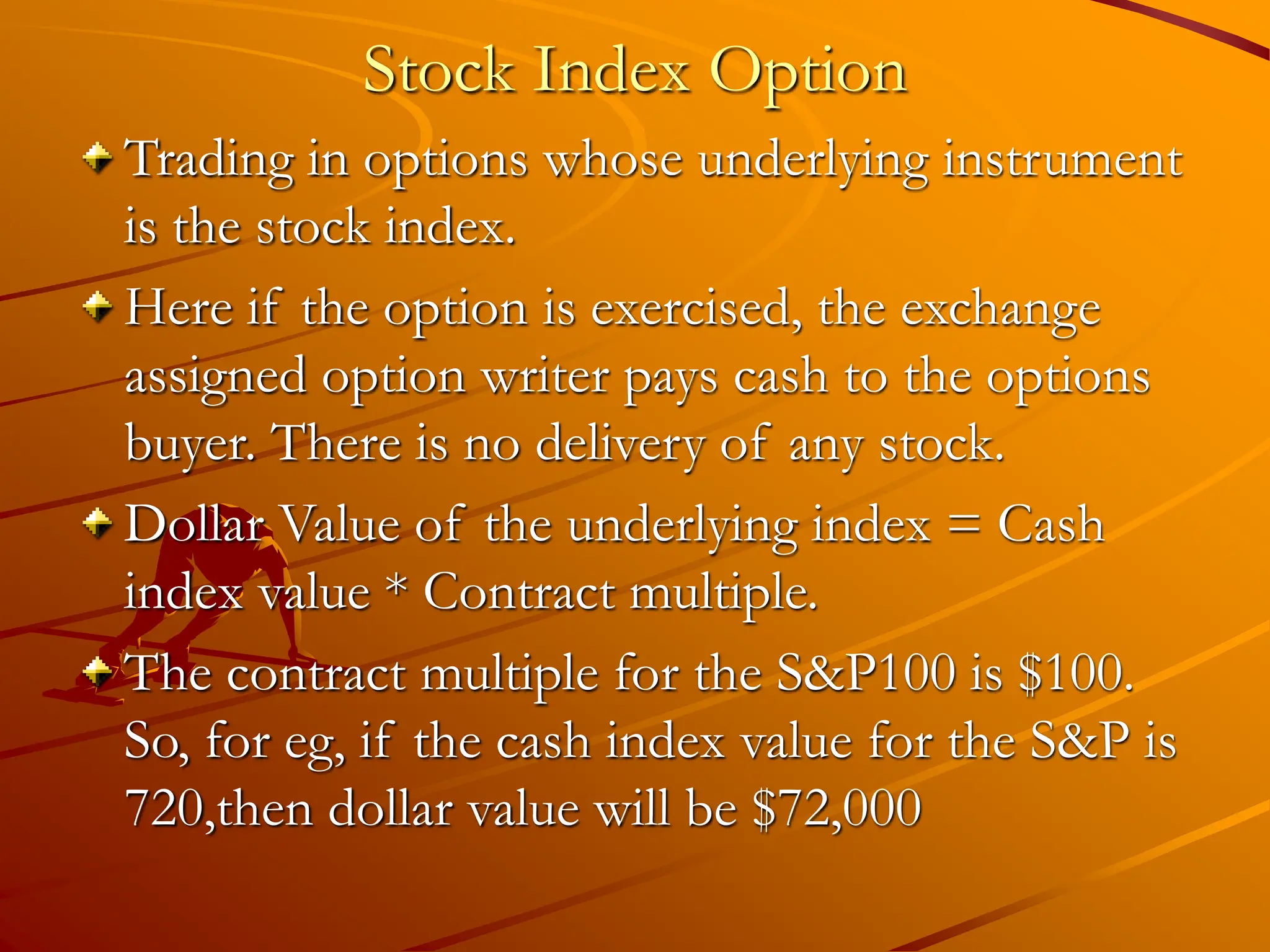
Stock Index Option
Trading in options whose underlying instrument
is the stock index.
Here if the option is exercised, the exchange
assigned option writer pays cash to the options
buyer. There is no delivery of any stock.
Dollar Value of the underlying index = Cash
index value * Contract multiple.
The contract multiple for the S&P100 is $100.
So, for eg, if the cash index value for the S&P is
720,then dollar value will be $72,000
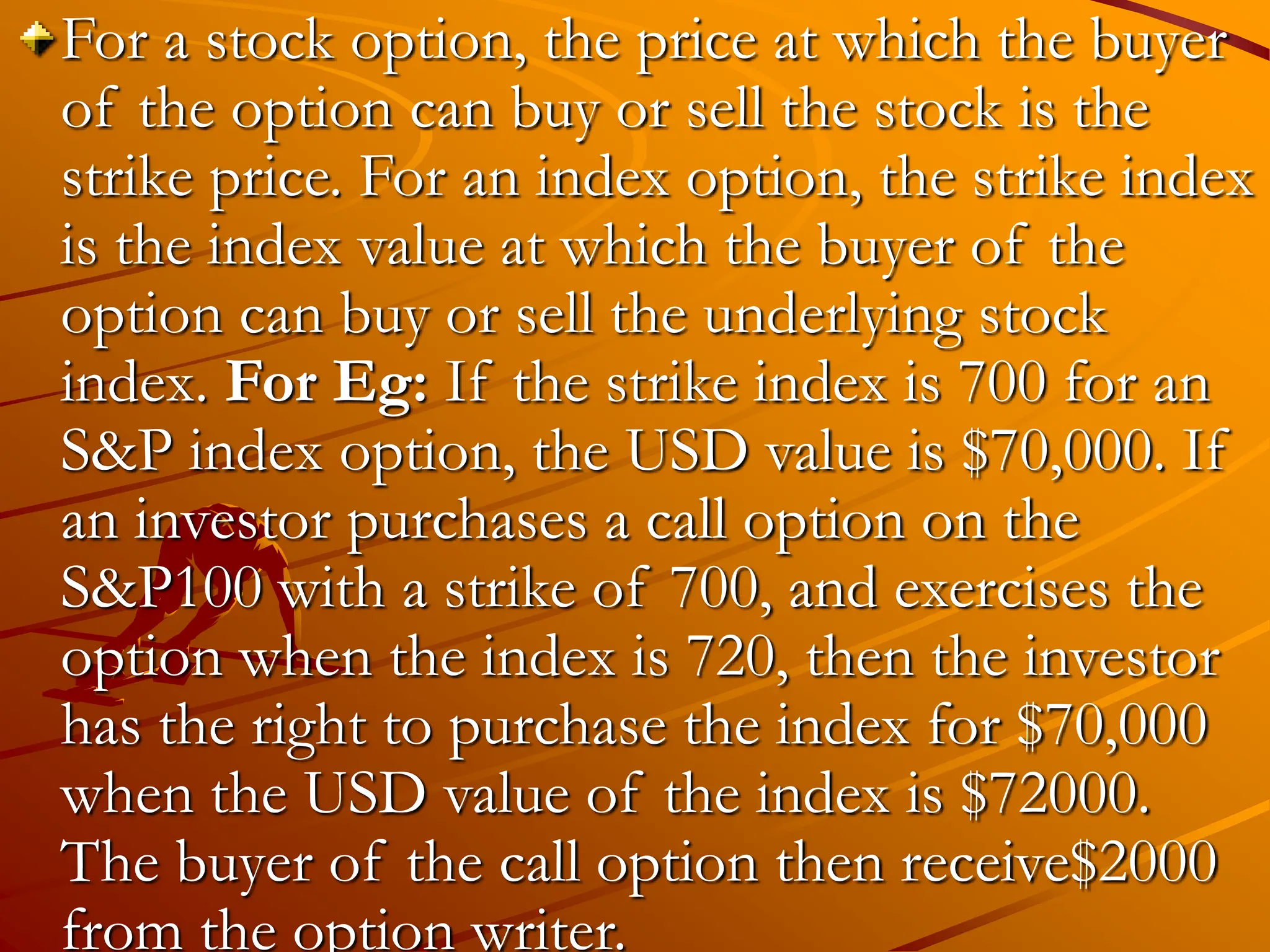
For a stock option, the price at which the buyer
of the option can buy or sell the stock is the
strike price. For an index option, the strike index
is the index value at which the buyer of the
option can buy or sell the underlying stock
index. For Eg: If the strike index is 700 for an
S&P index option, the USD value is $70,000. If
an investor purchases a call option on the
S&P100 with a strike of 700, and exercises the
option when the index is 720, then the investor
has the right to purchase the index for $70,000
when the USD value of the index is $72000.
The buyer of the call option then receive$2000
from the option writer.
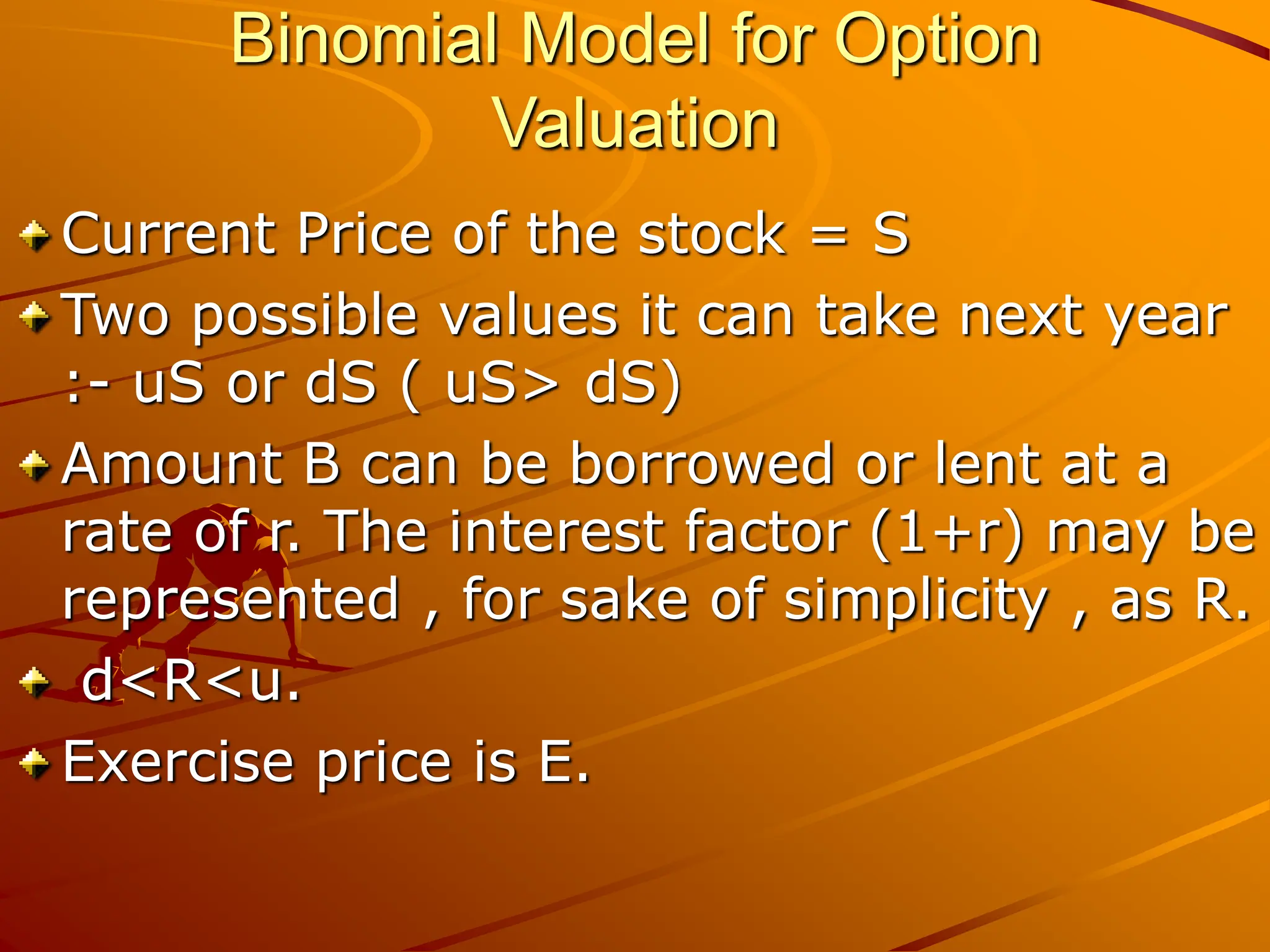
Binomial Model for Option
Valuation
Current Price of the stock = S
Two possible values it can take next year
:- uS or dS ( uS> dS)
Amount B can be borrowed or lent at a
rate of r. The interest factor (1+r) may be
represented , for sake of simplicity , as R.
d<R<u.
Exercise price is E.
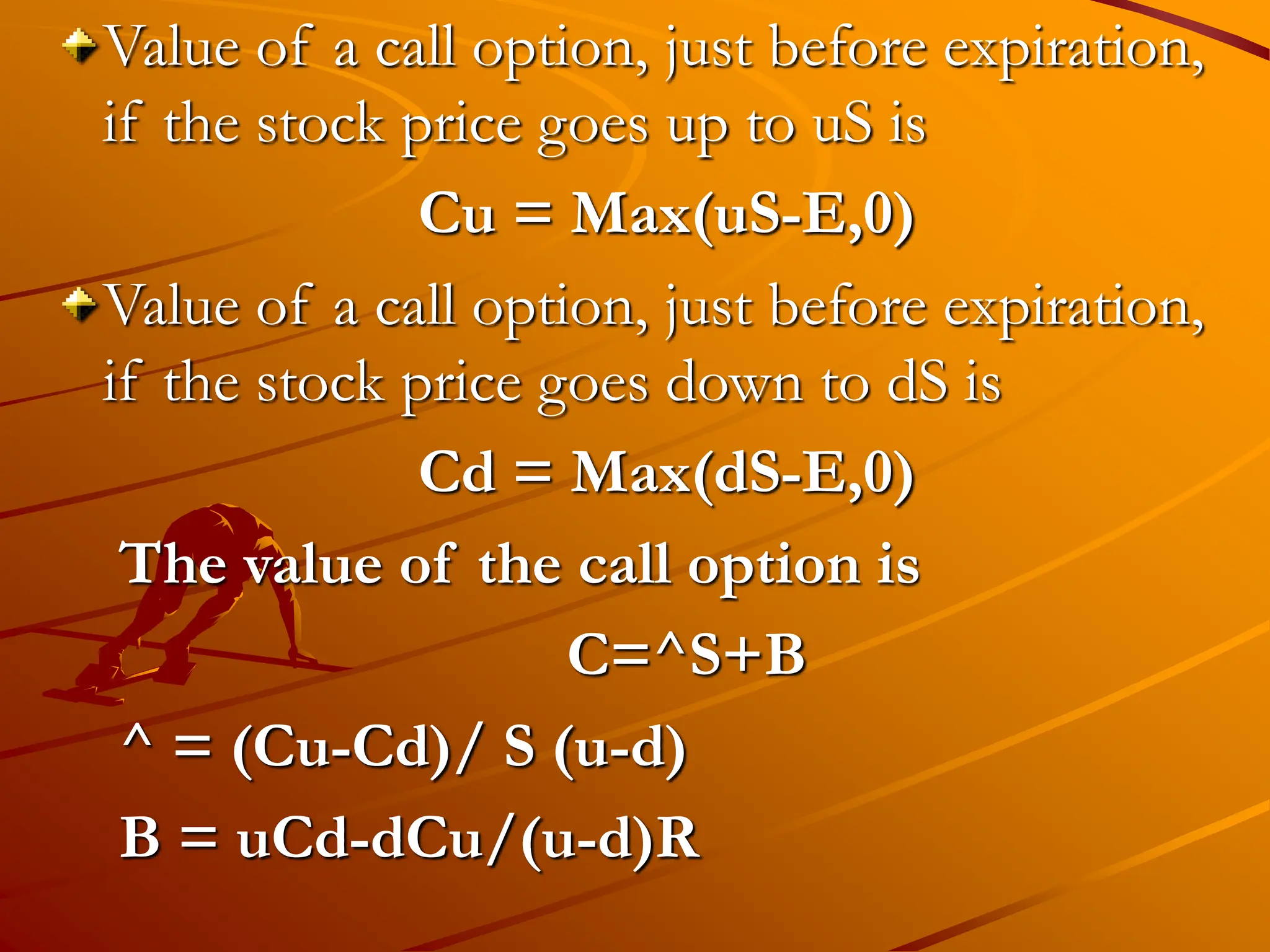
Value of a call option, just before expiration,
if the stock price goes up to uS is
Cu = Max(uS-E,0)
Value of a call option, just before expiration,
if the stock price goes down to dS is
Cd = Max(dS-E,0)
The value of the call option is
C=^S+B
^ = (Cu-Cd)/ S (u-d)
B = uCd-dCu/(u-d)R
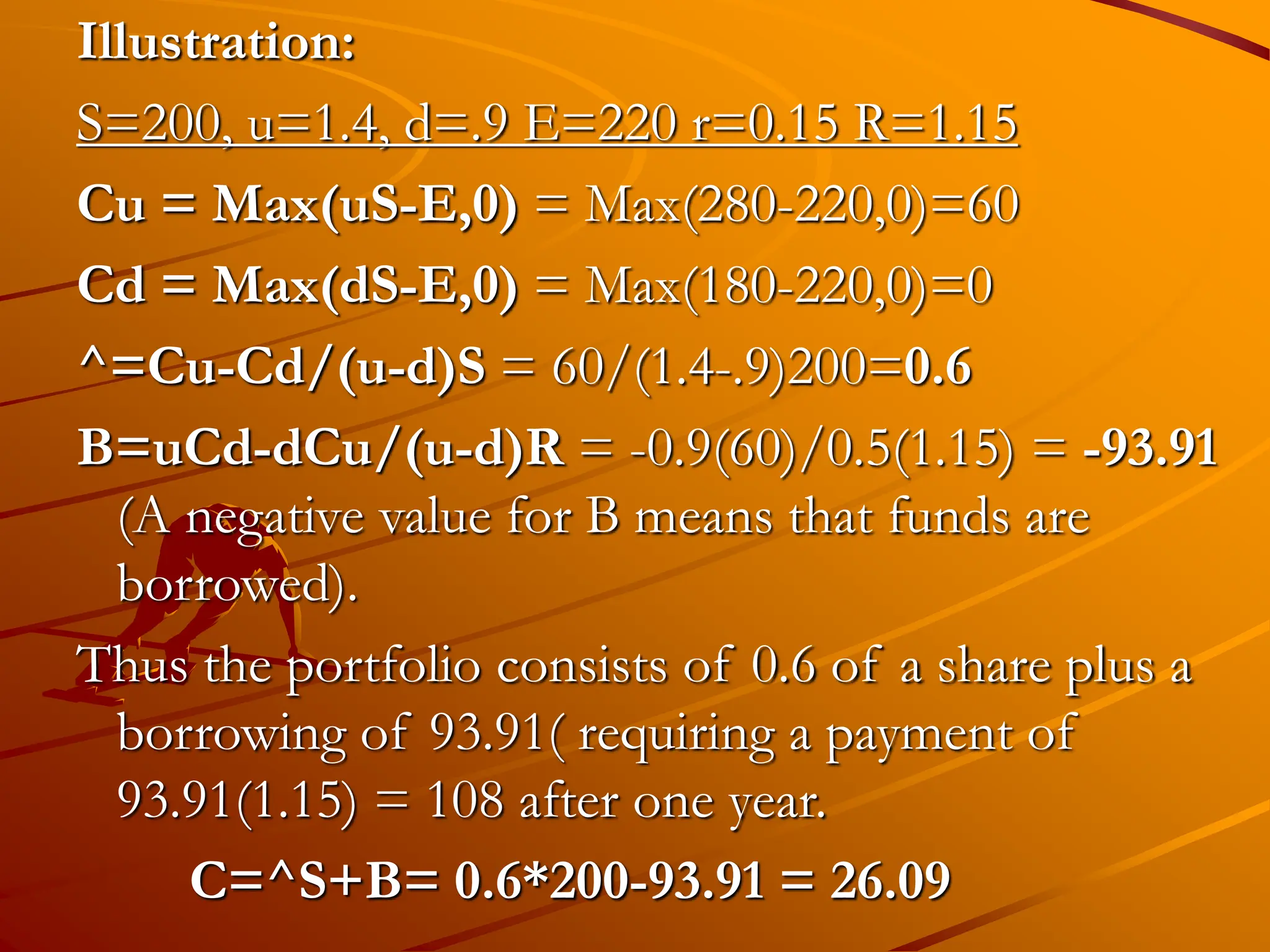
Illustration:
S=200, u=1.4, d=.9 E=220 r=0.15 R=1.15
Cu = Max(uS-E,0) = Max(280-220,0)=60
Cd = Max(dS-E,0) = Max(180-220,0)=0
^=Cu-Cd/(u-d)S = 60/(1.4-.9)200=0.6
B=uCd-dCu/(u-d)R = -0.9(60)/0.5(1.15) = -93.91
(A negative value for B means that funds are
borrowed).
Thus the portfolio consists of 0.6 of a share plus a
borrowing of 93.91( requiring a payment of
93.91(1.15) = 108 after one year.
C=^S+B= 0.6*200-93.91 = 26.09
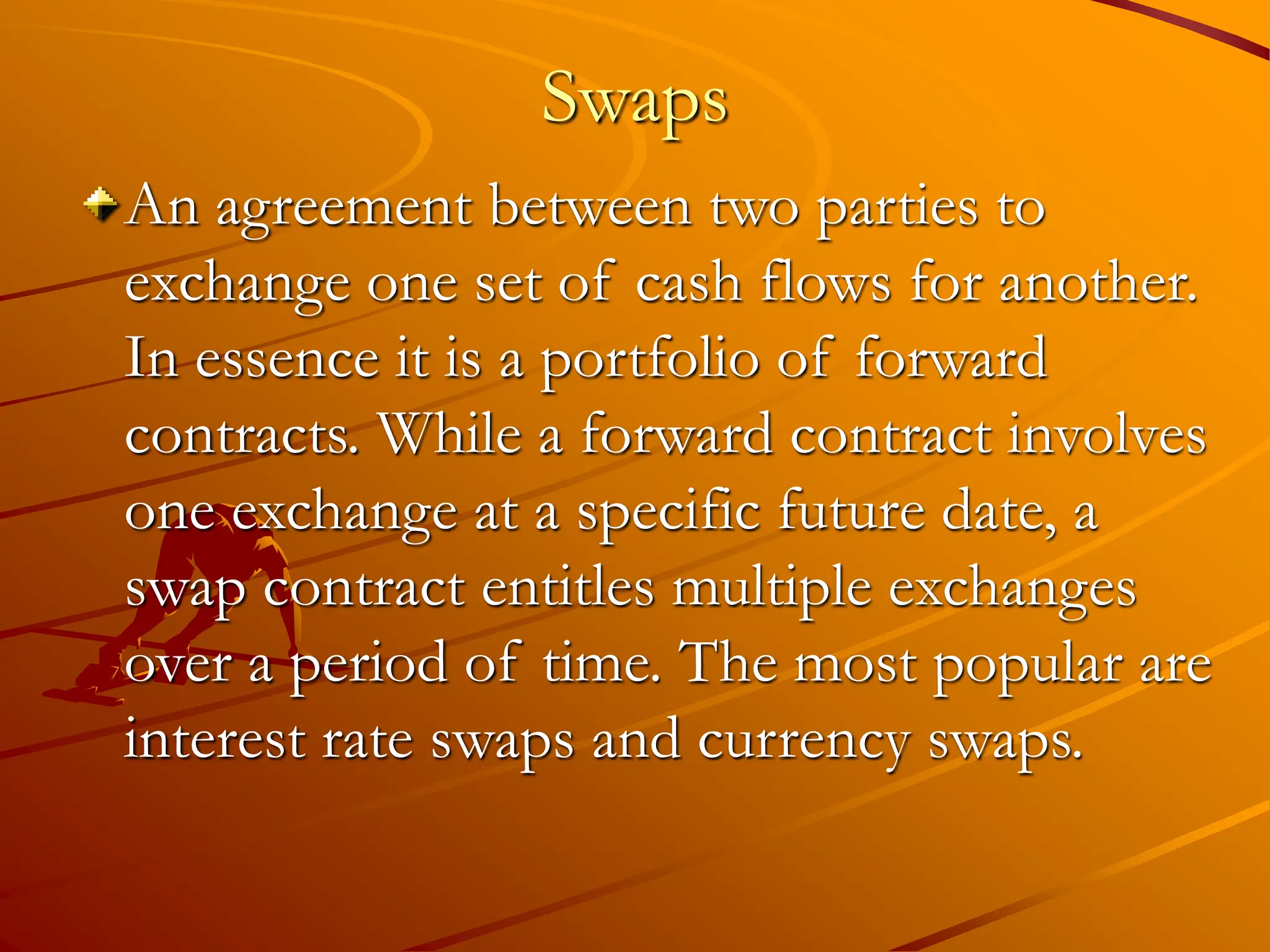
Swaps
An agreement between two parties to
exchange one set of cash flows for another.
In essence it is a portfolio of forward
contracts. While a forward contract involves
one exchange at a specific future date, a
swap contract entitles multiple exchanges
over a period of time. The most popular are
interest rate swaps and currency swaps.
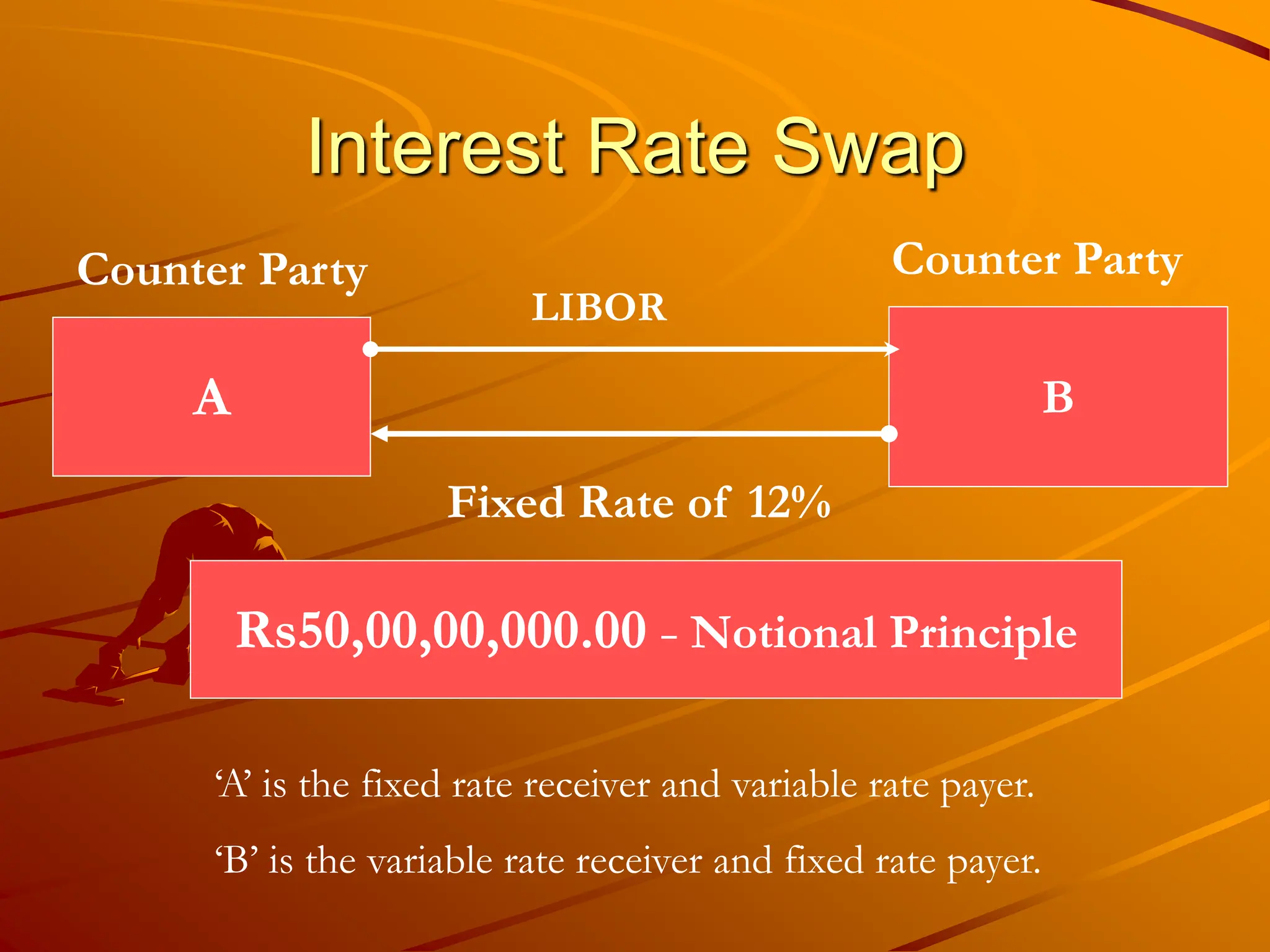
Interest Rate Swap
A B
Fixed Rate of 12%
LIBOR
‘A’ is the fixed rate receiver and variable rate payer.
‘B’ is the variable rate receiver and fixed rate payer.
Rs50,00,00,000.00 – Notional Principle
Counter Party Counter Party
The only Rupee exchanged between the parties are
the net interest payment, not the notional principle
amount.
In the given eg A pays LIBOR/2*50crs to B once
every six months. Say LIBOR=5% then A pays be
5%/2*50crs= 1.25crs
B pays A 12%/2*50crs=3crs
The value of the swap will fluctuate with market
interest rates.
If interest rates decline fixed rate payer is at a
loss, If interest rates rise variable rate payer is at a
loss. Conversely if rates rise fixed rate payer profits
and floating rate payer looses.
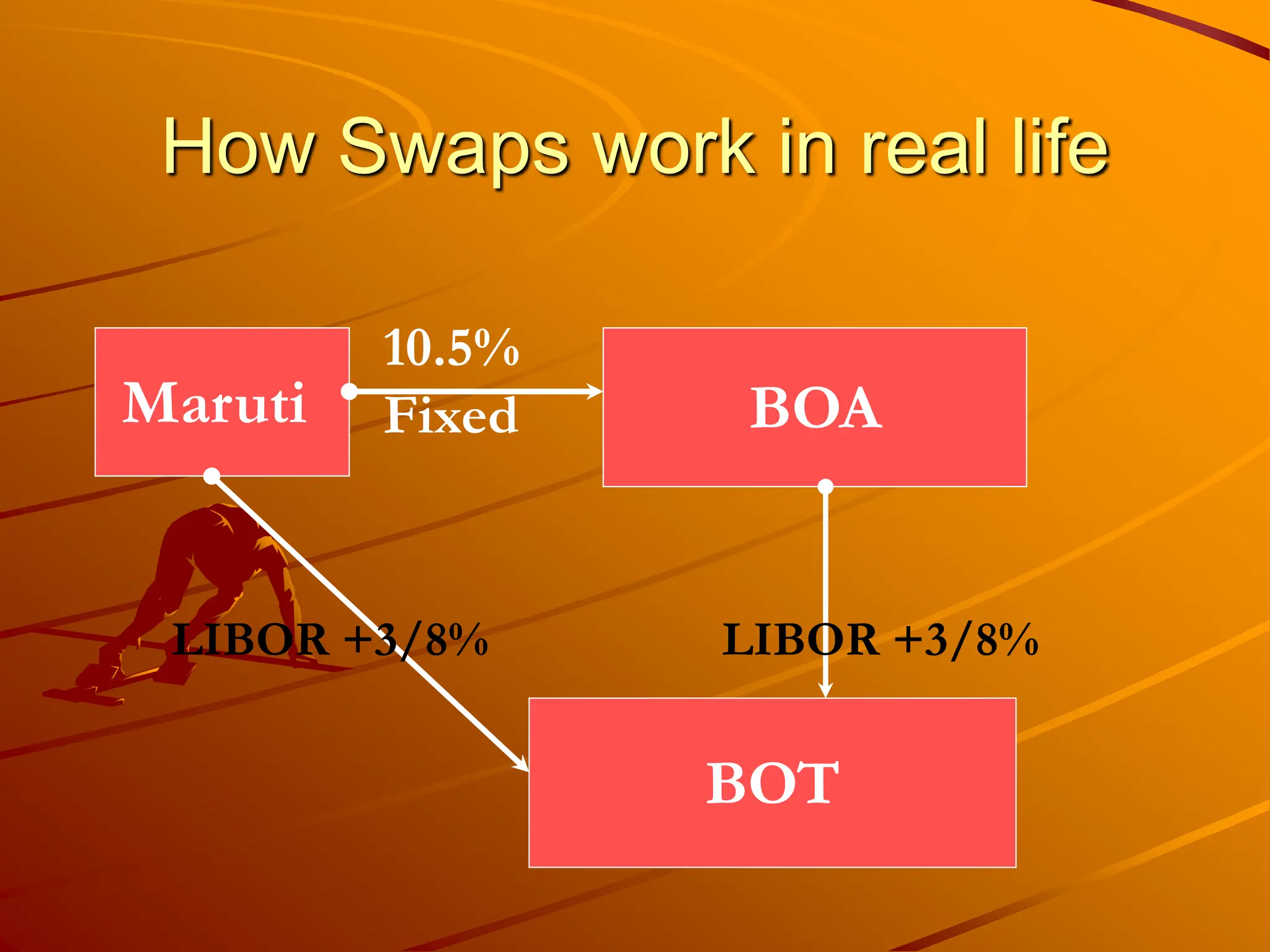
How Swaps work in real life
Maruti BOA
BOT
LIBOR +3/8%
10.5%
Fixed
LIBOR +3/8%

Derivatives paper trading ppt information

  • 1.
    Derivatives A financial contractof pre-determined duration, whose value is derived from the value of an underlying asset Securities  commodities  bullion  precious metals  currency  livestock  index such as interest rates, exchange rates
  • 2.
    What do derivativesdo? Derivatives attempt either to minimize the loss arising from adverse price movements of the underlying asset Or maximize the profits arising out of favorable price fluctuation. Since derivatives derive their value from the underlying asset they are called as derivatives.
  • 3.
    Types of Derivatives (UA:Underlying Asset) Based on the underlying assets derivatives are classified into. Financial Derivatives (UA: Fin asset) Commodity Derivatives (UA: gold etc) Index Derivative (BSE sensex)
  • 4.
    How are derivativesused? Derivatives are basically risk shifting instruments. Hedging is the most important aspect of derivatives and also their basic economic purpose Derivatives can be compared to an insurance policy. As one pays premium in advance to an insurance company in protection against a specific event, the derivative products have a payoff contingent upon the occurrence of some event for which he pays premium in advance.
  • 5.
    What is Risk? Theconcept of risk is simple. It is the potential for change in the price or value of some asset or commodity. The meaning of risk is not restricted just to the potential for loss. There is upside risk and there is downside risk as well.
  • 6.
    What is aHedge To Be cautious or to protect against loss. In financial parlance, hedging is the act of reducing uncertainty about future price movements in a commodity, financial security or foreign currency . Thus a hedge is a way of insuring an investment against risk.
  • 7.
    Derivative Instruments. Forward contracts Futures –Commodity – Financial (Stock index, interest rate & currency ) Options – Put – Call Swaps. – Interest Rate – Currency
  • 8.
    Forward Contracts. A oneto one bipartite contract, which is to be performed in future at the terms decided today. Eg: Jay and Viru enter into a contract to trade in one stock on Infosys 3 months from today the date of the contract @ a price of Rs4675/- Note: Product ,Price ,Quantity & Time have been determined in advance by both the parties. Delivery and payments will take place as per the terms of this contract on the designated date and place. This is a simple example of forward contract.
  • 9.
    Risks in aforward contract Liquidity risk: these contracts a biparty and not traded on the exchange. Default risk/credit risk/counter party risk. Say Jay owned one share of Infosys and the price went up to 4750/- three months hence, he profits by defaulting the contract and selling the stock at the market.
  • 10.
    Futures. Future contracts areorganized/standardized contracts in terms of quantity, quality, delivery time and place for settlement on any date in future. These contracts are traded on exchanges. These markets are very liquid In these markets, clearing corporation/house becomes the counter-party to all the trades or provides the unconditional guarantee for the settlement of trades i.e. assumes the financial integrity of the whole system. In other words, we may say that the credit risk of the transactions is eliminated by the exchange through the clearing corporation/house.
  • 11.
    The key elementsof a futures contract are: – Futures price – Settlement or Delivery Date – Underlying (infosys stock)
  • 12.
    Illustration. Let us onceagain take the earlier example where Jay and Viru entered into a contract to buy and sell Infosys shares. Now, assume that this contract is taking place through the exchange, traded on the exchange and clearing corporation/house is the counter-party to this, it would be called a futures contract.
  • 13.
    Positions in afutures contract Long - this is when a person buys a futures contract, and agrees to receive delivery at a future date. Eg: Viru’s position Short - this is when a person sells a futures contract, and agrees to make delivery. Eg: Jay’s Position
  • 14.
    How does onemake money in a futures contract? The long makes money when the underlying assets price rises above the futures price. The short makes money when the underlying asset’s price falls below the futures price. Concept of initial margin Degree of Leverage = 1/margin rate.
  • 15.
    Options An option isa contract giving the buyer the right, but not the obligation, to buy or sell an underlying asset at a specific price on or before a certain date. An option is a security, just like a stock or bond, and is a binding contract with strictly defined terms and properties.
  • 16.
    Options Lingo Underlying: Thisis the specific security / asset on which an options contract is based. Option Premium: Premium is the price paid by the buyer to the seller to acquire the right to buy or sell. It is the total cost of an option. It is the difference between the higher price paid for a security and the security's face amount at issue. The premium of an option is basically the sum of the option's intrinsic and time value.
  • 17.
    Strike Price orExercise Price :price of an option is the specified/ pre- determined price of the underlying asset at which the same can be bought or sold if the option buyer exercises his right to buy/ sell on or before the expiration day. Expiration date: The date on which the option expires is known as Expiration Date Exercise: An action by an option holder taking advantage of a favourable market situation .’Trade in’ the option for stock.
  • 18.
    Exercise Date: isthe date on which the option is actually exercised. European style of options: The European kind of option is the one which can be exercised by the buyer on the expiration day only & not anytime before that. American style of options: An American style option is the one which can be exercised by the buyer on or before the expiration date, i.e. anytime between the day of purchase of the option and the day of its expiry.
  • 19.
    Asian style ofoptions: these are in-between European and American. An Asian option's payoff depends on the average price of the underlying asset over a certain period of time. Option Holder Option seller/ writer Call option: An option contract giving the owner the right to buy a specified amount of an underlying security at a specified price within a specified time. Put Option: An option contract giving the owner the right to sell a specified amount of an underlying security at a specified price within a specified time
  • 20.
    In-the-money: For acall option, in- the-money is when the option's strike price is below the market price of the underlying stock. For a put option, in the money is when the strike price is above the market price of the underlying stock. In other words, this is when the stock option is worth money and can be turned around and exercised for a profit.
  • 21.
    – Intrinsic Value:The intrinsic value of an option is defined as the amount by which an option is in-the-money, or the immediate exercise value of the option when the underlying position is marked-to-market. For a call option: Intrinsic Value = Spot Price - Strike Price For a put option: Intrinsic Value = Strike Price - Spot Price
  • 22.
    Example of anOption Elvis and crocodiles.
  • 23.
    Positions Long Position: Theterm used when a person owns a security or commodity and wants to sell. If a person is long in a security then he wants it to go up in price. Short position: The term used to describe the selling of a security, commodity, or currency. The investor's sales exceed holdings because they believe the price will fall.
  • 24.
    Profit/Loss Profile ofa Long call Position 0 -3 100 103 Profit Loss Price of Asset XYZ at expira tion Option Price = Rs3 Strike Price = Rs100 Time to expiration = 1month
  • 25.
    Profit /Loss Profilefor a Short Call Position 100 103 0 Profit Loss Price of the Asset XYZ at expiration +3 Initial price of the asset = Rs100 Option price= Rs3 Strike price = Rs100 Time to expiration = 1 month
  • 26.
    Profit/Loss Profile for aLong Put Position 0 -2 98 100 Price of the Asset XYZ at expiration Profit Loss Initial price of the asset XYZ = Rs100 Option Price = Rs2 Strike price = Rs100 Time to expiration = 1 month
  • 27.
    Profit/Loss Profile fora Short Put Position 0 +2 94 100 Price of the Asset XYZ at expiration Profit Loss Initial price of the asset XYZ = Rs100 Option Price = Rs2 Strike price = Rs100 Time to expiration = 1 month
  • 28.
    Summary The profit andloss profile for a short put option is the mirror image of the long put option. The maximum profit from this position is the option price. The theoritical maximum loss can be substantial should the price of the underlying asset fall. Buying calls or selling puts allows investor to gain if the price of the underlying asset rises; and selling calls and buying puts allows the investors to gain if the price of the underlying asset falls.
  • 29.
    Long Call Short Put LongPut Short Call Price rises Price Falls
  • 30.
    Stock Index Option Tradingin options whose underlying instrument is the stock index. Here if the option is exercised, the exchange assigned option writer pays cash to the options buyer. There is no delivery of any stock. Dollar Value of the underlying index = Cash index value * Contract multiple. The contract multiple for the S&P100 is $100. So, for eg, if the cash index value for the S&P is 720,then dollar value will be $72,000
  • 31.
    For a stockoption, the price at which the buyer of the option can buy or sell the stock is the strike price. For an index option, the strike index is the index value at which the buyer of the option can buy or sell the underlying stock index. For Eg: If the strike index is 700 for an S&P index option, the USD value is $70,000. If an investor purchases a call option on the S&P100 with a strike of 700, and exercises the option when the index is 720, then the investor has the right to purchase the index for $70,000 when the USD value of the index is $72000. The buyer of the call option then receive$2000 from the option writer.
  • 32.
    Binomial Model forOption Valuation Current Price of the stock = S Two possible values it can take next year :- uS or dS ( uS> dS) Amount B can be borrowed or lent at a rate of r. The interest factor (1+r) may be represented , for sake of simplicity , as R. d<R<u. Exercise price is E.
  • 33.
    Value of acall option, just before expiration, if the stock price goes up to uS is Cu = Max(uS-E,0) Value of a call option, just before expiration, if the stock price goes down to dS is Cd = Max(dS-E,0) The value of the call option is C=^S+B ^ = (Cu-Cd)/ S (u-d) B = uCd-dCu/(u-d)R
  • 34.
    Illustration: S=200, u=1.4, d=.9E=220 r=0.15 R=1.15 Cu = Max(uS-E,0) = Max(280-220,0)=60 Cd = Max(dS-E,0) = Max(180-220,0)=0 ^=Cu-Cd/(u-d)S = 60/(1.4-.9)200=0.6 B=uCd-dCu/(u-d)R = -0.9(60)/0.5(1.15) = -93.91 (A negative value for B means that funds are borrowed). Thus the portfolio consists of 0.6 of a share plus a borrowing of 93.91( requiring a payment of 93.91(1.15) = 108 after one year. C=^S+B= 0.6*200-93.91 = 26.09
  • 35.
    Swaps An agreement betweentwo parties to exchange one set of cash flows for another. In essence it is a portfolio of forward contracts. While a forward contract involves one exchange at a specific future date, a swap contract entitles multiple exchanges over a period of time. The most popular are interest rate swaps and currency swaps.
  • 36.
    Interest Rate Swap AB Fixed Rate of 12% LIBOR ‘A’ is the fixed rate receiver and variable rate payer. ‘B’ is the variable rate receiver and fixed rate payer. Rs50,00,00,000.00 – Notional Principle Counter Party Counter Party
  • 37.
    The only Rupeeexchanged between the parties are the net interest payment, not the notional principle amount. In the given eg A pays LIBOR/2*50crs to B once every six months. Say LIBOR=5% then A pays be 5%/2*50crs= 1.25crs B pays A 12%/2*50crs=3crs The value of the swap will fluctuate with market interest rates. If interest rates decline fixed rate payer is at a loss, If interest rates rise variable rate payer is at a loss. Conversely if rates rise fixed rate payer profits and floating rate payer looses.
  • 38.
    How Swaps workin real life Maruti BOA BOT LIBOR +3/8% 10.5% Fixed LIBOR +3/8%