StudsPlanet
Leading Education consultant in India
www.StudsPlanet.com
Hedging with Derivatives andHedging with Derivatives and
Money Market HedgeMoney Market Hedge
Now that we’re familiar with options, let’s
look at using forward rates, futures rates
and call and put options to hedge a long
(Account Receivable or Note Receivable)
or short (Account Payable or Note
Payable) position in a currency. First,
let’s assume that we sold merchandise to
a British firm for 1 million pounds payable
in 6 months.
Hedging with a ForwardHedging with a Forward
Contract with a BankContract with a Bank
One alternative is to go to our bank who,
deals in foreign exchange, and simply
lock-in the value of the 1 million pounds
sterling that we will receive in six months
with a forward contract with the bank.
Assume that the forward rate that the
bank offers to us is USD 1.5179 per
pound. Then, we are guaranteed that the
amount we will receive will be the
following:
Hedging with a ForwardHedging with a Forward
Contract with a BankContract with a Bank
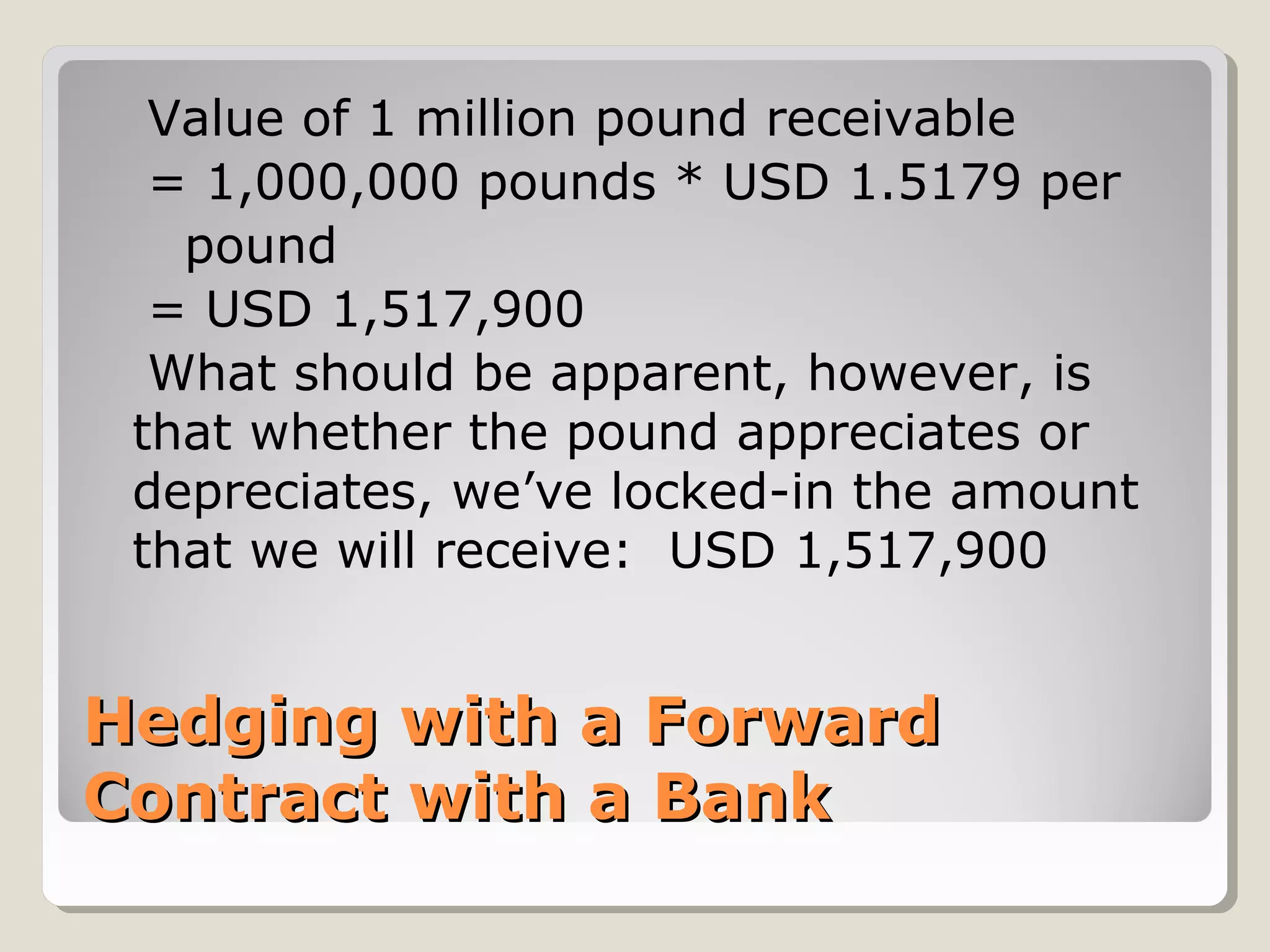
Value of 1 million pound receivable
= 1,000,000 pounds * USD 1.5179 per
pound
= USD 1,517,900
What should be apparent, however, is
that whether the pound appreciates or
depreciates, we’ve locked-in the amount
that we will receive: USD 1,517,900
Hedging with a FuturesHedging with a Futures
ContractContract
An alternative to contracting privately
with a bank is to contract for 1,000,000
pounds with futures contracts. Assuming
that the futures rate of exchange is USD
1.5204 per pound, but will include
transactions costs (commissions) of 0.2%,
we will net the following amount when we
receive the one million pounds in six
months:
Hedging with a FuturesHedging with a Futures
ContractContract
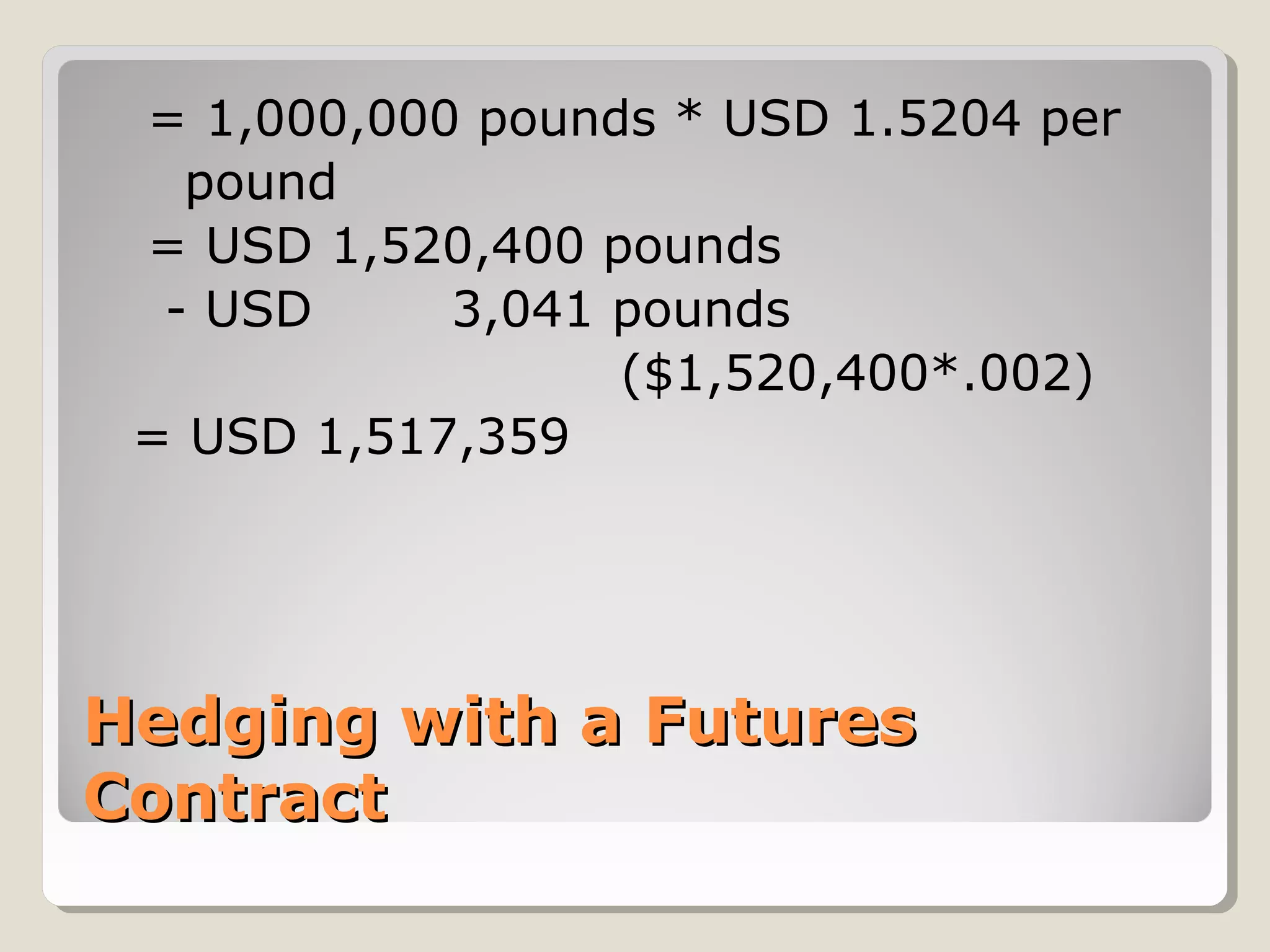
= 1,000,000 pounds * USD 1.5204 per
pound
= USD 1,520,400 pounds
- USD 3,041 pounds
($1,520,400*.002)
= USD 1,517,359
Hedging with a FuturesHedging with a Futures
ContractContract
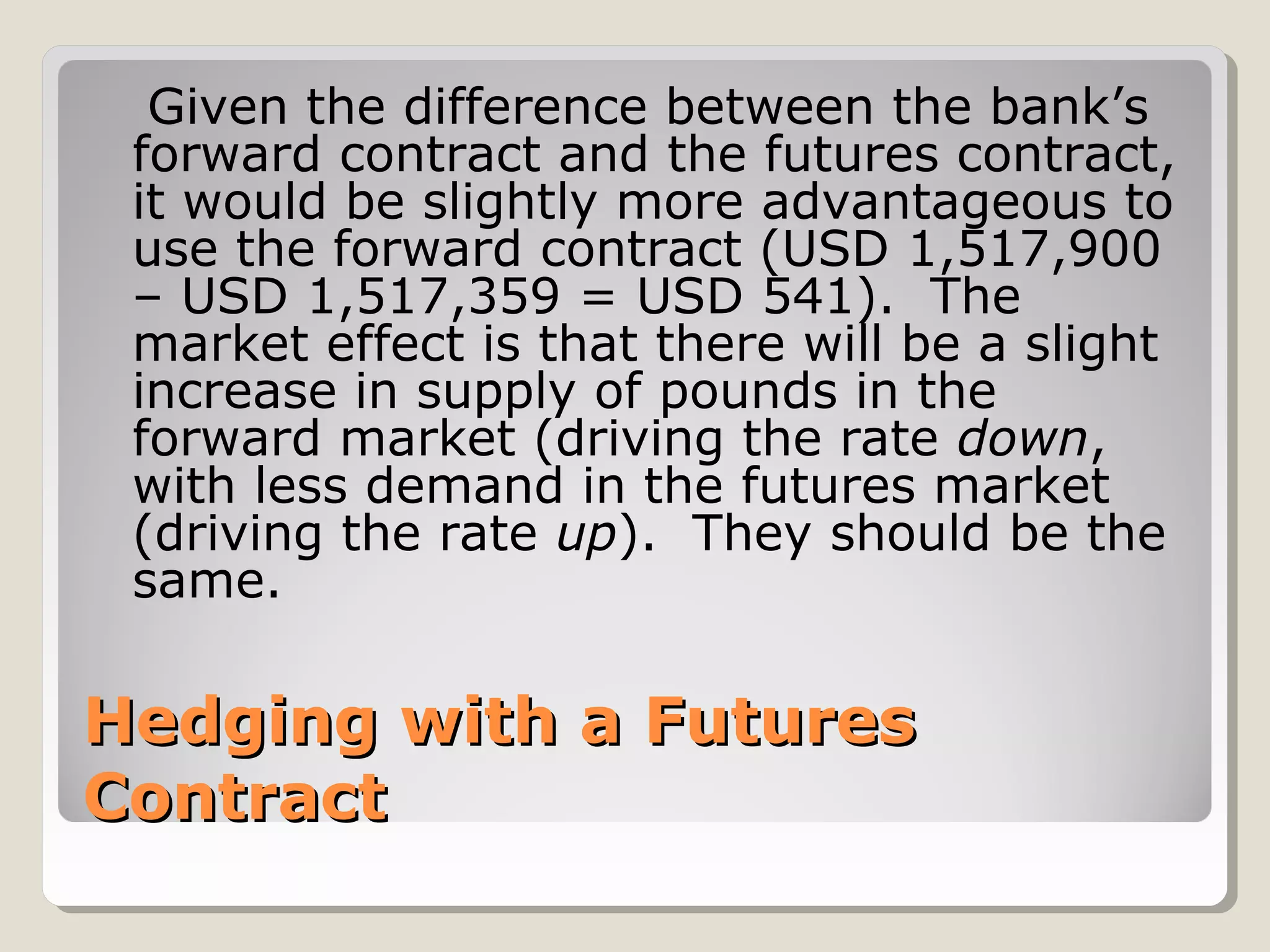
Given the difference between the bank’s
forward contract and the futures contract,
it would be slightly more advantageous to
use the forward contract (USD 1,517,900
– USD 1,517,359 = USD 541). The
market effect is that there will be a slight
increase in supply of pounds in the
forward market (driving the rate down,
with less demand in the futures market
(driving the rate up). They should be the
same.
Money Market HedgeMoney Market Hedge
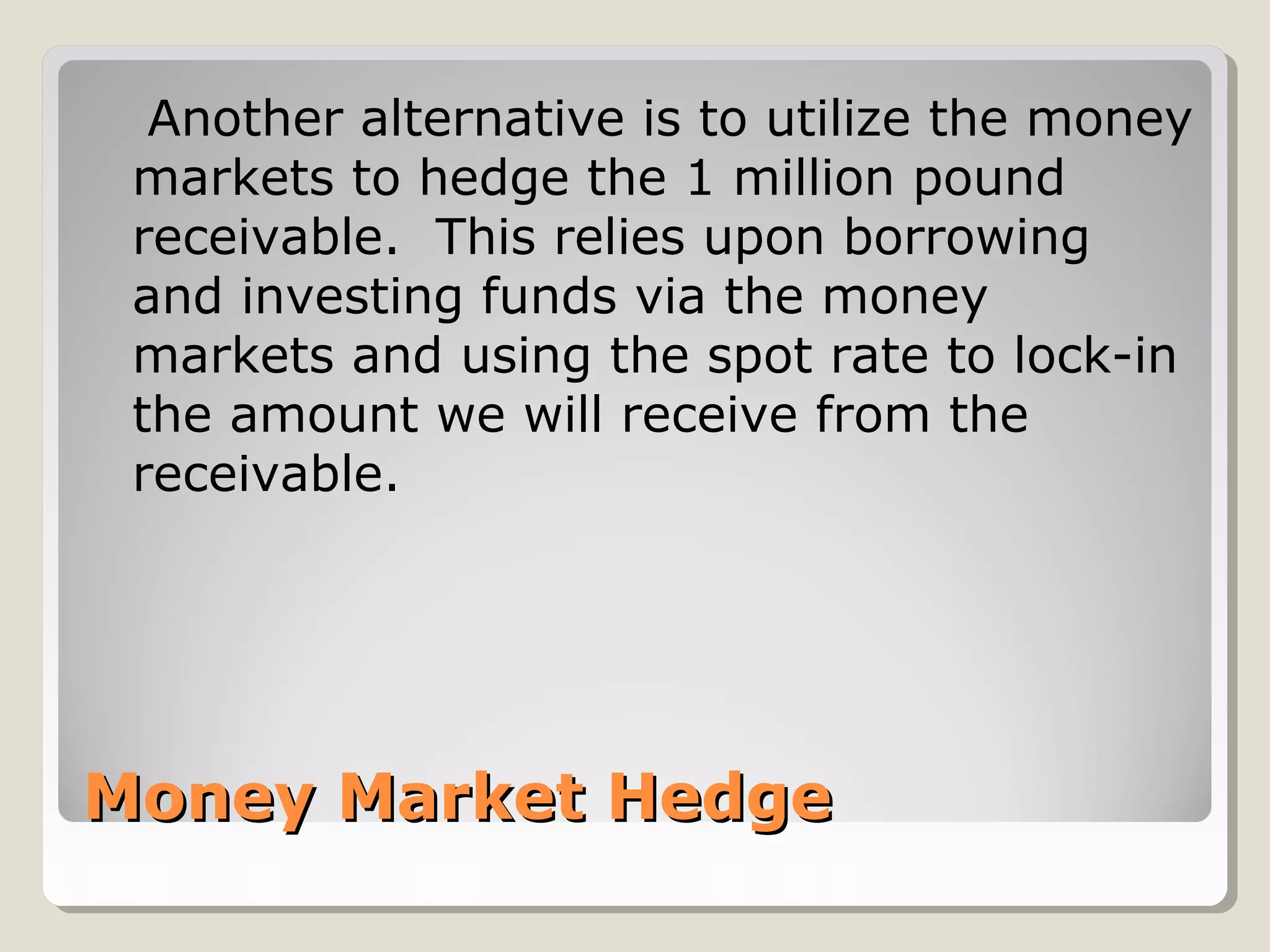
Another alternative is to utilize the money
markets to hedge the 1 million pound
receivable. This relies upon borrowing
and investing funds via the money
markets and using the spot rate to lock-in
the amount we will receive from the
receivable.
Money Market HedgeMoney Market Hedge
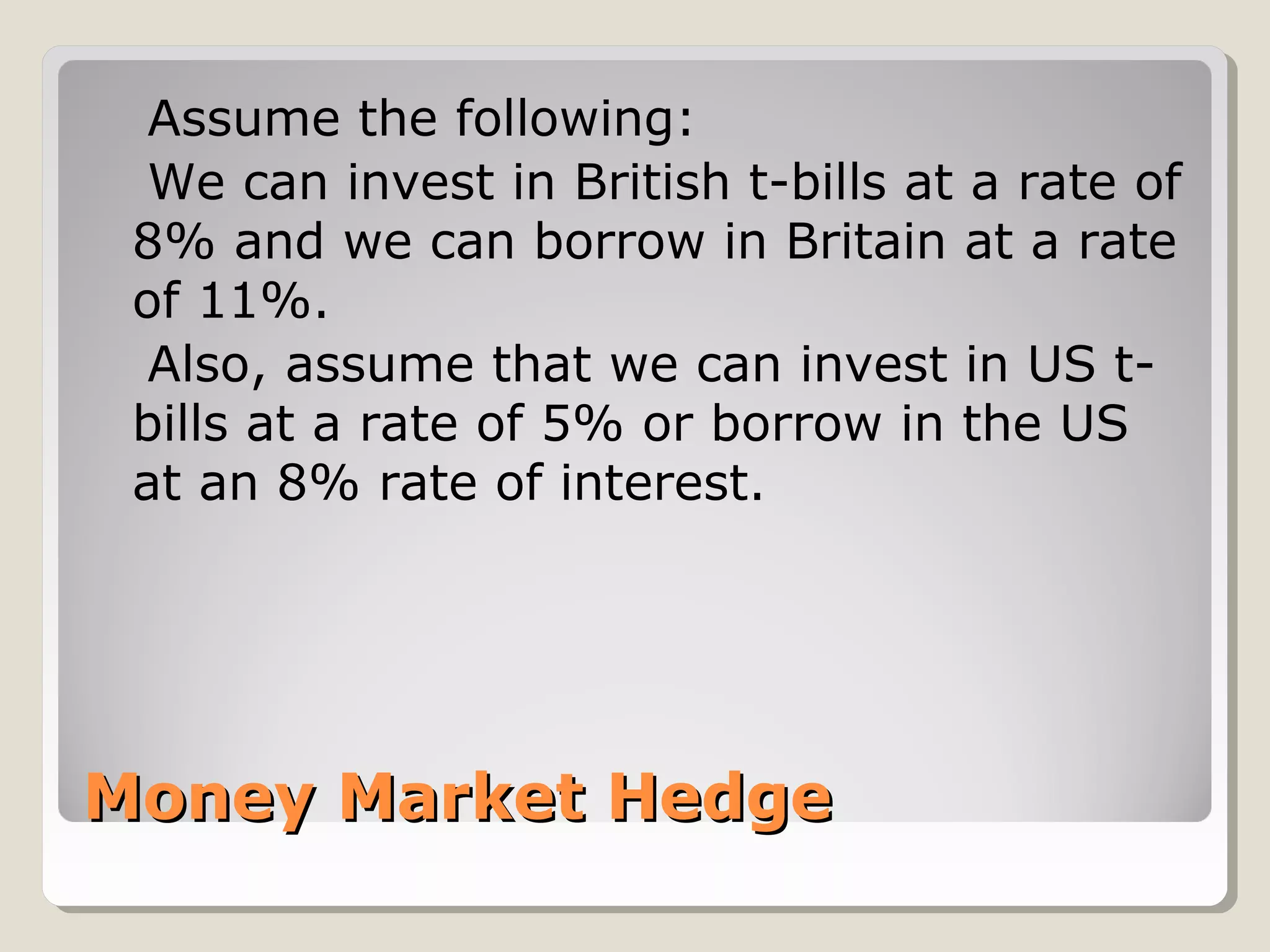
Assume the following:
We can invest in British t-bills at a rate of
8% and we can borrow in Britain at a rate
of 11%.
Also, assume that we can invest in US t-
bills at a rate of 5% or borrow in the US
at an 8% rate of interest.
Money Market HedgeMoney Market Hedge
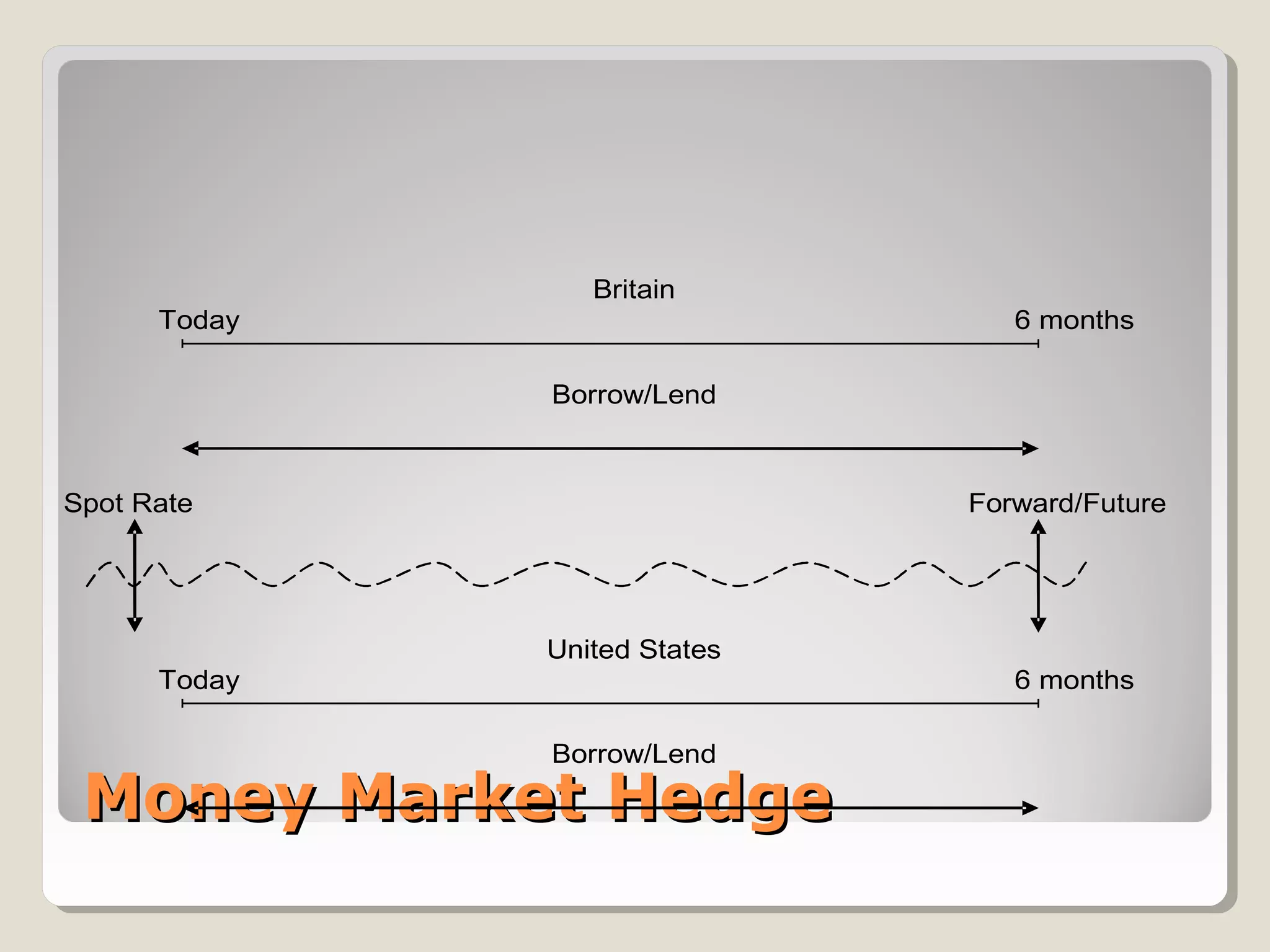
Now, think about what we are trying to
do. We will receive one million pounds in
six months, so we want to move the
pounds to the United States. The
following slide shows how we can
accomplish this through the money
markets:
Money Market HedgeMoney Market Hedge
Britain
Today 6 months
Borrow/Lend
Spot Rate Forward/Future
United States
Today 6 months
Borrow/Lend
Money Market HedgeMoney Market Hedge
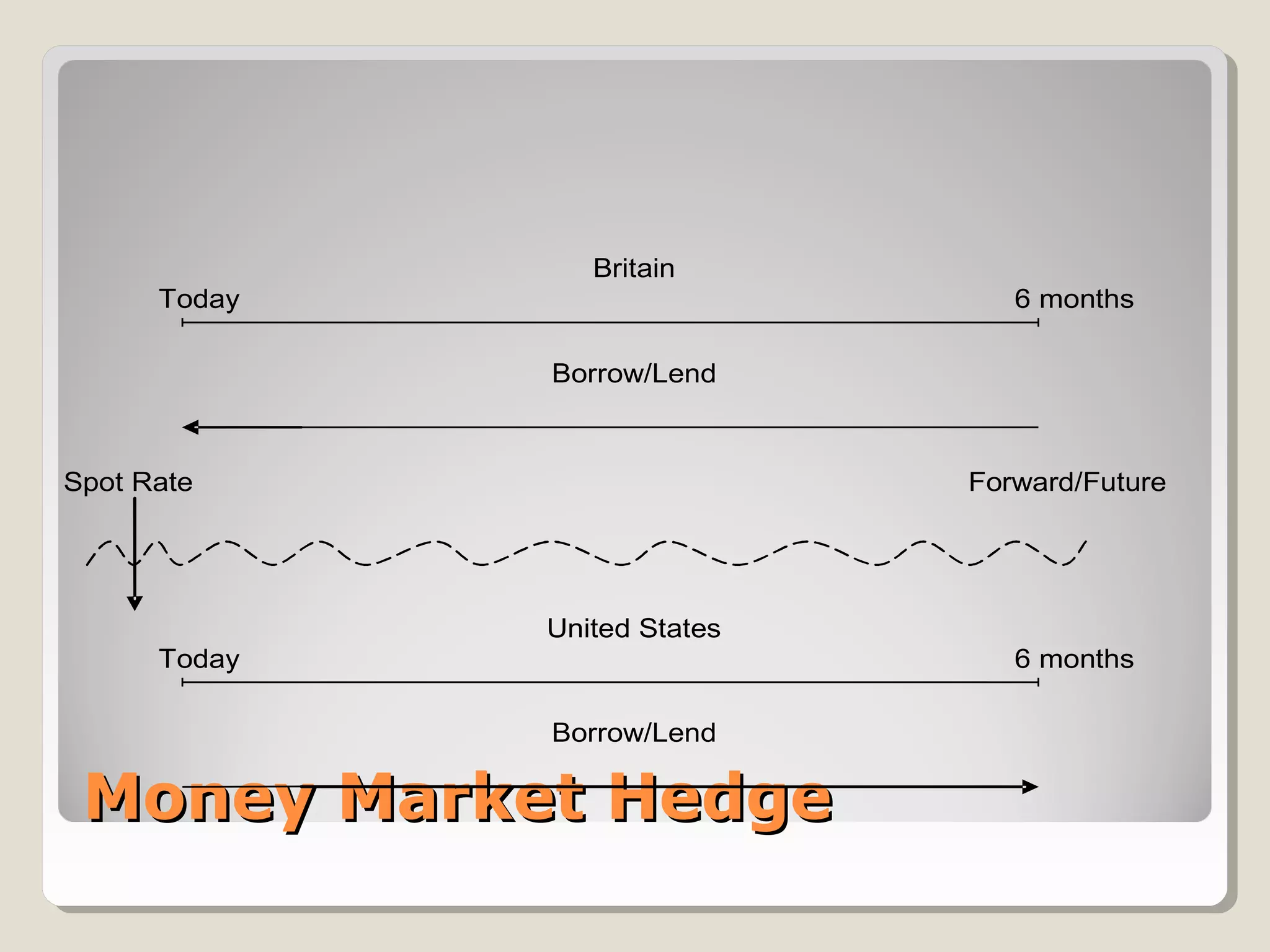
Since we are going to receive one million
pounds in six months, we want to move
the funds using the money markets as the
following arrows indicate:
Money Market HedgeMoney Market Hedge
Britain
Today 6 months
Borrow/Lend
Spot Rate Forward/Future
United States
Today 6 months
Borrow/Lend
Money Market HedgeMoney Market Hedge
As the arrows indicate, we want to
borrow against the 1 million pounds in
Britain, convert to US dollars at the spot
rate of exchange, and invest in U.S. t-
bills. The reason we want to invest in t-
bills is so we can compare the amount of
dollars we will receive today by borrowing
against the receivable with the amount of
dollars we will receive in six months using
a forward contract or a futures contract.
Money Market HedgeMoney Market Hedge
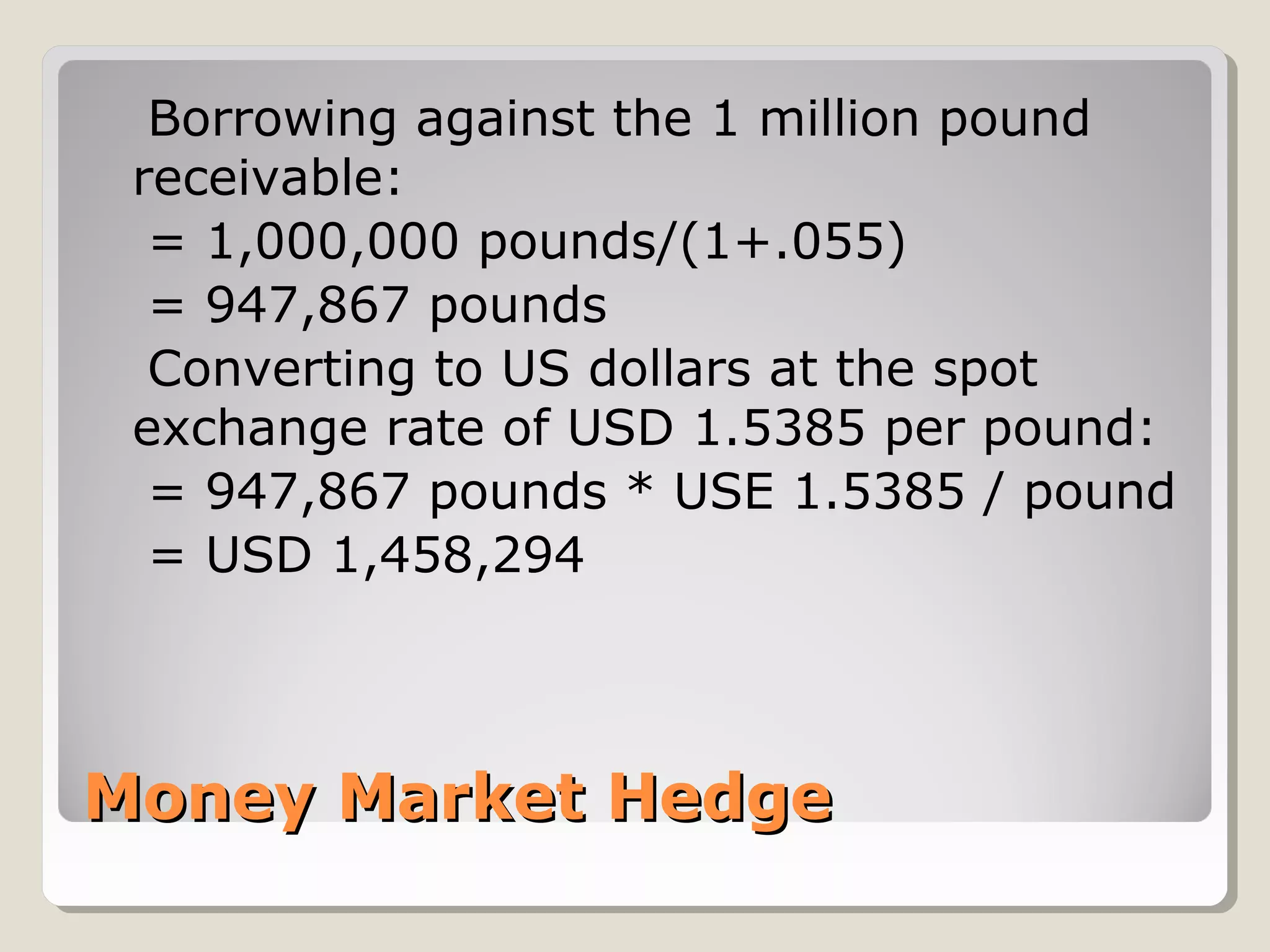
Borrowing against the 1 million pound
receivable:
= 1,000,000 pounds/(1+.055)
= 947,867 pounds
Converting to US dollars at the spot
exchange rate of USD 1.5385 per pound:
= 947,867 pounds * USE 1.5385 / pound
= USD 1,458,294
Money Market HedgeMoney Market Hedge
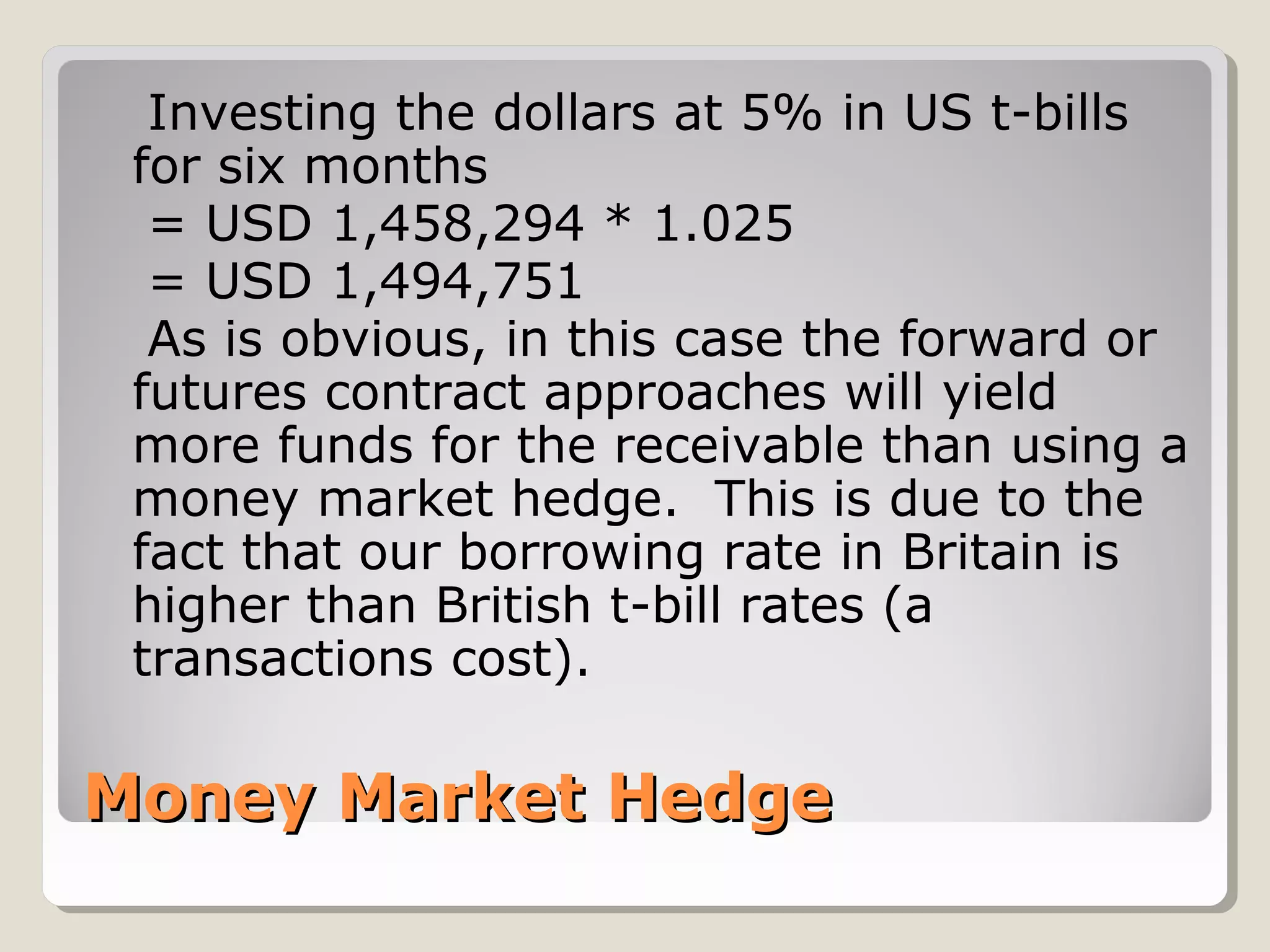
Investing the dollars at 5% in US t-bills
for six months
= USD 1,458,294 * 1.025
= USD 1,494,751
As is obvious, in this case the forward or
futures contract approaches will yield
more funds for the receivable than using a
money market hedge. This is due to the
fact that our borrowing rate in Britain is
higher than British t-bill rates (a
transactions cost).
Using a Put HedgeUsing a Put Hedge
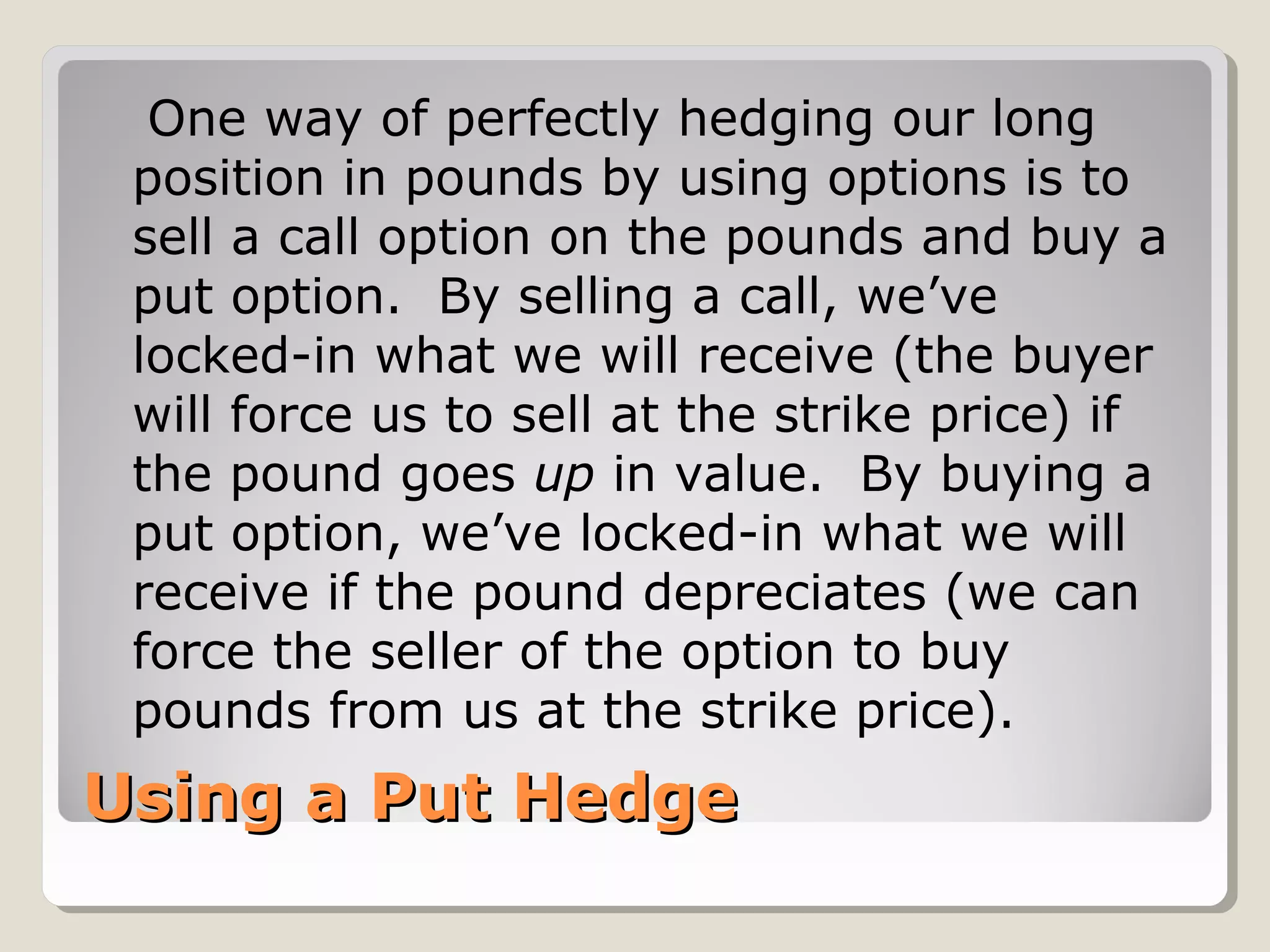
One way of perfectly hedging our long
position in pounds by using options is to
sell a call option on the pounds and buy a
put option. By selling a call, we’ve
locked-in what we will receive (the buyer
will force us to sell at the strike price) if
the pound goes up in value. By buying a
put option, we’ve locked-in what we will
receive if the pound depreciates (we can
force the seller of the option to buy
pounds from us at the strike price).
Using a Put HedgeUsing a Put Hedge
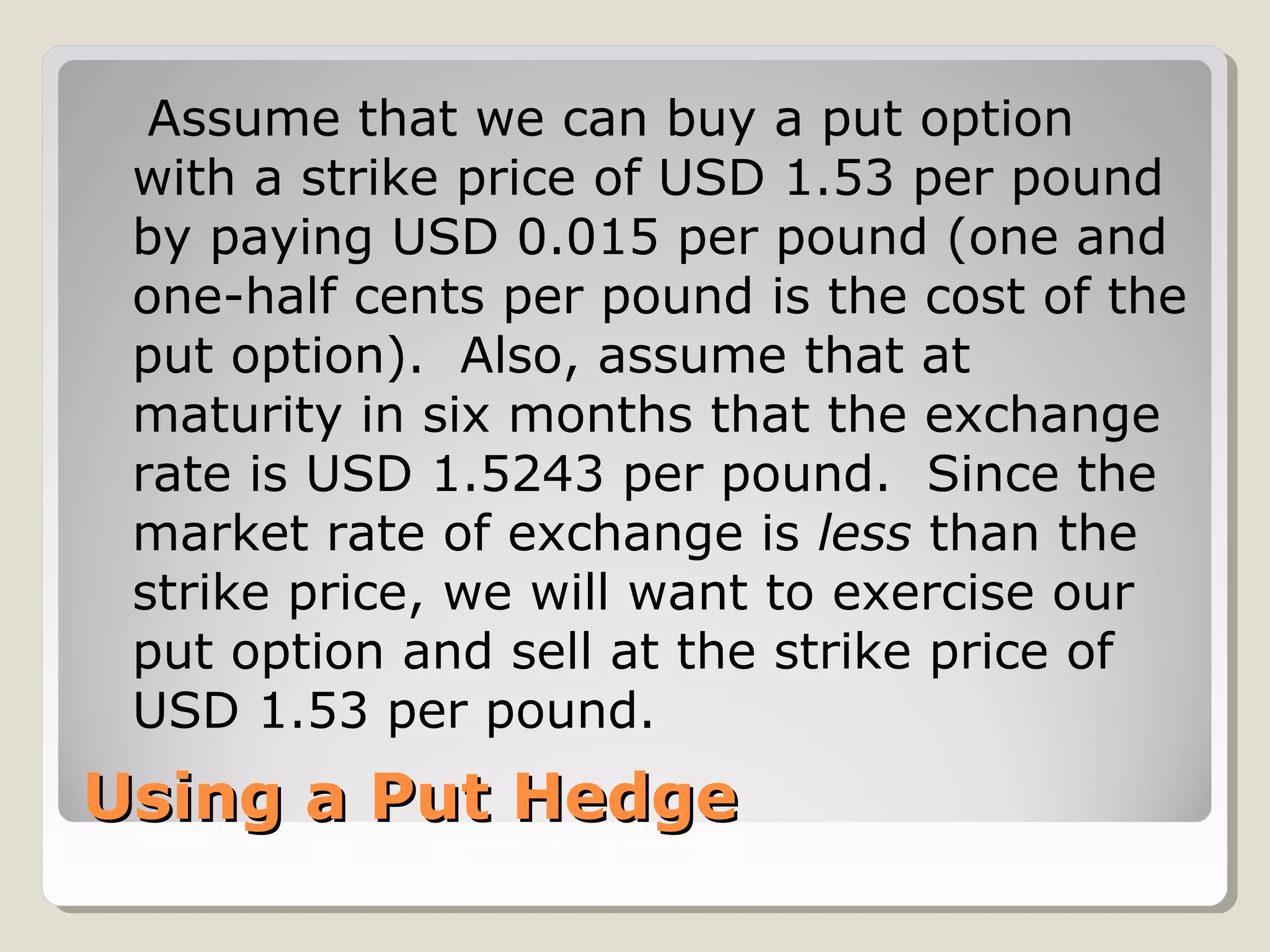
Assume that we can buy a put option
with a strike price of USD 1.53 per pound
by paying USD 0.015 per pound (one and
one-half cents per pound is the cost of the
put option). Also, assume that at
maturity in six months that the exchange
rate is USD 1.5243 per pound. Since the
market rate of exchange is less than the
strike price, we will want to exercise our
put option and sell at the strike price of
USD 1.53 per pound.
Using a Put HedgeUsing a Put Hedge
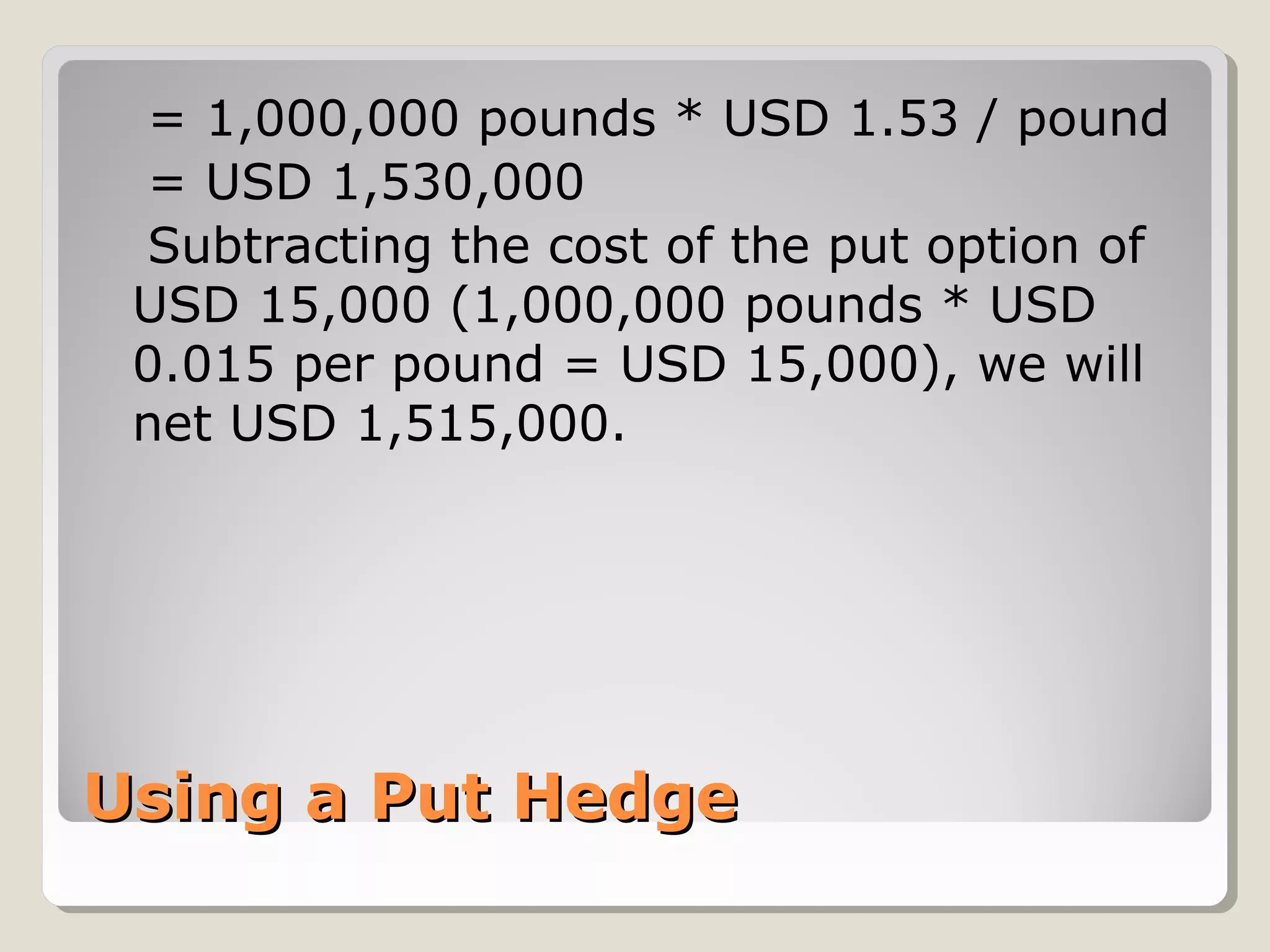
= 1,000,000 pounds * USD 1.53 / pound
= USD 1,530,000
Subtracting the cost of the put option of
USD 15,000 (1,000,000 pounds * USD
0.015 per pound = USD 15,000), we will
net USD 1,515,000.
Using a Put HedgeUsing a Put Hedge
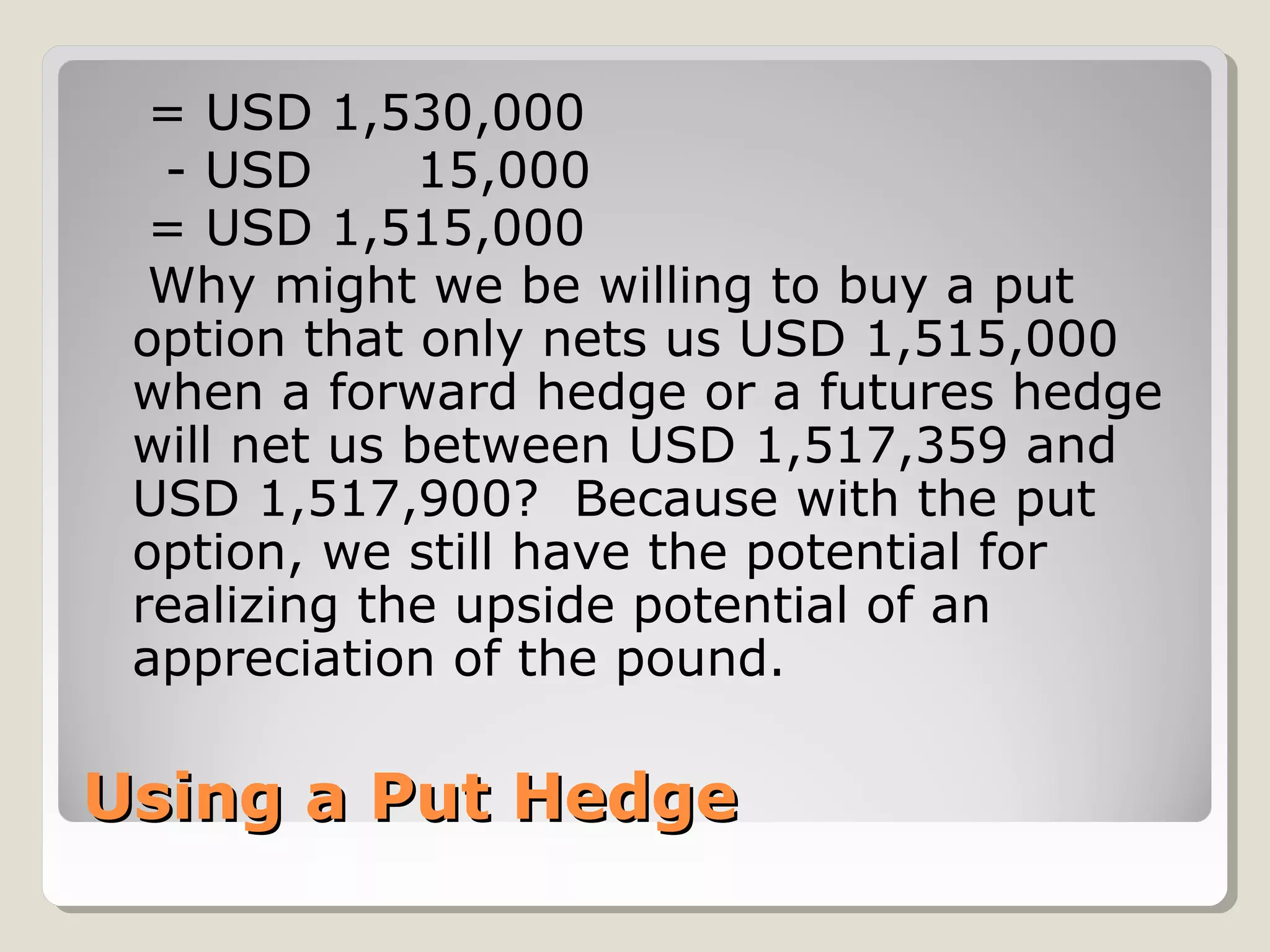
= USD 1,530,000
- USD 15,000
= USD 1,515,000
Why might we be willing to buy a put
option that only nets us USD 1,515,000
when a forward hedge or a futures hedge
will net us between USD 1,517,359 and
USD 1,517,900? Because with the put
option, we still have the potential for
realizing the upside potential of an
appreciation of the pound.

Hedging

  • 1.
    StudsPlanet Leading Education consultantin India www.StudsPlanet.com
  • 2.
    Hedging with DerivativesandHedging with Derivatives and Money Market HedgeMoney Market Hedge Now that we’re familiar with options, let’s look at using forward rates, futures rates and call and put options to hedge a long (Account Receivable or Note Receivable) or short (Account Payable or Note Payable) position in a currency. First, let’s assume that we sold merchandise to a British firm for 1 million pounds payable in 6 months.
  • 3.
    Hedging with aForwardHedging with a Forward Contract with a BankContract with a Bank One alternative is to go to our bank who, deals in foreign exchange, and simply lock-in the value of the 1 million pounds sterling that we will receive in six months with a forward contract with the bank. Assume that the forward rate that the bank offers to us is USD 1.5179 per pound. Then, we are guaranteed that the amount we will receive will be the following:
  • 4.
    Hedging with aForwardHedging with a Forward Contract with a BankContract with a Bank Value of 1 million pound receivable = 1,000,000 pounds * USD 1.5179 per pound = USD 1,517,900 What should be apparent, however, is that whether the pound appreciates or depreciates, we’ve locked-in the amount that we will receive: USD 1,517,900
  • 5.
    Hedging with aFuturesHedging with a Futures ContractContract An alternative to contracting privately with a bank is to contract for 1,000,000 pounds with futures contracts. Assuming that the futures rate of exchange is USD 1.5204 per pound, but will include transactions costs (commissions) of 0.2%, we will net the following amount when we receive the one million pounds in six months:
  • 6.
    Hedging with aFuturesHedging with a Futures ContractContract = 1,000,000 pounds * USD 1.5204 per pound = USD 1,520,400 pounds - USD 3,041 pounds ($1,520,400*.002) = USD 1,517,359
  • 7.
    Hedging with aFuturesHedging with a Futures ContractContract Given the difference between the bank’s forward contract and the futures contract, it would be slightly more advantageous to use the forward contract (USD 1,517,900 – USD 1,517,359 = USD 541). The market effect is that there will be a slight increase in supply of pounds in the forward market (driving the rate down, with less demand in the futures market (driving the rate up). They should be the same.
  • 8.
    Money Market HedgeMoneyMarket Hedge Another alternative is to utilize the money markets to hedge the 1 million pound receivable. This relies upon borrowing and investing funds via the money markets and using the spot rate to lock-in the amount we will receive from the receivable.
  • 9.
    Money Market HedgeMoneyMarket Hedge Assume the following: We can invest in British t-bills at a rate of 8% and we can borrow in Britain at a rate of 11%. Also, assume that we can invest in US t- bills at a rate of 5% or borrow in the US at an 8% rate of interest.
  • 10.
    Money Market HedgeMoneyMarket Hedge Now, think about what we are trying to do. We will receive one million pounds in six months, so we want to move the pounds to the United States. The following slide shows how we can accomplish this through the money markets:
  • 11.
    Money Market HedgeMoneyMarket Hedge Britain Today 6 months Borrow/Lend Spot Rate Forward/Future United States Today 6 months Borrow/Lend
  • 12.
    Money Market HedgeMoneyMarket Hedge Since we are going to receive one million pounds in six months, we want to move the funds using the money markets as the following arrows indicate:
  • 13.
    Money Market HedgeMoneyMarket Hedge Britain Today 6 months Borrow/Lend Spot Rate Forward/Future United States Today 6 months Borrow/Lend
  • 14.
    Money Market HedgeMoneyMarket Hedge As the arrows indicate, we want to borrow against the 1 million pounds in Britain, convert to US dollars at the spot rate of exchange, and invest in U.S. t- bills. The reason we want to invest in t- bills is so we can compare the amount of dollars we will receive today by borrowing against the receivable with the amount of dollars we will receive in six months using a forward contract or a futures contract.
  • 15.
    Money Market HedgeMoneyMarket Hedge Borrowing against the 1 million pound receivable: = 1,000,000 pounds/(1+.055) = 947,867 pounds Converting to US dollars at the spot exchange rate of USD 1.5385 per pound: = 947,867 pounds * USE 1.5385 / pound = USD 1,458,294
  • 16.
    Money Market HedgeMoneyMarket Hedge Investing the dollars at 5% in US t-bills for six months = USD 1,458,294 * 1.025 = USD 1,494,751 As is obvious, in this case the forward or futures contract approaches will yield more funds for the receivable than using a money market hedge. This is due to the fact that our borrowing rate in Britain is higher than British t-bill rates (a transactions cost).
  • 17.
    Using a PutHedgeUsing a Put Hedge One way of perfectly hedging our long position in pounds by using options is to sell a call option on the pounds and buy a put option. By selling a call, we’ve locked-in what we will receive (the buyer will force us to sell at the strike price) if the pound goes up in value. By buying a put option, we’ve locked-in what we will receive if the pound depreciates (we can force the seller of the option to buy pounds from us at the strike price).
  • 18.
    Using a PutHedgeUsing a Put Hedge Assume that we can buy a put option with a strike price of USD 1.53 per pound by paying USD 0.015 per pound (one and one-half cents per pound is the cost of the put option). Also, assume that at maturity in six months that the exchange rate is USD 1.5243 per pound. Since the market rate of exchange is less than the strike price, we will want to exercise our put option and sell at the strike price of USD 1.53 per pound.
  • 19.
    Using a PutHedgeUsing a Put Hedge = 1,000,000 pounds * USD 1.53 / pound = USD 1,530,000 Subtracting the cost of the put option of USD 15,000 (1,000,000 pounds * USD 0.015 per pound = USD 15,000), we will net USD 1,515,000.
  • 20.
    Using a PutHedgeUsing a Put Hedge = USD 1,530,000 - USD 15,000 = USD 1,515,000 Why might we be willing to buy a put option that only nets us USD 1,515,000 when a forward hedge or a futures hedge will net us between USD 1,517,359 and USD 1,517,900? Because with the put option, we still have the potential for realizing the upside potential of an appreciation of the pound.