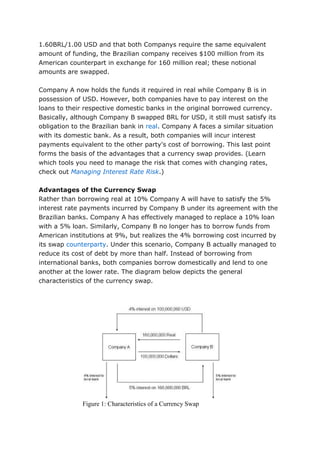
1) Currency swaps involve two companies exchanging loans in different currencies so they can each borrow at lower domestic rates rather than higher international rates. For example, a US and Brazilian company arrange for the US company to borrow Brazilian reals from a Brazilian bank at 5% while the Brazilian company borrows dollars from a US bank at 4%.
2) The companies then swap the loans, so the US company receives dollars and pays 5% interest to the Brazilian bank, while the Brazilian company receives reals and pays 4% interest to the US bank. This allows both companies to access lower domestic borrowing rates rather than higher international rates of 9-10%.
3) Currency swaps also involve an exchange of notional principal amounts