Foreign exchange risk management 2


1
Background
       Growing world trade over the past 25 years
       Companies involved in transactions involving foreign
        currencies
           about 22% of sales in FTSE 350 companies directly
            exposed to the US
           further 11% in regions tied to the dollar
           Pike & Neale, chapter 21
       Foreign exchange rate exposure of increasing
        importance
       Companies need to insure against adverse
        movements in exchange rates

    2
Scenario
       A UK company expects to receive $300,000 in 3
        months time. It is concerned that the pound will
        appreciate relative to the dollar and decides to
        hedge the transaction risk

       Current exchange rate is $1.50

       How much is $300,000 worth currently?
       How much would it be worth in three months time if
        the exchange rate moved to $1.60?


    3
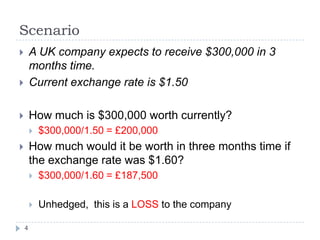
Scenario
       A UK company expects to receive $300,000 in 3
        months time.
       Current exchange rate is $1.50

       How much is $300,000 worth currently?
           $300,000/1.50 = £200,000
       How much would it be worth in three months time if
        the exchange rate was $1.60?
           $300,000/1.60 = £187,500

           Unhedged, this is a LOSS to the company

    4
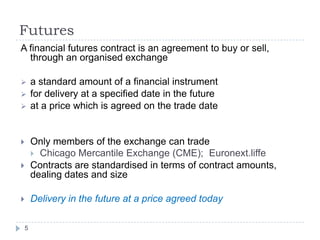
Futures
A financial futures contract is an agreement to buy or sell,
  through an organised exchange

       a standard amount of a financial instrument
       for delivery at a specified date in the future
       at a price which is agreed on the trade date


       Only members of the exchange can trade
         Chicago Mercantile Exchange (CME); Euronext.liffe
       Contracts are standardised in terms of contract amounts,
        dealing dates and size

       Delivery in the future at a price agreed today

    5
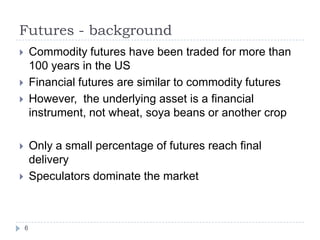
Futures - background
       Commodity futures have been traded for more than
        100 years in the US
       Financial futures are similar to commodity futures
       However, the underlying asset is a financial
        instrument, not wheat, soya beans or another crop

       Only a small percentage of futures reach final
        delivery
       Speculators dominate the market


    6
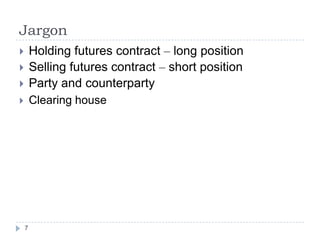
Jargon
       Holding futures contract – long position
       Selling futures contract – short position
       Party and counterparty
       Clearing house


    7
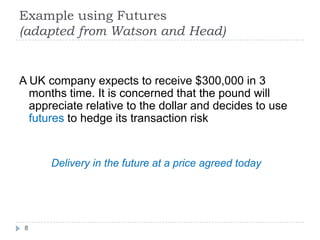
Example using Futures
(adapted from Watson and Head)


A UK company expects to receive $300,000 in 3
  months time. It is concerned that the pound will
  appreciate relative to the dollar and decides to use
  futures to hedge its transaction risk


      Delivery in the future at a price agreed today


 8
Using futures contracts
       Holding a futures contract means delivery at a
        specified date in the future of a pre-agreed amount
        of foreign currency

       The company will buy sterling futures

       This means it will take delivery of sterling and pay
        with the dollars it expects to receive


    9
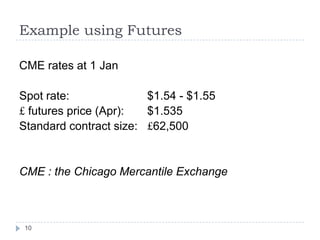
Example using Futures

CME rates at 1 Jan

Spot rate:              $1.54 - $1.55
£ futures price (Apr):  $1.535
Standard contract size: £62,500


CME : the Chicago Mercantile Exchange


 10
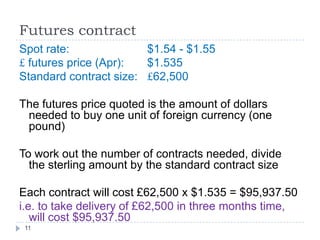
Futures contract
Spot rate:              $1.54 - $1.55
£ futures price (Apr):  $1.535
Standard contract size: £62,500

The futures price quoted is the amount of dollars
 needed to buy one unit of foreign currency (one
 pound)

To work out the number of contracts needed, divide
  the sterling amount by the standard contract size

Each contract will cost £62,500 x $1.535 = $95,937.50
i.e. to take delivery of £62,500 in three months time,
   will cost $95,937.50
 11
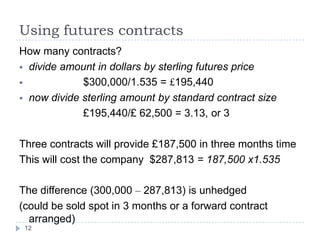
Using futures contracts
How many contracts?
 divide amount in dollars by sterling futures price
            $300,000/1.535 = £195,440
 now divide sterling amount by standard contract size
             £195,440/£ 62,500 = 3.13, or 3

Three contracts will provide £187,500 in three months time
This will cost the company $287,813 = 187,500 x1.535

The difference (300,000 – 287,813) is unhedged
(could be sold spot in 3 months or a forward contract
  arranged)
 12
What has happened?
The UK company
 expects dollars in the future and wants to fix the
  exchange rate now
 buys 3 futures contracts now
 receives a known amount of sterling in the future
  (from the contracts)
 settles in dollars from its dollar payment


 13
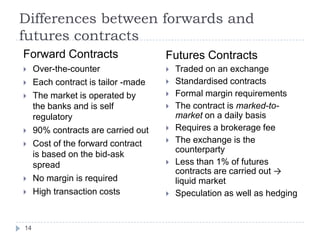
Differences between forwards and
futures contracts
Forward Contracts                    Futures Contracts
    Over-the-counter                   Traded on an exchange
    Each contract is tailor -made      Standardised contracts
    The market is operated by          Formal margin requirements
     the banks and is self              The contract is marked-to-
     regulatory                          market on a daily basis
    90% contracts are carried out      Requires a brokerage fee
    Cost of the forward contract       The exchange is the
                                         counterparty
     is based on the bid-ask
     spread                             Less than 1% of futures
                                         contracts are carried out →
    No margin is required               liquid market
    High transaction costs             Speculation as well as hedging


14
Less than 1% of contracts are carried out
means….
    Liquid market in contracts
    Euronext.liffe has an average daily volume of around
     3 million contracts worth hundreds of billions of
     pounds
    Standardised legal agreements
    Wide market appeal
    It is the contracts that are bought and sold, not the
     commodity
    Liquidity is good


    15
Options
    An option gives the owner the right but not the
     obligation to take delivery of a physical asset at or
     before a pre-agreed date
    Examples of options
        share options
        currency options


    The physical asset is called the underlying asset


    16
Currency Options

    The right to buy/sell currency
        at a given price
        at a given date
    CALL option - the right to buy
    PUT option - the right to sell
    Types of options
        American
        European


    17
What are you buying?
    Buying a currency option - a call - gives you the
     right, but not the obligation, to buy currency at a pre-
     agreed exchange rate at or before a pre-agreed time

    The pre-agreed exchange rate is called the strike
    The pre-agreed date is called the exercise date or
     the expiry
    The price you pay is called the premium

    If you do not trade at or before the exercise date,
     then the option expires worthless
    18
Option terminology
    In-the-money - profitable at the current exchange
     rate
    Out-of-the-money - not profitable at the current
     exchange rate
    At-the-money - exercise price = spot rate


    Intrinsic value – the value the holder of the option
     could realise if the option traded today
        positive if option in-the-money
        otherwise zero

    For the buyer of options, loss is limited to
     premium, potential gain is unlimited
    19
Example using options
(adapted from Watson and Head)

A UK company expects to receive $1m in 3 months
  and decides to hedge its transaction risk with
  currency options.

Currently $1.63/£.

£ is the foreign currency (on CME) and so company
  buys £ call options, strike price $1.65/£


 20
Using options
    The company will buy CME sterling currency options
    The underlying is a futures contract
    Contract size is £62,500
    Sterling is the foreign currency
    The company will buy call options
    This gives the company the right but not the
     obligation to sell dollars and buy sterling at a pre-
     agreed exchange rate


    21
Example using options

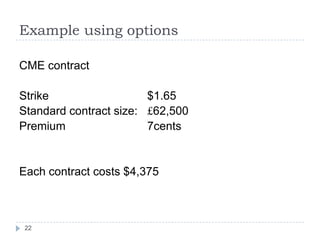
CME contract

Strike                  $1.65
Standard contract size: £62,500
Premium                 7cents


Each contract costs $4,375


 22
Using options
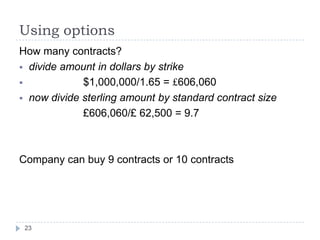
How many contracts?
 divide amount in dollars by strike
            $1,000,000/1.65 = £606,060
 now divide sterling amount by standard contract size
             £606,060/£ 62,500 = 9.7


Company can buy 9 contracts or 10 contracts


 23
Decision
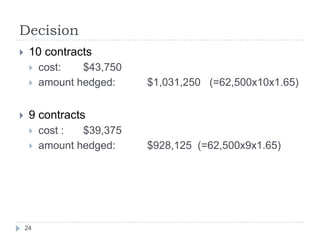
    10 contracts
        cost:   $43,750
        amount hedged:    $1,031,250 (=62,500x10x1.65)


    9 contracts
        cost :  $39,375
        amount hedged:    $928,125 (=62,500x9x1.65)


    24
Mechanism
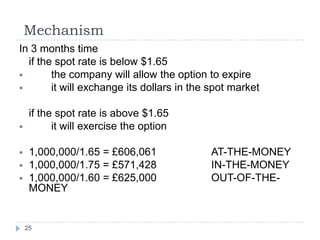
In 3 months time
  if the spot rate is below $1.65
       the company will allow the option to expire
       it will exchange its dollars in the spot market

     if the spot rate is above $1.65
          it will exercise the option

    1,000,000/1.65 = £606,061             AT-THE-MONEY
    1,000,000/1.75 = £571,428             IN-THE-MONEY
    1,000,000/1.60 = £625,000             OUT-OF-THE-
     MONEY


    25
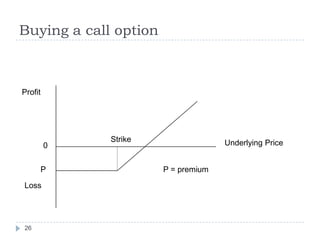
Buying a call option


Profit


             Strike                  Underlying Price
         0


         P             P = premium

Loss


26
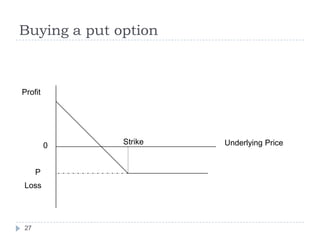
Buying a put option


Profit


         0    Strike   Underlying Price


     P
Loss


27
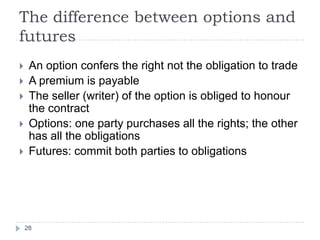
The difference between options and
futures
    An option confers the right not the obligation to trade
    A premium is payable
    The seller (writer) of the option is obliged to honour
     the contract
    Options: one party purchases all the rights; the other
     has all the obligations
    Futures: commit both parties to obligations


    28
Risk Management
Pros                           Cons
 Maintaining                   Complexity of
  competitiveness                instruments
                                Costs
 Reduction of bankruptcy
  risk                          Complex fin reporting
                                 and tax
 Reduction in volatility of
  cash flows


 29
Key Points: currency risk
    Considered use of futures and options to hedge
     forex risk
    Differences between forward/futures plus
     options/futures discussed
    Forex exposure management strategies discussed


    30
Reading
    Watson, D. & Head, A. Corporate Finance
     Principles and Practice, Chapter 12
    Arnold, G. Corporate Financial Management,
     Chapter 24
    Pike, R. & Neale, B. Corporate Finance and
     Investment, Chapter 21


    31

Pcf week 18 risk management forex 2

  • 1.
    Foreign exchange riskmanagement 2 1
  • 2.
    Background  Growing world trade over the past 25 years  Companies involved in transactions involving foreign currencies  about 22% of sales in FTSE 350 companies directly exposed to the US  further 11% in regions tied to the dollar  Pike & Neale, chapter 21  Foreign exchange rate exposure of increasing importance  Companies need to insure against adverse movements in exchange rates 2
  • 3.
    Scenario  A UK company expects to receive $300,000 in 3 months time. It is concerned that the pound will appreciate relative to the dollar and decides to hedge the transaction risk  Current exchange rate is $1.50  How much is $300,000 worth currently?  How much would it be worth in three months time if the exchange rate moved to $1.60? 3
  • 4.
    Scenario  A UK company expects to receive $300,000 in 3 months time.  Current exchange rate is $1.50  How much is $300,000 worth currently?  $300,000/1.50 = £200,000  How much would it be worth in three months time if the exchange rate was $1.60?  $300,000/1.60 = £187,500  Unhedged, this is a LOSS to the company 4
  • 5.
    Futures A financial futurescontract is an agreement to buy or sell, through an organised exchange  a standard amount of a financial instrument  for delivery at a specified date in the future  at a price which is agreed on the trade date  Only members of the exchange can trade  Chicago Mercantile Exchange (CME); Euronext.liffe  Contracts are standardised in terms of contract amounts, dealing dates and size  Delivery in the future at a price agreed today 5
  • 6.
    Futures - background  Commodity futures have been traded for more than 100 years in the US  Financial futures are similar to commodity futures  However, the underlying asset is a financial instrument, not wheat, soya beans or another crop  Only a small percentage of futures reach final delivery  Speculators dominate the market 6
  • 7.
    Jargon  Holding futures contract – long position  Selling futures contract – short position  Party and counterparty  Clearing house 7
  • 8.
    Example using Futures (adaptedfrom Watson and Head) A UK company expects to receive $300,000 in 3 months time. It is concerned that the pound will appreciate relative to the dollar and decides to use futures to hedge its transaction risk Delivery in the future at a price agreed today 8
  • 9.
    Using futures contracts  Holding a futures contract means delivery at a specified date in the future of a pre-agreed amount of foreign currency  The company will buy sterling futures  This means it will take delivery of sterling and pay with the dollars it expects to receive 9
  • 10.
    Example using Futures CMErates at 1 Jan Spot rate: $1.54 - $1.55 £ futures price (Apr): $1.535 Standard contract size: £62,500 CME : the Chicago Mercantile Exchange 10
  • 11.
    Futures contract Spot rate: $1.54 - $1.55 £ futures price (Apr): $1.535 Standard contract size: £62,500 The futures price quoted is the amount of dollars needed to buy one unit of foreign currency (one pound) To work out the number of contracts needed, divide the sterling amount by the standard contract size Each contract will cost £62,500 x $1.535 = $95,937.50 i.e. to take delivery of £62,500 in three months time, will cost $95,937.50 11
  • 12.
    Using futures contracts Howmany contracts?  divide amount in dollars by sterling futures price  $300,000/1.535 = £195,440  now divide sterling amount by standard contract size £195,440/£ 62,500 = 3.13, or 3 Three contracts will provide £187,500 in three months time This will cost the company $287,813 = 187,500 x1.535 The difference (300,000 – 287,813) is unhedged (could be sold spot in 3 months or a forward contract arranged) 12
  • 13.
    What has happened? TheUK company  expects dollars in the future and wants to fix the exchange rate now  buys 3 futures contracts now  receives a known amount of sterling in the future (from the contracts)  settles in dollars from its dollar payment 13
  • 14.
    Differences between forwardsand futures contracts Forward Contracts Futures Contracts  Over-the-counter  Traded on an exchange  Each contract is tailor -made  Standardised contracts  The market is operated by  Formal margin requirements the banks and is self  The contract is marked-to- regulatory market on a daily basis  90% contracts are carried out  Requires a brokerage fee  Cost of the forward contract  The exchange is the counterparty is based on the bid-ask spread  Less than 1% of futures contracts are carried out →  No margin is required liquid market  High transaction costs  Speculation as well as hedging 14
  • 15.
    Less than 1%of contracts are carried out means….  Liquid market in contracts  Euronext.liffe has an average daily volume of around 3 million contracts worth hundreds of billions of pounds  Standardised legal agreements  Wide market appeal  It is the contracts that are bought and sold, not the commodity  Liquidity is good 15
  • 16.
    Options  An option gives the owner the right but not the obligation to take delivery of a physical asset at or before a pre-agreed date  Examples of options  share options  currency options  The physical asset is called the underlying asset 16
  • 17.
    Currency Options  The right to buy/sell currency  at a given price  at a given date  CALL option - the right to buy  PUT option - the right to sell  Types of options  American  European 17
  • 18.
    What are youbuying?  Buying a currency option - a call - gives you the right, but not the obligation, to buy currency at a pre- agreed exchange rate at or before a pre-agreed time  The pre-agreed exchange rate is called the strike  The pre-agreed date is called the exercise date or the expiry  The price you pay is called the premium  If you do not trade at or before the exercise date, then the option expires worthless 18
  • 19.
    Option terminology  In-the-money - profitable at the current exchange rate  Out-of-the-money - not profitable at the current exchange rate  At-the-money - exercise price = spot rate  Intrinsic value – the value the holder of the option could realise if the option traded today  positive if option in-the-money  otherwise zero  For the buyer of options, loss is limited to premium, potential gain is unlimited 19
  • 20.
    Example using options (adaptedfrom Watson and Head) A UK company expects to receive $1m in 3 months and decides to hedge its transaction risk with currency options. Currently $1.63/£. £ is the foreign currency (on CME) and so company buys £ call options, strike price $1.65/£ 20
  • 21.
    Using options  The company will buy CME sterling currency options  The underlying is a futures contract  Contract size is £62,500  Sterling is the foreign currency  The company will buy call options  This gives the company the right but not the obligation to sell dollars and buy sterling at a pre- agreed exchange rate 21
  • 22.
    Example using options CMEcontract Strike $1.65 Standard contract size: £62,500 Premium 7cents Each contract costs $4,375 22
  • 23.
    Using options How manycontracts?  divide amount in dollars by strike  $1,000,000/1.65 = £606,060  now divide sterling amount by standard contract size £606,060/£ 62,500 = 9.7 Company can buy 9 contracts or 10 contracts 23
  • 24.
    Decision  10 contracts  cost: $43,750  amount hedged: $1,031,250 (=62,500x10x1.65)  9 contracts  cost : $39,375  amount hedged: $928,125 (=62,500x9x1.65) 24
  • 25.
    Mechanism In 3 monthstime if the spot rate is below $1.65  the company will allow the option to expire  it will exchange its dollars in the spot market if the spot rate is above $1.65  it will exercise the option  1,000,000/1.65 = £606,061 AT-THE-MONEY  1,000,000/1.75 = £571,428 IN-THE-MONEY  1,000,000/1.60 = £625,000 OUT-OF-THE- MONEY 25
  • 26.
    Buying a calloption Profit Strike Underlying Price 0 P P = premium Loss 26
  • 27.
    Buying a putoption Profit 0 Strike Underlying Price P Loss 27
  • 28.
    The difference betweenoptions and futures  An option confers the right not the obligation to trade  A premium is payable  The seller (writer) of the option is obliged to honour the contract  Options: one party purchases all the rights; the other has all the obligations  Futures: commit both parties to obligations 28
  • 29.
    Risk Management Pros Cons  Maintaining  Complexity of competitiveness instruments  Costs  Reduction of bankruptcy risk  Complex fin reporting and tax  Reduction in volatility of cash flows 29
  • 30.
    Key Points: currencyrisk  Considered use of futures and options to hedge forex risk  Differences between forward/futures plus options/futures discussed  Forex exposure management strategies discussed 30
  • 31.
    Reading  Watson, D. & Head, A. Corporate Finance Principles and Practice, Chapter 12  Arnold, G. Corporate Financial Management, Chapter 24  Pike, R. & Neale, B. Corporate Finance and Investment, Chapter 21 31