Currency and Interest
Rate Swaps

10

Chapter Ten

Chapter Objective:
This chapter discusses currency and interest rate swaps,
which are relatively new instruments for hedging longterm interest rate risk and foreign exchange risk.

Chapter Outline:
• Types of Swaps

• Size of the Swap Market
• The Swap Bank
• Interest Rate Swaps
• Currency Swaps
1
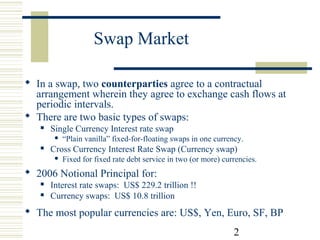
Swap Market
 In a swap, two counterparties agree to a contractual
arrangement wherein they agree to exchange cash flows at
periodic intervals.
 There are two basic types of swaps:


Single Currency Interest rate swap




“Plain vanilla” fixed-for-floating swaps in one currency.

Cross Currency Interest Rate Swap (Currency swap)


Fixed for fixed rate debt service in two (or more) currencies.

 2006 Notional Principal for:



Interest rate swaps: US$ 229.2 trillion !!
Currency swaps: US$ 10.8 trillion

 The most popular currencies are: US$, Yen, Euro, SF, BP
2
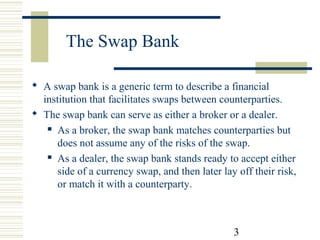
The Swap Bank
 A swap bank is a generic term to describe a financial
institution that facilitates swaps between counterparties.
 The swap bank can serve as either a broker or a dealer.
 As a broker, the swap bank matches counterparties but
does not assume any of the risks of the swap.
 As a dealer, the swap bank stands ready to accept either
side of a currency swap, and then later lay off their risk,
or match it with a counterparty.

3
Interest Rate Swap
 Used by companies and banks that require either fixed or
floating-rate debt.
 Interest rate swaps allow the companies (or banks) and the
swap bank to benefit by swapping fixed-for-floating interest
payments.
 Since principal is in the same currency and the same
amount, only interest payments are exchanged (net).

4
Interest Rate Swap
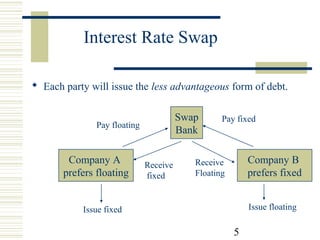
 Each party will issue the less advantageous form of debt.
Swap
Bank

Pay floating

Company A
prefers floating

Receive
fixed

Pay fixed

Company B
prefers fixed

Receive
Floating

Issue floating

Issue fixed

5
An Example of an Interest Rate Swap
 Bank A is a AAA-rated international bank located in the UK and wishes to
raise $10M to finance floating-rate Eurodollar loans.




It would make more sense for the bank to issue floating-rate notes at LIBOR to
finance floating-rate Eurodollar loans.
Bank A can issue 5-year fixed-rate Eurodollar bonds at 10 %

 Firm B is a BBB-rated U.S. company. It needs $10 M to finance an
investment with a five-year economic life.





Firm B can issue 5-year fixed-rate Eurodollar bonds at 11.75 %
Alternatively, firm B can raise the money by issuing 5-year floating-rate notes at
LIBOR + 0.50 percent.
Firm B would prefer to borrow at a fixed rate because it locks in a financing cost.

The borrowing opportunities of the two firms are:
COMPANY
Fixed rate
Floating rate

B

BANK A

11.75%

10%

LIBOR + .5%

LIBOR

6
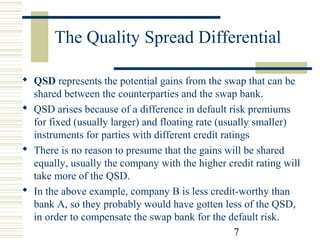
The Quality Spread Differential
 QSD represents the potential gains from the swap that can be
shared between the counterparties and the swap bank.
 QSD arises because of a difference in default risk premiums
for fixed (usually larger) and floating rate (usually smaller)
instruments for parties with different credit ratings
 There is no reason to presume that the gains will be shared
equally, usually the company with the higher credit rating will
take more of the QSD.
 In the above example, company B is less credit-worthy than
bank A, so they probably would have gotten less of the QSD,
in order to compensate the swap bank for the default risk.
7
An Example of an Interest Rate Swap
Swap
10.50%

Bank

LIBOR

The swap bank makes this offer to
Bank A: You pay LIBOR per year
on $10 million for 5 years and we
will pay you 10.50% on $10
million for 5 years

Bank
A
Issue $10M debt
at 10% fixed-rate

COMPANY
Fixed rate
Floating rate

B

BANK A

11.75%

10%

LIBOR + .5%

LIBOR

8
An Example of an Interest Rate Swap
0.50% of $10,000,000
= $50,000. That’s
quite a cost savings
per year for 5 years.

Here’s what’s in it for Bank A:
Bank A can borrow externally
at 10% fixed and have a net
borrowing position of

Swap

10.50%

Bank

-10.50% + 10% + LIBOR =

LIBOR

Bank
10%

LIBOR – 0.50% which is 0.50
% better than they can borrow
floating without a swap.

A
COMPANY
Fixed rate
Floating rate

B

BANK A

11.75%

10%

LIBOR + .5%

LIBOR

9
An Example of an Interest Rate Swap
The swap bank makes
this offer to company
B: You pay us 10.75%
per year on $10
million for 5 years and
we will pay you
LIBOR per year on
$10 million for 5
years.

Swap
Bank
10.75%
LIBOR

Company
B
Issue $10M debt at
LIBOR+0.50% floating-rate
COMPANY

Fixed rate
Floating rate

B

BANK A

11.75%

10%

LIBOR + .5%

LIBOR

10
An Example of an Interest Rate Swap
0.5 % of $10,000,000 =
$50,000 that’s quite a
cost savings per year for
5 years.

Swap
Here’s what’s in it for Firm B:
Firm B can borrow externally at
LIBOR + .50 % and have a net
borrowing position of

Bank

10.75%
LIBOR

Company

10.75 + (LIBOR + .50 ) - LIBOR = 11.25% which
is 0.50 % better than they can borrow floating
(11.75%).
COMPANY
Fixed rate
Floating rate

B

B
BANK A

11.75%

10%

LIBOR + .5%

LIBOR

11

LIBOR
+ .50%
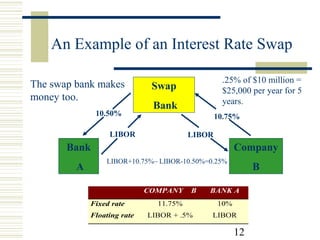
An Example of an Interest Rate Swap
The swap bank makes
money too.
10.50%

.25% of $10 million =
$25,000 per year for 5
years.

Swap
Bank

10.75%

LIBOR

LIBOR

Bank
A

Company
LIBOR+10.75%– LIBOR-10.50%=0.25%

COMPANY
Fixed rate
Floating rate

B

B

BANK A

11.75%

10%

LIBOR + .5%

LIBOR

12
An Example of an Interest Rate Swap
The swap bank makes .25%
Swap
10.50%

Bank
10.75%

LIBOR

LIBOR

Bank
A
A saves .50%
Fixed rate
Floating rate

Company

COMPANY

B

B
B saves .50%

BANK A

11.75%

10%

LIBOR + .5%

LIBOR

13
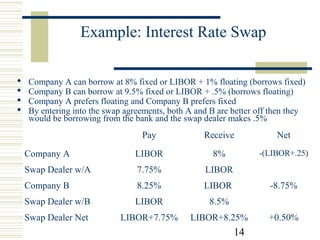
Example: Interest Rate Swap





Company A can borrow at 8% fixed or LIBOR + 1% floating (borrows fixed)
Company B can borrow at 9.5% fixed or LIBOR + .5% (borrows floating)
Company A prefers floating and Company B prefers fixed
By entering into the swap agreements, both A and B are better off then they
would be borrowing from the bank and the swap dealer makes .5%

Pay

Receive

Net

Company A

LIBOR

8%

-(LIBOR+.25)

Swap Dealer w/A

7.75%

LIBOR

Company B

8.25%

LIBOR

Swap Dealer w/B

LIBOR

8.5%

Swap Dealer Net

LIBOR+7.75%

LIBOR+8.25%

-8.75%

14

+0.50%
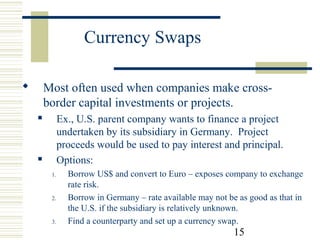
Currency Swaps


Most often used when companies make crossborder capital investments or projects.
Ex., U.S. parent company wants to finance a project
undertaken by its subsidiary in Germany. Project
proceeds would be used to pay interest and principal.
Options:




1.

2.

3.

Borrow US$ and convert to Euro – exposes company to exchange
rate risk.
Borrow in Germany – rate available may not be as good as that in
the U.S. if the subsidiary is relatively unknown.
Find a counterparty and set up a currency swap.

15
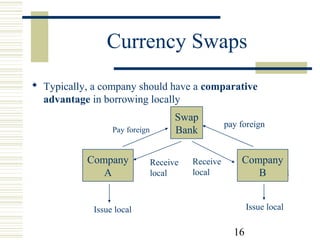
Currency Swaps
 Typically, a company should have a comparative
advantage in borrowing locally
Pay foreign

Company
issue local
A

Swap
Bank
Receive
local

Receive
local

pay foreign

Company
issue local
B
Issue local

Issue local

16
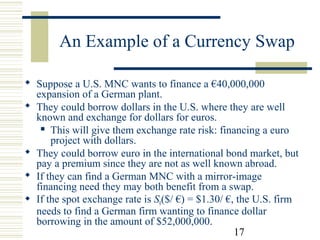
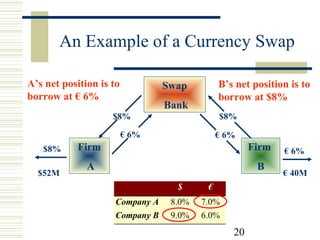
An Example of a Currency Swap
 Suppose a U.S. MNC wants to finance a €40,000,000
expansion of a German plant.
 They could borrow dollars in the U.S. where they are well
known and exchange for dollars for euros.
 This will give them exchange rate risk: financing a euro
project with dollars.
 They could borrow euro in the international bond market, but
pay a premium since they are not as well known abroad.
 If they can find a German MNC with a mirror-image
financing need they may both benefit from a swap.
 If the spot exchange rate is S0($/ €) = $1.30/ €, the U.S. firm
needs to find a German firm wanting to finance dollar
borrowing in the amount of $52,000,000.
17
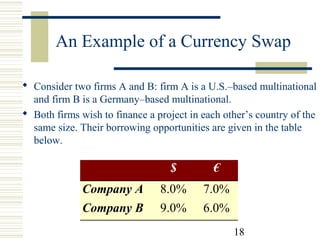
An Example of a Currency Swap
 Consider two firms A and B: firm A is a U.S.–based multinational
and firm B is a Germany–based multinational.
 Both firms wish to finance a project in each other’s country of the
same size. Their borrowing opportunities are given in the table
below.

$

€

Company A

8.0%

7.0%

Company B

9.0%

6.0%
18
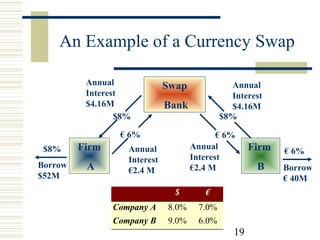
An Example of a Currency Swap
Annual
Interest
$4.16M
$8%

Swap
Bank

€ 6%
$8%

Firm

Borrow
$52M

A

Annual
Interest
$4.16M
$8%
€ 6%
Annual
Interest
€2.4 M

Annual
Interest
€2.4 M

$

€

Company A

8.0%

7.0%

Company B

9.0%

6.0%

19

Firm
B

€ 6%
Borrow
€ 40M
An Example of a Currency Swap
A’s net position is to
borrow at € 6%

B’s net position is to
borrow at $8%

Swap
Bank

$8%

$8%

€ 6%
$8%
$52M

€ 6%

Firm

Firm

A

B
$

€

Company A

8.0%

7.0%

Company B

9.0%

6.0%

20

€ 6%
€ 40M
Swap Market Quotations
 Swap banks will tailor the terms of interest rate and currency swaps to
customers’ needs. They also make a market in “plain vanilla” and currency
swaps and provide quotes for these. Since the swap banks are dealers for
these swaps, there is a bid-ask spread.

 Interest Rate Swap Example:
 Swap bank terms: USD: 2.50 – 2.65
Means that the bank is willing to pay fixed-rate 2.50% interest against receiving
LIBOR OR bank is willing to receive fixed-rate 2.65% against paying LIBOR.

 Currency Swap Example:
 Swap bank terms: USD 2.50 – 2.65
Euro 3.25 – 3.50
Means that bank is willing to make fixed rate USD payments at 2.5% in
return for receiving fixed rate Euro at 3.5% OR the bank is willing to
receive fixed-rate USD at 2.65% in return for making fixed-rate Euro
payments at 3.25%

21
Risks of Interest Rate
and Currency Swaps
Interest Rate Risk
 Interest rates might move against the swap bank after it has only gotten half of
a swap on the books, or if it has an unhedged position.
Basis Risk
 Floating rates of the two counterparties being pegged to two different indices
Exchange rate Risk
 Exchange rates might move against the swap bank after it has only gotten half
of a swap set up.
Credit Risk
 This is the major risk faced by a swap dealer—the risk that a counter party
will default on its end of the swap.
Mismatch Risk
 It’s hard to find a counterparty that wants to borrow the right amount of
money for the right amount of time.
Sovereign Risk
 The risk that a country will impose exchange rate restrictions that will
interfere with performance on the swap.

22

Ch10 XFJDFGJ DFJDF YJDFHJ

  • 1.
    Currency and Interest RateSwaps 10 Chapter Ten Chapter Objective: This chapter discusses currency and interest rate swaps, which are relatively new instruments for hedging longterm interest rate risk and foreign exchange risk. Chapter Outline: • Types of Swaps • Size of the Swap Market • The Swap Bank • Interest Rate Swaps • Currency Swaps 1
  • 2.
    Swap Market  Ina swap, two counterparties agree to a contractual arrangement wherein they agree to exchange cash flows at periodic intervals.  There are two basic types of swaps:  Single Currency Interest rate swap   “Plain vanilla” fixed-for-floating swaps in one currency. Cross Currency Interest Rate Swap (Currency swap)  Fixed for fixed rate debt service in two (or more) currencies.  2006 Notional Principal for:   Interest rate swaps: US$ 229.2 trillion !! Currency swaps: US$ 10.8 trillion  The most popular currencies are: US$, Yen, Euro, SF, BP 2
  • 3.
    The Swap Bank A swap bank is a generic term to describe a financial institution that facilitates swaps between counterparties.  The swap bank can serve as either a broker or a dealer.  As a broker, the swap bank matches counterparties but does not assume any of the risks of the swap.  As a dealer, the swap bank stands ready to accept either side of a currency swap, and then later lay off their risk, or match it with a counterparty. 3
  • 4.
    Interest Rate Swap Used by companies and banks that require either fixed or floating-rate debt.  Interest rate swaps allow the companies (or banks) and the swap bank to benefit by swapping fixed-for-floating interest payments.  Since principal is in the same currency and the same amount, only interest payments are exchanged (net). 4
  • 5.
    Interest Rate Swap Each party will issue the less advantageous form of debt. Swap Bank Pay floating Company A prefers floating Receive fixed Pay fixed Company B prefers fixed Receive Floating Issue floating Issue fixed 5
  • 6.
    An Example ofan Interest Rate Swap  Bank A is a AAA-rated international bank located in the UK and wishes to raise $10M to finance floating-rate Eurodollar loans.   It would make more sense for the bank to issue floating-rate notes at LIBOR to finance floating-rate Eurodollar loans. Bank A can issue 5-year fixed-rate Eurodollar bonds at 10 %  Firm B is a BBB-rated U.S. company. It needs $10 M to finance an investment with a five-year economic life.    Firm B can issue 5-year fixed-rate Eurodollar bonds at 11.75 % Alternatively, firm B can raise the money by issuing 5-year floating-rate notes at LIBOR + 0.50 percent. Firm B would prefer to borrow at a fixed rate because it locks in a financing cost. The borrowing opportunities of the two firms are: COMPANY Fixed rate Floating rate B BANK A 11.75% 10% LIBOR + .5% LIBOR 6
  • 7.
    The Quality SpreadDifferential  QSD represents the potential gains from the swap that can be shared between the counterparties and the swap bank.  QSD arises because of a difference in default risk premiums for fixed (usually larger) and floating rate (usually smaller) instruments for parties with different credit ratings  There is no reason to presume that the gains will be shared equally, usually the company with the higher credit rating will take more of the QSD.  In the above example, company B is less credit-worthy than bank A, so they probably would have gotten less of the QSD, in order to compensate the swap bank for the default risk. 7
  • 8.
    An Example ofan Interest Rate Swap Swap 10.50% Bank LIBOR The swap bank makes this offer to Bank A: You pay LIBOR per year on $10 million for 5 years and we will pay you 10.50% on $10 million for 5 years Bank A Issue $10M debt at 10% fixed-rate COMPANY Fixed rate Floating rate B BANK A 11.75% 10% LIBOR + .5% LIBOR 8
  • 9.
    An Example ofan Interest Rate Swap 0.50% of $10,000,000 = $50,000. That’s quite a cost savings per year for 5 years. Here’s what’s in it for Bank A: Bank A can borrow externally at 10% fixed and have a net borrowing position of Swap 10.50% Bank -10.50% + 10% + LIBOR = LIBOR Bank 10% LIBOR – 0.50% which is 0.50 % better than they can borrow floating without a swap. A COMPANY Fixed rate Floating rate B BANK A 11.75% 10% LIBOR + .5% LIBOR 9
  • 10.
    An Example ofan Interest Rate Swap The swap bank makes this offer to company B: You pay us 10.75% per year on $10 million for 5 years and we will pay you LIBOR per year on $10 million for 5 years. Swap Bank 10.75% LIBOR Company B Issue $10M debt at LIBOR+0.50% floating-rate COMPANY Fixed rate Floating rate B BANK A 11.75% 10% LIBOR + .5% LIBOR 10
  • 11.
    An Example ofan Interest Rate Swap 0.5 % of $10,000,000 = $50,000 that’s quite a cost savings per year for 5 years. Swap Here’s what’s in it for Firm B: Firm B can borrow externally at LIBOR + .50 % and have a net borrowing position of Bank 10.75% LIBOR Company 10.75 + (LIBOR + .50 ) - LIBOR = 11.25% which is 0.50 % better than they can borrow floating (11.75%). COMPANY Fixed rate Floating rate B B BANK A 11.75% 10% LIBOR + .5% LIBOR 11 LIBOR + .50%
  • 12.
    An Example ofan Interest Rate Swap The swap bank makes money too. 10.50% .25% of $10 million = $25,000 per year for 5 years. Swap Bank 10.75% LIBOR LIBOR Bank A Company LIBOR+10.75%– LIBOR-10.50%=0.25% COMPANY Fixed rate Floating rate B B BANK A 11.75% 10% LIBOR + .5% LIBOR 12
  • 13.
    An Example ofan Interest Rate Swap The swap bank makes .25% Swap 10.50% Bank 10.75% LIBOR LIBOR Bank A A saves .50% Fixed rate Floating rate Company COMPANY B B B saves .50% BANK A 11.75% 10% LIBOR + .5% LIBOR 13
  • 14.
    Example: Interest RateSwap     Company A can borrow at 8% fixed or LIBOR + 1% floating (borrows fixed) Company B can borrow at 9.5% fixed or LIBOR + .5% (borrows floating) Company A prefers floating and Company B prefers fixed By entering into the swap agreements, both A and B are better off then they would be borrowing from the bank and the swap dealer makes .5% Pay Receive Net Company A LIBOR 8% -(LIBOR+.25) Swap Dealer w/A 7.75% LIBOR Company B 8.25% LIBOR Swap Dealer w/B LIBOR 8.5% Swap Dealer Net LIBOR+7.75% LIBOR+8.25% -8.75% 14 +0.50%
  • 15.
    Currency Swaps  Most oftenused when companies make crossborder capital investments or projects. Ex., U.S. parent company wants to finance a project undertaken by its subsidiary in Germany. Project proceeds would be used to pay interest and principal. Options:   1. 2. 3. Borrow US$ and convert to Euro – exposes company to exchange rate risk. Borrow in Germany – rate available may not be as good as that in the U.S. if the subsidiary is relatively unknown. Find a counterparty and set up a currency swap. 15
  • 16.
    Currency Swaps  Typically,a company should have a comparative advantage in borrowing locally Pay foreign Company issue local A Swap Bank Receive local Receive local pay foreign Company issue local B Issue local Issue local 16
  • 17.
    An Example ofa Currency Swap  Suppose a U.S. MNC wants to finance a €40,000,000 expansion of a German plant.  They could borrow dollars in the U.S. where they are well known and exchange for dollars for euros.  This will give them exchange rate risk: financing a euro project with dollars.  They could borrow euro in the international bond market, but pay a premium since they are not as well known abroad.  If they can find a German MNC with a mirror-image financing need they may both benefit from a swap.  If the spot exchange rate is S0($/ €) = $1.30/ €, the U.S. firm needs to find a German firm wanting to finance dollar borrowing in the amount of $52,000,000. 17
  • 18.
    An Example ofa Currency Swap  Consider two firms A and B: firm A is a U.S.–based multinational and firm B is a Germany–based multinational.  Both firms wish to finance a project in each other’s country of the same size. Their borrowing opportunities are given in the table below. $ € Company A 8.0% 7.0% Company B 9.0% 6.0% 18
  • 19.
    An Example ofa Currency Swap Annual Interest $4.16M $8% Swap Bank € 6% $8% Firm Borrow $52M A Annual Interest $4.16M $8% € 6% Annual Interest €2.4 M Annual Interest €2.4 M $ € Company A 8.0% 7.0% Company B 9.0% 6.0% 19 Firm B € 6% Borrow € 40M
  • 20.
    An Example ofa Currency Swap A’s net position is to borrow at € 6% B’s net position is to borrow at $8% Swap Bank $8% $8% € 6% $8% $52M € 6% Firm Firm A B $ € Company A 8.0% 7.0% Company B 9.0% 6.0% 20 € 6% € 40M
  • 21.
    Swap Market Quotations Swap banks will tailor the terms of interest rate and currency swaps to customers’ needs. They also make a market in “plain vanilla” and currency swaps and provide quotes for these. Since the swap banks are dealers for these swaps, there is a bid-ask spread.  Interest Rate Swap Example:  Swap bank terms: USD: 2.50 – 2.65 Means that the bank is willing to pay fixed-rate 2.50% interest against receiving LIBOR OR bank is willing to receive fixed-rate 2.65% against paying LIBOR.  Currency Swap Example:  Swap bank terms: USD 2.50 – 2.65 Euro 3.25 – 3.50 Means that bank is willing to make fixed rate USD payments at 2.5% in return for receiving fixed rate Euro at 3.5% OR the bank is willing to receive fixed-rate USD at 2.65% in return for making fixed-rate Euro payments at 3.25% 21
  • 22.
    Risks of InterestRate and Currency Swaps Interest Rate Risk  Interest rates might move against the swap bank after it has only gotten half of a swap on the books, or if it has an unhedged position. Basis Risk  Floating rates of the two counterparties being pegged to two different indices Exchange rate Risk  Exchange rates might move against the swap bank after it has only gotten half of a swap set up. Credit Risk  This is the major risk faced by a swap dealer—the risk that a counter party will default on its end of the swap. Mismatch Risk  It’s hard to find a counterparty that wants to borrow the right amount of money for the right amount of time. Sovereign Risk  The risk that a country will impose exchange rate restrictions that will interfere with performance on the swap. 22

Editor's Notes

  • #10 We are calculating net cash outflow.