-Prepared by Mr.Amit A Rajdev,
-Faculty of Finance,VMPIM.
Transaction Exposure
1. What is TE?
Transaction exposure can be defined as the sensitivity of
“realized” domestic currency values of the firm’s contractual
cash flows denominated in foreign currencies to unexpected
exchange rate changes.
TE defined as the risk for changes in the exchange rates for
the contracts that are entered but not yet settled.
Transaction exposure arises from fixed-price contracting in a
world where exchange rates are changing randomly.
2. Management of TE
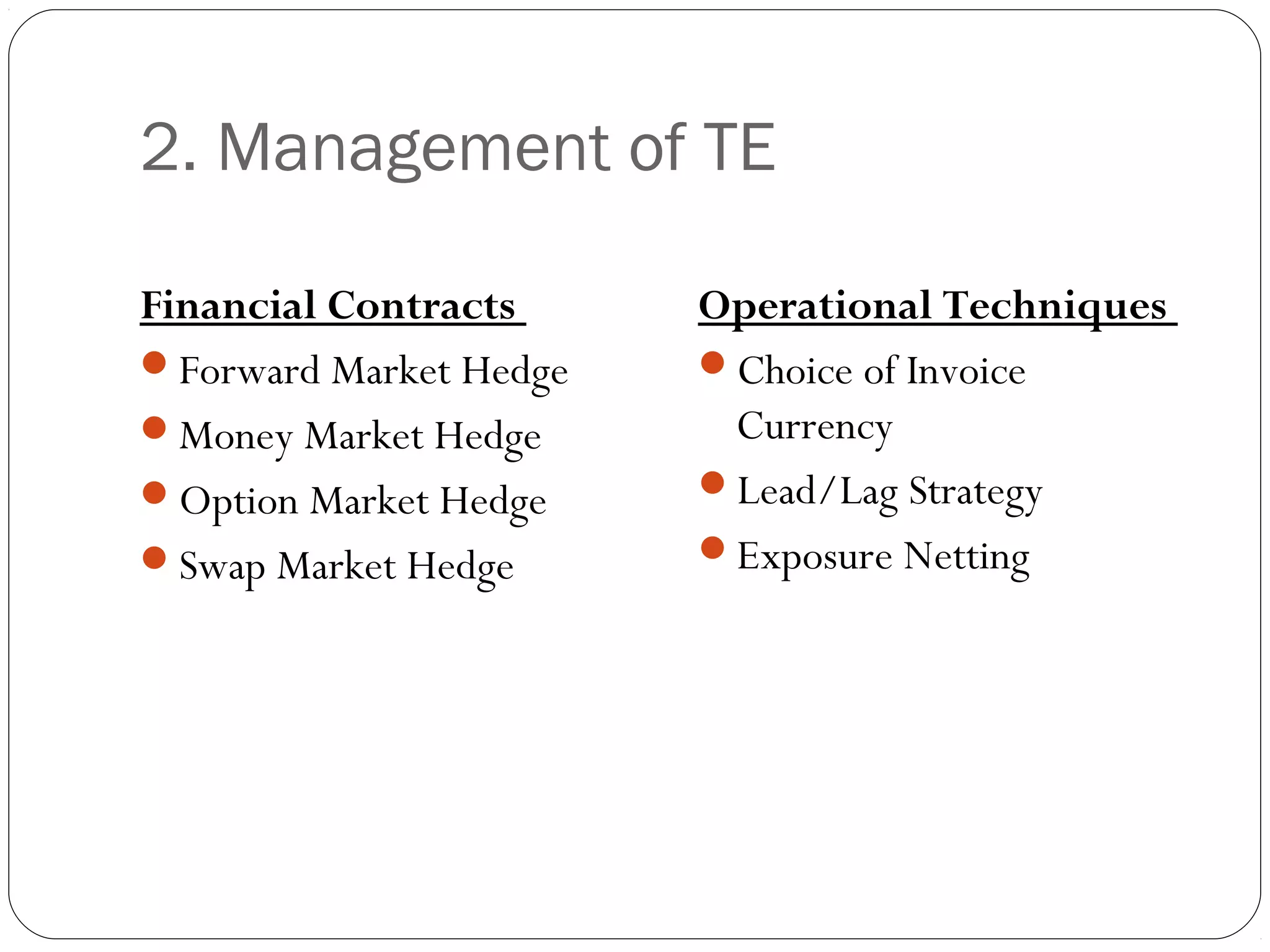
Financial Contracts
Forward Market Hedge
Money Market Hedge
Option Market Hedge
Swap Market Hedge
Operational Techniques
Choice of Invoice
Currency
Lead/Lag Strategy
Exposure Netting
Example: Write in your book.
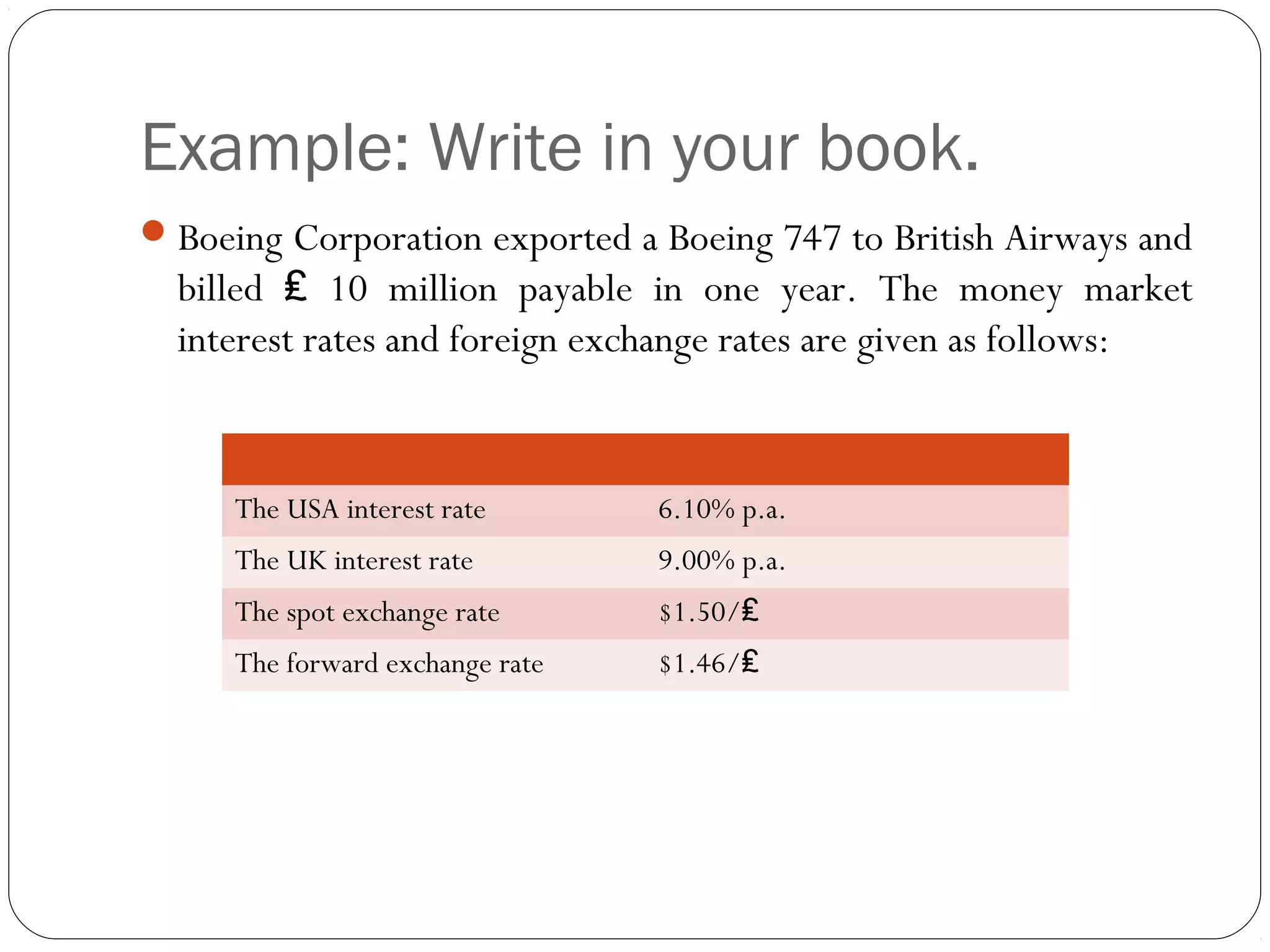
Boeing Corporation exported a Boeing 747 to British Airways and
billed 10 million payable in one year. The money market₤
interest rates and foreign exchange rates are given as follows:
The USA interest rate 6.10% p.a.
The UK interest rate 9.00% p.a.
The spot exchange rate $1.50/₤
The forward exchange rate $1.46/₤
Using Financial Contracts
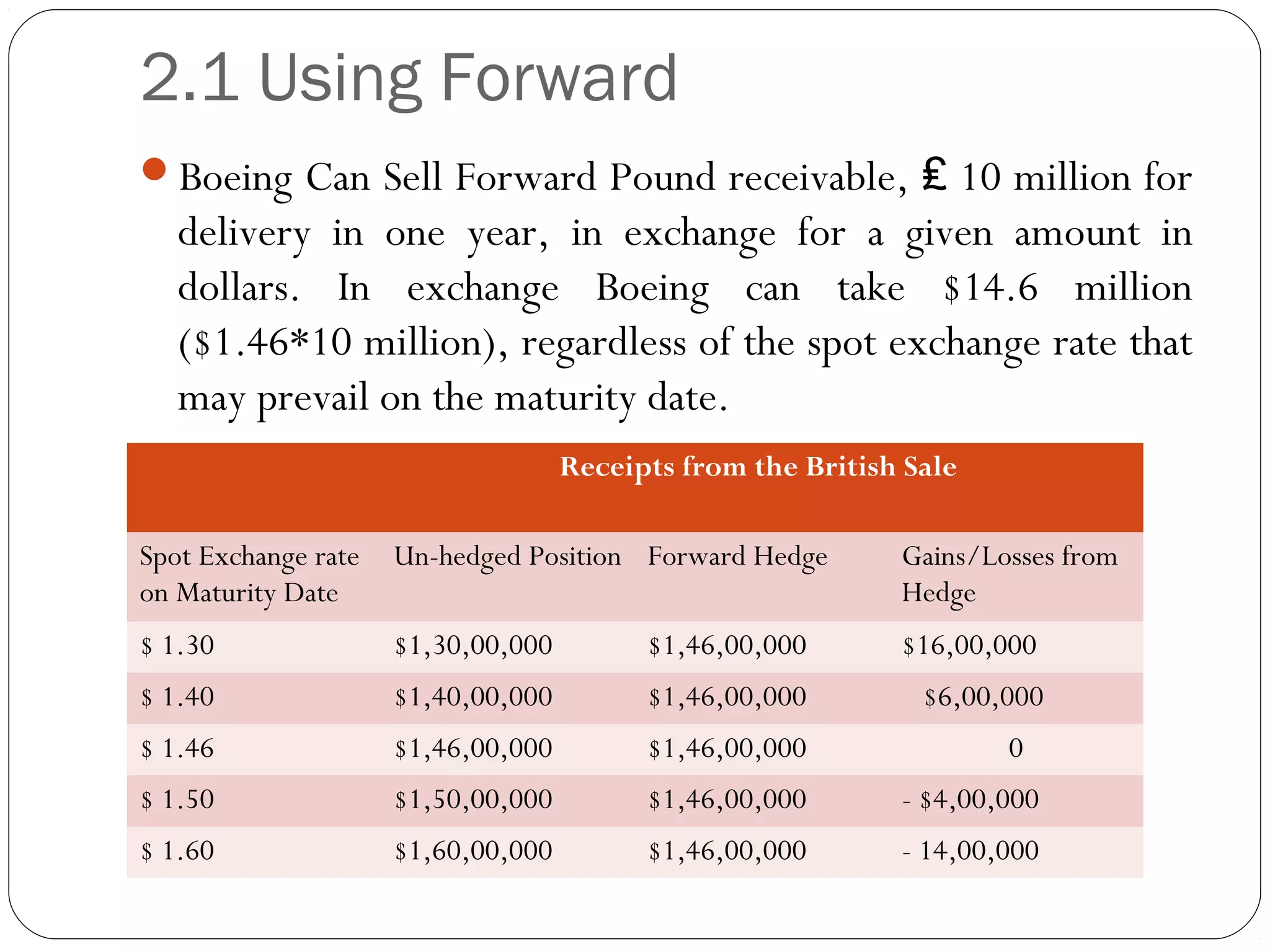
2.1 Using Forward
Boeing Can Sell Forward Pound receivable, 10 million for₤
delivery in one year, in exchange for a given amount in
dollars. In exchange Boeing can take $14.6 million
($1.46*10 million), regardless of the spot exchange rate that
may prevail on the maturity date.
Receipts from the British Sale
Spot Exchange rate
on Maturity Date
Un-hedged Position Forward Hedge Gains/Losses from
Hedge
$ 1.30 $1,30,00,000 $1,46,00,000 $16,00,000
$ 1.40 $1,40,00,000 $1,46,00,000 $6,00,000
$ 1.46 $1,46,00,000 $1,46,00,000 0
$ 1.50 $1,50,00,000 $1,46,00,000 - $4,00,000
$ 1.60 $1,60,00,000 $1,46,00,000 - 14,00,000
2.2 Money Market Hedge
The firm may borrow (lend) in foreign currency to hedge its
foreign currency receivables (payables), thereby matching its
assets and liabilities in the same currency.
Continuing with same example, Boeing can eliminate the
exchange exposure arising from the British sale by first
borrowing in pounds, then converting the loan proceeds into
dollars, which then can be invested at the dollar interest rate.
On maturity date of the loan, Boeing is going to use to
pound receivable to pay off the pound loan.
2.2 Money Market Hedge
If Boeing borrows a particular pound amount so that the
maturity value of this loan becomes exactly equal to
pound receivable from the British sale, Boeing’s net pound
exposure is reduced to zero, and Boeing will receive the
future maturity value of the dollar investment.
2.2 Money Market Hedge
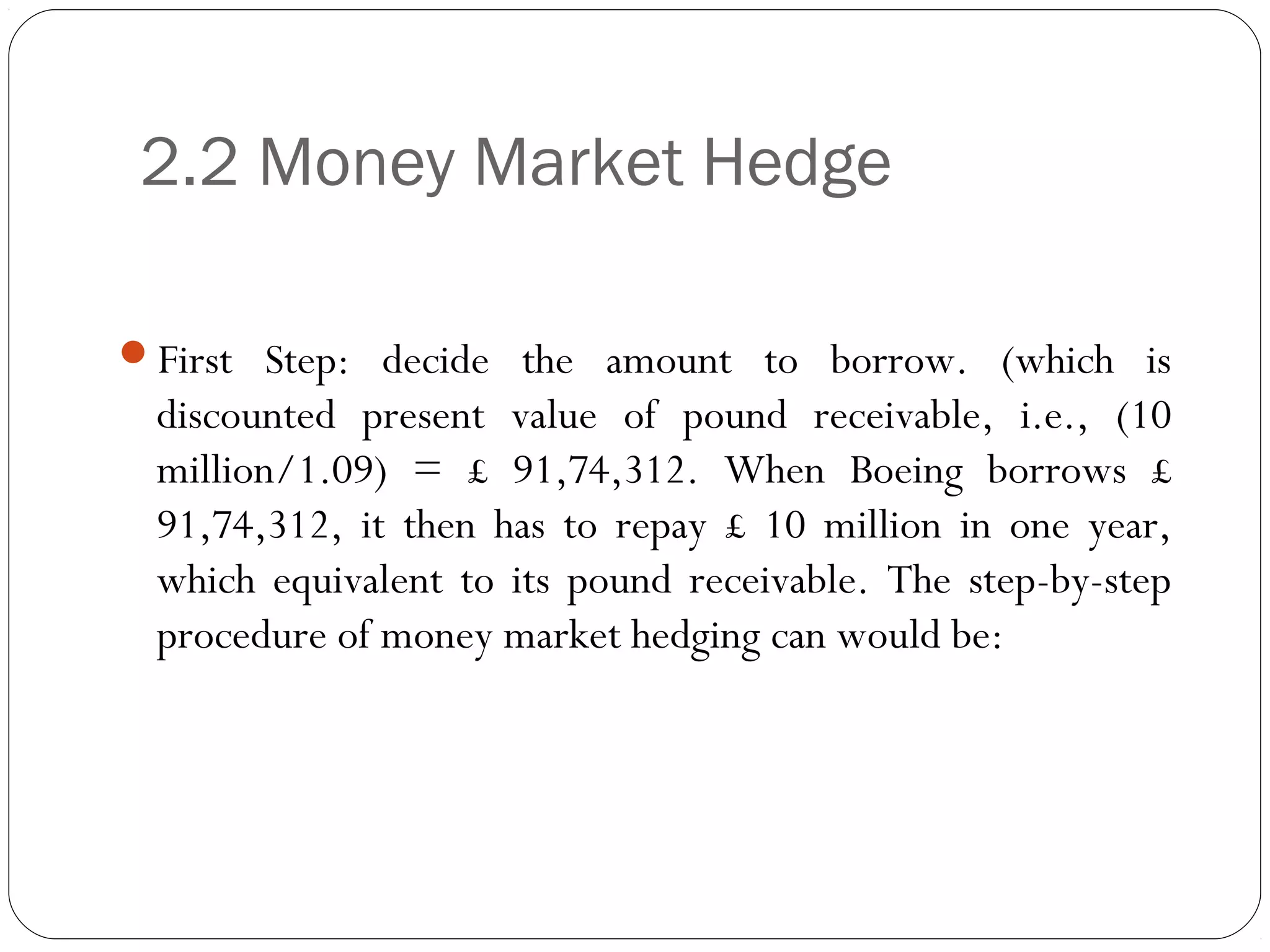
First Step: decide the amount to borrow. (which is
discounted present value of pound receivable, i.e., (10
million/1.09) = £ 91,74,312. When Boeing borrows £
91,74,312, it then has to repay £ 10 million in one year,
which equivalent to its pound receivable. The step-by-step
procedure of money market hedging can would be:
2.2 Money Market Hedge
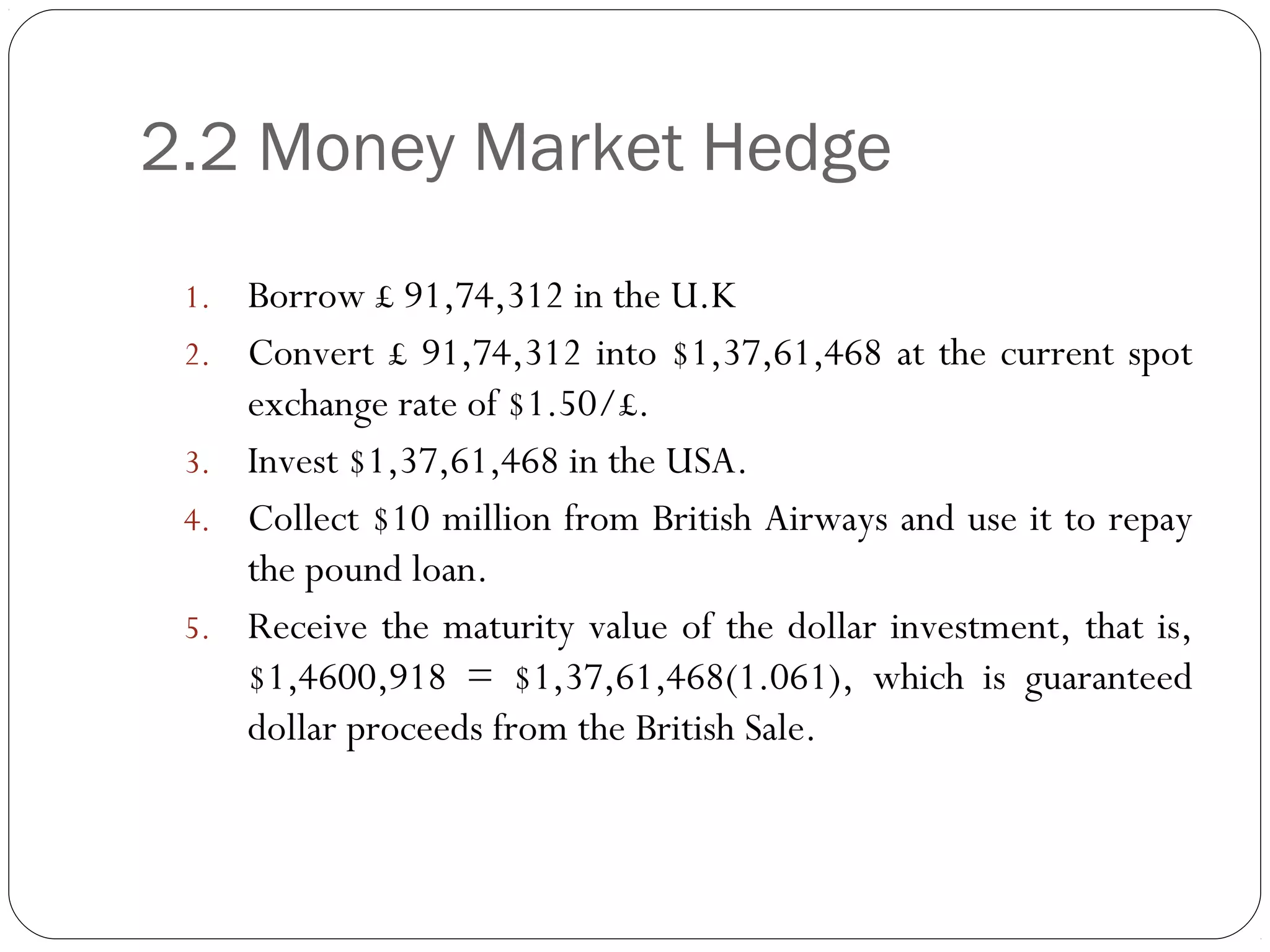
1. Borrow £ 91,74,312 in the U.K
2. Convert £ 91,74,312 into $1,37,61,468 at the current spot
exchange rate of $1.50/£.
3. Invest $1,37,61,468 in the USA.
4. Collect $10 million from British Airways and use it to repay
the pound loan.
5. Receive the maturity value of the dollar investment, that is,
$1,4600,918 = $1,37,61,468(1.061), which is guaranteed
dollar proceeds from the British Sale.
2.3 Options Market Hedge
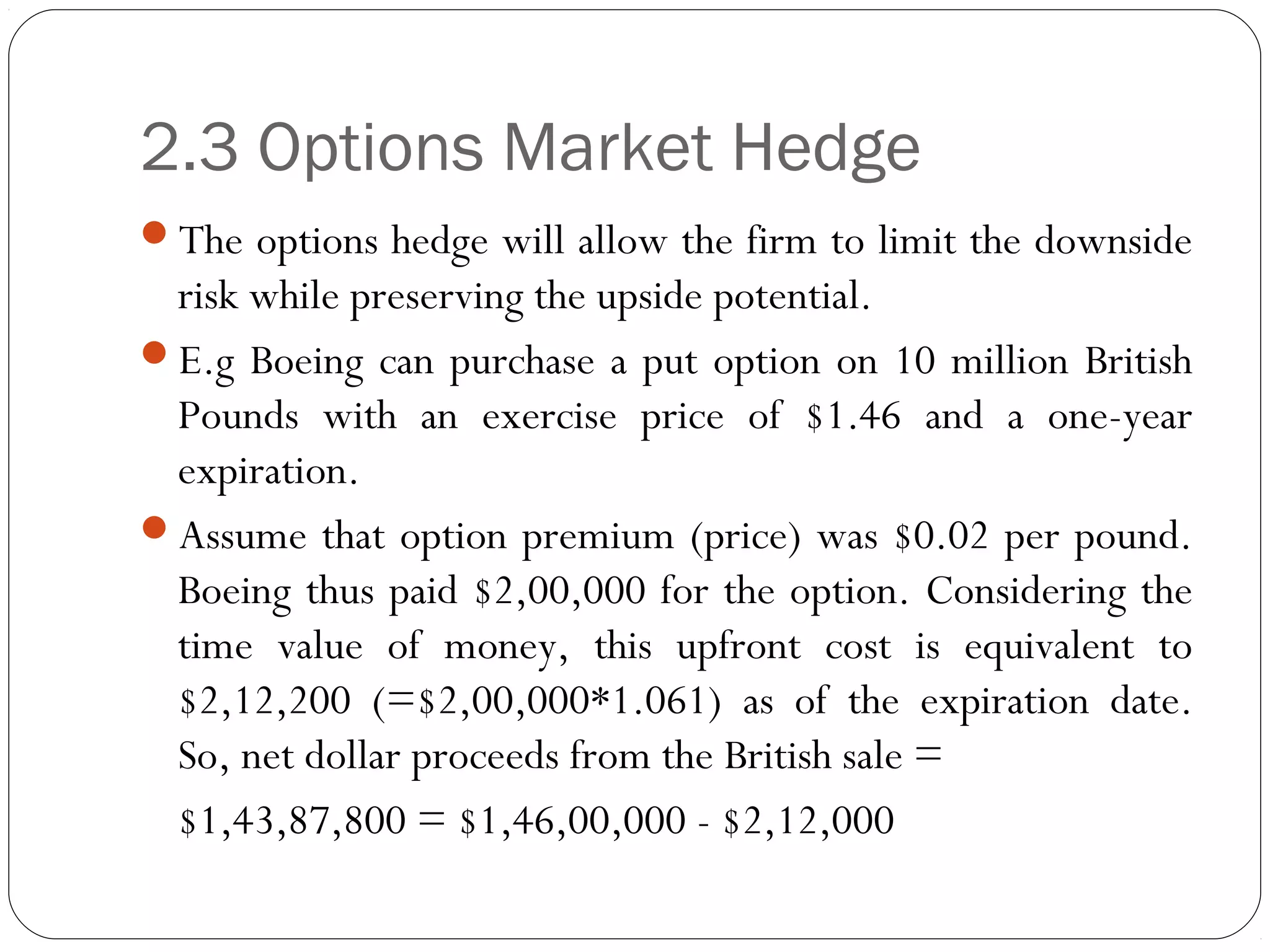
The options hedge will allow the firm to limit the downside
risk while preserving the upside potential.
E.g Boeing can purchase a put option on 10 million British
Pounds with an exercise price of $1.46 and a one-year
expiration.
Assume that option premium (price) was $0.02 per pound.
Boeing thus paid $2,00,000 for the option. Considering the
time value of money, this upfront cost is equivalent to
$2,12,200 (=$2,00,000*1.061) as of the expiration date.
So, net dollar proceeds from the British sale =
$1,43,87,800 = $1,46,00,000 - $2,12,000
2.3 Options Market Hedge
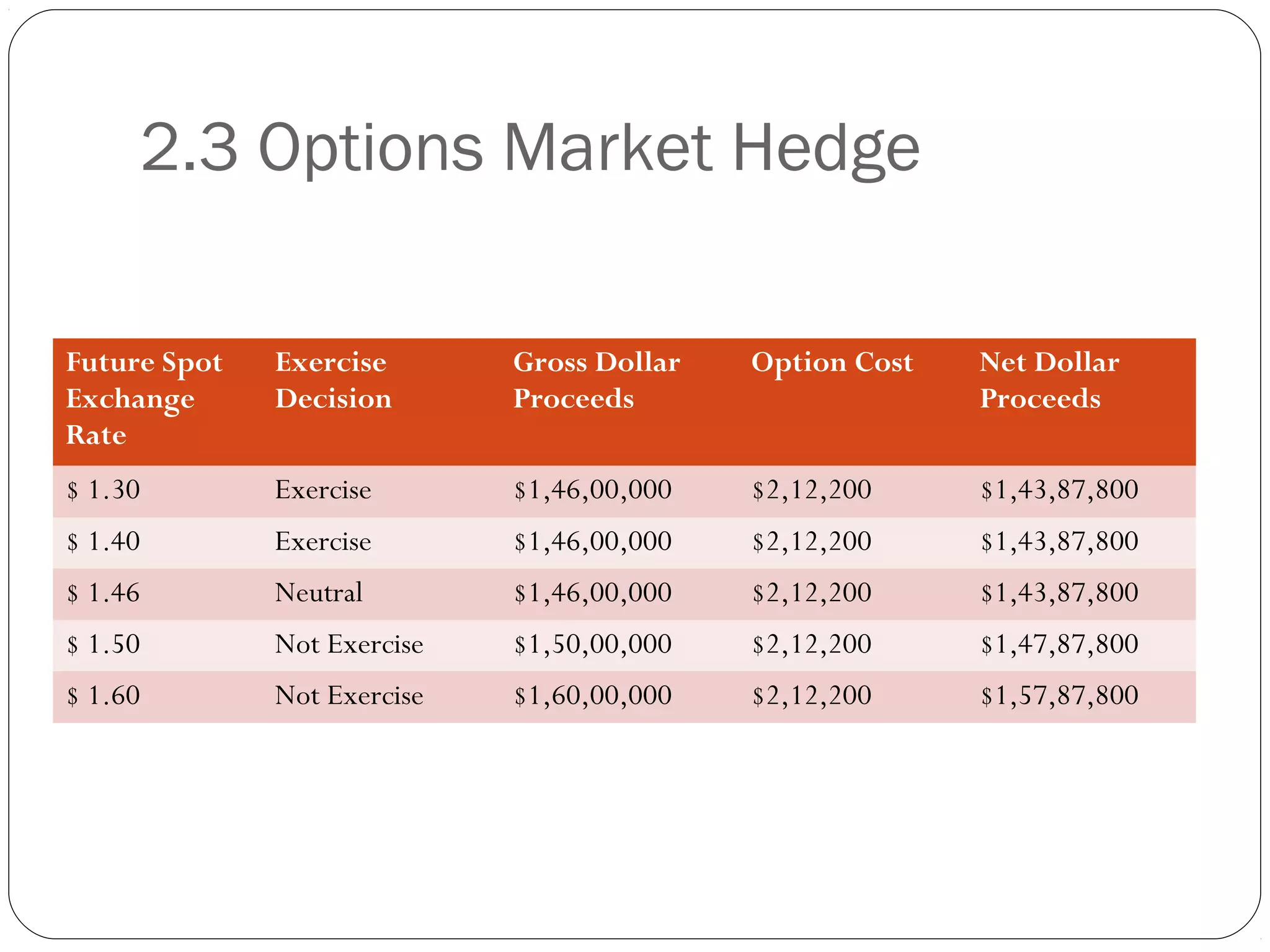
Future Spot
Exchange
Rate
Exercise
Decision
Gross Dollar
Proceeds
Option Cost Net Dollar
Proceeds
$ 1.30 Exercise $1,46,00,000 $2,12,200 $1,43,87,800
$ 1.40 Exercise $1,46,00,000 $2,12,200 $1,43,87,800
$ 1.46 Neutral $1,46,00,000 $2,12,200 $1,43,87,800
$ 1.50 Not Exercise $1,50,00,000 $2,12,200 $1,47,87,800
$ 1.60 Not Exercise $1,60,00,000 $2,12,200 $1,57,87,800
2.4 Hedging Through SWAPs
Firms often have to deal with a “sequence” of accounts
payable or receivable in terms of a foreign currency.
Such recurrent cash flows in a foreign currency can best be
hedged using a currency swap contract, which is an
agreement to exchange one currency for another at a
predetermined exchange rate, that is, the swap rate, on a
sequence of future dates.
Using Opeational Techniques
3.1 Hedging Through Invoice Currency
The firm can shift, share, or diversify exchange risk by
appropriately choosing the currency of invoice.
3.2 Hedging via Lead & Lag
The lead means to pay or collect early, whereas to lag means
to pay or collect late.
3.3 Exposure Netting
If the firm has a portfolio of currencies positions, it makes
sense to hedge residual exposure rather than hedge each
currency option separately.
Examples
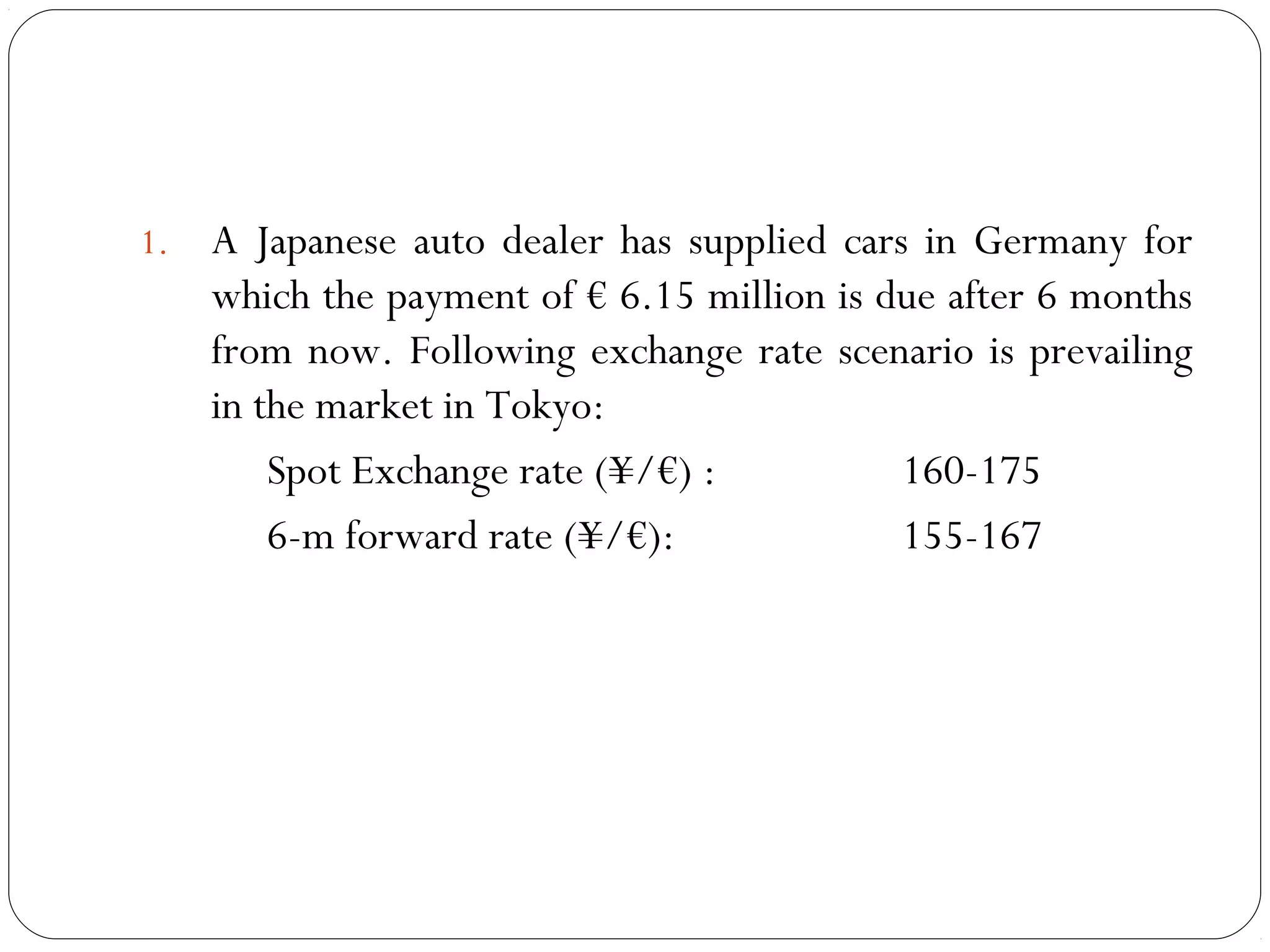
1. A Japanese auto dealer has supplied cars in Germany for
which the payment of € 6.15 million is due after 6 months
from now. Following exchange rate scenario is prevailing
in the market in Tokyo:
Spot Exchange rate (¥/€) : 160-175
6-m forward rate (¥/€): 155-167
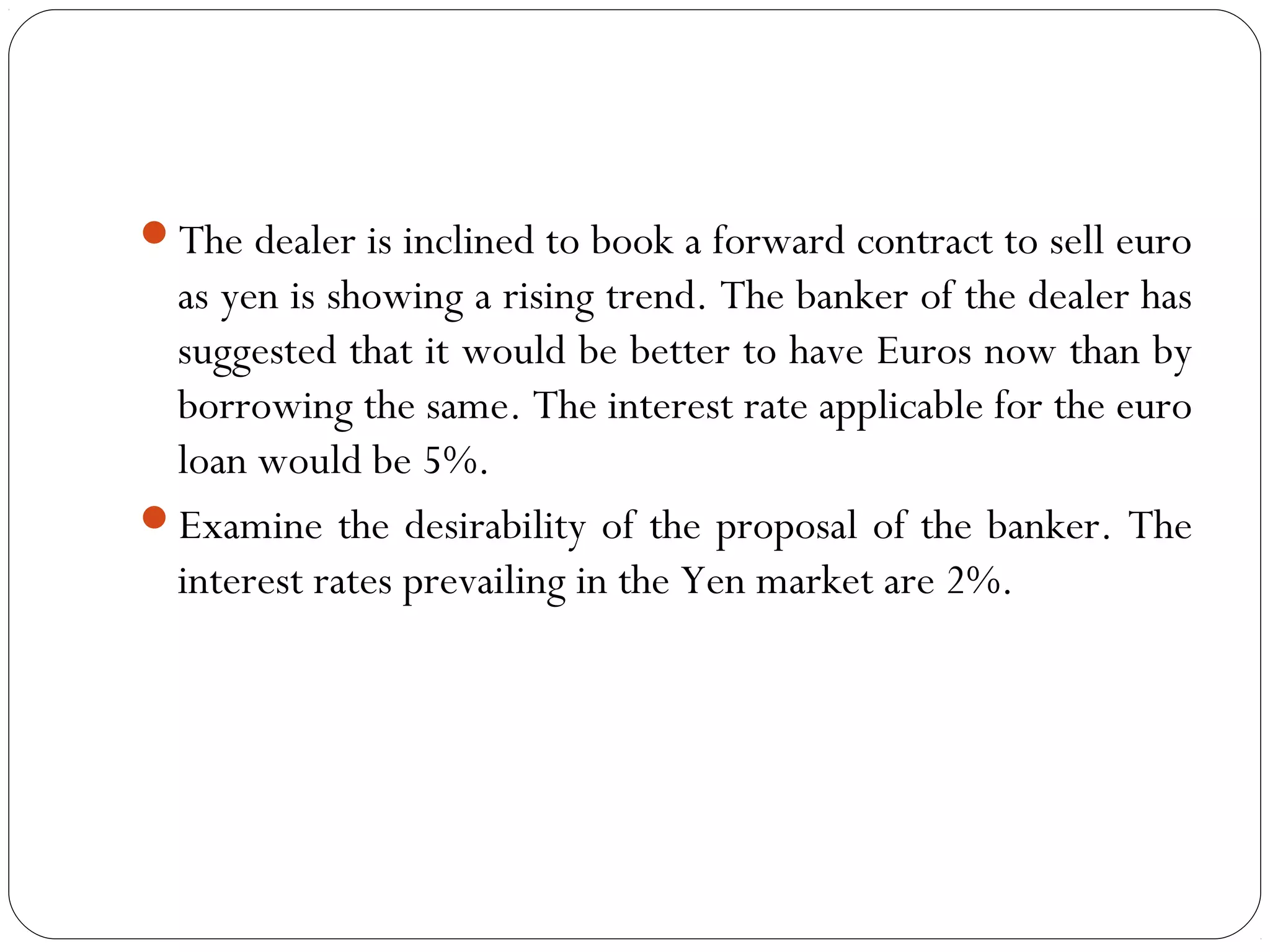
The dealer is inclined to book a forward contract to sell euro
as yen is showing a rising trend. The banker of the dealer has
suggested that it would be better to have Euros now than by
borrowing the same. The interest rate applicable for the euro
loan would be 5%.
Examine the desirability of the proposal of the banker. The
interest rates prevailing in the Yen market are 2%.
Solution-1
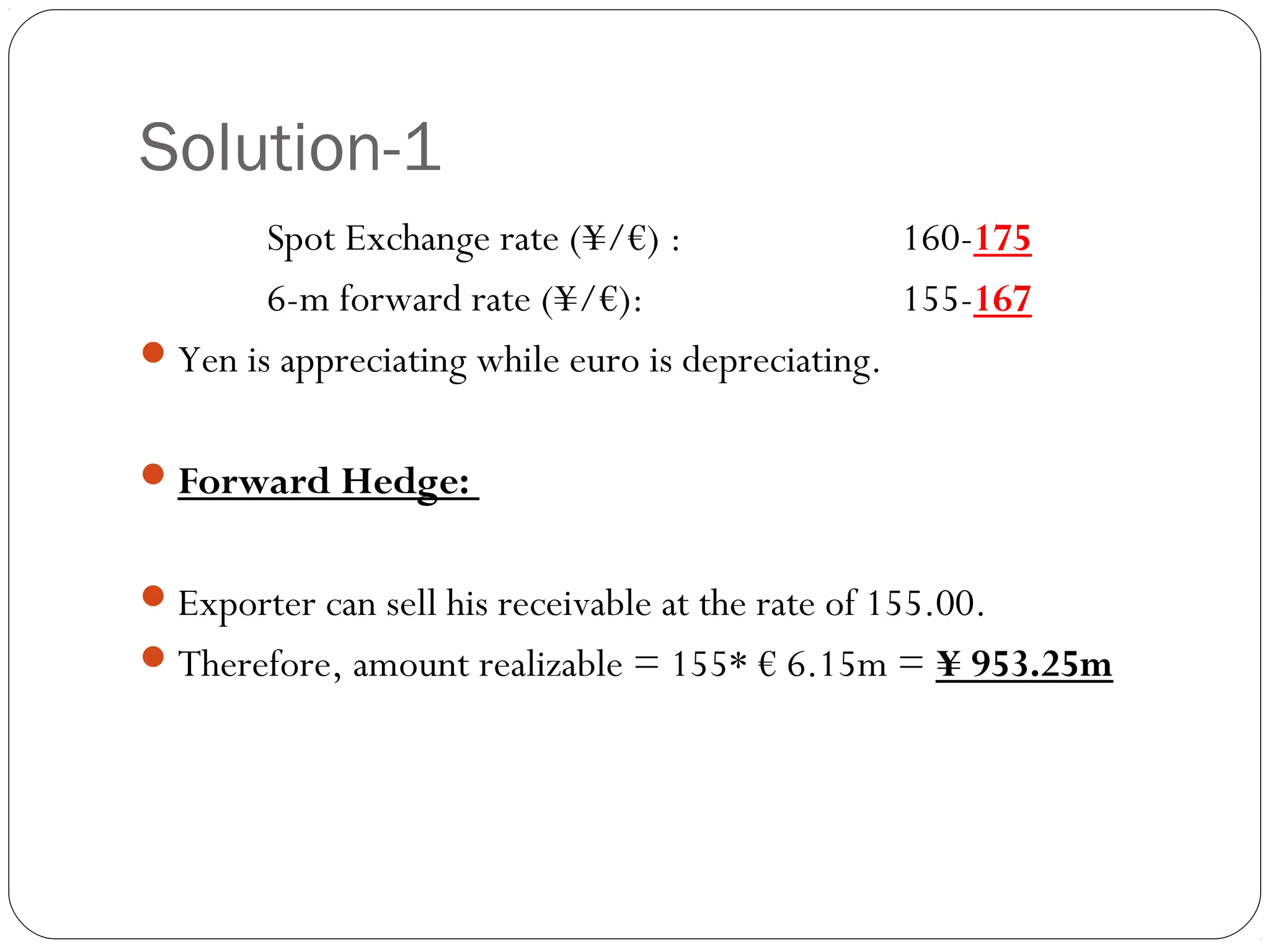
Spot Exchange rate (¥/€) : 160-175
6-m forward rate (¥/€): 155-167
Yen is appreciating while euro is depreciating.
Forward Hedge:
Exporter can sell his receivable at the rate of 155.00.
Therefore, amount realizable = 155* € 6.15m = ¥ 953.25m
Solution-1
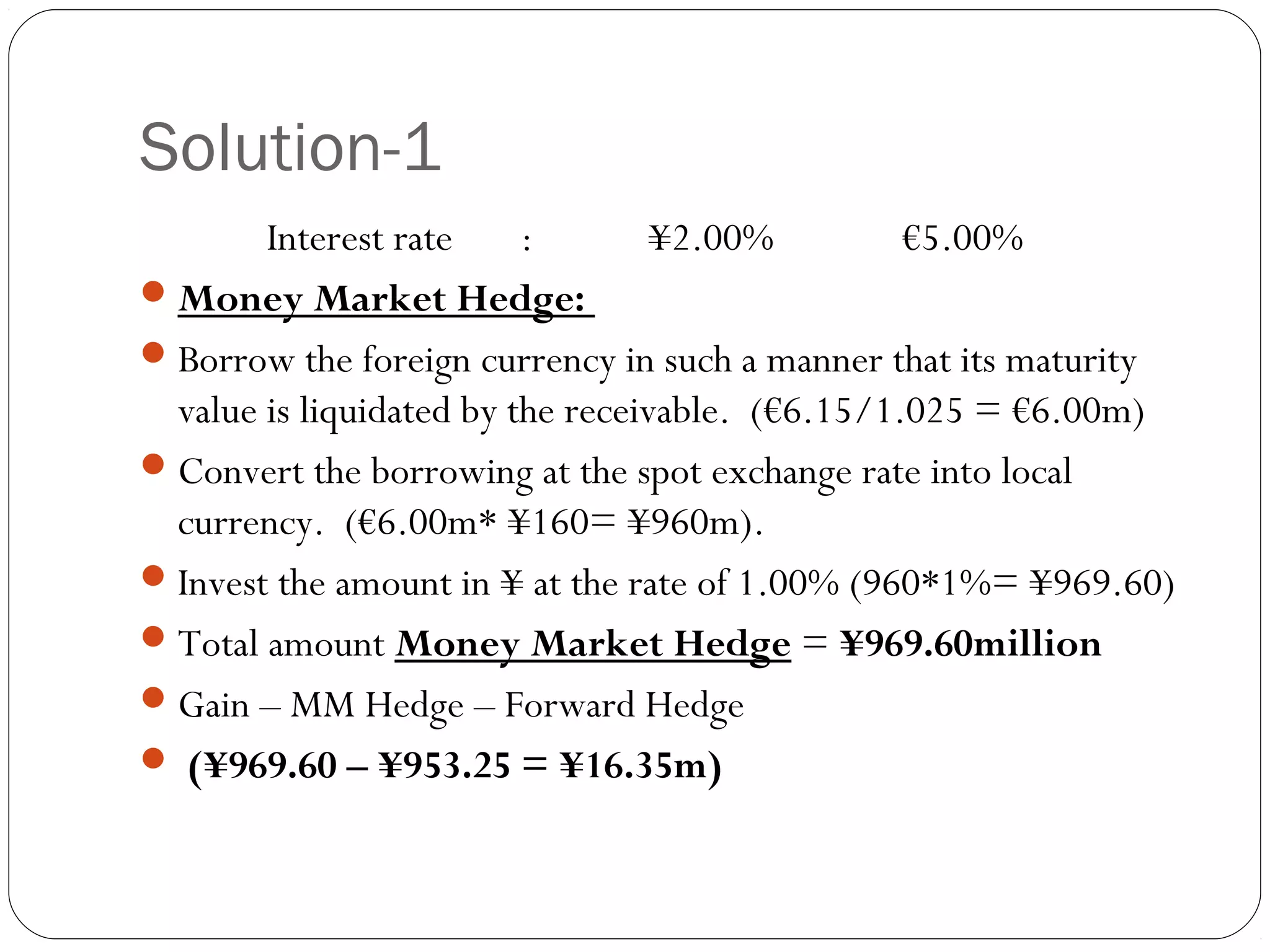
Interest rate : ¥2.00% €5.00%
Money Market Hedge:
Borrow the foreign currency in such a manner that its maturity
value is liquidated by the receivable. (€6.15/1.025 = €6.00m)
Convert the borrowing at the spot exchange rate into local
currency. (€6.00m* ¥160= ¥960m).
Invest the amount in ¥ at the rate of 1.00% (960*1%= ¥969.60)
Total amount Money Market Hedge = ¥969.60million
Gain – MM Hedge – Forward Hedge
 (¥969.60 – ¥953.25 = ¥16.35m)
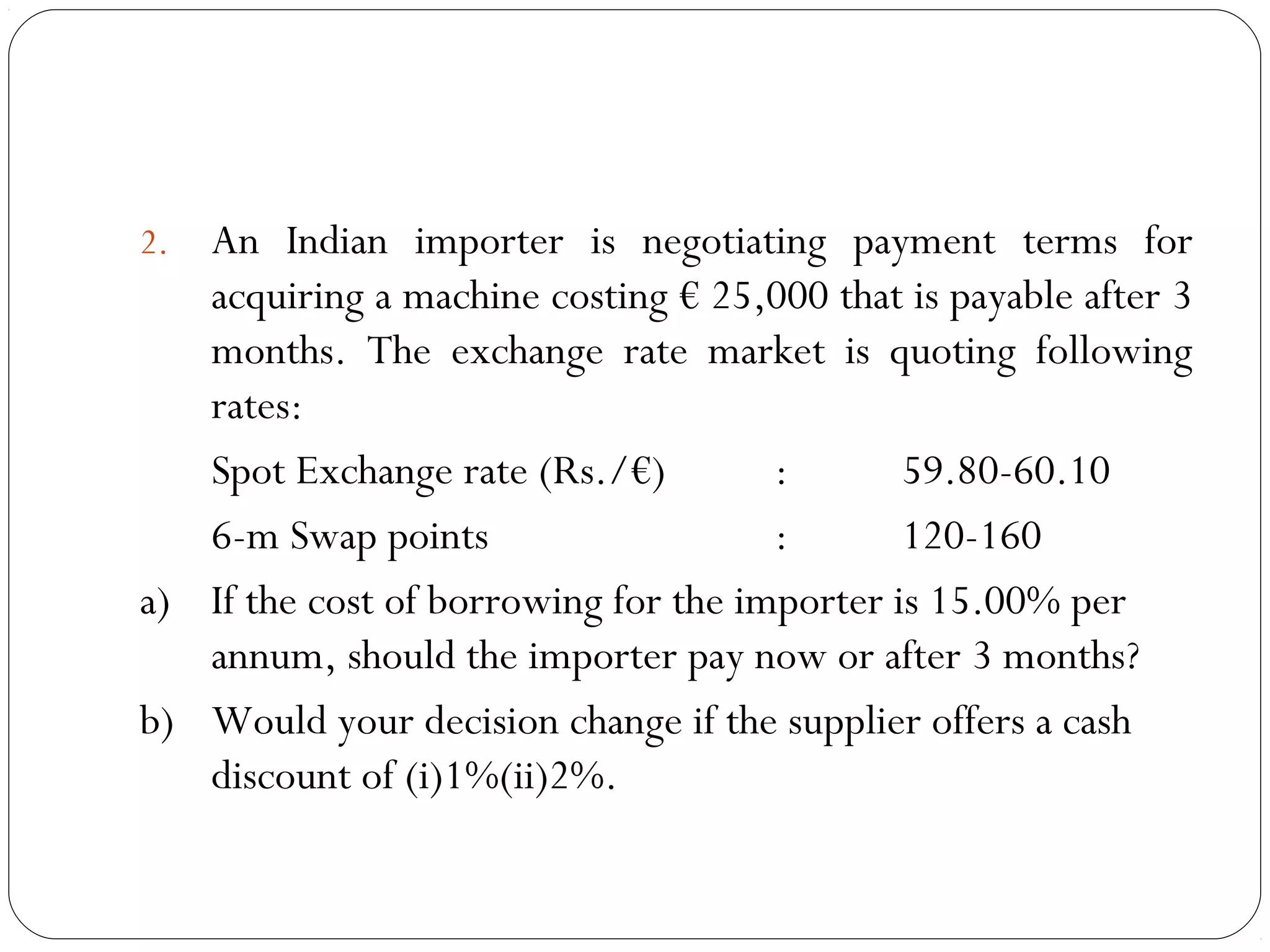
2. An Indian importer is negotiating payment terms for
acquiring a machine costing € 25,000 that is payable after 3
months. The exchange rate market is quoting following
rates:
Spot Exchange rate (Rs./€) : 59.80-60.10
6-m Swap points : 120-160
a) If the cost of borrowing for the importer is 15.00% per
annum, should the importer pay now or after 3 months?
b) Would your decision change if the supplier offers a cash
discount of (i)1%(ii)2%.
Solution-2
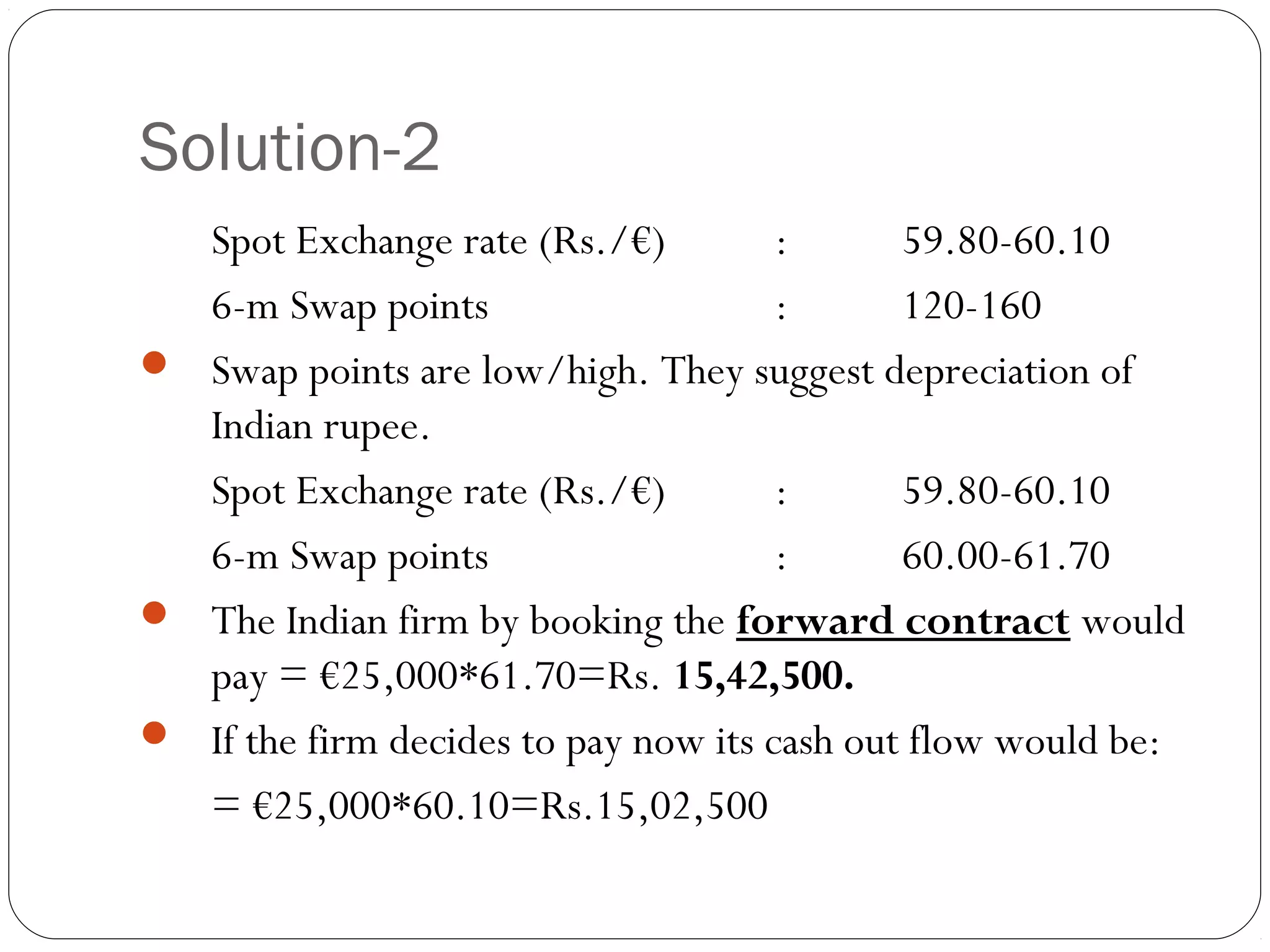
Spot Exchange rate (Rs./€) : 59.80-60.10
6-m Swap points : 120-160
 Swap points are low/high. They suggest depreciation of
Indian rupee.
Spot Exchange rate (Rs./€) : 59.80-60.10
6-m Swap points : 60.00-61.70
 The Indian firm by booking the forward contract would
pay = €25,000*61.70=Rs. 15,42,500.
 If the firm decides to pay now its cash out flow would be:
= €25,000*60.10=Rs.15,02,500
Solution-2
Cost of borrowing = 15%p.a.
Interest payable for 3-m = 15,02,500*3.75% = Rs.56344.
Effective amount = 15,02,500 + 56,344 = 15,58,844.
a. Conclusion: Since forward amount is less Rs. 15,42,500
compared to loan amount firm should go for credit period.
Solution-2
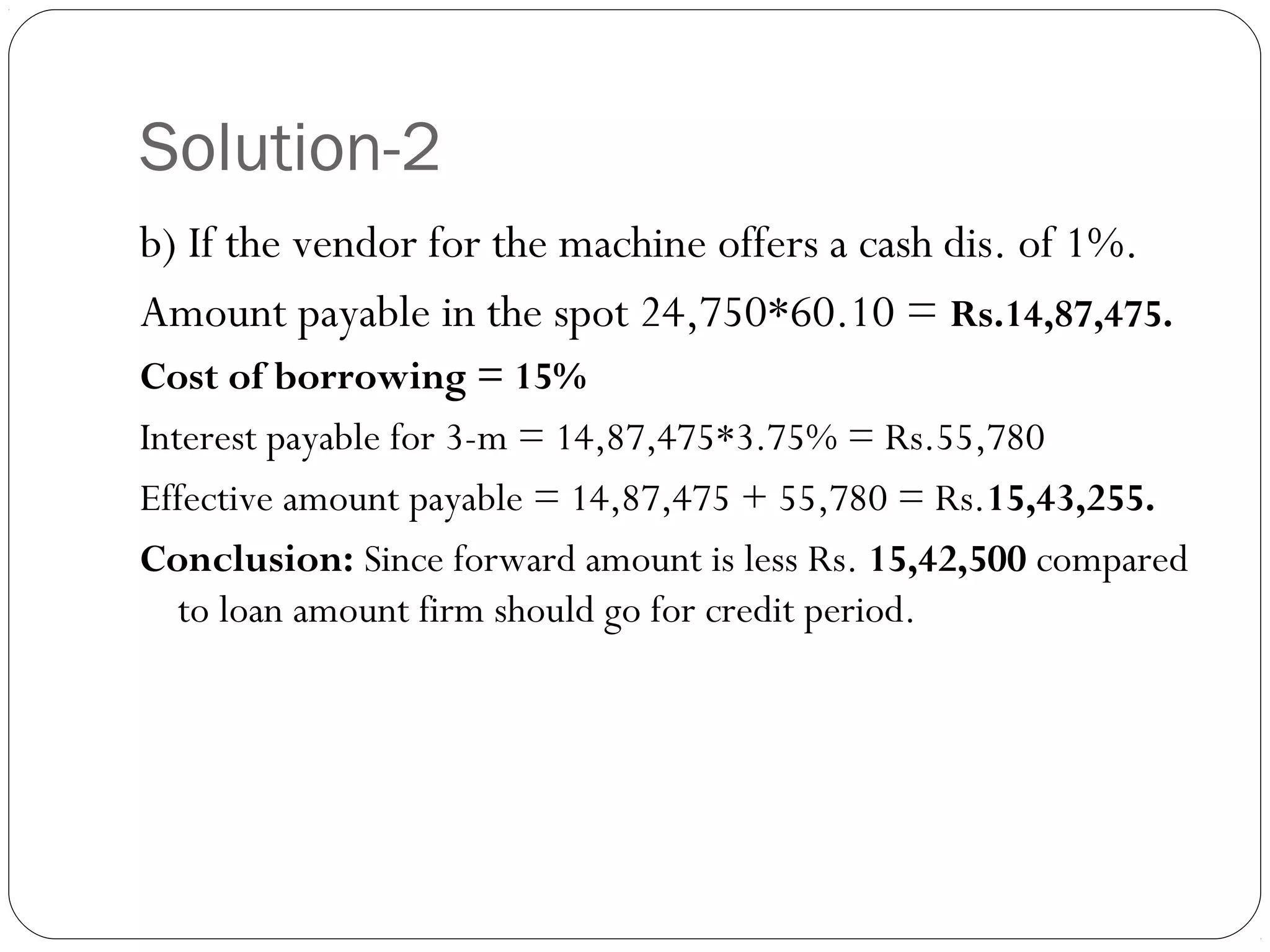
b) If the vendor for the machine offers a cash dis. of 1%.
Amount payable in the spot 24,750*60.10 = Rs.14,87,475.
Cost of borrowing = 15%
Interest payable for 3-m = 14,87,475*3.75% = Rs.55,780
Effective amount payable = 14,87,475 + 55,780 = Rs.15,43,255.
Conclusion: Since forward amount is less Rs. 15,42,500 compared
to loan amount firm should go for credit period.
Solution-2
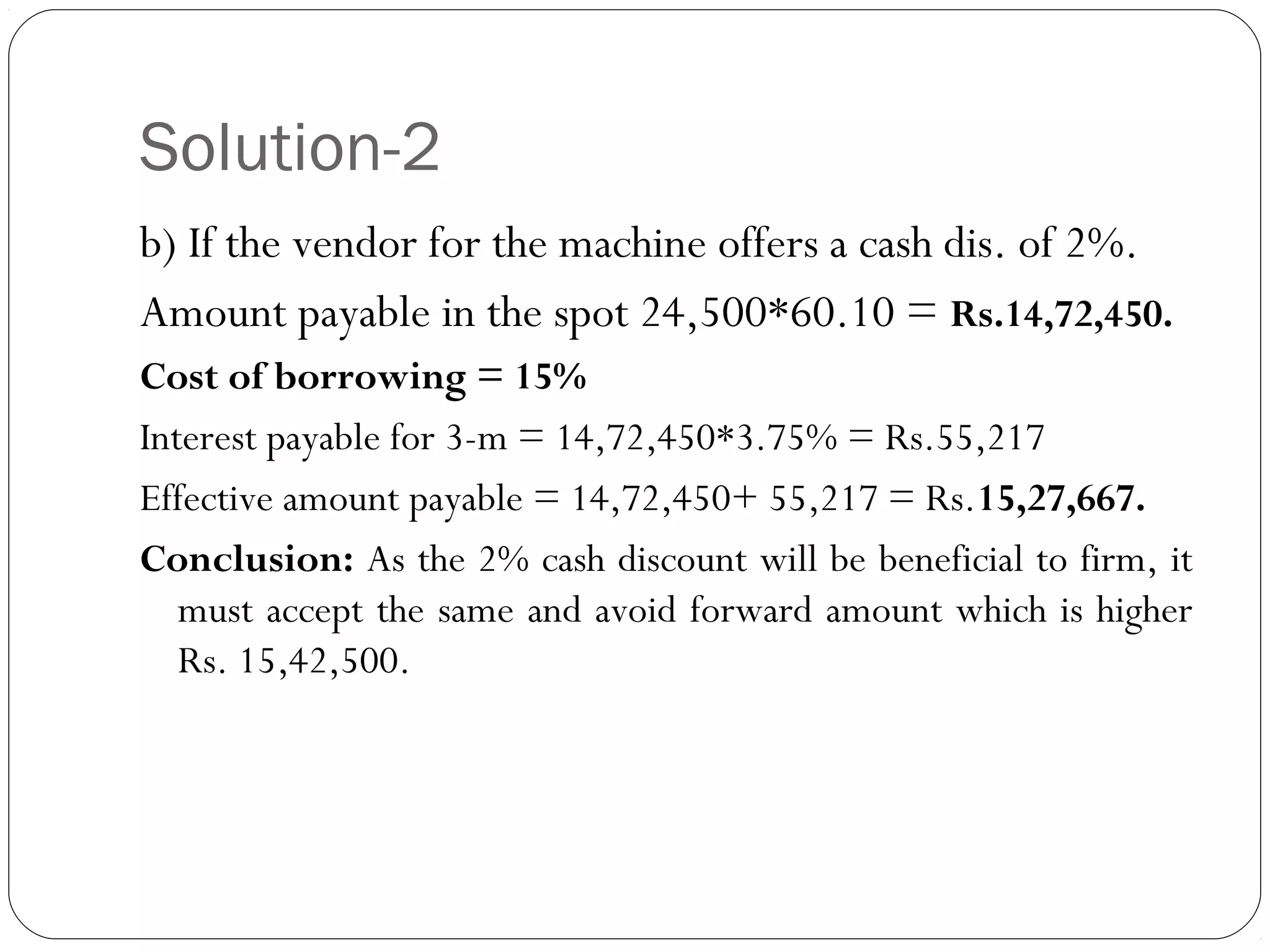
b) If the vendor for the machine offers a cash dis. of 2%.
Amount payable in the spot 24,500*60.10 = Rs.14,72,450.
Cost of borrowing = 15%
Interest payable for 3-m = 14,72,450*3.75% = Rs.55,217
Effective amount payable = 14,72,450+ 55,217 = Rs.15,27,667.
Conclusion: As the 2% cash discount will be beneficial to firm, it
must accept the same and avoid forward amount which is higher
Rs. 15,42,500.
3. Following scenario exists in the foreign exchange markets
and money markets in India and Britain:
Spot Rate (Rs./£) : 80.20-80.50
6-m Forward Rate (Rs./£) : 81.50-82.00
Interest rates:
Rs. : 10.00-10.50
£ : 05.50-06.00
1. ITL Ltd. expects to receive £ 10,000 in 6 months and faces a
choice of covering the exposure, either through money
market or forward market. Find out which hedge is more
efficient.
2. IPL Ltd. has to pay £ 10,000 in 6 months. It has also the
option of covering the exposure, either through money
market hedge or forward market. Find out which hedge is
more efficient.
Solution-3
 Forward Hedge:
1. ITL Ltd. may book a 6-m forward sell contract for receivables and
realize = 81.50*£10,000 = Rs. 8,15,000.
 Money Market Hedge:
 Borrow £ at 6%(borrowing rate) = £10,000/1.03 = £9708.74
 Convert borrowed amt at spot = £9708.74*80.20=Rs.7,78,640.95.
 Invest rupees for 6-m (deposit rate)=7,78,640.95*1.05=Rs. 8,17,573.
 Since realization in MM hedge is higher company should go for MM
hedge.
Interest Rate:
Rs.:10.00-10.50
£: 05.50-06.00
Spot (Rs./£) :80.20-80.50
Forward (Rs./£) :81.50-82.00
Solution-3
 Forward Hedge:
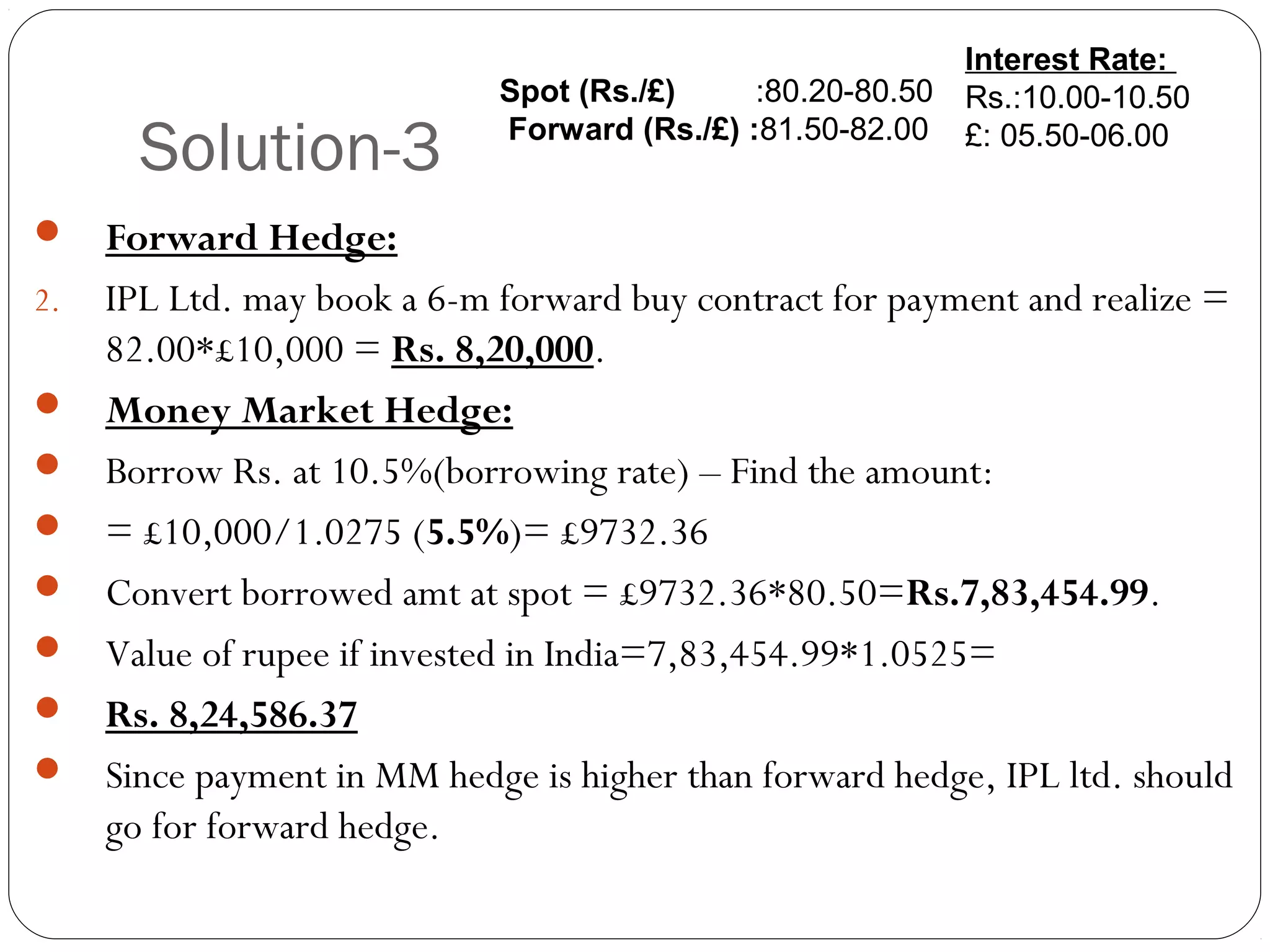
2. IPL Ltd. may book a 6-m forward buy contract for payment and realize =
82.00*£10,000 = Rs. 8,20,000.
 Money Market Hedge:
 Borrow Rs. at 10.5%(borrowing rate) – Find the amount:
 = £10,000/1.0275 (5.5%)= £9732.36
 Convert borrowed amt at spot = £9732.36*80.50=Rs.7,83,454.99.
 Value of rupee if invested in India=7,83,454.99*1.0525=
 Rs. 8,24,586.37
 Since payment in MM hedge is higher than forward hedge, IPL ltd. should
go for forward hedge.
Interest Rate:
Rs.:10.00-10.50
£: 05.50-06.00
Spot (Rs./£) :80.20-80.50
Forward (Rs./£) :81.50-82.00
Thank u…

Transaction exposure 1

  • 1.
    -Prepared by Mr.AmitA Rajdev, -Faculty of Finance,VMPIM. Transaction Exposure
  • 2.
    1. What isTE? Transaction exposure can be defined as the sensitivity of “realized” domestic currency values of the firm’s contractual cash flows denominated in foreign currencies to unexpected exchange rate changes. TE defined as the risk for changes in the exchange rates for the contracts that are entered but not yet settled. Transaction exposure arises from fixed-price contracting in a world where exchange rates are changing randomly.
  • 3.
    2. Management ofTE Financial Contracts Forward Market Hedge Money Market Hedge Option Market Hedge Swap Market Hedge Operational Techniques Choice of Invoice Currency Lead/Lag Strategy Exposure Netting
  • 4.
    Example: Write inyour book. Boeing Corporation exported a Boeing 747 to British Airways and billed 10 million payable in one year. The money market₤ interest rates and foreign exchange rates are given as follows: The USA interest rate 6.10% p.a. The UK interest rate 9.00% p.a. The spot exchange rate $1.50/₤ The forward exchange rate $1.46/₤
  • 5.
  • 6.
    2.1 Using Forward BoeingCan Sell Forward Pound receivable, 10 million for₤ delivery in one year, in exchange for a given amount in dollars. In exchange Boeing can take $14.6 million ($1.46*10 million), regardless of the spot exchange rate that may prevail on the maturity date. Receipts from the British Sale Spot Exchange rate on Maturity Date Un-hedged Position Forward Hedge Gains/Losses from Hedge $ 1.30 $1,30,00,000 $1,46,00,000 $16,00,000 $ 1.40 $1,40,00,000 $1,46,00,000 $6,00,000 $ 1.46 $1,46,00,000 $1,46,00,000 0 $ 1.50 $1,50,00,000 $1,46,00,000 - $4,00,000 $ 1.60 $1,60,00,000 $1,46,00,000 - 14,00,000
  • 7.
    2.2 Money MarketHedge The firm may borrow (lend) in foreign currency to hedge its foreign currency receivables (payables), thereby matching its assets and liabilities in the same currency. Continuing with same example, Boeing can eliminate the exchange exposure arising from the British sale by first borrowing in pounds, then converting the loan proceeds into dollars, which then can be invested at the dollar interest rate. On maturity date of the loan, Boeing is going to use to pound receivable to pay off the pound loan.
  • 8.
    2.2 Money MarketHedge If Boeing borrows a particular pound amount so that the maturity value of this loan becomes exactly equal to pound receivable from the British sale, Boeing’s net pound exposure is reduced to zero, and Boeing will receive the future maturity value of the dollar investment.
  • 9.
    2.2 Money MarketHedge First Step: decide the amount to borrow. (which is discounted present value of pound receivable, i.e., (10 million/1.09) = £ 91,74,312. When Boeing borrows £ 91,74,312, it then has to repay £ 10 million in one year, which equivalent to its pound receivable. The step-by-step procedure of money market hedging can would be:
  • 10.
    2.2 Money MarketHedge 1. Borrow £ 91,74,312 in the U.K 2. Convert £ 91,74,312 into $1,37,61,468 at the current spot exchange rate of $1.50/£. 3. Invest $1,37,61,468 in the USA. 4. Collect $10 million from British Airways and use it to repay the pound loan. 5. Receive the maturity value of the dollar investment, that is, $1,4600,918 = $1,37,61,468(1.061), which is guaranteed dollar proceeds from the British Sale.
  • 11.
    2.3 Options MarketHedge The options hedge will allow the firm to limit the downside risk while preserving the upside potential. E.g Boeing can purchase a put option on 10 million British Pounds with an exercise price of $1.46 and a one-year expiration. Assume that option premium (price) was $0.02 per pound. Boeing thus paid $2,00,000 for the option. Considering the time value of money, this upfront cost is equivalent to $2,12,200 (=$2,00,000*1.061) as of the expiration date. So, net dollar proceeds from the British sale = $1,43,87,800 = $1,46,00,000 - $2,12,000
  • 12.
    2.3 Options MarketHedge Future Spot Exchange Rate Exercise Decision Gross Dollar Proceeds Option Cost Net Dollar Proceeds $ 1.30 Exercise $1,46,00,000 $2,12,200 $1,43,87,800 $ 1.40 Exercise $1,46,00,000 $2,12,200 $1,43,87,800 $ 1.46 Neutral $1,46,00,000 $2,12,200 $1,43,87,800 $ 1.50 Not Exercise $1,50,00,000 $2,12,200 $1,47,87,800 $ 1.60 Not Exercise $1,60,00,000 $2,12,200 $1,57,87,800
  • 13.
    2.4 Hedging ThroughSWAPs Firms often have to deal with a “sequence” of accounts payable or receivable in terms of a foreign currency. Such recurrent cash flows in a foreign currency can best be hedged using a currency swap contract, which is an agreement to exchange one currency for another at a predetermined exchange rate, that is, the swap rate, on a sequence of future dates.
  • 14.
  • 15.
    3.1 Hedging ThroughInvoice Currency The firm can shift, share, or diversify exchange risk by appropriately choosing the currency of invoice.
  • 16.
    3.2 Hedging viaLead & Lag The lead means to pay or collect early, whereas to lag means to pay or collect late.
  • 17.
    3.3 Exposure Netting Ifthe firm has a portfolio of currencies positions, it makes sense to hedge residual exposure rather than hedge each currency option separately.
  • 18.
  • 19.
    1. A Japaneseauto dealer has supplied cars in Germany for which the payment of € 6.15 million is due after 6 months from now. Following exchange rate scenario is prevailing in the market in Tokyo: Spot Exchange rate (¥/€) : 160-175 6-m forward rate (¥/€): 155-167
  • 20.
    The dealer isinclined to book a forward contract to sell euro as yen is showing a rising trend. The banker of the dealer has suggested that it would be better to have Euros now than by borrowing the same. The interest rate applicable for the euro loan would be 5%. Examine the desirability of the proposal of the banker. The interest rates prevailing in the Yen market are 2%.
  • 21.
    Solution-1 Spot Exchange rate(¥/€) : 160-175 6-m forward rate (¥/€): 155-167 Yen is appreciating while euro is depreciating. Forward Hedge: Exporter can sell his receivable at the rate of 155.00. Therefore, amount realizable = 155* € 6.15m = ¥ 953.25m
  • 22.
    Solution-1 Interest rate :¥2.00% €5.00% Money Market Hedge: Borrow the foreign currency in such a manner that its maturity value is liquidated by the receivable. (€6.15/1.025 = €6.00m) Convert the borrowing at the spot exchange rate into local currency. (€6.00m* ¥160= ¥960m). Invest the amount in ¥ at the rate of 1.00% (960*1%= ¥969.60) Total amount Money Market Hedge = ¥969.60million Gain – MM Hedge – Forward Hedge  (¥969.60 – ¥953.25 = ¥16.35m)
  • 23.
    2. An Indianimporter is negotiating payment terms for acquiring a machine costing € 25,000 that is payable after 3 months. The exchange rate market is quoting following rates: Spot Exchange rate (Rs./€) : 59.80-60.10 6-m Swap points : 120-160 a) If the cost of borrowing for the importer is 15.00% per annum, should the importer pay now or after 3 months? b) Would your decision change if the supplier offers a cash discount of (i)1%(ii)2%.
  • 24.
    Solution-2 Spot Exchange rate(Rs./€) : 59.80-60.10 6-m Swap points : 120-160  Swap points are low/high. They suggest depreciation of Indian rupee. Spot Exchange rate (Rs./€) : 59.80-60.10 6-m Swap points : 60.00-61.70  The Indian firm by booking the forward contract would pay = €25,000*61.70=Rs. 15,42,500.  If the firm decides to pay now its cash out flow would be: = €25,000*60.10=Rs.15,02,500
  • 25.
    Solution-2 Cost of borrowing= 15%p.a. Interest payable for 3-m = 15,02,500*3.75% = Rs.56344. Effective amount = 15,02,500 + 56,344 = 15,58,844. a. Conclusion: Since forward amount is less Rs. 15,42,500 compared to loan amount firm should go for credit period.
  • 26.
    Solution-2 b) If thevendor for the machine offers a cash dis. of 1%. Amount payable in the spot 24,750*60.10 = Rs.14,87,475. Cost of borrowing = 15% Interest payable for 3-m = 14,87,475*3.75% = Rs.55,780 Effective amount payable = 14,87,475 + 55,780 = Rs.15,43,255. Conclusion: Since forward amount is less Rs. 15,42,500 compared to loan amount firm should go for credit period.
  • 27.
    Solution-2 b) If thevendor for the machine offers a cash dis. of 2%. Amount payable in the spot 24,500*60.10 = Rs.14,72,450. Cost of borrowing = 15% Interest payable for 3-m = 14,72,450*3.75% = Rs.55,217 Effective amount payable = 14,72,450+ 55,217 = Rs.15,27,667. Conclusion: As the 2% cash discount will be beneficial to firm, it must accept the same and avoid forward amount which is higher Rs. 15,42,500.
  • 28.
    3. Following scenarioexists in the foreign exchange markets and money markets in India and Britain: Spot Rate (Rs./£) : 80.20-80.50 6-m Forward Rate (Rs./£) : 81.50-82.00 Interest rates: Rs. : 10.00-10.50 £ : 05.50-06.00
  • 29.
    1. ITL Ltd.expects to receive £ 10,000 in 6 months and faces a choice of covering the exposure, either through money market or forward market. Find out which hedge is more efficient. 2. IPL Ltd. has to pay £ 10,000 in 6 months. It has also the option of covering the exposure, either through money market hedge or forward market. Find out which hedge is more efficient.
  • 30.
    Solution-3  Forward Hedge: 1.ITL Ltd. may book a 6-m forward sell contract for receivables and realize = 81.50*£10,000 = Rs. 8,15,000.  Money Market Hedge:  Borrow £ at 6%(borrowing rate) = £10,000/1.03 = £9708.74  Convert borrowed amt at spot = £9708.74*80.20=Rs.7,78,640.95.  Invest rupees for 6-m (deposit rate)=7,78,640.95*1.05=Rs. 8,17,573.  Since realization in MM hedge is higher company should go for MM hedge. Interest Rate: Rs.:10.00-10.50 £: 05.50-06.00 Spot (Rs./£) :80.20-80.50 Forward (Rs./£) :81.50-82.00
  • 31.
    Solution-3  Forward Hedge: 2.IPL Ltd. may book a 6-m forward buy contract for payment and realize = 82.00*£10,000 = Rs. 8,20,000.  Money Market Hedge:  Borrow Rs. at 10.5%(borrowing rate) – Find the amount:  = £10,000/1.0275 (5.5%)= £9732.36  Convert borrowed amt at spot = £9732.36*80.50=Rs.7,83,454.99.  Value of rupee if invested in India=7,83,454.99*1.0525=  Rs. 8,24,586.37  Since payment in MM hedge is higher than forward hedge, IPL ltd. should go for forward hedge. Interest Rate: Rs.:10.00-10.50 £: 05.50-06.00 Spot (Rs./£) :80.20-80.50 Forward (Rs./£) :81.50-82.00
  • 32.