Chapter 3
Hedging Strategies Using
Futures
1
Long & Short Hedges
A long futures hedge is appropriate when
you know you will purchase an asset in
the future and want to lock in the price
A short futures hedge is appropriate
when you know you will sell an asset in
the future and want to lock in the price
2
Arguments in Favor of Hedging
3
Companies should focus on the main
business they are in and take steps to
minimize risks arising from interest rates,
exchange rates, and other market variables
Arguments against Hedging
Shareholders are usually well diversified and
can make their own hedging decisions
It may increase risk to hedge when
competitors do not
Explaining a situation where there is a loss on
the hedge and a gain on the underlying can
be difficult
4
Short Hedge for Sale of an Asset
A short hedge is appropriate when the hedger
already owns an asset an expects to sell it at
some time in the future.
Eg: It is May 15. An oil producer has
negotiated a contract to sell 1 million barrels
of crude oil in August 15. Quotes:
Spot price : $60 per barrel
August oil futures price:$59 per barrel
1contract = 1000 barrels
5
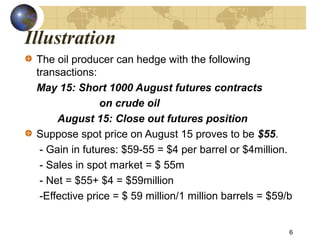
Illustration
The oil producer can hedge with the following
transactions:
May 15: Short 1000 August futures contracts
on crude oil
August 15: Close out futures position
Suppose spot price on August 15 proves to be $55.
- Gain in futures: $59-55 = $4 per barrel or $4million.
- Sales in spot market = $ 55m
- Net = $55+ $4 = $59million
-Effective price = $ 59 million/1 million barrels = $59/b
6
What if price of oil on August 15 proves
to be $65 per barrel?
Calculate gain/loss in futures position;
What is the net outcomes?
What is the effective price?
7
Long Hedge for Purchase of an Asset
A long hedge is appropriate when a company
knows it will have to purchase a certain asset
in the future and wants to lock in a price now.
Eg: A copper fabricator knows it will need
100,000 pounds of copper on May 15. The
spot price of copper is 340 cents/pound and
the May futures price is 320 cents/pound.
Each contract is for the delivery of 25,000
pound of copper.
8
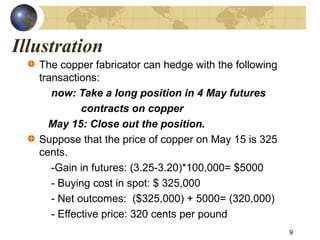
Illustration
The copper fabricator can hedge with the following
transactions:
now: Take a long position in 4 May futures
contracts on copper
May 15: Close out the position.
Suppose that the price of copper on May 15 is 325
cents.
-Gain in futures: (3.25-3.20)*100,000= $5000
- Buying cost in spot: $ 325,000
- Net outcomes: ($325,000) + 5000= (320,000)
- Effective price: 320 cents per pound
9
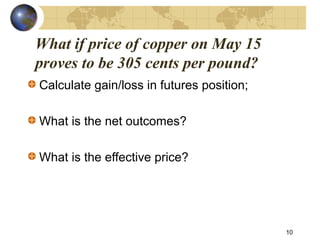
What if price of copper on May 15
proves to be 305 cents per pound?
Calculate gain/loss in futures position;
What is the net outcomes?
What is the effective price?
10
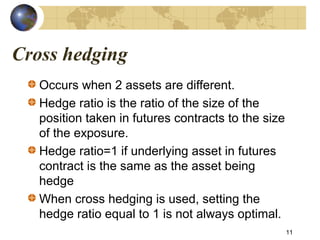
Cross hedging
Occurs when 2 assets are different.
Hedge ratio is the ratio of the size of the
position taken in futures contracts to the size
of the exposure.
Hedge ratio=1 if underlying asset in futures
contract is the same as the asset being
hedge
When cross hedging is used, setting the
hedge ratio equal to 1 is not always optimal.
11
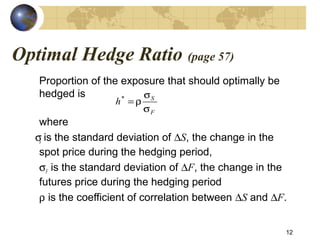
Optimal Hedge Ratio (page 57)
Proportion of the exposure that should optimally be
hedged is
where
σS is the standard deviation of ∆S, the change in the
spot price during the hedging period,
σF is the standard deviation of ∆F, the change in the
futures price during the hedging period
ρ is the coefficient of correlation between ∆S and ∆F.
12
F
S
h
σ
σ
ρ=*
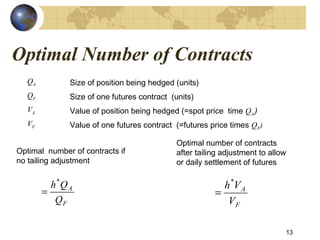
Optimal Number of Contracts
QA Size of position being hedged (units)
QF Size of one futures contract (units)
VA Value of position being hedged (=spot price time QA)
VF Value of one futures contract (=futures price times QF)
13
Optimal number of contracts if
no tailing adjustment
F
A
Q
Qh*
=
Optimal number of contracts
after tailing adjustment to allow
or daily settlement of futures
F
A
V
Vh*
=
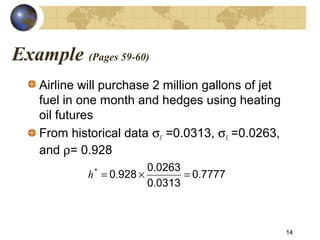
Example (Pages 59-60)
Airline will purchase 2 million gallons of jet
fuel in one month and hedges using heating
oil futures
From historical data σF =0.0313, σS =0.0263,
and ρ= 0.928
14
77770
03130
02630
9280 .
.
.
.*
=×=h
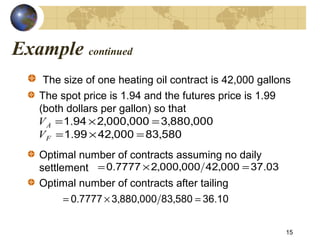
Example continued
The size of one heating oil contract is 42,000 gallons
The spot price is 1.94 and the futures price is 1.99
(both dollars per gallon) so that
Optimal number of contracts assuming no daily
settlement
Optimal number of contracts after tailing
15
033700042000000277770 .,,,. =×=
103658083000880377770 .,,,. =×=
5808300042991
00088030000002941
,,.
,,,,.
=×=
=×=
F
A
V
V
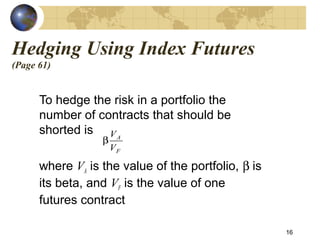
Hedging Using Index Futures
(Page 61)
To hedge the risk in a portfolio the
number of contracts that should be
shorted is
where VA is the value of the portfolio, β is
its beta, and VF is the value of one
futures contract
16
F
A
V
V
β
Example
S&P 500 futures price is 1,000
Value of Portfolio is $5 million
Beta of portfolio is 1.5
What position in futures contracts on the S&P
500 is necessary to hedge the portfolio?
17
Changing Beta
What position is necessary to reduce
the beta of the portfolio to 0.75?
What position is necessary to increase
the beta of the portfolio to 2.0?
18
Why Hedge Equity Returns
May want to be out of the market for a while.
Hedging avoids the costs of selling and
repurchasing the portfolio
Suppose stocks in your portfolio have an
average beta of 1.0, but you feel they have
been chosen well and will outperform the
market in both good and bad times. Hedging
ensures that the return you earn is the risk-
free return plus the excess return of your
portfolio over the market.
19

Futures hedging

  • 1.
  • 2.
    Long & ShortHedges A long futures hedge is appropriate when you know you will purchase an asset in the future and want to lock in the price A short futures hedge is appropriate when you know you will sell an asset in the future and want to lock in the price 2
  • 3.
    Arguments in Favorof Hedging 3 Companies should focus on the main business they are in and take steps to minimize risks arising from interest rates, exchange rates, and other market variables
  • 4.
    Arguments against Hedging Shareholdersare usually well diversified and can make their own hedging decisions It may increase risk to hedge when competitors do not Explaining a situation where there is a loss on the hedge and a gain on the underlying can be difficult 4
  • 5.
    Short Hedge forSale of an Asset A short hedge is appropriate when the hedger already owns an asset an expects to sell it at some time in the future. Eg: It is May 15. An oil producer has negotiated a contract to sell 1 million barrels of crude oil in August 15. Quotes: Spot price : $60 per barrel August oil futures price:$59 per barrel 1contract = 1000 barrels 5
  • 6.
    Illustration The oil producercan hedge with the following transactions: May 15: Short 1000 August futures contracts on crude oil August 15: Close out futures position Suppose spot price on August 15 proves to be $55. - Gain in futures: $59-55 = $4 per barrel or $4million. - Sales in spot market = $ 55m - Net = $55+ $4 = $59million -Effective price = $ 59 million/1 million barrels = $59/b 6
  • 7.
    What if priceof oil on August 15 proves to be $65 per barrel? Calculate gain/loss in futures position; What is the net outcomes? What is the effective price? 7
  • 8.
    Long Hedge forPurchase of an Asset A long hedge is appropriate when a company knows it will have to purchase a certain asset in the future and wants to lock in a price now. Eg: A copper fabricator knows it will need 100,000 pounds of copper on May 15. The spot price of copper is 340 cents/pound and the May futures price is 320 cents/pound. Each contract is for the delivery of 25,000 pound of copper. 8
  • 9.
    Illustration The copper fabricatorcan hedge with the following transactions: now: Take a long position in 4 May futures contracts on copper May 15: Close out the position. Suppose that the price of copper on May 15 is 325 cents. -Gain in futures: (3.25-3.20)*100,000= $5000 - Buying cost in spot: $ 325,000 - Net outcomes: ($325,000) + 5000= (320,000) - Effective price: 320 cents per pound 9
  • 10.
    What if priceof copper on May 15 proves to be 305 cents per pound? Calculate gain/loss in futures position; What is the net outcomes? What is the effective price? 10
  • 11.
    Cross hedging Occurs when2 assets are different. Hedge ratio is the ratio of the size of the position taken in futures contracts to the size of the exposure. Hedge ratio=1 if underlying asset in futures contract is the same as the asset being hedge When cross hedging is used, setting the hedge ratio equal to 1 is not always optimal. 11
  • 12.
    Optimal Hedge Ratio(page 57) Proportion of the exposure that should optimally be hedged is where σS is the standard deviation of ∆S, the change in the spot price during the hedging period, σF is the standard deviation of ∆F, the change in the futures price during the hedging period ρ is the coefficient of correlation between ∆S and ∆F. 12 F S h σ σ ρ=*
  • 13.
    Optimal Number ofContracts QA Size of position being hedged (units) QF Size of one futures contract (units) VA Value of position being hedged (=spot price time QA) VF Value of one futures contract (=futures price times QF) 13 Optimal number of contracts if no tailing adjustment F A Q Qh* = Optimal number of contracts after tailing adjustment to allow or daily settlement of futures F A V Vh* =
  • 14.
    Example (Pages 59-60) Airlinewill purchase 2 million gallons of jet fuel in one month and hedges using heating oil futures From historical data σF =0.0313, σS =0.0263, and ρ= 0.928 14 77770 03130 02630 9280 . . . .* =×=h
  • 15.
    Example continued The sizeof one heating oil contract is 42,000 gallons The spot price is 1.94 and the futures price is 1.99 (both dollars per gallon) so that Optimal number of contracts assuming no daily settlement Optimal number of contracts after tailing 15 033700042000000277770 .,,,. =×= 103658083000880377770 .,,,. =×= 5808300042991 00088030000002941 ,,. ,,,,. =×= =×= F A V V
  • 16.
    Hedging Using IndexFutures (Page 61) To hedge the risk in a portfolio the number of contracts that should be shorted is where VA is the value of the portfolio, β is its beta, and VF is the value of one futures contract 16 F A V V β
  • 17.
    Example S&P 500 futuresprice is 1,000 Value of Portfolio is $5 million Beta of portfolio is 1.5 What position in futures contracts on the S&P 500 is necessary to hedge the portfolio? 17
  • 18.
    Changing Beta What positionis necessary to reduce the beta of the portfolio to 0.75? What position is necessary to increase the beta of the portfolio to 2.0? 18
  • 19.
    Why Hedge EquityReturns May want to be out of the market for a while. Hedging avoids the costs of selling and repurchasing the portfolio Suppose stocks in your portfolio have an average beta of 1.0, but you feel they have been chosen well and will outperform the market in both good and bad times. Hedging ensures that the return you earn is the risk- free return plus the excess return of your portfolio over the market. 19