SOCIETAL IMAGE OF CHEMISTRY:
 *Chemistry was once viewed as a field of
  innovation resulting in medical
 breakthroughs and modern convenience.
 *Chemistry is now viewed by many as
fouling the planet.
ENERGY RESOURCES:
• RENEWABLE & NON-RENEWABLE
• RENEWABLE-
  SOLAR,WIND,TIDAL,HYDRO,GEOTHERMAL &
  BIOMASS
• NON-RENEWABLE-
  COAL,PETROLEUM,NATURAL GAS,NUCLEAR
  SOURCES ETC..
SUGGESTIONS OFFERED BY
        GREEN CHEMISTRY :
• It is better to prevent waste than to treat it
• Reduce over consumption of energy
• Reduce waste
• Avoid exploitation of resources
* Reduce the use of auxiliary substances
• Energy required must be recognized for their
  impact and reduced
• A raw material of feed stock should be
  renewable rather than depleting where ever
  technically possible.
AIMS OF GREEN CHEMISTRY:
• PREVENTION AND REDUCTION OF
  WASTES
• Treatment of wastes
• Disposal of wastes
• Recycle and reuse of wastes.
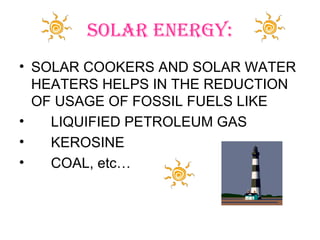
SOLAR ENERGY:
• SOLAR COOKERS AND SOLAR WATER
  HEATERS HELPS IN THE REDUCTION
  OF USAGE OF FOSSIL FUELS LIKE
•   LIQUIFIED PETROLEUM GAS
•   KEROSINE
•   COAL, etc…
BIOMASS ENERGY
•    Cow-dung , various plant materials
    like the residue after harvesting the
    crops, vegetable waste and sewage
    are decomposed in the absence of
    oxygen to give biogas. It leaves no
    residues like ash in woods and
    produces no smoke as in charcoal,
    coal burning.
BIOMASS ENERGY:
• The large-scale utilization of
  bio waste and sewage material
  provides a safe and efficient
  method of waste-disposal besides
  supplying energy and manure.
BENEFITS OF BIOMASS
• Renewable Feedstock
• Contributes no net CO2 to the
  atmosphere
• Conserves fossil fuel leading to a secure
domestic supply
• Platform for making an array of chemical
products from what is otherwise considered
  waste.
ECO FRIENDLY PLASTICS:
• Eco friendly plastics are also known as
  poly lactic acid plastics.
• They are manufactured from corn.
• Corn—starch—unrefined dextrose—
  fermentation—lactic acid—monomer—
  lactide –polymer—PLA –polymer
  modification –fiber, film bottle, thermo
  forming.
RECENT TRENDS IN GREEN
            CHEMISTRY:
• PET recycled from 2 litre soda bottles are
  used in new fleece.
• Eliminated chlorine bleach in fabrics
• No azo dyes, reduced formaldehyde
• Glucose is used as an alternative for benzene
  in synthesis of Adepic acid.
• Corn based poly lacticacid plastics ae used to
  make carpets.
• Diphenyl carbonate is used as an alternative
  for phosgene.
POLICIES OF GREEN CHEMISTRY
  *Prevent waste rather than treating it
  *Use renewable sources of energy
 • Choose substances so as to minimize the
   potential for chemical accidents, including
   releases, explosions, and fires.
• Auxiliary substances (solvents, etc.) should
   be made unnecessary wherever possible
   and innocuous when used.
DESIGNING GREEN PRODUCTS:
• Chemical products should be designed to
• Use renewable resources–
   preserve efficacy of function while
  reducing toxicity, and break down into
  innocuous degradation products at the
  end of their function so that they do not
  persist in the environment.
BETTERMENT OF ENVIRONMENT
• Eliminate nearly 100% of emissions in
  polymer manufacturing and processing
• 30-40% reduction in wastes
• Reduce 50% usage of plastics
• Replace all solvents and acid based
  catalysis that have adverse effects with
  solids ,or greener alternatives.
TWELVE PRINCIPLES OF GREEN
          CHEMISTRY
• Prevention of waste;
 *Atom economy;
* Less hazardous chemical synthesis;
• Designing safer chemicals;
• Safer solvents and auxiliaries;
• Energy efficient;
• Renewable feed stocks;
•   Reduce derivatives;
•   Catalysis;
•   Design for degradation;
•   Real time analysis for pollution prevention;
•   Safety.
DDT:
 *The use of DDT has increased enormously due to its
 effectiveness against mosquitoes and lice.
  *DDT is one of the effective insecticide .
 *It is cheap and less toxic to animals.
 *But later it was more toxic to fishes.
 *The chemical stability of DDT and its fat solubility
compounded the problem.
   *It takes about 8 years to metabolize half of the
amount          it assimilates.
• THUS GREEN CHEMISTRY HAPPENS
  TO BE THE REMEDY FOR VARIOUS
  ENVIRONMENTAL PROBLEMS LIKE
  SOIL POLLUTION, FOOD CHAIN
  MAINTENANCE, WATER AND AIR
  POLLUTION.
• LET’S ASPIRE , ASCEND AND ACHIEVE
  THE GOALS OF GREEN CHEMISTRY!!!!
Green chem original ppt

Green chem original ppt

  • 2.
    SOCIETAL IMAGE OFCHEMISTRY: *Chemistry was once viewed as a field of innovation resulting in medical breakthroughs and modern convenience. *Chemistry is now viewed by many as fouling the planet.
  • 3.
    ENERGY RESOURCES: • RENEWABLE& NON-RENEWABLE • RENEWABLE- SOLAR,WIND,TIDAL,HYDRO,GEOTHERMAL & BIOMASS • NON-RENEWABLE- COAL,PETROLEUM,NATURAL GAS,NUCLEAR SOURCES ETC..
  • 4.
    SUGGESTIONS OFFERED BY GREEN CHEMISTRY : • It is better to prevent waste than to treat it • Reduce over consumption of energy • Reduce waste • Avoid exploitation of resources * Reduce the use of auxiliary substances • Energy required must be recognized for their impact and reduced • A raw material of feed stock should be renewable rather than depleting where ever technically possible.
  • 5.
    AIMS OF GREENCHEMISTRY: • PREVENTION AND REDUCTION OF WASTES • Treatment of wastes • Disposal of wastes • Recycle and reuse of wastes.
  • 6.
    SOLAR ENERGY: • SOLARCOOKERS AND SOLAR WATER HEATERS HELPS IN THE REDUCTION OF USAGE OF FOSSIL FUELS LIKE • LIQUIFIED PETROLEUM GAS • KEROSINE • COAL, etc…
  • 7.
    BIOMASS ENERGY • Cow-dung , various plant materials like the residue after harvesting the crops, vegetable waste and sewage are decomposed in the absence of oxygen to give biogas. It leaves no residues like ash in woods and produces no smoke as in charcoal, coal burning.
  • 8.
    BIOMASS ENERGY: • Thelarge-scale utilization of bio waste and sewage material provides a safe and efficient method of waste-disposal besides supplying energy and manure.
  • 9.
    BENEFITS OF BIOMASS •Renewable Feedstock • Contributes no net CO2 to the atmosphere • Conserves fossil fuel leading to a secure domestic supply • Platform for making an array of chemical products from what is otherwise considered waste.
  • 10.
    ECO FRIENDLY PLASTICS: •Eco friendly plastics are also known as poly lactic acid plastics. • They are manufactured from corn. • Corn—starch—unrefined dextrose— fermentation—lactic acid—monomer— lactide –polymer—PLA –polymer modification –fiber, film bottle, thermo forming.
  • 11.
    RECENT TRENDS INGREEN CHEMISTRY: • PET recycled from 2 litre soda bottles are used in new fleece. • Eliminated chlorine bleach in fabrics • No azo dyes, reduced formaldehyde • Glucose is used as an alternative for benzene in synthesis of Adepic acid. • Corn based poly lacticacid plastics ae used to make carpets. • Diphenyl carbonate is used as an alternative for phosgene.
  • 12.
    POLICIES OF GREENCHEMISTRY *Prevent waste rather than treating it *Use renewable sources of energy • Choose substances so as to minimize the potential for chemical accidents, including releases, explosions, and fires. • Auxiliary substances (solvents, etc.) should be made unnecessary wherever possible and innocuous when used.
  • 13.
    DESIGNING GREEN PRODUCTS: •Chemical products should be designed to • Use renewable resources– preserve efficacy of function while reducing toxicity, and break down into innocuous degradation products at the end of their function so that they do not persist in the environment.
  • 14.
    BETTERMENT OF ENVIRONMENT •Eliminate nearly 100% of emissions in polymer manufacturing and processing • 30-40% reduction in wastes • Reduce 50% usage of plastics • Replace all solvents and acid based catalysis that have adverse effects with solids ,or greener alternatives.
  • 15.
    TWELVE PRINCIPLES OFGREEN CHEMISTRY • Prevention of waste; *Atom economy; * Less hazardous chemical synthesis; • Designing safer chemicals; • Safer solvents and auxiliaries; • Energy efficient; • Renewable feed stocks;
  • 16.
    Reduce derivatives; • Catalysis; • Design for degradation; • Real time analysis for pollution prevention; • Safety.
  • 17.
    DDT: *The useof DDT has increased enormously due to its effectiveness against mosquitoes and lice. *DDT is one of the effective insecticide . *It is cheap and less toxic to animals. *But later it was more toxic to fishes. *The chemical stability of DDT and its fat solubility compounded the problem. *It takes about 8 years to metabolize half of the amount it assimilates.
  • 18.
    • THUS GREENCHEMISTRY HAPPENS TO BE THE REMEDY FOR VARIOUS ENVIRONMENTAL PROBLEMS LIKE SOIL POLLUTION, FOOD CHAIN MAINTENANCE, WATER AND AIR POLLUTION. • LET’S ASPIRE , ASCEND AND ACHIEVE THE GOALS OF GREEN CHEMISTRY!!!!