
Healthcare Interoperability and Standards: Making different applications talk 
Rene James P. Balandra Jr. 
MS Health Informatics (Bioinformatics Track) 
HI 201 – Overview of Health Informatics
Driving Question 
How can healthcare institutions adopt standards to ensure interoperability?
Assumptions 
•All organizations and systems DO NOT SHARE a common platform or database.They are all disparate systems that need to share information. 
•There are NO Funding, Staffing or Technology problems or challenges. All projects have all the money they need. All projects have the correct staffing number and skills. All hardware, software and connections work perfectly. 
•Just focus on INTEROPERABILITY REQUIREMENTS.
Scenario 
•Scenario 4: Several city and municipal health units in Zamboanga have a basic EMR called BasicHealth. DOH wants to get all cases of Hypertension, Diabetes Mellitus and Cancer for their national registry. The DOH registry is an online system using software called RegistryTech.
Why Scenario 4? 
•Among the five scenarios to choose from, the scenario above is the one I’m most familiar with. As stated in a previous post, my work with the National Telehealth Center exposed me to the intricacies of our local public health sector. Coming into MSHI with an IT background, I also lack knowledge and practical experience in order to expound on any of the other possible scenarios.
Organizations Involved 
•Department Of Health 
•Regional Center for Health Development 
•Provincial Health Office 
•Municipal Health Office/Rural Health Unit 
–Barangay Health Stations
Applications Involved 
•BasicHealth 
•RegistryTech 
•Interoperability System
Interoperability Project Goals 
•Workload Prioritization 
•Faster information flow 
•Accuracy and Quality Data 
•Use of Standards
Workload Prioritization 
•More working hours in the practice of health care as opposed to writing and making reports 
•Encode only once; Use many times.
Faster information flow 
•Information flow as soon as a patient comes in and is reported. 
•Seeing the data trends and discrepancies the earliest time possible.
Accuracy and Quality Data 
•Duplication of patients will also be lessened 
•Restrictions in inputting data to check the validity of the data before it enters the system 
•Easier verification due to faster means to identify and isolate scrupulous data.
Use of Standards 
•Make sure that both systems are referring to the same thing 
–ICD-10 Codes 
–Philippine National Drug Formulary (PNDF) 
–Health Facility Codes
Data Elements To be Transferred 
–Patient Information 
•Birthday 
•Sex 
–Observations including but 
not limited to the ff: 
•Diagnosis 
•Patient History related to the hypertension, diabetes mellitus and cancer diseases 
•Risk Factors related to the hypertension, diabetes mellitus and cancer diseases 
•Medication History
Flow Of Information 
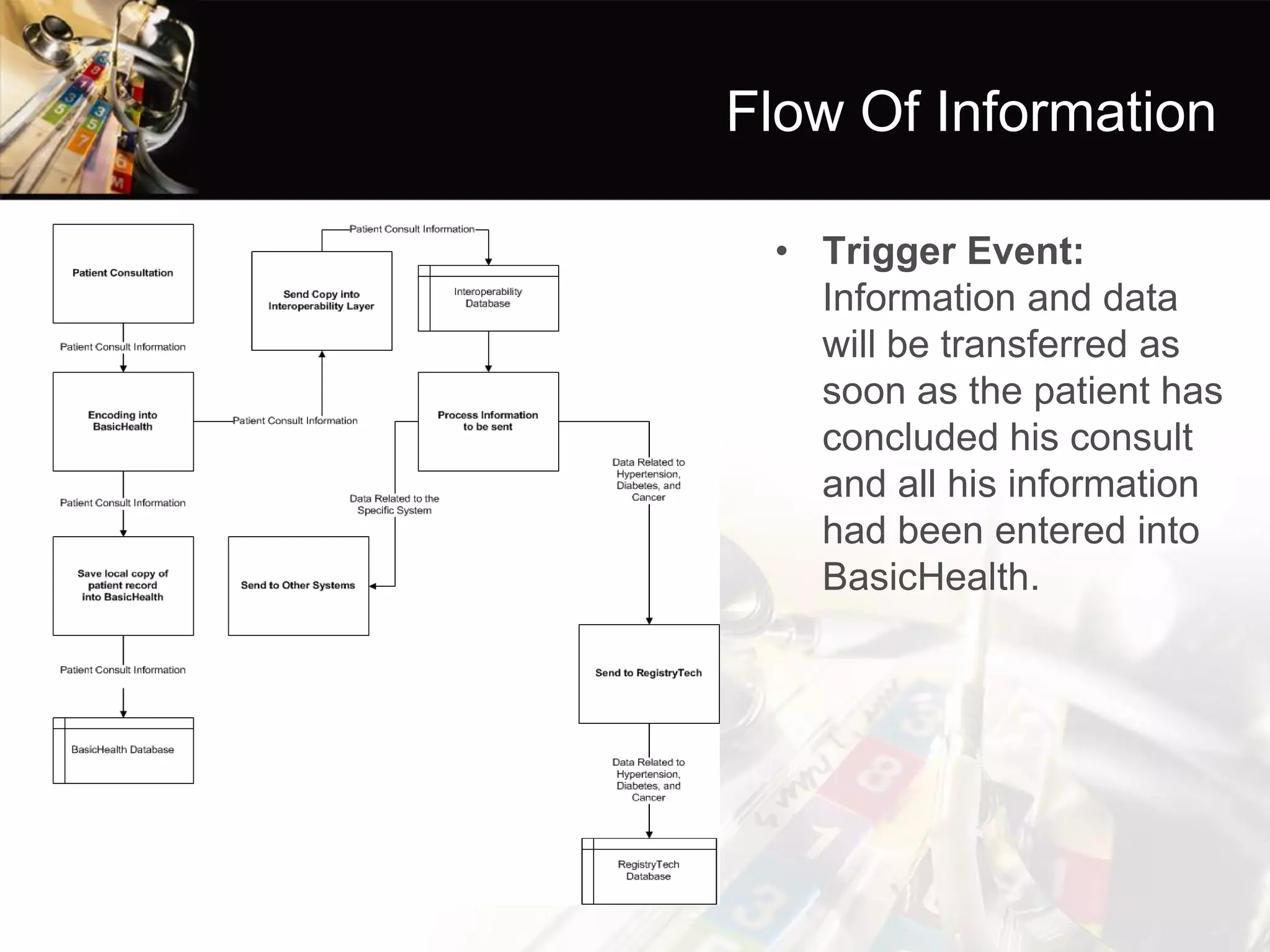
•Trigger Event: Information and data will be transferred as soon as the patient has concluded his consult and all his information had been entered into BasicHealth.
Thank you!

Healthcare Interoperability and Standards

  • 1.
    Healthcare Interoperability andStandards: Making different applications talk Rene James P. Balandra Jr. MS Health Informatics (Bioinformatics Track) HI 201 – Overview of Health Informatics
  • 2.
    Driving Question Howcan healthcare institutions adopt standards to ensure interoperability?
  • 3.
    Assumptions •All organizationsand systems DO NOT SHARE a common platform or database.They are all disparate systems that need to share information. •There are NO Funding, Staffing or Technology problems or challenges. All projects have all the money they need. All projects have the correct staffing number and skills. All hardware, software and connections work perfectly. •Just focus on INTEROPERABILITY REQUIREMENTS.
  • 4.
    Scenario •Scenario 4:Several city and municipal health units in Zamboanga have a basic EMR called BasicHealth. DOH wants to get all cases of Hypertension, Diabetes Mellitus and Cancer for their national registry. The DOH registry is an online system using software called RegistryTech.
  • 5.
    Why Scenario 4? •Among the five scenarios to choose from, the scenario above is the one I’m most familiar with. As stated in a previous post, my work with the National Telehealth Center exposed me to the intricacies of our local public health sector. Coming into MSHI with an IT background, I also lack knowledge and practical experience in order to expound on any of the other possible scenarios.
  • 6.
    Organizations Involved •DepartmentOf Health •Regional Center for Health Development •Provincial Health Office •Municipal Health Office/Rural Health Unit –Barangay Health Stations
  • 7.
    Applications Involved •BasicHealth •RegistryTech •Interoperability System
  • 8.
    Interoperability Project Goals •Workload Prioritization •Faster information flow •Accuracy and Quality Data •Use of Standards
  • 9.
    Workload Prioritization •Moreworking hours in the practice of health care as opposed to writing and making reports •Encode only once; Use many times.
  • 10.
    Faster information flow •Information flow as soon as a patient comes in and is reported. •Seeing the data trends and discrepancies the earliest time possible.
  • 11.
    Accuracy and QualityData •Duplication of patients will also be lessened •Restrictions in inputting data to check the validity of the data before it enters the system •Easier verification due to faster means to identify and isolate scrupulous data.
  • 12.
    Use of Standards •Make sure that both systems are referring to the same thing –ICD-10 Codes –Philippine National Drug Formulary (PNDF) –Health Facility Codes
  • 13.
    Data Elements Tobe Transferred –Patient Information •Birthday •Sex –Observations including but not limited to the ff: •Diagnosis •Patient History related to the hypertension, diabetes mellitus and cancer diseases •Risk Factors related to the hypertension, diabetes mellitus and cancer diseases •Medication History
  • 14.
    Flow Of Information •Trigger Event: Information and data will be transferred as soon as the patient has concluded his consult and all his information had been entered into BasicHealth.
  • 15.