
Nrip Nihalani
Plus91 Technologies Pvt. Ltd.
Adding Value to Healthcare


Clinical Data Standards and Data Portability
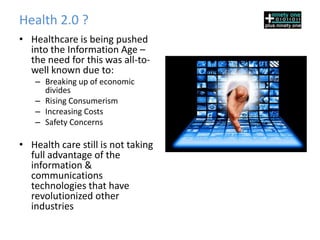
Health 2.0 ?
• Healthcare is being pushed
  into the Information Age –
  the need for this was all-to-
  well known due to:
   – Breaking up of economic
     divides
   – Rising Consumerism
   – Increasing Costs
   – Safety Concerns

• Health care still is not taking
  full advantage of the
  information &
  communications
  technologies that have
  revolutionized other
  industries
The Patient Empowerment Movement
• Empowering patients to maintain and improve
  their health
• Enabling clinicians and health-care
  organizations to provide safer and more
  evidence-based care
• THIS REQUIRES “creating a dynamic,
  networked information infrastructure” 
  must reliably ensure the private and secure
  movement of vital health information at the
  time that it is needed to the place where it is
  needed
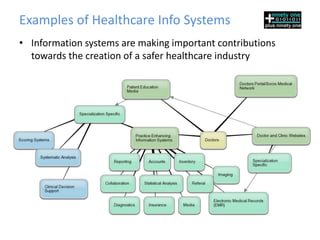
Examples of Healthcare Info Systems
• Information systems are making important contributions
  towards the creation of a safer healthcare industry
Benefits of eHealth / Health IT
• Deliver care to people located in remote places ;
  who do not have access to a hospital, through a
  tele-consultation.
• Help improve the quality of life of patients by, for
  e.g., monitoring the condition of the patient at
  distance at home, rather than in a hospital 
  particularly relevant for elderly, chronically ill
  persons and people living in remote regions
• Improve the quality of care by providing easier,
  safer and faster access to patient data, thereby
  allowing healthcare professionals to “Access the
  Right Data at the Right Time” and “Make an
  informed-based diagnosis”
Benefits of eHealth / Health IT
• The availability of information on the patient –
  such as his medical history, past diseases and
  interventions, allergies, reaction to
  medications in an EHR allows healthcare
  professionals to deliver a treatment tailored to
  the needs of the patient and thereby reduce
  risks of complications, adverse reactions etc.
• Clinical Decision Support Systems help in
  reducing reliance on memory, increasing
  vigilance, and contributing to standardization
  of processes
Benefits of eHealth / Health IT
• eHealth tools can help Physicians work more
  efficiently, by storing patient information in a
  single location, allowing access to information
  on the patient faster, taking medical decisions
  better and faster
• By allowing healthcare professionals to save
  time, eHealth tools also address the issue of
  shortage of healthcare professionals in many
  areas.
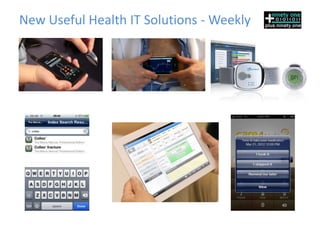
New Useful Health IT Solutions - Weekly
Data Sharing – Systems and Entities
• Useful New Health IT Solutions, Softwares,
  Devices launch every week.
• Also, Various healthcare entities use and
  modify a patient’s data, structured as well as
  residual, at different times - physicians,
  hospitals, laboratories, insurers, researchers
  and even the patients themselves
• The need for information sharing between
  different systems is thus critical – Else Data
  sharing will be a bottleneck and create poor,
  ineffective processes
Interoperability
• Interoperability means the ability of two or
  more systems to use and exchange data and
  human understandable information
• With interoperable systems, data can be
  exchanged and stored automatically rather
  than re-typed into the system each time.
• 3 levels of Interoperability
  1. ORGANISATIONAL INTEROPERABILITY
     • is the will and ability to work together and exchange
       information. It is brought about by an environment
       composed of laws, policies, and cooperation
       agreements
Interoperability
  2. SEMANTIC INTEROPERABILITY
     • ensures that the precise meaning of exchanged
       information is interpretable by any system or
       application not initially developed for the same
       purpose as the system initiating the exchange
  3. TECHNICAL INTEROPERABILITY
     • enables the exchange of information from a technical
       standpoint and guarantees:
        – data security and privacy
        – data integrity
        – access to relevant data associated with an identified patient
Interoperability  Data Standards
• Interoperability requires the creation,
  acceptance, and implementation of clinical
  data standards to ensure that data in one part
  of the system is available and usable across a
  variety of clinical settings
• Using standards for data sharing is the first
  step of interoperability.
• Standards allow a common definition of data
  and data exchange formats which is essential
  to enable interoperability both at the
  technical and semantic level.
canyouundertstandthis
• datastandardsdatastandardsareagreeduponrul
  esthatallowinformationtobesharedandprocess
  edinauniformandconsistentmannerforexample
  rulesinalanguagesentencesshouldendwithafull
  stopcommascanbeusedtoseparatepartsofafull
  sentenceorlistsnamesofindividualsmustbecapi
  talizedforexamplestandardplugsstandardplugs
  attachedtodevicesallowthemtobeusedinhome
  swheretherearestandardizedsockets
Now try this 
• Data standards are agreed upon rules – that allow
  information to be shared and processed in a
  uniform and consistent manner.
• For example “Rules in a language”
• Sentences should end with a fullstop. Commas
  can be used to separate parts of a full sentence or
  lists. Names of individuals must be capitalized.
• For Example “Standard Plugs”:
• Standard plugs attached to devices allow them to
  be used in homes where there are standardized
  sockets.
Data Standards
• At a minimum a Data Standard Must Contain:
  – Interface Specification
  – Nomenclature Standard
E.g of fulfilling Interoperability
• HL7 - (A Syntax Standard)
   – Successful standard for the intra-hospital communication
     of clinical, administrative and financial data. It supports the
     active management of key workflows within and across
     providers through data exchange, e.g. registration of
     patients, placement of orders and reporting of results.
• SNOMED CT: ( A Semantic Standard)
   – It is a systematically organised collection of medical
     terminology covering most areas of clinical information. It
     provides a consistent way to index, store, retrieve and
     aggregate clinical data across specialties and sites of care
• Syntax + Semantics can fulfill Interoperability
CATEGORIES OF DATA STANDARDS
• DATA EXCHANGE STANDARDS  HL7, DICOM
   – Allow transactions to flow between systems/organizations
• TERMINOLOGY SNOMED, ICD-9
   – Vocabularies, provide specific codes for clinical concepts
• DOCUMENT  CCR
   – Indicate what type of information is included in a
     document and where can it be found.
• APPLICATION CCOW
   – Determine the way business rules are implemented and
     software systems interact
STANDARDS  FOLLOWING QUALITIES:
• TRANSPARENT: should be easily available for
  all stakeholders
• RELEVANT AND USER-DRIVEN: should be
  based on real-world business use cases
• APPROPRIATE: should provide reasoning
  behind the choice of implementation
  technologies
• EFFECTIVE: should reuse existing work as well
  as global and ISO/IEC Base Standards as much
  as possible
STANDARDS  FOLLOWING QUALITIES:
• THOROUGH: should address eHealth
  interoperability in relation to application
  functionality, data integrity and availability,
  patients’ privacy and safety and performance
  aspects
• COLLABORATIVE: setting procedures should
  maintain a cooperative spirit
• TESTING AND VALIDATION: should have clear
  criteria that can be tested in order to validate
  interoperability
Standards for Standards
• Standards must be made such that they
  – Ensure applications developed for various
    platforms catering to different healthcare
    processes will work for another
  – Enable the movement of a datastore (database or
    otherwise) from one eHealth solution to another.
  – Enable reversibility, moving data from software
    systems to Non- software processes
Nomenclature
• Data Portability - is the process by which the
  is medical record in whole or in part can be
  transferred between two Electronic Systems
• Structured Field - is a data element in a
  medical record which is defined and has a
  defined structure
• Residual Data is The data in a medical record
  that is not defined by structured fields and is
  important information for patient care
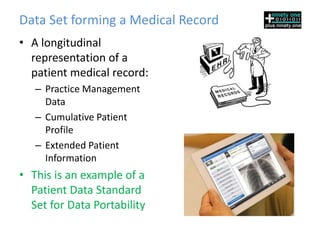
Data Set forming a Medical Record
• A longitudinal
  representation of a
  patient medical record:
   – Practice Management
     Data
   – Cumulative Patient
     Profile
   – Extended Patient
     Information
• This is an example of a
  Patient Data Standard
  Set for Data Portability
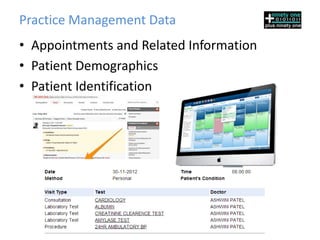
Practice Management Data
• Appointments and Related Information
• Patient Demographics
• Patient Identification
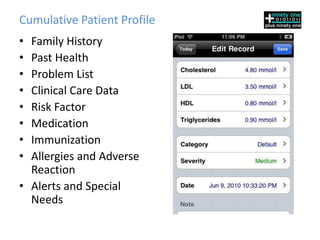
Cumulative Patient Profile
• Family History
• Past Health
• Problem List
• Clinical Care Data
• Risk Factor
• Medication
• Immunization
• Allergies and Adverse
  Reaction
• Alerts and Special
  Needs
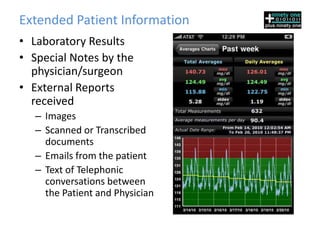
Extended Patient Information
• Laboratory Results
• Special Notes by the
  physician/surgeon
• External Reports
  received
   – Images
   – Scanned or Transcribed
     documents
   – Emails from the patient
   – Text of Telephonic
     conversations between
     the Patient and Physician
Thanks for Viewing this Presentation

If you’d wish for me further help, please contact me


Blog: http://wirelysis.blogspot.com
Twitter: @nrip
Email: n.nihalani@plus91.in
Corporate: http://www.plus91.in
References
• Clinical Data Standards in Healthcare - ihealth
  Reports
• http://www.scoop.it/t/healthcare-technology
• COCIR eHealth Toolkit 2012
• http://technology4doctors.blogspot.com
• Connecting for Health – Markle Foundation
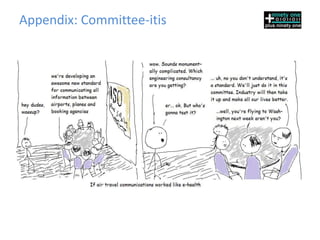
Appendix: Committee-itis

Clinical Data Standards and Data Portability

  • 1.
    Nrip Nihalani Plus91 TechnologiesPvt. Ltd. Adding Value to Healthcare Clinical Data Standards and Data Portability
  • 2.
    Health 2.0 ? •Healthcare is being pushed into the Information Age – the need for this was all-to- well known due to: – Breaking up of economic divides – Rising Consumerism – Increasing Costs – Safety Concerns • Health care still is not taking full advantage of the information & communications technologies that have revolutionized other industries
  • 3.
    The Patient EmpowermentMovement • Empowering patients to maintain and improve their health • Enabling clinicians and health-care organizations to provide safer and more evidence-based care • THIS REQUIRES “creating a dynamic, networked information infrastructure”  must reliably ensure the private and secure movement of vital health information at the time that it is needed to the place where it is needed
  • 4.
    Examples of HealthcareInfo Systems • Information systems are making important contributions towards the creation of a safer healthcare industry
  • 5.
    Benefits of eHealth/ Health IT • Deliver care to people located in remote places ; who do not have access to a hospital, through a tele-consultation. • Help improve the quality of life of patients by, for e.g., monitoring the condition of the patient at distance at home, rather than in a hospital  particularly relevant for elderly, chronically ill persons and people living in remote regions • Improve the quality of care by providing easier, safer and faster access to patient data, thereby allowing healthcare professionals to “Access the Right Data at the Right Time” and “Make an informed-based diagnosis”
  • 6.
    Benefits of eHealth/ Health IT • The availability of information on the patient – such as his medical history, past diseases and interventions, allergies, reaction to medications in an EHR allows healthcare professionals to deliver a treatment tailored to the needs of the patient and thereby reduce risks of complications, adverse reactions etc. • Clinical Decision Support Systems help in reducing reliance on memory, increasing vigilance, and contributing to standardization of processes
  • 7.
    Benefits of eHealth/ Health IT • eHealth tools can help Physicians work more efficiently, by storing patient information in a single location, allowing access to information on the patient faster, taking medical decisions better and faster • By allowing healthcare professionals to save time, eHealth tools also address the issue of shortage of healthcare professionals in many areas.
  • 8.
    New Useful HealthIT Solutions - Weekly
  • 9.
    Data Sharing –Systems and Entities • Useful New Health IT Solutions, Softwares, Devices launch every week. • Also, Various healthcare entities use and modify a patient’s data, structured as well as residual, at different times - physicians, hospitals, laboratories, insurers, researchers and even the patients themselves • The need for information sharing between different systems is thus critical – Else Data sharing will be a bottleneck and create poor, ineffective processes
  • 10.
    Interoperability • Interoperability meansthe ability of two or more systems to use and exchange data and human understandable information • With interoperable systems, data can be exchanged and stored automatically rather than re-typed into the system each time. • 3 levels of Interoperability 1. ORGANISATIONAL INTEROPERABILITY • is the will and ability to work together and exchange information. It is brought about by an environment composed of laws, policies, and cooperation agreements
  • 11.
    Interoperability 2.SEMANTIC INTEROPERABILITY • ensures that the precise meaning of exchanged information is interpretable by any system or application not initially developed for the same purpose as the system initiating the exchange 3. TECHNICAL INTEROPERABILITY • enables the exchange of information from a technical standpoint and guarantees: – data security and privacy – data integrity – access to relevant data associated with an identified patient
  • 12.
    Interoperability  DataStandards • Interoperability requires the creation, acceptance, and implementation of clinical data standards to ensure that data in one part of the system is available and usable across a variety of clinical settings • Using standards for data sharing is the first step of interoperability. • Standards allow a common definition of data and data exchange formats which is essential to enable interoperability both at the technical and semantic level.
  • 13.
    canyouundertstandthis • datastandardsdatastandardsareagreeduponrul esthatallowinformationtobesharedandprocess edinauniformandconsistentmannerforexample rulesinalanguagesentencesshouldendwithafull stopcommascanbeusedtoseparatepartsofafull sentenceorlistsnamesofindividualsmustbecapi talizedforexamplestandardplugsstandardplugs attachedtodevicesallowthemtobeusedinhome swheretherearestandardizedsockets
  • 14.
    Now try this • Data standards are agreed upon rules – that allow information to be shared and processed in a uniform and consistent manner. • For example “Rules in a language” • Sentences should end with a fullstop. Commas can be used to separate parts of a full sentence or lists. Names of individuals must be capitalized. • For Example “Standard Plugs”: • Standard plugs attached to devices allow them to be used in homes where there are standardized sockets.
  • 15.
    Data Standards • Ata minimum a Data Standard Must Contain: – Interface Specification – Nomenclature Standard
  • 16.
    E.g of fulfillingInteroperability • HL7 - (A Syntax Standard) – Successful standard for the intra-hospital communication of clinical, administrative and financial data. It supports the active management of key workflows within and across providers through data exchange, e.g. registration of patients, placement of orders and reporting of results. • SNOMED CT: ( A Semantic Standard) – It is a systematically organised collection of medical terminology covering most areas of clinical information. It provides a consistent way to index, store, retrieve and aggregate clinical data across specialties and sites of care • Syntax + Semantics can fulfill Interoperability
  • 17.
    CATEGORIES OF DATASTANDARDS • DATA EXCHANGE STANDARDS  HL7, DICOM – Allow transactions to flow between systems/organizations • TERMINOLOGY SNOMED, ICD-9 – Vocabularies, provide specific codes for clinical concepts • DOCUMENT  CCR – Indicate what type of information is included in a document and where can it be found. • APPLICATION CCOW – Determine the way business rules are implemented and software systems interact
  • 18.
    STANDARDS  FOLLOWINGQUALITIES: • TRANSPARENT: should be easily available for all stakeholders • RELEVANT AND USER-DRIVEN: should be based on real-world business use cases • APPROPRIATE: should provide reasoning behind the choice of implementation technologies • EFFECTIVE: should reuse existing work as well as global and ISO/IEC Base Standards as much as possible
  • 19.
    STANDARDS  FOLLOWINGQUALITIES: • THOROUGH: should address eHealth interoperability in relation to application functionality, data integrity and availability, patients’ privacy and safety and performance aspects • COLLABORATIVE: setting procedures should maintain a cooperative spirit • TESTING AND VALIDATION: should have clear criteria that can be tested in order to validate interoperability
  • 20.
    Standards for Standards •Standards must be made such that they – Ensure applications developed for various platforms catering to different healthcare processes will work for another – Enable the movement of a datastore (database or otherwise) from one eHealth solution to another. – Enable reversibility, moving data from software systems to Non- software processes
  • 21.
    Nomenclature • Data Portability- is the process by which the is medical record in whole or in part can be transferred between two Electronic Systems • Structured Field - is a data element in a medical record which is defined and has a defined structure • Residual Data is The data in a medical record that is not defined by structured fields and is important information for patient care
  • 22.
    Data Set forminga Medical Record • A longitudinal representation of a patient medical record: – Practice Management Data – Cumulative Patient Profile – Extended Patient Information • This is an example of a Patient Data Standard Set for Data Portability
  • 23.
    Practice Management Data •Appointments and Related Information • Patient Demographics • Patient Identification
  • 24.
    Cumulative Patient Profile •Family History • Past Health • Problem List • Clinical Care Data • Risk Factor • Medication • Immunization • Allergies and Adverse Reaction • Alerts and Special Needs
  • 25.
    Extended Patient Information •Laboratory Results • Special Notes by the physician/surgeon • External Reports received – Images – Scanned or Transcribed documents – Emails from the patient – Text of Telephonic conversations between the Patient and Physician
  • 26.
    Thanks for Viewingthis Presentation If you’d wish for me further help, please contact me Blog: http://wirelysis.blogspot.com Twitter: @nrip Email: n.nihalani@plus91.in Corporate: http://www.plus91.in
  • 27.
    References • Clinical DataStandards in Healthcare - ihealth Reports • http://www.scoop.it/t/healthcare-technology • COCIR eHealth Toolkit 2012 • http://technology4doctors.blogspot.com • Connecting for Health – Markle Foundation
  • 28.