Almost-Standard Gauge:
Misadventures in
Interoperability
Megan Douglas, JD
Associate Project Director, Health IT Policy
Morehouse School of Medicine
3rd Annual Policy Prescriptions Symposium
Houston, TX
June 11, 2016
The Following Presenters Have Disclosed Relevant Financial Relationships:
Cedric Dark, MD MPH FAAEM FACEP
Community Health Choice, Event Sponsorship; Schumacher Clinical Partners, Event Sponsorship
Seth Trueger, MD MPH
Emergency Physicians Monthly, Employee, Salary
The Following Presenters Have Disclosed No Financial Relationships:
Megan Douglas, JD
Elena M. Marks, JD MPH
Laura Medford-Davis, MD
Bich-May Nguyen, MD MPH
The Following Planners Have Disclosed Relevant Financial Relationships:
Cedric Dark, MD MPH FAAEM FACEP
Community Health Choice, Event Sponsorship; Schumacher Clinical Partners,
Event Sponsorship
The Following Planning Committee Members and Staff Have Disclosed No
Relevant Financial Relationships:
Emily DeVillers, CAE
Kay Whalen, MBA CAE
Janet Wilson, CAE
The project described was supported
by the National Institute on Minority
Health and Health Disparities (NIMHD)
Grant Number U54MD008173, a
component of the National Institutes of
Health (NIH) and Its contents are solely
the responsibility of the authors and do
not necessarily represent the official
views of NIMHD or NIH.
Official Statement
Learning Objectives
• Define interoperability as distinguished from health
information exchange
• Describe the current status of interoperability at a
national level
• Assess organizational and policy barriers and
facilitators to interoperability
Setting the Stage
• No Matter Where
– https://www.youtube.com/watch?v=qMurGr623Ms
• Ideal vs. Reality
• Evolution, NOT revolution
DEFINITIONS
Health Information Exchange (HIE*)
Ability of two or more health information systems to
exchange clinical information to provide access to
longitudinal information
*Not to be confused with HIE (governance entities
that facilitate HIE)
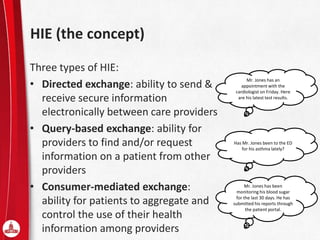
HIE (the concept)
Three types of HIE:
• Directed exchange: ability to send &
receive secure information
electronically between care providers
• Query-based exchange: ability for
providers to find and/or request
information on a patient from other
providers
• Consumer-mediated exchange:
ability for patients to aggregate and
control the use of their health
information among providers
Mr. Jones has an
appointment with the
cardiologist on Friday. Here
are his latest test results.
Has Mr. Jones been to the ED
for his asthma lately?
Mr. Jones has been
monitoring his blood sugar
for the last 30 days. He has
submitted his reports through
the patient portal.
HIE (Governance entities)
• State, regional, system-based
– Every state has different
strategy/model
– Public, private, public-private
partnership
• Direct participation vs. network
of networks
• Services offered
– DIRECT messaging (HIPAA-
compliant e-mail)
– Query-based searches
– Automatic notifications
• Distinguish between adoption
& utilization
– How much data is actually
flowing?
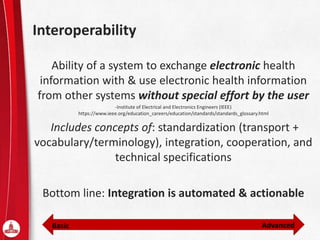
Interoperability
Ability of a system to exchange electronic health
information with & use electronic health information
from other systems without special effort by the user
-Institute of Electrical and Electronics Engineers (IEEE)
https://www.ieee.org/education_careers/education/standards/standards_glossary.html
Includes concepts of: standardization (transport +
vocabulary/terminology), integration, cooperation, and
technical specifications
Bottom line: Integration is automated & actionable
Basic Advanced
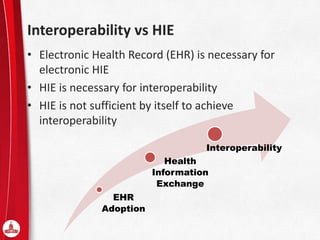
Interoperability vs HIE
• Electronic Health Record (EHR) is necessary for
electronic HIE
• HIE is necessary for interoperability
• HIE is not sufficient by itself to achieve
interoperability
EHR
Adoption
Health
Information
Exchange
Interoperability
Electronic
Health
Record
ClinicalDecision
Health Information
Exchange
Advanced
Interoperability
Basic
Interoperability
Clinical
Care
Document
(CCD)
STATUS
The Interoperability Unicorn
“Many have heard about it, but few have seen it”
Numbers...?
• We don’t know how many providers have
“interoperable” systems
• But we do know:
Proportion of physicians who reported
electronically sharing health information, 2013
and 2014
SOURCE: 2013 and 2014 National Electronic Health Record Surveys; HealthIT.gov
http://dashboard.healthit.gov/evaluations/data-briefs/physician-electronic-exchange-patient-health-information.php
Proportion of physicians who electronically
shared any patient health information with
other providers, 2014
SOURCE: 2013 and 2014 National Electronic Health Record Surveys; HealthIT.gov
http://dashboard.healthit.gov/evaluations/data-briefs/physician-electronic-exchange-patient-health-information.php
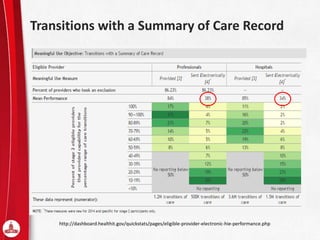
Transitions with a Summary of Care Record
http://dashboard.healthit.gov/quickstats/pages/eligible-provider-electronic-hie-performance.php
Percent of non-federal acute care hospitals that
electronically exchanged with providers outside
their organization: 2008-2014.
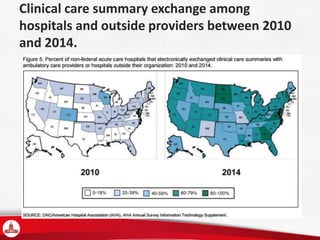
Clinical care summary exchange among
hospitals and outside providers between 2010
and 2014.
Percent of U.S. Hospitals that Routinely Electronically
Notify Patient's Primary Care Provider upon
Emergency Room Entry
HealthIT.gov Dashboard - http://dashboard.healthit.gov/quickstats/pages/FIG-Hospital-Routine-Electronic-Notification.php
BARRIERS & FACILITATORS
TO INTEROPERABILITY
Why is interoperability so hard?
Technical?
Business?
Moral?
Moral
For the “public good”
– Increases efficiency
– Reduces costs to the system
– Patients prefer record sharing
– Improves care coordination
– Improves health outcomes
– Improve population health
Privacy/security
– Data breaches
Technical
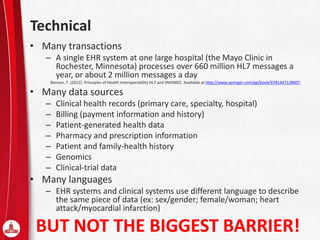
• Many transactions
– A single EHR system at one large hospital (the Mayo Clinic in
Rochester, Minnesota) processes over 660 million HL7 messages a
year, or about 2 million messages a day
Benson, T. (2012). Principles of Health Interoperability HL7 and SNOMED. Available at http://www.springer.com/gp/book/9781447128007.
• Many data sources
– Clinical health records (primary care, specialty, hospital)
– Billing (payment information and history)
– Patient-generated health data
– Pharmacy and prescription information
– Patient and family-health history
– Genomics
– Clinical-trial data
• Many languages
– EHR systems and clinical systems use different language to describe
the same piece of data (ex: sex/gender; female/woman; heart
attack/myocardial infarction)
BUT NOT THE BIGGEST BARRIER!
Business (aka )
• “It is usually in each vendor’s financial self-interest to
provide a proprietary nonstandard interface to a
customer, even though they know well that this is
ultimately creating an interoperability nightmare”
Benson, T. (2012). Principles of Health Interoperability HL7 and SNOMED. Available at
http://www.springer.com/gp/book/9781447128007.
• Patient “ownership” – system competition
• Data ownership
• Inadequate ROI/business case
• Liability
– Data protection – chain of custody (“typically addressed in
layers of complex legal agreements between vendors and
healthcare facilities”)
Munro, D. The Healthcare IT Quote Of 2015.
Available at http://healthstandards.com/blog/2015/12/01/quote-of-2015/.
State Initiatives
• Laws
– North Carolina Session Law 2015-241 s. 12A.4 and 12A.5
• As of February 1, 2018, all Medicaid providers must be
connected to the HIE in order to continue to receive payments
for Medicaid services provided. By June 1, 2018, all other entities
that receive state funds for the provision of health services,
including local management entities/managed care
organizations, also must be connected
• Funding
– ONC has 56 cooperative agreements with
states/territories
• Governance
• Public-private partnership
– Texas Health Services Authority (THSA) partnered with
InterSystems in 2013
• Network of networks (favored, not mandatory)
• Services
– Clinical Document Exchange (Treatment)
– Federated Trust Framework (Security/Confidentiality/Accuracy)
– Patient Consent Management (opt-in or opt-out)
– eHealth Exchange
• Fees (based on size of HIE)
– Implementation fee: $20-$130k
– Annual fee: $15-$110k
• State HIN, public-private
partnership
• Network of networks
• Members
– Payers
– State agencies
– Regional HIEs
• Services
– Direct messaging
– Query-based record
retrieval
• Mission-based Service
Area HIE
– Focus on small, rural
providers, practices,
hospitals
• Services
– Query-based record
retrieval
– Direct messaging
– Medication management
– Quality performance
dashboard
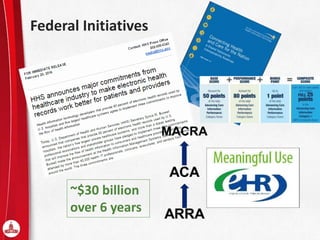
Federal Initiatives
~$30 billion
over 6 years
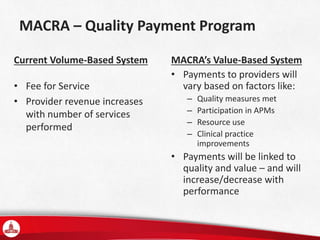
MACRA – Quality Payment Program
Current Volume-Based System
• Fee for Service
• Provider revenue increases
with number of services
performed
MACRA’s Value-Based System
• Payments to providers will
vary based on factors like:
– Quality measures met
– Participation in APMs
– Resource use
– Clinical practice
improvements
• Payments will be linked to
quality and value – and will
increase/decrease with
performance
Merit-Based Incentive Payment System (MIPS)
Proposed Rule
• Meaningful Use  Advancing Care Information
• 25% of Composite Performance Score (Quality,
Resource Use, Clinical Practice Improvement
Activities)
• Focus on Patient Electronic Access, Coordination of
Care through Patient Engagement, Health
Information Exchange
• Bonus for submitting clinical quality measures
(CQM) electronically
Health IT is in its...

Misadventures in Interoperability

  • 1.
    Almost-Standard Gauge: Misadventures in Interoperability MeganDouglas, JD Associate Project Director, Health IT Policy Morehouse School of Medicine 3rd Annual Policy Prescriptions Symposium Houston, TX June 11, 2016
  • 2.
    The Following PresentersHave Disclosed Relevant Financial Relationships: Cedric Dark, MD MPH FAAEM FACEP Community Health Choice, Event Sponsorship; Schumacher Clinical Partners, Event Sponsorship Seth Trueger, MD MPH Emergency Physicians Monthly, Employee, Salary The Following Presenters Have Disclosed No Financial Relationships: Megan Douglas, JD Elena M. Marks, JD MPH Laura Medford-Davis, MD Bich-May Nguyen, MD MPH The Following Planners Have Disclosed Relevant Financial Relationships: Cedric Dark, MD MPH FAAEM FACEP Community Health Choice, Event Sponsorship; Schumacher Clinical Partners, Event Sponsorship The Following Planning Committee Members and Staff Have Disclosed No Relevant Financial Relationships: Emily DeVillers, CAE Kay Whalen, MBA CAE Janet Wilson, CAE
  • 3.
    The project describedwas supported by the National Institute on Minority Health and Health Disparities (NIMHD) Grant Number U54MD008173, a component of the National Institutes of Health (NIH) and Its contents are solely the responsibility of the authors and do not necessarily represent the official views of NIMHD or NIH. Official Statement
  • 4.
    Learning Objectives • Defineinteroperability as distinguished from health information exchange • Describe the current status of interoperability at a national level • Assess organizational and policy barriers and facilitators to interoperability
  • 5.
    Setting the Stage •No Matter Where – https://www.youtube.com/watch?v=qMurGr623Ms • Ideal vs. Reality • Evolution, NOT revolution
  • 6.
  • 7.
    Health Information Exchange(HIE*) Ability of two or more health information systems to exchange clinical information to provide access to longitudinal information *Not to be confused with HIE (governance entities that facilitate HIE)
  • 8.
    HIE (the concept) Threetypes of HIE: • Directed exchange: ability to send & receive secure information electronically between care providers • Query-based exchange: ability for providers to find and/or request information on a patient from other providers • Consumer-mediated exchange: ability for patients to aggregate and control the use of their health information among providers Mr. Jones has an appointment with the cardiologist on Friday. Here are his latest test results. Has Mr. Jones been to the ED for his asthma lately? Mr. Jones has been monitoring his blood sugar for the last 30 days. He has submitted his reports through the patient portal.
  • 9.
    HIE (Governance entities) •State, regional, system-based – Every state has different strategy/model – Public, private, public-private partnership • Direct participation vs. network of networks • Services offered – DIRECT messaging (HIPAA- compliant e-mail) – Query-based searches – Automatic notifications • Distinguish between adoption & utilization – How much data is actually flowing?
  • 10.
    Interoperability Ability of asystem to exchange electronic health information with & use electronic health information from other systems without special effort by the user -Institute of Electrical and Electronics Engineers (IEEE) https://www.ieee.org/education_careers/education/standards/standards_glossary.html Includes concepts of: standardization (transport + vocabulary/terminology), integration, cooperation, and technical specifications Bottom line: Integration is automated & actionable Basic Advanced
  • 11.
    Interoperability vs HIE •Electronic Health Record (EHR) is necessary for electronic HIE • HIE is necessary for interoperability • HIE is not sufficient by itself to achieve interoperability EHR Adoption Health Information Exchange Interoperability
  • 12.
  • 13.
  • 14.
    The Interoperability Unicorn “Manyhave heard about it, but few have seen it”
  • 15.
    Numbers...? • We don’tknow how many providers have “interoperable” systems • But we do know:
  • 16.
    Proportion of physicianswho reported electronically sharing health information, 2013 and 2014 SOURCE: 2013 and 2014 National Electronic Health Record Surveys; HealthIT.gov http://dashboard.healthit.gov/evaluations/data-briefs/physician-electronic-exchange-patient-health-information.php
  • 17.
    Proportion of physicianswho electronically shared any patient health information with other providers, 2014 SOURCE: 2013 and 2014 National Electronic Health Record Surveys; HealthIT.gov http://dashboard.healthit.gov/evaluations/data-briefs/physician-electronic-exchange-patient-health-information.php
  • 18.
    Transitions with aSummary of Care Record http://dashboard.healthit.gov/quickstats/pages/eligible-provider-electronic-hie-performance.php
  • 19.
    Percent of non-federalacute care hospitals that electronically exchanged with providers outside their organization: 2008-2014.
  • 20.
    Clinical care summaryexchange among hospitals and outside providers between 2010 and 2014.
  • 21.
    Percent of U.S.Hospitals that Routinely Electronically Notify Patient's Primary Care Provider upon Emergency Room Entry HealthIT.gov Dashboard - http://dashboard.healthit.gov/quickstats/pages/FIG-Hospital-Routine-Electronic-Notification.php
  • 22.
  • 23.
    Why is interoperabilityso hard? Technical? Business? Moral?
  • 24.
    Moral For the “publicgood” – Increases efficiency – Reduces costs to the system – Patients prefer record sharing – Improves care coordination – Improves health outcomes – Improve population health Privacy/security – Data breaches
  • 25.
    Technical • Many transactions –A single EHR system at one large hospital (the Mayo Clinic in Rochester, Minnesota) processes over 660 million HL7 messages a year, or about 2 million messages a day Benson, T. (2012). Principles of Health Interoperability HL7 and SNOMED. Available at http://www.springer.com/gp/book/9781447128007. • Many data sources – Clinical health records (primary care, specialty, hospital) – Billing (payment information and history) – Patient-generated health data – Pharmacy and prescription information – Patient and family-health history – Genomics – Clinical-trial data • Many languages – EHR systems and clinical systems use different language to describe the same piece of data (ex: sex/gender; female/woman; heart attack/myocardial infarction) BUT NOT THE BIGGEST BARRIER!
  • 26.
    Business (aka ) •“It is usually in each vendor’s financial self-interest to provide a proprietary nonstandard interface to a customer, even though they know well that this is ultimately creating an interoperability nightmare” Benson, T. (2012). Principles of Health Interoperability HL7 and SNOMED. Available at http://www.springer.com/gp/book/9781447128007. • Patient “ownership” – system competition • Data ownership • Inadequate ROI/business case • Liability – Data protection – chain of custody (“typically addressed in layers of complex legal agreements between vendors and healthcare facilities”) Munro, D. The Healthcare IT Quote Of 2015. Available at http://healthstandards.com/blog/2015/12/01/quote-of-2015/.
  • 27.
    State Initiatives • Laws –North Carolina Session Law 2015-241 s. 12A.4 and 12A.5 • As of February 1, 2018, all Medicaid providers must be connected to the HIE in order to continue to receive payments for Medicaid services provided. By June 1, 2018, all other entities that receive state funds for the provision of health services, including local management entities/managed care organizations, also must be connected • Funding – ONC has 56 cooperative agreements with states/territories • Governance
  • 28.
    • Public-private partnership –Texas Health Services Authority (THSA) partnered with InterSystems in 2013 • Network of networks (favored, not mandatory) • Services – Clinical Document Exchange (Treatment) – Federated Trust Framework (Security/Confidentiality/Accuracy) – Patient Consent Management (opt-in or opt-out) – eHealth Exchange • Fees (based on size of HIE) – Implementation fee: $20-$130k – Annual fee: $15-$110k
  • 29.
    • State HIN,public-private partnership • Network of networks • Members – Payers – State agencies – Regional HIEs • Services – Direct messaging – Query-based record retrieval • Mission-based Service Area HIE – Focus on small, rural providers, practices, hospitals • Services – Query-based record retrieval – Direct messaging – Medication management – Quality performance dashboard
  • 30.
  • 31.
    MACRA – QualityPayment Program Current Volume-Based System • Fee for Service • Provider revenue increases with number of services performed MACRA’s Value-Based System • Payments to providers will vary based on factors like: – Quality measures met – Participation in APMs – Resource use – Clinical practice improvements • Payments will be linked to quality and value – and will increase/decrease with performance
  • 32.
    Merit-Based Incentive PaymentSystem (MIPS) Proposed Rule • Meaningful Use  Advancing Care Information • 25% of Composite Performance Score (Quality, Resource Use, Clinical Practice Improvement Activities) • Focus on Patient Electronic Access, Coordination of Care through Patient Engagement, Health Information Exchange • Bonus for submitting clinical quality measures (CQM) electronically
  • 33.
    Health IT isin its...