Healthcare evolves with Data
Interoperability
1
Data Interoperability in Healthcare
➢ Interoperability is the ability of devices and systems to exchange and use
electronic information from other devices and systems without special effort on the part
of the user.
➢ Data Interoperability have come a long way in giving healthcare providers vital patient
information.
➢ Interoperability in healthcare includes the technologies used in patient care to enable the
sharing of data to meet the goals of delivering personalized care and effective
population health management.
2
Data Interoperability in Healthcare
✓ The current lack of interoperability in healthcare can compromise patient safety, contribute to
clinician burn-out, and waste billions of dollars a year.
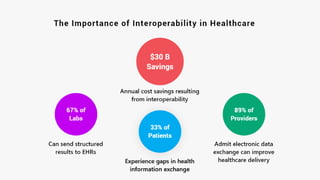
✓ One survey has quoted that the lack of healthcare data interoperability costs the U.S. health
system over $30 billion* a year.
✓ The lack of interoperability in healthcare hinders development, which may be the biggest
missed opportunity for the health interoperability ecosystem.
✓ They face challenges accessing data, integrating into highly-customized environments, and
scaling semantic interoperability across a variety of data landscapes.
* - https://www.westhealth.org/press-release/new-analysis-by-west-health-institute-finds-medical-
device-interoperability-could-save-more-than-30-billion-a-year/
3
4
Data Interoperability in Healthcare
❖ In today’s health interoperability ecosystem, organizations that define interoperability as
engaging in the bi-directional exchange of data are experiencing the greatest success.
❖ The demand for Electronic Health Record (EHR) systems that collect and manage
personal health data and the need for flexible access to eHealth systems has increased.
❖ Interoperability in healthcare will continue to evolve and improve as new advancements
in technology are made. For the healthcare industry to move forward, clinical data needs
to flow freely across networks.
5
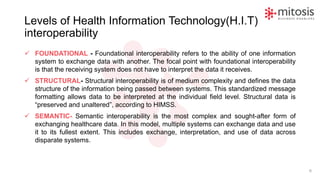
Levels of Health Information Technology(H.I.T)
interoperability
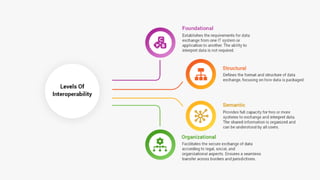
✓ FOUNDATIONAL - Foundational interoperability refers to the ability of one information
system to exchange data with another. The focal point with foundational interoperability
is that the receiving system does not have to interpret the data it receives.
✓ STRUCTURAL- Structural interoperability is of medium complexity and defines the data
structure of the information being passed between systems. This standardized message
formatting allows data to be interpreted at the individual field level. Structural data is
“preserved and unaltered”, according to HIMSS.
✓ SEMANTIC- Semantic interoperability is the most complex and sought-after form of
exchanging healthcare data. In this model, multiple systems can exchange data and use
it to its fullest extent. This includes exchange, interpretation, and use of data across
disparate systems.
6
7
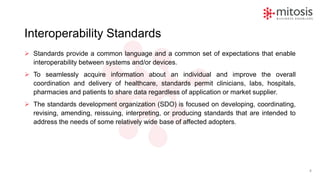
Interoperability Standards
➢ Standards provide a common language and a common set of expectations that enable
interoperability between systems and/or devices.
➢ To seamlessly acquire information about an individual and improve the overall
coordination and delivery of healthcare, standards permit clinicians, labs, hospitals,
pharmacies and patients to share data regardless of application or market supplier.
➢ The standards development organization (SDO) is focused on developing, coordinating,
revising, amending, reissuing, interpreting, or producing standards that are intended to
address the needs of some relatively wide base of affected adopters.
8
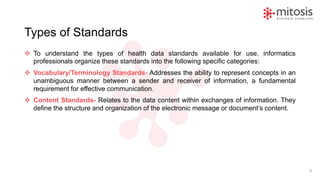
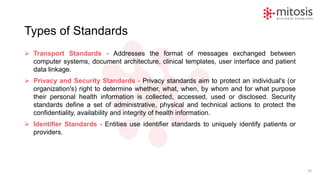
Types of Standards
❖ To understand the types of health data standards available for use, informatics
professionals organize these standards into the following specific categories:
❖ Vocabulary/Terminology Standards- Addresses the ability to represent concepts in an
unambiguous manner between a sender and receiver of information, a fundamental
requirement for effective communication.
❖ Content Standards- Relates to the data content within exchanges of information. They
define the structure and organization of the electronic message or document’s content.
9
Types of Standards
➢ Transport Standards - Addresses the format of messages exchanged between
computer systems, document architecture, clinical templates, user interface and patient
data linkage.
➢ Privacy and Security Standards - Privacy standards aim to protect an individual's (or
organization's) right to determine whether, what, when, by whom and for what purpose
their personal health information is collected, accessed, used or disclosed. Security
standards define a set of administrative, physical and technical actions to protect the
confidentiality, availability and integrity of health information.
➢ Identifier Standards - Entities use identifier standards to uniquely identify patients or
providers.
10
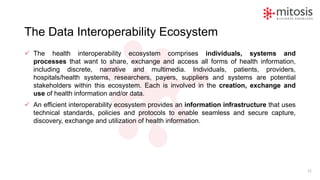
The Data Interoperability Ecosystem
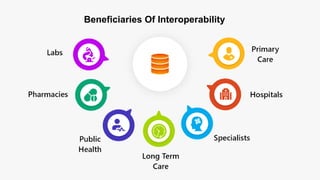
✓ The health interoperability ecosystem comprises individuals, systems and
processes that want to share, exchange and access all forms of health information,
including discrete, narrative and multimedia. Individuals, patients, providers,
hospitals/health systems, researchers, payers, suppliers and systems are potential
stakeholders within this ecosystem. Each is involved in the creation, exchange and
use of health information and/or data.
✓ An efficient interoperability ecosystem provides an information infrastructure that uses
technical standards, policies and protocols to enable seamless and secure capture,
discovery, exchange and utilization of health information.
11
12
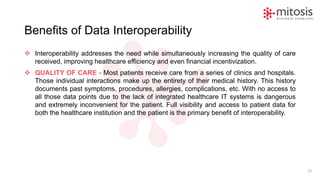
Benefits of Data Interoperability
❖ Interoperability addresses the need while simultaneously increasing the quality of care
received, improving healthcare efficiency and even financial incentivization.
❖ QUALITY OF CARE - Most patients receive care from a series of clinics and hospitals.
Those individual interactions make up the entirety of their medical history. This history
documents past symptoms, procedures, allergies, complications, etc. With no access to
all those data points due to the lack of integrated healthcare IT systems is dangerous
and extremely inconvenient for the patient. Full visibility and access to patient data for
both the healthcare institution and the patient is the primary benefit of interoperability.
13
Benefits of Data Interoperability
❖ EFFICIENCY - By having real-time results at their fingertips medical practices can cut
down on repetitive tasks and drastically increase margins by treating more patients and
increasing the quality of care they receive. Patients will have more control over their
own data, removing a significant amount of that administrative burden.
❖ FINANCIAL INCENTIVES & REIMBURSEMENTS - Meaningful use, which offered
incentives to practices that adopted electronic health records (EHR) set the tone for
interoperability between systems and its alignment with financial incentives. This will
continue to play a major role in future developments in value-based care, such
as mips/MACRA, amplifying the relationship between patient outcomes and financial
performance.
14
How Interoperability Improves Healthcare
✓ Improving patient care and safety is the prime directive and end goal of interoperability.
Additional goals are improved care coordination and experiences for patients, lowered
healthcare costs, and more robust public health data.
✓ Improved care coordination and patient experiences - Patients must often do
administrative tasks like searching for documents, filling out multiple forms, re-explaining
their symptoms or medical history and sorting out insurance (both before and, often,
after receiving care). This means today’s patient experience is still surprisingly
redundant and inefficient.
✓ By using interoperability to streamline this process, healthcare facilities will be
empowered to give patients faster and more accurate and coordinated treatment and
enhancing their overall experience.
15
16
Beneficiaries Of Interoperability
How Interoperability Improves Healthcare
➢ Greater patient safety - By creating and implementing advanced interoperability, with
the aim to capture and interpret data across systems and applications, healthcare
organizations can better prevent errors, because of missing or incomplete patient data,
and pinpoint their errors’ causes if they do occur.
➢ Lacking data on a patient’s vital signs and history – including allergies, medications or
pre-existing conditions — healthcare organizations may be prone to fatal errors.
➢ If care providers can exchange and examine data, they can analyze the exact cause of a
medical error to detect the trends in the decision-making leading up to the error. Once a
pattern has been identified, healthcare organizations can begin remediating these issues
to prevent future errors.
17
How Interoperability Improves Healthcare
❖ Stronger privacy and security for patients - Interoperability can help enhance the
privacy and security of patient data by requiring organizations to fully assess where
their PHI resides and with whom it needs to be shared. When PHI is entered into
secure, interoperable systems, organizations can gain a better idea of where their data
is located and who has access to it, helping them secure patient data and protect
privacy.
❖ Higher productivity and reduced healthcare costs - Interoperability gives
organizations the opportunity to save time with every patient encounter by getting the
right data to the patient, the provider and affiliate at the right time, every time.
❖ More accurate public health data - Faster and more accurate collection and
interpretation of public health data is possible when IT systems can interact. This can
help organizations answer pressing questions for both patients and providers.
18
Conclusion
✓ Healthcare organizations understand the time has come to base healthcare on the best
and most complete information possible. Significantly better patient care and
experiences are possible through the implementation of data interoperability.
✓ These factors will create a more efficient and effective process for offering healthcare.
With patient safety in the balance, the effort required to obtain interoperability will prove
worthwhile.
19
To assist you with our services,
Please reach us at
20
hello@mitosistech.com
+91-7824035173
+1-(415) 251-2064
www.mitosistech.com

Healthcare evolves with Data Interoperability

  • 1.
    Healthcare evolves withData Interoperability 1
  • 2.
    Data Interoperability inHealthcare ➢ Interoperability is the ability of devices and systems to exchange and use electronic information from other devices and systems without special effort on the part of the user. ➢ Data Interoperability have come a long way in giving healthcare providers vital patient information. ➢ Interoperability in healthcare includes the technologies used in patient care to enable the sharing of data to meet the goals of delivering personalized care and effective population health management. 2
  • 3.
    Data Interoperability inHealthcare ✓ The current lack of interoperability in healthcare can compromise patient safety, contribute to clinician burn-out, and waste billions of dollars a year. ✓ One survey has quoted that the lack of healthcare data interoperability costs the U.S. health system over $30 billion* a year. ✓ The lack of interoperability in healthcare hinders development, which may be the biggest missed opportunity for the health interoperability ecosystem. ✓ They face challenges accessing data, integrating into highly-customized environments, and scaling semantic interoperability across a variety of data landscapes. * - https://www.westhealth.org/press-release/new-analysis-by-west-health-institute-finds-medical- device-interoperability-could-save-more-than-30-billion-a-year/ 3
  • 4.
  • 5.
    Data Interoperability inHealthcare ❖ In today’s health interoperability ecosystem, organizations that define interoperability as engaging in the bi-directional exchange of data are experiencing the greatest success. ❖ The demand for Electronic Health Record (EHR) systems that collect and manage personal health data and the need for flexible access to eHealth systems has increased. ❖ Interoperability in healthcare will continue to evolve and improve as new advancements in technology are made. For the healthcare industry to move forward, clinical data needs to flow freely across networks. 5
  • 6.
    Levels of HealthInformation Technology(H.I.T) interoperability ✓ FOUNDATIONAL - Foundational interoperability refers to the ability of one information system to exchange data with another. The focal point with foundational interoperability is that the receiving system does not have to interpret the data it receives. ✓ STRUCTURAL- Structural interoperability is of medium complexity and defines the data structure of the information being passed between systems. This standardized message formatting allows data to be interpreted at the individual field level. Structural data is “preserved and unaltered”, according to HIMSS. ✓ SEMANTIC- Semantic interoperability is the most complex and sought-after form of exchanging healthcare data. In this model, multiple systems can exchange data and use it to its fullest extent. This includes exchange, interpretation, and use of data across disparate systems. 6
  • 7.
  • 8.
    Interoperability Standards ➢ Standardsprovide a common language and a common set of expectations that enable interoperability between systems and/or devices. ➢ To seamlessly acquire information about an individual and improve the overall coordination and delivery of healthcare, standards permit clinicians, labs, hospitals, pharmacies and patients to share data regardless of application or market supplier. ➢ The standards development organization (SDO) is focused on developing, coordinating, revising, amending, reissuing, interpreting, or producing standards that are intended to address the needs of some relatively wide base of affected adopters. 8
  • 9.
    Types of Standards ❖To understand the types of health data standards available for use, informatics professionals organize these standards into the following specific categories: ❖ Vocabulary/Terminology Standards- Addresses the ability to represent concepts in an unambiguous manner between a sender and receiver of information, a fundamental requirement for effective communication. ❖ Content Standards- Relates to the data content within exchanges of information. They define the structure and organization of the electronic message or document’s content. 9
  • 10.
    Types of Standards ➢Transport Standards - Addresses the format of messages exchanged between computer systems, document architecture, clinical templates, user interface and patient data linkage. ➢ Privacy and Security Standards - Privacy standards aim to protect an individual's (or organization's) right to determine whether, what, when, by whom and for what purpose their personal health information is collected, accessed, used or disclosed. Security standards define a set of administrative, physical and technical actions to protect the confidentiality, availability and integrity of health information. ➢ Identifier Standards - Entities use identifier standards to uniquely identify patients or providers. 10
  • 11.
    The Data InteroperabilityEcosystem ✓ The health interoperability ecosystem comprises individuals, systems and processes that want to share, exchange and access all forms of health information, including discrete, narrative and multimedia. Individuals, patients, providers, hospitals/health systems, researchers, payers, suppliers and systems are potential stakeholders within this ecosystem. Each is involved in the creation, exchange and use of health information and/or data. ✓ An efficient interoperability ecosystem provides an information infrastructure that uses technical standards, policies and protocols to enable seamless and secure capture, discovery, exchange and utilization of health information. 11
  • 12.
  • 13.
    Benefits of DataInteroperability ❖ Interoperability addresses the need while simultaneously increasing the quality of care received, improving healthcare efficiency and even financial incentivization. ❖ QUALITY OF CARE - Most patients receive care from a series of clinics and hospitals. Those individual interactions make up the entirety of their medical history. This history documents past symptoms, procedures, allergies, complications, etc. With no access to all those data points due to the lack of integrated healthcare IT systems is dangerous and extremely inconvenient for the patient. Full visibility and access to patient data for both the healthcare institution and the patient is the primary benefit of interoperability. 13
  • 14.
    Benefits of DataInteroperability ❖ EFFICIENCY - By having real-time results at their fingertips medical practices can cut down on repetitive tasks and drastically increase margins by treating more patients and increasing the quality of care they receive. Patients will have more control over their own data, removing a significant amount of that administrative burden. ❖ FINANCIAL INCENTIVES & REIMBURSEMENTS - Meaningful use, which offered incentives to practices that adopted electronic health records (EHR) set the tone for interoperability between systems and its alignment with financial incentives. This will continue to play a major role in future developments in value-based care, such as mips/MACRA, amplifying the relationship between patient outcomes and financial performance. 14
  • 15.
    How Interoperability ImprovesHealthcare ✓ Improving patient care and safety is the prime directive and end goal of interoperability. Additional goals are improved care coordination and experiences for patients, lowered healthcare costs, and more robust public health data. ✓ Improved care coordination and patient experiences - Patients must often do administrative tasks like searching for documents, filling out multiple forms, re-explaining their symptoms or medical history and sorting out insurance (both before and, often, after receiving care). This means today’s patient experience is still surprisingly redundant and inefficient. ✓ By using interoperability to streamline this process, healthcare facilities will be empowered to give patients faster and more accurate and coordinated treatment and enhancing their overall experience. 15
  • 16.
  • 17.
    How Interoperability ImprovesHealthcare ➢ Greater patient safety - By creating and implementing advanced interoperability, with the aim to capture and interpret data across systems and applications, healthcare organizations can better prevent errors, because of missing or incomplete patient data, and pinpoint their errors’ causes if they do occur. ➢ Lacking data on a patient’s vital signs and history – including allergies, medications or pre-existing conditions — healthcare organizations may be prone to fatal errors. ➢ If care providers can exchange and examine data, they can analyze the exact cause of a medical error to detect the trends in the decision-making leading up to the error. Once a pattern has been identified, healthcare organizations can begin remediating these issues to prevent future errors. 17
  • 18.
    How Interoperability ImprovesHealthcare ❖ Stronger privacy and security for patients - Interoperability can help enhance the privacy and security of patient data by requiring organizations to fully assess where their PHI resides and with whom it needs to be shared. When PHI is entered into secure, interoperable systems, organizations can gain a better idea of where their data is located and who has access to it, helping them secure patient data and protect privacy. ❖ Higher productivity and reduced healthcare costs - Interoperability gives organizations the opportunity to save time with every patient encounter by getting the right data to the patient, the provider and affiliate at the right time, every time. ❖ More accurate public health data - Faster and more accurate collection and interpretation of public health data is possible when IT systems can interact. This can help organizations answer pressing questions for both patients and providers. 18
  • 19.
    Conclusion ✓ Healthcare organizationsunderstand the time has come to base healthcare on the best and most complete information possible. Significantly better patient care and experiences are possible through the implementation of data interoperability. ✓ These factors will create a more efficient and effective process for offering healthcare. With patient safety in the balance, the effort required to obtain interoperability will prove worthwhile. 19
  • 20.
    To assist youwith our services, Please reach us at 20 hello@mitosistech.com +91-7824035173 +1-(415) 251-2064 www.mitosistech.com