Xml dom
By
Sana mateen
DOM
• The Document Object Model (DOM) is a W3C standard. It defines a
standard for accessing documents like HTML and XML.
• Definition of DOM as put by the W3C is:
• The Document Object Model (DOM) is an application programming
interface (API) for HTML and XML documents. It defines the logical
structure of documents and the way a document is accessed and
manipulated. DOM defines the objects and properties and methods
(interface) to access all XML elements. The DOM is separated into 3
different parts / levels:
• Core DOM - standard model for any structured document
• XML DOM - standard model for XML documents
• HTML DOM - standard model for HTML documents
XML DOM
• XML DOM is a standard object model for XML.
• XML documents have a hierarchy of informational units called nodes;
DOM is a standard programming interface of describing those nodes and
the relationships between them.
• As XML DOM also provides an API that allows a developer to add, edit,
move or remove nodes at any point on the tree in order to create an
application.
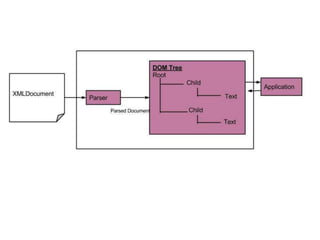
• Below is the diagram for the DOM structure which depicts that parser
evaluates an XML document as a DOM structure by traversing through
each nodes.
ADVANTAGES and DISADVANTAGES
• XML DOM is language and
platform independent.
• XML DOM is travesible -
Information in XML DOM is
organized in a hierarchy which
allows developer to navigate
around the hierarchy looking for
specific information.
• XML DOM is modifiable - It is
dynamic in nature providing
developer a scope to add, edit,
move or remove nodes at any
point on the tree.
• It consumes more memory (if the
XML structure is large) as
program written once remains in
memory all the time until and
unless removed explicitly.
• Due to the larger usage of
memory its operational speed,
compared to SAX is slower.
Dom Document
• A DOM document is a collection of nodes or pieces of information,
organized in a hierarchy.
• Some types of nodes may have child nodes of various types and others are
leaf nodes that cannot have anything below them in the document structure.
• Below is a list of the node types, and which node types they may have as
children:
• Document -- Element (maximum of one), ProcessingInstruction, Comment,
DocumentType (maximum of one)
• DocumentFragment -- Element, ProcessingInstruction, Comment, Text,
CDATASection, EntityReference
• EntityReference -- Element, ProcessingInstruction, Comment, Text,
CDATASection, EntityReference
• Element -- Element, Text, Comment, ProcessingInstruction,
CDATASection, EntityReference
• Attr -- Text, EntityReference
• ProcessingInstruction -- no children
• Comment -- no children
• Text -- no children
• CDATASection -- no children
• Entity -- Element, ProcessingInstruction, Comment, Text, CDATASection,
EntityReference
• Notation -- no children
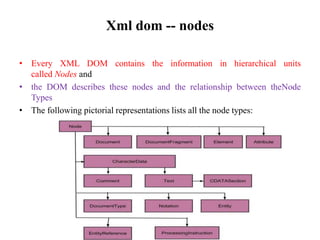
Xml dom -- nodes
• Every XML DOM contains the information in hierarchical units
called Nodes and
• the DOM describes these nodes and the relationship between theNode
Types
• The following pictorial representations lists all the node types:

Xml dom

  • 1.
  • 2.
    DOM • The DocumentObject Model (DOM) is a W3C standard. It defines a standard for accessing documents like HTML and XML. • Definition of DOM as put by the W3C is: • The Document Object Model (DOM) is an application programming interface (API) for HTML and XML documents. It defines the logical structure of documents and the way a document is accessed and manipulated. DOM defines the objects and properties and methods (interface) to access all XML elements. The DOM is separated into 3 different parts / levels: • Core DOM - standard model for any structured document • XML DOM - standard model for XML documents • HTML DOM - standard model for HTML documents
  • 3.
    XML DOM • XMLDOM is a standard object model for XML. • XML documents have a hierarchy of informational units called nodes; DOM is a standard programming interface of describing those nodes and the relationships between them. • As XML DOM also provides an API that allows a developer to add, edit, move or remove nodes at any point on the tree in order to create an application. • Below is the diagram for the DOM structure which depicts that parser evaluates an XML document as a DOM structure by traversing through each nodes.
  • 5.
    ADVANTAGES and DISADVANTAGES •XML DOM is language and platform independent. • XML DOM is travesible - Information in XML DOM is organized in a hierarchy which allows developer to navigate around the hierarchy looking for specific information. • XML DOM is modifiable - It is dynamic in nature providing developer a scope to add, edit, move or remove nodes at any point on the tree. • It consumes more memory (if the XML structure is large) as program written once remains in memory all the time until and unless removed explicitly. • Due to the larger usage of memory its operational speed, compared to SAX is slower.
  • 6.
    Dom Document • ADOM document is a collection of nodes or pieces of information, organized in a hierarchy. • Some types of nodes may have child nodes of various types and others are leaf nodes that cannot have anything below them in the document structure. • Below is a list of the node types, and which node types they may have as children: • Document -- Element (maximum of one), ProcessingInstruction, Comment, DocumentType (maximum of one) • DocumentFragment -- Element, ProcessingInstruction, Comment, Text, CDATASection, EntityReference • EntityReference -- Element, ProcessingInstruction, Comment, Text, CDATASection, EntityReference • Element -- Element, Text, Comment, ProcessingInstruction, CDATASection, EntityReference
  • 7.
    • Attr --Text, EntityReference • ProcessingInstruction -- no children • Comment -- no children • Text -- no children • CDATASection -- no children • Entity -- Element, ProcessingInstruction, Comment, Text, CDATASection, EntityReference • Notation -- no children
  • 9.
    Xml dom --nodes • Every XML DOM contains the information in hierarchical units called Nodes and • the DOM describes these nodes and the relationship between theNode Types • The following pictorial representations lists all the node types: