Patients Health Information
Translator (PHIT)
Team: Caramez-
Karkhanis-Yeramreddy
Faculty: Daniel Ries
Key Standards in Health Informatics Systems
Overview
Meaningful use aims to improve:
 Quality, safety, efficiency
 Maintaining privacy and security of patient health
information
Three Stages:
 Stage 1 : Implement and use certified Electronic
Health Record
 Stage 2 : Health care providers can exchange the
information, Improves efficiency and patient care.
 Stage 3 : Achieve Outcome
Overview(2)
Information exchange
systems must be:
Compatible
Must meet standards
Must be certified
Exchange information
helps Clinical
Decision Support
The Real Problem
Clinical Settings
 In the cases of emergency, unplanned care is
delivered at the Emergency room.
 Physicians are not able to provide efficient care
because they lack critical information about the
patient.
 Lack of Interoperability is hindering the exchange of
data in todays healthcare.
 Situation is explained further by taking a case
example.
Case Example
Situation
 85 years old female, falls at home and informs
911.
 Patient is rushed to ER at MGH(uses EPIC).
 Unable to provide information about her.
 CT scans reveal that patient has a Subdural
Hematoma resulted from a serious head injury.
 The Hospital needed more information but it
was not available.
Patient Details
Prior Medical History
 Followed by a Geriatric physician at Carney
Hospital outpatient clinic (Cerner)
Conditions
 Atrial Fibrillation (Cardiac arrhythmia)
Probable Medication
 Warfarin sodium for a long time (is the active
ingredient of CoumadinR)
Warfarin
Anticoagulant (blood thinner)
Indications: used to prevent harmful blood clots from
forming or growing larger on the legs, lungs, or clots
associated with Irregular, rapid heartbeat called atrial
fibrillation
Warfarin increases your risk of bleeding, which can be
severe or life-threatening:
 Patients 65 years old or older
 History of trauma, such as an accident or surgery
 Take other medicines that increase your risk of
bleeding, including
must be monitored carefully with blood testing
Clinical and Technical Gaps
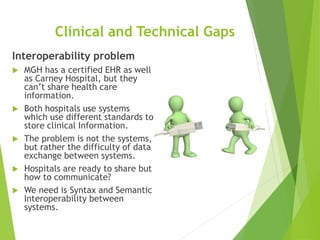
Interoperability problem
 MGH has a certified EHR as well
as Carney Hospital, but they
can’t share health care
information.
 Both hospitals use systems
which use different standards to
store clinical Information.
 The problem is not the systems,
but rather the difficulty of data
exchange between systems.
 Hospitals are ready to share but
how to communicate?
 We need is Syntax and Semantic
Interoperability between
systems.
The Massachusetts Health
Information Highway (Mass HIway)
 Statewide health information exchange (October2012)
 Offers providers a way to secure sending of health
information from one User to another
 This meaningful exchange of information can enable the
Commonwealth’s care community to:
 Positively influence care coordination and delivery
 Avoid readmissions and medical errors
 Reduce administrative costs and duplicative testing
 Enhance communication among providers
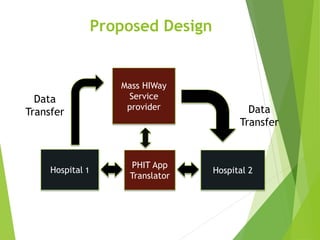
Proposed Design
Hospital 1 Hospital 2
Mass HIWay
Service
provider
PHIT App
Translator
Data
Transfer Data
Transfer
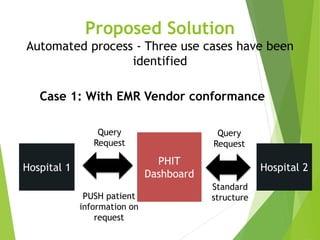
Proposed Solution
Automated process - Three use cases have been
identified
Hospital 1
PHIT
Dashboard
Hospital 2
PUSH patient
information on
request
Standard
structure
Query
Request
Query
Request
Case 1: With EMR Vendor conformance
Proposed Solution(2)
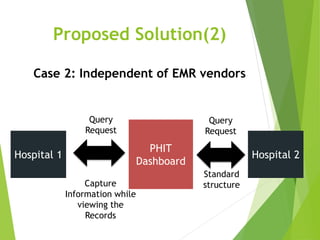
Case 2: Independent of EMR vendors
Case 2: Independent of
EMR vendors
Hospital 1
PHIT
Dashboard
Hospital 2
Capture
Information while
viewing the
Records
Standard
structure
Query
Request
Query
Request
Proposed Solution(3)
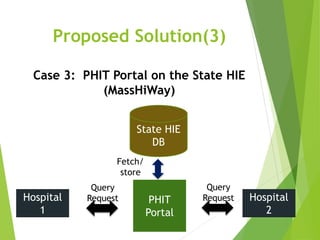
Case 3: PHIT Portal on the State HIE
(MassHiWay)
Hospital
1
PHIT
Portal
Hospital
2
Query
Request
Query
Request
State HIE
DB
Fetch/
store
Standards to be used
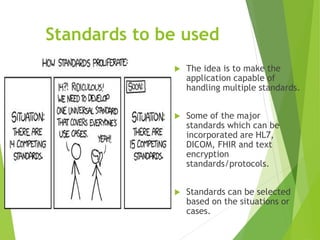
 The idea is to make the
application capable of
handling multiple standards.
 Some of the major
standards which can be
incorporated are HL7,
DICOM, FHIR and text
encryption
standards/protocols.
 Standards can be selected
based on the situations or
cases.
Real Time Examples
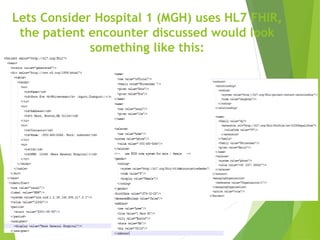
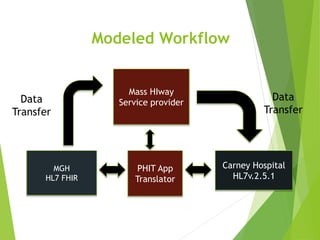
Lets Consider Hospital 1 (MGH) uses HL7 FHIR,
the patient encounter discussed would look
something like this:
MGH
HL7 FHIR
Carney Hospital
HL7v.2.5.1
Mass HIway
Service provider
PHIT App
Translator
Data
Transfer
Data
Transfer
Modeled Workflow
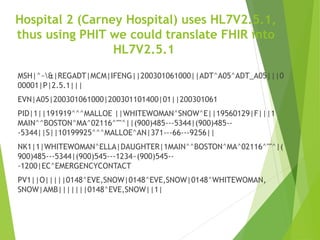
Hospital 2 (Carney Hospital) uses HL7V2.5.1,
thus using PHIT we could translate FHIR into
HL7V2.5.1.
MSH|^~&|REGADT|MCM|IFENG||200301061000||ADT^A05^ADT_A05|||0
00001|P|2.5.1|||
EVN|A05|200301061000|200301101400|01||200301061
PID|1||191919^^^MALLOE ||WHITEWOMAN^SNOW^E||19560129|F|||1
MAIN^^BOSTON^MA^02116^""^||(900)485--‐5344|(900)485--
‐5344||S||10199925^^^MALLOE^AN|371--‐66--‐9256||
NK1|1|WHITEWOMAN^ELLA|DAUGHTER|1MAIN^^BOSTON^MA^02116^""^|(
900)485--‐5344|(900)545--‐1234~(900)545--
‐1200|EC^EMERGENCYCONTACT
PV1||O|||||0148^EVE,SNOW|0148^EVE,SNOW|0148^WHITEWOMAN,
SNOW|AMB|||||||0148^EVE,SNOW||1|
Semantics(LOINC/SNOMED)
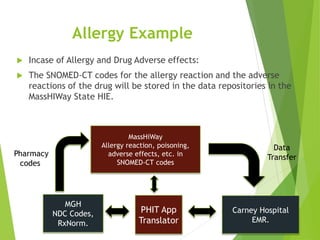
Allergy Example
 Incase of Allergy and Drug Adverse effects:
 The SNOMED-CT codes for the allergy reaction and the adverse
reactions of the drug will be stored in the data repositories in the
MassHIWay State HIE.
MGH
NDC Codes,
RxNorm.
Carney Hospital
EMR.
MassHiWay
Allergy reaction, poisoning,
adverse effects, etc. in
SNOMED-CT codes
PHIT App
Translator
Pharmacy
codes
Data
Transfer
Potential Impact
 Brings lots of benefits during the decision-making
process.
 Can save lives especially at the ER when you need
to act quickly.
 Enhance communication among providers.
 Improve quality of care.
 Can prevent or avoid patients critical/life
threatening condition.
Questions??
Thank You!

KeyStandards_FinalPresentation_04162015

  • 1.
    Patients Health Information Translator(PHIT) Team: Caramez- Karkhanis-Yeramreddy Faculty: Daniel Ries Key Standards in Health Informatics Systems
  • 2.
    Overview Meaningful use aimsto improve:  Quality, safety, efficiency  Maintaining privacy and security of patient health information Three Stages:  Stage 1 : Implement and use certified Electronic Health Record  Stage 2 : Health care providers can exchange the information, Improves efficiency and patient care.  Stage 3 : Achieve Outcome
  • 3.
    Overview(2) Information exchange systems mustbe: Compatible Must meet standards Must be certified Exchange information helps Clinical Decision Support
  • 4.
    The Real Problem ClinicalSettings  In the cases of emergency, unplanned care is delivered at the Emergency room.  Physicians are not able to provide efficient care because they lack critical information about the patient.  Lack of Interoperability is hindering the exchange of data in todays healthcare.  Situation is explained further by taking a case example.
  • 5.
    Case Example Situation  85years old female, falls at home and informs 911.  Patient is rushed to ER at MGH(uses EPIC).  Unable to provide information about her.  CT scans reveal that patient has a Subdural Hematoma resulted from a serious head injury.  The Hospital needed more information but it was not available.
  • 6.
    Patient Details Prior MedicalHistory  Followed by a Geriatric physician at Carney Hospital outpatient clinic (Cerner) Conditions  Atrial Fibrillation (Cardiac arrhythmia) Probable Medication  Warfarin sodium for a long time (is the active ingredient of CoumadinR)
  • 7.
    Warfarin Anticoagulant (blood thinner) Indications:used to prevent harmful blood clots from forming or growing larger on the legs, lungs, or clots associated with Irregular, rapid heartbeat called atrial fibrillation Warfarin increases your risk of bleeding, which can be severe or life-threatening:  Patients 65 years old or older  History of trauma, such as an accident or surgery  Take other medicines that increase your risk of bleeding, including must be monitored carefully with blood testing
  • 8.
    Clinical and TechnicalGaps Interoperability problem  MGH has a certified EHR as well as Carney Hospital, but they can’t share health care information.  Both hospitals use systems which use different standards to store clinical Information.  The problem is not the systems, but rather the difficulty of data exchange between systems.  Hospitals are ready to share but how to communicate?  We need is Syntax and Semantic Interoperability between systems.
  • 9.
    The Massachusetts Health InformationHighway (Mass HIway)  Statewide health information exchange (October2012)  Offers providers a way to secure sending of health information from one User to another  This meaningful exchange of information can enable the Commonwealth’s care community to:  Positively influence care coordination and delivery  Avoid readmissions and medical errors  Reduce administrative costs and duplicative testing  Enhance communication among providers
  • 10.
    Proposed Design Hospital 1Hospital 2 Mass HIWay Service provider PHIT App Translator Data Transfer Data Transfer
  • 11.
    Proposed Solution Automated process- Three use cases have been identified Hospital 1 PHIT Dashboard Hospital 2 PUSH patient information on request Standard structure Query Request Query Request Case 1: With EMR Vendor conformance
  • 12.
    Proposed Solution(2) Case 2:Independent of EMR vendors Case 2: Independent of EMR vendors Hospital 1 PHIT Dashboard Hospital 2 Capture Information while viewing the Records Standard structure Query Request Query Request
  • 13.
    Proposed Solution(3) Case 3:PHIT Portal on the State HIE (MassHiWay) Hospital 1 PHIT Portal Hospital 2 Query Request Query Request State HIE DB Fetch/ store
  • 14.
    Standards to beused  The idea is to make the application capable of handling multiple standards.  Some of the major standards which can be incorporated are HL7, DICOM, FHIR and text encryption standards/protocols.  Standards can be selected based on the situations or cases.
  • 15.
  • 16.
    Lets Consider Hospital1 (MGH) uses HL7 FHIR, the patient encounter discussed would look something like this:
  • 17.
    MGH HL7 FHIR Carney Hospital HL7v.2.5.1 MassHIway Service provider PHIT App Translator Data Transfer Data Transfer Modeled Workflow
  • 18.
    Hospital 2 (CarneyHospital) uses HL7V2.5.1, thus using PHIT we could translate FHIR into HL7V2.5.1. MSH|^~&|REGADT|MCM|IFENG||200301061000||ADT^A05^ADT_A05|||0 00001|P|2.5.1||| EVN|A05|200301061000|200301101400|01||200301061 PID|1||191919^^^MALLOE ||WHITEWOMAN^SNOW^E||19560129|F|||1 MAIN^^BOSTON^MA^02116^""^||(900)485--‐5344|(900)485-- ‐5344||S||10199925^^^MALLOE^AN|371--‐66--‐9256|| NK1|1|WHITEWOMAN^ELLA|DAUGHTER|1MAIN^^BOSTON^MA^02116^""^|( 900)485--‐5344|(900)545--‐1234~(900)545-- ‐1200|EC^EMERGENCYCONTACT PV1||O|||||0148^EVE,SNOW|0148^EVE,SNOW|0148^WHITEWOMAN, SNOW|AMB|||||||0148^EVE,SNOW||1|
  • 19.
  • 20.
    Allergy Example  Incaseof Allergy and Drug Adverse effects:  The SNOMED-CT codes for the allergy reaction and the adverse reactions of the drug will be stored in the data repositories in the MassHIWay State HIE. MGH NDC Codes, RxNorm. Carney Hospital EMR. MassHiWay Allergy reaction, poisoning, adverse effects, etc. in SNOMED-CT codes PHIT App Translator Pharmacy codes Data Transfer
  • 21.
    Potential Impact  Bringslots of benefits during the decision-making process.  Can save lives especially at the ER when you need to act quickly.  Enhance communication among providers.  Improve quality of care.  Can prevent or avoid patients critical/life threatening condition.
  • 22.
  • 23.