Achieving Interoperability
John W. Loonsk MD FACMI
June 2013
Achieving Interoperability
• The health IT interoperability milieu
• Interoperability is…
• Breadth and depth
• The inducing process
• Status going forward
Health IT interoperability milieu
• Health IT interoperability - notoriously bad
• “Standards impede innovation” - CTO
• ONC defunds HITSP - begins S & I framework
• MU prioritizes adoption then exchange
• Republican chairs question HIT interoperability
progress before election
• There is a Stage II?
• “Reboot HITECH” report
• Growing diversity in “networks” – HealtheWay, CCC,
EHR:HIE Working Group, CommonWell, DIRECT
Interoperability is…
1. Data content exchange
• Intra and inter-organizational
• Foundational, structural, semantic
2. EHR and other system data
portability
Interoperability also is…
3. Supporting infrastructure for exchange
• Transactions, security architecture, metadata,
provider & patient directories, indices, electronic
consent
• Sharing the burden of support
4. Increasing functions that can span applications
• eRx, PH, CDS, research, analytics, case
management etc.
5. Co-managed information and more…
• Care plans, problem and medication lists etc.
Interoperability also is…
6. Non-technical
• Policy interoperability
• Laws, rules and practices
• Incentives and disincentive
• Commercial alignment
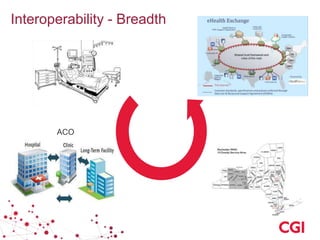
Interoperability - Breadth
ACO
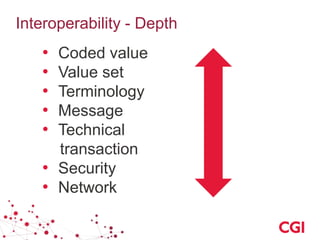
Interoperability - Depth
• Coded value
• Value set
• Terminology
• Message
• Technical
transaction
• Security
• Network
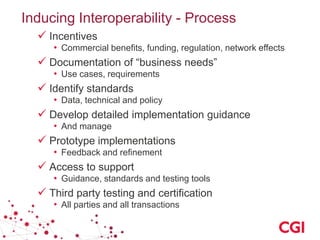
Inducing Interoperability - Process
 Incentives
• Commercial benefits, funding, regulation, network effects
 Documentation of “business needs”
• Use cases, requirements
 Identify standards
• Data, technical and policy
 Develop detailed implementation guidance
• And manage
 Prototype implementations
• Feedback and refinement
 Access to support
• Guidance, standards and testing tools
 Third party testing and certification
• All parties and all transactions
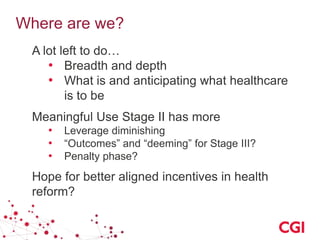
Where are we?
A lot left to do…
• Breadth and depth
• What is and anticipating what healthcare
is to be
Meaningful Use Stage II has more
• Leverage diminishing
• “Outcomes” and “deeming” for Stage III?
• Penalty phase?
Hope for better aligned incentives in health
reform?
Achieving Interoperability
John W. Loonsk MD FACMI
June 2013
Interoperability and
Health Information Exchange
June 6, 2013
13
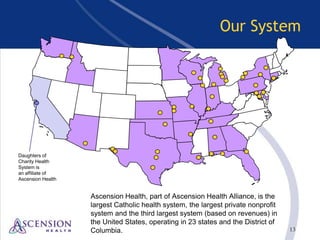
Ascension Health, part of Ascension Health Alliance, is the
largest Catholic health system, the largest private nonprofit
system and the third largest system (based on revenues) in
the United States, operating in 23 states and the District of
Columbia.
Our System
Daughters of
Charity Health
System is
an affiliate of
Ascension Health
14
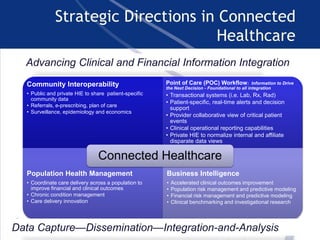
Strategic Directions in Connected
Healthcare
Community Interoperability
• Public and private HIE to share patient-specific
community data
• Referrals, e-prescribing, plan of care
• Surveillance, epidemiology and economics
Point of Care (POC) Workflow: Information to Drive
the Next Decision - Foundational to all integration
• Transactional systems (i.e. Lab, Rx, Rad)
• Patient-specific, real-time alerts and decision
support
• Provider collaborative view of critical patient
events
• Clinical operational reporting capabilities
• Private HIE to normalize internal and affiliate
disparate data views
Population Health Management
• Coordinate care delivery across a population to
improve financial and clinical outcomes
• Chronic condition management
• Care delivery innovation
Business Intelligence
• Accelerated clinical outcomes improvement
• Population risk management and predictive modeling
• Financial risk management and predictive modeling
• Clinical benchmarking and investigational research
Connected Healthcare
Data Capture—Dissemination—Integration-and-Analysis
Advancing Clinical and Financial Information Integration
15
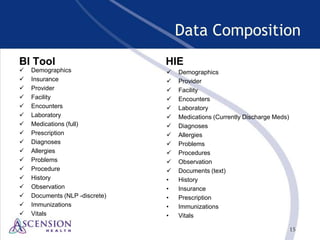
Data Composition
BI Tool
 Demographics
 Insurance
 Provider
 Facility
 Encounters
 Laboratory
 Medications (full)
 Prescription
 Diagnoses
 Allergies
 Problems
 Procedure
 History
 Observation
 Documents (NLP -discrete)
 Immunizations
 Vitals
HIE
 Demographics
 Provider
 Facility
 Encounters
 Laboratory
 Medications (Currently Discharge Meds)
 Diagnoses
 Allergies
 Problems
 Procedures
 Observation
 Documents (text)
• History
• Insurance
• Prescription
• Immunizations
• Vitals
16
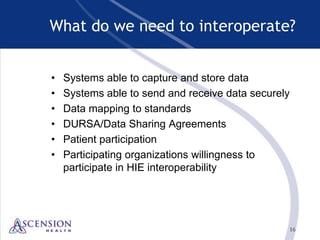
What do we need to interoperate?
• Systems able to capture and store data
• Systems able to send and receive data securely
• Data mapping to standards
• DURSA/Data Sharing Agreements
• Patient participation
• Participating organizations willingness to
participate in HIE interoperability
17
Implementing Interoperability in large
Health Systems
• Meaningful use program helped move EHR
vendors forward
• Meaning use program focused vendors on
implementations of EHR applications
• Multiple vendor platforms within your Health
System increases the work time to reach
interoperability
• Competition among vendors with HIE products
18
If you interoperate, you must map
• Multiple vendor platforms
– Hospital
– Practice Systems
– Other systems
• Free text entry fields are the enemy of standards
– PCPs
– Race/ethnicity
– Other stories we have all heard
19
Standards for interoperating
Historically, we have had multiple versions of HL-7
– 2.x for most transactions
– 2.5.x for Immunizations
– V3 not implemented widespread
• Soap vs Rstful
• XCA vs XDS.b
• CCD uses?
• Direct push
– HISP to HISP connectivity now needed
• Integrated Provider Master
• Mapping to standards, both national and intra-organization
• Remove opportunities for free text entry when a standard can be
implemented

Panel: Achieving Interoperability Dr. John Loonsk & Janet King

  • 1.
    Achieving Interoperability John W.Loonsk MD FACMI June 2013
  • 2.
    Achieving Interoperability • Thehealth IT interoperability milieu • Interoperability is… • Breadth and depth • The inducing process • Status going forward
  • 3.
    Health IT interoperabilitymilieu • Health IT interoperability - notoriously bad • “Standards impede innovation” - CTO • ONC defunds HITSP - begins S & I framework • MU prioritizes adoption then exchange • Republican chairs question HIT interoperability progress before election • There is a Stage II? • “Reboot HITECH” report • Growing diversity in “networks” – HealtheWay, CCC, EHR:HIE Working Group, CommonWell, DIRECT
  • 4.
    Interoperability is… 1. Datacontent exchange • Intra and inter-organizational • Foundational, structural, semantic 2. EHR and other system data portability
  • 5.
    Interoperability also is… 3.Supporting infrastructure for exchange • Transactions, security architecture, metadata, provider & patient directories, indices, electronic consent • Sharing the burden of support 4. Increasing functions that can span applications • eRx, PH, CDS, research, analytics, case management etc. 5. Co-managed information and more… • Care plans, problem and medication lists etc.
  • 6.
    Interoperability also is… 6.Non-technical • Policy interoperability • Laws, rules and practices • Incentives and disincentive • Commercial alignment
  • 7.
  • 8.
    Interoperability - Depth •Coded value • Value set • Terminology • Message • Technical transaction • Security • Network
  • 9.
    Inducing Interoperability -Process  Incentives • Commercial benefits, funding, regulation, network effects  Documentation of “business needs” • Use cases, requirements  Identify standards • Data, technical and policy  Develop detailed implementation guidance • And manage  Prototype implementations • Feedback and refinement  Access to support • Guidance, standards and testing tools  Third party testing and certification • All parties and all transactions
  • 10.
    Where are we? Alot left to do… • Breadth and depth • What is and anticipating what healthcare is to be Meaningful Use Stage II has more • Leverage diminishing • “Outcomes” and “deeming” for Stage III? • Penalty phase? Hope for better aligned incentives in health reform?
  • 11.
    Achieving Interoperability John W.Loonsk MD FACMI June 2013
  • 12.
  • 13.
    13 Ascension Health, partof Ascension Health Alliance, is the largest Catholic health system, the largest private nonprofit system and the third largest system (based on revenues) in the United States, operating in 23 states and the District of Columbia. Our System Daughters of Charity Health System is an affiliate of Ascension Health
  • 14.
    14 Strategic Directions inConnected Healthcare Community Interoperability • Public and private HIE to share patient-specific community data • Referrals, e-prescribing, plan of care • Surveillance, epidemiology and economics Point of Care (POC) Workflow: Information to Drive the Next Decision - Foundational to all integration • Transactional systems (i.e. Lab, Rx, Rad) • Patient-specific, real-time alerts and decision support • Provider collaborative view of critical patient events • Clinical operational reporting capabilities • Private HIE to normalize internal and affiliate disparate data views Population Health Management • Coordinate care delivery across a population to improve financial and clinical outcomes • Chronic condition management • Care delivery innovation Business Intelligence • Accelerated clinical outcomes improvement • Population risk management and predictive modeling • Financial risk management and predictive modeling • Clinical benchmarking and investigational research Connected Healthcare Data Capture—Dissemination—Integration-and-Analysis Advancing Clinical and Financial Information Integration
  • 15.
    15 Data Composition BI Tool Demographics  Insurance  Provider  Facility  Encounters  Laboratory  Medications (full)  Prescription  Diagnoses  Allergies  Problems  Procedure  History  Observation  Documents (NLP -discrete)  Immunizations  Vitals HIE  Demographics  Provider  Facility  Encounters  Laboratory  Medications (Currently Discharge Meds)  Diagnoses  Allergies  Problems  Procedures  Observation  Documents (text) • History • Insurance • Prescription • Immunizations • Vitals
  • 16.
    16 What do weneed to interoperate? • Systems able to capture and store data • Systems able to send and receive data securely • Data mapping to standards • DURSA/Data Sharing Agreements • Patient participation • Participating organizations willingness to participate in HIE interoperability
  • 17.
    17 Implementing Interoperability inlarge Health Systems • Meaningful use program helped move EHR vendors forward • Meaning use program focused vendors on implementations of EHR applications • Multiple vendor platforms within your Health System increases the work time to reach interoperability • Competition among vendors with HIE products
  • 18.
    18 If you interoperate,you must map • Multiple vendor platforms – Hospital – Practice Systems – Other systems • Free text entry fields are the enemy of standards – PCPs – Race/ethnicity – Other stories we have all heard
  • 19.
    19 Standards for interoperating Historically,we have had multiple versions of HL-7 – 2.x for most transactions – 2.5.x for Immunizations – V3 not implemented widespread • Soap vs Rstful • XCA vs XDS.b • CCD uses? • Direct push – HISP to HISP connectivity now needed • Integrated Provider Master • Mapping to standards, both national and intra-organization • Remove opportunities for free text entry when a standard can be implemented