A PRESENTATION ON
FILE ORGANIZATION
By
Ganesh V.Pawar
FILE ORGANIZATION
TYPES OF FILE ORGANIZATION
 Serial
 Sequential
 Indexed Sequential
 Direct Access /Random Access
Serial File Organization
 A collection of records
 No particular sequence
 Cannot be used as master
 Used as temporary transaction file
 Records stored in the order received
Sequential File Organization
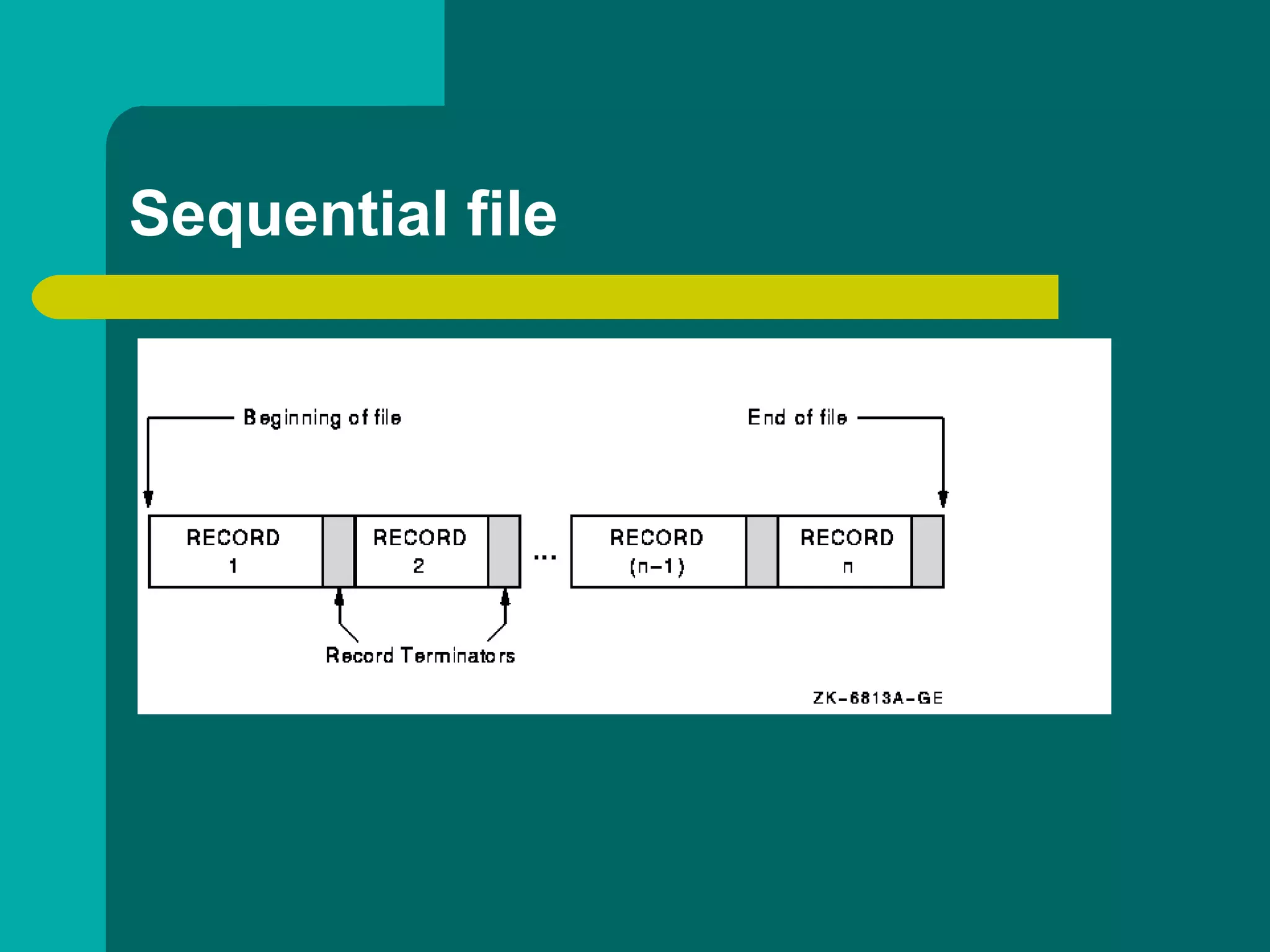
 A collection of records
 Stored in key sequence
 Adding/deleting record requires making new
file
 Used as master files
Sequential file
Advantages
 Simple file design
 Very efficient when most of the records must
be processed e.g. Payroll
 Very efficient if the data has a natural order
 Can be stored on inexpensive devices like
magnetic tape.
Disadvantages
 Entire file must be processed even if a single
record is to be searched.
 Transactions have to be sorted before
processing
 Overall processing is slow
Direct (Random) File Organization
 Records are read directly from or written on
to the file.
 The records are stored at known address.
 Address is calculated by applying a
mathematical function to the key field.
Direct (Random) File Organization
 A random file would have to be stored on a
direct access backing storage medium e.g.
magnetic disc, CD, DVD
 Example : Any information retrieval system.
Eg Train timetable system.
Advantages
 Any record can be directly accessed.
 Speed of record processing is very fast.
 Up-to-date file because of online updating.
 Concurrent processing is possible.
Disadvantages
 More complex than sequential
 Does not fully use memory locations
 More security and backup problems
Indexed sequential file
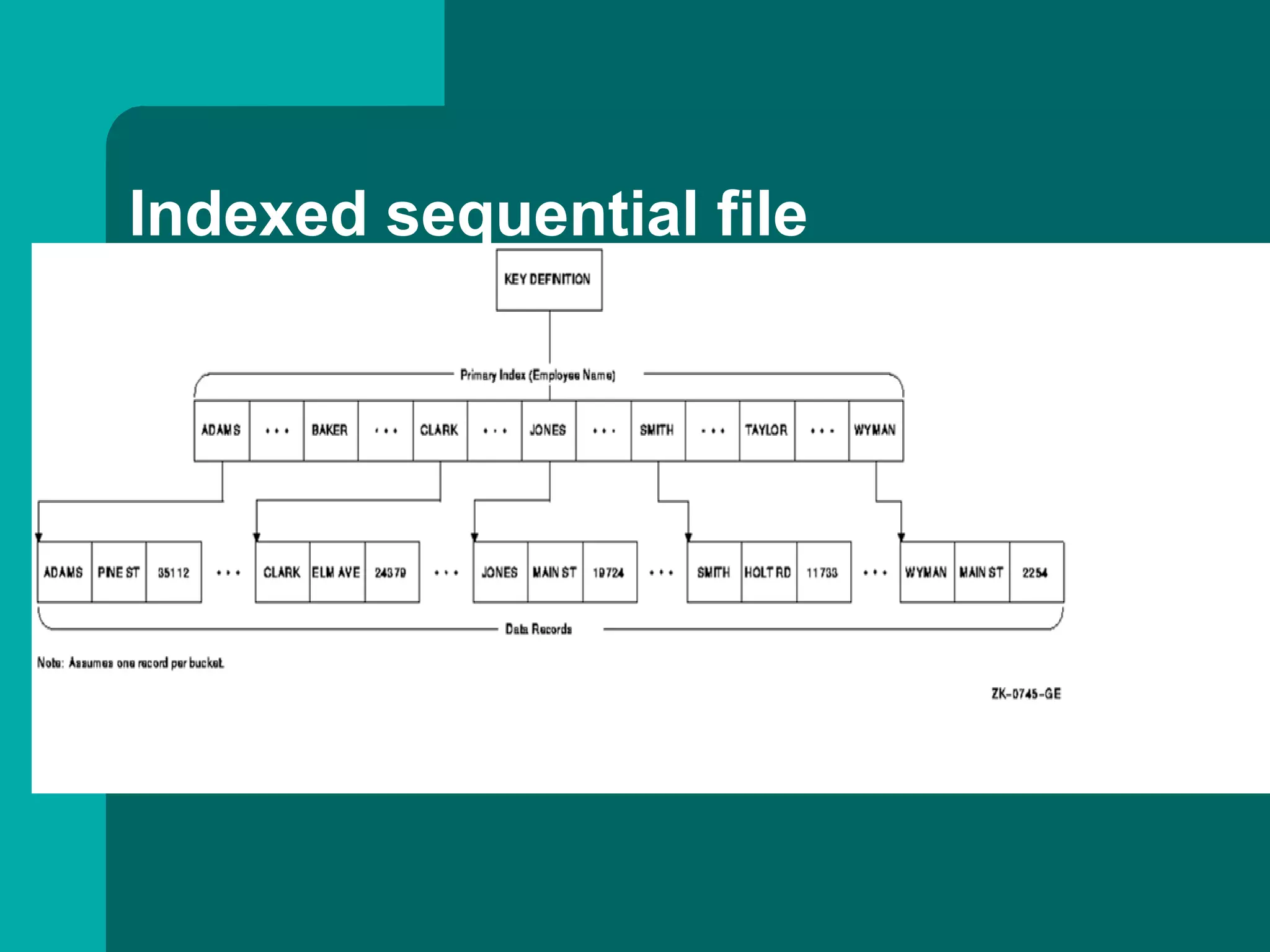
 Each record of a file has a key field which
uniquely identifies that record.
 An index consists of keys and addresses.
 An indexed sequential file is a sequential
file (i.e. sorted into order of a key field) which
has an index.
 A full index to a file is one in which there is
an entry for every record.
Indexed sequential file
 Indexed sequential files are important for
applications where data needs to be
accessed.....
– sequentially
– randomly using the index.
Indexed sequential file
 An indexed sequential file can only be stored
on a random access device
e.g. magnetic disc, CD.
Advantages
 Provides flexibility for users who need both
type of accesses with the same file
 Faster than sequential
Disadvantages
 Extra storage space for the index is required

File organization

  • 1.
    A PRESENTATION ON FILEORGANIZATION By Ganesh V.Pawar
  • 2.
  • 3.
    TYPES OF FILEORGANIZATION  Serial  Sequential  Indexed Sequential  Direct Access /Random Access
  • 4.
    Serial File Organization A collection of records  No particular sequence  Cannot be used as master  Used as temporary transaction file  Records stored in the order received
  • 5.
    Sequential File Organization A collection of records  Stored in key sequence  Adding/deleting record requires making new file  Used as master files
  • 6.
  • 7.
    Advantages  Simple filedesign  Very efficient when most of the records must be processed e.g. Payroll  Very efficient if the data has a natural order  Can be stored on inexpensive devices like magnetic tape.
  • 8.
    Disadvantages  Entire filemust be processed even if a single record is to be searched.  Transactions have to be sorted before processing  Overall processing is slow
  • 9.
    Direct (Random) FileOrganization  Records are read directly from or written on to the file.  The records are stored at known address.  Address is calculated by applying a mathematical function to the key field.
  • 10.
    Direct (Random) FileOrganization  A random file would have to be stored on a direct access backing storage medium e.g. magnetic disc, CD, DVD  Example : Any information retrieval system. Eg Train timetable system.
  • 11.
    Advantages  Any recordcan be directly accessed.  Speed of record processing is very fast.  Up-to-date file because of online updating.  Concurrent processing is possible.
  • 12.
    Disadvantages  More complexthan sequential  Does not fully use memory locations  More security and backup problems
  • 13.
    Indexed sequential file Each record of a file has a key field which uniquely identifies that record.  An index consists of keys and addresses.  An indexed sequential file is a sequential file (i.e. sorted into order of a key field) which has an index.  A full index to a file is one in which there is an entry for every record.
  • 14.
  • 15.
    Indexed sequential file Indexed sequential files are important for applications where data needs to be accessed..... – sequentially – randomly using the index.
  • 16.
    Indexed sequential file An indexed sequential file can only be stored on a random access device e.g. magnetic disc, CD.
  • 17.
    Advantages  Provides flexibilityfor users who need both type of accesses with the same file  Faster than sequential
  • 18.
    Disadvantages  Extra storagespace for the index is required