









By : Tehseen Riaz
Bsc, Pharm-D, Rph, Mphil(Pharmaceutics)
 Systematic Investigation towards increasing
the sum of knowledge.
 Research means finding answers to the
questions.
 Research is search for knowledge.
 Quantitative Research
 Qualitative Research
 Mixed-Method Research
 Quantitative methods emphasize objective
measurements and the statistical,
mathematical, or numerical analysis of data
collected through polls, questionnaires, and
surveys, or by manipulating pre-existing
statistical data using computational
techniques.
 Qualitative Research is primarily
exploratory research. It is used to gain an
understanding of underlying reasons,
opinions, and motivations. It provides
insights into the problem or helps to develop
ideas or hypotheses for potential quantitative
research.
 Mixed methods research is more specific in
that it includes the mixing of qualitative and
quantitative data, methods, methodologies,
and/or paradigms in a research study or set
of related studies. One could argue
that mixed methods research is a special case
of multimethod research.
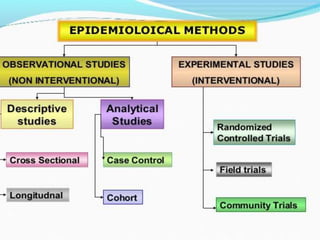
Observational Studies
Descriptive research is a study designed to depict the participants in
an accurate way. The three main ways to collect this information are:
Observational, defined as a method of viewing and recording the
participants. Case study, defined as an in-depth study of an individual or
group of individuals.
Cross-sectional study (also known as a cross-sectional
analysis, transversal study, prevalence study) is a type of
observational study that analyzes data collected from a population, or a
representative subset, at a specific point in time—that is, cross-
sectional data.
Longitudinal study is an observational research method in which
data is gathered for the same subjects repeatedly over a period of
time.Longitudinal research projects can extend over years or even decades.
In a longitudinal cohort study, the same individuals are observed over
the study period.
Experimental Trials:
Randomized controlled trial: (RCT) A study in which
people are allocated at random (by chance alone) to receive one of
several clinical interventions. One of these interventions is the
standard of comparison or control. The control may be a standard
practice, a placebo ("sugar pill"), or no intervention at all.
Field trial competition for animal to test their levels of skill and
training in retrieving or pointing.
Community trial is a competitive event at which different
people living together compete against one another.
The most important of these elements are
manipulation and control.
 Manipulation means that something is purposefully
changed by the researcher in the environment.
Control is used to prevent outside factors from
influencing the study outcome.
When something is manipulated and controlled and
then the outcome happens, it makes us more confident
that the manipulation "caused" the outcome.
 In addition, experiments involve highly controlled
and systematic procedures in an effort to
minimize error and bias, which also increases our
confidence that the manipulation "caused" the outcome.
Random assignment means that if
there are groups or treatments in the
experiment, participants are assigned
to these groups or treatments, or
randomly (like the flip of a coin).
Random selection means that no
matter who the participant is, he/she
has an equal chance of getting into
all of the groups or treatments in an
experiment.

Health system research

  • 1.
    By : TehseenRiaz Bsc, Pharm-D, Rph, Mphil(Pharmaceutics)
  • 3.
     Systematic Investigationtowards increasing the sum of knowledge.  Research means finding answers to the questions.  Research is search for knowledge.
  • 4.
     Quantitative Research Qualitative Research  Mixed-Method Research
  • 5.
     Quantitative methodsemphasize objective measurements and the statistical, mathematical, or numerical analysis of data collected through polls, questionnaires, and surveys, or by manipulating pre-existing statistical data using computational techniques.
  • 6.
     Qualitative Researchis primarily exploratory research. It is used to gain an understanding of underlying reasons, opinions, and motivations. It provides insights into the problem or helps to develop ideas or hypotheses for potential quantitative research.
  • 7.
     Mixed methodsresearch is more specific in that it includes the mixing of qualitative and quantitative data, methods, methodologies, and/or paradigms in a research study or set of related studies. One could argue that mixed methods research is a special case of multimethod research.
  • 16.
    Observational Studies Descriptive researchis a study designed to depict the participants in an accurate way. The three main ways to collect this information are: Observational, defined as a method of viewing and recording the participants. Case study, defined as an in-depth study of an individual or group of individuals. Cross-sectional study (also known as a cross-sectional analysis, transversal study, prevalence study) is a type of observational study that analyzes data collected from a population, or a representative subset, at a specific point in time—that is, cross- sectional data. Longitudinal study is an observational research method in which data is gathered for the same subjects repeatedly over a period of time.Longitudinal research projects can extend over years or even decades. In a longitudinal cohort study, the same individuals are observed over the study period.
  • 17.
    Experimental Trials: Randomized controlledtrial: (RCT) A study in which people are allocated at random (by chance alone) to receive one of several clinical interventions. One of these interventions is the standard of comparison or control. The control may be a standard practice, a placebo ("sugar pill"), or no intervention at all. Field trial competition for animal to test their levels of skill and training in retrieving or pointing. Community trial is a competitive event at which different people living together compete against one another.
  • 23.
    The most importantof these elements are manipulation and control.  Manipulation means that something is purposefully changed by the researcher in the environment. Control is used to prevent outside factors from influencing the study outcome. When something is manipulated and controlled and then the outcome happens, it makes us more confident that the manipulation "caused" the outcome.  In addition, experiments involve highly controlled and systematic procedures in an effort to minimize error and bias, which also increases our confidence that the manipulation "caused" the outcome.
  • 24.
    Random assignment meansthat if there are groups or treatments in the experiment, participants are assigned to these groups or treatments, or randomly (like the flip of a coin). Random selection means that no matter who the participant is, he/she has an equal chance of getting into all of the groups or treatments in an experiment.