Methods and Research Design
Dr. Sooad K. Al-Daihan
Biochemistry Department
Methods & Research Design
Introduction
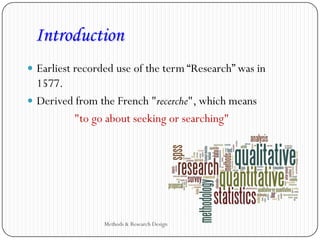
 Earliest recorded use of the term “Research” was in
1577.
 Derived from the French "recerche", which means
"to go about seeking or searching"
Methods & Research Design
Continue…
 Searching for:
knowledge or as any systematic investigation
 In order to:
find an answer
establish novel facts
solve new or existing problems
prove new ideas
develop new theories
 Scientific Research: using scientific methods.
Methods & Research Design
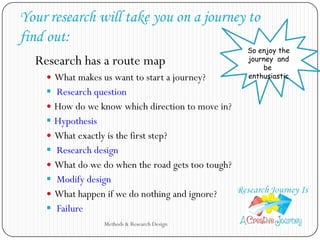
Your research will take you on a journey to
find out:
Methods & Research Design
Research has a route map
 What makes us want to start a journey?
 Research question
 How do we know which direction to move in?
 Hypothesis
 What exactly is the first step?
 Research design
 What do we do when the road gets too tough?
 Modify design
 What happen if we do nothing and ignore?
 Failure
So enjoy the
journey and
be
enthusiastic
Research Plan
Methods & Research Design
Portray
 What you intend to do
 SpecificAims
 Why it is important
 Background and Significance
 What has been done so far
 Preliminary Studies
 How you are going to do it
 Research Design and Methods
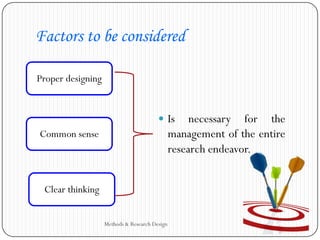
Factors to be considered
 Is necessary for the
management of the entire
research endeavor.
Methods & Research Design
Proper designing
Common sense
Clear thinking
Research Design
A master plan that specifies the methods
and procedures for collecting and
analyzing needed information.
Methods & Research Design
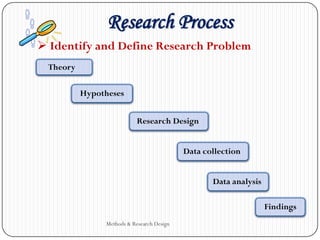
Research Process
Methods & Research Design
Theory
Hypotheses
Research Design
Data collection
Data analysis
Findings
 Identify and Define Research Problem
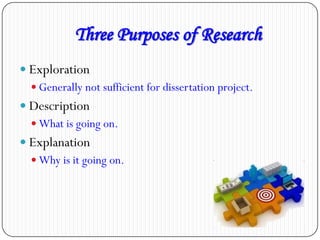
Three Purposes of Research
 Exploration
 Generally not sufficient for dissertation project.
 Description
 What is going on.
 Explanation
 Why is it going on.
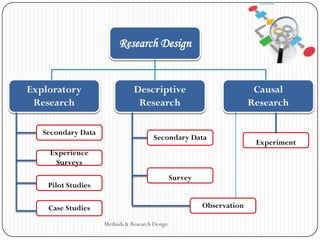
Research Design
Exploratory
Research
Descriptive
Research
Causal
Research
Secondary Data
Experience
Surveys
Pilot Studies
Case Studies
Experiment
Secondary Data
Survey
Observation
Methods & Research Design
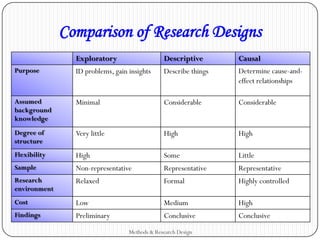
Comparison of Research Designs
Exploratory Descriptive Causal
Purpose ID problems, gain insights Describe things Determine cause-and-
effect relationships
Assumed
background
knowledge
Minimal Considerable Considerable
Degree of
structure
Very little High High
Flexibility High Some Little
Sample Non-representative Representative Representative
Research
environment
Relaxed Formal Highly controlled
Cost Low Medium High
Findings Preliminary Conclusive Conclusive
Methods & Research Design
Exploratory research is most commonly unstructured,
“informal” research that is undertaken to gain
background information about the general nature of the
research problem.
Exploratory research is usually conducted when the
researcher does not know much about the problem and
needs additional information or desires new or more
recent information.
Research Design: Exploratory Research
Methods & Research Design
 Exploratory research is used in a number of
situations:
 To gain background information
 To define terms
 To clarify problems and hypotheses
 To establish research priorities
Continue…
Methods & Research Design
Example…. Case Study
The case: Morning Rush Hour:
1. Identify the problem in the case.
2. Identify the cause of the problem.
3. Work on solution.
4. Implementation plan.
5. Backup plan.
Methods & Research Design
Research Design: Descriptive Research
• Descriptive research is undertaken to provide
answers to questions of who, what, where, when,
and how – but not why.
• e.g. H1N1 in a population?
Prevalence in different cities?
What causes H1N1?
How many people vaccinated?
Methods & Research Design
Example…. Survey
A method of Quantitative research
 Using questionnaires, Delphi method, interviews,
normative.
 e.g. Statistical survey, a method for collecting
quantitative information about items in a
population.
Methods & Research Design
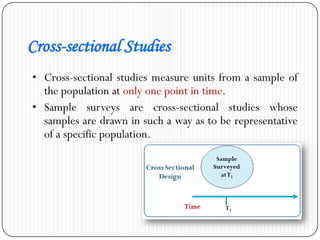
Cross-sectional Studies
• Cross-sectional studies measure units from a sample of
the population at only one point in time.
• Sample surveys are cross-sectional studies whose
samples are drawn in such a way as to be representative
of a specific population.
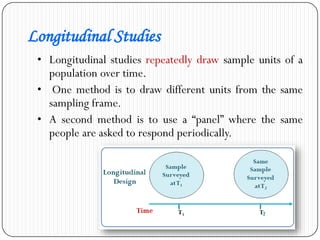
Longitudinal Studies
• Longitudinal studies repeatedly draw sample units of a
population over time.
• One method is to draw different units from the same
sampling frame.
• A second method is to use a “panel” where the same
people are asked to respond periodically.
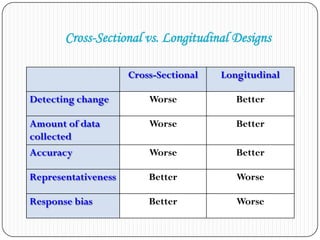
Cross-Sectional vs. Longitudinal Designs
Cross-Sectional Longitudinal
Detecting change Worse Better
Amount of data
collected
Worse Better
Accuracy Worse Better
Representativeness Better Worse
Response bias Better Worse
Causal Research
• Causal Research explores the effect of one thing on
another and more specifically, the effect of one variable
on another.
• Causal relationships are typically determined by the use
of experiments, but other methods are also used.
Methods & Research Design
Experiments
An experiment is defined as manipulating (changing
values/situations) one or more independent variables to see
how the dependent variable(s) is/are affected, while also
controlling the affects of additional extraneous variables.
Independent variables: those over which the researcher
has control and wishes to manipulate.
Dependent variables: those over which the researcher has
little to no direct control, but has a strong interest in
testing.
Methods & Research Design
For example:
 If a scientist conducts an experiment to test the theory
that a vitamin could extend a person’s life-expectancy, then
the independent variable is the amount of vitamin that is
given to the subjects within the experiment.
This is controlled by the experimenting scientist.
The dependent variable, or the variable being affected by
the independent variable in this case, is life span.
Methods & Research Design
other examples of dependent and independent
variables in science:
A scientist studies the impact of a drug on cancer. The
independent variable is the administration of the drug. The
dependent variable is the impact the drug has on cancer.
A scientist studies how many days people can eat soup until
they get sick. The independent variable is the number of days of
consuming soup.The dependent variable is the onset of illness.
Types of Experiments
• Two broad classes:
• Laboratory experiments: those in which the independent
variable is manipulated and measures of the dependent
variable are taken in a contrived, artificial setting for the
purpose of controlling the many possible extraneous variables
that may affect the dependent variable.
• Field experiments: those in which the independent
variables are manipulated and measurements of the dependent
variable are made on test units in their natural setting
Methods & Research Design
Comparison
Methods & Research Design
 Comparison is used to determine and quantify relationships
between two or more variables by observing different groups
that either by choice or circumstance are exposed to different
treatments.
 Examples: in the 1950s investigations initiated to study the
relationship between cigarette smoking and lung cancer in
which scientists compared individuals who were smoking
with non-smokers and correlated smoking with various
health problems including lung cancer.
Getting Started
Main Points That You Must Get Across
Research design, if carried out successfully, will accomplish
Specific Aims.
Methods are feasible and well developed.
Approach is original.
Data will be analyzed correctly.
Enough subjects/specimens will be tested to lead to
conclusive results.
Limitations are of minor concern only.
Study can be accomplished in requested time.
Methods & Research Design
 Describe overall approach that will be used to achieve aims.
 Consider using flowchart or table.
Methods & Research Design
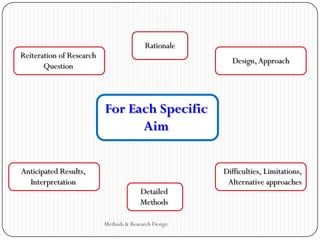
For Each Specific
Aim
Reiteration of Research
Question
Rationale
Design,Approach
Anticipated Results,
Interpretation
Detailed
Methods
Difficulties, Limitations,
Alternative approaches
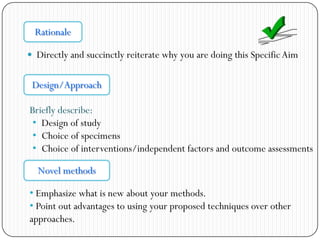
 Directly and succinctly reiterate why you are doing this SpecificAim
Rationale
Design/Approach
Briefly describe:
• Design of study
• Choice of specimens
• Choice of interventions/independent factors and outcome assessments
Novel methods
• Emphasize what is new about your methods.
• Point out advantages to using your proposed techniques over other
approaches.
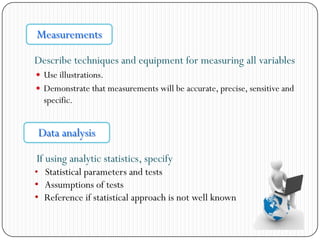
Describe techniques and equipment for measuring all variables
 Use illustrations.
 Demonstrate that measurements will be accurate, precise, sensitive and
specific.
Measurements
Data analysis
If using analytic statistics, specify
• Statistical parameters and tests
• Assumptions of tests
• Reference if statistical approach is not well known
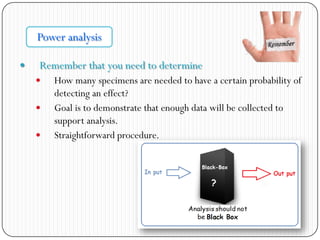
 Remember that you need to determine
 How many specimens are needed to have a certain probability of
detecting an effect?
 Goal is to demonstrate that enough data will be collected to
support analysis.
 Straightforward procedure.
Power analysis
Number of Specimens in Research Plan
 State assumptions and methods used for power analysis
 Specify primary outcome variable.
 Specify factor(s) or independent variable(s) of interest.
 State proposed statistical test or interval estimation.
Examples
Analysis of variance
Linear regression
 Note that each test has specific formula for power/number
of specimens.
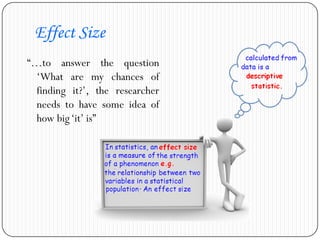
Effect Size
“…to answer the question
‘What are my chances of
finding it?’, the researcher
needs to have some idea of
how big‘it’ is”
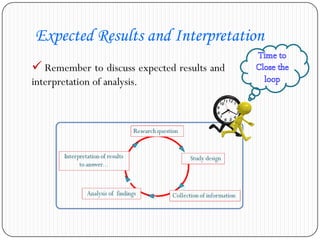
Expected Results and Interpretation
 Remember to discuss expected results and
interpretation of analysis.
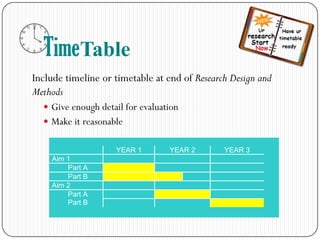
Table
Include timeline or timetable at end of Research Design and
Methods
 Give enough detail for evaluation
 Make it reasonable
YEAR 1 YEAR 2 YEAR 3
Aim 1
Part A
Part B
Aim 2
Part A
Part B
Ending
 Close Research Design and Methods with overall
statement about significance of study.
 Be enthusiastic.
Avoid
 Overly ambitious research plans
 Contingent Specific Aims
 Complex, emerging techniques without establishing
familiarity or including expert
 Too little detail on data analysis
 Under-powered studies
Summary:
Successful Research Design and Methods
 Bright idea
 Well developed and clearly described methods
 Appropriate data analysis
 Large enough sample size
 Plenty of time to do the work
 Only minor limitations
 Clear pathway
 Strong conclusions
Methods & Research Design

How to design_research_and_methodالنسخة الأخيرة-د. سعاد

  • 1.
    Methods and ResearchDesign Dr. Sooad K. Al-Daihan Biochemistry Department Methods & Research Design
  • 2.
    Introduction  Earliest recordeduse of the term “Research” was in 1577.  Derived from the French "recerche", which means "to go about seeking or searching" Methods & Research Design
  • 3.
  • 4.
    Continue…  Searching for: knowledgeor as any systematic investigation  In order to: find an answer establish novel facts solve new or existing problems prove new ideas develop new theories  Scientific Research: using scientific methods. Methods & Research Design
  • 5.
    Your research willtake you on a journey to find out: Methods & Research Design Research has a route map  What makes us want to start a journey?  Research question  How do we know which direction to move in?  Hypothesis  What exactly is the first step?  Research design  What do we do when the road gets too tough?  Modify design  What happen if we do nothing and ignore?  Failure So enjoy the journey and be enthusiastic
  • 6.
    Research Plan Methods &Research Design Portray  What you intend to do  SpecificAims  Why it is important  Background and Significance  What has been done so far  Preliminary Studies  How you are going to do it  Research Design and Methods
  • 7.
    Factors to beconsidered  Is necessary for the management of the entire research endeavor. Methods & Research Design Proper designing Common sense Clear thinking
  • 8.
    Research Design A masterplan that specifies the methods and procedures for collecting and analyzing needed information. Methods & Research Design
  • 9.
    Research Process Methods &Research Design Theory Hypotheses Research Design Data collection Data analysis Findings  Identify and Define Research Problem
  • 10.
    Three Purposes ofResearch  Exploration  Generally not sufficient for dissertation project.  Description  What is going on.  Explanation  Why is it going on.
  • 11.
    Research Design Exploratory Research Descriptive Research Causal Research Secondary Data Experience Surveys PilotStudies Case Studies Experiment Secondary Data Survey Observation Methods & Research Design
  • 12.
    Comparison of ResearchDesigns Exploratory Descriptive Causal Purpose ID problems, gain insights Describe things Determine cause-and- effect relationships Assumed background knowledge Minimal Considerable Considerable Degree of structure Very little High High Flexibility High Some Little Sample Non-representative Representative Representative Research environment Relaxed Formal Highly controlled Cost Low Medium High Findings Preliminary Conclusive Conclusive Methods & Research Design
  • 13.
    Exploratory research ismost commonly unstructured, “informal” research that is undertaken to gain background information about the general nature of the research problem. Exploratory research is usually conducted when the researcher does not know much about the problem and needs additional information or desires new or more recent information. Research Design: Exploratory Research Methods & Research Design
  • 14.
     Exploratory researchis used in a number of situations:  To gain background information  To define terms  To clarify problems and hypotheses  To establish research priorities Continue… Methods & Research Design
  • 15.
    Example…. Case Study Thecase: Morning Rush Hour: 1. Identify the problem in the case. 2. Identify the cause of the problem. 3. Work on solution. 4. Implementation plan. 5. Backup plan. Methods & Research Design
  • 16.
    Research Design: DescriptiveResearch • Descriptive research is undertaken to provide answers to questions of who, what, where, when, and how – but not why. • e.g. H1N1 in a population? Prevalence in different cities? What causes H1N1? How many people vaccinated? Methods & Research Design
  • 17.
    Example…. Survey A methodof Quantitative research  Using questionnaires, Delphi method, interviews, normative.  e.g. Statistical survey, a method for collecting quantitative information about items in a population. Methods & Research Design
  • 18.
    Cross-sectional Studies • Cross-sectionalstudies measure units from a sample of the population at only one point in time. • Sample surveys are cross-sectional studies whose samples are drawn in such a way as to be representative of a specific population.
  • 19.
    Longitudinal Studies • Longitudinalstudies repeatedly draw sample units of a population over time. • One method is to draw different units from the same sampling frame. • A second method is to use a “panel” where the same people are asked to respond periodically.
  • 20.
    Cross-Sectional vs. LongitudinalDesigns Cross-Sectional Longitudinal Detecting change Worse Better Amount of data collected Worse Better Accuracy Worse Better Representativeness Better Worse Response bias Better Worse
  • 21.
    Causal Research • CausalResearch explores the effect of one thing on another and more specifically, the effect of one variable on another. • Causal relationships are typically determined by the use of experiments, but other methods are also used. Methods & Research Design
  • 22.
    Experiments An experiment isdefined as manipulating (changing values/situations) one or more independent variables to see how the dependent variable(s) is/are affected, while also controlling the affects of additional extraneous variables. Independent variables: those over which the researcher has control and wishes to manipulate. Dependent variables: those over which the researcher has little to no direct control, but has a strong interest in testing. Methods & Research Design
  • 23.
    Methods & ResearchDesign For example:  If a scientist conducts an experiment to test the theory that a vitamin could extend a person’s life-expectancy, then the independent variable is the amount of vitamin that is given to the subjects within the experiment. This is controlled by the experimenting scientist. The dependent variable, or the variable being affected by the independent variable in this case, is life span.
  • 24.
    Methods & ResearchDesign other examples of dependent and independent variables in science: A scientist studies the impact of a drug on cancer. The independent variable is the administration of the drug. The dependent variable is the impact the drug has on cancer. A scientist studies how many days people can eat soup until they get sick. The independent variable is the number of days of consuming soup.The dependent variable is the onset of illness.
  • 25.
    Types of Experiments •Two broad classes: • Laboratory experiments: those in which the independent variable is manipulated and measures of the dependent variable are taken in a contrived, artificial setting for the purpose of controlling the many possible extraneous variables that may affect the dependent variable. • Field experiments: those in which the independent variables are manipulated and measurements of the dependent variable are made on test units in their natural setting Methods & Research Design
  • 26.
    Comparison Methods & ResearchDesign  Comparison is used to determine and quantify relationships between two or more variables by observing different groups that either by choice or circumstance are exposed to different treatments.  Examples: in the 1950s investigations initiated to study the relationship between cigarette smoking and lung cancer in which scientists compared individuals who were smoking with non-smokers and correlated smoking with various health problems including lung cancer.
  • 27.
    Getting Started Main PointsThat You Must Get Across Research design, if carried out successfully, will accomplish Specific Aims. Methods are feasible and well developed. Approach is original. Data will be analyzed correctly. Enough subjects/specimens will be tested to lead to conclusive results. Limitations are of minor concern only. Study can be accomplished in requested time. Methods & Research Design
  • 28.
    Methods & ResearchDesign  Describe overall approach that will be used to achieve aims.  Consider using flowchart or table.
  • 29.
    Methods & ResearchDesign For Each Specific Aim Reiteration of Research Question Rationale Design,Approach Anticipated Results, Interpretation Detailed Methods Difficulties, Limitations, Alternative approaches
  • 30.
     Directly andsuccinctly reiterate why you are doing this SpecificAim Rationale Design/Approach Briefly describe: • Design of study • Choice of specimens • Choice of interventions/independent factors and outcome assessments Novel methods • Emphasize what is new about your methods. • Point out advantages to using your proposed techniques over other approaches.
  • 31.
    Describe techniques andequipment for measuring all variables  Use illustrations.  Demonstrate that measurements will be accurate, precise, sensitive and specific. Measurements Data analysis If using analytic statistics, specify • Statistical parameters and tests • Assumptions of tests • Reference if statistical approach is not well known
  • 32.
     Remember thatyou need to determine  How many specimens are needed to have a certain probability of detecting an effect?  Goal is to demonstrate that enough data will be collected to support analysis.  Straightforward procedure. Power analysis
  • 33.
    Number of Specimensin Research Plan  State assumptions and methods used for power analysis  Specify primary outcome variable.  Specify factor(s) or independent variable(s) of interest.  State proposed statistical test or interval estimation. Examples Analysis of variance Linear regression  Note that each test has specific formula for power/number of specimens.
  • 34.
    Effect Size “…to answerthe question ‘What are my chances of finding it?’, the researcher needs to have some idea of how big‘it’ is”
  • 35.
    Expected Results andInterpretation  Remember to discuss expected results and interpretation of analysis.
  • 36.
    Table Include timeline ortimetable at end of Research Design and Methods  Give enough detail for evaluation  Make it reasonable YEAR 1 YEAR 2 YEAR 3 Aim 1 Part A Part B Aim 2 Part A Part B
  • 37.
    Ending  Close ResearchDesign and Methods with overall statement about significance of study.  Be enthusiastic.
  • 38.
    Avoid  Overly ambitiousresearch plans  Contingent Specific Aims  Complex, emerging techniques without establishing familiarity or including expert  Too little detail on data analysis  Under-powered studies
  • 39.
    Summary: Successful Research Designand Methods  Bright idea  Well developed and clearly described methods  Appropriate data analysis  Large enough sample size  Plenty of time to do the work  Only minor limitations  Clear pathway  Strong conclusions
  • 40.
  • 41.