MPH Thesis on: Assessment of the
Health Information System in Buea
Health District.
By
Akumengwa Neba N.
Department of Public Health and Hygiene
Faculty of Health Sciences
University of Buea
November 2014
Supervisor: Dr. Nde Peter F.
Co-supervisor: Dr. Atashili J.
Outline
 Background
 Problem Statement
 Justification
 Goal
 Objectives
 Research Questions
 Methodology
 Results/Discussion
 Conclusions/Recommendations
Background
 The Health Information System (HIS); is
“A set of components and procedures
organized with the objective of generating
information to improve health care
management decisions at all levels of the
health system”. Lippeveld, et al (2000)
Background Cont….
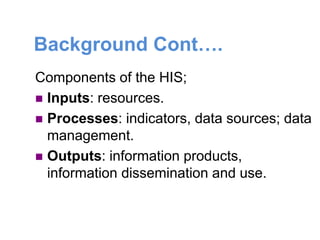
Components of the HIS;
 Inputs: resources.
 Processes: indicators, data sources; data
management.
 Outputs: information products,
information dissemination and use.
Background Cont….
 HIS in most developing countries are
weak, fragmented and often focused
exclusively on disease-specific program
areas, ( WHO, 2001)
 In addition, most developing countries
District Health Information Systems are
inefficient in providing management
information. Raeisi, et al (2013)
Background Cont….
 Cameroon is amongst other United
Nations Commission on Information and
Accountability priority Countries that
needs focused support to improve on
their HIS and reporting on the MDGs.
( WHO, 2012)
Background Cont..
Problem statement
 Erroneous/fraudulent vaccination
reporting by health personnel.
 Lack of motivation to collect data.
 Quality of HIS staff.
 Attitude toward assignment as a HIS Staff
 Irregular, inadequate data reporting and
feedback.
Background cont..
Justification
 For better decision-making
 To improve health service delivery,
 There is the need for a strong HIS
(with reliable, complete, timely, accurate,
adequate information).
 COIA: Cameroons HIS is present but not
adequate (42.5%).( WHO, 2012)
Background Cont…
Research questions
 What is the overall HIS situation?
 How adequate are HIS components?
 What are strengths and weaknesses of
the?
 What are the priority areas for HIS
improvement?
Background Cont….
Goal
 To improve the HIS in Buea Health District through
identifying and highlighting the weakness inherent in the
system.
Objectives
General Objective
To established an understanding on the HIS situation
Background Cont….
Specific Objectives
 To determine how adequate is the overall HIS
 To determine the situation of the various HIS
components
 To identify weaknesses/weaknesses existing in
the HIS
 To identify priority areas for improvement on the
HIS.
Methodology
 Study setting
Buea health District, RDPH, MOH, NIS
 Study design
Cross-sectional study with group and in-depth interviews
 Study population
Stakeholders of the HIS in BHD, RDPH, MoH
 Duration of Study
Six months ( April to September)
 Sampling
Non-probabilistic: convenience, purposive sampling
 Sample size
27 health facilities and institutions
Methodology Cont…
 Ethical Consideration
Administrative approval from: FHS, RDPH, MoH.
 Study Procedure
In-depth and group interviews
HMN Assessment Tool Version 4.00 PDF topic guide
 Inclusion criteria
Involvement with HIS activities
Acceptance to take part in study
 Exclusion criteria
Non involvement with HIS activities
Non-acceptance to participate
Methodology Cont…
 Data collection tool and technique
HMN Assessment Tool Version 4.00 PDF
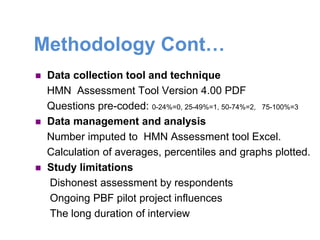
Questions pre-coded: 0-24%=0, 25-49%=1, 50-74%=2, 75-100%=3
 Data management and analysis
Number imputed to HMN Assessment tool Excel.
Calculation of averages, percentiles and graphs plotted.
 Study limitations
Dishonest assessment by respondents
Ongoing PBF pilot project influences
The long duration of interview
Methodology Cont…
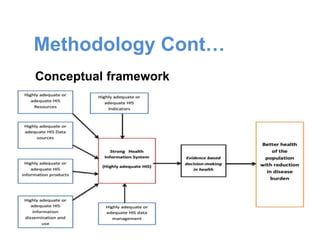
Conceptual framework
Results /Discussion
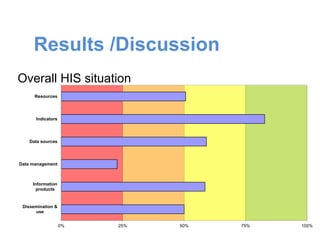
0% 25% 50% 75% 100%
Resources
Indicators
Data sources
Data management
Information
products
Dissemination &
use
Overall HIS situation
Results /Discussion Cont..
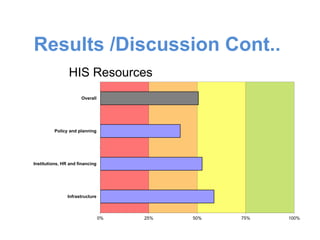
0% 25% 50% 75% 100%
Overall
Policy and planning
Institutions, HR and financing
Infrastructure
HIS Resources
Results /Discussion Cont..
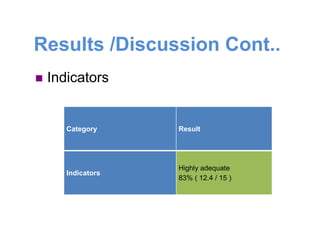
 Indicators
Category Result
Indicators
Highly adequate
83% ( 12.4 / 15 )
Results /Discussion Cont..
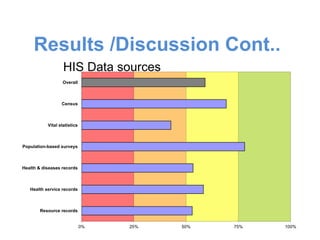
0% 25% 50% 75% 100%
Overall
Census
Vital statistics
Population-based surveys
Health & diseases records
Health service records
Resource records
HIS Data sources
Results /Discussion Cont..
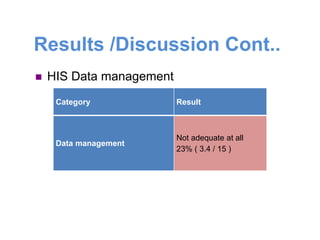
 HIS Data management
Category Result
Data management
Not adequate at all
23% ( 3.4 / 15 )
Results /Discussion Cont..
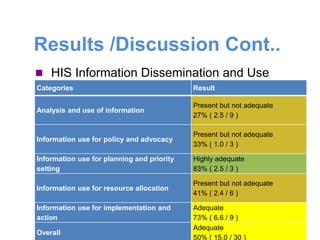
 HIS Information Dissemination and Use
Categories Result
Analysis and use of information
Present but not adequate
27% ( 2.5 / 9 )
Information use for policy and advocacy
Present but not adequate
33% ( 1.0 / 3 )
Information use for planning and priority
setting
Highly adequate
83% ( 2.5 / 3 )
Information use for resource allocation
Present but not adequate
41% ( 2.4 / 6 )
Information use for implementation and
action
Adequate
73% ( 6.6 / 9 )
Overall
Adequate
50% ( 15.0 / 30 )
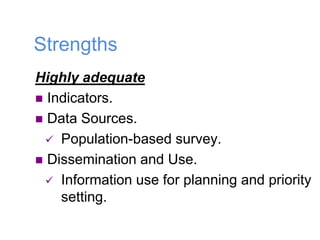
Strengths
Highly adequate
 Indicators.
 Data Sources.
 Population-based survey.
 Dissemination and Use.
 Information use for planning and priority
setting.
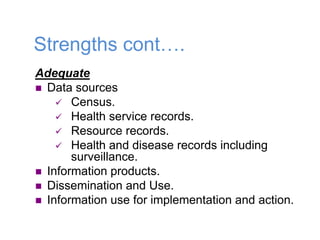
Strengths cont….
Adequate
 Data sources
 Census.
 Health service records.
 Resource records.
 Health and disease records including
surveillance.
 Information products.
 Dissemination and Use.
 Information use for implementation and action.
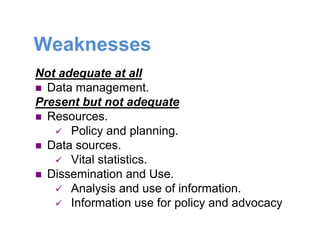
Weaknesses
Not adequate at all
 Data management.
Present but not adequate
 Resources.
 Policy and planning.
 Data sources.
 Vital statistics.
 Dissemination and Use.
 Analysis and use of information.

 Information use for policy and advocacy
Priority areas for improvement
 Data management.
 Resource Policy and planning.
 Data sources: Vital statistics.
 Dissemination and use: Analysis and use
of information, use of information in
designing policy
Conclusion
 This study revealed that one (data
management) amongst the six HIS
components, was not adequate at all,
while the other HIS components were
rated above 50%.
 Results obtained provide a baseline from
where measures to improve on the HIS
situation could be based.
Recommendations
 Reduce workload of healthcare delivery
and data collection on staff.
 Motivation: financial and psychological
 Introduce ICT in data management at
each level of HIS.
 Well integrated and easy to understand
data collection forms.
Recommendations
 Organise regular training on HIS activities
and follow-up.
 Provide regular feedback to data reported
by each health facility.
 Decision–making: based on information
products of the HIS.
 Improvement in HIS staffing quality and
quantity..
Thank You

Mph thesis slides

  • 1.
    MPH Thesis on:Assessment of the Health Information System in Buea Health District. By Akumengwa Neba N. Department of Public Health and Hygiene Faculty of Health Sciences University of Buea November 2014 Supervisor: Dr. Nde Peter F. Co-supervisor: Dr. Atashili J.
  • 2.
    Outline  Background  ProblemStatement  Justification  Goal  Objectives  Research Questions  Methodology  Results/Discussion  Conclusions/Recommendations
  • 3.
    Background  The HealthInformation System (HIS); is “A set of components and procedures organized with the objective of generating information to improve health care management decisions at all levels of the health system”. Lippeveld, et al (2000)
  • 4.
    Background Cont…. Components ofthe HIS;  Inputs: resources.  Processes: indicators, data sources; data management.  Outputs: information products, information dissemination and use.
  • 5.
    Background Cont….  HISin most developing countries are weak, fragmented and often focused exclusively on disease-specific program areas, ( WHO, 2001)  In addition, most developing countries District Health Information Systems are inefficient in providing management information. Raeisi, et al (2013)
  • 6.
    Background Cont….  Cameroonis amongst other United Nations Commission on Information and Accountability priority Countries that needs focused support to improve on their HIS and reporting on the MDGs. ( WHO, 2012)
  • 7.
    Background Cont.. Problem statement Erroneous/fraudulent vaccination reporting by health personnel.  Lack of motivation to collect data.  Quality of HIS staff.  Attitude toward assignment as a HIS Staff  Irregular, inadequate data reporting and feedback.
  • 8.
    Background cont.. Justification  Forbetter decision-making  To improve health service delivery,  There is the need for a strong HIS (with reliable, complete, timely, accurate, adequate information).  COIA: Cameroons HIS is present but not adequate (42.5%).( WHO, 2012)
  • 9.
    Background Cont… Research questions What is the overall HIS situation?  How adequate are HIS components?  What are strengths and weaknesses of the?  What are the priority areas for HIS improvement?
  • 10.
    Background Cont…. Goal  Toimprove the HIS in Buea Health District through identifying and highlighting the weakness inherent in the system. Objectives General Objective To established an understanding on the HIS situation
  • 11.
    Background Cont…. Specific Objectives To determine how adequate is the overall HIS  To determine the situation of the various HIS components  To identify weaknesses/weaknesses existing in the HIS  To identify priority areas for improvement on the HIS.
  • 12.
    Methodology  Study setting Bueahealth District, RDPH, MOH, NIS  Study design Cross-sectional study with group and in-depth interviews  Study population Stakeholders of the HIS in BHD, RDPH, MoH  Duration of Study Six months ( April to September)  Sampling Non-probabilistic: convenience, purposive sampling  Sample size 27 health facilities and institutions
  • 13.
    Methodology Cont…  EthicalConsideration Administrative approval from: FHS, RDPH, MoH.  Study Procedure In-depth and group interviews HMN Assessment Tool Version 4.00 PDF topic guide  Inclusion criteria Involvement with HIS activities Acceptance to take part in study  Exclusion criteria Non involvement with HIS activities Non-acceptance to participate
  • 14.
    Methodology Cont…  Datacollection tool and technique HMN Assessment Tool Version 4.00 PDF Questions pre-coded: 0-24%=0, 25-49%=1, 50-74%=2, 75-100%=3  Data management and analysis Number imputed to HMN Assessment tool Excel. Calculation of averages, percentiles and graphs plotted.  Study limitations Dishonest assessment by respondents Ongoing PBF pilot project influences The long duration of interview
  • 15.
  • 16.
    Results /Discussion 0% 25%50% 75% 100% Resources Indicators Data sources Data management Information products Dissemination & use Overall HIS situation
  • 17.
    Results /Discussion Cont.. 0%25% 50% 75% 100% Overall Policy and planning Institutions, HR and financing Infrastructure HIS Resources
  • 18.
    Results /Discussion Cont.. Indicators Category Result Indicators Highly adequate 83% ( 12.4 / 15 )
  • 19.
    Results /Discussion Cont.. 0%25% 50% 75% 100% Overall Census Vital statistics Population-based surveys Health & diseases records Health service records Resource records HIS Data sources
  • 20.
    Results /Discussion Cont.. HIS Data management Category Result Data management Not adequate at all 23% ( 3.4 / 15 )
  • 21.
    Results /Discussion Cont.. HIS Information Dissemination and Use Categories Result Analysis and use of information Present but not adequate 27% ( 2.5 / 9 ) Information use for policy and advocacy Present but not adequate 33% ( 1.0 / 3 ) Information use for planning and priority setting Highly adequate 83% ( 2.5 / 3 ) Information use for resource allocation Present but not adequate 41% ( 2.4 / 6 ) Information use for implementation and action Adequate 73% ( 6.6 / 9 ) Overall Adequate 50% ( 15.0 / 30 )
  • 22.
    Strengths Highly adequate  Indicators. Data Sources.  Population-based survey.  Dissemination and Use.  Information use for planning and priority setting.
  • 23.
    Strengths cont…. Adequate  Datasources  Census.  Health service records.  Resource records.  Health and disease records including surveillance.  Information products.  Dissemination and Use.  Information use for implementation and action.
  • 24.
    Weaknesses Not adequate atall  Data management. Present but not adequate  Resources.  Policy and planning.  Data sources.  Vital statistics.  Dissemination and Use.  Analysis and use of information.  Information use for policy and advocacy
  • 25.
    Priority areas forimprovement  Data management.  Resource Policy and planning.  Data sources: Vital statistics.  Dissemination and use: Analysis and use of information, use of information in designing policy
  • 26.
    Conclusion  This studyrevealed that one (data management) amongst the six HIS components, was not adequate at all, while the other HIS components were rated above 50%.  Results obtained provide a baseline from where measures to improve on the HIS situation could be based.
  • 27.
    Recommendations  Reduce workloadof healthcare delivery and data collection on staff.  Motivation: financial and psychological  Introduce ICT in data management at each level of HIS.  Well integrated and easy to understand data collection forms.
  • 28.
    Recommendations  Organise regulartraining on HIS activities and follow-up.  Provide regular feedback to data reported by each health facility.  Decision–making: based on information products of the HIS.  Improvement in HIS staffing quality and quantity..
  • 29.