Dr.Rituja Kaushal
Department of Community Medicine
PCMS & RC , Bhanpur
Contents :
I. Overview
II. Definition of Health Systems Research (HSR)
III. Purpose
IV. Focus
V. Features of Health systems research
VI. Steps in conducting HSR
VII. HSR in India
VIII. Institutes conducting HSR
IX. Structure of HSR
X. Priorty areas of functioning with problems & solutions
XI. Utilisation & promotion of HSR
XII. Future of HSR in India
In this presentation an attempt is made to describe what HSR is &
its importance & utility in managerial & policy decision making for
improving the health care through appropriate reforms in the
Health systems. Brief description of the steps involved in
undertaking HSR , the efforts to promote & strengthen HSR has been
highlighted followed by some directions for making them more
effective & relevant.
Overview
The culture of research has provided a rational knowledge based
framework within which the Health processes takes place .
In view of the growing dissatisfaction with the prevailing health
care delivery among the people & the concern & interest in finding
out ways for improving health care , research on
sources,organisation & accomplishments of health care has been
considered important & urgent.
Towards facilitating governments to obtain relevant information on
the health services performance , the concept of health services
research was developed during 1981-1982 & was used by WHO in its
sixth general prog. of work.
Then , a need is felt for integration of various health related issues
into a certain type of research having a comprehensive approach
towards the health system development. Thus the focus got shifted
from the health services research & the WHO in the seventh general
prog. Of work for years 1984-1989 employed the nomenclature of
Health Systems Research.
Definition
Health system research is defined as the systematic study of the
means by which biomedical , sociomedical & other relevant
knowledge is brought to bear on the health of communities under a
given set of conditions.
Health system research goes beyond the boundaries of health
services research which mostly has been limited to narrow concern
with government programmes & it covers the private sector ,
indigenous health care providers & practices ,efforts initiated by
health care by the community itself as well as the intersectoral
influence on health.
Purpose
I. To solve health problems .
II. To improve the health of people through improvement of the
various interrelated components of the health system .
III. To enhance efficiency & effectiveness of health system as an
integral part of the overall socio economic development.
IV. Analysis of problem from technical & human angle & translation
of research results into implementable solutions .
Focus
Focus is primarily on the primary health care including
integration of treatment & preventive measures for control
of diseases , nutrition , family planning & environmental
safety , problems of referral etc. It involves learning how to
work with other sectors in a wide range of development
activities that may prove important for health.
As a tool :
HSR can be considered a great help & effective tool for
health system managers at all levels .It can assist health
managers in more rational health planning& resource
allocation & should result in better design of health systems
& encourage greater personal , family & community self
reliance in the solution of health problems.
Important features of HSR :
 Should focus on priorty problems .
 Should be action oriented .
 Multi disciplinary & multi sectoral approach .
 Participatory nature .
 Timeliness .
 Simple & short term research designs .
 Cost effectiveness .
 Increased accessibility to HSR ressults for decision makers .
 Ability to influence decision making.
 Scope of HSR is very wide .
 Constituent in a continuum of research series .
 Emphasis in HSR should be to improve the existing health care
services incrementally .
 HSR is also a means to promote development of simplest , least
expensive ,acceptable ,most widely usable & affordable
technology .
 Through initiating improvement in specific management issues by
using available facilities & personnel , HSR can remove the blocks
to effective & efficient services.
Steps in conducting HSR
Development of HSR proposal on a relevant problem which cannot
be solved without/which can be solved more effectively , with more
information collected through research .
Implementation/actual operationalisation of the proposal in the
targeted field area & collect relevant data .
Analysis & interpretation of data & preparation of report
highlighting study results & their implications for action including
recommendations for implementation of the research
findings/results .
Dissemination of study results .
HSR in India
ICMR acts as a nodal agency for research in India to promote
medical research in the initial stage ,& later on to promote field
based operational research to develop programme strategies for
delivery of health services .
Task force on operational research (OR) cons tituted in 1974 by
GoI.
Under various National prog. , there are research & training instt.
established with the purpose of contributing towards strenghtening
the prog . strategies through basic & applied research as well as to
provide in service training to the concerned staff . Eg. Malaria
,Filariasis ,TB ,Leprosy ,Nutrition etc.
Accord . to the recommendation of International Commission of
Health research for development formulated in 1987 , every country
should make more effective use of research to guide their policies &
actions.
Evolution of the concept of Essential National Health Research
(ENHR) took place with a base in each developing country to
understand it’s own problem , improve health policy & man-
agement , enhance the effectiveness of limited resources , foster
innovations & experimentation & provide the foundation for a
stronger developing country voice in setting international priorties.
Complexities of health problems at country level demands
skills/training in generating more relevant & area specific
information for identifying solutions to the health problems.
Concerned officials & staff need to be sensitized & equipped with
skills in conducting & utilising HSR which is an important tool to
diagnose the problems as well as to develop suitable alternate
strategies for solving the problem through experimentation , so that
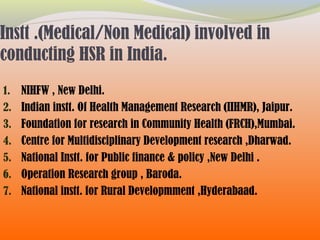
Instt .(Medical/Non Medical) involved in
conducting HSR in India.
1. NIHFW , New Delhi.
2. Indian instt. Of Health Management Research (IIHMR), Jaipur.
3. Foundation for research in Community Health (FRCH),Mumbai.
4. Centre for Multidisciplinary Development research ,Dharwad.
5. National Instt. for Public finance & policy ,New Delhi .
6. Operation Research group , Baroda.
7. National instt. for Rural Developmment ,Hyderabaad.
Structure :
The WHO supported HSR project/programme in India is
being co-ordinated by the NIHFW at national
level.Organising training courses in capacity building in HSR
has been an ongoing activity .
For promoting HSR in India in a well co-ordinated manner ,
the National Conference on HSR recommended constitution
of a three tier body with NIHFW as the co-ordinating agency
at the National level & a core group to act as an advisory
body to the agencies involved in HSR as well as a broad
based group of organisations to actively undertake HSR
activities at the functional level.
Priority areas for HSR in India
1. Adolescents Health .
2. Gerontology concerning problems .
3. Women’s health & empowerment .
4. Primary health care .
5. Decentralisation in context of the Panchayati Raj system .
6. Improvement of the referral system .
7. Vertical & horizontal integration at different levels in the
administrative hierarchy .
Problem & Solutions related to
HSR :
Problem :Inadequate utilisation
of results of HSR studies by
health managers in taking
decisions for
changes/improvement of
health care .
Lack of dissemination of
research findings.
Poor access for managers to
relevant research findings.
Solutions :
Preparation of reference
document consolidating the
relevant findings of research
studies ,indicating their
implication & utility for bringing
desired results.
Eg : With financial support from
WHO , NIHFW has prepared a
Bibliographic Database on HSR
studies conducted by different
institutions in India.
Utilisation of HSR :
I. It fills gap between the researchers , policy makers ,& other
administrators responsible for implementation of health
programmes .
II. By proper co-ordination of research efforts it avoids unnecessary
duplication of studies .
III. Fill gaps in information for specific topics & geographic area.
IV. Acts as a tool for improved managerial & policy decision making.
V. HSR provides not only a means to analyse & interpret the
routinely available data but also helps in generating additional
information required , through scientific methods.
Thus ,in order that HSR is fully utilised , the decision makers have
to identify the areas/issues on which decisions are to be taken , the
type of information required for supporting these decisions , take
stock of the available/existing information & their sources , &
specific questions to be answered through new information as well
as measures to be taken to design & implement research for
obtaining these information .
Eg. Where use of HSR results in
decision making in India.
1. Decision to impliment Community Health Workers Scheme in
delivery of primary health care.
2. Decision regarding use of Bio-larvicides as part of Malaria Control
Prog.
3. Decision on Prog. Strategies as well as steep increases in federal
government financial allocations for NPCB.
4. Issues related to financing of health care in India based on
findings of research on health expenditure by Central & State
Governments etc.
4. Policy decisions on blood banking in India , related to legislative
& control mechanisms to encourage voluntary blood donations ,
compulsory screening of all blood samples etc.
5. Implementation of Multi drug therapy in National Leprosy
Eradication Programme .
6. Issues related to financing of health care in India based on findings
of research on health expenditure by Central & State Governments
etc.
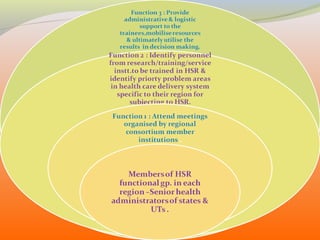
Promotion of HSR : 3 phases of the process
Future of HSR in India :
I. More action oriented research are needed in actually solving the
problems thereby validating the recommendations.
II. In addition to current individual localised research approach ,
multi centric studies may be promoted.
III. Efforts to standardise research procedures for common issues may
be prepared for comparability of research results.
IV. HSR efforts in the field of human resource development need
more attention .
V. Studies in the field of health economics related to alternate
health care financing mechanism ,cost containment ,economic
evaluation of prog. Should be encouraged.
VI. Holistic studies covering all elements of the health system should
be regularly conducted.
VII . There is need to develop rapid assessment techniques using
epidemiological,statistical & anthropological methods through
experimentation & proper validation to enable rational decision
making without losing time.
VIII . Mechanism for sharing research results through proper reporting
to all interested parties ,conferences ,publication etc. need to be
developed & sustained.
IX .There is need for focussing HSR in districts .

Health system research ppt

  • 1.
    Dr.Rituja Kaushal Department ofCommunity Medicine PCMS & RC , Bhanpur
  • 2.
    Contents : I. Overview II.Definition of Health Systems Research (HSR) III. Purpose IV. Focus V. Features of Health systems research VI. Steps in conducting HSR VII. HSR in India VIII. Institutes conducting HSR IX. Structure of HSR X. Priorty areas of functioning with problems & solutions XI. Utilisation & promotion of HSR XII. Future of HSR in India
  • 3.
    In this presentationan attempt is made to describe what HSR is & its importance & utility in managerial & policy decision making for improving the health care through appropriate reforms in the Health systems. Brief description of the steps involved in undertaking HSR , the efforts to promote & strengthen HSR has been highlighted followed by some directions for making them more effective & relevant.
  • 4.
    Overview The culture ofresearch has provided a rational knowledge based framework within which the Health processes takes place . In view of the growing dissatisfaction with the prevailing health care delivery among the people & the concern & interest in finding out ways for improving health care , research on sources,organisation & accomplishments of health care has been considered important & urgent.
  • 5.
    Towards facilitating governmentsto obtain relevant information on the health services performance , the concept of health services research was developed during 1981-1982 & was used by WHO in its sixth general prog. of work. Then , a need is felt for integration of various health related issues into a certain type of research having a comprehensive approach towards the health system development. Thus the focus got shifted from the health services research & the WHO in the seventh general prog. Of work for years 1984-1989 employed the nomenclature of Health Systems Research.
  • 6.
    Definition Health system researchis defined as the systematic study of the means by which biomedical , sociomedical & other relevant knowledge is brought to bear on the health of communities under a given set of conditions. Health system research goes beyond the boundaries of health services research which mostly has been limited to narrow concern with government programmes & it covers the private sector , indigenous health care providers & practices ,efforts initiated by health care by the community itself as well as the intersectoral influence on health.
  • 7.
    Purpose I. To solvehealth problems . II. To improve the health of people through improvement of the various interrelated components of the health system . III. To enhance efficiency & effectiveness of health system as an integral part of the overall socio economic development. IV. Analysis of problem from technical & human angle & translation of research results into implementable solutions .
  • 8.
    Focus Focus is primarilyon the primary health care including integration of treatment & preventive measures for control of diseases , nutrition , family planning & environmental safety , problems of referral etc. It involves learning how to work with other sectors in a wide range of development activities that may prove important for health.
  • 9.
    As a tool: HSR can be considered a great help & effective tool for health system managers at all levels .It can assist health managers in more rational health planning& resource allocation & should result in better design of health systems & encourage greater personal , family & community self reliance in the solution of health problems.
  • 10.
    Important features ofHSR :  Should focus on priorty problems .  Should be action oriented .  Multi disciplinary & multi sectoral approach .  Participatory nature .  Timeliness .  Simple & short term research designs .  Cost effectiveness .  Increased accessibility to HSR ressults for decision makers .  Ability to influence decision making.  Scope of HSR is very wide .
  • 11.
     Constituent ina continuum of research series .  Emphasis in HSR should be to improve the existing health care services incrementally .  HSR is also a means to promote development of simplest , least expensive ,acceptable ,most widely usable & affordable technology .  Through initiating improvement in specific management issues by using available facilities & personnel , HSR can remove the blocks to effective & efficient services.
  • 12.
    Steps in conductingHSR Development of HSR proposal on a relevant problem which cannot be solved without/which can be solved more effectively , with more information collected through research . Implementation/actual operationalisation of the proposal in the targeted field area & collect relevant data . Analysis & interpretation of data & preparation of report highlighting study results & their implications for action including recommendations for implementation of the research findings/results . Dissemination of study results .
  • 13.
    HSR in India ICMRacts as a nodal agency for research in India to promote medical research in the initial stage ,& later on to promote field based operational research to develop programme strategies for delivery of health services . Task force on operational research (OR) cons tituted in 1974 by GoI.
  • 14.
    Under various Nationalprog. , there are research & training instt. established with the purpose of contributing towards strenghtening the prog . strategies through basic & applied research as well as to provide in service training to the concerned staff . Eg. Malaria ,Filariasis ,TB ,Leprosy ,Nutrition etc. Accord . to the recommendation of International Commission of Health research for development formulated in 1987 , every country should make more effective use of research to guide their policies & actions.
  • 15.
    Evolution of theconcept of Essential National Health Research (ENHR) took place with a base in each developing country to understand it’s own problem , improve health policy & man- agement , enhance the effectiveness of limited resources , foster innovations & experimentation & provide the foundation for a stronger developing country voice in setting international priorties. Complexities of health problems at country level demands skills/training in generating more relevant & area specific information for identifying solutions to the health problems. Concerned officials & staff need to be sensitized & equipped with skills in conducting & utilising HSR which is an important tool to diagnose the problems as well as to develop suitable alternate strategies for solving the problem through experimentation , so that
  • 16.
    Instt .(Medical/Non Medical)involved in conducting HSR in India. 1. NIHFW , New Delhi. 2. Indian instt. Of Health Management Research (IIHMR), Jaipur. 3. Foundation for research in Community Health (FRCH),Mumbai. 4. Centre for Multidisciplinary Development research ,Dharwad. 5. National Instt. for Public finance & policy ,New Delhi . 6. Operation Research group , Baroda. 7. National instt. for Rural Developmment ,Hyderabaad.
  • 17.
    Structure : The WHOsupported HSR project/programme in India is being co-ordinated by the NIHFW at national level.Organising training courses in capacity building in HSR has been an ongoing activity . For promoting HSR in India in a well co-ordinated manner , the National Conference on HSR recommended constitution of a three tier body with NIHFW as the co-ordinating agency at the National level & a core group to act as an advisory body to the agencies involved in HSR as well as a broad based group of organisations to actively undertake HSR activities at the functional level.
  • 19.
    Priority areas forHSR in India 1. Adolescents Health . 2. Gerontology concerning problems . 3. Women’s health & empowerment . 4. Primary health care . 5. Decentralisation in context of the Panchayati Raj system . 6. Improvement of the referral system . 7. Vertical & horizontal integration at different levels in the administrative hierarchy .
  • 20.
    Problem & Solutionsrelated to HSR : Problem :Inadequate utilisation of results of HSR studies by health managers in taking decisions for changes/improvement of health care . Lack of dissemination of research findings. Poor access for managers to relevant research findings. Solutions : Preparation of reference document consolidating the relevant findings of research studies ,indicating their implication & utility for bringing desired results. Eg : With financial support from WHO , NIHFW has prepared a Bibliographic Database on HSR studies conducted by different institutions in India.
  • 21.
    Utilisation of HSR: I. It fills gap between the researchers , policy makers ,& other administrators responsible for implementation of health programmes . II. By proper co-ordination of research efforts it avoids unnecessary duplication of studies . III. Fill gaps in information for specific topics & geographic area. IV. Acts as a tool for improved managerial & policy decision making. V. HSR provides not only a means to analyse & interpret the routinely available data but also helps in generating additional information required , through scientific methods.
  • 22.
    Thus ,in orderthat HSR is fully utilised , the decision makers have to identify the areas/issues on which decisions are to be taken , the type of information required for supporting these decisions , take stock of the available/existing information & their sources , & specific questions to be answered through new information as well as measures to be taken to design & implement research for obtaining these information .
  • 23.
    Eg. Where useof HSR results in decision making in India. 1. Decision to impliment Community Health Workers Scheme in delivery of primary health care. 2. Decision regarding use of Bio-larvicides as part of Malaria Control Prog. 3. Decision on Prog. Strategies as well as steep increases in federal government financial allocations for NPCB. 4. Issues related to financing of health care in India based on findings of research on health expenditure by Central & State Governments etc.
  • 24.
    4. Policy decisionson blood banking in India , related to legislative & control mechanisms to encourage voluntary blood donations , compulsory screening of all blood samples etc. 5. Implementation of Multi drug therapy in National Leprosy Eradication Programme . 6. Issues related to financing of health care in India based on findings of research on health expenditure by Central & State Governments etc.
  • 25.
    Promotion of HSR: 3 phases of the process
  • 26.
    Future of HSRin India : I. More action oriented research are needed in actually solving the problems thereby validating the recommendations. II. In addition to current individual localised research approach , multi centric studies may be promoted. III. Efforts to standardise research procedures for common issues may be prepared for comparability of research results. IV. HSR efforts in the field of human resource development need more attention . V. Studies in the field of health economics related to alternate health care financing mechanism ,cost containment ,economic evaluation of prog. Should be encouraged. VI. Holistic studies covering all elements of the health system should be regularly conducted.
  • 27.
    VII . Thereis need to develop rapid assessment techniques using epidemiological,statistical & anthropological methods through experimentation & proper validation to enable rational decision making without losing time. VIII . Mechanism for sharing research results through proper reporting to all interested parties ,conferences ,publication etc. need to be developed & sustained. IX .There is need for focussing HSR in districts .

Editor's Notes