Embolization of HCC:Embolization of HCC:
Cocktails, Beads, Hot, or Bland-Cocktails, Beads, Hot, or Bland-
Does it make any difference?Does it make any difference?
vs.vs.
Doxy Bead Man
DisclosuresDisclosures
• Guerbet LLC, BTG – consultant, researchGuerbet LLC, BTG – consultant, research
• MERIT Medical– medical monitor,MERIT Medical– medical monitor,
HiQUALITY trialHiQUALITY trial
• Sirtex – speaker, proctorSirtex – speaker, proctor
• Cambridge University Press - royaltiesCambridge University Press - royalties
Monday...
www.io-central.org
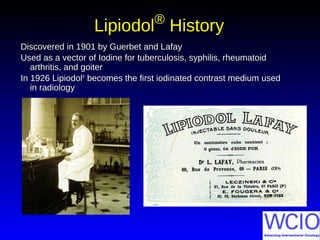
LipiodolLipiodol®®
HistoryHistory
Discovered in 1901 by Guerbet and LafayDiscovered in 1901 by Guerbet and Lafay
Used as a vector of Iodine for tuberculosis, syphilis, rheumatoidUsed as a vector of Iodine for tuberculosis, syphilis, rheumatoid
arthritis, and goiterarthritis, and goiter
In 1926 LipiodolIn 1926 Lipiodol®®
becomes the first iodinated contrast medium usedbecomes the first iodinated contrast medium used
in radiologyin radiology
LipiodolLipiodol®®
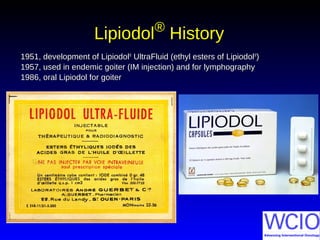
HistoryHistory
1951, development of Lipiodol1951, development of Lipiodol®®
UltraFluid (ethyl esters of LipiodolUltraFluid (ethyl esters of Lipiodol®®
))
1957, used in endemic goiter (IM injection) and for lymphography1957, used in endemic goiter (IM injection) and for lymphography
1986, oral Lipiodol for goiter1986, oral Lipiodol for goiter
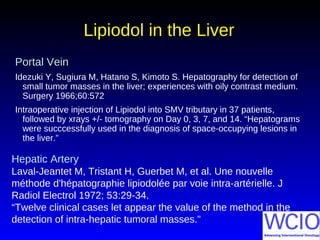
Lipiodol in the LiverLipiodol in the Liver
Portal VeinPortal Vein
Idezuki Y, Sugiura M, Hatano S, Kimoto S. Hepatography for detection of
small tumor masses in the liver; experiences with oily contrast medium.
Surgery 1966;60:572
Intraoperative injection of Lipiodol into SMV tributary in 37 patients,
followed by xrays +/- tomography on Day 0, 3, 7, and 14. “Hepatograms
were succcessfully used in the diagnosis of space-occupying lesions in
the liver.”
Hepatic Artery
Laval-Jeantet M, Tristant H, Guerbet M, et al. Une nouvelle
méthode d'hépatographie lipiodolée par voie intra-artérielle. J
Radiol Electrol 1972; 53:29-34.
“Twelve clinical cases let appear the value of the method in the
detection of intra-hepatic tumoral masses.”
Lipiodol in the LiverLipiodol in the Liver
• First use of Lipiodol for chemoembolizationFirst use of Lipiodol for chemoembolization
• ““In 1981, Prof. Konno who used for the first time lipiodol, saidIn 1981, Prof. Konno who used for the first time lipiodol, said
that if we injected Lipiodol directly into the hepatic artery ofthat if we injected Lipiodol directly into the hepatic artery of
patients with hepatocellular carcinoma, it binds selectively topatients with hepatocellular carcinoma, it binds selectively to
the tumor and accumulates for prolonged periods up tothe tumor and accumulates for prolonged periods up to
several months.”several months.”
Bonnemai B, Guerbet M. Histoire du Lipiodol (1901-1994) ou Comment unBonnemai B, Guerbet M. Histoire du Lipiodol (1901-1994) ou Comment un
médicament peut évoluer avec son tempsmédicament peut évoluer avec son temps.. In: Revue d'histoire de laIn: Revue d'histoire de la
pharmacie, 83e année, N. 305, 1995. pp. 159-170.pharmacie, 83e année, N. 305, 1995. pp. 159-170.
• 19831983 - First publications of diagnostic and therapeutic- First publications of diagnostic and therapeutic
Lipiodol via the hepatic artery for HCC.Lipiodol via the hepatic artery for HCC.
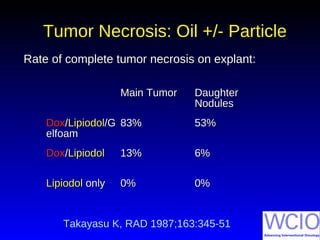
Tumor Necrosis: Oil +/- ParticleTumor Necrosis: Oil +/- Particle
Rate of complete tumor necrosis on explant:Rate of complete tumor necrosis on explant:
Main TumorMain Tumor DaughterDaughter
NodulesNodules
DoxDox//LipiodolLipiodol/G/G
elfoamelfoam
83%83% 53%53%
DoxDox//LipiodolLipiodol 13%13% 6%6%
LipiodolLipiodol onlyonly 0%0% 0%0%
Takayasu K, RAD 1987;163:345-51
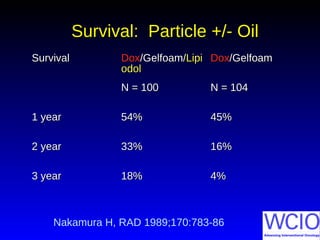
Survival: Particle +/- OilSurvival: Particle +/- Oil
SurvivalSurvival DoxDox/Gelfoam//Gelfoam/LipiLipi
odolodol
DoxDox/Gelfoam/Gelfoam
N = 100N = 100 N = 104N = 104
1 year1 year 54%54% 45%45%
2 year2 year 33%33% 16%16%
3 year3 year 18%18% 4%4%
Nakamura H, RAD 1989;170:783-86
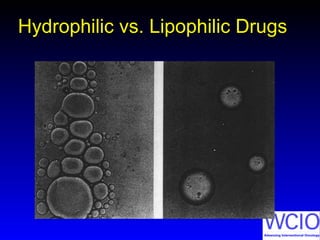
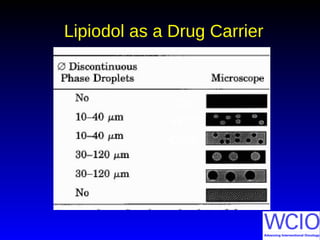
Hydrophilic vs. Lipophilic DrugsHydrophilic vs. Lipophilic Drugs
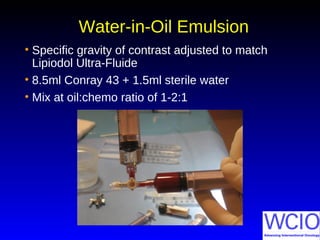
Water-in-Oil Emulsion
• Specific gravity of contrast adjusted to match
Lipiodol Ultra-Fluide
• 8.5ml Conray 43 + 1.5ml sterile water
• Mix at oil:chemo ratio of 1-2:1
Lipiodol as a Drug Carrier
Oil
W/O
O/W
Copyright © 2011 by the American Roentgen Ray Society
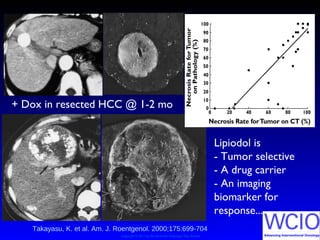
Takayasu, K. et al. Am. J. Roentgenol. 2000;175:699-704
Lipiodol is
- Tumor selective
- A drug carrier
- An imaging
biomarker for
response...
+ Dox in resected HCC @ 1-2 mo
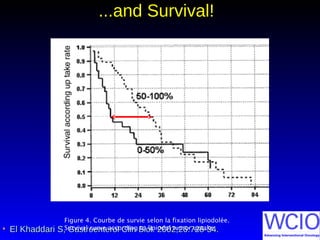
...and Survival!...and Survival!
• El Khaddari S,El Khaddari S, Gastroenterol Clin Biol. 2002;26:728-34.Gastroenterol Clin Biol. 2002;26:728-34.
Figure 4. Courbe de survie selon la fixation lipiodolée.
Survival curve according to lipiodol tumor uptake.
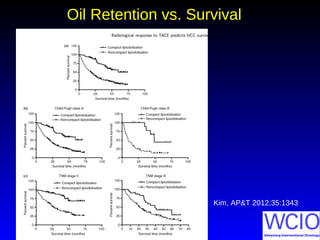
Oil Retention vs. Survival
Kim, AP&T 2012;35:1343
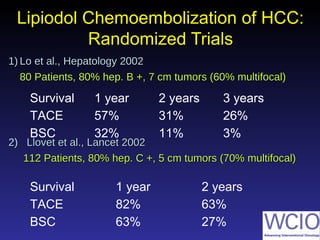
Lipiodol Chemoembolization of HCC:Lipiodol Chemoembolization of HCC:
Randomized TrialsRandomized Trials
1)1) Lo et al., Hepatology 2002Lo et al., Hepatology 2002
80 Patients, 80% hep. B +, 7 cm tumors (60% multifocal)80 Patients, 80% hep. B +, 7 cm tumors (60% multifocal)
2)2) Llovet et al., Lancet 2002Llovet et al., Lancet 2002
112 Patients, 80% hep. C +, 5 cm tumors (70% multifocal)112 Patients, 80% hep. C +, 5 cm tumors (70% multifocal)
Survival 1 year 2 years 3 years
TACE 57% 31% 26%
BSC 32% 11% 3%
Survival 1 year 2 years
TACE 82% 63%
BSC 63% 27%
15
What about bland?What about bland?
15
1-year 2-year 3-year HR
Control 63% 27% 17%
Chembo 82% 63% 29% 0.47 [0.25-0.91]
p=0.02
Bland 75% 50% 29% 0.57 [0.31-1.04]
p=0.07
Llovet, Lancet 2002
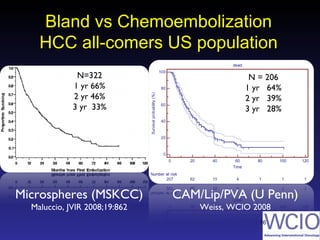
Bland vs ChemoembolizationBland vs Chemoembolization
HCC all-comers US populationHCC all-comers US population
16
N=322
1 yr 66%
2 yr 46%
3 yr 33%
N = 206
1 yr 64%
2 yr 39%
3 yr 28%
Microspheres (MSKCC)
Maluccio, JVIR 2008;19:862
CAM/Lip/PVA (U Penn)
Weiss, WCIO 2008
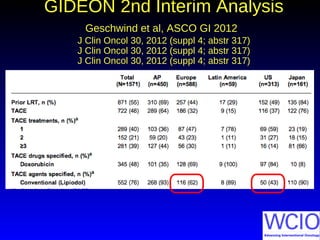
GIDEON 2nd Interim Analysis
Geschwind et al, ASCO GI 2012
J Clin Oncol 30, 2012 (suppl 4; abstr 317)
9
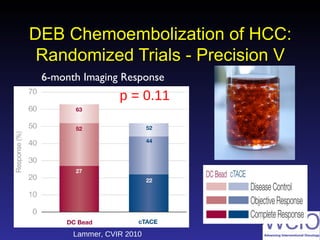
DEB Chemoembolization of HCC:DEB Chemoembolization of HCC:
Randomized Trials - Precision VRandomized Trials - Precision V
9
Lammer, CVIR 2010
p = 0.11
6-month Imaging Response
DEB Chemoembolization of HCC:DEB Chemoembolization of HCC:
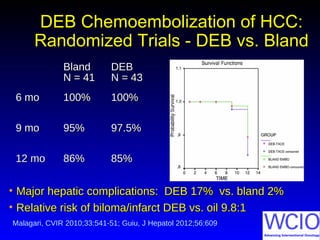
Randomized Trials - DEB vs. BlandRandomized Trials - DEB vs. Bland
• Major hepatic complications: DEB 17% vs. bland 2%Major hepatic complications: DEB 17% vs. bland 2%
• Relative risk of biloma/infarct DEB vs. oil 9.8:1Relative risk of biloma/infarct DEB vs. oil 9.8:1
BlandBland
N = 41N = 41
DEBDEB
N = 43N = 43
6 mo6 mo 100%100% 100%100%
9 mo9 mo 95%95% 97.5%97.5%
12 mo12 mo 86%86% 85%85%
Malagari, CVIR 2010;33:541-51; Guiu, J Hepatol 2012;56:609
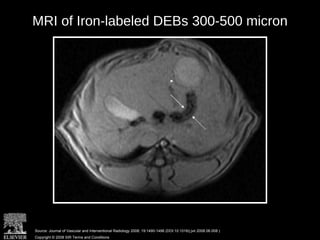
MRI of Iron-labeled DEBs 300-500 micron
Source: Journal of Vascular and Interventional Radiology 2008; 19:1490-1496 (DOI:10.1016/j.jvir.2008.06.008 )
Copyright © 2008 SIR Terms and Conditions
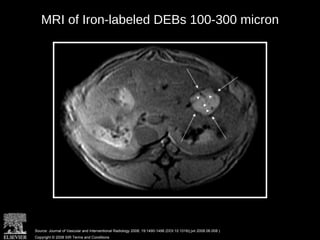
MRI of Iron-labeled DEBs 100-300 micron
Source: Journal of Vascular and Interventional Radiology 2008; 19:1490-1496 (DOI:10.1016/j.jvir.2008.06.008 )
Copyright © 2008 SIR Terms and Conditions
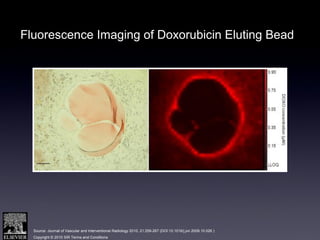
Source: Journal of Vascular and Interventional Radiology 2010; 21:259-267 (DOI:10.1016/j.jvir.2009.10.026 )
Copyright © 2010 SIR Terms and Conditions
Fluorescence Imaging of Doxorubicin Eluting Bead
2626
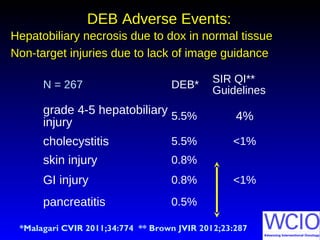
DEB Adverse Events:DEB Adverse Events:
Hepatobiliary necrosis due to dox in normal tissueHepatobiliary necrosis due to dox in normal tissue
Non-target injuries due to lack of image guidanceNon-target injuries due to lack of image guidance
*Malagari CVIR 2011;34:774 ** Brown JVIR 2012;23:287
N = 267 DEB*
SIR QI**
Guidelines
grade 4-5 hepatobiliary
injury
5.5% 4%
cholecystitis 5.5% <1%
skin injury 0.8%
GI injury 0.8% <1%
pancreatitis 0.5%
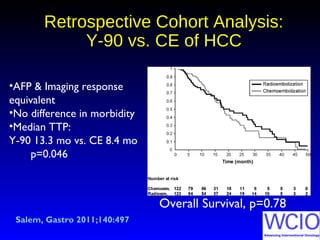
Retrospective Cohort Analysis:Retrospective Cohort Analysis:
Y-90 vs. CE of HCCY-90 vs. CE of HCC
Overall Survival, p=0.78
•AFP & Imaging response
equivalent
•No difference in morbidity
•Median TTP:
Y-90 13.3 mo vs. CE 8.4 mo
p=0.046
Salem, Gastro 2011;140:497
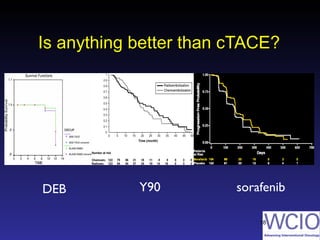
Is anything better than cTACE?Is anything better than cTACE?
18
DEB Y90 sorafenib
Hepatic Embolotherapy:Hepatic Embolotherapy:
Cocktails, Beads, Hot, or Bland-Cocktails, Beads, Hot, or Bland-
Does it make any difference?Does it make any difference?
Probably notProbably not
Caveats:Caveats:
Cardiac, hematologic, renal insufficiency- blandCardiac, hematologic, renal insufficiency- bland
Extrahepatic collaterals - blandExtrahepatic collaterals - bland
Limiting PES a priority (frail, caretaker) - Y-90Limiting PES a priority (frail, caretaker) - Y-90
Whipple/ biliary stent - Y-90Whipple/ biliary stent - Y-90
‫شكرا‬

HCC EMBOLIZATION

  • 1.
    Embolization of HCC:Embolizationof HCC: Cocktails, Beads, Hot, or Bland-Cocktails, Beads, Hot, or Bland- Does it make any difference?Does it make any difference? vs.vs. Doxy Bead Man
  • 2.
    DisclosuresDisclosures • Guerbet LLC,BTG – consultant, researchGuerbet LLC, BTG – consultant, research • MERIT Medical– medical monitor,MERIT Medical– medical monitor, HiQUALITY trialHiQUALITY trial • Sirtex – speaker, proctorSirtex – speaker, proctor • Cambridge University Press - royaltiesCambridge University Press - royalties
  • 3.
  • 4.
  • 5.
    LipiodolLipiodol®® HistoryHistory Discovered in 1901by Guerbet and LafayDiscovered in 1901 by Guerbet and Lafay Used as a vector of Iodine for tuberculosis, syphilis, rheumatoidUsed as a vector of Iodine for tuberculosis, syphilis, rheumatoid arthritis, and goiterarthritis, and goiter In 1926 LipiodolIn 1926 Lipiodol®® becomes the first iodinated contrast medium usedbecomes the first iodinated contrast medium used in radiologyin radiology
  • 6.
    LipiodolLipiodol®® HistoryHistory 1951, development ofLipiodol1951, development of Lipiodol®® UltraFluid (ethyl esters of LipiodolUltraFluid (ethyl esters of Lipiodol®® )) 1957, used in endemic goiter (IM injection) and for lymphography1957, used in endemic goiter (IM injection) and for lymphography 1986, oral Lipiodol for goiter1986, oral Lipiodol for goiter
  • 7.
    Lipiodol in theLiverLipiodol in the Liver Portal VeinPortal Vein Idezuki Y, Sugiura M, Hatano S, Kimoto S. Hepatography for detection of small tumor masses in the liver; experiences with oily contrast medium. Surgery 1966;60:572 Intraoperative injection of Lipiodol into SMV tributary in 37 patients, followed by xrays +/- tomography on Day 0, 3, 7, and 14. “Hepatograms were succcessfully used in the diagnosis of space-occupying lesions in the liver.” Hepatic Artery Laval-Jeantet M, Tristant H, Guerbet M, et al. Une nouvelle méthode d'hépatographie lipiodolée par voie intra-artérielle. J Radiol Electrol 1972; 53:29-34. “Twelve clinical cases let appear the value of the method in the detection of intra-hepatic tumoral masses.”
  • 8.
    Lipiodol in theLiverLipiodol in the Liver • First use of Lipiodol for chemoembolizationFirst use of Lipiodol for chemoembolization • ““In 1981, Prof. Konno who used for the first time lipiodol, saidIn 1981, Prof. Konno who used for the first time lipiodol, said that if we injected Lipiodol directly into the hepatic artery ofthat if we injected Lipiodol directly into the hepatic artery of patients with hepatocellular carcinoma, it binds selectively topatients with hepatocellular carcinoma, it binds selectively to the tumor and accumulates for prolonged periods up tothe tumor and accumulates for prolonged periods up to several months.”several months.” Bonnemai B, Guerbet M. Histoire du Lipiodol (1901-1994) ou Comment unBonnemai B, Guerbet M. Histoire du Lipiodol (1901-1994) ou Comment un médicament peut évoluer avec son tempsmédicament peut évoluer avec son temps.. In: Revue d'histoire de laIn: Revue d'histoire de la pharmacie, 83e année, N. 305, 1995. pp. 159-170.pharmacie, 83e année, N. 305, 1995. pp. 159-170. • 19831983 - First publications of diagnostic and therapeutic- First publications of diagnostic and therapeutic Lipiodol via the hepatic artery for HCC.Lipiodol via the hepatic artery for HCC.
  • 12.
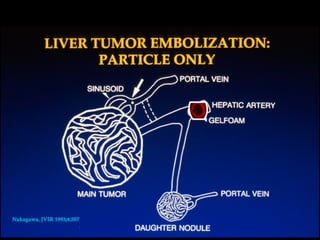
    Tumor Necrosis: Oil+/- ParticleTumor Necrosis: Oil +/- Particle Rate of complete tumor necrosis on explant:Rate of complete tumor necrosis on explant: Main TumorMain Tumor DaughterDaughter NodulesNodules DoxDox//LipiodolLipiodol/G/G elfoamelfoam 83%83% 53%53% DoxDox//LipiodolLipiodol 13%13% 6%6% LipiodolLipiodol onlyonly 0%0% 0%0% Takayasu K, RAD 1987;163:345-51
  • 13.
    Survival: Particle +/-OilSurvival: Particle +/- Oil SurvivalSurvival DoxDox/Gelfoam//Gelfoam/LipiLipi odolodol DoxDox/Gelfoam/Gelfoam N = 100N = 100 N = 104N = 104 1 year1 year 54%54% 45%45% 2 year2 year 33%33% 16%16% 3 year3 year 18%18% 4%4% Nakamura H, RAD 1989;170:783-86
  • 14.
    Hydrophilic vs. LipophilicDrugsHydrophilic vs. Lipophilic Drugs
  • 15.
    Water-in-Oil Emulsion • Specificgravity of contrast adjusted to match Lipiodol Ultra-Fluide • 8.5ml Conray 43 + 1.5ml sterile water • Mix at oil:chemo ratio of 1-2:1
  • 16.
    Lipiodol as aDrug Carrier Oil W/O O/W
  • 17.
    Copyright © 2011by the American Roentgen Ray Society Takayasu, K. et al. Am. J. Roentgenol. 2000;175:699-704 Lipiodol is - Tumor selective - A drug carrier - An imaging biomarker for response... + Dox in resected HCC @ 1-2 mo
  • 18.
    ...and Survival!...and Survival! •El Khaddari S,El Khaddari S, Gastroenterol Clin Biol. 2002;26:728-34.Gastroenterol Clin Biol. 2002;26:728-34. Figure 4. Courbe de survie selon la fixation lipiodolée. Survival curve according to lipiodol tumor uptake.
  • 19.
    Oil Retention vs.Survival Kim, AP&T 2012;35:1343
  • 20.
    Lipiodol Chemoembolization ofHCC:Lipiodol Chemoembolization of HCC: Randomized TrialsRandomized Trials 1)1) Lo et al., Hepatology 2002Lo et al., Hepatology 2002 80 Patients, 80% hep. B +, 7 cm tumors (60% multifocal)80 Patients, 80% hep. B +, 7 cm tumors (60% multifocal) 2)2) Llovet et al., Lancet 2002Llovet et al., Lancet 2002 112 Patients, 80% hep. C +, 5 cm tumors (70% multifocal)112 Patients, 80% hep. C +, 5 cm tumors (70% multifocal) Survival 1 year 2 years 3 years TACE 57% 31% 26% BSC 32% 11% 3% Survival 1 year 2 years TACE 82% 63% BSC 63% 27%
  • 21.
    15 What about bland?Whatabout bland? 15 1-year 2-year 3-year HR Control 63% 27% 17% Chembo 82% 63% 29% 0.47 [0.25-0.91] p=0.02 Bland 75% 50% 29% 0.57 [0.31-1.04] p=0.07 Llovet, Lancet 2002
  • 22.
    Bland vs ChemoembolizationBlandvs Chemoembolization HCC all-comers US populationHCC all-comers US population 16 N=322 1 yr 66% 2 yr 46% 3 yr 33% N = 206 1 yr 64% 2 yr 39% 3 yr 28% Microspheres (MSKCC) Maluccio, JVIR 2008;19:862 CAM/Lip/PVA (U Penn) Weiss, WCIO 2008
  • 23.
    GIDEON 2nd InterimAnalysis Geschwind et al, ASCO GI 2012 J Clin Oncol 30, 2012 (suppl 4; abstr 317) J Clin Oncol 30, 2012 (suppl 4; abstr 317) J Clin Oncol 30, 2012 (suppl 4; abstr 317)
  • 24.
    9 DEB Chemoembolization ofHCC:DEB Chemoembolization of HCC: Randomized Trials - Precision VRandomized Trials - Precision V 9 Lammer, CVIR 2010 p = 0.11 6-month Imaging Response
  • 25.
    DEB Chemoembolization ofHCC:DEB Chemoembolization of HCC: Randomized Trials - DEB vs. BlandRandomized Trials - DEB vs. Bland • Major hepatic complications: DEB 17% vs. bland 2%Major hepatic complications: DEB 17% vs. bland 2% • Relative risk of biloma/infarct DEB vs. oil 9.8:1Relative risk of biloma/infarct DEB vs. oil 9.8:1 BlandBland N = 41N = 41 DEBDEB N = 43N = 43 6 mo6 mo 100%100% 100%100% 9 mo9 mo 95%95% 97.5%97.5% 12 mo12 mo 86%86% 85%85% Malagari, CVIR 2010;33:541-51; Guiu, J Hepatol 2012;56:609
  • 26.
    MRI of Iron-labeledDEBs 300-500 micron Source: Journal of Vascular and Interventional Radiology 2008; 19:1490-1496 (DOI:10.1016/j.jvir.2008.06.008 ) Copyright © 2008 SIR Terms and Conditions
  • 27.
    MRI of Iron-labeledDEBs 100-300 micron Source: Journal of Vascular and Interventional Radiology 2008; 19:1490-1496 (DOI:10.1016/j.jvir.2008.06.008 ) Copyright © 2008 SIR Terms and Conditions
  • 28.
    Source: Journal ofVascular and Interventional Radiology 2010; 21:259-267 (DOI:10.1016/j.jvir.2009.10.026 ) Copyright © 2010 SIR Terms and Conditions Fluorescence Imaging of Doxorubicin Eluting Bead
  • 29.
  • 30.
    DEB Adverse Events:DEBAdverse Events: Hepatobiliary necrosis due to dox in normal tissueHepatobiliary necrosis due to dox in normal tissue Non-target injuries due to lack of image guidanceNon-target injuries due to lack of image guidance *Malagari CVIR 2011;34:774 ** Brown JVIR 2012;23:287 N = 267 DEB* SIR QI** Guidelines grade 4-5 hepatobiliary injury 5.5% 4% cholecystitis 5.5% <1% skin injury 0.8% GI injury 0.8% <1% pancreatitis 0.5%
  • 31.
    Retrospective Cohort Analysis:RetrospectiveCohort Analysis: Y-90 vs. CE of HCCY-90 vs. CE of HCC Overall Survival, p=0.78 •AFP & Imaging response equivalent •No difference in morbidity •Median TTP: Y-90 13.3 mo vs. CE 8.4 mo p=0.046 Salem, Gastro 2011;140:497
  • 32.
    Is anything betterthan cTACE?Is anything better than cTACE? 18 DEB Y90 sorafenib
  • 33.
    Hepatic Embolotherapy:Hepatic Embolotherapy: Cocktails,Beads, Hot, or Bland-Cocktails, Beads, Hot, or Bland- Does it make any difference?Does it make any difference? Probably notProbably not Caveats:Caveats: Cardiac, hematologic, renal insufficiency- blandCardiac, hematologic, renal insufficiency- bland Extrahepatic collaterals - blandExtrahepatic collaterals - bland Limiting PES a priority (frail, caretaker) - Y-90Limiting PES a priority (frail, caretaker) - Y-90 Whipple/ biliary stent - Y-90Whipple/ biliary stent - Y-90
  • 34.

Editor's Notes

  • #2 Moretti Italian Glass beads , “Ruby Flowers”, by Amy Bland
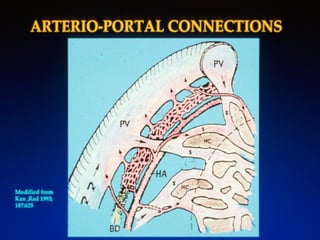
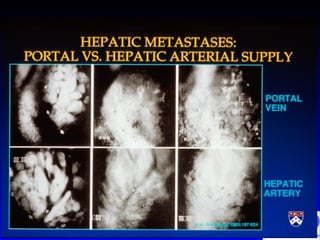
  • #10 In-vivo videomicroscopy studies have demonstrated that the hepatic arterial blood feeding tumors actually passes through numerous presinusoidal shunts into the terminal portal vessels and sinusoids before entering the tumor, particularly through the peribiliary capillary plexus. This has important implications for chemoembolization.
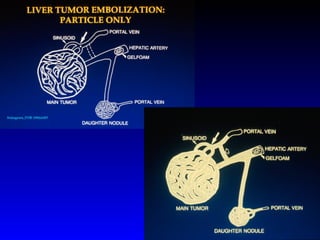
  • #12 Particulate embolics occlude arteries 200 microns or larger, proximal to the level of the pre-sinusoidal shunts, allowing portal blood flow to continue to the tumor and daughter nodules. Oily agents occlude the pre-sinusoidal shunts, but may wash out with time. Oil followed by particulate embolics causes the greatest and most durable tumor ischemia.
  • #15 Most chemotherapeutic drugs used for adenocarcinomas are lipophobic, and remain in the aqueous phase of the emulsion, which can wash out while the oil stays behind. Lipophilic drugs will be taken up by the oily micelles and remain in the tumor.
  • #18 who needs ADC maps or mRECIST?
  • #19 validated imaging response marker correlating to survival. &amp;gt;50% oil uptake improves med survival from 10 to 30 months.
  • #27 Axial T2*-weighted MR image of the liver after embolization with 300–500-μm IOEs. Less intense and partially distributed signal void at the rim of the tumor (arrowhead) is seen without signal void inside the tumor. Note the intense signal void with blooming artifact (white arrow) caused by the clustered IOEs within the left hepatic artery located at a significant distance from the tumor bed.
  • #28 Axial T2*-weighted MR image (field of view, 16 × 16; matrix size, 256 × 160; repetition/echo time, 200/15 msec; flip angle, 45°) of the liver after embolization with 100–300-μm IOEs. Note the multiple punctate signal voids inside the tumor (arrowheads) and circumferentially distributed at the rim of the tumor (white arrows), showing the ability of MR imaging to track the distribution of IOEs in tumor bed.
  • #29 Doxorubicin quantitative mapping in the tissue around DEBs. Left: unstained tissue section of a vessel occluded by four doxorubicin DEBs (100–300 μm, day 28). Right: fluorescence microspectroscopy image of free doxorubicin around the same vessel. Scale bar: 50 μm.