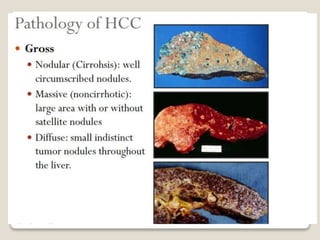
•HCC is the most common primary maignancy of liver.
•Worldwide 4th Most common malignancy.
•Secondaries are more common in lliver.
•Male : Female = 4:1
•Right lobe involved more.
•28/100,000 in South east asia- increased prevalence
of HBV infection.
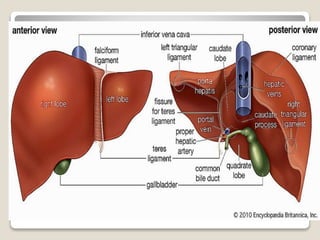
Anatomy of liver
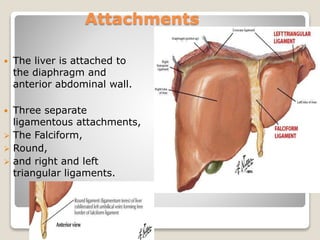
Attachments
 The liver is attached to
the diaphragm and
anterior abdominal wall.
 Three separate
ligamentous attachments,
 The Falciform,
 Round,
 and right and left
triangular ligaments.
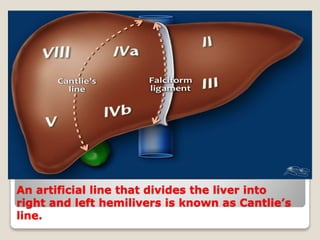
An artificial line that divides the liver into
right and left hemilivers is known as Cantlie’s
line.
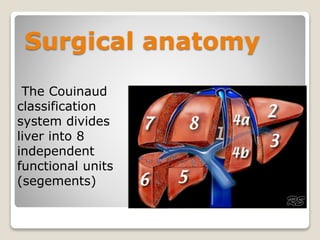
Surgical anatomy
The Couinaud
classification
system divides
liver into 8
independent
functional units
(segements)
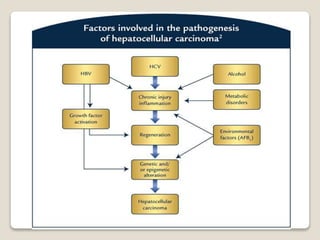
Hepatitis B and/or C ,More common in chronic positive HbsAg
External sources:
•Alcoholic cirrhosis
•Aflatoxin B1 – fungus aspergillus
Inherited errors of metabolism:
•Hereditary hemochromatosis
•Porphyriacutaneatarda
•Alpha1-antitrypsin deficiency,Wilson’s disease,
Hepatic adenoma
Focal Nodular hyperplasia
HCC and Cirrhosis
•Risk factors for HCC are also risk factors for liver
cirrhosis.
•60%-80% of HCC have cirrhosis.
•Cirrhosis is a prerequisite for HCC in inherited
metabolic diseases and autoimmune D.
•Annual incidence rate of HCC in hepatitis C-related
cirrhosis:2-8%.
•The exact pathogenesis is unknown.
•The disease seems to occur in stages:
Chronic liver injury --> cell death –regeneration-cellular
metabolic dysfunction- release of inflammatory mediators-
increase risk of transforming mutation of hepatocytes.
•Preneoplastic changes –hepatocytes dysplasia can
be seen.
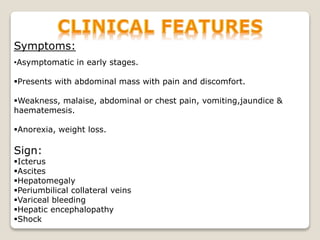
Symptoms:
•Asymptomatic in early stages.
Presents with abdominal mass with pain and discomfort.
Weakness, malaise, abdominal or chest pain, vomiting,jaundice &
haematemesis.
Anorexia, weight loss.
Sign:
Icterus
Ascites
Hepatomegaly
Periumbilical collateral veins
Variceal bleeding
Hepatic encephalopathy
Shock
Presentation
•Asymptomatic
•Symptomatic
•Symptoms due to complication
•Symptoms due to metastasis
1)Serum alpha feto-protein
•Produced by 60% of HCC
•Level depends on size of tumor
•May be normal in small tumor
•Both sensitivity and specificity – low
•Can be high in presence of HBV & HCV replication and a/c
liver necrosis.
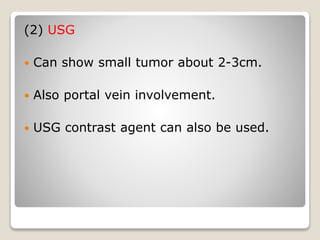
(2) USG
 Can show small tumor about 2-3cm.
 Also portal vein involvement.
 USG contrast agent can also be used.
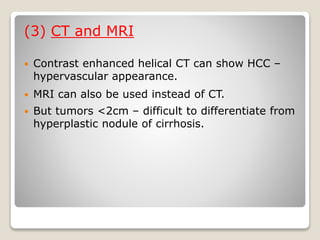
(3) CT and MRI
 Contrast enhanced helical CT can show HCC –
hypervascular appearance.
 MRI can also be used instead of CT.
 But tumors <2cm – difficult to differentiate from
hyperplastic nodule of cirrhosis.
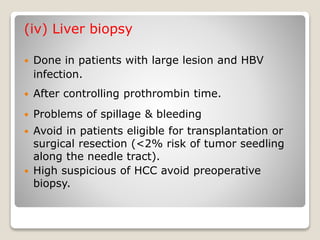
(iv) Liver biopsy
 Done in patients with large lesion and HBV
infection.
 After controlling prothrombin time.
 Problems of spillage & bleeding
 Avoid in patients eligible for transplantation or
surgical resection (<2% risk of tumor seedling
along the needle tract).
 High suspicious of HCC avoid preoperative
biopsy.
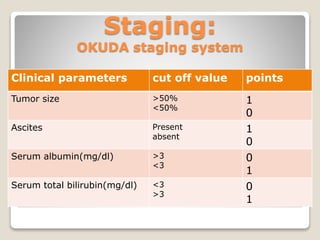
Staging:
OKUDA staging system
Clinical parameters cut off value points
Tumor size >50%
<50%
1
0
Ascites Present
absent
1
0
Serum albumin(mg/dl) >3
<3
0
1
Serum total bilirubin(mg/dl) <3
>3
0
1
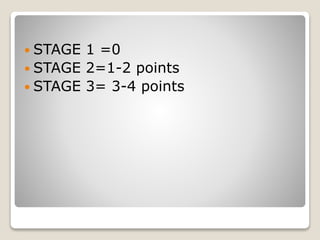
 STAGE 1 =0
 STAGE 2=1-2 points
 STAGE 3= 3-4 points
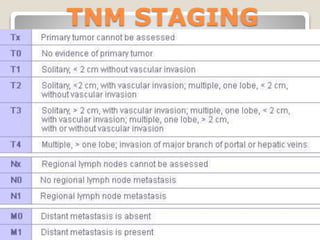
TNM STAGING
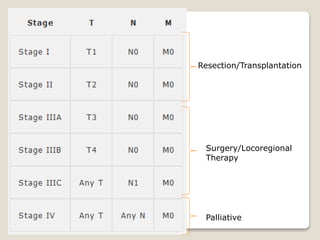
Resection/Transplantation
Surgery/Locoregional
Therapy
Palliative
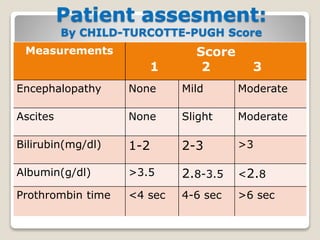
Patient assesment:
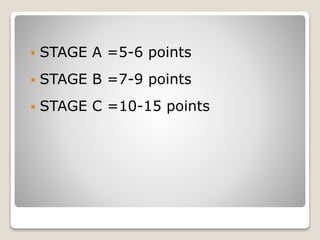
By CHILD-TURCOTTE-PUGH Score
Measurements Score
1 2 3
Encephalopathy None Mild Moderate
Ascites None Slight Moderate
Bilirubin(mg/dl) 1-2 2-3 >3
Albumin(g/dl) >3.5 2.8-3.5 <2.8
Prothrombin time <4 sec 4-6 sec >6 sec
 STAGE A =5-6 points
 STAGE B =7-9 points
 STAGE C =10-15 points
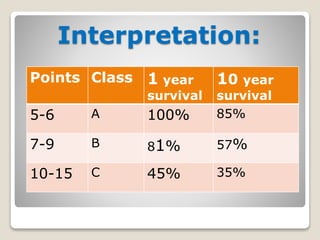
Interpretation:
Points Class 1 year
survival
10 year
survival
5-6 A 100% 85%
7-9 B 81% 57%
10-15 C 45% 35%
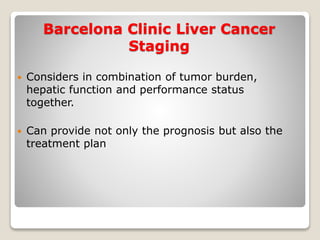
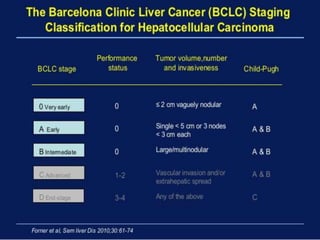
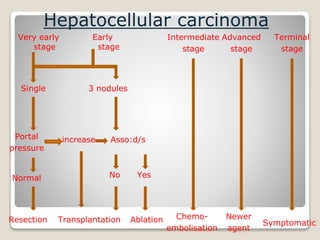
Barcelona Clinic Liver Cancer
Staging
 Considers in combination of tumor burden,
hepatic function and performance status
together.
 Can provide not only the prognosis but also the
treatment plan
Hepatocellular carcinoma
Very early
stage
Early
stage
Intermediate
stage
Terminal
stage
Advanced
stage
Single 3 nodules
Portal
pressure
Normal
increase Asso:d/s
Resection Transplantation
YesNo
Ablation Chemo-
embolisation
Newer
agent
Symptomatic
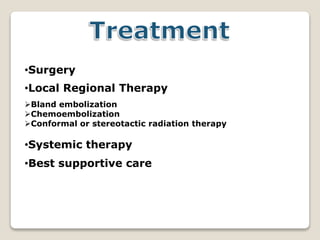
•Surgery
•Local Regional Therapy
Bland embolization
Chemoembolization
Conformal or stereotactic radiation therapy
•Systemic therapy
•Best supportive care
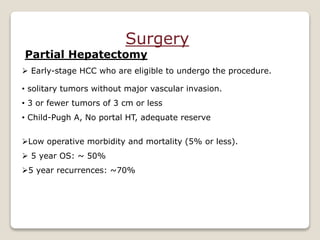
Surgery
Partial Hepatectomy
 Early-stage HCC who are eligible to undergo the procedure.
• solitary tumors without major vascular invasion.
• 3 or fewer tumors of 3 cm or less
• Child-Pugh A, No portal HT, adequate reserve
Low operative morbidity and mortality (5% or less).
 5 year OS: ~ 50%
5 year recurrences: ~70%
Liver Transplantation
— Potentially curative for early HCC.
— 4years of Survival: 85%.
— Removes detectable and undetectable lesions,
— treats underlying cirrhosis
United Network for Organ Sharing (UNOS)/Milan criteria
•Patient has one lesion smaller than 5cm
•Upto 3 lesions smaller than 3cm.
•No macrovascular involvement
•No extrahepatic disease
•Child pugh score A,B.
Bridge therapy
Locoregional treatment of HCC as a bridge to liver
transplantation in eligible patients waiting for the
procedure.
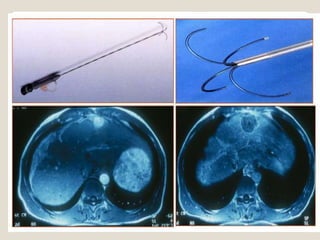
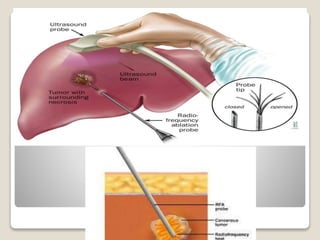
• Radiofrequency ablation (RFA),
•Chemoembolization
•Radioembolization
Local Regional Therapy
Aim: selective tumor necrosis,
•They are not comparable to that of liver resection or
transplantation.
•Not be used in place of resection or transplantation eligible
patients
Local Regional Therapy
Ablation: inducing direct necrosis
Chemical : ethanol (PEI), acetic acid
Physical: radiofrequency ablation [RFA], microwave ablation,
Cryoablation
Laparoscopic, percutaneousor open approaches.
Indications: local disease only completely amenable to
ablative therapy according to the size and location of the
tumor(s).
Tumor necrosis is assessed by CT/MRI at intervals an no
contrast uptake
•Ablation Limitation
•Near to Dome
•Thin capsule
•Near to major blood vessels,bile duct or
abdominal organ.
Embolization
Aim: selective catheter-based infusion of particles targeted to the
arterial branch of the hepatic artery feeding the tumor leading to
ischemia.
Types:
Bland embolization,
Chemoembolization
Radioembolization
Caution:
Proper arterial anatomy outlined
Embolizationis limited to a segment, subsegment, or lobe
Indications:
All HCC tumors are embolizable if the arterial supply is isolated.
Used in unresectable/inoperable tumors not amenable to ablation
(>5cm),alone or followed by ablation
Bland embolization(BE)&Chemoembolization(CE)
Particles to block arterial flow. :
— Gelatinsponge,
— polyvinylalcohol, and
— polyacrylamidemicrospheres
Chemotherapeutic agents:
— Doxorubicin and/or Cisplatin
Containdications to CE:
•Child C
•Portal vein thrombosis
•Bilirubin> 3 mg/ml
•liver abscess
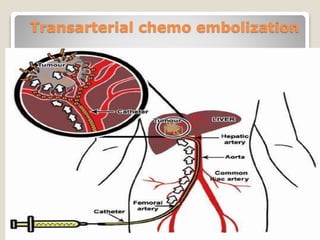
Transarterial chemo embolization
Radioembolization
Agents:
• Microspheres embedded with yttrium-90 (beta radiation
emitter)
Tumor necrosis is more likely to be induced by radiation
rather than ischemia.
Complications:
— cholecystitis
— abscess formation
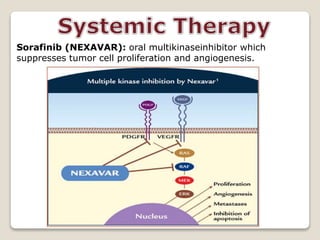
Sorafinib (NEXAVAR): oral multikinaseinhibitor which
suppresses tumor cell proliferation and angiogenesis.
•As viral infection with HBV is the most important aetiology and
HBV vaccination is already avaliable, vaccination should be
done.
•Consider about the universal precaution in handling infected
blood and its products in medical personal.
•Early diagnosis and prompt treatment
 To get early diagnosis, screening procedures should be done in
endemic area
 All pt must be given prompt treatment after being diagnosed as
HCC or chr. hepatitis
Hcc

Hcc

  • 2.
    •HCC is themost common primary maignancy of liver. •Worldwide 4th Most common malignancy. •Secondaries are more common in lliver. •Male : Female = 4:1 •Right lobe involved more. •28/100,000 in South east asia- increased prevalence of HBV infection.
  • 3.
  • 4.
    Attachments  The liveris attached to the diaphragm and anterior abdominal wall.  Three separate ligamentous attachments,  The Falciform,  Round,  and right and left triangular ligaments.
  • 5.
    An artificial linethat divides the liver into right and left hemilivers is known as Cantlie’s line.
  • 6.
    Surgical anatomy The Couinaud classification systemdivides liver into 8 independent functional units (segements)
  • 7.
    Hepatitis B and/orC ,More common in chronic positive HbsAg External sources: •Alcoholic cirrhosis •Aflatoxin B1 – fungus aspergillus Inherited errors of metabolism: •Hereditary hemochromatosis •Porphyriacutaneatarda •Alpha1-antitrypsin deficiency,Wilson’s disease, Hepatic adenoma Focal Nodular hyperplasia
  • 8.
    HCC and Cirrhosis •Riskfactors for HCC are also risk factors for liver cirrhosis. •60%-80% of HCC have cirrhosis. •Cirrhosis is a prerequisite for HCC in inherited metabolic diseases and autoimmune D. •Annual incidence rate of HCC in hepatitis C-related cirrhosis:2-8%.
  • 9.
    •The exact pathogenesisis unknown. •The disease seems to occur in stages: Chronic liver injury --> cell death –regeneration-cellular metabolic dysfunction- release of inflammatory mediators- increase risk of transforming mutation of hepatocytes. •Preneoplastic changes –hepatocytes dysplasia can be seen.
  • 11.
    Symptoms: •Asymptomatic in earlystages. Presents with abdominal mass with pain and discomfort. Weakness, malaise, abdominal or chest pain, vomiting,jaundice & haematemesis. Anorexia, weight loss. Sign: Icterus Ascites Hepatomegaly Periumbilical collateral veins Variceal bleeding Hepatic encephalopathy Shock
  • 12.
    Presentation •Asymptomatic •Symptomatic •Symptoms due tocomplication •Symptoms due to metastasis
  • 13.
    1)Serum alpha feto-protein •Producedby 60% of HCC •Level depends on size of tumor •May be normal in small tumor •Both sensitivity and specificity – low •Can be high in presence of HBV & HCV replication and a/c liver necrosis.
  • 14.
    (2) USG  Canshow small tumor about 2-3cm.  Also portal vein involvement.  USG contrast agent can also be used.
  • 15.
    (3) CT andMRI  Contrast enhanced helical CT can show HCC – hypervascular appearance.  MRI can also be used instead of CT.  But tumors <2cm – difficult to differentiate from hyperplastic nodule of cirrhosis.
  • 16.
    (iv) Liver biopsy Done in patients with large lesion and HBV infection.  After controlling prothrombin time.  Problems of spillage & bleeding  Avoid in patients eligible for transplantation or surgical resection (<2% risk of tumor seedling along the needle tract).  High suspicious of HCC avoid preoperative biopsy.
  • 17.
    Staging: OKUDA staging system Clinicalparameters cut off value points Tumor size >50% <50% 1 0 Ascites Present absent 1 0 Serum albumin(mg/dl) >3 <3 0 1 Serum total bilirubin(mg/dl) <3 >3 0 1
  • 18.
     STAGE 1=0  STAGE 2=1-2 points  STAGE 3= 3-4 points
  • 19.
  • 20.
  • 21.
    Patient assesment: By CHILD-TURCOTTE-PUGHScore Measurements Score 1 2 3 Encephalopathy None Mild Moderate Ascites None Slight Moderate Bilirubin(mg/dl) 1-2 2-3 >3 Albumin(g/dl) >3.5 2.8-3.5 <2.8 Prothrombin time <4 sec 4-6 sec >6 sec
  • 22.
     STAGE A=5-6 points  STAGE B =7-9 points  STAGE C =10-15 points
  • 23.
    Interpretation: Points Class 1year survival 10 year survival 5-6 A 100% 85% 7-9 B 81% 57% 10-15 C 45% 35%
  • 24.
    Barcelona Clinic LiverCancer Staging  Considers in combination of tumor burden, hepatic function and performance status together.  Can provide not only the prognosis but also the treatment plan
  • 26.
    Hepatocellular carcinoma Very early stage Early stage Intermediate stage Terminal stage Advanced stage Single3 nodules Portal pressure Normal increase Asso:d/s Resection Transplantation YesNo Ablation Chemo- embolisation Newer agent Symptomatic
  • 28.
    •Surgery •Local Regional Therapy Blandembolization Chemoembolization Conformal or stereotactic radiation therapy •Systemic therapy •Best supportive care
  • 29.
    Surgery Partial Hepatectomy  Early-stageHCC who are eligible to undergo the procedure. • solitary tumors without major vascular invasion. • 3 or fewer tumors of 3 cm or less • Child-Pugh A, No portal HT, adequate reserve Low operative morbidity and mortality (5% or less).  5 year OS: ~ 50% 5 year recurrences: ~70%
  • 30.
    Liver Transplantation — Potentiallycurative for early HCC. — 4years of Survival: 85%. — Removes detectable and undetectable lesions, — treats underlying cirrhosis United Network for Organ Sharing (UNOS)/Milan criteria •Patient has one lesion smaller than 5cm •Upto 3 lesions smaller than 3cm. •No macrovascular involvement •No extrahepatic disease •Child pugh score A,B.
  • 31.
    Bridge therapy Locoregional treatmentof HCC as a bridge to liver transplantation in eligible patients waiting for the procedure. • Radiofrequency ablation (RFA), •Chemoembolization •Radioembolization Local Regional Therapy Aim: selective tumor necrosis, •They are not comparable to that of liver resection or transplantation. •Not be used in place of resection or transplantation eligible patients
  • 32.
    Local Regional Therapy Ablation:inducing direct necrosis Chemical : ethanol (PEI), acetic acid Physical: radiofrequency ablation [RFA], microwave ablation, Cryoablation Laparoscopic, percutaneousor open approaches. Indications: local disease only completely amenable to ablative therapy according to the size and location of the tumor(s). Tumor necrosis is assessed by CT/MRI at intervals an no contrast uptake
  • 35.
    •Ablation Limitation •Near toDome •Thin capsule •Near to major blood vessels,bile duct or abdominal organ.
  • 36.
    Embolization Aim: selective catheter-basedinfusion of particles targeted to the arterial branch of the hepatic artery feeding the tumor leading to ischemia. Types: Bland embolization, Chemoembolization Radioembolization Caution: Proper arterial anatomy outlined Embolizationis limited to a segment, subsegment, or lobe Indications: All HCC tumors are embolizable if the arterial supply is isolated. Used in unresectable/inoperable tumors not amenable to ablation (>5cm),alone or followed by ablation
  • 37.
    Bland embolization(BE)&Chemoembolization(CE) Particles toblock arterial flow. : — Gelatinsponge, — polyvinylalcohol, and — polyacrylamidemicrospheres Chemotherapeutic agents: — Doxorubicin and/or Cisplatin Containdications to CE: •Child C •Portal vein thrombosis •Bilirubin> 3 mg/ml •liver abscess
  • 38.
  • 39.
    Radioembolization Agents: • Microspheres embeddedwith yttrium-90 (beta radiation emitter) Tumor necrosis is more likely to be induced by radiation rather than ischemia. Complications: — cholecystitis — abscess formation
  • 40.
    Sorafinib (NEXAVAR): oralmultikinaseinhibitor which suppresses tumor cell proliferation and angiogenesis.
  • 41.
    •As viral infectionwith HBV is the most important aetiology and HBV vaccination is already avaliable, vaccination should be done. •Consider about the universal precaution in handling infected blood and its products in medical personal. •Early diagnosis and prompt treatment  To get early diagnosis, screening procedures should be done in endemic area  All pt must be given prompt treatment after being diagnosed as HCC or chr. hepatitis

Editor's Notes

  • #5 The falciform ligament, which is situated on the anterior surface of the liver, arises from the anterior leaflets of the right and left triangular ligaments and terminates inferiorly where the ligamentum teres enters the umbilical fissure