Lesson 1: What are hazards?
 What are hazards?
 Which hazard is the
most
severe?
List types of human and natural events (only those generated by human and
physical processes) that harm people, homes, or possessions. You can name actual
events, such as a recent earthquake or hurricane if you know them.
Which hazard would you consider the "worst" - jot down their reasons.
Why is this natural event hazardous for people? (For example, consider the
frequency and severity of the event, the number of people affected, or whether or not
the event can be predicted.)
http://www.preventionweb.net/risk
How do we categorise our list?
Hazards: extreme events that
pose threat to people’s lives and
property.
Natural Hazards: caused by
physical factors such as the
weather, or movement of the
Earth’s crust or atmosphere.
Human hazards: man-made such
as poverty, conflict and how well
prepared we are
Classifying ‘hazards’
Geological / geophysical: hazards that
are related to the structure of the
earth. Examples include….
Atmospheric hazards: Include hazards
that are caused by the air and
weather. Examples include….
Biological hazards: essentially
controlled by solar energy. Examples
include….
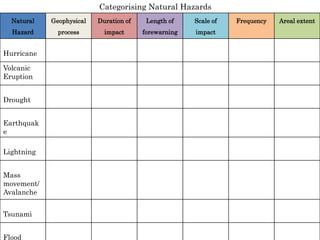
Natural
Hazard
Geophysical
process
Duration of
impact
Length of
forewarning
Scale of
impact
Frequency Areal extent
Hurricane
Volcanic
Eruption
Drought
Earthquak
e
Lightning
Mass
movement/
Avalanche
Tsunami
Flood
 Geophysical process [Tectonic, Geomorphological, Atmospheric,
Biological]
 Duration of impact [Instant, seconds, minutes, hours, days,
months, years, decades]
 Length of forewarning [Seconds, minutes, hours, days, months,
years, decades]
 Scale of impact [Local, Regional or International]
 Frequency [between events of a similar magnitude, frequent,
rare,]
 Areal extent [size of the area covered by the hazard – large, small]
Categorising Natural Hazards
Natural
Hazard
Geophysical
process
Duration of
impact
Length of
forewarning
Scale of
impact
Frequency Areal extent
Hurricane
Volcanic
Eruption
Drought
Earthquak
e
Lightning
Mass
movement/
Avalanche
Tsunami
Flood
Categorising Natural Hazards
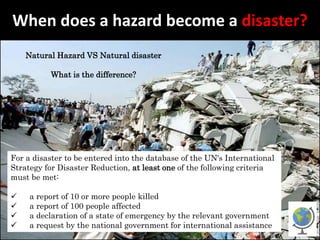
When does a hazard become a disaster?
Natural Hazard VS Natural disaster
What is the difference?
For a disaster to be entered into the database of the UN's International
Strategy for Disaster Reduction, at least one of the following criteria
must be met:
 a report of 10 or more people killed
 a report of 100 people affected
 a declaration of a state of emergency by the relevant government
 a request by the national government for international assistance
Where are natural hazards?
a) Examine the map showing natural hazards around the world:
http://risk.preventionweb.net
b) Name 5 areas of the world where:
- You are likely to experience an earthquake.
- You are affected by severe tropical cyclones.
- you are prone to drought and water shortages.
- you are vulnerable to wildfires.
- you could experience a tsunami
b) Describe the distribution of:
Earthquakes
Volcanoes
Tropical storms
Drought
General: Most earthquakes are
located in the
North/South/East/West
Specific: There are clusters in….
A linear pattern
along……Countries/Areas that
experience this are……
Where are natural hazards?
a) Examine the map showing natural hazards around the world:
http://risk.preventionweb.net
b) Name 5 areas of the world where:
- You are likely to experience an earthquake.
- You are affected by severe tropical cyclones.
- you are prone to drought and water shortages.
- you are vulnerable to wildfires.
- you could experience a tsunami
b) Describe the distribution of:
Earthquakes
Volcanoes
Tropical storms
Drought
General: Most earthquakes are
located in the
North/South/East/West
Specific: There are clusters in….
A linear pattern
along……Countries/Areas that
experience this are……

Hazards Week 1

  • 1.
    Lesson 1: Whatare hazards?  What are hazards?  Which hazard is the most severe? List types of human and natural events (only those generated by human and physical processes) that harm people, homes, or possessions. You can name actual events, such as a recent earthquake or hurricane if you know them. Which hazard would you consider the "worst" - jot down their reasons. Why is this natural event hazardous for people? (For example, consider the frequency and severity of the event, the number of people affected, or whether or not the event can be predicted.) http://www.preventionweb.net/risk How do we categorise our list?
  • 2.
    Hazards: extreme eventsthat pose threat to people’s lives and property. Natural Hazards: caused by physical factors such as the weather, or movement of the Earth’s crust or atmosphere. Human hazards: man-made such as poverty, conflict and how well prepared we are
  • 3.
    Classifying ‘hazards’ Geological /geophysical: hazards that are related to the structure of the earth. Examples include…. Atmospheric hazards: Include hazards that are caused by the air and weather. Examples include…. Biological hazards: essentially controlled by solar energy. Examples include….
  • 4.
    Natural Hazard Geophysical process Duration of impact Length of forewarning Scaleof impact Frequency Areal extent Hurricane Volcanic Eruption Drought Earthquak e Lightning Mass movement/ Avalanche Tsunami Flood  Geophysical process [Tectonic, Geomorphological, Atmospheric, Biological]  Duration of impact [Instant, seconds, minutes, hours, days, months, years, decades]  Length of forewarning [Seconds, minutes, hours, days, months, years, decades]  Scale of impact [Local, Regional or International]  Frequency [between events of a similar magnitude, frequent, rare,]  Areal extent [size of the area covered by the hazard – large, small] Categorising Natural Hazards
  • 5.
    Natural Hazard Geophysical process Duration of impact Length of forewarning Scaleof impact Frequency Areal extent Hurricane Volcanic Eruption Drought Earthquak e Lightning Mass movement/ Avalanche Tsunami Flood Categorising Natural Hazards
  • 6.
    When does ahazard become a disaster? Natural Hazard VS Natural disaster What is the difference? For a disaster to be entered into the database of the UN's International Strategy for Disaster Reduction, at least one of the following criteria must be met:  a report of 10 or more people killed  a report of 100 people affected  a declaration of a state of emergency by the relevant government  a request by the national government for international assistance
  • 7.
    Where are naturalhazards? a) Examine the map showing natural hazards around the world: http://risk.preventionweb.net b) Name 5 areas of the world where: - You are likely to experience an earthquake. - You are affected by severe tropical cyclones. - you are prone to drought and water shortages. - you are vulnerable to wildfires. - you could experience a tsunami b) Describe the distribution of: Earthquakes Volcanoes Tropical storms Drought General: Most earthquakes are located in the North/South/East/West Specific: There are clusters in…. A linear pattern along……Countries/Areas that experience this are……
  • 8.
    Where are naturalhazards? a) Examine the map showing natural hazards around the world: http://risk.preventionweb.net b) Name 5 areas of the world where: - You are likely to experience an earthquake. - You are affected by severe tropical cyclones. - you are prone to drought and water shortages. - you are vulnerable to wildfires. - you could experience a tsunami b) Describe the distribution of: Earthquakes Volcanoes Tropical storms Drought General: Most earthquakes are located in the North/South/East/West Specific: There are clusters in…. A linear pattern along……Countries/Areas that experience this are……

Editor's Notes

  • #4 What is the same about every natural hazard/different? Ask students to generate a list of all the things that the natural hazards discussed in class have in common (e.g., all can damage property and endanger people's lives). Ask them to generate another list of things that are different (or perhaps unique) about the hazards (e.g., methods of study and prediction or locations where events are likely to occur).
  • #7 http://www.met.reading.ac.uk/~sgs02rpa/extreme.html#160819