Introductionto
EnvironmentalScienceandDisaster
Management
Environmental Science
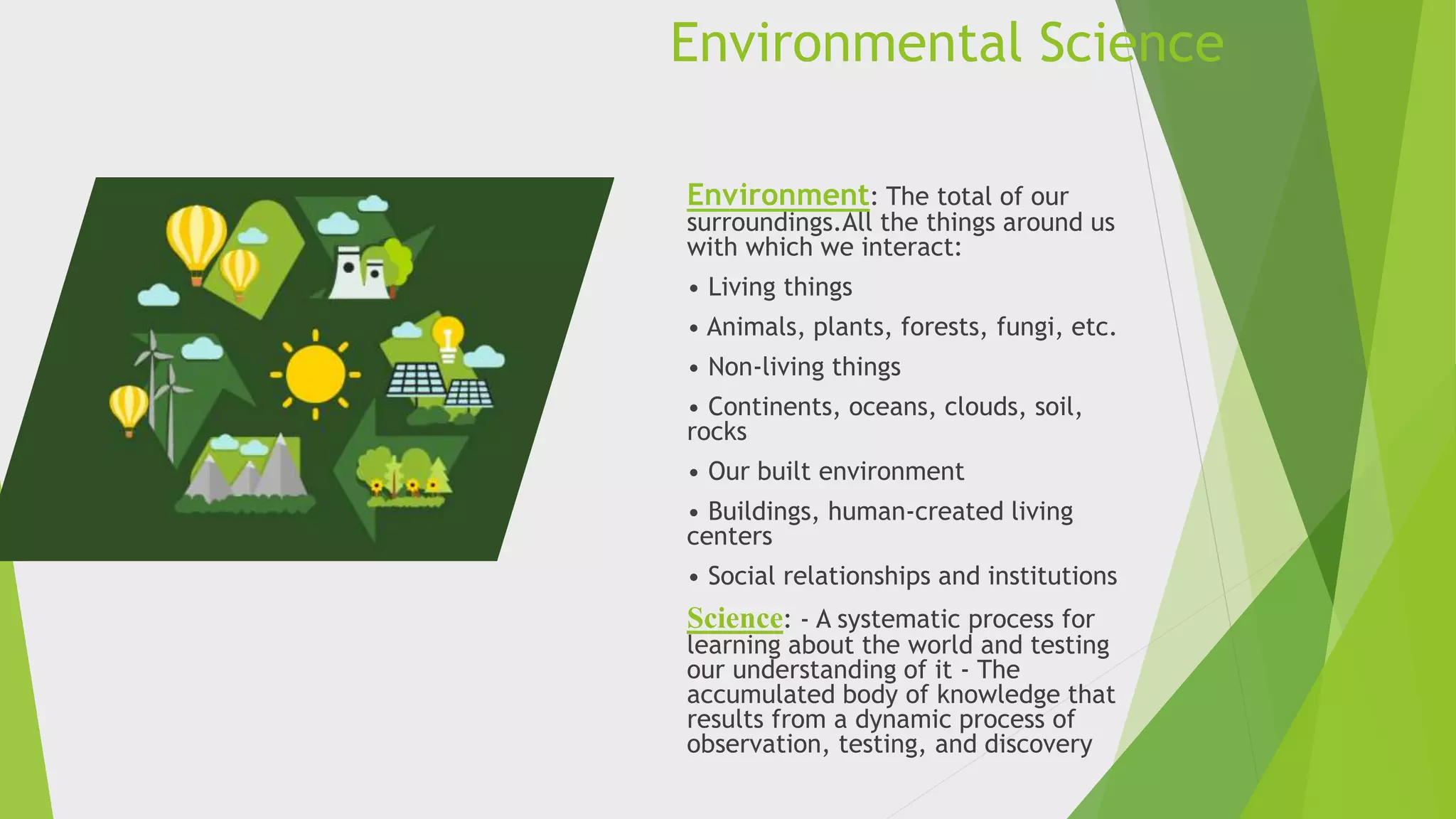
Environment: The total of our
surroundings.All the things around us
with which we interact:
• Living things
• Animals, plants, forests, fungi, etc.
• Non-living things
• Continents, oceans, clouds, soil,
rocks
• Our built environment
• Buildings, human-created living
centers
• Social relationships and institutions
Science: - A systematic process for
learning about the world and testing
our understanding of it - The
accumulated body of knowledge that
results from a dynamic process of
observation, testing, and discovery
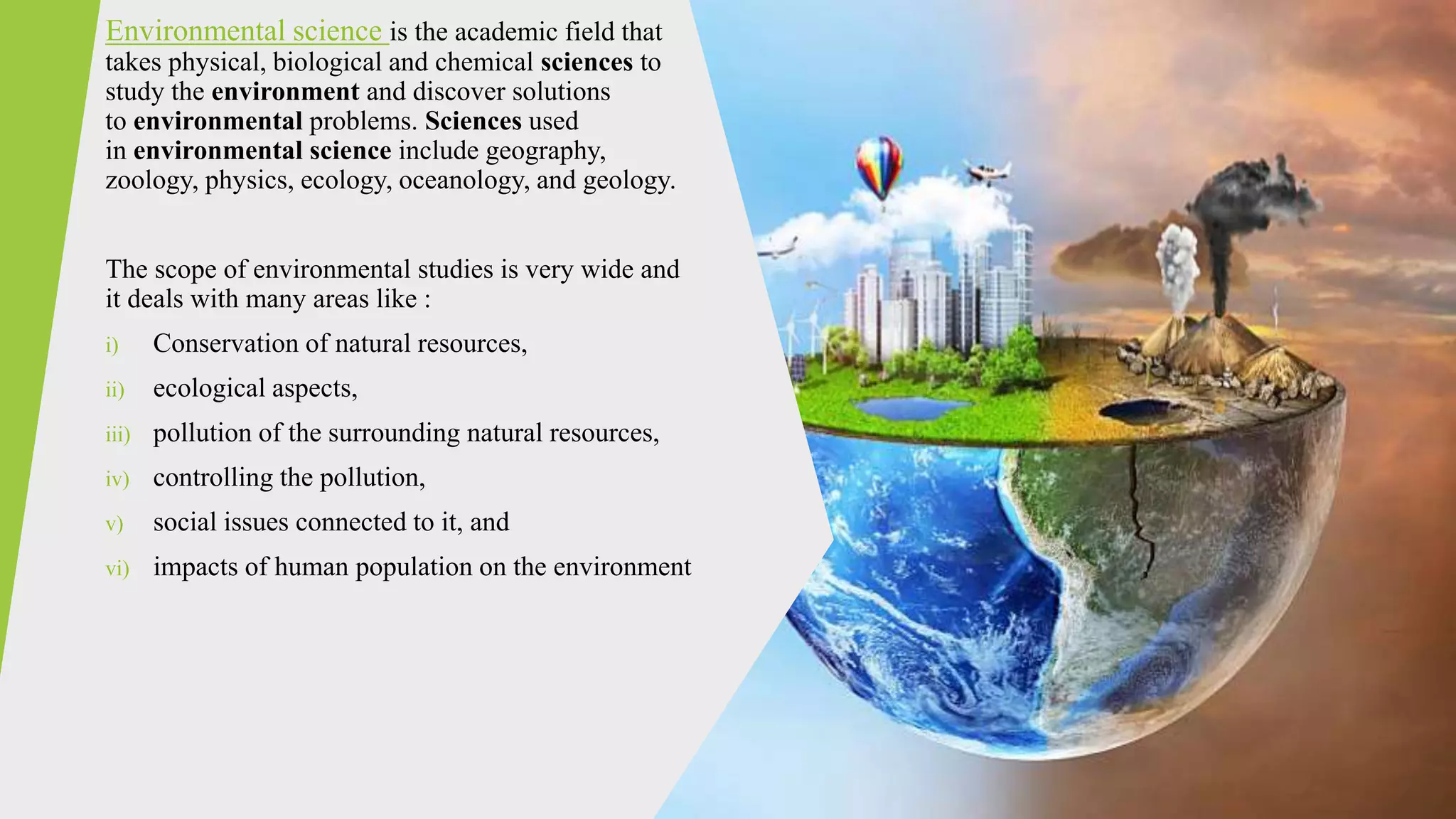
Environmental science is the academic field that
takes physical, biological and chemical sciences to
study the environment and discover solutions
to environmental problems. Sciences used
in environmental science include geography,
zoology, physics, ecology, oceanology, and geology.
The scope of environmental studies is very wide and
it deals with many areas like :
i) Conservation of natural resources,
ii) ecological aspects,
iii) pollution of the surrounding natural resources,
iv) controlling the pollution,
v) social issues connected to it, and
vi) impacts of human population on the environment
Environmental Science and
Disaster Management (ESDM)
Getting quality education along with
enough expertise in the field is very
important for any student's career. The
Department of Environmental
Science and Disaster Management at
DIU and other university’s is such a
platform. It connects students directly
with the environment by providing deep
knowledge and real-life experience.
Fig. Proportional impact of different
types of disaster in countries between
1980 and 2015—number of events,
persons killed, and economic loss.
(Source EM-DAT: The Emergency Events
Database—Université catholique de
Louvain (UCL)—CRED, D. Guha-Sapir—
www.emdat.be, Brussels, Belgium)
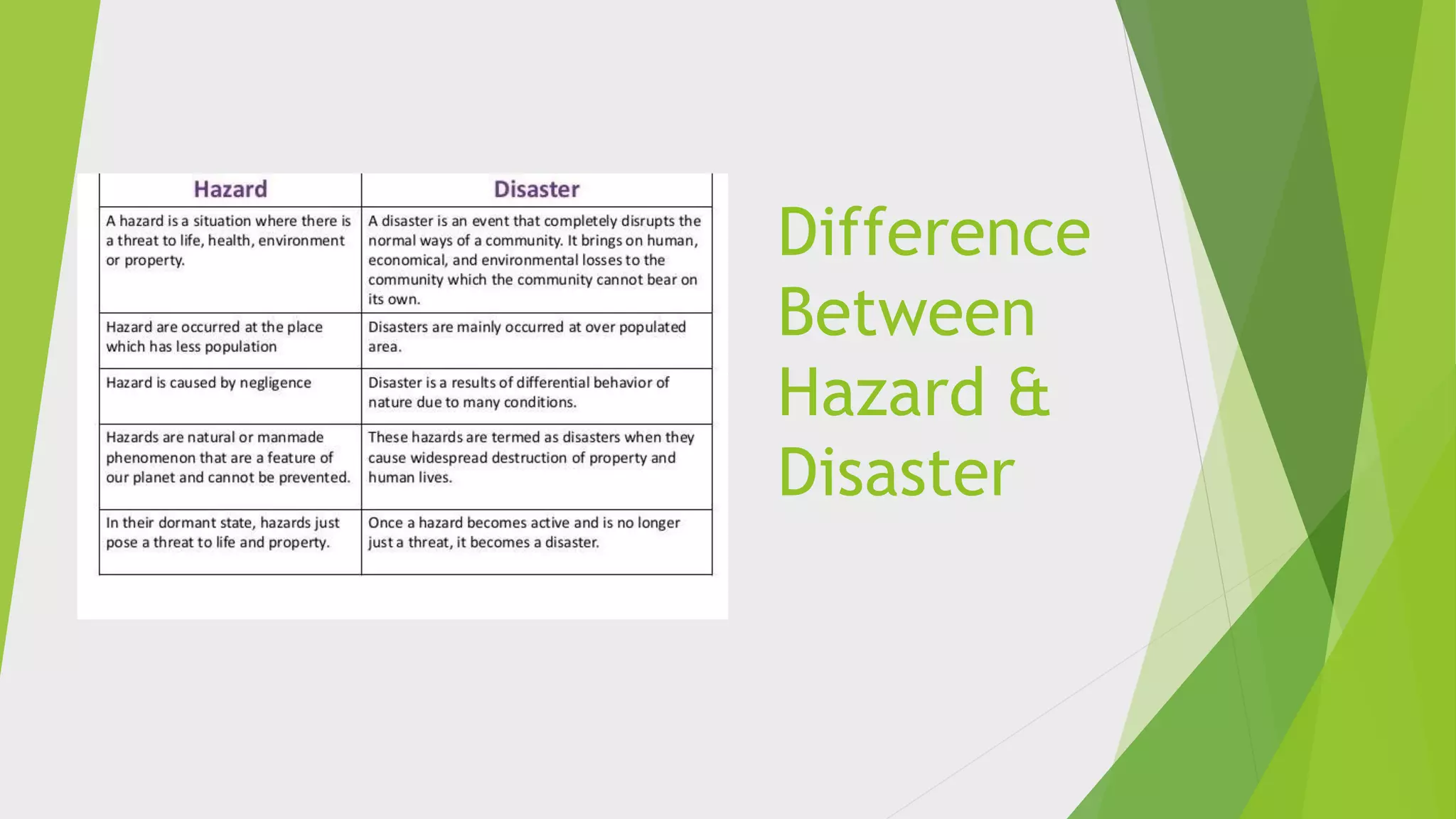
Disaster & Disaster Management
Hazard : A hazard is any agent that can cause harm or damage to humans,
property, or the environment. Risk is defined as the probability that exposure to
a hazard will lead to a negative consequence, or more simply, a hazard poses no
risk if there is no exposure to that hazard.
Disaster : A disaster is a sudden, calamitous event that seriously disrupts the
functioning of a community or society and causes human, material, and economic
or environmental losses that exceed the community's or society's ability to cope
using its own resources. Though often caused by nature, disasters can have human
origins.
Disaster Management : Disaster Management can be defined as the organization
and management of resources and responsibilities for dealing with all humanitarian
aspects of emergencies, in particular preparedness, response and recovery in order
to lessen the impact of disasters.
Examples are cloud bursts, floods, earthquakes, tsunami, cyclones, volcano
eruption etc. Man-made disaster occurs due to technological, industrial accidents,
security – related, terrorism and such factors.
Difference
Between
Hazard &
Disaster
The main aim of disaster management
Disaster management aims to reduce, or avoid, the potential losses from
hazards, assure prompt and appropriate assistance to victims of disaster, and
achieve rapid and effective recovery.
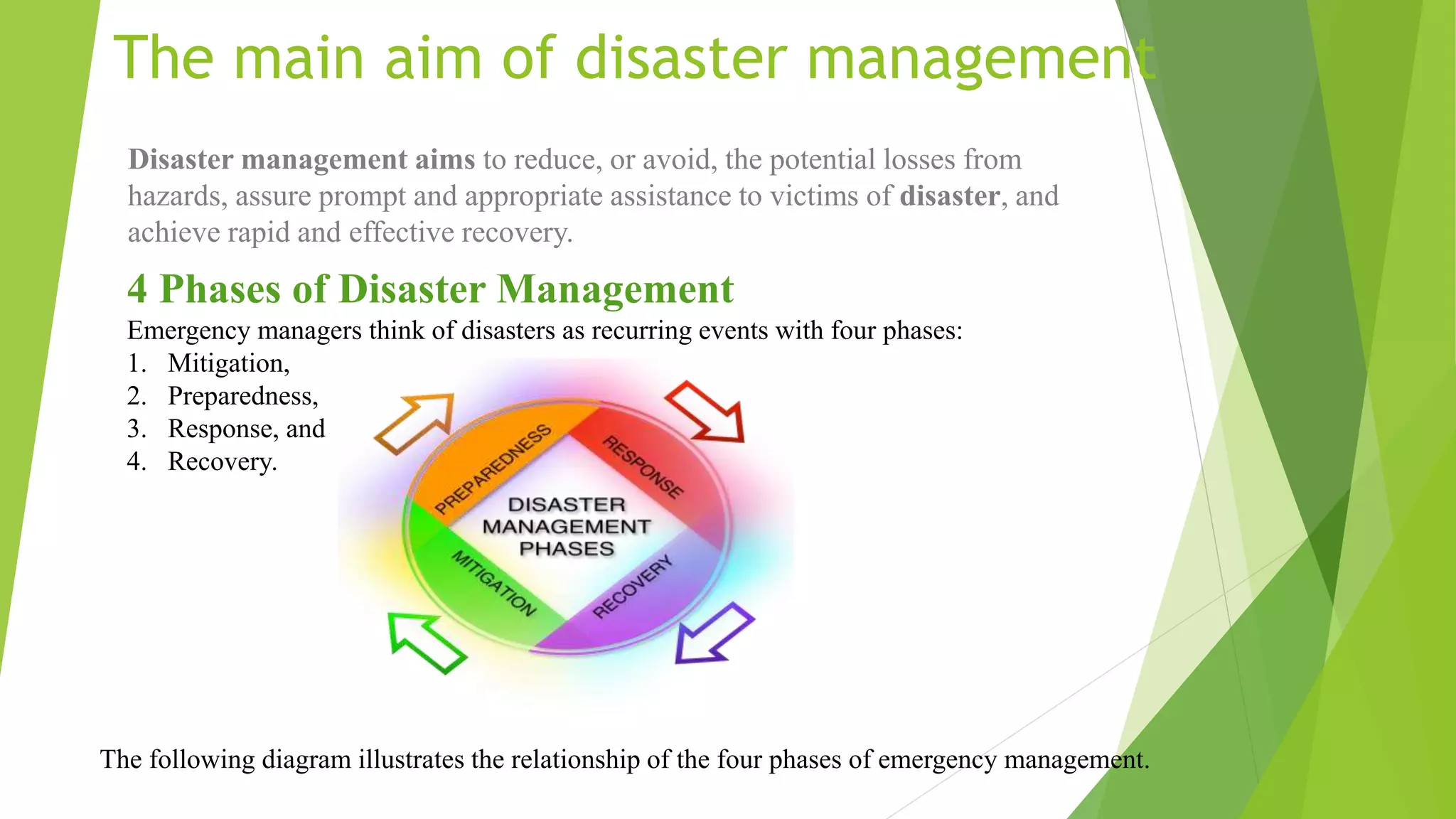
4 Phases of Disaster Management
Emergency managers think of disasters as recurring events with four phases:
1. Mitigation,
2. Preparedness,
3. Response, and
4. Recovery.
The following diagram illustrates the relationship of the four phases of emergency management.
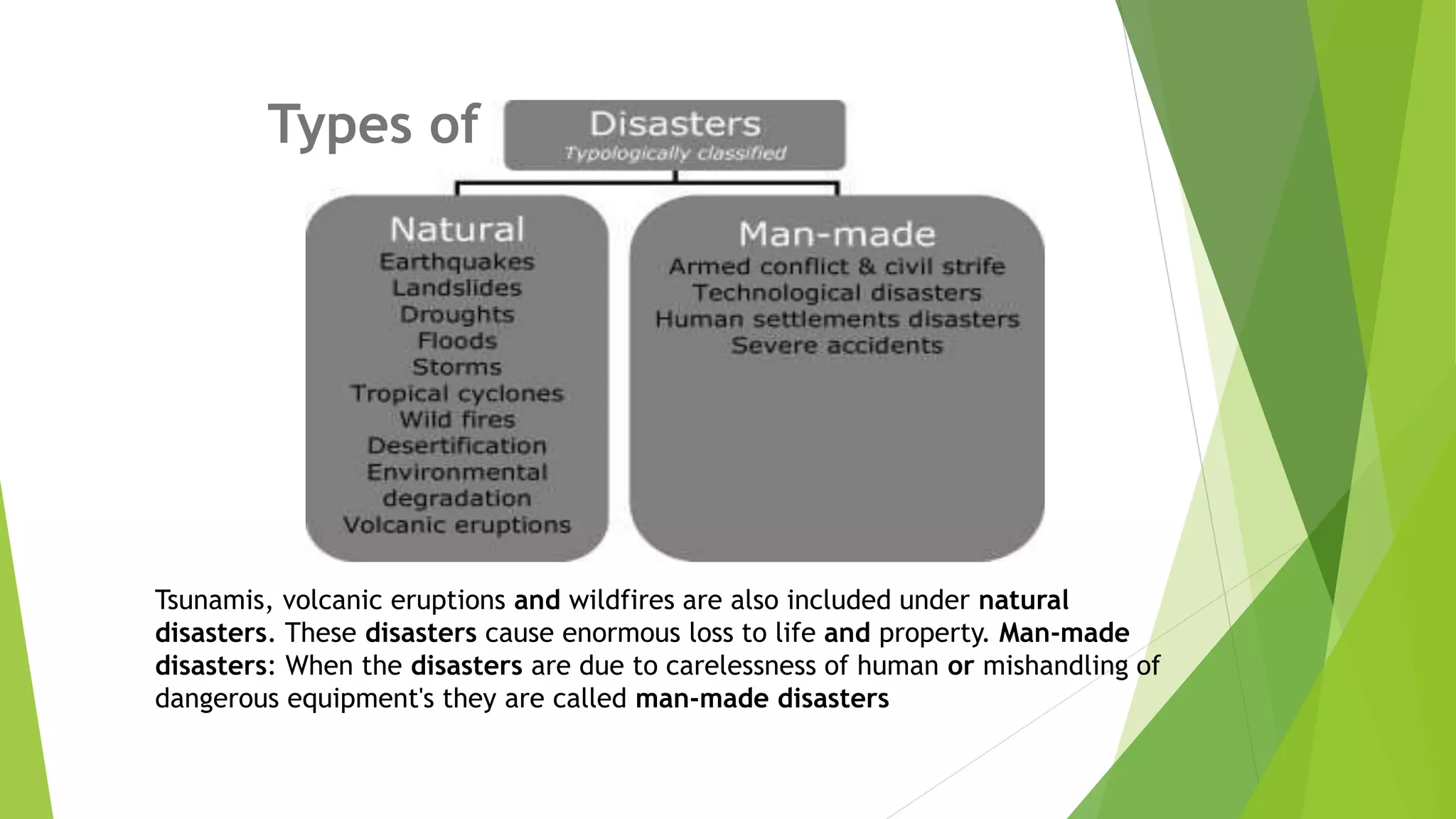
Tsunamis, volcanic eruptions and wildfires are also included under natural
disasters. These disasters cause enormous loss to life and property. Man-made
disasters: When the disasters are due to carelessness of human or mishandling of
dangerous equipment's they are called man-made disasters
Types of
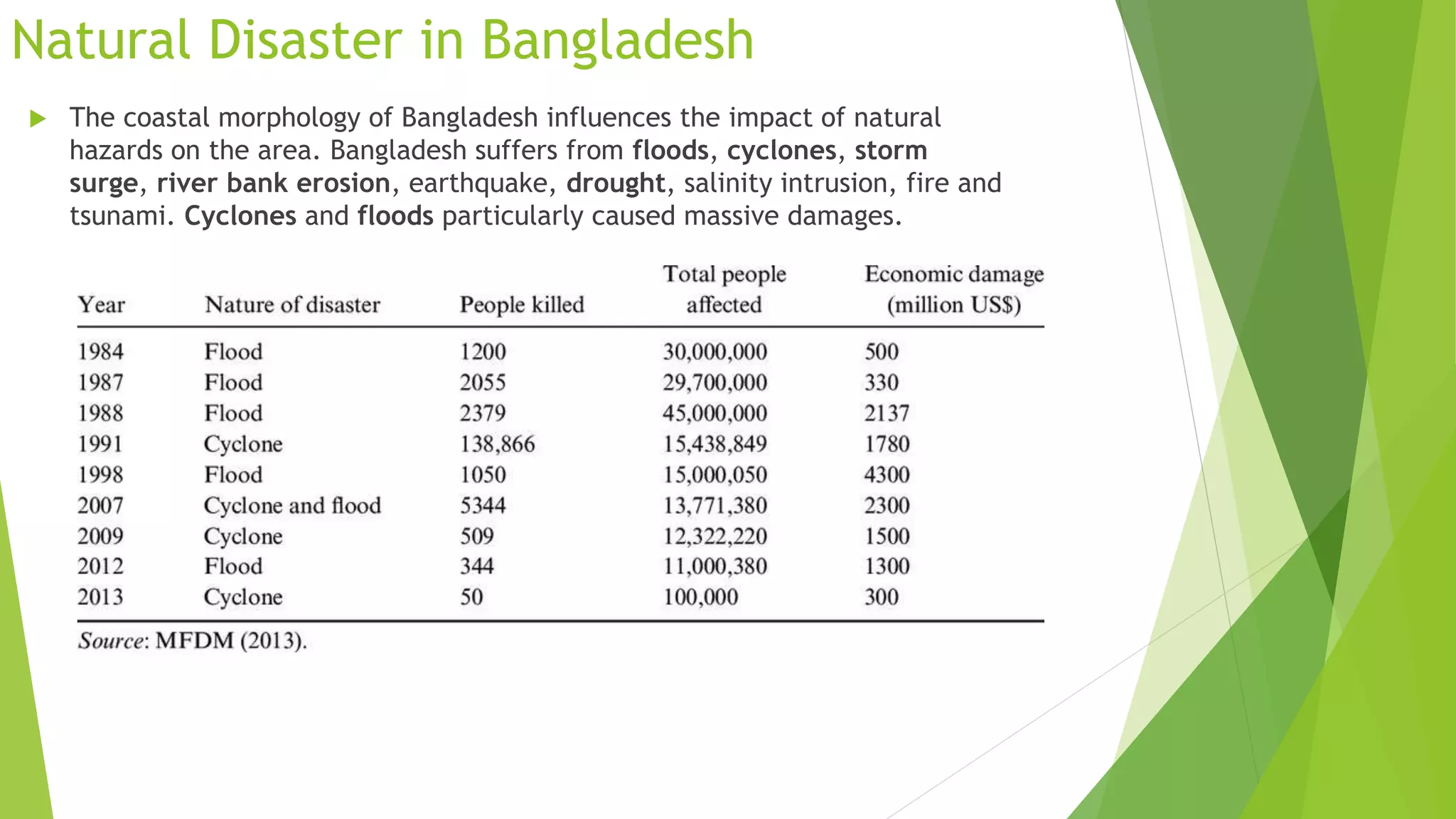
Natural Disaster in Bangladesh
 The coastal morphology of Bangladesh influences the impact of natural
hazards on the area. Bangladesh suffers from floods, cyclones, storm
surge, river bank erosion, earthquake, drought, salinity intrusion, fire and
tsunami. Cyclones and floods particularly caused massive damages.
The Sustainable Development Goals (SDGs), also
known as the Global Goals, were adopted by all
United Nations Member States in 2015 as a universal
call to action to end poverty, protect the planet and
ensure that all people enjoy peace and prosperity by
2030.
Introduction to environmental science & disaster management

Introduction to environmental science & disaster management

  • 1.
  • 2.
    Environmental Science Environment: Thetotal of our surroundings.All the things around us with which we interact: • Living things • Animals, plants, forests, fungi, etc. • Non-living things • Continents, oceans, clouds, soil, rocks • Our built environment • Buildings, human-created living centers • Social relationships and institutions Science: - A systematic process for learning about the world and testing our understanding of it - The accumulated body of knowledge that results from a dynamic process of observation, testing, and discovery
  • 3.
    Environmental science isthe academic field that takes physical, biological and chemical sciences to study the environment and discover solutions to environmental problems. Sciences used in environmental science include geography, zoology, physics, ecology, oceanology, and geology. The scope of environmental studies is very wide and it deals with many areas like : i) Conservation of natural resources, ii) ecological aspects, iii) pollution of the surrounding natural resources, iv) controlling the pollution, v) social issues connected to it, and vi) impacts of human population on the environment
  • 4.
    Environmental Science and DisasterManagement (ESDM) Getting quality education along with enough expertise in the field is very important for any student's career. The Department of Environmental Science and Disaster Management at DIU and other university’s is such a platform. It connects students directly with the environment by providing deep knowledge and real-life experience. Fig. Proportional impact of different types of disaster in countries between 1980 and 2015—number of events, persons killed, and economic loss. (Source EM-DAT: The Emergency Events Database—Université catholique de Louvain (UCL)—CRED, D. Guha-Sapir— www.emdat.be, Brussels, Belgium)
  • 5.
    Disaster & DisasterManagement Hazard : A hazard is any agent that can cause harm or damage to humans, property, or the environment. Risk is defined as the probability that exposure to a hazard will lead to a negative consequence, or more simply, a hazard poses no risk if there is no exposure to that hazard. Disaster : A disaster is a sudden, calamitous event that seriously disrupts the functioning of a community or society and causes human, material, and economic or environmental losses that exceed the community's or society's ability to cope using its own resources. Though often caused by nature, disasters can have human origins. Disaster Management : Disaster Management can be defined as the organization and management of resources and responsibilities for dealing with all humanitarian aspects of emergencies, in particular preparedness, response and recovery in order to lessen the impact of disasters. Examples are cloud bursts, floods, earthquakes, tsunami, cyclones, volcano eruption etc. Man-made disaster occurs due to technological, industrial accidents, security – related, terrorism and such factors.
  • 6.
  • 7.
    The main aimof disaster management Disaster management aims to reduce, or avoid, the potential losses from hazards, assure prompt and appropriate assistance to victims of disaster, and achieve rapid and effective recovery. 4 Phases of Disaster Management Emergency managers think of disasters as recurring events with four phases: 1. Mitigation, 2. Preparedness, 3. Response, and 4. Recovery. The following diagram illustrates the relationship of the four phases of emergency management.
  • 8.
    Tsunamis, volcanic eruptionsand wildfires are also included under natural disasters. These disasters cause enormous loss to life and property. Man-made disasters: When the disasters are due to carelessness of human or mishandling of dangerous equipment's they are called man-made disasters Types of
  • 9.
    Natural Disaster inBangladesh  The coastal morphology of Bangladesh influences the impact of natural hazards on the area. Bangladesh suffers from floods, cyclones, storm surge, river bank erosion, earthquake, drought, salinity intrusion, fire and tsunami. Cyclones and floods particularly caused massive damages.
  • 10.
    The Sustainable DevelopmentGoals (SDGs), also known as the Global Goals, were adopted by all United Nations Member States in 2015 as a universal call to action to end poverty, protect the planet and ensure that all people enjoy peace and prosperity by 2030.