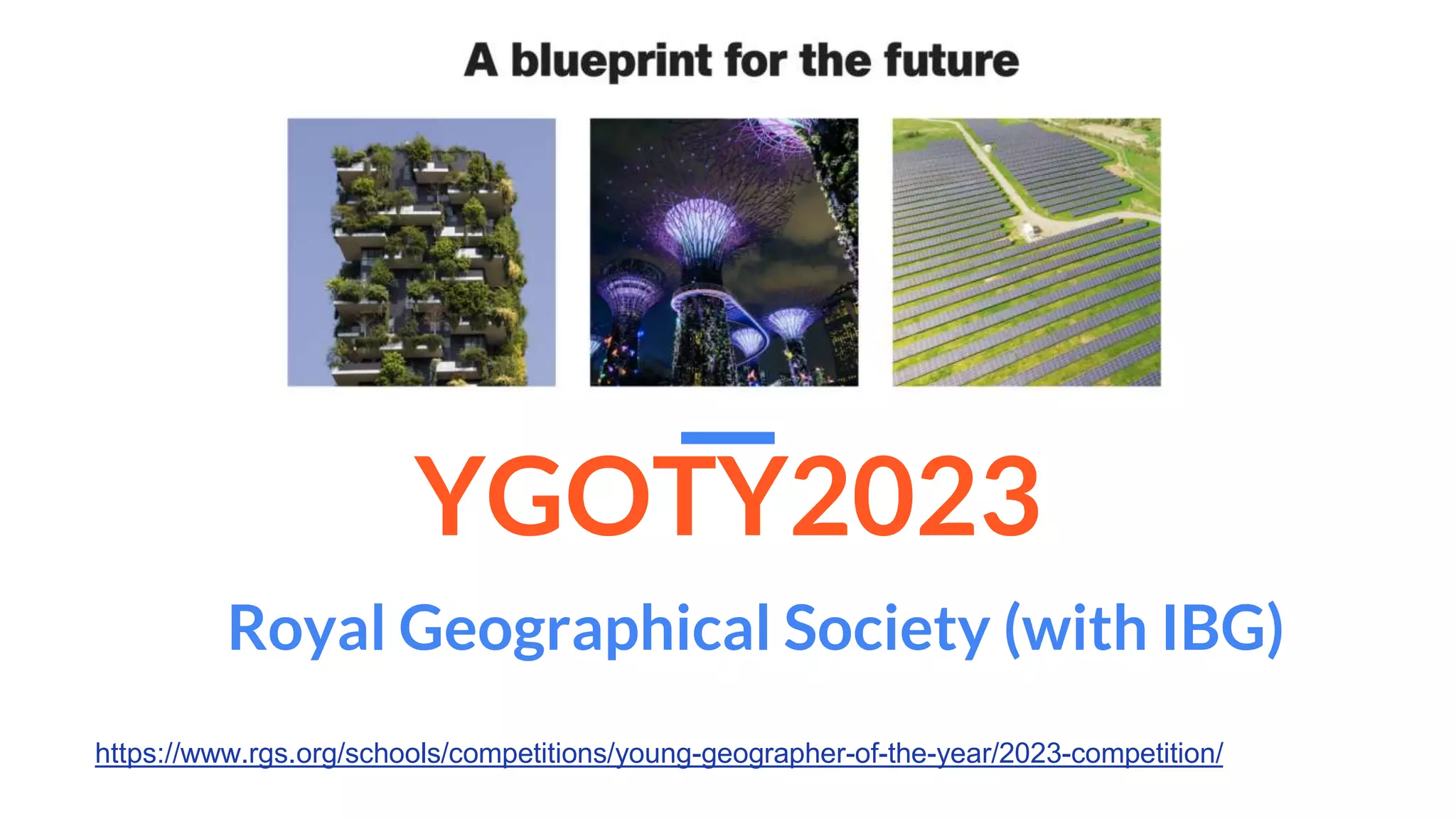
YGOTY2023
Royal Geographical Society (with IBG)
https://www.rgs.org/schools/competitions/young-geographer-of-the-year/2023-competition/
Young Geographer of the Year Competition 2023
Details
The RGS are looking for innovative ideas to address problems in
areas such as food production and supply, energy and
sustainability, water security, resources, population growth,
economic crisis, transport, travel, urbanisation, risk management,
trade, environmental management, biodiversity and more.
Your ideas and recommendations should be forward-thinking,
taking into consideration the depth of the problems and the
reasons behind them, as well as what can be done to mitigate
them.
Details
Your blueprint for the future could be a design for an eco-city,
or a plan to produce and distribute enough food to feed the
world. It could be a look at the future of energy and how we can
produce enough energy sustainably without harming the
environment, or a plan to revolutionise travel and transport in
your country or beyond.
Your plan must be realistic, but they welcome ideas for
futuristic strategies and new technologies.
Criteria
Key Stage 2 (pupils aged 7-11)
Key Stage 3 (pupils aged 11-14)
Key Stage 4 or GCSE (pupils aged 14-16)
Key Stage 5 or A Level (pupils aged 16-18)
Students should enter the Key Stage category they will be in on 30 June 2023.
Entry format
KS2, KS3 and KS4 students should produce an A3 size poster
entry.
This can be handmade (then submitted electronically using a
scanned copy or photograph) or using PowerPoint, Word,
Publisher or PDF, etc.
Key Stage 3 criteria:
Provide your plan for at least two or more geographical issues, using
annotated images, maps or diagrams.
Using your blueprint for the future, we want to
see the problems of today solved by the
geographers of tomorrow.
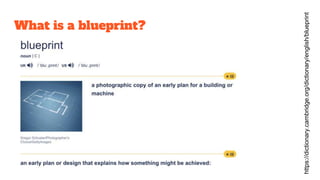
What is a blueprint?
https://dictionary.cambridge.org/dictionary/english/blueprint
The problems to be solved… suggestions
Food production and
supply
Energy and sustainability
Water security
Resources
Population growth
Economic crisis
Transport and travel
Urbanisation
Risk management
Trade
Environmental management
Biodiversity
& more….
The problems to be solved… suggestions
Food production and
supply
Energy and sustainability
Water security
Resources
Population growth
Economic crisis
Transport and travel
Urbanisation
Risk management
Trade
Environmental management
Biodiversity
& more….
Pick two - connect
them perhaps…
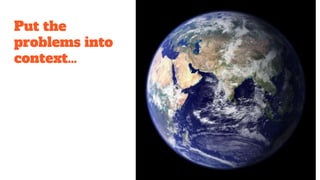
Put the
problems into
context…
E.g. Eco Cities
A term coined by Richard Register.
An eco-city or ecocity is
"a human settlement modeled on the self-sustaining resilient
structure and function of natural ecosystems".
What do you think the characteristics of an
eco-city would be?
You will need maps, images or diagrams
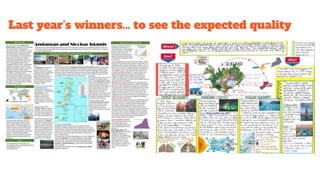
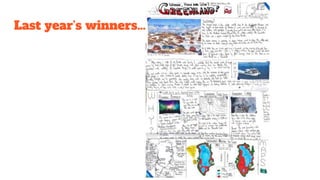
Last year’s winners… to see the expected quality
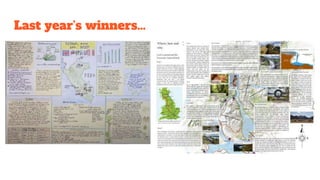
Last year’s winners…
Format
All entries should address this year’s theme and must meet the following criteria:
● A well-annotated and informative geographical overview which
demonstrates understanding of the issues addressed and shows innovation
and connected thinking.
● Good use of images, maps, data and other sources of information.
● Excellent attention to spelling, punctuation and grammar.
● Use of accurate geographical terminology.
● Original and independently produced - class sets of identical entries or
entries which have copied information from other sources, such as the
internet, will not be accepted.
● If produced electronically, please use a minimum font size of point 10.
Step 1: Choose the future problems you are
going to try to solve.
Think about work we have done during the
year.
Step 2: Identify some appropriate images and
maps to use - do not copy
Step 3: Decide on your format
Hand-written or using ICT or a mix?
A3 poster format. How to use the space?
Some suggested problems “by 2050”... the
mid-point of the century
Focus on 2 of these…
Food production and
supply
Energy and sustainability
Water security
Resources
Population growth
Economic crisis
Transport and travel
Urbanisation
Risk management
Trade
Environmental management
Biodiversity
& more….
In Y7 and 8 we study these in particular…
Food production and
supply
Energy and sustainability
Water security
Resources
Population growth
Economic crisis
Transport and travel
Urbanisation
Risk management
Trade
Environmental management
Biodiversity
& more….
Some possible areas to consider:
Artificial Intelligence (AI)
/ˌärdəˈfiSHəl inˈteləjəns/
noun
the theory and development of computer systems able to perform
tasks that normally require human intelligence, such as visual
perception, speech recognition, decision-making, and translation
between languages.
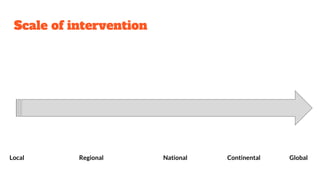
Scale of intervention
Local Regional National Continental Global
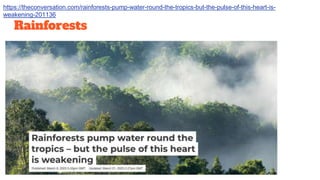
Rainforests
https://theconversation.com/rainforests-pump-water-round-the-tropics-but-the-pulse-of-this-heart-is-
weakening-201136
Other RGS-IBG resources
https://21stcenturychallenges.org/
Other RGS-IBG resources
https://21stcenturychallenges.org/

YGOTY 2023.pptx

  • 1.
    YGOTY2023 Royal Geographical Society(with IBG) https://www.rgs.org/schools/competitions/young-geographer-of-the-year/2023-competition/
  • 2.
    Young Geographer ofthe Year Competition 2023
  • 3.
    Details The RGS arelooking for innovative ideas to address problems in areas such as food production and supply, energy and sustainability, water security, resources, population growth, economic crisis, transport, travel, urbanisation, risk management, trade, environmental management, biodiversity and more. Your ideas and recommendations should be forward-thinking, taking into consideration the depth of the problems and the reasons behind them, as well as what can be done to mitigate them.
  • 4.
    Details Your blueprint forthe future could be a design for an eco-city, or a plan to produce and distribute enough food to feed the world. It could be a look at the future of energy and how we can produce enough energy sustainably without harming the environment, or a plan to revolutionise travel and transport in your country or beyond. Your plan must be realistic, but they welcome ideas for futuristic strategies and new technologies.
  • 5.
    Criteria Key Stage 2(pupils aged 7-11) Key Stage 3 (pupils aged 11-14) Key Stage 4 or GCSE (pupils aged 14-16) Key Stage 5 or A Level (pupils aged 16-18) Students should enter the Key Stage category they will be in on 30 June 2023.
  • 6.
    Entry format KS2, KS3and KS4 students should produce an A3 size poster entry. This can be handmade (then submitted electronically using a scanned copy or photograph) or using PowerPoint, Word, Publisher or PDF, etc. Key Stage 3 criteria: Provide your plan for at least two or more geographical issues, using annotated images, maps or diagrams.
  • 7.
    Using your blueprintfor the future, we want to see the problems of today solved by the geographers of tomorrow.
  • 8.
    What is ablueprint? https://dictionary.cambridge.org/dictionary/english/blueprint
  • 9.
    The problems tobe solved… suggestions Food production and supply Energy and sustainability Water security Resources Population growth Economic crisis Transport and travel Urbanisation Risk management Trade Environmental management Biodiversity & more….
  • 10.
    The problems tobe solved… suggestions Food production and supply Energy and sustainability Water security Resources Population growth Economic crisis Transport and travel Urbanisation Risk management Trade Environmental management Biodiversity & more…. Pick two - connect them perhaps…
  • 11.
  • 12.
    E.g. Eco Cities Aterm coined by Richard Register. An eco-city or ecocity is "a human settlement modeled on the self-sustaining resilient structure and function of natural ecosystems".
  • 13.
    What do youthink the characteristics of an eco-city would be?
  • 14.
    You will needmaps, images or diagrams
  • 15.
    Last year’s winners…to see the expected quality
  • 16.
  • 17.
  • 18.
    Format All entries shouldaddress this year’s theme and must meet the following criteria: ● A well-annotated and informative geographical overview which demonstrates understanding of the issues addressed and shows innovation and connected thinking. ● Good use of images, maps, data and other sources of information. ● Excellent attention to spelling, punctuation and grammar. ● Use of accurate geographical terminology. ● Original and independently produced - class sets of identical entries or entries which have copied information from other sources, such as the internet, will not be accepted. ● If produced electronically, please use a minimum font size of point 10.
  • 19.
    Step 1: Choosethe future problems you are going to try to solve. Think about work we have done during the year.
  • 20.
    Step 2: Identifysome appropriate images and maps to use - do not copy
  • 21.
    Step 3: Decideon your format Hand-written or using ICT or a mix? A3 poster format. How to use the space?
  • 22.
    Some suggested problems“by 2050”... the mid-point of the century
  • 23.
    Focus on 2of these… Food production and supply Energy and sustainability Water security Resources Population growth Economic crisis Transport and travel Urbanisation Risk management Trade Environmental management Biodiversity & more….
  • 24.
    In Y7 and8 we study these in particular… Food production and supply Energy and sustainability Water security Resources Population growth Economic crisis Transport and travel Urbanisation Risk management Trade Environmental management Biodiversity & more….
  • 25.
    Some possible areasto consider: Artificial Intelligence (AI) /ˌärdəˈfiSHəl inˈteləjəns/ noun the theory and development of computer systems able to perform tasks that normally require human intelligence, such as visual perception, speech recognition, decision-making, and translation between languages.
  • 26.
    Scale of intervention LocalRegional National Continental Global
  • 27.
  • 28.
  • 29.