FAULT & EVENT TREE ANALYSIS

             BY

      NITESH M. DONGARE
FAULT TREE ANALYSIS
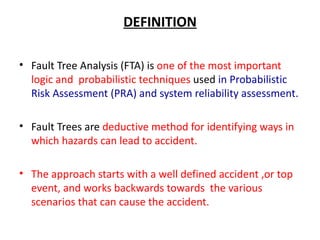
DEFINITION

• Fault Tree Analysis (FTA) is one of the most important
  logic and probabilistic techniques used in Probabilistic
  Risk Assessment (PRA) and system reliability assessment.

• Fault Trees are deductive method for identifying ways in
  which hazards can lead to accident.

• The approach starts with a well defined accident ,or top
  event, and works backwards towards the various
  scenarios that can cause the accident.
STEPS IN CARRYING OUT A FAULT TREE ANALYSIS


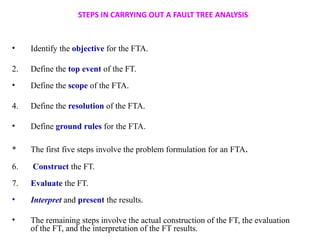
•    Identify the objective for the FTA.

2.   Define the top event of the FT.
•    Define the scope of the FTA.

4.   Define the resolution of the FTA.

•    Define ground rules for the FTA.

*    The first five steps involve the problem formulation for an FTA.

6.   Construct the FT.
7.   Evaluate the FT.
•    Interpret and present the results.

•    The remaining steps involve the actual construction of the FT, the evaluation
     of the FT, and the interpretation of the FT results.
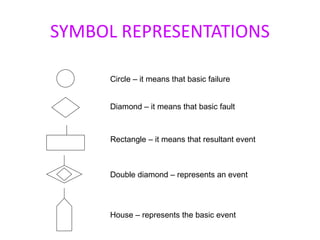
SYMBOL REPRESENTATIONS

      Circle – it means that basic failure


      Diamond – it means that basic fault


      Rectangle – it means that resultant event


      Double diamond – represents an event


      House – represents the basic event
FAULT TREE CONSTRUCTION`

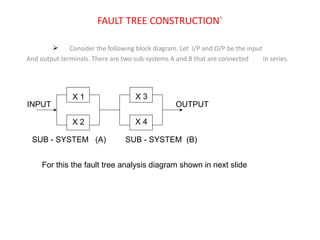
             Consider the following block diagram. Let I/P and O/P be the input
And output terminals. There are two sub-systems A and B that are connected       in series.


               X1                    X3
INPUT                                              OUTPUT

               X2                    X4

 SUB - SYSTEM (A)                 SUB - SYSTEM (B)


     For this the fault tree analysis diagram shown in next slide
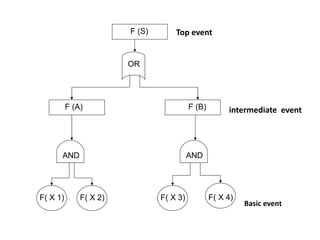
F (S)       Top event


                        OR


          F (A)                           F (B)        intermediate event


      AND                                 AND


F( X 1)       F( X 2)           F( X 3)           F( X 4)
                                                            Basic event
CONTINUE…..
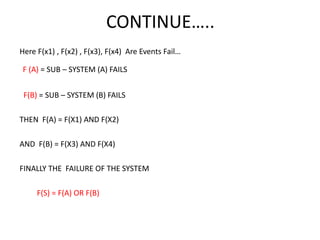
Here F(x1) , F(x2) , F(x3), F(x4) Are Events Fail…

F (A) = SUB – SYSTEM (A) FAILS


 F(B) = SUB – SYSTEM (B) FAILS

THEN F(A) = F(X1) AND F(X2)

AND F(B) = F(X3) AND F(X4)

FINALLY THE FAILURE OF THE SYSTEM

     F(S) = F(A) OR F(B)
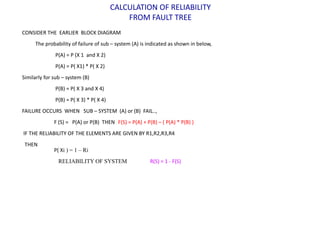
CALCULATION OF RELIABILITY
                                             FROM FAULT TREE
CONSIDER THE EARLIER BLOCK DIAGRAM
     The probability of failure of sub – system (A) is indicated as shown in below,
              P(A) = P (X 1 and X 2)
              P(A) = P( X1) * P( X 2)
Similarly for sub – system (B)
              P(B) = P( X 3 and X 4)
              P(B) = P( X 3) * P( X 4)
FAILURE OCCURS WHEN SUB – SYSTEM (A) or (B) FAIL..,
              F (S) = P(A) or P(B) THEN F(S) = P(A) + P(B) – ( P(A) * P(B) )
IF THE RELIABILITY OF THE ELEMENTS ARE GIVEN BY R1,R2,R3,R4
 THEN
              P( Xi ) = 1 – Ri
                RELIABILITY OF SYSTEM                   R(S) = 1 - F(S)
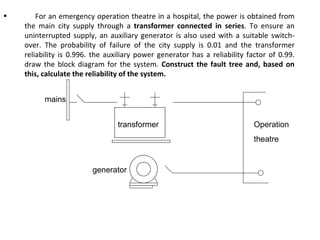
•       For an emergency operation theatre in a hospital, the power is obtained from
    the main city supply through a transformer connected in series. To ensure an
    uninterrupted supply, an auxiliary generator is also used with a suitable switch-
    over. The probability of failure of the city supply is 0.01 and the transformer
    reliability is 0.996. the auxiliary power generator has a reliability factor of 0.99.
    draw the block diagram for the system. Construct the fault tree and, based on
    this, calculate the reliability of the system.


          mains


                                 transformer                                Operation
                                                                            theatre


                         generator
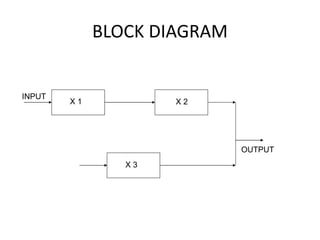
BLOCK DIAGRAM


INPUT
        X1           X2


                             OUTPUT
                X3
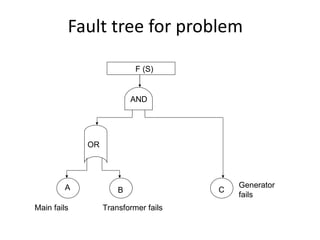
Fault tree for problem

                           F (S)


                          AND


             OR


        A                                 Generator
                      B               C
                                          fails
Main fails        Transformer fails
SOLUTION
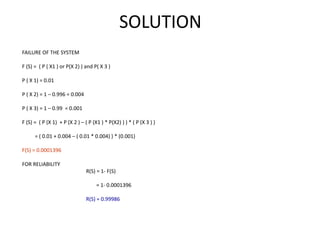
FAILURE OF THE SYSTEM

F (S) = ( P ( X1 ) or P(X 2) ) and P( X 3 )

P ( X 1) = 0.01

P ( X 2) = 1 – 0.996 = 0.004

P ( X 3) = 1 – 0.99 = 0.001

F (S) = ( P (X 1) + P (X 2 ) – ( P (X1 ) * P(X2) ) ) * ( P (X 3 ) )

      = ( 0.01 + 0.004 – ( 0.01 * 0.004) ) * (0.001)

F(S) = 0.0001396

FOR RELIABILITY
                                R(S) = 1- F(S)

                                     = 1- 0.0001396

                                R(S) = 0.99986
USES
•   Use of FTA to understand of the logic leading to the top event.

•   Use of FTA to prioritize the contributors leading to the top event.

•   Use of FTA as a proactive tool to prevent the top event.

•   Use of FTA to monitor the performance of the system.

•   Use of FTA to minimize and optimize resources.

•   Use of FTA to assist in designing a system.

•   Use of FTA as a diagnostic tool to identify and correct causes of the top event.
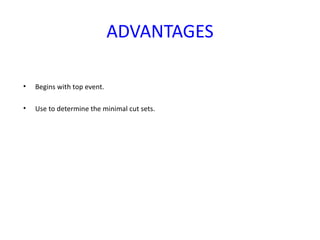
ADVANTAGES

•   Begins with top event.

•   Use to determine the minimal cut sets.
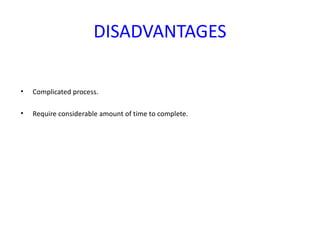
DISADVANTAGES

•   Complicated process.

•   Require considerable amount of time to complete.
EVENT TREE ANALYSIS
DEFINITION

• Event trees begin with an initiating event & work
  towards the final result.


• This method provides information on how a failure can
  occur & the probability of occurrence.
STEPS INVOLVED IN AN ETA

1. Identify an initiating event of interest.

2. Identify the safety functions designed
   to deal with the initiating event.

3. Construct the event tree.

4. Describe the resulting accident event
   sequences
EXAMPLE
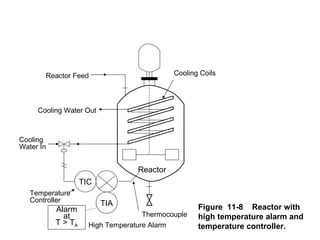
• Oxidation reactor high temp. Alarm alerts operator at
  temp T1.
• Operator reestablish cooling water flow to the oxidation
  reactor.
• Automatic shutdown system stops reaction at temp. T2.
  ( T2 > T1)

These safety functions are listed in the order in which they
  are intended to occur.
Reactor Feed                          Cooling Coils


     Cooling Water Out


Cooling
Water In


                                   Reactor
                    TIC
   Temperature
   Controller             TIA
           Alarm                                    Figure 11-8 Reactor with
             at                      Thermocouple   high temperature alarm and
           T > TA     High Temperature Alarm        temperature controller.
Step 1 - Identify the initiating event


•    system or equipment failure
•    human error
•    process upset


    [Example]

            “Loss of Cooling Water”
             to an Oxidation Reactor
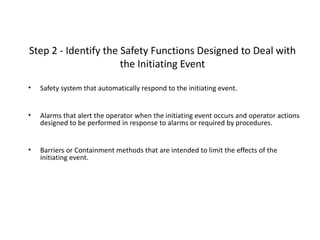
Step 2 - Identify the Safety Functions Designed to Deal with
                      the Initiating Event

•   Safety system that automatically respond to the initiating event.


•   Alarms that alert the operator when the initiating event occurs and operator actions
    designed to be performed in response to alarms or required by procedures.


•   Barriers or Containment methods that are intended to limit the effects of the
    initiating event.
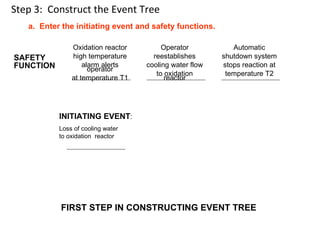
Step 3: Construct the Event Tree
   a. Enter the initiating event and safety functions.

               Oxidation reactor        Operator            Automatic
SAFETY         high temperature      reestablishes       shutdown system
FUNCTION           alarm alerts    cooling water flow    stops reaction at
                     operator
                                      to oxidation        temperature T2
               at temperature T1         reactor


           INITIATING EVENT:
           Loss of cooling water
           to oxidation reactor


           FIRST STEP IN CONSTRUCTING EVENT TREE
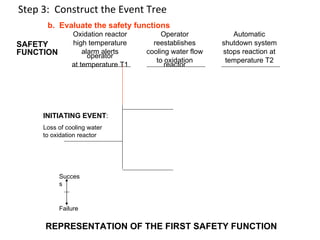
Step 3: Construct the Event Tree
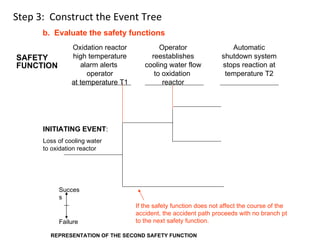
      b. Evaluate the safety functions
               Oxidation reactor        Operator           Automatic
SAFETY         high temperature      reestablishes      shutdown system
FUNCTION           alarm alerts    cooling water flow   stops reaction at
                     operator
                                      to oxidation       temperature T2
               at temperature T1         reactor


     INITIATING EVENT:
     Loss of cooling water
     to oxidation reactor


           Succes
           s


           Failure


     REPRESENTATION OF THE FIRST SAFETY FUNCTION
Step 3: Construct the Event Tree
      b. Evaluate the safety functions
                Oxidation reactor           Operator                  Automatic
SAFETY          high temperature         reestablishes             shutdown system
FUNCTION           alarm alerts        cooling water flow          stops reaction at
                     operator             to oxidation              temperature T2
                at temperature T1            reactor


      INITIATING EVENT:
      Loss of cooling water
      to oxidation reactor


           Succes
           s
                                    If the safety function does not affect the course of the
                                    accident, the accident path proceeds with no branch pt
           Failure                  to the next safety function.

        REPRESENTATION OF THE SECOND SAFETY FUNCTION
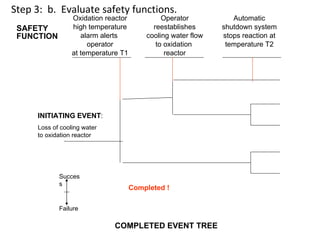
Step 3: b. Evaluate safety functions.
                 Oxidation reactor            Operator           Automatic
 SAFETY          high temperature          reestablishes      shutdown system
 FUNCTION           alarm alerts         cooling water flow   stops reaction at
                      operator              to oxidation       temperature T2
                 at temperature T1             reactor


     INITIATING EVENT:
     Loss of cooling water
     to oxidation reactor


            Succes
            s
                                     Completed !

            Failure

                             COMPLETED EVENT TREE
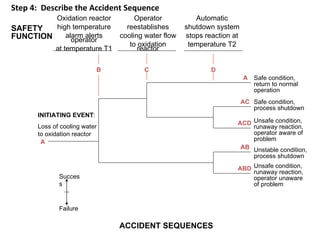
Step 4: Describe the Accident Sequence
         Oxidation reactor         Operator           Automatic
SAFETY   high temperature       reestablishes      shutdown system
FUNCTION     alarm alerts     cooling water flow   stops reaction at
               operator
                                 to oxidation       temperature T2
         at temperature T1          reactor

                          B          C                     D
                                                                       A Safe condition,
                                                                         return to normal
                                                                         operation
                                                                       AC Safe condition,
                                                                          process shutdown
      INITIATING EVENT:
                                                                   ACD Unsafe condition,
      Loss of cooling water                                            runaway reaction,
      to oxidation reactor                                             operator aware of
       A                                                               problem
                                                                    AB Unstable condition,
                                                                       process shutdown

                                                                   ABD Unsafe condition,
                                                                       runaway reaction,
             Succes                                                    operator unaware
             s                                                         of problem


             Failure

                              ACCIDENT SEQUENCES
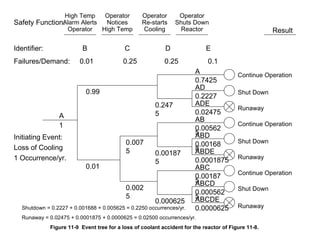
High Temp      Operator       Operator      Operator
Safety Function:
               Alarm Alerts         Notices        Re-starts    Shuts Down
                     Operator      High Temp       Cooling        Reactor                             Result

Identifier:                B                C               D                E
Failures/Demand:          0.01             0.25             0.25              0.1
                                                                         A                Continue Operation
                                                                         0.7425
                                                                         AD
                            0.99                                                          Shut Down
                                                                         0.2227
                                                        0.247            ADE
                                                                                          Runaway
                                                        5                0.02475
                 A
                                                                         AB
                 1                                                                        Continue Operation
                                                                         0.00562
                                                                         5
                                                                         ABD
Initiating Event:
                                            0.007                                         Shut Down
Loss of Cooling                                                          0.00168
                                            5                            8
                                                                         ABDE
                                                        0.00187
1 Occurrence/yr.                                                                          Runaway
                                                        5                0.0001875
                            0.01                                         ABC
                                                                                          Continue Operation
                                                                         0.00187
                                                                         5
                                                                         ABCD
                                            0.002                                         Shut Down
                                                                         0.000562
                                            5                            5
                                                                         ABCDE
                                                        0.000625
   Shutdown = 0.2227 + 0.001688 + 0.005625 = 0.2250 occurrences/yr.      0.0000625        Runaway
   Runaway = 0.02475 + 0.0001875 + 0.0000625 = 0.02500 occurrences/yr.
              Figure 11-9 Event tree for a loss of coolant accident for the reactor of Figure 11-8.
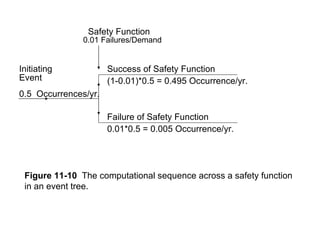
Safety Function
               0.01 Failures/Demand


Initiating            Success of Safety Function
Event                 (1-0.01)*0.5 = 0.495 Occurrence/yr.
0.5 Occurrences/yr.

                      Failure of Safety Function
                      0.01*0.5 = 0.005 Occurrence/yr.


 Figure 11-10 The computational sequence across a safety function
 in an event tree.
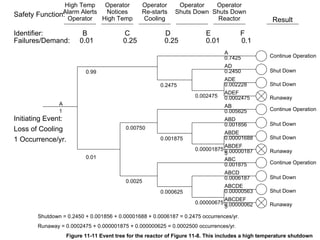
High Temp    Operator           Operator      Operator   Operator
               Alarm Alerts
Safety Function:             Notices            Re-starts    Shuts Down Shuts Down
                 Operator   High Temp           Cooling                   Reactor                   Result
Identifier:              B               C               D                E             F
Failures/Demand:        0.01             0.25            0.25             0.01          0.1
                                                                                 A
                                                                                 0.7425            Continue Operation
                                                                                 AD
                          0.99                                                   0.2450            Shut Down
                                                                                 ADE
                                                        0.2475                   0.002228          Shut Down
                                                                                 ADEF
                                                                     0.002475    0.0002475         Runaway
               A                                                                 AB
               1                                                                 0.005625          Continue Operation
Initiating Event:                                                                ABD
                                                                                 0.001856          Shut Down
Loss of Cooling                           0.00750
                                                                                 ABDE
1 Occurrence/yr.                                        0.001875                 0.00001688        Shut Down
                                                                                ABDEF
                                                                     0.00001875 0.00000187         Runaway
                                                                                5
                          0.01                                                  ABC
                                                                                0.001875           Continue Operation
                                                                                 ABCD
                                                                                 0.0006187         Shut Down
                                          0.0025
                                                                                 ABCDE
                                                        0.000625                 0.00000563        Shut Down
                                                                                ABCDEF
                                                                     0.00000675 0.00000062         Runaway
                                                                                5
       Shutdown = 0.2450 + 0.001856 + 0.00001688 + 0.0006187 = 0.2475 occurrences/yr.
       Runaway = 0.0002475 + 0.000001875 + 0.000000625 = 0.0002500 occurrences/yr.
                   Figure 11-11 Event tree for the reactor of Figure 11-8. This includes a high temperature shutdown
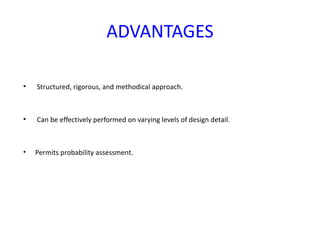
ADVANTAGES

•   Structured, rigorous, and methodical approach.


•   Can be effectively performed on varying levels of design detail.


•   Permits probability assessment.
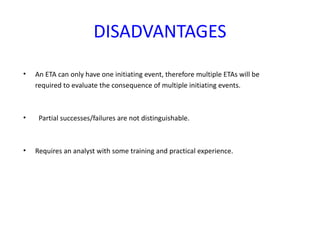
DISADVANTAGES
•   An ETA can only have one initiating event, therefore multiple ETAs will be
    required to evaluate the consequence of multiple initiating events.


•    Partial successes/failures are not distinguishable.


•   Requires an analyst with some training and practical experience.
FAULT & EVENT TREE ANALYSIS

FAULT & EVENT TREE ANALYSIS

  • 1.
    FAULT & EVENTTREE ANALYSIS BY NITESH M. DONGARE
  • 2.
  • 3.
    DEFINITION • Fault TreeAnalysis (FTA) is one of the most important logic and probabilistic techniques used in Probabilistic Risk Assessment (PRA) and system reliability assessment. • Fault Trees are deductive method for identifying ways in which hazards can lead to accident. • The approach starts with a well defined accident ,or top event, and works backwards towards the various scenarios that can cause the accident.
  • 4.
    STEPS IN CARRYINGOUT A FAULT TREE ANALYSIS • Identify the objective for the FTA. 2. Define the top event of the FT. • Define the scope of the FTA. 4. Define the resolution of the FTA. • Define ground rules for the FTA. * The first five steps involve the problem formulation for an FTA. 6. Construct the FT. 7. Evaluate the FT. • Interpret and present the results. • The remaining steps involve the actual construction of the FT, the evaluation of the FT, and the interpretation of the FT results.
  • 5.
    SYMBOL REPRESENTATIONS Circle – it means that basic failure Diamond – it means that basic fault Rectangle – it means that resultant event Double diamond – represents an event House – represents the basic event
  • 6.
    FAULT TREE CONSTRUCTION`  Consider the following block diagram. Let I/P and O/P be the input And output terminals. There are two sub-systems A and B that are connected in series. X1 X3 INPUT OUTPUT X2 X4 SUB - SYSTEM (A) SUB - SYSTEM (B) For this the fault tree analysis diagram shown in next slide
  • 7.
    F (S) Top event OR F (A) F (B) intermediate event AND AND F( X 1) F( X 2) F( X 3) F( X 4) Basic event
  • 8.
    CONTINUE….. Here F(x1) ,F(x2) , F(x3), F(x4) Are Events Fail… F (A) = SUB – SYSTEM (A) FAILS F(B) = SUB – SYSTEM (B) FAILS THEN F(A) = F(X1) AND F(X2) AND F(B) = F(X3) AND F(X4) FINALLY THE FAILURE OF THE SYSTEM F(S) = F(A) OR F(B)
  • 9.
    CALCULATION OF RELIABILITY FROM FAULT TREE CONSIDER THE EARLIER BLOCK DIAGRAM The probability of failure of sub – system (A) is indicated as shown in below, P(A) = P (X 1 and X 2) P(A) = P( X1) * P( X 2) Similarly for sub – system (B) P(B) = P( X 3 and X 4) P(B) = P( X 3) * P( X 4) FAILURE OCCURS WHEN SUB – SYSTEM (A) or (B) FAIL.., F (S) = P(A) or P(B) THEN F(S) = P(A) + P(B) – ( P(A) * P(B) ) IF THE RELIABILITY OF THE ELEMENTS ARE GIVEN BY R1,R2,R3,R4 THEN P( Xi ) = 1 – Ri RELIABILITY OF SYSTEM R(S) = 1 - F(S)
  • 10.
    For an emergency operation theatre in a hospital, the power is obtained from the main city supply through a transformer connected in series. To ensure an uninterrupted supply, an auxiliary generator is also used with a suitable switch- over. The probability of failure of the city supply is 0.01 and the transformer reliability is 0.996. the auxiliary power generator has a reliability factor of 0.99. draw the block diagram for the system. Construct the fault tree and, based on this, calculate the reliability of the system. mains transformer Operation theatre generator
  • 11.
    BLOCK DIAGRAM INPUT X1 X2 OUTPUT X3
  • 12.
    Fault tree forproblem F (S) AND OR A Generator B C fails Main fails Transformer fails
  • 13.
    SOLUTION FAILURE OF THESYSTEM F (S) = ( P ( X1 ) or P(X 2) ) and P( X 3 ) P ( X 1) = 0.01 P ( X 2) = 1 – 0.996 = 0.004 P ( X 3) = 1 – 0.99 = 0.001 F (S) = ( P (X 1) + P (X 2 ) – ( P (X1 ) * P(X2) ) ) * ( P (X 3 ) ) = ( 0.01 + 0.004 – ( 0.01 * 0.004) ) * (0.001) F(S) = 0.0001396 FOR RELIABILITY R(S) = 1- F(S) = 1- 0.0001396 R(S) = 0.99986
  • 14.
    USES • Use of FTA to understand of the logic leading to the top event. • Use of FTA to prioritize the contributors leading to the top event. • Use of FTA as a proactive tool to prevent the top event. • Use of FTA to monitor the performance of the system. • Use of FTA to minimize and optimize resources. • Use of FTA to assist in designing a system. • Use of FTA as a diagnostic tool to identify and correct causes of the top event.
  • 15.
    ADVANTAGES • Begins with top event. • Use to determine the minimal cut sets.
  • 16.
    DISADVANTAGES • Complicated process. • Require considerable amount of time to complete.
  • 17.
  • 18.
    DEFINITION • Event treesbegin with an initiating event & work towards the final result. • This method provides information on how a failure can occur & the probability of occurrence.
  • 19.
    STEPS INVOLVED INAN ETA 1. Identify an initiating event of interest. 2. Identify the safety functions designed to deal with the initiating event. 3. Construct the event tree. 4. Describe the resulting accident event sequences
  • 20.
    EXAMPLE • Oxidation reactorhigh temp. Alarm alerts operator at temp T1. • Operator reestablish cooling water flow to the oxidation reactor. • Automatic shutdown system stops reaction at temp. T2. ( T2 > T1) These safety functions are listed in the order in which they are intended to occur.
  • 21.
    Reactor Feed Cooling Coils Cooling Water Out Cooling Water In Reactor TIC Temperature Controller TIA Alarm Figure 11-8 Reactor with at Thermocouple high temperature alarm and T > TA High Temperature Alarm temperature controller.
  • 22.
    Step 1 -Identify the initiating event • system or equipment failure • human error • process upset [Example] “Loss of Cooling Water” to an Oxidation Reactor
  • 23.
    Step 2 -Identify the Safety Functions Designed to Deal with the Initiating Event • Safety system that automatically respond to the initiating event. • Alarms that alert the operator when the initiating event occurs and operator actions designed to be performed in response to alarms or required by procedures. • Barriers or Containment methods that are intended to limit the effects of the initiating event.
  • 24.
    Step 3: Constructthe Event Tree a. Enter the initiating event and safety functions. Oxidation reactor Operator Automatic SAFETY high temperature reestablishes shutdown system FUNCTION alarm alerts cooling water flow stops reaction at operator to oxidation temperature T2 at temperature T1 reactor INITIATING EVENT: Loss of cooling water to oxidation reactor FIRST STEP IN CONSTRUCTING EVENT TREE
  • 25.
    Step 3: Constructthe Event Tree b. Evaluate the safety functions Oxidation reactor Operator Automatic SAFETY high temperature reestablishes shutdown system FUNCTION alarm alerts cooling water flow stops reaction at operator to oxidation temperature T2 at temperature T1 reactor INITIATING EVENT: Loss of cooling water to oxidation reactor Succes s Failure REPRESENTATION OF THE FIRST SAFETY FUNCTION
  • 26.
    Step 3: Constructthe Event Tree b. Evaluate the safety functions Oxidation reactor Operator Automatic SAFETY high temperature reestablishes shutdown system FUNCTION alarm alerts cooling water flow stops reaction at operator to oxidation temperature T2 at temperature T1 reactor INITIATING EVENT: Loss of cooling water to oxidation reactor Succes s If the safety function does not affect the course of the accident, the accident path proceeds with no branch pt Failure to the next safety function. REPRESENTATION OF THE SECOND SAFETY FUNCTION
  • 27.
    Step 3: b.Evaluate safety functions. Oxidation reactor Operator Automatic SAFETY high temperature reestablishes shutdown system FUNCTION alarm alerts cooling water flow stops reaction at operator to oxidation temperature T2 at temperature T1 reactor INITIATING EVENT: Loss of cooling water to oxidation reactor Succes s Completed ! Failure COMPLETED EVENT TREE
  • 28.
    Step 4: Describethe Accident Sequence Oxidation reactor Operator Automatic SAFETY high temperature reestablishes shutdown system FUNCTION alarm alerts cooling water flow stops reaction at operator to oxidation temperature T2 at temperature T1 reactor B C D A Safe condition, return to normal operation AC Safe condition, process shutdown INITIATING EVENT: ACD Unsafe condition, Loss of cooling water runaway reaction, to oxidation reactor operator aware of A problem AB Unstable condition, process shutdown ABD Unsafe condition, runaway reaction, Succes operator unaware s of problem Failure ACCIDENT SEQUENCES
  • 29.
    High Temp Operator Operator Operator Safety Function: Alarm Alerts Notices Re-starts Shuts Down Operator High Temp Cooling Reactor Result Identifier: B C D E Failures/Demand: 0.01 0.25 0.25 0.1 A Continue Operation 0.7425 AD 0.99 Shut Down 0.2227 0.247 ADE Runaway 5 0.02475 A AB 1 Continue Operation 0.00562 5 ABD Initiating Event: 0.007 Shut Down Loss of Cooling 0.00168 5 8 ABDE 0.00187 1 Occurrence/yr. Runaway 5 0.0001875 0.01 ABC Continue Operation 0.00187 5 ABCD 0.002 Shut Down 0.000562 5 5 ABCDE 0.000625 Shutdown = 0.2227 + 0.001688 + 0.005625 = 0.2250 occurrences/yr. 0.0000625 Runaway Runaway = 0.02475 + 0.0001875 + 0.0000625 = 0.02500 occurrences/yr. Figure 11-9 Event tree for a loss of coolant accident for the reactor of Figure 11-8.
  • 30.
    Safety Function 0.01 Failures/Demand Initiating Success of Safety Function Event (1-0.01)*0.5 = 0.495 Occurrence/yr. 0.5 Occurrences/yr. Failure of Safety Function 0.01*0.5 = 0.005 Occurrence/yr. Figure 11-10 The computational sequence across a safety function in an event tree.
  • 31.
    High Temp Operator Operator Operator Operator Alarm Alerts Safety Function: Notices Re-starts Shuts Down Shuts Down Operator High Temp Cooling Reactor Result Identifier: B C D E F Failures/Demand: 0.01 0.25 0.25 0.01 0.1 A 0.7425 Continue Operation AD 0.99 0.2450 Shut Down ADE 0.2475 0.002228 Shut Down ADEF 0.002475 0.0002475 Runaway A AB 1 0.005625 Continue Operation Initiating Event: ABD 0.001856 Shut Down Loss of Cooling 0.00750 ABDE 1 Occurrence/yr. 0.001875 0.00001688 Shut Down ABDEF 0.00001875 0.00000187 Runaway 5 0.01 ABC 0.001875 Continue Operation ABCD 0.0006187 Shut Down 0.0025 ABCDE 0.000625 0.00000563 Shut Down ABCDEF 0.00000675 0.00000062 Runaway 5 Shutdown = 0.2450 + 0.001856 + 0.00001688 + 0.0006187 = 0.2475 occurrences/yr. Runaway = 0.0002475 + 0.000001875 + 0.000000625 = 0.0002500 occurrences/yr. Figure 11-11 Event tree for the reactor of Figure 11-8. This includes a high temperature shutdown
  • 32.
    ADVANTAGES • Structured, rigorous, and methodical approach. • Can be effectively performed on varying levels of design detail. • Permits probability assessment.
  • 33.
    DISADVANTAGES • An ETA can only have one initiating event, therefore multiple ETAs will be required to evaluate the consequence of multiple initiating events. • Partial successes/failures are not distinguishable. • Requires an analyst with some training and practical experience.