FAULT TREE ANALYSIS
Introduction
• Fault Tree Analysis was originally developed in
1962 at Bell Laboratories by H.A. Watson.
• FTA is a deductive analysis approach for resolving
an undesired event into its causes.
• Logic diagrams and Boolean Algebra are used to
identify the cause of the top event.
2
Contd…
• A logic diagram called Fault tree is constructed to
show the event relationship.
• Probability of occurrence values are assigned to
the lowest events in the tree in order to obtain
the probability of occurrence of the top event.
3
Why FTA is Carried Out?
• Identify the cause of a failure.
• Monitor and control safety performance of a
complex system.
• To identify the effects of human errors .
• Minimize and optimize resources.
4
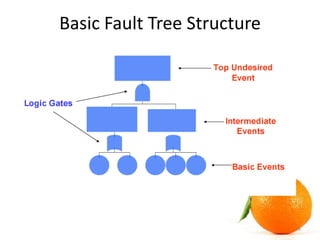
The Fault Tree
• Fault tree is the logical model of the relationship of
the undesired event to more basic events.
• The top event of the Fault tree is the undesired event.
• The middle events are intermediate events and the
basic events are at the bottom.
• The logic relationship of events are shown by logic
symbols or gates.
5
Basic Fault Tree Structure
6
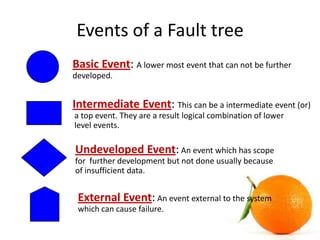
Events of a Fault tree
7
Basic Event: A lower most event that can not be further
developed.
Intermediate Event: This can be a intermediate event (or)
a top event. They are a result logical combination of lower
level events.
Undeveloped Event: An event which has scope
for further development but not done usually because
of insufficient data.
External Event: An event external to the system
which can cause failure.
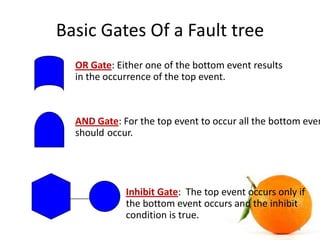
Basic Gates Of a Fault tree
8
OR Gate: Either one of the bottom event results
in the occurrence of the top event.
AND Gate: For the top event to occur all the bottom even
should occur.
Inhibit Gate: The top event occurs only if
the bottom event occurs and the inhibit
condition is true.
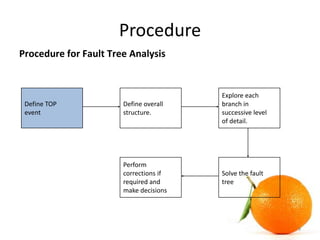
Procedure
9
Procedure for Fault Tree Analysis
Define TOP
event
Define overall
structure.
Explore each
branch in
successive level
of detail.
Solve the fault
tree
Perform
corrections if
required and
make decisions
Procedure
Define Top Event:
• Use PHA, P&ID, Process description etc., to define the top event.
• If its too broad, overly large FTA will result. E.g. Fire in process.
• If its too narrow, the exercise will be costly. E.g. Leak in the valve.
• The boundaries for top event definition can be a System, Sub-system, Unit,
Equipment (or) a Function.
• Some good examples are: Overpressure in vessel V1, Motor fails to start,
Reactor high temperature safety function fails etc.,
10
Procedure
• Define overall structure:
• Determine the intermediate events &
combination of failure that will lead to the top
event.
• Arrange them accordingly using logical
relationship
11
Procedure
Explore each branch in successive level of detail:
• Continue the top down process until the root cause for each
branch is identified and/or until further decomposition is
considered unnecessary.
• So each branch will end with a basic event or an undeveloped
event.
• Consider Common cause failure & Systematic failures in the
process of decomposition.
• A good guide to stop decomposing is to go no further than
physical (or) functional bounds set by the top event.
12
Procedure
13
Solve the Fault Tree:
 Assign probabilities of failure to the lowest level
event in each branch of the tree.
 From this data the intermediate event frequency
and the top level event frequency can be
determined using Boolean Algebra and Minimal Cut
Set methods.
Procedure
14
Minimal Cut Set theory:
 The fault tree consists of many levels of basic and intermediate
events linked together by AND and OR gates. Some basic
events may appear in different places of the fault tree.
 The minimal cut set analysis provides a new fault tree, logically
equivalent to the original, with an OR gate beneath the top
event, whose inputs (bottom)are minimal cut sets.
 Each minimal cut set is an AND gate with a set of basic event
inputs necessary and sufficient to cause the top event.
Procedure
15
Perform corrections and make decisions:
 Application of Boolean Algebra and Minimal Cut Set
theory will result in identifying the basic events(A)
and combination of basic events(B.C.D) that have
major influence on the TOP event.
• This will give clear insight on what needs to be
attended and where resources has to be put for
problem solving.
Example
16
Specifications for the BPC FT
• Undesired top event : Motor does not start
when switch is closed.
• Boundary of the FT : The circuit containing the
motor, battery, and switch.
• Resolution of the FT: The basic components in
the circuit excluding the wiring.
• Initial State of System: Switch open, normal
operating conditions.
17
Start of BPC FT (1)
18
Start of BPC FT (2)
19
Start of BPC FT (3)
20
Advantages Of FTA
21
•Deals well with parallel, redundant or alternative
fault paths.
•Searches for possible causes of an end effect which
may not have been foreseen.
•The cut sets derived in FTA can give enormous
insight into various ways top event occurs.
•Very useful tool for focused analysis where analysis
is required for one or two major outcomes.
Disadvantages Of FTA
• Requires a separate fault tree for each top event
and makes it difficult to analyze complex systems.
• Fault trees developed by different individuals are
usually different in structure, producing different
cut set elements and results.
• The same event may appear in different parts of
the tree, leading to some initial confusion.
22
Applications
• Used in the field of safety engineering and
Reliability engineering to determine the
probability of a safety accident or a particular
system level failure.
• Aerospace Engineering.
23
THANKYOU

FAULT TREE ANALYSIS (FTA) SEMINAR PRESENTATION

  • 1.
  • 2.
    Introduction • Fault TreeAnalysis was originally developed in 1962 at Bell Laboratories by H.A. Watson. • FTA is a deductive analysis approach for resolving an undesired event into its causes. • Logic diagrams and Boolean Algebra are used to identify the cause of the top event. 2
  • 3.
    Contd… • A logicdiagram called Fault tree is constructed to show the event relationship. • Probability of occurrence values are assigned to the lowest events in the tree in order to obtain the probability of occurrence of the top event. 3
  • 4.
    Why FTA isCarried Out? • Identify the cause of a failure. • Monitor and control safety performance of a complex system. • To identify the effects of human errors . • Minimize and optimize resources. 4
  • 5.
    The Fault Tree •Fault tree is the logical model of the relationship of the undesired event to more basic events. • The top event of the Fault tree is the undesired event. • The middle events are intermediate events and the basic events are at the bottom. • The logic relationship of events are shown by logic symbols or gates. 5
  • 6.
    Basic Fault TreeStructure 6
  • 7.
    Events of aFault tree 7 Basic Event: A lower most event that can not be further developed. Intermediate Event: This can be a intermediate event (or) a top event. They are a result logical combination of lower level events. Undeveloped Event: An event which has scope for further development but not done usually because of insufficient data. External Event: An event external to the system which can cause failure.
  • 8.
    Basic Gates Ofa Fault tree 8 OR Gate: Either one of the bottom event results in the occurrence of the top event. AND Gate: For the top event to occur all the bottom even should occur. Inhibit Gate: The top event occurs only if the bottom event occurs and the inhibit condition is true.
  • 9.
    Procedure 9 Procedure for FaultTree Analysis Define TOP event Define overall structure. Explore each branch in successive level of detail. Solve the fault tree Perform corrections if required and make decisions
  • 10.
    Procedure Define Top Event: •Use PHA, P&ID, Process description etc., to define the top event. • If its too broad, overly large FTA will result. E.g. Fire in process. • If its too narrow, the exercise will be costly. E.g. Leak in the valve. • The boundaries for top event definition can be a System, Sub-system, Unit, Equipment (or) a Function. • Some good examples are: Overpressure in vessel V1, Motor fails to start, Reactor high temperature safety function fails etc., 10
  • 11.
    Procedure • Define overallstructure: • Determine the intermediate events & combination of failure that will lead to the top event. • Arrange them accordingly using logical relationship 11
  • 12.
    Procedure Explore each branchin successive level of detail: • Continue the top down process until the root cause for each branch is identified and/or until further decomposition is considered unnecessary. • So each branch will end with a basic event or an undeveloped event. • Consider Common cause failure & Systematic failures in the process of decomposition. • A good guide to stop decomposing is to go no further than physical (or) functional bounds set by the top event. 12
  • 13.
    Procedure 13 Solve the FaultTree:  Assign probabilities of failure to the lowest level event in each branch of the tree.  From this data the intermediate event frequency and the top level event frequency can be determined using Boolean Algebra and Minimal Cut Set methods.
  • 14.
    Procedure 14 Minimal Cut Settheory:  The fault tree consists of many levels of basic and intermediate events linked together by AND and OR gates. Some basic events may appear in different places of the fault tree.  The minimal cut set analysis provides a new fault tree, logically equivalent to the original, with an OR gate beneath the top event, whose inputs (bottom)are minimal cut sets.  Each minimal cut set is an AND gate with a set of basic event inputs necessary and sufficient to cause the top event.
  • 15.
    Procedure 15 Perform corrections andmake decisions:  Application of Boolean Algebra and Minimal Cut Set theory will result in identifying the basic events(A) and combination of basic events(B.C.D) that have major influence on the TOP event. • This will give clear insight on what needs to be attended and where resources has to be put for problem solving.
  • 16.
  • 17.
    Specifications for theBPC FT • Undesired top event : Motor does not start when switch is closed. • Boundary of the FT : The circuit containing the motor, battery, and switch. • Resolution of the FT: The basic components in the circuit excluding the wiring. • Initial State of System: Switch open, normal operating conditions. 17
  • 18.
    Start of BPCFT (1) 18
  • 19.
    Start of BPCFT (2) 19
  • 20.
    Start of BPCFT (3) 20
  • 21.
    Advantages Of FTA 21 •Dealswell with parallel, redundant or alternative fault paths. •Searches for possible causes of an end effect which may not have been foreseen. •The cut sets derived in FTA can give enormous insight into various ways top event occurs. •Very useful tool for focused analysis where analysis is required for one or two major outcomes.
  • 22.
    Disadvantages Of FTA •Requires a separate fault tree for each top event and makes it difficult to analyze complex systems. • Fault trees developed by different individuals are usually different in structure, producing different cut set elements and results. • The same event may appear in different parts of the tree, leading to some initial confusion. 22
  • 23.
    Applications • Used inthe field of safety engineering and Reliability engineering to determine the probability of a safety accident or a particular system level failure. • Aerospace Engineering. 23
  • 24.