HAPTIC TECHNOLOGY
What Does The Future Hold For Touch?

Sam McDaniel
MKTG 7546
WHAT IS MY TREND?
 While Haptics have been around for decades, there
  is a recent push and resurgence in the technology.
 The trend is driven by consumers’ desire to have a
  more real and a better user experience with
  products.
 The trend is evolving as haptics become more
  efficient and frankly, better. New iterations of the
  technology are pushing the horizon of its uses and
  feasible applications.
SO WHAT ARE HAPTICS?
 From the Greeks
 Tactile Feedback Technology which takes
  advantage of the sense of touch by applying
  various motions to users.
 Described as “doing for touch what computer
  graphics did for vision.
 Scope of the industry
     Gaming
     Medical
     Computers
     Phones
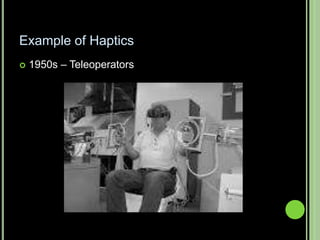
Example of Haptics
   1950s – Teleoperators
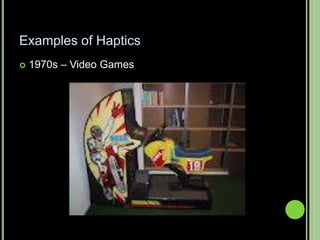
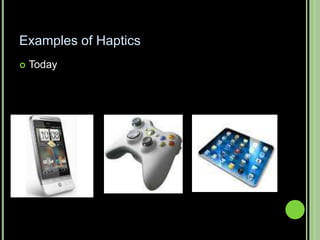
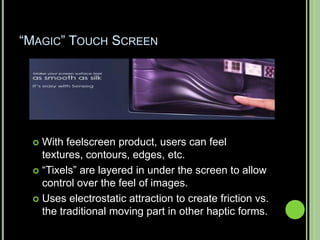
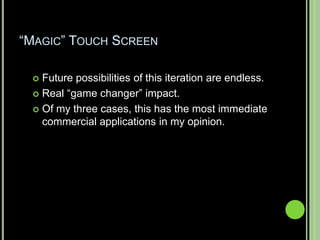
Examples of Haptics
   1970s – Video Games
Examples of Haptics
   Today
FINANCIAL IMPLICATIONS
CURRENT APPLICATIONS

 Electronic E-paper Reader
 “Magic” Touch Screen

 Vibrating Tattoos
ELECTRONIC E-PAPER READER
                    More durable and
                     damage resistant than
                     traditional glass
                     readers.
                    6 in. display with the
                     ability to bend 40
                     degrees.
                    Closer to traditional
                     paper than current
                     readers.
ELECTRONIC E-PAPER READER
 Important next step in
  the way people get
  news and
  entertainment.
 If done right, this could
  be a nice segue into
  digital paper books.
“MAGIC” TOUCH SCREEN


  With feelscreen product, users can feel
   textures, contours, edges, etc.
  “Tixels” are layered in under the screen to allow
   control over the feel of images.
  Uses electrostatic attraction to create friction vs.
   the traditional moving part in other haptic forms.
“MAGIC” TOUCH SCREEN

  Future possibilities of this iteration are endless.
  Real “game changer” impact.

  Of my three cases, this has the most immediate
   commercial applications in my opinion.
VIBRATING TATTOOS
 Tattoo is created using
  ferromagnetic ink.
 Depending on
  notification, tattoo will
  vibrate differently.
 Allow users to feel
  when they have a
  call, etc. in a variety of
  settings.
VIBRATING TATTOOS
FUTURE USE #1
FUTURE USE #2
INTERVIEWER RESULTS
INTERVIEWER RESULTS - HIGHLIGHTS
   Now a standard option

   Customer needs

   Long term growth

   Changes in Business Landscape

   Competitive Advantage

   Future Iterations
MY PERSONAL TAKEAWAYS

   Need for the technology is apparent.

   Amazement at the ability for multiple devices to
    allow the exact same user experience.

   Differentiation by companies will only accelerate.
    Apple vs. Others

   Potential for haptics to enter new markets and
    industries is immense.
IN CONCLUSION
   Recent resurgence in haptics is directly tied to
    consumers desire to have more personable and
    more integrated experiences.

   Future looks bright as people, businesses, and
    industries change the way they operate.

   Focus is now on differentiation of the users’
    experience

Haptic Technology Trends Assessment Presentation

  • 1.
    HAPTIC TECHNOLOGY What DoesThe Future Hold For Touch? Sam McDaniel MKTG 7546
  • 2.
    WHAT IS MYTREND?  While Haptics have been around for decades, there is a recent push and resurgence in the technology.  The trend is driven by consumers’ desire to have a more real and a better user experience with products.  The trend is evolving as haptics become more efficient and frankly, better. New iterations of the technology are pushing the horizon of its uses and feasible applications.
  • 3.
    SO WHAT AREHAPTICS?  From the Greeks  Tactile Feedback Technology which takes advantage of the sense of touch by applying various motions to users.  Described as “doing for touch what computer graphics did for vision.  Scope of the industry  Gaming  Medical  Computers  Phones
  • 4.
    Example of Haptics  1950s – Teleoperators
  • 5.
    Examples of Haptics  1970s – Video Games
  • 6.
  • 7.
  • 8.
    CURRENT APPLICATIONS  ElectronicE-paper Reader  “Magic” Touch Screen  Vibrating Tattoos
  • 9.
    ELECTRONIC E-PAPER READER  More durable and damage resistant than traditional glass readers.  6 in. display with the ability to bend 40 degrees.  Closer to traditional paper than current readers.
  • 10.
    ELECTRONIC E-PAPER READER Important next step in the way people get news and entertainment.  If done right, this could be a nice segue into digital paper books.
  • 11.
    “MAGIC” TOUCH SCREEN  With feelscreen product, users can feel textures, contours, edges, etc.  “Tixels” are layered in under the screen to allow control over the feel of images.  Uses electrostatic attraction to create friction vs. the traditional moving part in other haptic forms.
  • 12.
    “MAGIC” TOUCH SCREEN  Future possibilities of this iteration are endless.  Real “game changer” impact.  Of my three cases, this has the most immediate commercial applications in my opinion.
  • 13.
    VIBRATING TATTOOS  Tattoois created using ferromagnetic ink.  Depending on notification, tattoo will vibrate differently.  Allow users to feel when they have a call, etc. in a variety of settings.
  • 14.
  • 15.
  • 16.
  • 17.
  • 18.
    INTERVIEWER RESULTS -HIGHLIGHTS  Now a standard option  Customer needs  Long term growth  Changes in Business Landscape  Competitive Advantage  Future Iterations
  • 19.
    MY PERSONAL TAKEAWAYS  Need for the technology is apparent.  Amazement at the ability for multiple devices to allow the exact same user experience.  Differentiation by companies will only accelerate. Apple vs. Others  Potential for haptics to enter new markets and industries is immense.
  • 20.
    IN CONCLUSION  Recent resurgence in haptics is directly tied to consumers desire to have more personable and more integrated experiences.  Future looks bright as people, businesses, and industries change the way they operate.  Focus is now on differentiation of the users’ experience