August 25, 2010


CONTENT STRATEGY EXERCISES
UX Week 2010
August 25, 2010              Content Strategy Workshop Exercises            Page 2 of 19


EXERCISE 1A: USER NEEDS AND BUSINESS GOALS

User Persona

Take a look at the sample persona and scenario on the next page, and think about how
you’d communicate a list of user goals.

What does he need or expect to nd when he does his research?


1.


2.


3.


4.


5.
August 25, 2010               Content Strategy Workshop Exercises              Page 3 of 19


USER PERSONA

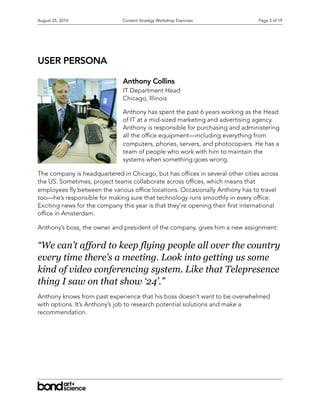
                              Anthony Collins
                              IT Department Head
                              Chicago, Illinois

                              Anthony has spent the past 6 years working as the Head
                              of IT at a mid-sized marketing and advertising agency.
                              Anthony is responsible for purchasing and administering
                              all the of ce equipment—including everything from
                              computers, phones, servers, and photocopiers. He has a
                              team of people who work with him to maintain the
                              systems when something goes wrong.

The company is headquartered in Chicago, but has of ces in several other cities across
the US. Sometimes, project teams collaborate across of ces, which means that
employees y between the various of ce locations. Occasionally Anthony has to travel
too—he’s responsible for making sure that technology runs smoothly in every of ce.
Exciting news for the company this year is that they’re opening their rst international
of ce in Amsterdam.

Anthony’s boss, the owner and president of the company, gives him a new assignment:


“We can’t afford to keep flying people all over the country
every time there’s a meeting. Look into getting us some
kind of video conferencing system. Like that Telepresence
thing I saw on that show ‘24’.”
Anthony knows from past experience that his boss doesn’t want to be overwhelmed
with options. It’s Anthony’s job to research potential solutions and make a
recommendation.
August 25, 2010              Content Strategy Workshop Exercises             Page 4 of 19


EXERCISE 1B: USER NEEDS AND BUSINESS GOALS

Case Study

Take a look at the sample case study on the next page, and think about how you’d
communicate a list of business goals.

What does this company expect to achieve by putting information on the web?


1.


2.


3.


4.


5.
August 25, 2010                Content Strategy Workshop Exercises               Page 5 of 19


CASE STUDY

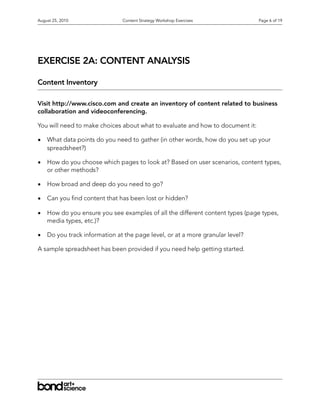
                               Cisco Systems, Inc.
                               NASDAQ: CSCO
                               San Jose, California

                               One of the world's biggest technology companies, Cisco
                               is an American multinational corporation that designs
                               and sells consumer electronics, networking and
                               communications technology and services.
                               Headquartered in California, Cisco has more than 65,000
                               employees and annual revenue of US$36.11 billion as of
                               2009.

Cisco de nes its mission as follows:

“We enable people to make powerful connections.
Cisco hardware, software, and service offerings are used
to create the Internet solutions that make networks
possible — providing easy access to information
anywhere, at any time.”
Industry analysts expect the expect the videoconferencing industry to generate more
than $1 billion in annual revenue in 2011, with compound annual growth rates of 17-21%
each year after. These projections take into account several market forces, including the
economic downturn, which reduces budgets for travel, and increased attention to
environmental or “green” causes.

Cisco is a leading player in developing solutions for business collaboration, including
videoconferencing. Cisco offers a wide variety of products and services at all price
points — from their high-end Telepresence suites to conferencing tools built into
mobile and desktop phones, and including their recent purchase of web-based
conferencing software provider, WebEx.
August 25, 2010                Content Strategy Workshop Exercises             Page 6 of 19


EXERCISE 2A: CONTENT ANALYSIS

Content Inventory

Visit http://www.cisco.com and create an inventory of content related to business
collaboration and videoconferencing.

You will need to make choices about what to evaluate and how to document it:

•   What data points do you need to gather (in other words, how do you set up your
    spreadsheet?)

•   How do you choose which pages to look at? Based on user scenarios, content types,
    or other methods?

•   How broad and deep do you need to go?

•   Can you nd content that has been lost or hidden?

•   How do you ensure you see examples of all the different content types (page types,
    media types, etc.)?

•   Do you track information at the page level, or at a more granular level?

A sample spreadsheet has been provided if you need help getting started.
August 25, 2010            Content Strategy Workshop Exercises   Page 7 of 19


Replace with spreadsheet
August 25, 2010                 Content Strategy Workshop Exercises                Page 8 of 19


EXERCISE 2B: CONTENT ANALYSIS

Content Audit

Based on the content inventory you just completed, and the user needs and
business goals you completed in Exercise 1, assess the quality of this content.

You will need to make decisions about how to de ne “quality” content. Remember:
there is no overall de nition of “good content”— there’s only subjective quality within
your business and user context.

•   Does the content communicate clearly?

•   Is the content complete? Do you have all the content that needs to be there?

•   Is the content up-to-date? Are the examples presented fresh?

•   Is the tone and style appropriate for your the reader? Is it appropriate for your
    brand?

•   Is the content relevant to its intended audience? Are there other audiences this
    content might be relevant to?

•   What business purpose does the content serve? Does it help meet business goals?

How will you document your ndings? If you add to your spreadsheet, how will you track
your assessment?

Since this is a subjective exercise, how will you persuade your project team that your
assessment is valid? How will you present your ndings?
August 25, 2010                Content Strategy Workshop Exercises               Page 9 of 19


EXERCISE 3A: MESSAGING

Messaging Architecture

Going back to your understanding of the user and the business, what are the main
points that should be communicated about this line of products?

Primary Message

One focused, memorable sentence that captures the essence of what this is and the
value it provides. Should answer what? and why? questions.


Secondary Messages

Supporting points that provide context and more speci c information, answering
additional questions like who? and how? and when? and how much?

1.


2.


3.


Call to Action

What do you want the user to think or do differently after seeing this information?
August 25, 2010                 Content Strategy Workshop Exercises               Page 10 of 19


EXERCISE 3B: MESSAGING

Content Annotations

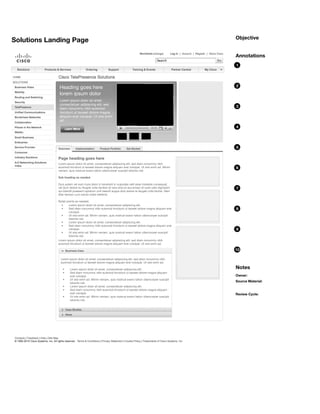
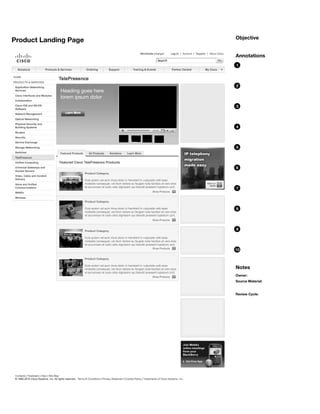
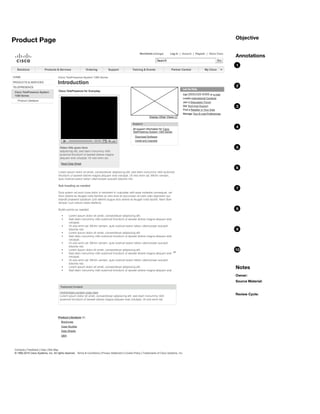
Based on the wireframes on the next pages which show common templates, provide
direction about how to communicate your primary and secondary messages.

Imagine you are giving guidance to a copywriter, who may be a freelancer, a colleague,
or a client. If you’ve ever written annotations for wireframes, you might think of these as
annotation for content rather than interaction.

Good annotations will:

•   Help the writer understand and focus on the goal of the page

•   Prioritize the information presented, both in the ow of text and in the placement on
    the page

•   Give direction about what to say and how to say it

•   Tie back to the overall messaging architecture

Great annotations will also:

•   Direct the writer to appropriate source materials, both online and of ine

•   Guide selection of images, videos, and data visualizations, if available

•   Indicate how often each content element should be reviewed, edited, or deleted
August 25, 2010           Content Strategy Workshop Exercises   Page 11 of 19


Replace with wireframes
August 25, 2010   Content Strategy Workshop Exercises   Page 12 of 19
August 25, 2010   Content Strategy Workshop Exercises   Page 13 of 19
August 25, 2010               Content Strategy Workshop Exercises              Page 14 of 19


EXERCISE 4A: TESTING

User Interviews

In an interview setting, you can use a “think-aloud” protocol to learn how readers
process and make sense of content.

Working in pairs, select one person to be the participant and one to act as moderator.

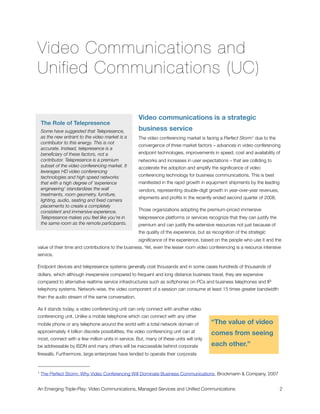
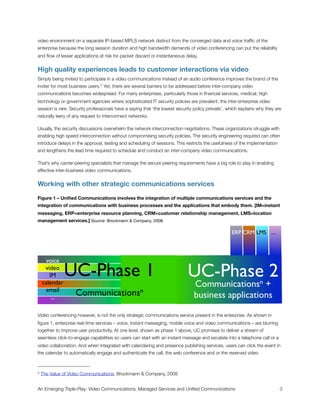
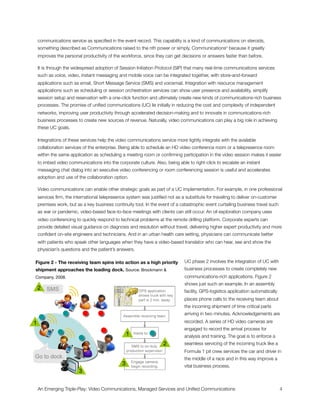
The participant should read the whitepaper on the next page. (If this were a real test,
the participant would be recruited to match the characteristics of the intended
audience. To the extent possible, the participant should pretend to adopt the persona
of Anthony, the IT Director.)

The moderator should rst quickly read through the whitepaper. Then work off the
moderator guide that appears on page 18.
August 25, 2010           Content Strategy Workshop Exercises   Page 15 of 19


Replace with whitepaper
August 25, 2010   Content Strategy Workshop Exercises   Page 16 of 19
August 25, 2010   Content Strategy Workshop Exercises   Page 17 of 19
August 25, 2010                 Content Strategy Workshop Exercises                Page 18 of 19


MODERATOR GUIDE

Introduction and Setup

Introduce yourself
I’m a researcher working with Cisco Systems to help them gather feedback on some of
their products and services. I don’t work for Cisco, so I hope you feel you can be
completely honest with me. You’re not going to hurt my feelings if you don’t like
something, and you won’t make me happy if you do.

Explain the goal and process for the task
We’d like to get your feedback on a whitepaper about videoconferencing. You’ll be
asked to read the whitepaper and tell me what you think it means. One thing that I’m
going to ask you to a little differently is I’m going to ask you to “think out loud” as
you’re reading. I don’t want you to read the whitepaper to me, I want you to tell me
what you think it means or how you’re making sense of it.

Start the test
This will take about ## minutes. Do you have any questions for me before we begin?


During the Test

•   You may want to provide more context for the participant, such as “Please review
    this document as if you were reading it at work.”

•   Remind the participant that “It is important that you say aloud everything that you
    think as you’re reading this document.”

•   Encourage the participant to explain images, charts, or other graphics to you.

•   If the participant starts reading silently, prompt him or her with “please keep
    talking”or “tell me what you’re thinking now.”

•   During longer interviews, you can tell the participant that they can stop the test: “If
    you were using this document at work and you reach a point where you’d quit
    reading it, let me know that too.”

•   Thank the participant at the end of the interview.

Handouts for Why UX Design Needs Content Strategy

  • 1.
    August 25, 2010 CONTENTSTRATEGY EXERCISES UX Week 2010
  • 2.
    August 25, 2010 Content Strategy Workshop Exercises Page 2 of 19 EXERCISE 1A: USER NEEDS AND BUSINESS GOALS User Persona Take a look at the sample persona and scenario on the next page, and think about how you’d communicate a list of user goals. What does he need or expect to nd when he does his research? 1. 2. 3. 4. 5.
  • 3.
    August 25, 2010 Content Strategy Workshop Exercises Page 3 of 19 USER PERSONA Anthony Collins IT Department Head Chicago, Illinois Anthony has spent the past 6 years working as the Head of IT at a mid-sized marketing and advertising agency. Anthony is responsible for purchasing and administering all the of ce equipment—including everything from computers, phones, servers, and photocopiers. He has a team of people who work with him to maintain the systems when something goes wrong. The company is headquartered in Chicago, but has of ces in several other cities across the US. Sometimes, project teams collaborate across of ces, which means that employees y between the various of ce locations. Occasionally Anthony has to travel too—he’s responsible for making sure that technology runs smoothly in every of ce. Exciting news for the company this year is that they’re opening their rst international of ce in Amsterdam. Anthony’s boss, the owner and president of the company, gives him a new assignment: “We can’t afford to keep flying people all over the country every time there’s a meeting. Look into getting us some kind of video conferencing system. Like that Telepresence thing I saw on that show ‘24’.” Anthony knows from past experience that his boss doesn’t want to be overwhelmed with options. It’s Anthony’s job to research potential solutions and make a recommendation.
  • 4.
    August 25, 2010 Content Strategy Workshop Exercises Page 4 of 19 EXERCISE 1B: USER NEEDS AND BUSINESS GOALS Case Study Take a look at the sample case study on the next page, and think about how you’d communicate a list of business goals. What does this company expect to achieve by putting information on the web? 1. 2. 3. 4. 5.
  • 5.
    August 25, 2010 Content Strategy Workshop Exercises Page 5 of 19 CASE STUDY Cisco Systems, Inc. NASDAQ: CSCO San Jose, California One of the world's biggest technology companies, Cisco is an American multinational corporation that designs and sells consumer electronics, networking and communications technology and services. Headquartered in California, Cisco has more than 65,000 employees and annual revenue of US$36.11 billion as of 2009. Cisco de nes its mission as follows: “We enable people to make powerful connections. Cisco hardware, software, and service offerings are used to create the Internet solutions that make networks possible — providing easy access to information anywhere, at any time.” Industry analysts expect the expect the videoconferencing industry to generate more than $1 billion in annual revenue in 2011, with compound annual growth rates of 17-21% each year after. These projections take into account several market forces, including the economic downturn, which reduces budgets for travel, and increased attention to environmental or “green” causes. Cisco is a leading player in developing solutions for business collaboration, including videoconferencing. Cisco offers a wide variety of products and services at all price points — from their high-end Telepresence suites to conferencing tools built into mobile and desktop phones, and including their recent purchase of web-based conferencing software provider, WebEx.
  • 6.
    August 25, 2010 Content Strategy Workshop Exercises Page 6 of 19 EXERCISE 2A: CONTENT ANALYSIS Content Inventory Visit http://www.cisco.com and create an inventory of content related to business collaboration and videoconferencing. You will need to make choices about what to evaluate and how to document it: • What data points do you need to gather (in other words, how do you set up your spreadsheet?) • How do you choose which pages to look at? Based on user scenarios, content types, or other methods? • How broad and deep do you need to go? • Can you nd content that has been lost or hidden? • How do you ensure you see examples of all the different content types (page types, media types, etc.)? • Do you track information at the page level, or at a more granular level? A sample spreadsheet has been provided if you need help getting started.
  • 7.
    August 25, 2010 Content Strategy Workshop Exercises Page 7 of 19 Replace with spreadsheet
  • 8.
    August 25, 2010 Content Strategy Workshop Exercises Page 8 of 19 EXERCISE 2B: CONTENT ANALYSIS Content Audit Based on the content inventory you just completed, and the user needs and business goals you completed in Exercise 1, assess the quality of this content. You will need to make decisions about how to de ne “quality” content. Remember: there is no overall de nition of “good content”— there’s only subjective quality within your business and user context. • Does the content communicate clearly? • Is the content complete? Do you have all the content that needs to be there? • Is the content up-to-date? Are the examples presented fresh? • Is the tone and style appropriate for your the reader? Is it appropriate for your brand? • Is the content relevant to its intended audience? Are there other audiences this content might be relevant to? • What business purpose does the content serve? Does it help meet business goals? How will you document your ndings? If you add to your spreadsheet, how will you track your assessment? Since this is a subjective exercise, how will you persuade your project team that your assessment is valid? How will you present your ndings?
  • 9.
    August 25, 2010 Content Strategy Workshop Exercises Page 9 of 19 EXERCISE 3A: MESSAGING Messaging Architecture Going back to your understanding of the user and the business, what are the main points that should be communicated about this line of products? Primary Message One focused, memorable sentence that captures the essence of what this is and the value it provides. Should answer what? and why? questions. Secondary Messages Supporting points that provide context and more speci c information, answering additional questions like who? and how? and when? and how much? 1. 2. 3. Call to Action What do you want the user to think or do differently after seeing this information?
  • 10.
    August 25, 2010 Content Strategy Workshop Exercises Page 10 of 19 EXERCISE 3B: MESSAGING Content Annotations Based on the wireframes on the next pages which show common templates, provide direction about how to communicate your primary and secondary messages. Imagine you are giving guidance to a copywriter, who may be a freelancer, a colleague, or a client. If you’ve ever written annotations for wireframes, you might think of these as annotation for content rather than interaction. Good annotations will: • Help the writer understand and focus on the goal of the page • Prioritize the information presented, both in the ow of text and in the placement on the page • Give direction about what to say and how to say it • Tie back to the overall messaging architecture Great annotations will also: • Direct the writer to appropriate source materials, both online and of ine • Guide selection of images, videos, and data visualizations, if available • Indicate how often each content element should be reviewed, edited, or deleted
  • 11.
    August 25, 2010 Content Strategy Workshop Exercises Page 11 of 19 Replace with wireframes
  • 12.
    August 25, 2010 Content Strategy Workshop Exercises Page 12 of 19
  • 13.
    August 25, 2010 Content Strategy Workshop Exercises Page 13 of 19
  • 14.
    August 25, 2010 Content Strategy Workshop Exercises Page 14 of 19 EXERCISE 4A: TESTING User Interviews In an interview setting, you can use a “think-aloud” protocol to learn how readers process and make sense of content. Working in pairs, select one person to be the participant and one to act as moderator. The participant should read the whitepaper on the next page. (If this were a real test, the participant would be recruited to match the characteristics of the intended audience. To the extent possible, the participant should pretend to adopt the persona of Anthony, the IT Director.) The moderator should rst quickly read through the whitepaper. Then work off the moderator guide that appears on page 18.
  • 15.
    August 25, 2010 Content Strategy Workshop Exercises Page 15 of 19 Replace with whitepaper
  • 16.
    August 25, 2010 Content Strategy Workshop Exercises Page 16 of 19
  • 17.
    August 25, 2010 Content Strategy Workshop Exercises Page 17 of 19
  • 18.
    August 25, 2010 Content Strategy Workshop Exercises Page 18 of 19 MODERATOR GUIDE Introduction and Setup Introduce yourself I’m a researcher working with Cisco Systems to help them gather feedback on some of their products and services. I don’t work for Cisco, so I hope you feel you can be completely honest with me. You’re not going to hurt my feelings if you don’t like something, and you won’t make me happy if you do. Explain the goal and process for the task We’d like to get your feedback on a whitepaper about videoconferencing. You’ll be asked to read the whitepaper and tell me what you think it means. One thing that I’m going to ask you to a little differently is I’m going to ask you to “think out loud” as you’re reading. I don’t want you to read the whitepaper to me, I want you to tell me what you think it means or how you’re making sense of it. Start the test This will take about ## minutes. Do you have any questions for me before we begin? During the Test • You may want to provide more context for the participant, such as “Please review this document as if you were reading it at work.” • Remind the participant that “It is important that you say aloud everything that you think as you’re reading this document.” • Encourage the participant to explain images, charts, or other graphics to you. • If the participant starts reading silently, prompt him or her with “please keep talking”or “tell me what you’re thinking now.” • During longer interviews, you can tell the participant that they can stop the test: “If you were using this document at work and you reach a point where you’d quit reading it, let me know that too.” • Thank the participant at the end of the interview.