
















A Crash Course in
 Content Strategy
     A workshop at the
  School of Visual Concepts
           January 25, 2013
Your host: James Callan
    @scarequotes
(This workshop stands on the
blog posts and books of giants.)
Introductions!
             Who are you?
           What brings you here?

What’s a website with content that you like?
(Bonus points if it’s not straight-up media.)

         What do you like about it?
Why is content important?
“You are all in publishing!”


                     Jeffrey Zeldman,
                      king of the web


                       http://www.zeldman.com/2011/03/15/web-design-is-publishing/
A content strategy
gives you the structure to decide what to publish,
       accounts for the resources you have,
         and helps you plan for the future.
People don’t visit your site
 to see the amazing design.
People don’t visit your site
for a great user experience.
They want your content.
From Signal vs. Noise: http://37signals.com/svn/posts/3404-reminder-design-is-still-about-words
“Like a gentleman in a finely crafted suit
who wants to burp you the alphabet,
even if your website looks nice, no one
will stick around to hear what
you have to say if you don’t
craft something compelling.”


                                              Jason Santa Maria
                                              @jasonsantamaria

                                http://jasonsantamaria.com/articles/the-elements-of-content-strategy/
“Apple has ... given us a solid example of how
 high-quality content contributes to a user’s
 experience, and how, when you reduce the
 quality, it interferes with that experience.”


                                            Jared Spool,
                                              @jmspool

                                   “iOS6 Maps Is An Incredible Gift
                                  to UX and Content Professionals”
It’s also a lot of work,
if you want to do it well.
Divide into teams of 2-3 people.
We’re going to go analyze some web content.
When you’re in your teams, get a website from me.
       Then we’ll go to the computer lab.
Pull up your site on a computer.
   Start looking through the content.
Click through as many pages as you can.
Gut check: Is it good?
Is there enough? Too much?
         Take notes.
Be ready to spend 5 minutes telling us:
  What content was useful and usable?
        What content was missing?
What’s the most ridiculous thing you found?
And we’re back downstairs.
Keep your burger joint in mind as we
   discuss more content tactics.
Step 1:
Know what content you’re working with.
The content inventory:
  The cornerstone of any
successful content strategy!
How do you know
if your content is good?

  Inventory and audit.
Inventory:
What content do we have?
Audit:
How good is the content we have?
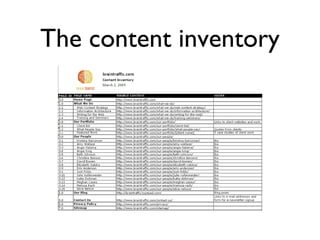
The content inventory
Yes.
It really is a big, big spreadsheet
  that documents every page—
     every piece of content—
          on your website.
How do you do a content inventory?
   Click each link on your site.
    Document what you find.
Or get a bot to do it for you.
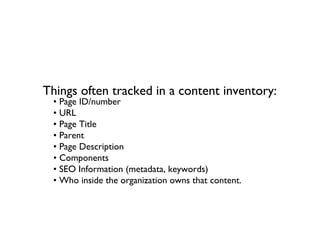
Things often tracked in a content inventory:
 • Page ID/number
 • URL
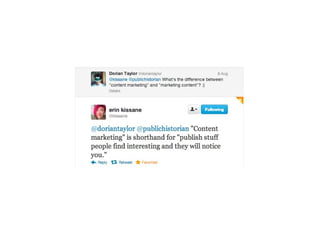
 • Page Title
 • Parent
 • Page Description
 • Components
 • SEO Information (metadata, keywords)
 • Who inside the organization owns that content.
The inventory is quantitative.
    What’s on the site?
Followup: the content audit.
That’s qualitative: How good is what you’ve got?
Is there ROT?
Look for content that’s:
      Redundant
     Outdated or
         Trivial
You can tailor an audit to evaluate all kinds of qualities.
                   Is content on brand?
                        Is it accessible?
                Do people understand it?
             Is it meeting customer needs?
                  Is it in a usable format?
         (There are many possible measures.)
So your audit uncovers some
problems.

Now what?
Remember the nutshell:
1. What content do we have?
2. What content do we need?
3. Fill the gap: edit, create & curate.
Erin Kissane’s even shorter breakdown:
1. Evaluate.
2. Design.
3. Execute.
Step 2:
Give yourself metrics
for evaluating content.
Message Architecture

What are your brand’s key messages?
 Are you delivering them? How?
 Does your audience believe you?
Your message architecture is not a
  tagline, or a mission statement.
     It’s communication goals.
         Specific terminology.
 The backbone of your messaging.
What content on the site–just content,
   not layout–can we keep, as is?
      What needs to be edited?
What’s missing and needs to be created?
    And what needs to be killed?
Let’s try an exercise.
Let’s come up with a message architecture
       for each of your burger joints.
When you know your messaging architecture,
   all of your content can be on brand.
              Even the details!
One example of contrasts:
Cook’s Illustrated vs. Allrecipes.com
“I hate the idea that cooking should be
  a celebration or a party. Cooking is about
  putting food on the table night after night,
 and there isn’t anything glamorous about it.
    Cooking isn’t creative, and it isn’t easy.
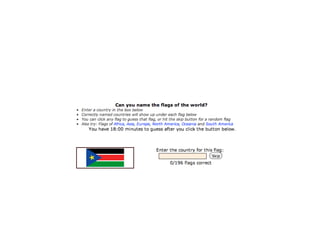
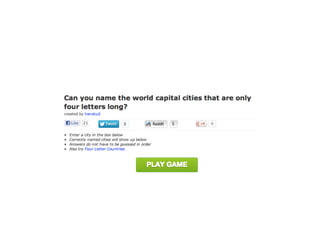
      It’s serious, and it’s hard to do well,
just as everything worth doing is damn hard.”
Neither approach is the right approach.
They work for their respective companies.
So we’ve done steps 1 and 2.
We’re doing content strategy!
This would be a good time for lunch,
    if we haven’t done it already.
Back up a sec:
What is content strategy?
First word: What is content?
“In the web industry, anything that conveys meaningful
      information to humans is called ‘content.’”


                                              Erin Kissane
                                               @kissane


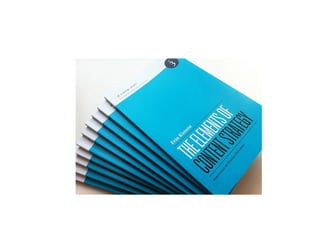
                                     The Elements of Content Strategy
“Content is anything an organization
  or individual creates and shares
         to tell their story.”


                                Ann Handley
                               @marketingprofs
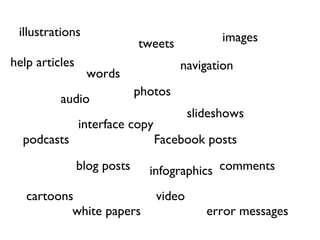
illustrations                                 images
                             tweets
help articles                         navigation
                 words
                             photos
          audio
                                         slideshows
                interface copy
  podcasts                       Facebook posts
                blog posts     infographics comments

   cartoons                      video
           white papers                     error messages
(It’s not just words.)
Word two: What is strategy?
It’s a plan for getting stuff done
    in order to achieve a goal.
Put ’em together:
What is content strategy?
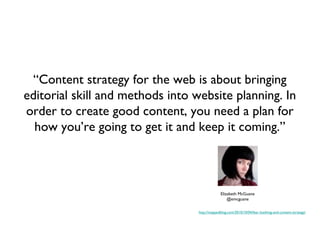
“Content strategy for the web is about bringing
editorial skill and methods into website planning. In
order to create good content, you need a plan for
  how you’re going to get it and keep it coming.”


                                               Elizabeth McGuane
                                                   @emcguane

                                  http://mappedblog.com/2010/10/04/fear-loathing-and-content-strategy/
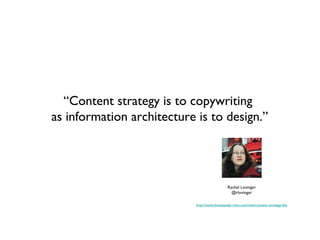
“Content strategy is to copywriting
as information architecture is to design.”


                                              Rachel Lovinger
                                                @rlovinger

                            http://www.boxesandarrows.com/view/content-strategy-the
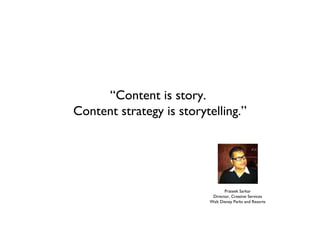
“Content is story.
Content strategy is storytelling.”


                                 Prateek Sarkar
                           Director, Creative Services
                          Walt Disney Parks and Resorts
The benchmark definition:
“Content strategy plans for the creation, publication,
    and governance of useful, usable content.”


                                           Kristina Halvorson,
                                        Content Strategy for the Web
Creation:
Who’s providing your content?
Publication:
How are you getting your content to users?
Governance:
 How do you keep content up-to-date?
When do you send content out to pasture?
Useful:
How does this content benefit you?
  How does it benefit your user?
Usable:
Can people find, consume, and act on your content?
Speaking of “usable”:
Is content strategy part of
   user experience (UX)?
You can’t create great UX
  around bad content.
“Content strategy helps organizations use content
        to achieve their business goals.”


                                       Melissa Rach
                                       @melissarach
“(God help a business if UX isn’t one of
 their business goals, but helping the user
isn’t an inherent part of content strategy).”


                                     Melissa Rach
                                     @melissarach
One more thing to note:
 “Content strategy is not a single solution
or deliverable. It's a process and a mindset.”
Is content strategy
 part of marketing?
(Marketers have been very excited
   to talk content strategy!)
“Everything you write should be crafted
with the intention of selling, educating, or
      increasing customer loyalty.”
“Important content like FAQs, Docs, Press Releases,
  Welcome messages, etc. sometimes fall into some
other bucket of ‘Content That Does No Marketing™.’

Bullshit. It’s all marketing when you’re doing it right.”


                                             Des Traynor
                                            COO, Intercom
                                             @destraynor
Step 3:
Use your content strategy to
drive your content marketing.
Content strategy
       vs.
content marketing.
Content strategy:
The plan. The big picture.
Content marketing:
The execution. Tactics.
Content marketing:
Content that earns you interest
   and wins you customers.
Pop quiz:
Can you name some creative ways
   companies sold bubblegum
    using content marketing?
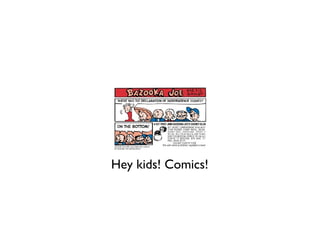
Hey kids! Comics!
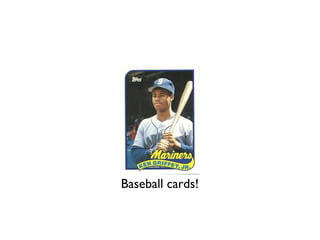
Baseball cards!
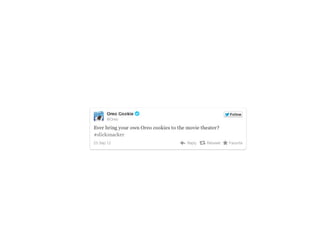
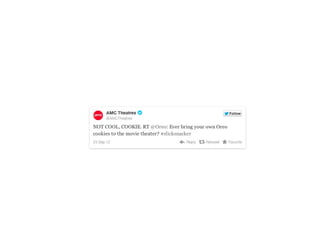
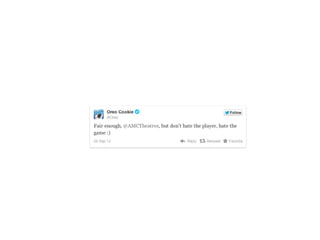
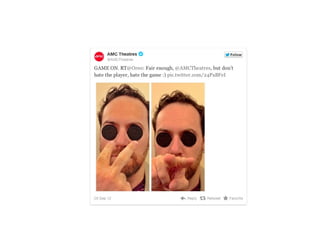
Let’s look at a couple of real, recent examples of
content marketing informed by content strategy.
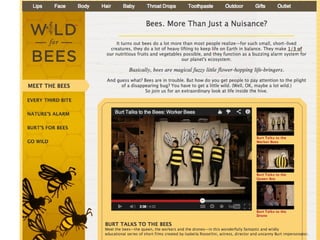
Another example: Burt’s Bees
Any ideas for using content
marketing for your burger joints?
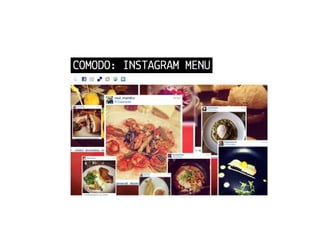
Here’s what Comodo, a
restaurant in NYC, did.
Again, having that architecture
    helps you drive what you
  produce. It makes you more
 effective at collaboration with
other departments, such as SEO.
Content strategy is closely allied
       with user experience.
It’s closely allied with marketing.
“Good links are important, but good experiences
are essential. Need to build links? Start by
building out good content.”


                                    Jonathon Colman
                                       @jcolman
Content strategists may be
        involved in:
   Project management.
      Data modeling.
   Change management.
       Social media.
          Editorial.
        Taxonomy.
 Information architecture.
            SEO.
      And other stuff.
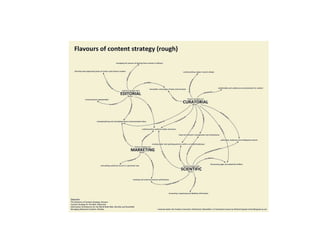
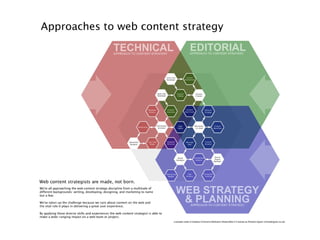
Different content strategists
  have different emphases.
Front-end content strategy
What your audience sees and experiences.
It includes:• User experience content
strategy• Marketing and editorial content
strategy
Back-end content strategy 
This is how to make the content work
well. It includes:• "Intelligent" content •
Content governance and operations
(That breakdown courtesy of Kathy Hanbury.)


                                  @kathyhanbury
What makes good content?
“Good content” is in the eye of the
beholder. Ultimately, your users decide.
What are your goals?
What is your content supposed
      to achieve for you?
“There’s really only one central principle of good
content: it should be appropriate for your
business, for your users, and for its context.
Appropriate in its method of delivery, in its style
and structure, and above all in its substance.”


                                              Erin Kissane
                                               @kissane

                                     The Elements of Content Strategy
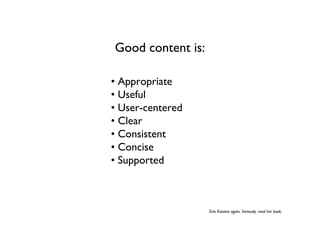
Good content is:

• Appropriate
• Useful
• User-centered
• Clear
• Consistent
• Concise
• Supported


                   Erin Kissane again. Seriously, read her book.
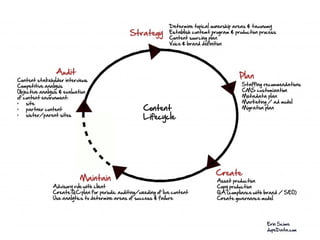
One thing to keep in mind:

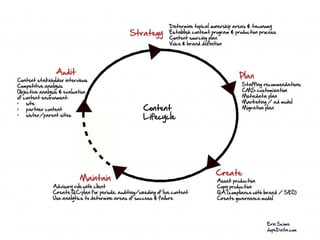
Content strategy is a process. It’s a cycle.
It never really ends.
Content strategy is a design discipline.
     You are contributing to the way
   something functions at its very core.
   Content experts should be involved
from the beginning of a web design project.
“Content first!”
“Content is king!”
“Design from
the content out!”
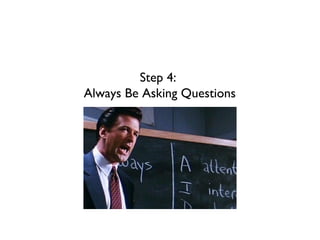
Step 4:
Always Be Asking Questions
Talk to everyone involved with the
content, preferably one-on-one, about
  what they need and want from the
            site’s content.
The goal is to get an idea of how
content works within the organization.
ASK QUESTIONS.
(Go with the classics: who, what, when,
        where, why, and how.)
Who’s supplying the content?
 Who is the target audience?
Who’s maintaining the content?
What content do we need?
When will we publish?
Where will we publish?
(Our site, email, Facebook, Twitter,
                etc.)
How will all of this get done?
And a big one, especially in discovery:
               WHY?
     Why do we need a blog?
 Why do we need a Twitter feed?
   Why aren’t we using a CMS?
                 Etc.
Step 5:
What’s your style?
Editorial Style Guide

      What’s our tone?
Which dictionary do we consult?
 Do we use the serial comma?
Editorial process

   Who’s creating our content?
How do we decide it’s good enough?
How do we evaluate its effectiveness?
Editorial Calendar

 How do we decide when to publish?
(Tweet twice a day? Update home page
 when new products launch? Respond
 to holidays? Respond to news events?
           How quickly? Etc.)
Step 6:
Figure out what your content looks like.
           Even on the inside.
Content Template
            (a.k.a. Page Table)

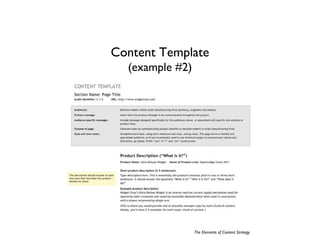
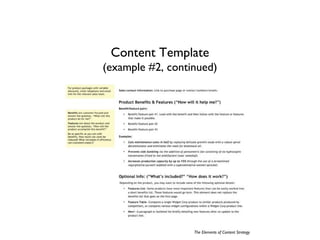
  What needs to go on each kind of
page? Includes both visible and invisible
 content. Accompanies site map and
  wireframes. Communication bridge
 between subject matter experts and
                writers.
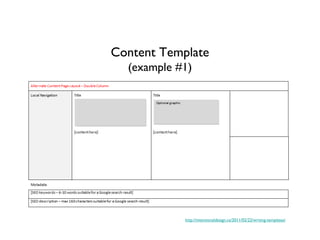
Content Template
  (example #1)


            http://intentionaldesign.ca/2011/02/22/writing-templates/
Content Template
  (example #2)


                 The Elements of Content Strategy
Content Template
(example #2, continued)


                  The Elements of Content Strategy
And content strategy is not, ultimately,
 about learning a particular tool. The
tools help the process, but they’re not
       the point of the process.
Also, not every project is a site-wide
redesign. Content strategy works on a
       project-by-project basis.
Governance!
How content strategy plays
     out over time.
“If IA is the spatial side of information,
I see content strategy as the temporal side
               of the same coin.”


                                   Louis Rosenfeld
                                   @louisrosenfeld
“When I look at where most websites fail, it’s in
     managing their content over time.”


                                    Karen McGrane
                                    @karenmcgrane
Let’s look at one example of what
       governance can mean.
Who knows Sporcle.com? A
bottomless supply of trivia quizzes,
    mostly generated by users.
July 9, 2011:
South Sudan splits off from Sudan to
    become a separate country.
So?
So Sporcle had a lot of geography
       quizzes to update.
And they just did it again this month
after the UN recognized Palestine as
 a “non-member observer state” —
meeting Sporcle’s working definition
           of “country.”
Consultants and agencies:
  People want to hear from you!
Yay, buy-in! But you don’t get to be
      there for the long haul.
In-house:
  Buy in can be a major challenge!
But you know the brand and business
goals, and you are there for the long
                haul.
Content strategy is not a quick fix.
   It’s a long process. One reason
  content is valuable is because it’s
messy, and difficult, and requires a lot
             of resources.
To keep your content working:
Track when content will need to be
       archived or updated.
    Use the editorial calendar.
        Use a rolling audit.
   Budget time to get that done.
What does a content strategy look like?
Whatever your approach and your
background, learn about the other
    areas of content strategy.
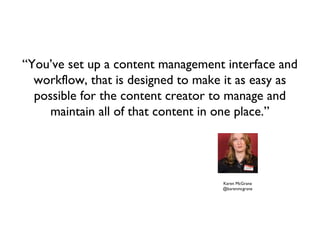
“You’ve set up a content management interface and
  workflow, that is designed to make it as easy as
  possible for the content creator to manage and
     maintain all of that content in one place.”


                                    Karen McGrane
                                    @karenmcgrane
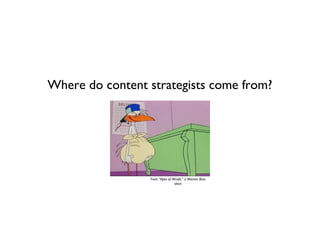
Where do content strategists come from?


                 From “Apes of Wrath,” a Warner Bros.
                                short.
Content strategy is a big playground.
People join in from different perspectives,
          and tend to specialize.
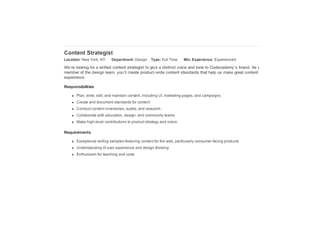
Where can you find content strategists?
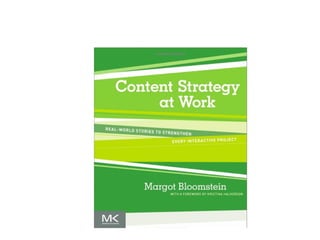
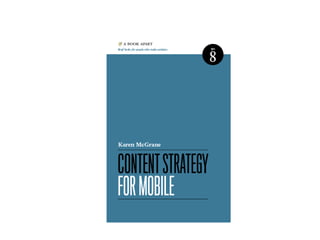
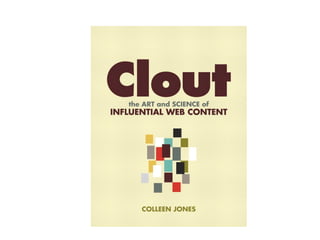
RESOURCES: BOOKS
RESOURCES: BLOGS
RESOURCES: PODCAST!
Come to a meetup with Content Strategy Seattle!

http://www.meetup.com/content-strategy-seattle
Join the Google Group, or LinkedIn discussion groups.
Follow smart people on Twitter.
Content strategists are a friendly, helpful group.
        (I think it’s a job requirement.)
I’m tired of yammering.
I know you’ve got questions. Shoot!
THANK YOU
Remember to fill out your evaluation.


       Don’t forget to write.
               james@scarequot.es
                http://scarequot.es
              Twitter: @scarequotes

Intro to Content Strategy: January 2013

  • 1.
    A Crash Coursein Content Strategy A workshop at the School of Visual Concepts January 25, 2013
  • 2.
    Your host: JamesCallan @scarequotes
  • 3.
    (This workshop standson the blog posts and books of giants.)
  • 4.
    Introductions! Who are you? What brings you here? What’s a website with content that you like? (Bonus points if it’s not straight-up media.) What do you like about it?
  • 6.
    Why is contentimportant?
  • 7.
    “You are allin publishing!” Jeffrey Zeldman, king of the web http://www.zeldman.com/2011/03/15/web-design-is-publishing/
  • 9.
    A content strategy givesyou the structure to decide what to publish, accounts for the resources you have, and helps you plan for the future.
  • 10.
    People don’t visityour site to see the amazing design.
  • 11.
    People don’t visityour site for a great user experience.
  • 12.
  • 13.
    From Signal vs.Noise: http://37signals.com/svn/posts/3404-reminder-design-is-still-about-words
  • 14.
    From Signal vs.Noise: http://37signals.com/svn/posts/3404-reminder-design-is-still-about-words
  • 15.
    “Like a gentlemanin a finely crafted suit who wants to burp you the alphabet, even if your website looks nice, no one will stick around to hear what you have to say if you don’t craft something compelling.” Jason Santa Maria @jasonsantamaria http://jasonsantamaria.com/articles/the-elements-of-content-strategy/
  • 17.
    “Apple has ...given us a solid example of how high-quality content contributes to a user’s experience, and how, when you reduce the quality, it interferes with that experience.” Jared Spool, @jmspool “iOS6 Maps Is An Incredible Gift to UX and Content Professionals”
  • 18.
    It’s also alot of work, if you want to do it well.
  • 19.
    Divide into teamsof 2-3 people. We’re going to go analyze some web content.
  • 20.
    When you’re inyour teams, get a website from me. Then we’ll go to the computer lab.
  • 21.
    Pull up yoursite on a computer. Start looking through the content. Click through as many pages as you can.
  • 22.
    Gut check: Isit good? Is there enough? Too much? Take notes.
  • 23.
    Be ready tospend 5 minutes telling us: What content was useful and usable? What content was missing? What’s the most ridiculous thing you found?
  • 24.
    And we’re backdownstairs. Keep your burger joint in mind as we discuss more content tactics.
  • 25.
    Step 1: Know whatcontent you’re working with.
  • 26.
    The content inventory: The cornerstone of any successful content strategy!
  • 27.
    How do youknow if your content is good? Inventory and audit.
  • 28.
  • 29.
    Audit: How good isthe content we have?
  • 30.
  • 31.
    Yes. It really isa big, big spreadsheet that documents every page— every piece of content— on your website.
  • 32.
    How do youdo a content inventory? Click each link on your site. Document what you find.
  • 33.
    Or get abot to do it for you.
  • 34.
    Things often trackedin a content inventory: • Page ID/number • URL • Page Title • Parent • Page Description • Components • SEO Information (metadata, keywords) • Who inside the organization owns that content.
  • 35.
    The inventory isquantitative. What’s on the site?
  • 36.
    Followup: the contentaudit. That’s qualitative: How good is what you’ve got?
  • 37.
    Is there ROT? Lookfor content that’s: Redundant Outdated or Trivial
  • 38.
    You can tailoran audit to evaluate all kinds of qualities. Is content on brand? Is it accessible? Do people understand it? Is it meeting customer needs? Is it in a usable format? (There are many possible measures.)
  • 39.
    So your audituncovers some problems. Now what?
  • 40.
    Remember the nutshell: 1.What content do we have? 2. What content do we need? 3. Fill the gap: edit, create & curate.
  • 41.
    Erin Kissane’s evenshorter breakdown: 1. Evaluate. 2. Design. 3. Execute.
  • 42.
    Step 2: Give yourselfmetrics for evaluating content.
  • 43.
    Message Architecture What areyour brand’s key messages? Are you delivering them? How? Does your audience believe you?
  • 44.
    Your message architectureis not a tagline, or a mission statement. It’s communication goals. Specific terminology. The backbone of your messaging.
  • 45.
    What content onthe site–just content, not layout–can we keep, as is? What needs to be edited? What’s missing and needs to be created? And what needs to be killed?
  • 46.
    Let’s try anexercise. Let’s come up with a message architecture for each of your burger joints.
  • 47.
    When you knowyour messaging architecture, all of your content can be on brand. Even the details!
  • 53.
    One example ofcontrasts: Cook’s Illustrated vs. Allrecipes.com
  • 54.
    “I hate theidea that cooking should be a celebration or a party. Cooking is about putting food on the table night after night, and there isn’t anything glamorous about it. Cooking isn’t creative, and it isn’t easy. It’s serious, and it’s hard to do well, just as everything worth doing is damn hard.”
  • 56.
    Neither approach isthe right approach. They work for their respective companies.
  • 57.
    So we’ve donesteps 1 and 2. We’re doing content strategy!
  • 58.
    This would bea good time for lunch, if we haven’t done it already.
  • 59.
    Back up asec: What is content strategy?
  • 60.
    First word: Whatis content?
  • 61.
    “In the webindustry, anything that conveys meaningful information to humans is called ‘content.’” Erin Kissane @kissane The Elements of Content Strategy
  • 62.
    “Content is anythingan organization or individual creates and shares to tell their story.” Ann Handley @marketingprofs
  • 63.
    illustrations images tweets help articles navigation words photos audio slideshows interface copy podcasts Facebook posts blog posts infographics comments cartoons video white papers error messages
  • 64.
  • 65.
    Word two: Whatis strategy?
  • 66.
    It’s a planfor getting stuff done in order to achieve a goal.
  • 67.
    Put ’em together: Whatis content strategy?
  • 68.
    “Content strategy forthe web is about bringing editorial skill and methods into website planning. In order to create good content, you need a plan for how you’re going to get it and keep it coming.” Elizabeth McGuane @emcguane http://mappedblog.com/2010/10/04/fear-loathing-and-content-strategy/
  • 69.
    “Content strategy isto copywriting as information architecture is to design.” Rachel Lovinger @rlovinger http://www.boxesandarrows.com/view/content-strategy-the
  • 70.
    “Content is story. Contentstrategy is storytelling.” Prateek Sarkar Director, Creative Services Walt Disney Parks and Resorts
  • 72.
  • 73.
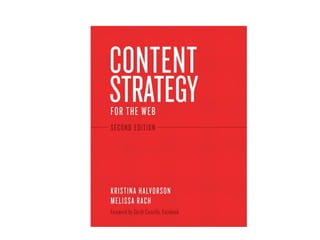
    “Content strategy plansfor the creation, publication, and governance of useful, usable content.” Kristina Halvorson, Content Strategy for the Web
  • 74.
  • 75.
    Publication: How are yougetting your content to users?
  • 76.
    Governance: How doyou keep content up-to-date? When do you send content out to pasture?
  • 77.
    Useful: How does thiscontent benefit you? How does it benefit your user?
  • 78.
    Usable: Can people find,consume, and act on your content?
  • 79.
    Speaking of “usable”: Iscontent strategy part of user experience (UX)?
  • 80.
    You can’t creategreat UX around bad content.
  • 81.
    “Content strategy helpsorganizations use content to achieve their business goals.” Melissa Rach @melissarach
  • 82.
    “(God help abusiness if UX isn’t one of their business goals, but helping the user isn’t an inherent part of content strategy).” Melissa Rach @melissarach
  • 83.
    One more thingto note: “Content strategy is not a single solution or deliverable. It's a process and a mindset.”
  • 84.
    Is content strategy part of marketing?
  • 86.
    (Marketers have beenvery excited to talk content strategy!)
  • 87.
    “Everything you writeshould be crafted with the intention of selling, educating, or increasing customer loyalty.”
  • 88.
    “Important content likeFAQs, Docs, Press Releases, Welcome messages, etc. sometimes fall into some other bucket of ‘Content That Does No Marketing™.’ Bullshit. It’s all marketing when you’re doing it right.” Des Traynor COO, Intercom @destraynor
  • 89.
    Step 3: Use yourcontent strategy to drive your content marketing.
  • 90.
    Content strategy vs. content marketing.
  • 91.
  • 92.
  • 93.
    Content marketing: Content thatearns you interest and wins you customers.
  • 96.
    Pop quiz: Can youname some creative ways companies sold bubblegum using content marketing?
  • 97.
  • 98.
  • 99.
    Let’s look ata couple of real, recent examples of content marketing informed by content strategy.
  • 104.
  • 106.
    Any ideas forusing content marketing for your burger joints?
  • 107.
    Here’s what Comodo,a restaurant in NYC, did.
  • 109.
    Again, having thatarchitecture helps you drive what you produce. It makes you more effective at collaboration with other departments, such as SEO.
  • 110.
    Content strategy isclosely allied with user experience. It’s closely allied with marketing.
  • 111.
    “Good links areimportant, but good experiences are essential. Need to build links? Start by building out good content.” Jonathon Colman @jcolman
  • 112.
    Content strategists maybe involved in: Project management. Data modeling. Change management. Social media. Editorial. Taxonomy. Information architecture. SEO. And other stuff.
  • 113.
    Different content strategists have different emphases.
  • 114.
    Front-end content strategy Whatyour audience sees and experiences. It includes:• User experience content strategy• Marketing and editorial content strategy
  • 115.
    Back-end content strategy  Thisis how to make the content work well. It includes:• "Intelligent" content • Content governance and operations
  • 116.
    (That breakdown courtesyof Kathy Hanbury.) @kathyhanbury
  • 117.
  • 118.
    “Good content” isin the eye of the beholder. Ultimately, your users decide.
  • 119.
    What are yourgoals? What is your content supposed to achieve for you?
  • 120.
    “There’s really onlyone central principle of good content: it should be appropriate for your business, for your users, and for its context. Appropriate in its method of delivery, in its style and structure, and above all in its substance.” Erin Kissane @kissane The Elements of Content Strategy
  • 121.
    Good content is: •Appropriate • Useful • User-centered • Clear • Consistent • Concise • Supported Erin Kissane again. Seriously, read her book.
  • 122.
    One thing tokeep in mind: Content strategy is a process. It’s a cycle. It never really ends.
  • 124.
    Content strategy isa design discipline. You are contributing to the way something functions at its very core. Content experts should be involved from the beginning of a web design project.
  • 125.
  • 126.
  • 127.
  • 128.
    Step 4: Always BeAsking Questions
  • 129.
    Talk to everyoneinvolved with the content, preferably one-on-one, about what they need and want from the site’s content.
  • 130.
    The goal isto get an idea of how content works within the organization.
  • 131.
    ASK QUESTIONS. (Go withthe classics: who, what, when, where, why, and how.)
  • 132.
    Who’s supplying thecontent? Who is the target audience? Who’s maintaining the content?
  • 133.
  • 134.
    When will wepublish?
  • 135.
    Where will wepublish? (Our site, email, Facebook, Twitter, etc.)
  • 136.
    How will allof this get done?
  • 137.
    And a bigone, especially in discovery: WHY? Why do we need a blog? Why do we need a Twitter feed? Why aren’t we using a CMS? Etc.
  • 138.
  • 139.
    Editorial Style Guide What’s our tone? Which dictionary do we consult? Do we use the serial comma?
  • 141.
    Editorial process Who’s creating our content? How do we decide it’s good enough? How do we evaluate its effectiveness?
  • 142.
    Editorial Calendar Howdo we decide when to publish? (Tweet twice a day? Update home page when new products launch? Respond to holidays? Respond to news events? How quickly? Etc.)
  • 143.
    Step 6: Figure outwhat your content looks like. Even on the inside.
  • 144.
    Content Template (a.k.a. Page Table) What needs to go on each kind of page? Includes both visible and invisible content. Accompanies site map and wireframes. Communication bridge between subject matter experts and writers.
  • 145.
    Content Template (example #1) http://intentionaldesign.ca/2011/02/22/writing-templates/
  • 146.
    Content Template (example #2) The Elements of Content Strategy
  • 147.
    Content Template (example #2,continued) The Elements of Content Strategy
  • 148.
    And content strategyis not, ultimately, about learning a particular tool. The tools help the process, but they’re not the point of the process.
  • 149.
    Also, not everyproject is a site-wide redesign. Content strategy works on a project-by-project basis.
  • 150.
  • 151.
    “If IA isthe spatial side of information, I see content strategy as the temporal side of the same coin.” Louis Rosenfeld @louisrosenfeld
  • 152.
    “When I lookat where most websites fail, it’s in managing their content over time.” Karen McGrane @karenmcgrane
  • 153.
    Let’s look atone example of what governance can mean.
  • 154.
    Who knows Sporcle.com?A bottomless supply of trivia quizzes, mostly generated by users.
  • 155.
    July 9, 2011: SouthSudan splits off from Sudan to become a separate country.
  • 156.
  • 157.
    So Sporcle hada lot of geography quizzes to update.
  • 161.
    And they justdid it again this month after the UN recognized Palestine as a “non-member observer state” — meeting Sporcle’s working definition of “country.”
  • 162.
    Consultants and agencies: People want to hear from you! Yay, buy-in! But you don’t get to be there for the long haul.
  • 163.
    In-house: Buyin can be a major challenge! But you know the brand and business goals, and you are there for the long haul.
  • 164.
    Content strategy isnot a quick fix. It’s a long process. One reason content is valuable is because it’s messy, and difficult, and requires a lot of resources.
  • 165.
    To keep yourcontent working: Track when content will need to be archived or updated. Use the editorial calendar. Use a rolling audit. Budget time to get that done.
  • 166.
    What does acontent strategy look like?
  • 167.
    Whatever your approachand your background, learn about the other areas of content strategy.
  • 169.
    “You’ve set upa content management interface and workflow, that is designed to make it as easy as possible for the content creator to manage and maintain all of that content in one place.” Karen McGrane @karenmcgrane
  • 170.
    Where do contentstrategists come from? From “Apes of Wrath,” a Warner Bros. short.
  • 171.
    Content strategy isa big playground. People join in from different perspectives, and tend to specialize.
  • 173.
    Where can youfind content strategists?
  • 179.
  • 189.
  • 192.
  • 194.
    Come to ameetup with Content Strategy Seattle! http://www.meetup.com/content-strategy-seattle
  • 195.
    Join the GoogleGroup, or LinkedIn discussion groups.
  • 196.
    Follow smart peopleon Twitter. Content strategists are a friendly, helpful group. (I think it’s a job requirement.)
  • 197.
    I’m tired ofyammering. I know you’ve got questions. Shoot!
  • 198.
    THANK YOU Remember tofill out your evaluation. Don’t forget to write. james@scarequot.es http://scarequot.es Twitter: @scarequotes

Editor's Notes

  • #5 Take notes. Discuss. Pull up examples and let’s tease out how they might do their content.
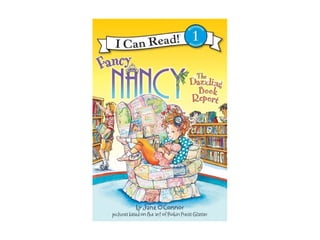
  • #6 I’m going to start with a story. Any parents here? Who knows Fancy Nancy? My daughter read Fancy Nancy and the Dazzling Book Report a few months ago, and of course, I read it, too. And realized that it’s a perfect illustration of one of the fundamentals of content strategy. If you don’t know her, Fancy Nancy is a young girl who likes things to be fancy. She likes to use fancy words and dress in fancy clothes and stave off a non-fancy existence. One day she’s assigned a book report on a biography of Sacajawea. She reads the book, and gets really excited about putting the report together. She gets out lots of art supplies, and puts together a beautiful and elaborate cover for the report. She wants to make it look as amazing as possible. And of course she runs out of time. She figured she knew what she wants to say, so it won’t take long to write, and Sacajawea deserves an awesome cover. Of course she spends so much time designing the cover that she ends up writing two sentences that don’t say much about the book. Can you relate? Yeah. Content strategy at its core is an I Can Read-level lesson: Leave yourself time to produce good content. Nancy learns her lesson, and her teacher is forgiving, and everything works out. It’s touching. Let’s see if we can learn some lessons that we can apply to the web and other digital experiences.
  • #9 But there’s a difference between throwing stuff out onto the net willy-nilly and having a publishing plan, just like there’s a difference between cranking out 50,000 words during National Novel Writing Month and becoming a published novelist.
  • #10 Because here’s the thing about your site:
  • #13 They want to find stuff out! They want to be entertained! They want your content so bad they’d just as soon not visit your site to get it (Google search results, RSS feeds, Instapaper, etc.) Note: This isn’t a content. All the other elements of your site are important, too.
  • #14 Craigslist may be ugly, but they’ve got content you want. (And if we really took out ALL content, those photos wouldn’t be there, either.)
  • #24 DON’T fixate on design issues. Think about content. Everything from the class descriptions and marketing messages to word choice.
  • #25 DON’T fixate on design issues. Think about content. Everything from the class descriptions and marketing messages to word choice.
  • #26 Side note: how many pages do you think the site has? Over 2000 HTML docs! (Not all pages, but that’s a lot of stuff.)
  • #27 This is the formal version of what we started out doing.
  • #30 Secret: you can do them both together, many times. You just did!
  • #31 We’re not doing this in here. But this is something you could do. Yes, this means that an actual content inventory of the SVC website would have over 2000 lines.
  • #34 Talk about CAT and Integrity. There’s no one tool that does everything, or does it the way you want, but there are options, and more coming all the time. Check the Google Group or LinkedIn discussions. http://107.22.198.75/cat/#job/e41c6dc528dd89803bd00f31f7e958b5
  • #35 WHAT is this content? WHO is responsible for it? Content owner is very important info the minute you’re on a site larger than a one-person show.
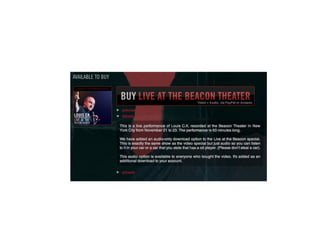
  • #49 “ We have added an audio-only download option to the Live at the Beacon sepecial. This is exactly the same show as the video special but just audio so you can listen to it in your car or a car that you stole that has a CD player. (Please don’t steal a car.)”
  • #50 Thank you for buying Tig Notaro — Live. The audio files are available in MP3 or FLAC format. If you’ve never heard of FLAC, use MP3. If you want both, go ahead and knock yourself out.
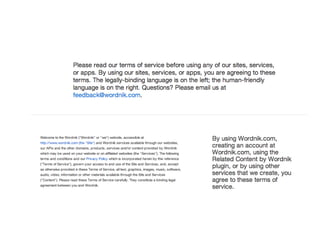
  • #51 From Wordnik.com Terms of Service. They’re all about words, so they value clarity. This balances the legal department’s need for specificity with the brand’s commitment to being clear and human.
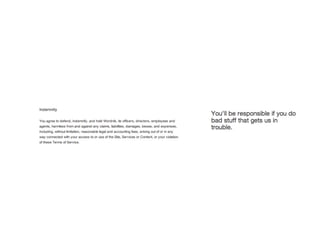
  • #52 Indemnity vs. “you’ll be responsible if you do bad stuff that gets us in trouble.” Is this appropriate for all sites? Probably not. (Though wouldn’t it be nice if it were?)
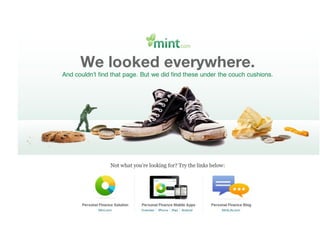
  • #53 Mint’s 404 page. Note that it’s funny, it’s clear, and it gives you some ideas about what to do next. It’s not just cute, it keeps things running.
  • #55 Christopher Kimball, who founded Cook’s Illustrated. I’d be surprised if this is their official messaging architecture, but this attitude drives their approach to recipes: Perfect them, publish them in the magazine, put them on the web behind a paywall — that works.
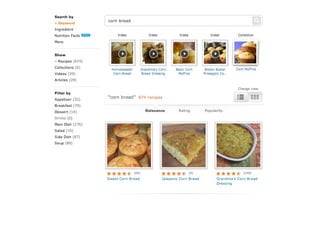
  • #56 By contrast, Allrecipes.com is all about volume. Search for “corn bread” and you get 674 recipes! I guarantee they’re not all perfect, but they’re not about approaching it that way. They make money via ads and pro memberships, not the same as Cook’s.
  • #75 In-house writers? Users? Vendors? Clients?
  • #83 So, you know, not necessarily. Here’s a little secret: “Strategy” is not inherently good. It may be a content strategy to trick you into paying for stuff you don’t really want. Strategy? Yes. User friendly? No. Do it? Please don’t.
  • #84 That’s right. I’m here to CHANGE YOUR MINDSET.
  • #86 Let me tell you a secret: One of the first things I loved about content strategy was the chance to get away from marketing. Marketers were following right behind, though. And in retrospect I was naive.
  • #89 Remember the Mint, Wordnik, and Louis C.K. examples from before.
  • #91 Here’s a debate you’ll hear about a lot. What’s the difference between content strategy and content marketing? Is there a difference? (I bet there’s ten conversations on Quora about this RIGHT NOW, and exponentially more on Twitter.)
  • #93 Confession: Many people, even really smart people, blur the line. Because the line between the two is not a bright and shiny one. They’re really two ends on a continuum.
  • #102 Because you know, no outside food or beverages in the movie theater.
  • #104 Shane Adams, who runs AMC social media, wrote: “I promise this post isn’t meant to be one giant #humblebrag. I have a point to all this. The truth is that an interaction like this is why I believe so fervently in the power of social media professionals within brands. With the proper structure and governance (and a buttload of trust from your superiors), stuff like this can happen.” And yes, those are Oreos on his eyes.
  • #106 http://www.burtsbees.com/wildforbees.html Burt’s brand, of course, focuses on bees. And their site publishes lots of info about their products, but also about bees — and they turned some creativity over to Isabella Rossellini, who plays both Burt and a bee in this sketch. (Based on her “Green Porno” sketches, which are all about like this.)
  • #109 They printed an Instagram hashtag on the bottom of their menu: #comodomenu. And encouraged people to take pictures of their meals and post them to Instagram. One reason they can do this: They’re confident in their product. They’re willing to risk some loss of control.
  • #112 Jonathon has moved over to content strategy but started as an SEO guy.
  • #115 One way to break it down.
  • #116 We’re not going to dive deep into this today, but it’s worth keeping in the back of your mind.
  • #121 Don’t overlook these three pieces: The Business The user The context Point of discussion: NBC and the Olympics. People complained about the time delay for the summer games—but NBC got record-breaking ratings for their coverage. Was this good content strategy?
  • #125 Think back to Fancy Nancy: Her book report cover is worthless without an actual book report.
  • #128 Jeffrey Zeldman
  • #138 You should be asking “why” so much that you could be mistaken for a three-year-old.
  • #140 The best style guide is probably the one your content creators already use. But if you get to pick, I recommend either Chicago or the Yahoo! Manual of Style.
  • #142 Content strategists are usually good communicators, but that doesn’t mean they’re always copywriters or other content producers.
  • #143 You can use anything from a wall calendar to a Wordpress plugin.
  • #150 Don’t count on redesigns, in my experience. Start figuring out how to practice content strategy with the site you have now. Evolution, not revolution.
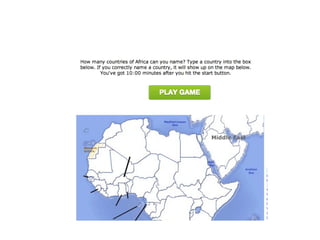
  • #159 Obvious ones, like “Countries of Africa.”
  • #160 Less obvious ones, like “Flags of the World.”
  • #161 And even less obvious ones, like this. “We finally came to the realization that we’d better take action and start an inventory of any quiz that might eventually include South Sudan.As you might expect. There are a lot of them. Obviously the biggest deal will be having South Sudan added to our Countries of the World quiz. In a lot of ways, its the flagship quiz on Sporcle, with a lot of folks working hard to get 195/195. When we add a new country for this quiz, the 319,438 people who have a perfect score on this quiz, will now only have 195/196 answers correct. We know this is going to be traumatizing for more than a few of you.”
  • #166 Yes, this is one thing you can put on a spreadsheet. Examples: “This says ‘new.’ When should it stop saying that?” “ This copy talks about being cutting-edge technology. We’ll need to revisit when the next line comes out. Pull it or edit it.”
  • #167 Let’s dig in to the Buzzfeed strategy: http://cdixon.org/2012/07/24/buzzfeeds-strategy/
  • #170 Which CMS? Depends. There’s no one right answer, or even two right answers. You’ve got to know what your content creators need, what your business needs from the content, and promote a system that makes it easy. Ugly systems produce substandard content.
  • #175 Agencies!
  • #176 In-house! This is a job description for Codecademy. Note: part of the design team. Strong writing component.
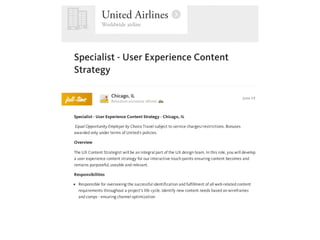
  • #177 In-house, at companies like United Airlines. Note the UX specialization.
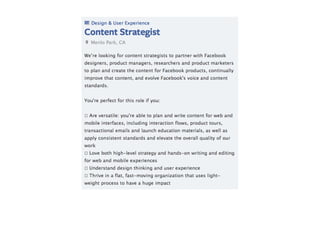
  • #178 Facebook! (Timeline story.)
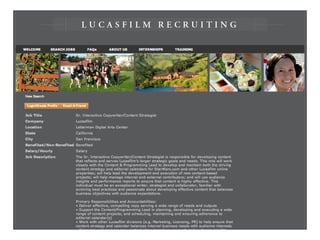
  • #179 Lucasfilm! STAR WARS! The Sr. Interactive Copywriter/Content Strategist is responsible for developing content that reflects and serves Lucasfilm’s larger strategic goals and needs. This role will work closely with the Content & Programming Lead to develop and maintain both the driving content strategy and editorial calendars for StarWars.com and other Lucasfilm online properties; will help lead the development and execution of new content-based projects; will help manage internal and external contributors; and will use audience insights and performance reports to ensure that content is highly effective. This individual must be an exceptional writer, strategist and collaborator, familiar with evolving best practices and passionate about developing effective content that balances business objectives with audience expectations.
  • #185 Harnesses the power of rhetoric.
  • #186 Tactical but great. Very helpful for helping persuade people used to writing for other formats, or at least for giving you some guidance in working with them.
  • #189 If you want to dig into the more wonky side of content and learn to talk better with IT.
  • #195 We are behind on scheduling one, but we’re out there. Join us!