Enterprise UX
Industry Report
2017 to 2018
Copyright © 2017 by UXPin Inc.
All rights reserved. No part of this publication text may be uploaded or
posted online without the prior written permission of the publisher.
For permission requests, write to the publisher, addressed “Attention:
Permissions Request,” to hello@uxpin.com.
Enterprise UX
Industry Report
2017 to 2018
Index
Introduction6
UX Background and Experience 8
Most enterprise designers are self-taught 9
Enterprise designers are fairly experienced 9
Majority of enterprise designers are in-house 10
Significantly more enterprise designers join
massive companies after 3 years 10
Enterprise UX Challenges 12
Legacy technology issues increase with company size 13
UX consistency is an almost universal challenge 13
Executive buy-in becomes a greater challenge
as company size increases  15
Collaboration becomes more difficult
as developers outnumber designers  16
Product Development Process 17
Most organizations use pattern libraries or
design systems (or are currently building them)  18
Waterfall organizations are less likely
to use pattern libraries or design systems 18
Prototyping is one of the most common UX activities 20
Product Platforms 21
Design Leadership 22
Mostly self-taught 24
Team Structure  25
Complete co-location more prevalent in
waterfall organizations 26
More developers per designer as company size increases 26
UX Maturity and Value 29
Full-time UX roles are newer to waterfall vs. Agile companies 30
Most waterfall organizations employ less than 5 full-time UX roles 31
Waterfall organizations tend to value UX less  31
Design Income 33
Income By Function 36
Conclusion37
Marcin Treder
Since co-founding UXPin in 2010, he has helped build and lead prod-
uct teams in the Poland and Silicon Valley office. Previously, he was a
UX Manager at Grupa Nokaut, an enterprise ecommerce platform. He
holds an M.A. in Psychology from the University of Gdansk.
Jerry Cao
Jerry Cao is a content strategist at UXPin where he gets to put his over-
ly active imagination to paper every day. In a past life, he developed
content strategies for clients at Brafton and worked in traditional ad-
vertising at DDB San Francisco. In his spare time he enjoys playing elec-
tric guitar, watching foreign horror films, and expanding his knowledge
of random facts. Follow me on Twitter
Vince Ho
Before joining UXPin in 2016 Vincent was a Sr. Research Analyst at a fi-
nancial institution responsible for the company’s quantitative research
design / deployment and analysis. He is currently the Data Analyst at
UXPin supporting the Sales, Marketing, and Product teams in measur-
ing key metrics and discovering meaningful patterns.
Authors
Introduction
In the world of enterprise products, UX has historically been an af-
terthought. Product teams were engineering-driven. Functionality
came before usability or usefulness. Buyer needs superseded those
of end-users.
While the issues of legacy technology, bureaucracy, and complex use
cases still exist, the status quo is changing. We are undoubtedly in
the midst of an enterprise UX renaissance. Startups like Gusto, Stripe,
and Slack are setting the expectation that business products should
be useful, usable, and satisfying. Meanwhile, large organizations
like IBM, GE, and Salesforce are prioritizing design as a competitive
advantage by hiring thousands of designers to reshape processes
and culture.
At UXPin, we’ve seen this transformation firsthand amongst our
customers. As design thinking comes of age, more enterprise teams
are seeking the right tools and processes to deliver on the promise
of design-driven product development.
Introduction 7
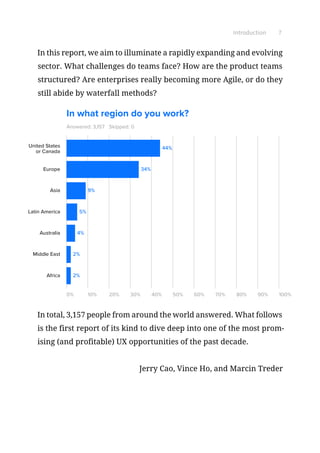
In this report, we aim to illuminate a rapidly expanding and evolving
sector. What challenges do teams face? How are the product teams
structured? Are enterprises really becoming more Agile, or do they
still abide by waterfall methods?
Answered: 3,157
0% 10% 20% 30% 40% 50% 60% 70% 80% 90% 100%
United States
or Canada
Europe
Asia
Latin America
Australia
Middle East
Africa
34%
44%
9%
5%
4%
2%
2%
Skipped: 0
In what region do you work?
In total, 3,157 people from around the world answered. What follows
is the first report of its kind to dive deep into one of the most prom-
ising (and profitable) UX opportunities of the past decade.
Jerry Cao, Vince Ho, and Marcin Treder
UX Background and Experience
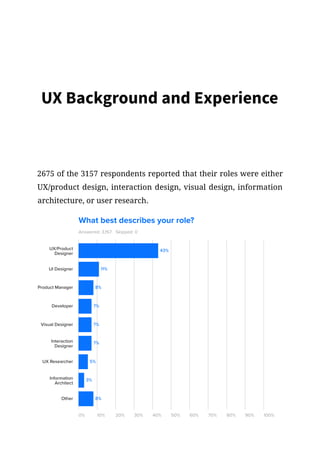
2675 of the 3157 respondents reported that their roles were either
UX/product design, interaction design, visual design, information
architecture, or user research.
Answered: 3,157
0% 10% 20% 30% 40% 50% 60% 70% 80% 90% 100%
UX/Product
Designer
UI Designer
Product Manager
Developer
Visual Designer
Interaction
Designer
UX Researcher
11%
43%
8%
7%
7%
7%
5%
Information
Architect
Other
3%
8%
Skipped: 0
What best describes your role?
UX Background and Experience 9
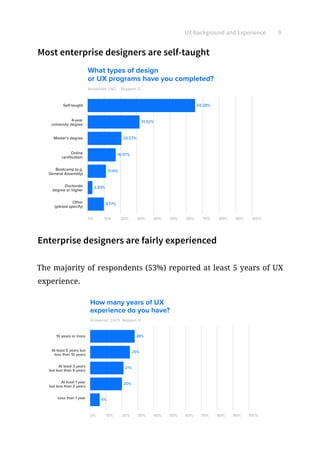
Most enterprise designers are self-taught
Answered: 1,167
0% 10% 20% 30% 40% 50% 60% 70% 80% 90% 100%
Self-taught
4-year
university degree
Master’s degree
Online
certification
Bootcamp (e.g.
General Assembly)
Doctorate
degree or higher
31.53%
65.38%
20.57%
16.97%
11.14%
2.83%
Other
(please specify)
9.77%
Skipped: 0
What types of design
or UX programs have you completed?
Enterprise designers are fairly experienced
The majority of respondents (53%) reported at least 5 years of UX
experience.
Answered: 2,675
0% 10% 20% 30% 40% 50% 60% 70% 80% 90% 100%
10 years or more
At least 5 years but
less than 10 years
At least 3 years
but less than 5 years
At least 1 year
but less than 3 years
Less than 1 year
25%
28%
21%
20%
6%
Skipped: 0
How many years of UX
experience do you have?
UX Background and Experience 10
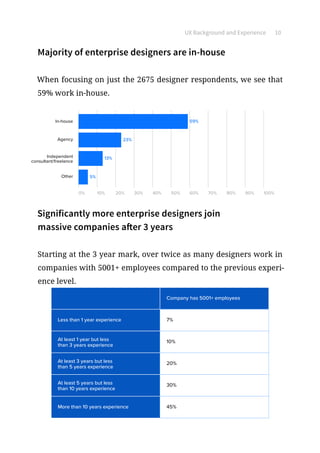
Majority of enterprise designers are in-house
When focusing on just the 2675 designer respondents, we see that
59% work in-house.
0% 10% 20% 30% 40% 50% 60% 70% 80% 90% 100%
In-house
Agency
Independent
consultant/freelance
Other
23%
59%
13%
5%
Significantly more enterprise designers join
massive companies after 3 years
Starting at the 3 year mark, over twice as many designers work in
companies with 5001+ employees compared to the previous experi-
ence level.
Less than 1 year experience
At least 1 year but less
than 3 years experience
At least 3 years but less
than 5 years experience
At least 5 years but less
than 10 years experience
More than 10 years experience
7%
Company has 5001+ employees
10%
20%
30%
45%
UX Background and Experience 11
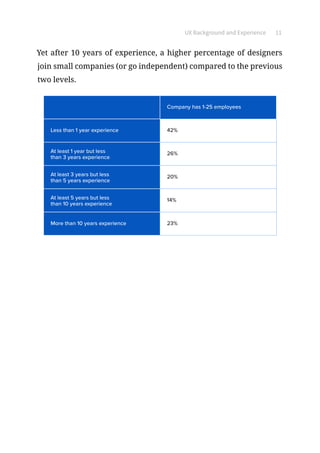
Yet after 10 years of experience, a higher percentage of designers
join small companies (or go independent) compared to the previous
two levels.
Less than 1 year experience
At least 1 year but less
than 3 years experience
At least 3 years but less
than 5 years experience
At least 5 years but less
than 10 years experience
More than 10 years experience
42%
Company has 1-25 employees
26%
20%
14%
23%
Enterprise UX Challenges
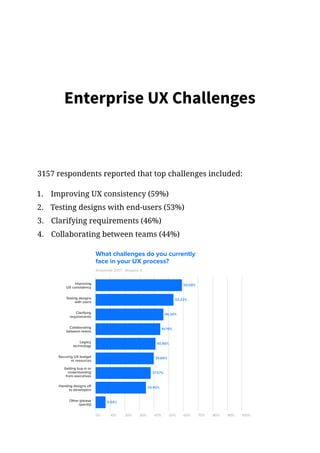
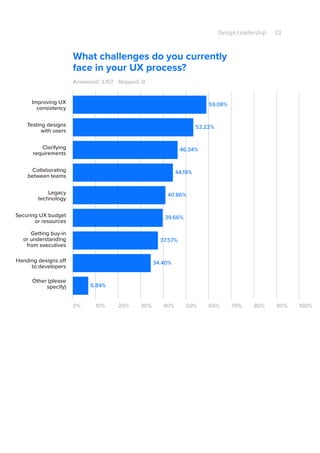
3157 respondents reported that top challenges included:
1.	 Improving UX consistency (59%)
2.	 Testing designs with end-users (53%)
3.	 Clarifying requirements (46%)
4.	 Collaborating between teams (44%)
Answered: 3,157
0% 10% 20% 30% 40% 50% 60% 70% 80% 90% 100%
Improving
UX consistency
Testing designs
with users
Clarifying
requirements
Collaborating
between teams
Legacy
technology
Securing UX budget
or resources
Getting buy-in or
understanding
from executives
53.22%
59.08%
46.34%
44.19%
40.86%
39.66%
37.57%
Handing designs off
to developers
34.40%
Other (please
specify)
6.84%
Skipped: 0
What challenges do you currently
face in your UX process?
Enterprise UX Challenges 13
Let’s explore some major trends below.
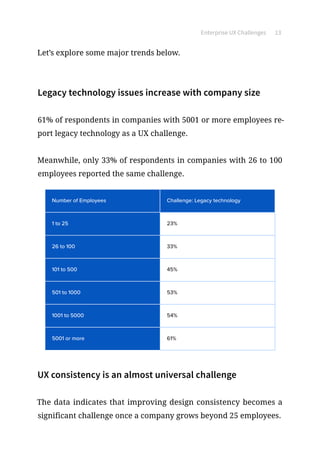
Legacy technology issues increase with company size
61% of respondents in companies with 5001 or more employees re-
port legacy technology as a UX challenge.
Meanwhile, only 33% of respondents in companies with 26 to 100
employees reported the same challenge.
1 to 25
Number of Employees
26 to 100
101 to 500
501 to 1000
1001 to 5000
23%
Challenge: Legacy technology
33%
45%
53%
54%
5001 or more 61%
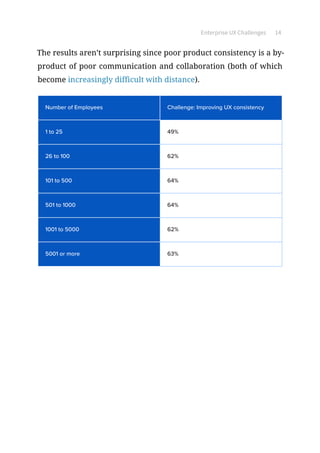
UX consistency is an almost universal challenge
The data indicates that improving design consistency becomes a
significant challenge once a company grows beyond 25 employees.
Enterprise UX Challenges 14
The results aren’t surprising since poor product consistency is a by-
product of poor communication and collaboration (both of which
become increasingly difficult with distance).
1 to 25
Number of Employees
26 to 100
101 to 500
501 to 1000
1001 to 5000
49%
Challenge: Improving UX consistency
62%
64%
64%
62%
5001 or more 63%
Enterprise UX Challenges 15
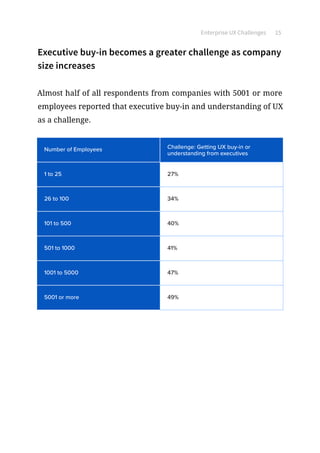
Executive buy-in becomes a greater challenge as company
size increases
Almost half of all respondents from companies with 5001 or more
employees reported that executive buy-in and understanding of UX
as a challenge.
1 to 25
Number of Employees
26 to 100
101 to 500
501 to 1000
1001 to 5000
27%
Challenge: Getting UX buy-in or
understanding from executives
34%
40%
41%
47%
5001 or more 49%
Enterprise UX Challenges 16
Collaboration becomes more difficult as developers out-
number designers
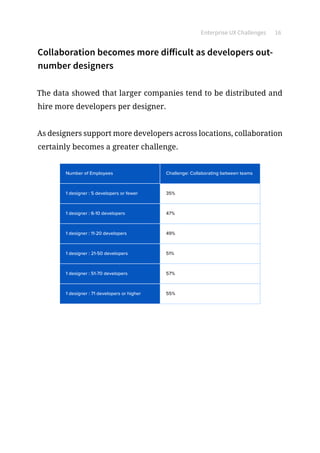
The data showed that larger companies tend to be distributed and
hire more developers per designer.
As designers support more developers across locations, collaboration
certainly becomes a greater challenge.
1 designer : 5 developers or fewer
Number of Employees
1 designer : 6-10 developers
1 designer : 11-20 developers
1 designer : 21-50 developers
1 designer : 51-70 developers
35%
Challenge: Collaborating between teams
47%
49%
51%
57%
1 designer : 71 developers or higher 55%
Product Development Process
Nearly 17 years after the introduction of the Agile manifesto and 5
years after the introduction of Agile UX, the prevalence of collabo-
rative methodologies is undeniable.
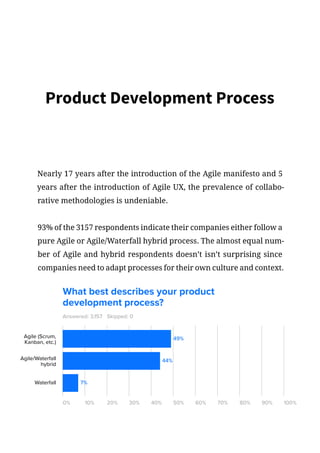
93% of the 3157 respondents indicate their companies either follow a
pure Agile or Agile/Waterfall hybrid process. The almost equal num-
ber of Agile and hybrid respondents doesn’t isn’t surprising since
companies need to adapt processes for their own culture and context.
Answered: 3,157
0% 10% 20% 30% 40% 50% 60% 70% 80% 90% 100%
Agile (Scrum,
Kanban, etc.)
Agile/Waterfall
hybrid
Waterfall
44%
49%
7%
Skipped: 0
What best describes your product
development process?
Product Development Process 18
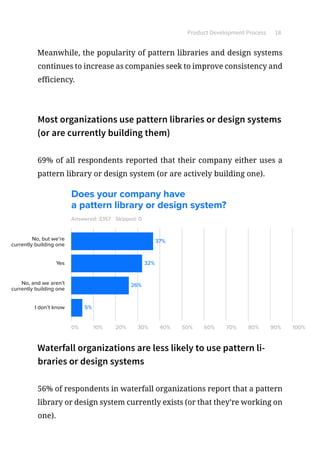
Meanwhile, the popularity of pattern libraries and design systems
continues to increase as companies seek to improve consistency and
efficiency.
Most organizations use pattern libraries or design systems
(or are currently building them)
69% of all respondents reported that their company either uses a
pattern library or design system (or are actively building one).
Answered: 3,157
0% 10% 20% 30% 40% 50% 60% 70% 80% 90% 100%
No, but we’re
currently building one
Yes
No, and we aren’t
currently building one
32%
37%
26%
I don’t know 5%
Skipped: 0
Does your company have
a pattern library or design system?
Waterfall organizations are less likely to use pattern li-
braries or design systems
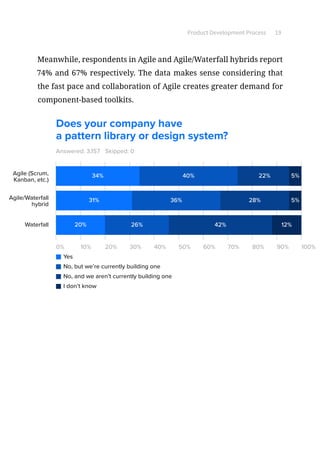
56% of respondents in waterfall organizations report that a pattern
library or design system currently exists (or that they’re working on
one).
Product Development Process 19
Meanwhile, respondents in Agile and Agile/Waterfall hybrids report
74% and 67% respectively. The data makes sense considering that
the fast pace and collaboration of Agile creates greater demand for
component-based toolkits.
Answered: 3,157
0% 10% 20% 30% 40% 50% 60% 70% 80% 90% 100%
Agile (Scrum,
Kanban, etc.)
Agile/Waterfall
hybrid
Yes
No, but we’re currently building one
No, and we aren’t currently building one
I don’t know
Waterfall
31%
34% 40% 22%
28%
42%
5%
5%
12%
36%
26%20%
Skipped: 0
Does your company have
a pattern library or design system?
Product Development Process 20
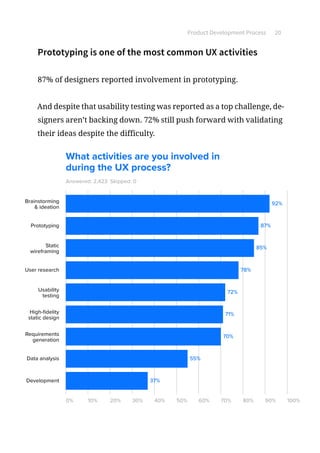
Prototyping is one of the most common UX activities
87% of designers reported involvement in prototyping.
And despite that usability testing was reported as a top challenge, de-
signers aren’t backing down. 72% still push forward with validating
their ideas despite the difficulty.
Answered: 2,423
0% 10% 20% 30% 40% 50% 60% 70% 80% 90% 100%
Brainstorming
 ideation
Prototyping
Static
wireframing
User research
Usability
testing
High-fidelity
static design
Requirements
generation
87%
92%
85%
78%
72%
71%
70%
Data analysis 55%
Development 37%
Skipped: 0
What activities are you involved in
during the UX process?
Product Platforms
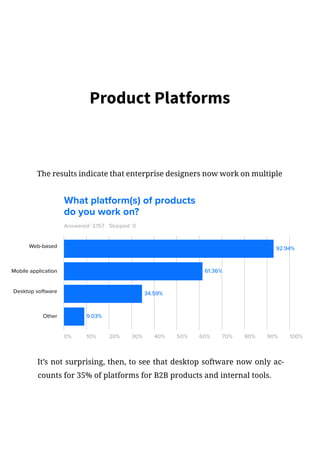
The results indicate that enterprise designers now work on multiple
platforms. Cloud products, however, remain the most popular.
Answered: 3,157
0% 10% 20% 30% 40% 50% 60% 70% 80% 90% 100%
Web-based
Mobile application
Desktop software
61.36%
92.94%
34.59%
Other 9.03%
Skipped: 0
What platform(s) of products
do you work on?
It’s not surprising, then, to see that desktop software now only ac-
counts for 35% of platforms for B2B products and internal tools.
Design Leadership
To explore design leadership, we zoomed in on respondents who
reported titles of manager/supervisor, director, VP, or C-level. Their
areas of focus include UX/product design, interaction design, visual
design, IA architect, or UX researcher.
The following represents 1167 design leader respondents (37% of
respondents from all roles).
Face similar challenges as individual contributors
Similar to responses of individual contributors, the top challenges
faced by enterprise UX leaders include:
1.	 Improving UX consistency (56%)
2.	 Testing designs with end-users (52%)
3.	 Clarifying requirements (45%)
4.	 Collaborating between teams (44%)
Design Leadership 23
Answered: 3,157
0% 10% 20% 30% 40% 50% 60% 70% 80% 90% 100%
Improving UX
consistency
Testing designs
with users
Clarifying
requirements
Collaborating
between teams
Legacy
technology
Securing UX budget
or resources
Getting buy-in
or understanding
from executives
53.22%
59.08%
46.34%
44.19%
40.86%
39.66%
37.57%
Handing designs off
to developers
34.40%
Other (please
specify) 6.84%
Skipped: 0
What challenges do you currently
face in your UX process?
Design Leadership 24
Mostly self-taught
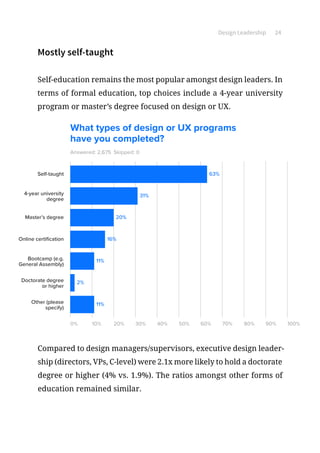
Self-education remains the most popular amongst design leaders. In
terms of formal education, top choices include a 4-year university
program or master’s degree focused on design or UX.
Answered: 2,675
0% 10% 20% 30% 40% 50% 60% 70% 80% 90% 100%
Self-taught
4-year university
degree
Master’s degree
Online certification
Bootcamp (e.g.
General Assembly)
Doctorate degree
or higher
Other (please
specify)
31%
63%
20%
16%
11%
2%
11%
Skipped: 0
What types of design or UX programs
have you completed?
Compared to design managers/supervisors, executive design leader-
ship (directors, VPs, C-level) were 2.1x more likely to hold a doctorate
degree or higher (4% vs. 1.9%). The ratios amongst other forms of
education remained similar.
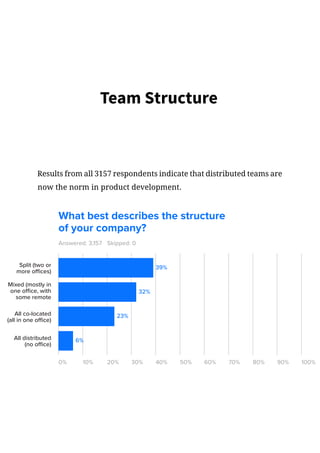
Team Structure
Results from all 3157 respondents indicate that distributed teams are
now the norm in product development.
Answered: 3,157
0% 10% 20% 30% 40% 50% 60% 70% 80% 90% 100%
Split (two or
more offices)
Mixed (mostly in
one office, with
some remote
All co-located
(all in one office)
32%
39%
23%
All distributed
(no office)
6%
Skipped: 0
What best describes the structure
of your company?
Team Structure 26
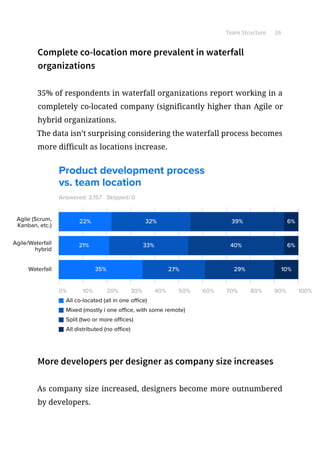
Complete co-location more prevalent in waterfall
organizations
35% of respondents in waterfall organizations report working in a
completely co-located company (significantly higher than Agile or
hybrid organizations.
The data isn’t surprising considering the waterfall process becomes
more difficult as locations increase.
Answered: 3,157
0% 10% 20% 30% 40% 50% 60% 70% 80% 90% 100%
Agile (Scrum,
Kanban, etc.)
Agile/Waterfall
hybrid
All co-located (all in one office)
Mixed (mostly i one office, with some remote)
Split (two or more offices)
All distributed (no office)
Waterfall
21%
22% 32% 39%
40%
29%
6%
6%
10%
33%
27%35%
Skipped: 0
Product development process
vs. team location
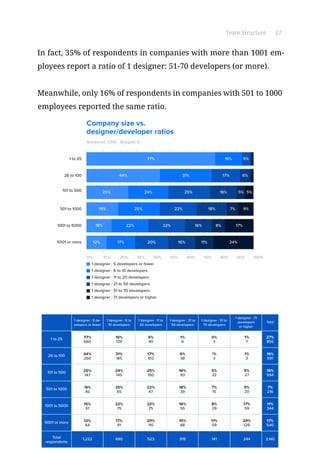
More developers per designer as company size increases
As company size increased, designers become more outnumbered
by developers.
Team Structure 27
In fact, 35% of respondents in companies with more than 1001 em-
ployees report a ratio of 1 designer: 51-70 developers (or more).
Meanwhile, only 16% of respondents in companies with 501 to 1000
employees reported the same ratio.
Answered: 3,140
0% 10% 20% 30% 40% 50% 60% 70% 80% 90% 100%
1 to 25
26 to 100
1 designer : 6 to 10 developers
1 designer : 11 to 20 developers
1 designer : 21 to 50 developers
1 designer : 51 to 70 developers
101 to 500
501 to 1000
1001 to 5000
5001 or more
77% 16%
17%
5%
6%44% 31%
1 designer : 71 developers or higher
1 designer : 5 developers or fewer
7%19% 25%
25% 25%
9%
5%5%
8%16%
16%
17%
24%
24%
11%11%
Skipped: 0
16%20%17%12%
22%
22% 18%
22%15%
Company size vs.
designer/developer ratios
Total
27%
855
19%
591
19%
594
7%
216
11%
344
17%
540
3,140
1 to 25
26 to 100
101 to 500
501 to 1000
1001 to 5000
5001 or more
Total
respondents
1 designer : 5 de-
velopers or fewer
1 designer : 6 to
10 developers
1 designer : 11 to
20 developers
1 designer : 21 to
50 developers
1 designer : 51 to
70 developers
1 designer : 71
developers
or higher
77%
660
44%
260
25%
147
19%
40
15%
51
12%
64
16%
139
16%
139
31%
185
31%
185
24%
145
25%
55
25%
55
22%
75
17%
91
5%
40
17%
102
25%
150
22%
47
22%
75
20%
110
20%
110
1%
6
6%
38
16%
93
18%
39
16%
55
15%
88
0%
3
1%
3
5%
32
5%
32
7%
15
8%
29
11%
59
1%
7
1%
3
5%
27
9%
20
17%
59
24%
128
1,222 690 523 319 141 244
Team Structure 28
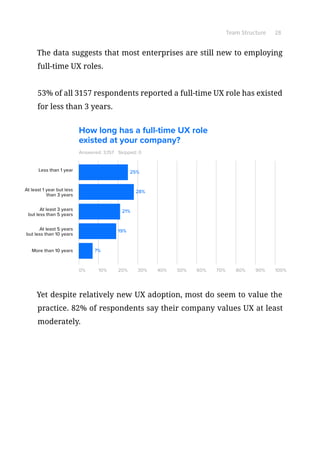
The data suggests that most enterprises are still new to employing
full-time UX roles.
53% of all 3157 respondents reported a full-time UX role has existed
for less than 3 years.
Answered: 3,157
0% 10% 20% 30% 40% 50% 60% 70% 80% 90% 100%
Less than 1 year
At least 1 year but less
than 3 years
At least 3 years
but less than 5 years
At least 5 years
but less than 10 years
More than 10 years
28%
25%
21%
19%
7%
Skipped: 0
How long has a full-time UX role
existed at your company?
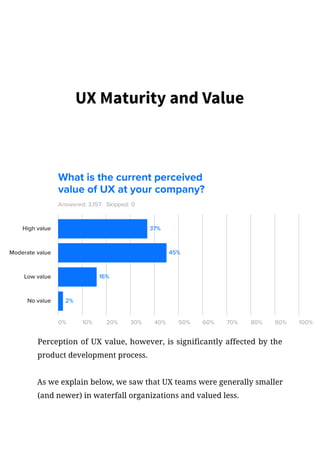
Yet despite relatively new UX adoption, most do seem to value the
practice. 82% of respondents say their company values UX at least
moderately.
UX Maturity and Value
Answered: 3,157
0% 10% 20% 30% 40% 50% 60% 70% 80% 90% 100%
High value
Moderate value
Low value
45%
37%
16%
No value 2%
Skipped: 0
What is the current perceived
value of UX at your company?
Perception of UX value, however, is significantly affected by the
product development process.
As we explain below, we saw that UX teams were generally smaller
(and newer) in waterfall organizations and valued less.
UX Maturity and Value 30
Full-time UX roles are newer to waterfall vs. Agile compa-
nies
•	
Answered: 3,157
0% 10% 20% 30% 40% 50% 60% 70% 80% 90% 100%
Waterfall orgs
23%
43%
18%
12%
5%
Skipped: 0
How long has your company had at least
one full-time UX role?
At least 1 year but less than 3 years
At least 3 years but less than 5 years
At least 5 years but less than 10 years
More than 10 years
Less than 1 year
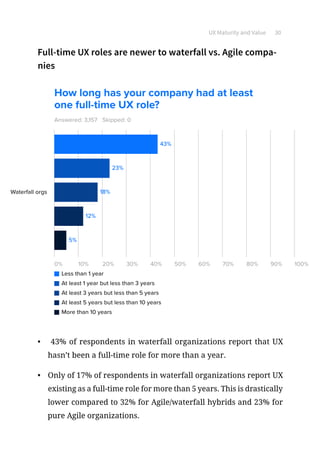
43% of respondents in waterfall organizations report that UX
hasn’t been a full-time role for more than a year.
•	 Only of 17% of respondents in waterfall organizations report UX
existing as a full-time role for more than 5 years. This is drastically
lower compared to 32% for Agile/waterfall hybrids and 23% for
pure Agile organizations.
UX Maturity and Value 31
Most waterfall organizations employ less than 5 full-time
UX roles
•	
Answered: 2,675
0% 10% 20% 30% 40% 50% 60% 70% 80% 90% 100%
Agile (Scrum,
Kanban, etc.)
Agile/Waterfall
hybrid
0
1 to 5
6 to 15
16 to 30
Waterfall
10%
10% 58% 16%
16%
7%
5% 11%
13%
4%
8%
31 or more
3%
54%
56%29%
Skipped: 0
Product development process
vs. full-time UX roles
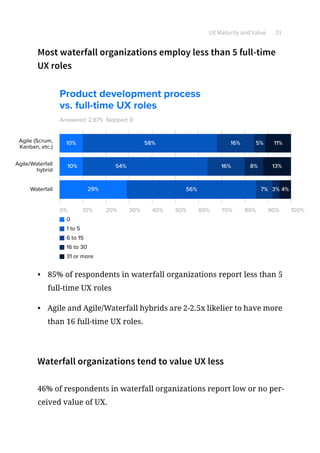
85% of respondents in waterfall organizations report less than 5
full-time UX roles
•	 Agile and Agile/Waterfall hybrids are 2-2.5x likelier to have more
than 16 full-time UX roles.
Waterfall organizations tend to value UX less
46% of respondents in waterfall organizations report low or no per-
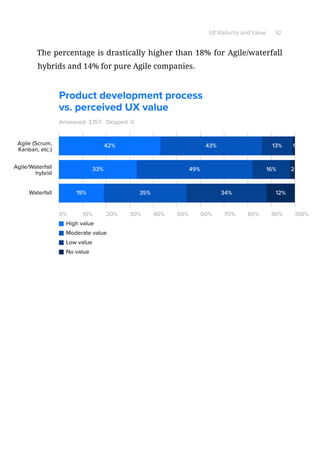
ceived value of UX.
UX Maturity and Value 32
The percentage is drastically higher than 18% for Agile/waterfall
hybrids and 14% for pure Agile companies.
Answered: 3,157
0% 10% 20% 30% 40% 50% 60% 70% 80% 90% 100%
Agile (Scrum,
Kanban, etc.)
Agile/Waterfall
hybrid
High value
Moderate value
Low value
No value
Waterfall
33%
42% 43% 13%
16%
34%
1
249%
35%19%
Skipped: 0
Product development process
vs. perceived UX value
12%
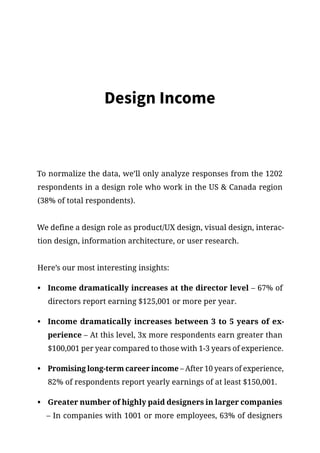
Design Income
To normalize the data, we’ll only analyze responses from the 1202
respondents in a design role who work in the US  Canada region
(38% of total respondents).
We define a design role as product/UX design, visual design, interac-
tion design, information architecture, or user research.
Here’s our most interesting insights:
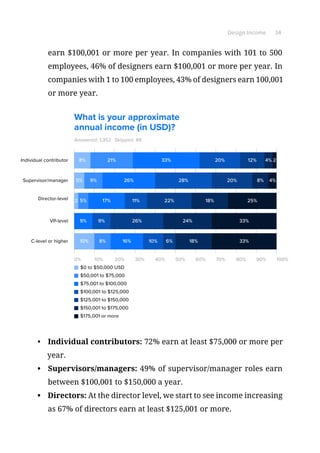
•	 Income dramatically increases at the director level – 67% of
directors report earning $125,001 or more per year.
•	 Income dramatically increases between 3 to 5 years of ex-
perience – At this level, 3x more respondents earn greater than
$100,001 per year compared to those with 1-3 years of experience.
•	 Promising long-term career income – After 10 years of experience,
82% of respondents report yearly earnings of at least $150,001.
•	 Greater number of highly paid designers in larger companies
– In companies with 1001 or more employees, 63% of designers
Design Income 34
earn $100,001 or more per year. In companies with 101 to 500
employees, 46% of designers earn $100,001 or more per year. In
companies with 1 to 100 employees, 43% of designers earn 100,001
or more year.
•	
Answered: 1,352
0% 10% 20% 30% 40% 50% 60% 70% 80% 90% 100%
Individual contributor
Supervisor/manager
$75,001 to $100,000
$100,001 to $125,000
$125,001 to $150,000
$150,001 to $175,000
Director-level
VP-level
C-level or higher
21%8% 33% 20%
20%28%
4%
4%
12% 2
8%9%5%
5%
26%
$175,001 or more
$50,001 to $75,000
24%9% 9%
17%2 11%
10%
33%
33%
25%18%
18%6%16%
22%
Skipped: 49
$0 to $50,000 USD
26%
8%10%
What is your approximate
annual income (in USD)?
Individual contributors: 72% earn at least $75,000 or more per
year.
•	 Supervisors/managers: 49% of supervisor/manager roles earn
between $100,001 to $150,000 a year.
•	 Directors: At the director level, we start to see income increasing
as 67% of directors earn at least $125,001 or more.
Design Income 35
•	 VPs: At the VP level, income drastically increases with 58% of re-
spondents earning at least $150,001 or more.
•	 C-level or higher: Interestingly enough, we see more lower in-
come ranges among CEOs than any other group surveyed. In fact,
9.8% of the C suite reported incomes of $0 to $50,000. However,
since 30% still earn at least $175,001 or more, the data leads us to
believe that the C-suite likely earns higher cash salary or takes a
lower salary but significantly higher equity.
Design Income 36
Income By Function
What is your approximate
annual income (in USD)?
Answered: 1,352
0% 10% 20% 30% 40% 50% 60% 70% 80% 90% 100%
$75,001 to $100,000
$100,001 to $125,000
$125,001 to $150,000
$150,001 to $175,000
23%16% 29% 15%
17%19%
4%
6%
8% 5%
5%18%7%
13%
29%
$175,001 or more
$50,001 to $75,000
27% 23%
30%2% 23%
18%
9%9%
19%
8%10%
16%17%16%
15%
Skipped: 49
$0 to $50,000 USD
21%
10%3%
Less than 1 year
At least 1 year but less
than 3 years
At least 3 years
but less than 5 years
At least 5 years
but less than 10 years
More than 10 years
9%3%
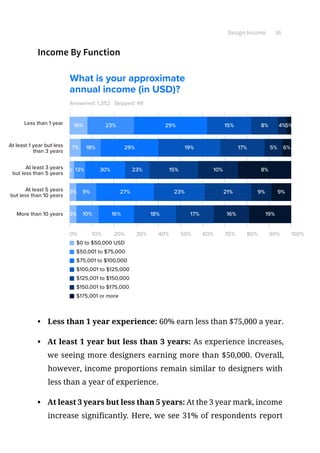
•	 Less than 1 year experience: 60% earn less than $75,000 a year.
•	 At least 1 year but less than 3 years: As experience increases,
we seeing more designers earning more than $50,000. Overall,
however, income proportions remain similar to designers with
less than a year of experience.
•	 At least 3 years but less than 5 years: At the 3 year mark, income
increase significantly. Here, we see 31% of respondents report
Conclusion
incomes of at least $100,001 per year.
•	 At least 5 years but less than 10 years: Compared to the previ-
ous level of experience, we now see 3x more respondents earn
$125,001 -150,000 per year.
•	 10 years or more: 58% of highly experienced design profession-
als (either principal contributors or leadership) will earn at least
$125,001 per year. Compared to the previous level of experience,
5x more respondents in this bracket earn $150,001 or more.
Conclusion 38
With UX spreading across the enterprise, more teams experience the
growing pains of scaling design culture and processes.
•	 Design consistency, usability testing, and clear requirements re-
main pressing issues with majority of respondents.
•	 Designers per developer decreases as company size increases.
•	 Over half of respondents indicated that a full-time UX role was
just introduced in the past 3 years.
Product teams, however, are quickly adapting to enterprise sprawl
with more collaborative processes and toolkits. Nearly 70% of re-
spondents report using a design system and over 90% follow some
form of Agile methods.
Enterprises are finally facing the reality that business users expect
the same quality of experience as consumer products. While trans-
formation won’t happen overnight, the future certainly looks prom-
ising. As UX continues to evolve as a core business competency, so too
will the processes and platforms that support collaborative product
development.
Enterprise UX Industry Report 2017–2018

Enterprise UX Industry Report 2017–2018

  • 1.
  • 2.
    Copyright © 2017by UXPin Inc. All rights reserved. No part of this publication text may be uploaded or posted online without the prior written permission of the publisher. For permission requests, write to the publisher, addressed “Attention: Permissions Request,” to hello@uxpin.com. Enterprise UX Industry Report 2017 to 2018
  • 3.
    Index Introduction6 UX Background andExperience 8 Most enterprise designers are self-taught 9 Enterprise designers are fairly experienced 9 Majority of enterprise designers are in-house 10 Significantly more enterprise designers join massive companies after 3 years 10 Enterprise UX Challenges 12 Legacy technology issues increase with company size 13 UX consistency is an almost universal challenge 13 Executive buy-in becomes a greater challenge as company size increases 15 Collaboration becomes more difficult as developers outnumber designers 16 Product Development Process 17 Most organizations use pattern libraries or design systems (or are currently building them) 18 Waterfall organizations are less likely to use pattern libraries or design systems 18 Prototyping is one of the most common UX activities 20
  • 4.
    Product Platforms 21 DesignLeadership 22 Mostly self-taught 24 Team Structure 25 Complete co-location more prevalent in waterfall organizations 26 More developers per designer as company size increases 26 UX Maturity and Value 29 Full-time UX roles are newer to waterfall vs. Agile companies 30 Most waterfall organizations employ less than 5 full-time UX roles 31 Waterfall organizations tend to value UX less 31 Design Income 33 Income By Function 36 Conclusion37
  • 5.
    Marcin Treder Since co-foundingUXPin in 2010, he has helped build and lead prod- uct teams in the Poland and Silicon Valley office. Previously, he was a UX Manager at Grupa Nokaut, an enterprise ecommerce platform. He holds an M.A. in Psychology from the University of Gdansk. Jerry Cao Jerry Cao is a content strategist at UXPin where he gets to put his over- ly active imagination to paper every day. In a past life, he developed content strategies for clients at Brafton and worked in traditional ad- vertising at DDB San Francisco. In his spare time he enjoys playing elec- tric guitar, watching foreign horror films, and expanding his knowledge of random facts. Follow me on Twitter Vince Ho Before joining UXPin in 2016 Vincent was a Sr. Research Analyst at a fi- nancial institution responsible for the company’s quantitative research design / deployment and analysis. He is currently the Data Analyst at UXPin supporting the Sales, Marketing, and Product teams in measur- ing key metrics and discovering meaningful patterns. Authors
  • 6.
    Introduction In the worldof enterprise products, UX has historically been an af- terthought. Product teams were engineering-driven. Functionality came before usability or usefulness. Buyer needs superseded those of end-users. While the issues of legacy technology, bureaucracy, and complex use cases still exist, the status quo is changing. We are undoubtedly in the midst of an enterprise UX renaissance. Startups like Gusto, Stripe, and Slack are setting the expectation that business products should be useful, usable, and satisfying. Meanwhile, large organizations like IBM, GE, and Salesforce are prioritizing design as a competitive advantage by hiring thousands of designers to reshape processes and culture. At UXPin, we’ve seen this transformation firsthand amongst our customers. As design thinking comes of age, more enterprise teams are seeking the right tools and processes to deliver on the promise of design-driven product development.
  • 7.
    Introduction 7 In thisreport, we aim to illuminate a rapidly expanding and evolving sector. What challenges do teams face? How are the product teams structured? Are enterprises really becoming more Agile, or do they still abide by waterfall methods? Answered: 3,157 0% 10% 20% 30% 40% 50% 60% 70% 80% 90% 100% United States or Canada Europe Asia Latin America Australia Middle East Africa 34% 44% 9% 5% 4% 2% 2% Skipped: 0 In what region do you work? In total, 3,157 people from around the world answered. What follows is the first report of its kind to dive deep into one of the most prom- ising (and profitable) UX opportunities of the past decade. Jerry Cao, Vince Ho, and Marcin Treder
  • 8.
    UX Background andExperience 2675 of the 3157 respondents reported that their roles were either UX/product design, interaction design, visual design, information architecture, or user research. Answered: 3,157 0% 10% 20% 30% 40% 50% 60% 70% 80% 90% 100% UX/Product Designer UI Designer Product Manager Developer Visual Designer Interaction Designer UX Researcher 11% 43% 8% 7% 7% 7% 5% Information Architect Other 3% 8% Skipped: 0 What best describes your role?
  • 9.
    UX Background andExperience 9 Most enterprise designers are self-taught Answered: 1,167 0% 10% 20% 30% 40% 50% 60% 70% 80% 90% 100% Self-taught 4-year university degree Master’s degree Online certification Bootcamp (e.g. General Assembly) Doctorate degree or higher 31.53% 65.38% 20.57% 16.97% 11.14% 2.83% Other (please specify) 9.77% Skipped: 0 What types of design or UX programs have you completed? Enterprise designers are fairly experienced The majority of respondents (53%) reported at least 5 years of UX experience. Answered: 2,675 0% 10% 20% 30% 40% 50% 60% 70% 80% 90% 100% 10 years or more At least 5 years but less than 10 years At least 3 years but less than 5 years At least 1 year but less than 3 years Less than 1 year 25% 28% 21% 20% 6% Skipped: 0 How many years of UX experience do you have?
  • 10.
    UX Background andExperience 10 Majority of enterprise designers are in-house When focusing on just the 2675 designer respondents, we see that 59% work in-house. 0% 10% 20% 30% 40% 50% 60% 70% 80% 90% 100% In-house Agency Independent consultant/freelance Other 23% 59% 13% 5% Significantly more enterprise designers join massive companies after 3 years Starting at the 3 year mark, over twice as many designers work in companies with 5001+ employees compared to the previous experi- ence level. Less than 1 year experience At least 1 year but less than 3 years experience At least 3 years but less than 5 years experience At least 5 years but less than 10 years experience More than 10 years experience 7% Company has 5001+ employees 10% 20% 30% 45%
  • 11.
    UX Background andExperience 11 Yet after 10 years of experience, a higher percentage of designers join small companies (or go independent) compared to the previous two levels. Less than 1 year experience At least 1 year but less than 3 years experience At least 3 years but less than 5 years experience At least 5 years but less than 10 years experience More than 10 years experience 42% Company has 1-25 employees 26% 20% 14% 23%
  • 12.
    Enterprise UX Challenges 3157respondents reported that top challenges included: 1. Improving UX consistency (59%) 2. Testing designs with end-users (53%) 3. Clarifying requirements (46%) 4. Collaborating between teams (44%) Answered: 3,157 0% 10% 20% 30% 40% 50% 60% 70% 80% 90% 100% Improving UX consistency Testing designs with users Clarifying requirements Collaborating between teams Legacy technology Securing UX budget or resources Getting buy-in or understanding from executives 53.22% 59.08% 46.34% 44.19% 40.86% 39.66% 37.57% Handing designs off to developers 34.40% Other (please specify) 6.84% Skipped: 0 What challenges do you currently face in your UX process?
  • 13.
    Enterprise UX Challenges13 Let’s explore some major trends below. Legacy technology issues increase with company size 61% of respondents in companies with 5001 or more employees re- port legacy technology as a UX challenge. Meanwhile, only 33% of respondents in companies with 26 to 100 employees reported the same challenge. 1 to 25 Number of Employees 26 to 100 101 to 500 501 to 1000 1001 to 5000 23% Challenge: Legacy technology 33% 45% 53% 54% 5001 or more 61% UX consistency is an almost universal challenge The data indicates that improving design consistency becomes a significant challenge once a company grows beyond 25 employees.
  • 14.
    Enterprise UX Challenges14 The results aren’t surprising since poor product consistency is a by- product of poor communication and collaboration (both of which become increasingly difficult with distance). 1 to 25 Number of Employees 26 to 100 101 to 500 501 to 1000 1001 to 5000 49% Challenge: Improving UX consistency 62% 64% 64% 62% 5001 or more 63%
  • 15.
    Enterprise UX Challenges15 Executive buy-in becomes a greater challenge as company size increases Almost half of all respondents from companies with 5001 or more employees reported that executive buy-in and understanding of UX as a challenge. 1 to 25 Number of Employees 26 to 100 101 to 500 501 to 1000 1001 to 5000 27% Challenge: Getting UX buy-in or understanding from executives 34% 40% 41% 47% 5001 or more 49%
  • 16.
    Enterprise UX Challenges16 Collaboration becomes more difficult as developers out- number designers The data showed that larger companies tend to be distributed and hire more developers per designer. As designers support more developers across locations, collaboration certainly becomes a greater challenge. 1 designer : 5 developers or fewer Number of Employees 1 designer : 6-10 developers 1 designer : 11-20 developers 1 designer : 21-50 developers 1 designer : 51-70 developers 35% Challenge: Collaborating between teams 47% 49% 51% 57% 1 designer : 71 developers or higher 55%
  • 17.
    Product Development Process Nearly17 years after the introduction of the Agile manifesto and 5 years after the introduction of Agile UX, the prevalence of collabo- rative methodologies is undeniable. 93% of the 3157 respondents indicate their companies either follow a pure Agile or Agile/Waterfall hybrid process. The almost equal num- ber of Agile and hybrid respondents doesn’t isn’t surprising since companies need to adapt processes for their own culture and context. Answered: 3,157 0% 10% 20% 30% 40% 50% 60% 70% 80% 90% 100% Agile (Scrum, Kanban, etc.) Agile/Waterfall hybrid Waterfall 44% 49% 7% Skipped: 0 What best describes your product development process?
  • 18.
    Product Development Process18 Meanwhile, the popularity of pattern libraries and design systems continues to increase as companies seek to improve consistency and efficiency. Most organizations use pattern libraries or design systems (or are currently building them) 69% of all respondents reported that their company either uses a pattern library or design system (or are actively building one). Answered: 3,157 0% 10% 20% 30% 40% 50% 60% 70% 80% 90% 100% No, but we’re currently building one Yes No, and we aren’t currently building one 32% 37% 26% I don’t know 5% Skipped: 0 Does your company have a pattern library or design system? Waterfall organizations are less likely to use pattern li- braries or design systems 56% of respondents in waterfall organizations report that a pattern library or design system currently exists (or that they’re working on one).
  • 19.
    Product Development Process19 Meanwhile, respondents in Agile and Agile/Waterfall hybrids report 74% and 67% respectively. The data makes sense considering that the fast pace and collaboration of Agile creates greater demand for component-based toolkits. Answered: 3,157 0% 10% 20% 30% 40% 50% 60% 70% 80% 90% 100% Agile (Scrum, Kanban, etc.) Agile/Waterfall hybrid Yes No, but we’re currently building one No, and we aren’t currently building one I don’t know Waterfall 31% 34% 40% 22% 28% 42% 5% 5% 12% 36% 26%20% Skipped: 0 Does your company have a pattern library or design system?
  • 20.
    Product Development Process20 Prototyping is one of the most common UX activities 87% of designers reported involvement in prototyping. And despite that usability testing was reported as a top challenge, de- signers aren’t backing down. 72% still push forward with validating their ideas despite the difficulty. Answered: 2,423 0% 10% 20% 30% 40% 50% 60% 70% 80% 90% 100% Brainstorming ideation Prototyping Static wireframing User research Usability testing High-fidelity static design Requirements generation 87% 92% 85% 78% 72% 71% 70% Data analysis 55% Development 37% Skipped: 0 What activities are you involved in during the UX process?
  • 21.
    Product Platforms The resultsindicate that enterprise designers now work on multiple platforms. Cloud products, however, remain the most popular. Answered: 3,157 0% 10% 20% 30% 40% 50% 60% 70% 80% 90% 100% Web-based Mobile application Desktop software 61.36% 92.94% 34.59% Other 9.03% Skipped: 0 What platform(s) of products do you work on? It’s not surprising, then, to see that desktop software now only ac- counts for 35% of platforms for B2B products and internal tools.
  • 22.
    Design Leadership To exploredesign leadership, we zoomed in on respondents who reported titles of manager/supervisor, director, VP, or C-level. Their areas of focus include UX/product design, interaction design, visual design, IA architect, or UX researcher. The following represents 1167 design leader respondents (37% of respondents from all roles). Face similar challenges as individual contributors Similar to responses of individual contributors, the top challenges faced by enterprise UX leaders include: 1. Improving UX consistency (56%) 2. Testing designs with end-users (52%) 3. Clarifying requirements (45%) 4. Collaborating between teams (44%)
  • 23.
    Design Leadership 23 Answered:3,157 0% 10% 20% 30% 40% 50% 60% 70% 80% 90% 100% Improving UX consistency Testing designs with users Clarifying requirements Collaborating between teams Legacy technology Securing UX budget or resources Getting buy-in or understanding from executives 53.22% 59.08% 46.34% 44.19% 40.86% 39.66% 37.57% Handing designs off to developers 34.40% Other (please specify) 6.84% Skipped: 0 What challenges do you currently face in your UX process?
  • 24.
    Design Leadership 24 Mostlyself-taught Self-education remains the most popular amongst design leaders. In terms of formal education, top choices include a 4-year university program or master’s degree focused on design or UX. Answered: 2,675 0% 10% 20% 30% 40% 50% 60% 70% 80% 90% 100% Self-taught 4-year university degree Master’s degree Online certification Bootcamp (e.g. General Assembly) Doctorate degree or higher Other (please specify) 31% 63% 20% 16% 11% 2% 11% Skipped: 0 What types of design or UX programs have you completed? Compared to design managers/supervisors, executive design leader- ship (directors, VPs, C-level) were 2.1x more likely to hold a doctorate degree or higher (4% vs. 1.9%). The ratios amongst other forms of education remained similar.
  • 25.
    Team Structure Results fromall 3157 respondents indicate that distributed teams are now the norm in product development. Answered: 3,157 0% 10% 20% 30% 40% 50% 60% 70% 80% 90% 100% Split (two or more offices) Mixed (mostly in one office, with some remote All co-located (all in one office) 32% 39% 23% All distributed (no office) 6% Skipped: 0 What best describes the structure of your company?
  • 26.
    Team Structure 26 Completeco-location more prevalent in waterfall organizations 35% of respondents in waterfall organizations report working in a completely co-located company (significantly higher than Agile or hybrid organizations. The data isn’t surprising considering the waterfall process becomes more difficult as locations increase. Answered: 3,157 0% 10% 20% 30% 40% 50% 60% 70% 80% 90% 100% Agile (Scrum, Kanban, etc.) Agile/Waterfall hybrid All co-located (all in one office) Mixed (mostly i one office, with some remote) Split (two or more offices) All distributed (no office) Waterfall 21% 22% 32% 39% 40% 29% 6% 6% 10% 33% 27%35% Skipped: 0 Product development process vs. team location More developers per designer as company size increases As company size increased, designers become more outnumbered by developers.
  • 27.
    Team Structure 27 Infact, 35% of respondents in companies with more than 1001 em- ployees report a ratio of 1 designer: 51-70 developers (or more). Meanwhile, only 16% of respondents in companies with 501 to 1000 employees reported the same ratio. Answered: 3,140 0% 10% 20% 30% 40% 50% 60% 70% 80% 90% 100% 1 to 25 26 to 100 1 designer : 6 to 10 developers 1 designer : 11 to 20 developers 1 designer : 21 to 50 developers 1 designer : 51 to 70 developers 101 to 500 501 to 1000 1001 to 5000 5001 or more 77% 16% 17% 5% 6%44% 31% 1 designer : 71 developers or higher 1 designer : 5 developers or fewer 7%19% 25% 25% 25% 9% 5%5% 8%16% 16% 17% 24% 24% 11%11% Skipped: 0 16%20%17%12% 22% 22% 18% 22%15% Company size vs. designer/developer ratios Total 27% 855 19% 591 19% 594 7% 216 11% 344 17% 540 3,140 1 to 25 26 to 100 101 to 500 501 to 1000 1001 to 5000 5001 or more Total respondents 1 designer : 5 de- velopers or fewer 1 designer : 6 to 10 developers 1 designer : 11 to 20 developers 1 designer : 21 to 50 developers 1 designer : 51 to 70 developers 1 designer : 71 developers or higher 77% 660 44% 260 25% 147 19% 40 15% 51 12% 64 16% 139 16% 139 31% 185 31% 185 24% 145 25% 55 25% 55 22% 75 17% 91 5% 40 17% 102 25% 150 22% 47 22% 75 20% 110 20% 110 1% 6 6% 38 16% 93 18% 39 16% 55 15% 88 0% 3 1% 3 5% 32 5% 32 7% 15 8% 29 11% 59 1% 7 1% 3 5% 27 9% 20 17% 59 24% 128 1,222 690 523 319 141 244
  • 28.
    Team Structure 28 Thedata suggests that most enterprises are still new to employing full-time UX roles. 53% of all 3157 respondents reported a full-time UX role has existed for less than 3 years. Answered: 3,157 0% 10% 20% 30% 40% 50% 60% 70% 80% 90% 100% Less than 1 year At least 1 year but less than 3 years At least 3 years but less than 5 years At least 5 years but less than 10 years More than 10 years 28% 25% 21% 19% 7% Skipped: 0 How long has a full-time UX role existed at your company? Yet despite relatively new UX adoption, most do seem to value the practice. 82% of respondents say their company values UX at least moderately.
  • 29.
    UX Maturity andValue Answered: 3,157 0% 10% 20% 30% 40% 50% 60% 70% 80% 90% 100% High value Moderate value Low value 45% 37% 16% No value 2% Skipped: 0 What is the current perceived value of UX at your company? Perception of UX value, however, is significantly affected by the product development process. As we explain below, we saw that UX teams were generally smaller (and newer) in waterfall organizations and valued less.
  • 30.
    UX Maturity andValue 30 Full-time UX roles are newer to waterfall vs. Agile compa- nies • Answered: 3,157 0% 10% 20% 30% 40% 50% 60% 70% 80% 90% 100% Waterfall orgs 23% 43% 18% 12% 5% Skipped: 0 How long has your company had at least one full-time UX role? At least 1 year but less than 3 years At least 3 years but less than 5 years At least 5 years but less than 10 years More than 10 years Less than 1 year 43% of respondents in waterfall organizations report that UX hasn’t been a full-time role for more than a year. • Only of 17% of respondents in waterfall organizations report UX existing as a full-time role for more than 5 years. This is drastically lower compared to 32% for Agile/waterfall hybrids and 23% for pure Agile organizations.
  • 31.
    UX Maturity andValue 31 Most waterfall organizations employ less than 5 full-time UX roles • Answered: 2,675 0% 10% 20% 30% 40% 50% 60% 70% 80% 90% 100% Agile (Scrum, Kanban, etc.) Agile/Waterfall hybrid 0 1 to 5 6 to 15 16 to 30 Waterfall 10% 10% 58% 16% 16% 7% 5% 11% 13% 4% 8% 31 or more 3% 54% 56%29% Skipped: 0 Product development process vs. full-time UX roles 85% of respondents in waterfall organizations report less than 5 full-time UX roles • Agile and Agile/Waterfall hybrids are 2-2.5x likelier to have more than 16 full-time UX roles. Waterfall organizations tend to value UX less 46% of respondents in waterfall organizations report low or no per- ceived value of UX.
  • 32.
    UX Maturity andValue 32 The percentage is drastically higher than 18% for Agile/waterfall hybrids and 14% for pure Agile companies. Answered: 3,157 0% 10% 20% 30% 40% 50% 60% 70% 80% 90% 100% Agile (Scrum, Kanban, etc.) Agile/Waterfall hybrid High value Moderate value Low value No value Waterfall 33% 42% 43% 13% 16% 34% 1 249% 35%19% Skipped: 0 Product development process vs. perceived UX value 12%
  • 33.
    Design Income To normalizethe data, we’ll only analyze responses from the 1202 respondents in a design role who work in the US Canada region (38% of total respondents). We define a design role as product/UX design, visual design, interac- tion design, information architecture, or user research. Here’s our most interesting insights: • Income dramatically increases at the director level – 67% of directors report earning $125,001 or more per year. • Income dramatically increases between 3 to 5 years of ex- perience – At this level, 3x more respondents earn greater than $100,001 per year compared to those with 1-3 years of experience. • Promising long-term career income – After 10 years of experience, 82% of respondents report yearly earnings of at least $150,001. • Greater number of highly paid designers in larger companies – In companies with 1001 or more employees, 63% of designers
  • 34.
    Design Income 34 earn$100,001 or more per year. In companies with 101 to 500 employees, 46% of designers earn $100,001 or more per year. In companies with 1 to 100 employees, 43% of designers earn 100,001 or more year. • Answered: 1,352 0% 10% 20% 30% 40% 50% 60% 70% 80% 90% 100% Individual contributor Supervisor/manager $75,001 to $100,000 $100,001 to $125,000 $125,001 to $150,000 $150,001 to $175,000 Director-level VP-level C-level or higher 21%8% 33% 20% 20%28% 4% 4% 12% 2 8%9%5% 5% 26% $175,001 or more $50,001 to $75,000 24%9% 9% 17%2 11% 10% 33% 33% 25%18% 18%6%16% 22% Skipped: 49 $0 to $50,000 USD 26% 8%10% What is your approximate annual income (in USD)? Individual contributors: 72% earn at least $75,000 or more per year. • Supervisors/managers: 49% of supervisor/manager roles earn between $100,001 to $150,000 a year. • Directors: At the director level, we start to see income increasing as 67% of directors earn at least $125,001 or more.
  • 35.
    Design Income 35 • VPs: At the VP level, income drastically increases with 58% of re- spondents earning at least $150,001 or more. • C-level or higher: Interestingly enough, we see more lower in- come ranges among CEOs than any other group surveyed. In fact, 9.8% of the C suite reported incomes of $0 to $50,000. However, since 30% still earn at least $175,001 or more, the data leads us to believe that the C-suite likely earns higher cash salary or takes a lower salary but significantly higher equity.
  • 36.
    Design Income 36 IncomeBy Function What is your approximate annual income (in USD)? Answered: 1,352 0% 10% 20% 30% 40% 50% 60% 70% 80% 90% 100% $75,001 to $100,000 $100,001 to $125,000 $125,001 to $150,000 $150,001 to $175,000 23%16% 29% 15% 17%19% 4% 6% 8% 5% 5%18%7% 13% 29% $175,001 or more $50,001 to $75,000 27% 23% 30%2% 23% 18% 9%9% 19% 8%10% 16%17%16% 15% Skipped: 49 $0 to $50,000 USD 21% 10%3% Less than 1 year At least 1 year but less than 3 years At least 3 years but less than 5 years At least 5 years but less than 10 years More than 10 years 9%3% • Less than 1 year experience: 60% earn less than $75,000 a year. • At least 1 year but less than 3 years: As experience increases, we seeing more designers earning more than $50,000. Overall, however, income proportions remain similar to designers with less than a year of experience. • At least 3 years but less than 5 years: At the 3 year mark, income increase significantly. Here, we see 31% of respondents report
  • 37.
    Conclusion incomes of atleast $100,001 per year. • At least 5 years but less than 10 years: Compared to the previ- ous level of experience, we now see 3x more respondents earn $125,001 -150,000 per year. • 10 years or more: 58% of highly experienced design profession- als (either principal contributors or leadership) will earn at least $125,001 per year. Compared to the previous level of experience, 5x more respondents in this bracket earn $150,001 or more.
  • 38.
    Conclusion 38 With UXspreading across the enterprise, more teams experience the growing pains of scaling design culture and processes. • Design consistency, usability testing, and clear requirements re- main pressing issues with majority of respondents. • Designers per developer decreases as company size increases. • Over half of respondents indicated that a full-time UX role was just introduced in the past 3 years. Product teams, however, are quickly adapting to enterprise sprawl with more collaborative processes and toolkits. Nearly 70% of re- spondents report using a design system and over 90% follow some form of Agile methods. Enterprises are finally facing the reality that business users expect the same quality of experience as consumer products. While trans- formation won’t happen overnight, the future certainly looks prom- ising. As UX continues to evolve as a core business competency, so too will the processes and platforms that support collaborative product development.