THE UX LANDSCAPE
Cleveland UXPA
World Usability Day 2015
1
Me
I’ve built small and large UX
teams.
Co-founded the DFW UXPA
chapter in 2002.
UXPA International Board,
President 2008-2009.
Teach at Kent State’s UXD
program.
Provide user experience
research and design consulting.
I’m Going To Do All This In 15 Minutes…
The UX Landscape
The Continuing Challenge
(Part Of) The Solution
The UX Landscape
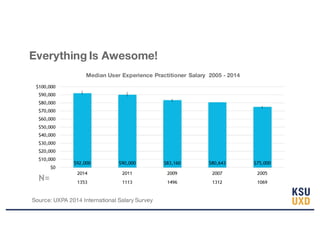
Everything Is Awesome!
Source: UXPA 2014 International Salary Survey
Median User Experience Practitioner Salary 2005 - 2014
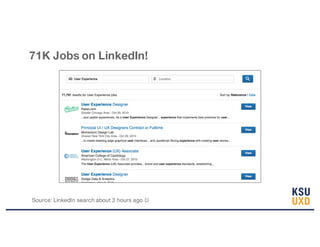
71K Jobs on LinkedIn!
Source: LinkedIn search about 3 hours ago J
So why do we still struggle
for relevance?
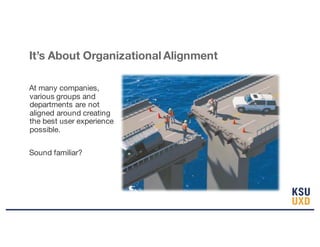
It’s About Organizational Alignment
At many companies,
various groups and
departments are not
aligned around creating
the best user experience
possible.
Sound familiar?
Time for a story.
At a former company, product
management asked my UX team to
conduct field research with small
businesses.
We identified an opportunity for an
accounting product that served
new value dimensions.
That’s awesome! Woo!
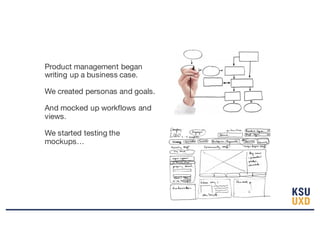
Product management began
writing up a business case.
We created personas and goals.
And mocked up workflows and
views.
We started testing the
mockups…
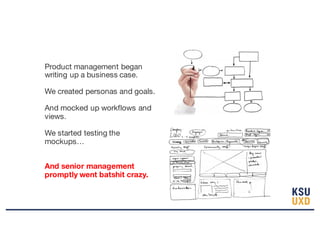
Product management began
writing up a business case.
We created personas and goals.
And mocked up workflows and
views.
We started testing the
mockups…
And senior management
promptly went batshit crazy.
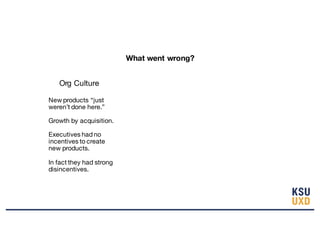
What went wrong?
Org Culture
New products “just
weren’t done here.”
Growth by acquisition.
Executives had no
incentives to create
new products.
In fact they had strong
disincentives.
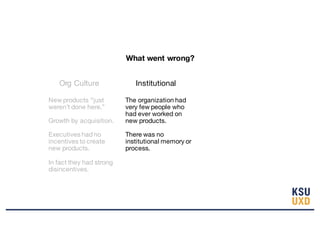
What went wrong?
Org Culture
New products “just
weren’t done here.”
Growth by acquisition.
Executives had no
incentives to create
new products.
In fact they had strong
disincentives.
Institutional
The organization had
very few people who
had ever worked on
new products.
There was no
institutional memory or
process.
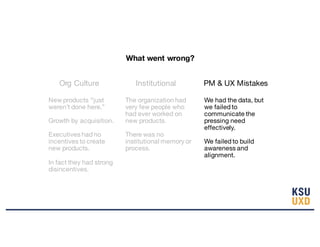
What went wrong?
Org Culture
New products “just
weren’t done here.”
Growth by acquisition.
Executives had no
incentives to create
new products.
In fact they had strong
disincentives.
Institutional
The organization had
very few people who
had ever worked on
new products.
There was no
institutional memory or
process.
PM & UX Mistakes
We had the data, but
we failed to
communicate the
pressing need
effectively.
We failed to build
awareness and
alignment.
Once we started showing the
prototype, it was perceived as
insubordinate and threatening.
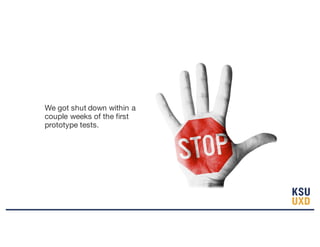
We got shut down within a
couple weeks of the first
prototype tests.
But organizational
cultures can be changed!
So I tried.
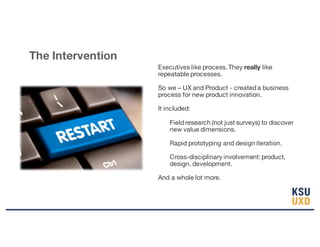
Executives like process. They really like
repeatable processes.
So we – UX and Product - created a business
process for new product innovation.
It included:
Field research (not just surveys) to discover
new value dimensions.
Rapid prototyping and design iteration.
Cross-disciplinary involvement: product,
design, development.
And a whole lot more.
The Intervention
Rapid contextual innovation – “RCI”
The “3-3-1” process
3 people
3 weeks
1 viable opportunity
We Even Had A Fancy Name…
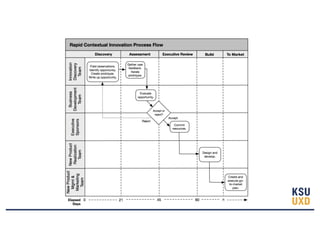
We even made a bad-ass
process map…
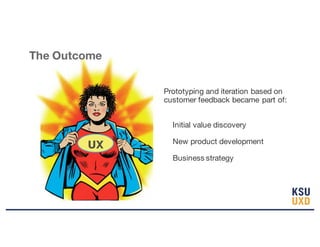
Prototyping and iteration based on
customer feedback became part of:
Initial value discovery
New product development
Business strategy
UX
UX
The Outcome
We moved UX up the
value creation chain.
We utilized our skills at
the front end of the
process…
On an equal footing with
product management and
development.
The Outcome
Our challenge as UX
professionals…
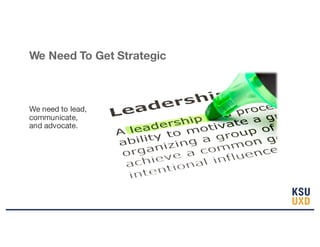
We Need To Get Strategic
We need to lead,
communicate,
and advocate.
So how do you “do”
strategic UX?
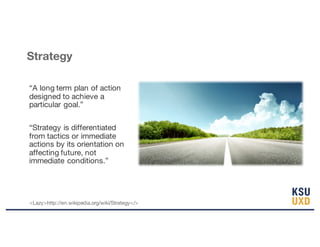
Strategy
“A long term plan of action
designed to achieve a
particular goal.”
“Strategy is differentiated
from tactics or immediate
actions by its orientation on
affecting future, not
immediate conditions.”
<Lazy>http://en.wikipedia.org/wiki/Strategy</>
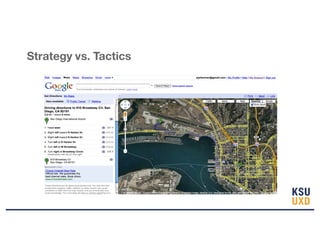
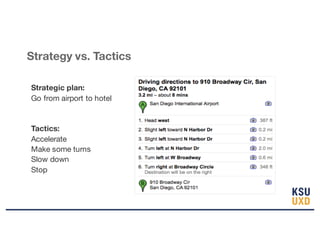
Strategy vs. Tactics
Strategic plan:
Go from airport to hotel
Tactics:
Accelerate
Make some turns
Slow down
Stop
Tactics are good techniques…
but only if you know where
you’re going.
Do you?
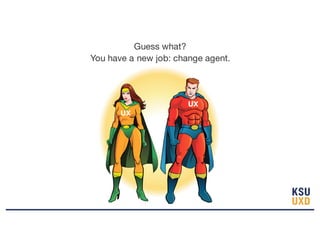
Guess what?
You have a new job: change agent.
UX
UX
Change Agent
A person who leads a business initiative by:
Defining and researching the problem
Planning the intervention
Building business support for the intervention
Enlisting others to help drive change
Six Sigma - http://Isixsigma.com/dictionary/change-agent/
UXmatters - The User Experience Practitioner As Change Agent – http://bit.ly/a2Xwux
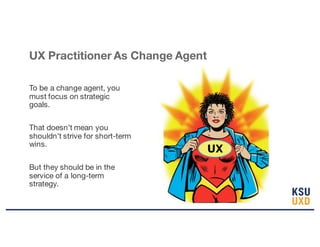
UX Practitioner As Change Agent
To be a change agent, you
must focus on strategic
goals.
That doesn’t mean you
shouldn’t strive for short-term
wins.
But they should be in the
service of a long-term
strategy.
UX
Research and design is only
half of your job!
The other half is leading your organization
to more fully incorporate UX practices.
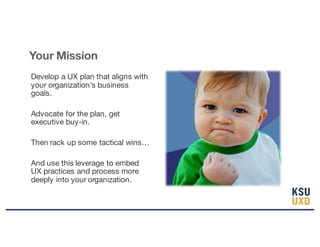
Develop a UX plan that aligns with
your organization’s business
goals.
Advocate for the plan, get
executive buy-in.
Then rack up some tactical wins…
And use this leverage to embed
UX practices and process more
deeply into your organization.
Your Mission
Now go be a UX superhero.
Thanks for your time.
More on UX and organizations:
slideshare.net/paulsherman

The UX Landscape 2015

  • 1.
    THE UX LANDSCAPE ClevelandUXPA World Usability Day 2015 1
  • 2.
    Me I’ve built smalland large UX teams. Co-founded the DFW UXPA chapter in 2002. UXPA International Board, President 2008-2009. Teach at Kent State’s UXD program. Provide user experience research and design consulting.
  • 3.
    I’m Going ToDo All This In 15 Minutes… The UX Landscape The Continuing Challenge (Part Of) The Solution
  • 4.
  • 5.
    Everything Is Awesome! Source:UXPA 2014 International Salary Survey Median User Experience Practitioner Salary 2005 - 2014
  • 6.
    71K Jobs onLinkedIn! Source: LinkedIn search about 3 hours ago J
  • 7.
    So why dowe still struggle for relevance?
  • 8.
    It’s About OrganizationalAlignment At many companies, various groups and departments are not aligned around creating the best user experience possible. Sound familiar?
  • 9.
    Time for astory.
  • 10.
    At a formercompany, product management asked my UX team to conduct field research with small businesses. We identified an opportunity for an accounting product that served new value dimensions. That’s awesome! Woo!
  • 11.
    Product management began writingup a business case. We created personas and goals. And mocked up workflows and views. We started testing the mockups…
  • 12.
    Product management began writingup a business case. We created personas and goals. And mocked up workflows and views. We started testing the mockups… And senior management promptly went batshit crazy.
  • 13.
    What went wrong? OrgCulture New products “just weren’t done here.” Growth by acquisition. Executives had no incentives to create new products. In fact they had strong disincentives.
  • 14.
    What went wrong? OrgCulture New products “just weren’t done here.” Growth by acquisition. Executives had no incentives to create new products. In fact they had strong disincentives. Institutional The organization had very few people who had ever worked on new products. There was no institutional memory or process.
  • 15.
    What went wrong? OrgCulture New products “just weren’t done here.” Growth by acquisition. Executives had no incentives to create new products. In fact they had strong disincentives. Institutional The organization had very few people who had ever worked on new products. There was no institutional memory or process. PM & UX Mistakes We had the data, but we failed to communicate the pressing need effectively. We failed to build awareness and alignment.
  • 16.
    Once we startedshowing the prototype, it was perceived as insubordinate and threatening.
  • 17.
    We got shutdown within a couple weeks of the first prototype tests.
  • 18.
    But organizational cultures canbe changed! So I tried.
  • 19.
    Executives like process.They really like repeatable processes. So we – UX and Product - created a business process for new product innovation. It included: Field research (not just surveys) to discover new value dimensions. Rapid prototyping and design iteration. Cross-disciplinary involvement: product, design, development. And a whole lot more. The Intervention
  • 20.
    Rapid contextual innovation– “RCI” The “3-3-1” process 3 people 3 weeks 1 viable opportunity We Even Had A Fancy Name…
  • 21.
    We even madea bad-ass process map…
  • 23.
    Prototyping and iterationbased on customer feedback became part of: Initial value discovery New product development Business strategy UX UX The Outcome
  • 24.
    We moved UXup the value creation chain. We utilized our skills at the front end of the process… On an equal footing with product management and development. The Outcome
  • 25.
    Our challenge asUX professionals…
  • 26.
    We Need ToGet Strategic We need to lead, communicate, and advocate.
  • 27.
    So how doyou “do” strategic UX?
  • 28.
    Strategy “A long termplan of action designed to achieve a particular goal.” “Strategy is differentiated from tactics or immediate actions by its orientation on affecting future, not immediate conditions.” <Lazy>http://en.wikipedia.org/wiki/Strategy</>
  • 29.
  • 30.
    Strategy vs. Tactics Strategicplan: Go from airport to hotel Tactics: Accelerate Make some turns Slow down Stop
  • 31.
    Tactics are goodtechniques… but only if you know where you’re going. Do you?
  • 32.
    Guess what? You havea new job: change agent. UX UX
  • 33.
    Change Agent A personwho leads a business initiative by: Defining and researching the problem Planning the intervention Building business support for the intervention Enlisting others to help drive change Six Sigma - http://Isixsigma.com/dictionary/change-agent/ UXmatters - The User Experience Practitioner As Change Agent – http://bit.ly/a2Xwux
  • 34.
    UX Practitioner AsChange Agent To be a change agent, you must focus on strategic goals. That doesn’t mean you shouldn’t strive for short-term wins. But they should be in the service of a long-term strategy. UX
  • 35.
    Research and designis only half of your job! The other half is leading your organization to more fully incorporate UX practices.
  • 36.
    Develop a UXplan that aligns with your organization’s business goals. Advocate for the plan, get executive buy-in. Then rack up some tactical wins… And use this leverage to embed UX practices and process more deeply into your organization. Your Mission
  • 37.
    Now go bea UX superhero. Thanks for your time.
  • 38.
    More on UXand organizations: slideshare.net/paulsherman