A B
δ+ δ-
If,‘q’ is the charge and ‘l’ is distance between positive and
negative charge
𝜇 = q × l
𝑈𝑛𝑖𝑡 𝑜𝑓 𝑑𝑖𝑝𝑜𝑙𝑒 𝑚𝑜𝑚𝑒𝑛𝑡 𝜇 𝑖𝑠 𝐷𝑒𝑏𝑦𝑒 (𝐷)
1
Dipole moment
4.
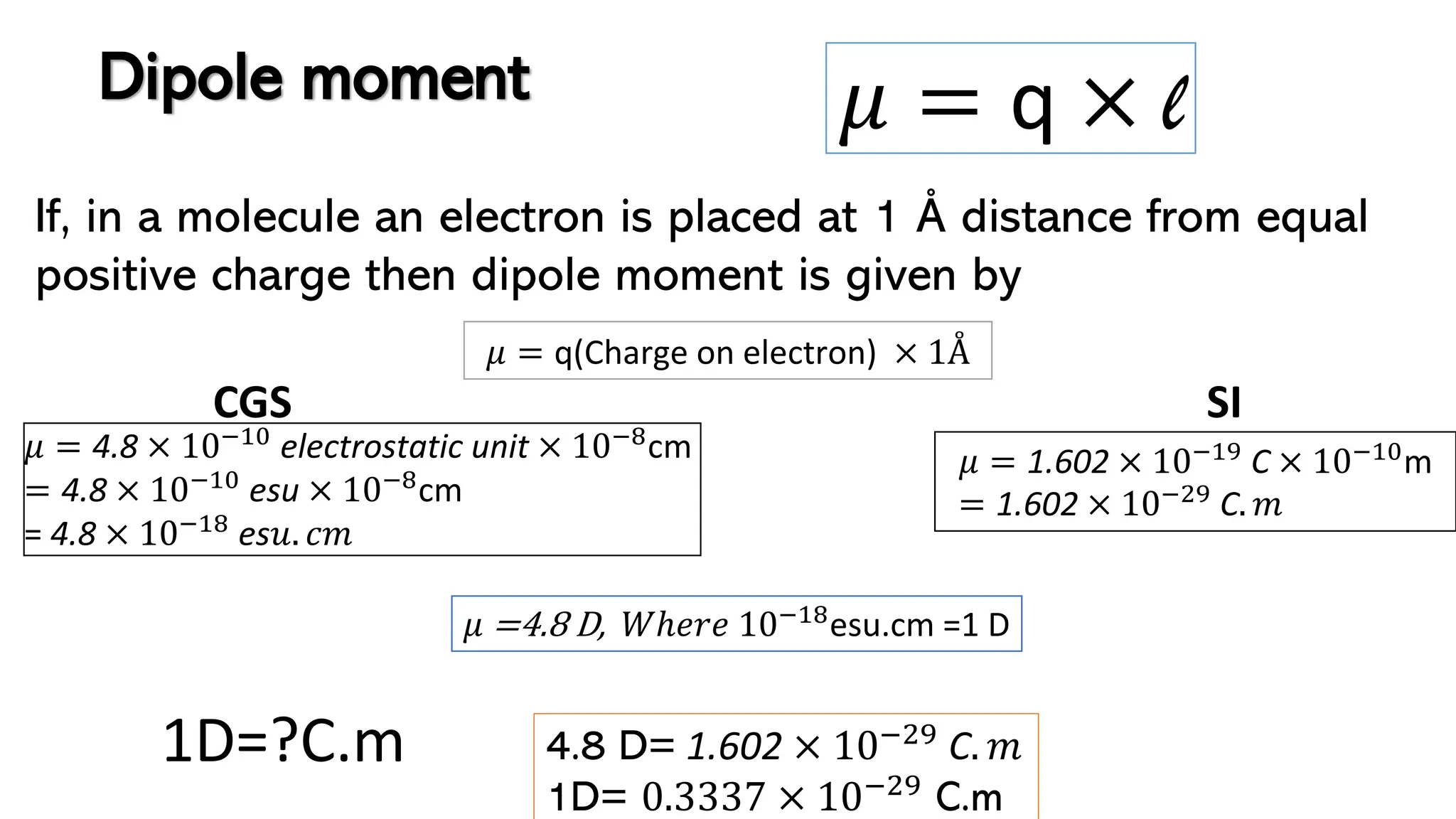
If, in amolecule an electron is placed at 1 Å distance from equal
positive charge then dipole moment is given by
𝜇 = q × l
𝜇 = 4.8 × 10⁻¹⁰ electrostatic unit × 10−8cm
= 4.8 × 10−10 esu × 10−8cm
= 4.8 × 10⁻¹⁸ es𝑢. 𝑐𝑚
1D=?C.m
𝜇 = 1.602 × 10−19
C × 10−10
m
= 1.602 × 10⁻²⁹
C. 𝑚
4.8 D= 1.602 × 10⁻²⁹ C. 𝑚
1D= 0.3337 × 10⁻²⁹
C.m
Dipole moment
𝜇 = q(Charge on electron) × 1Å
𝜇 =4.8 D, 𝑊ℎ𝑒𝑟𝑒 10−18esu.cm =1 D
SI
CGS
5.
Calculate dipole momentvalues of HF, HCl and HBr molecules whose bond length
is 0.92Å, 1.27Å, and 1.41Å, respectively
𝜇 = q(Charge on electron) × 1Å
𝜇(𝐻𝐹) = 4.8 × 10−10 𝑒𝑠𝑢 × 9.2 × 10−9cm = 4.42 × 10⁻¹⁸esu.cm =4.42 D
𝜇(𝐻𝐶𝑙) = 4.8 × 10−10 𝑒𝑠𝑢 × 12.7 × 10−9cm =6.10 × 10⁻¹⁸ esu.cm =6.10 D
𝜇(𝐻𝐵𝑟) =4.8 × 10−10 𝑒𝑠𝑢 × 14.1 × 10−9cm =6.77 × 10⁻¹⁸ esu.cm =6.77 D
𝜇 = q(Charge on electron) × 1Å
𝜇(𝐻𝐹) = 1.602 × 10−19 C × 9.2 × 10−11m = 14.74 × 10⁻³⁰C.m
𝜇(𝐻𝐶𝑙) = 1.602 × 10−19 C × 12.7 × 10−11m =20.34 × 10⁻³⁰ C.m
𝜇(𝐻𝐵𝑟) =1.602 × 10−19 C × 14.1 × 10−11m =22.59 × 10⁻³⁰C.m
Calculating dipole moment (Theoretical)
1D= 0.3337 × 10⁻²⁹
C.m
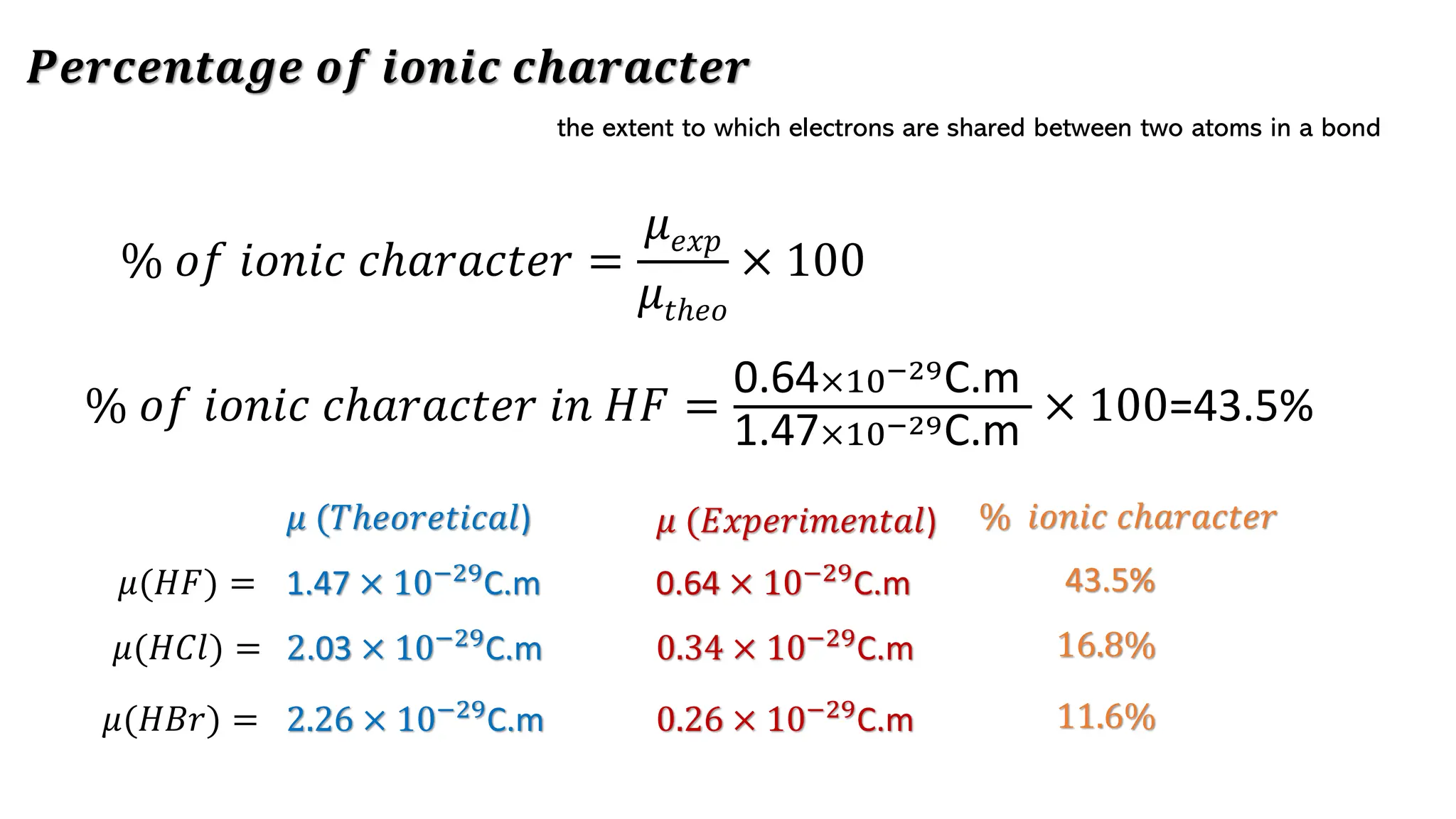
% 𝑜𝑓 𝑖𝑜𝑛𝑖𝑐𝑐ℎ𝑎𝑟𝑎𝑐𝑡𝑒𝑟 =
𝜇𝑒𝑥𝑝
𝜇𝑡ℎ𝑒𝑜
× 100
1.47 × 10⁻²⁹C.m
2.03 × 10⁻²⁹C.m
2.26 × 10⁻²⁹
C.m
𝜇(𝐻𝐹) =
𝜇(𝐻𝐶𝑙) =
𝜇(𝐻𝐵𝑟) =
0.64 × 10⁻²⁹C.m
0.34 × 10⁻²⁹C.m
0.26 × 10⁻²⁹
C.m
43.5%
16.8%
11.6%
% 𝑜𝑓 𝑖𝑜𝑛𝑖𝑐 𝑐ℎ𝑎𝑟𝑎𝑐𝑡𝑒𝑟 𝑖𝑛 𝐻𝐹 =
0.64×10⁻²⁹C.m
1.47×10⁻²⁹C.m
× 100=43.5%
𝜇 (𝑇ℎ𝑒𝑜𝑟𝑒𝑡𝑖𝑐𝑎𝑙) 𝜇 (𝐸𝑥𝑝𝑒𝑟𝑖𝑚𝑒𝑛𝑡𝑎𝑙) % 𝑖𝑜𝑛𝑖𝑐 𝑐ℎ𝑎𝑟𝑎𝑐𝑡𝑒𝑟
𝑷𝒆𝒓𝒄𝒆𝒏𝒕𝒂𝒈𝒆 𝒐𝒇 𝒊𝒐𝒏𝒊𝒄 𝒄𝒉𝒂𝒓𝒂𝒄𝒕𝒆𝒓
the extent to which electrons are shared between two atoms in a bond
8.
2
1 3
0
0
25
50
75
100
Electronegativity difference
%
ionic
Character
1.7
%𝒐𝒇 𝒊𝒐𝒏𝒊𝒄 𝒄𝒉𝒂𝒓𝒂𝒄𝒕𝒆𝒓 & 𝒆𝒍𝒆𝒄𝒕𝒓𝒐𝒏𝒆𝒈𝒂𝒕𝒊𝒗𝒊𝒕𝒚 𝒅𝒊𝒇𝒇𝒆𝒓𝒏𝒄𝒆
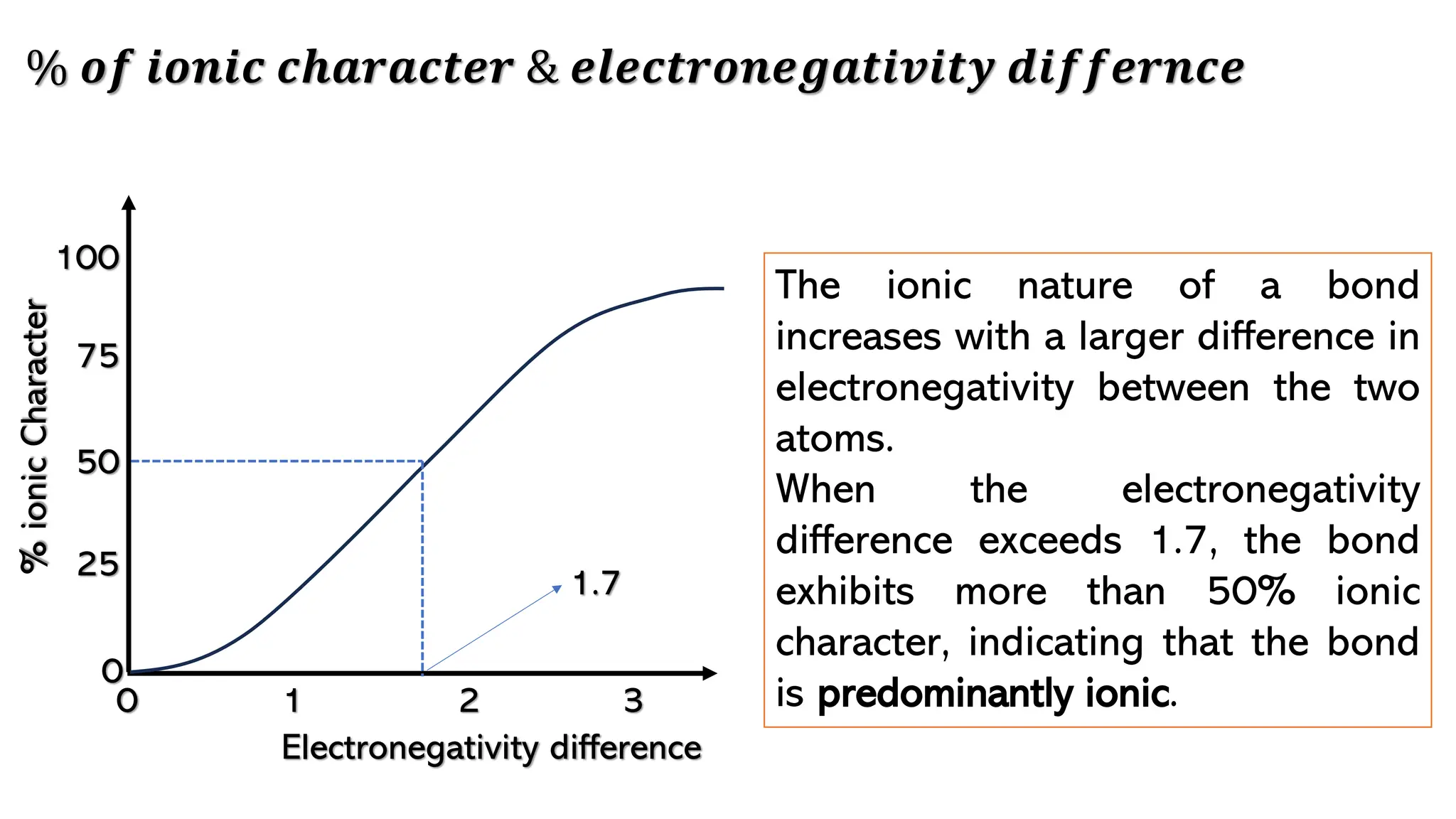
The ionic nature of a bond
increases with a larger difference in
electronegativity between the two
atoms.
When the electronegativity
difference exceeds 1.7, the bond
exhibits more than 50% ionic
character, indicating that the bond
is predominantly ionic.