DR. ANINDITA SAHA
DETERMINATION OF
HAEMOGLOBIN
Haemoglobin
 It is an iron-containing oxygen-
transport metalloprotein in the red blood
cells.
 Haemoglobin in the blood carries
oxygen from the respiratory organs
(lungs) to the rest of the body (i.e. the
tissues).
 There it releases the oxygen to
permit aerobic respiration to provide
energy to power the functions of the
Structure of haemoglobin:
 Haemoglobin is a conjugated protein.
Haemoglobin = Heme +
globin
(Conjugated
protein) (prosthetic group)
(protein)
 Heme contains ferrous ion (Fe 2+) in
the centre of a large heterocyclic ring
called porphyrin ring made up of 4
pyrrole group.
 It gives red colour to the blood.
 Different Hbs are produced during
different phases of life like embryonic ,
fetal and adult.
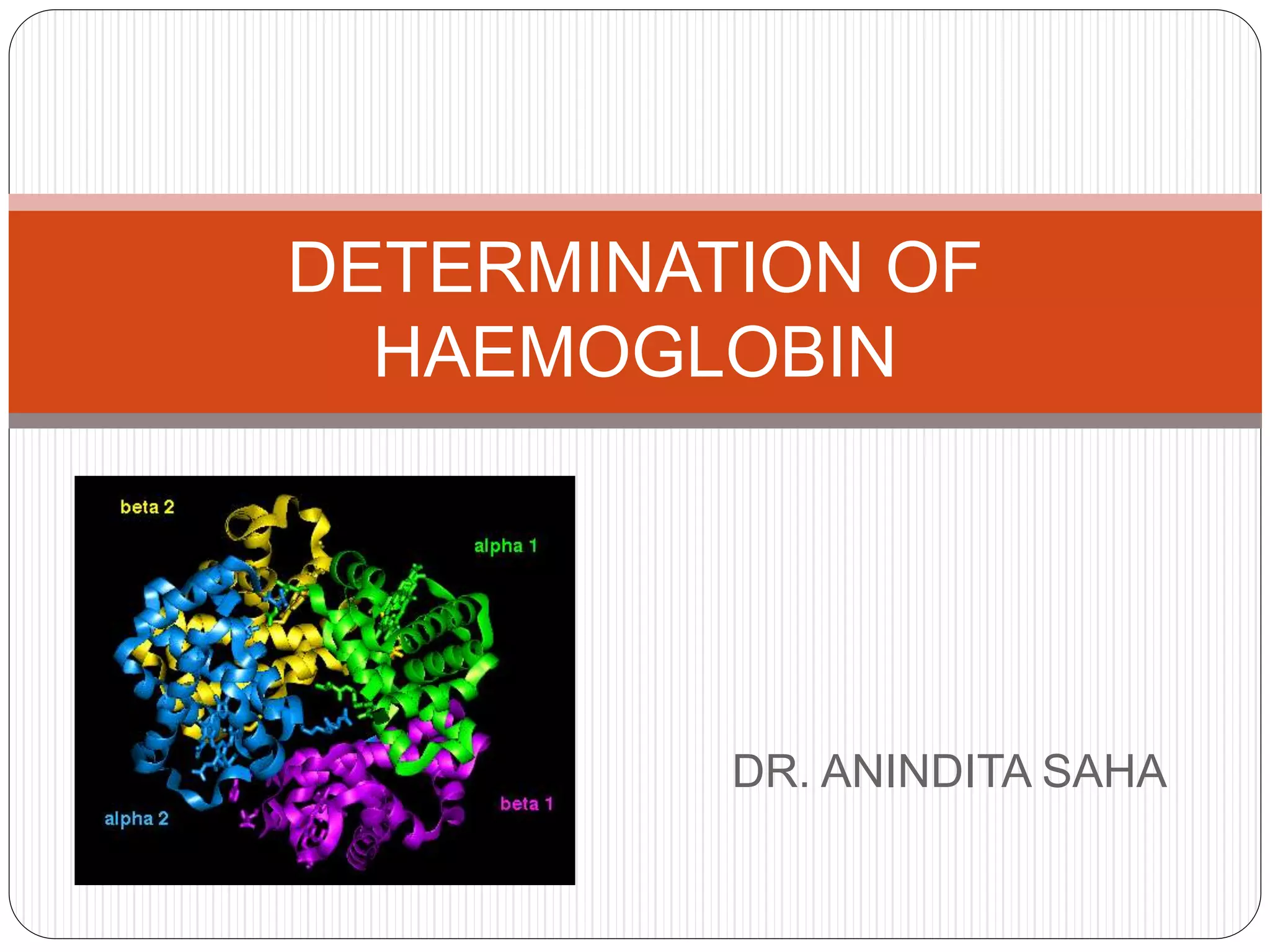
 Each consists of tetramer of globin
polypeptide chain..
 Adult Hb – alpha2 beta2( Hb A )
alpha2 delta2 (Hb A2)
 Fetal Hb - alpha2 gamma2( Hb F)
METHODS OF HAEMOGLOBIN
ESTIMATION
 Haemoglobin concentration can be
estimated by
1) Measurement of its colour( colorimetric
method )
2) Property of combining with oxygen
3) Property of combining with carbon
monoxide
4) Its iron content
5) Measurement of specific gravity
COLORIMETRIC METHOD
This method is based on colorimetric
measurement of the intensity of colour
developed on addition of some
substances to the blood.
 This method includes the following :
1) cyanmethaemoglobin method(most
accurate)
2) oxyhaemoglobin method
3) electronic counter method
4) direct reading electronic
haemoglobinometer
5) Sahli’s method
SAHLI’S METHOD
EQUIPMENTS :
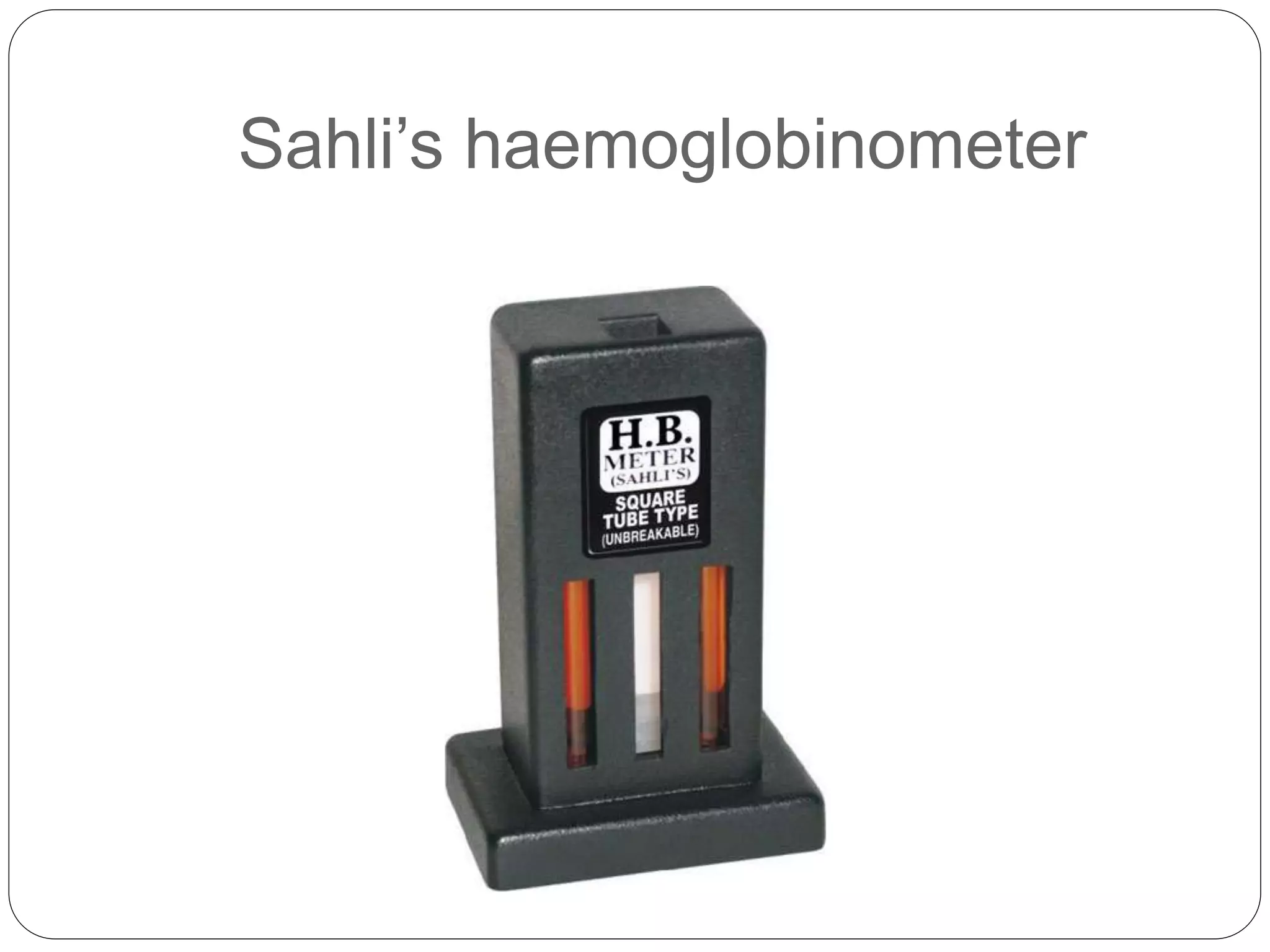
1) Sahli’s haemoglobinometer
comparator
2) Sahli’s haemoglobinometer tube
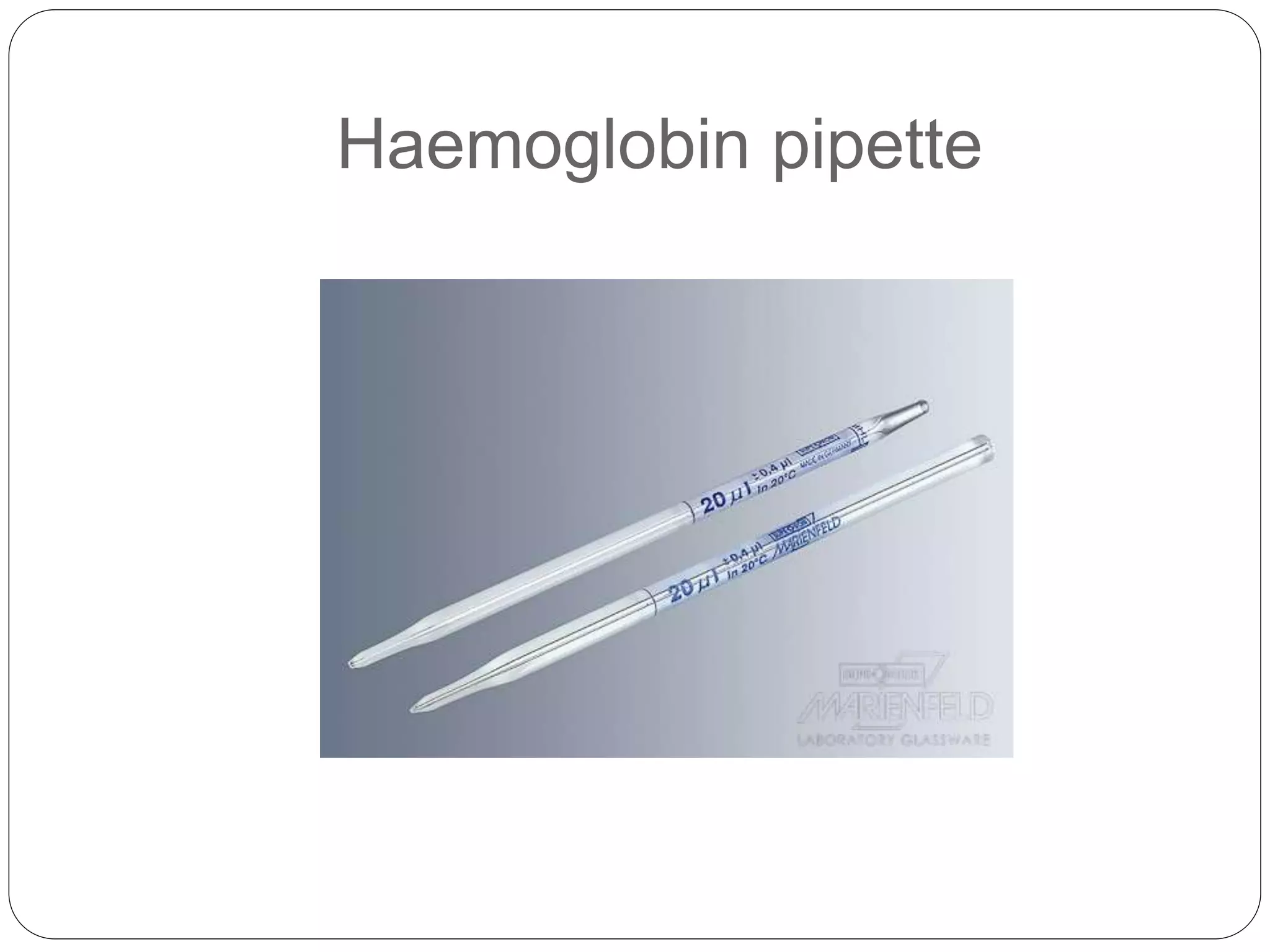
3) Sahli’s pipette or haemoglobin
pipette
4) glass dropper
5) glass rod for stirring
Sahli’s haemoglobinometer
Sahli’s haemoglobinometer tube
It is a graduated tube marked on
ascending order on both sides.
one side – shows grams per 100 ml
(gm%)
opposite side – percenatage
100% = 14.5gm%
Haemoglobin comparator
It is used for matching the colour of acid
haematin formed in the
haemoglobinometer tube.
Haemoglobin pipette
 It is a slender special pipette with a
single mark 20 cumm.
USE:
used for quantitative estimation of
haemoglobin in blood.
Haemoglobin pipette
REAGENTS :
1) N/10 HCl
2) distilled water
PRINCIPLE :
Hb N/10 HCl acid
haematin
(present in blood) (brown in
colour)
This brown colour is diluted with distilled
water to match that of brown glass
standard and Hb value is read directly in
grams from the scale of
haemoglobinometer.
PROCEDURE:
Fill sahli’s Hb tube upto mark 2 with N/10 HCl
Put 20 ul (0.02 ml) of blood from Hb pipette
Stir with stirrer
10 min
Add distilled water drop by drop and stir till
colour matches with comparator and take
reading at lower meniscus
Advantages:
1)Simple bedside test
2) reagents and apparatus are cheap.
Disadvantages:
1) There can be visual error
2) Colour of acid hematin is not stable . It
fades after reaching its peak.
3) Comparator can fade over years.
4) Carboxy , met and sulfhaemoglobin
cannot be converted to acid haematin.
5) This method is not suitable for infants
as fetal haemoglobin is also not
converted to acid haematin.
ELECTRONIC COUNTER
METHOD
 It is a multiparameter determining
electronic equipment.
 Instrument is sysmex series of
instrument.
 Hb is measured in a designated channel
using sodium lauryl sulphate
(SLS)method.
 Blood is diluted using reagent
diluent(isotonic conductive) and then
SLS haemoglobin reagent is added.
PRINCIPLE:
 works on electrical impedence principle.
 Surfactants within SLS reagent lyse RBCs
and release Hb and reduce turbidity
developing from cell membrane and plasma
lipids.
 SLS converts Fe2+ to Fe3+ forming
methaemoglobin.
 Methemoglobin combines with SLS to
form SLShemichrome molecule.
 The absorbance of this molecule is
measured at 555nm to determine Hb
ADVANTAGES:
1) Free Hb is rapidly converted to
detectable chromogen, decreasing
measurement time.
2) Reagent is cyanide free(toxic chemical
– environmental hazard)
DISADVANTAGE:
1) High WBC count (> 30,000/ul) causes
false elevation of Hb.
Normal haemoglobin values:
 At birth – 13.5 to 19.5 gm/dl
 Children (2-5 yrs) – 11 to 14 gm/dl
 Children (6 – 12 yrs) – 11.5 to 15.5
gm/dl
 Adult female – 13 to 15 gm/dl
 Adult male – 14 to 16 gm/dl
Conditions of decreased
haemoglobin:
1) Anaemia
2) Pregnancy
Conditions of increased haemoglobin:
Physiological: 1)new borns and infants
Pathological : 1)
polycythemia(polycythemivera,kidney
tumours,high altitude)
2) dehydration
3 ) hypoxia(COPD, congenital
heart disease)
THANK
YOU
DETERMINATION OF PCV
DEFINITION:
 Packed cell volume is defined as ratio of
volume of packed RBCs to that of
whole blood .
 It is the volume occupied by red blood
cells when anticoagulated blood is
centrifuged.
 Expressed in percentage.
ESTIMATION OF PCV IS HELPFUL FOR:
1) determination of red cell indices like
MCV , MCHC
2)Diagnosis of anaemia or polycythemia
3)To counter check the value of Hb in
the reported sample as Hb in gm/dl x 3
= PCV.
4) Useful as a screening test for
anaemia.
METHODS:
 Macro method ( Wintrobe’s tube
method )
 Micro method ( capillary tube method )
 Automated method
WINTROBE’S METHOD:
 Apparatus required:
1)wintrobe’s tube
2)Pasteur pipette with a rubber teat
sufficiently long to reach the bottom of
the wintrobe tube.
3)Centrifuge machine
Wintrobe’s tube:
 Special thick walled glass tube
 Length – 110 mm
 Internal diameter – 3 mm
 Flat inner base
 It is graduated from 0 ( bottom ) to 10
(top ) for PCV and 0 ( top ) to 10 (
bottom ) for ESR.
 The markings are at an interval of 1mm
each and holds 1 ml of blood.
 USES OF WINTROBE’S TUBE :
1) Determination of PCV.
2)Determination of ESR.
3)Buffy coat smear preparation for LE
cell phenomenon and studies of
abnormal cells in aleukemic leukemia.
Wintrobe’s tube
Pasteur pipette
Procedure:
 Fill the pasteur pipette with very well
mixed anticoagulated blood .
 Introduce the pipette at the bottom of the
wintrobe tube and slowly fill it upto 10
mark.
 Tip of pipette should remain below the
rising meniscus of blood to avoid
foaming.
 Centrifuge the tube at 3000 rpm for 30
min.
 Upper most layer of PLASMA (yellow)
 Middle narrow layer of BUFFYCOAT
comprised of WBCs and platelets
 Lower most layer of PACKED
RBCs(red)
 Note the lower most height of coloumn
of packed RBC layer and express in
percentage.
AUTOMATIC ELECTONIC
ANALYSER
In multi channel coulter counter , PCV
can be estimated with other
hematologic indices in 40 – 50 seconds.
NORMAL VALUE:
 Adult male – 40 – 50%
 Adult female – 38 – 45%
 New born - 44 – 60%
 CAUSES OF INCREASED PCV :
polycythaemia
dehydration due to severe vomiting ,
diarrhoea
burns
shock
CAUSE OF DECREASED PCV:
anaemia
pregnancy
THANK
YOU

Determination of haemoglobin

  • 1.
  • 2.
    Haemoglobin  It isan iron-containing oxygen- transport metalloprotein in the red blood cells.  Haemoglobin in the blood carries oxygen from the respiratory organs (lungs) to the rest of the body (i.e. the tissues).  There it releases the oxygen to permit aerobic respiration to provide energy to power the functions of the
  • 3.
    Structure of haemoglobin: Haemoglobin is a conjugated protein. Haemoglobin = Heme + globin (Conjugated protein) (prosthetic group) (protein)
  • 4.
     Heme containsferrous ion (Fe 2+) in the centre of a large heterocyclic ring called porphyrin ring made up of 4 pyrrole group.  It gives red colour to the blood.
  • 5.
     Different Hbsare produced during different phases of life like embryonic , fetal and adult.  Each consists of tetramer of globin polypeptide chain..  Adult Hb – alpha2 beta2( Hb A ) alpha2 delta2 (Hb A2)  Fetal Hb - alpha2 gamma2( Hb F)
  • 7.
    METHODS OF HAEMOGLOBIN ESTIMATION Haemoglobin concentration can be estimated by 1) Measurement of its colour( colorimetric method ) 2) Property of combining with oxygen 3) Property of combining with carbon monoxide 4) Its iron content 5) Measurement of specific gravity
  • 8.
    COLORIMETRIC METHOD This methodis based on colorimetric measurement of the intensity of colour developed on addition of some substances to the blood.
  • 9.
     This methodincludes the following : 1) cyanmethaemoglobin method(most accurate) 2) oxyhaemoglobin method 3) electronic counter method 4) direct reading electronic haemoglobinometer 5) Sahli’s method
  • 10.
    SAHLI’S METHOD EQUIPMENTS : 1)Sahli’s haemoglobinometer comparator 2) Sahli’s haemoglobinometer tube 3) Sahli’s pipette or haemoglobin pipette 4) glass dropper 5) glass rod for stirring
  • 13.
  • 14.
    Sahli’s haemoglobinometer tube Itis a graduated tube marked on ascending order on both sides. one side – shows grams per 100 ml (gm%) opposite side – percenatage 100% = 14.5gm%
  • 15.
    Haemoglobin comparator It isused for matching the colour of acid haematin formed in the haemoglobinometer tube.
  • 16.
    Haemoglobin pipette  Itis a slender special pipette with a single mark 20 cumm. USE: used for quantitative estimation of haemoglobin in blood.
  • 17.
  • 19.
    REAGENTS : 1) N/10HCl 2) distilled water
  • 20.
    PRINCIPLE : Hb N/10HCl acid haematin (present in blood) (brown in colour) This brown colour is diluted with distilled water to match that of brown glass standard and Hb value is read directly in grams from the scale of haemoglobinometer.
  • 21.
    PROCEDURE: Fill sahli’s Hbtube upto mark 2 with N/10 HCl Put 20 ul (0.02 ml) of blood from Hb pipette Stir with stirrer 10 min Add distilled water drop by drop and stir till colour matches with comparator and take reading at lower meniscus
  • 23.
    Advantages: 1)Simple bedside test 2)reagents and apparatus are cheap.
  • 24.
    Disadvantages: 1) There canbe visual error 2) Colour of acid hematin is not stable . It fades after reaching its peak. 3) Comparator can fade over years. 4) Carboxy , met and sulfhaemoglobin cannot be converted to acid haematin. 5) This method is not suitable for infants as fetal haemoglobin is also not converted to acid haematin.
  • 25.
    ELECTRONIC COUNTER METHOD  Itis a multiparameter determining electronic equipment.  Instrument is sysmex series of instrument.  Hb is measured in a designated channel using sodium lauryl sulphate (SLS)method.  Blood is diluted using reagent diluent(isotonic conductive) and then SLS haemoglobin reagent is added.
  • 26.
    PRINCIPLE:  works onelectrical impedence principle.  Surfactants within SLS reagent lyse RBCs and release Hb and reduce turbidity developing from cell membrane and plasma lipids.  SLS converts Fe2+ to Fe3+ forming methaemoglobin.  Methemoglobin combines with SLS to form SLShemichrome molecule.  The absorbance of this molecule is measured at 555nm to determine Hb
  • 28.
    ADVANTAGES: 1) Free Hbis rapidly converted to detectable chromogen, decreasing measurement time. 2) Reagent is cyanide free(toxic chemical – environmental hazard) DISADVANTAGE: 1) High WBC count (> 30,000/ul) causes false elevation of Hb.
  • 29.
    Normal haemoglobin values: At birth – 13.5 to 19.5 gm/dl  Children (2-5 yrs) – 11 to 14 gm/dl  Children (6 – 12 yrs) – 11.5 to 15.5 gm/dl  Adult female – 13 to 15 gm/dl  Adult male – 14 to 16 gm/dl
  • 30.
    Conditions of decreased haemoglobin: 1)Anaemia 2) Pregnancy Conditions of increased haemoglobin: Physiological: 1)new borns and infants Pathological : 1) polycythemia(polycythemivera,kidney tumours,high altitude) 2) dehydration 3 ) hypoxia(COPD, congenital heart disease)
  • 31.
  • 32.
  • 33.
    DEFINITION:  Packed cellvolume is defined as ratio of volume of packed RBCs to that of whole blood .  It is the volume occupied by red blood cells when anticoagulated blood is centrifuged.  Expressed in percentage.
  • 34.
    ESTIMATION OF PCVIS HELPFUL FOR: 1) determination of red cell indices like MCV , MCHC 2)Diagnosis of anaemia or polycythemia 3)To counter check the value of Hb in the reported sample as Hb in gm/dl x 3 = PCV. 4) Useful as a screening test for anaemia.
  • 35.
    METHODS:  Macro method( Wintrobe’s tube method )  Micro method ( capillary tube method )  Automated method
  • 36.
    WINTROBE’S METHOD:  Apparatusrequired: 1)wintrobe’s tube 2)Pasteur pipette with a rubber teat sufficiently long to reach the bottom of the wintrobe tube. 3)Centrifuge machine
  • 37.
    Wintrobe’s tube:  Specialthick walled glass tube  Length – 110 mm  Internal diameter – 3 mm  Flat inner base  It is graduated from 0 ( bottom ) to 10 (top ) for PCV and 0 ( top ) to 10 ( bottom ) for ESR.  The markings are at an interval of 1mm each and holds 1 ml of blood.
  • 38.
     USES OFWINTROBE’S TUBE : 1) Determination of PCV. 2)Determination of ESR. 3)Buffy coat smear preparation for LE cell phenomenon and studies of abnormal cells in aleukemic leukemia.
  • 39.
  • 40.
  • 41.
    Procedure:  Fill thepasteur pipette with very well mixed anticoagulated blood .  Introduce the pipette at the bottom of the wintrobe tube and slowly fill it upto 10 mark.  Tip of pipette should remain below the rising meniscus of blood to avoid foaming.  Centrifuge the tube at 3000 rpm for 30 min.
  • 42.
     Upper mostlayer of PLASMA (yellow)  Middle narrow layer of BUFFYCOAT comprised of WBCs and platelets  Lower most layer of PACKED RBCs(red)  Note the lower most height of coloumn of packed RBC layer and express in percentage.
  • 44.
    AUTOMATIC ELECTONIC ANALYSER In multichannel coulter counter , PCV can be estimated with other hematologic indices in 40 – 50 seconds.
  • 45.
    NORMAL VALUE:  Adultmale – 40 – 50%  Adult female – 38 – 45%  New born - 44 – 60%
  • 46.
     CAUSES OFINCREASED PCV : polycythaemia dehydration due to severe vomiting , diarrhoea burns shock CAUSE OF DECREASED PCV: anaemia pregnancy
  • 47.