TWINKLE
M.Sc. CHEMISTRY
Department of Chemistry
University of Delhi
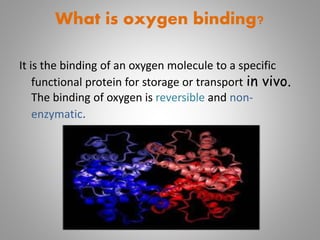
It is the binding of an oxygen molecule to a specific
functional protein for storage or transport in vivo.
The binding of oxygen is reversible and non-
enzymatic.
What is oxygen binding?
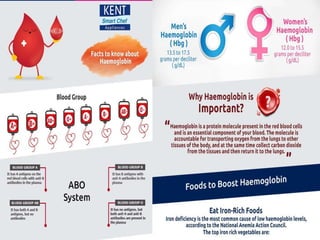
What is HAEMOGLOBIN?
• Iron containing metalloporphyrin present in
RBC of all vertebrates and some invertebrates.
• Haemoglobin: heme+ globin .i.e. heme
group embedded in the globin chain.
• Found in leguminous plant nodules,some
invertebrates like snails and all vertebrates
except cytostomata fish.
Research history
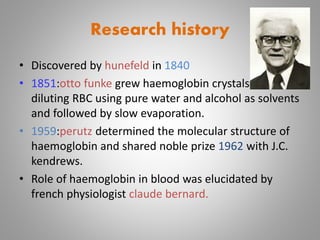
• Discovered by hunefeld in 1840
• 1851:otto funke grew haemoglobin crystals by
diluting RBC using pure water and alcohol as solvents
and followed by slow evaporation.
• 1959:perutz determined the molecular structure of
haemoglobin and shared noble prize 1962 with J.C.
kendrews.
• Role of haemoglobin in blood was elucidated by
french physiologist claude bernard.
The first one….
• The first protein to be crystallised in (1849)
• The first protein with a physiological purpose
of O2 transport (1864)
• One of the first protein whose molecular
weight was established (1830)
• One of the first protein whose tertiary and
quaternary structures were determined by
crystallography.(1960)
Site of synthesis
• Heme part is synthesised in a series of steps in
mitochondria and cytosol of immature
RBC.
• Globin part is synthesised by ribosomes in
cytosol.
• Production of Hb happens in reticulocyte in
the bone marrow.
Structural aspects
each Hb molecule is a tetramer of four heme
units bound to the globin part.
HEME GROUP:
• Contains heterocyclic ring containing 4
nitrogrn atoms
• Fe(ll) at its center.
• Attached to proximal histidine unit.
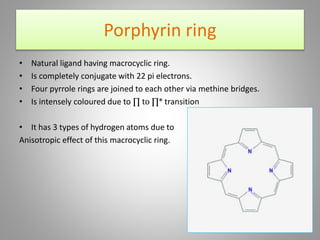
Porphyrin ring
• Natural ligand having macrocyclic ring.
• Is completely conjugate with 22 pi electrons.
• Four pyrrole rings are joined to each other via methine bridges.
• Is intensely coloured due to ∏ to ∏* transition
• It has 3 types of hydrogen atoms due to
Anisotropic effect of this macrocyclic ring.
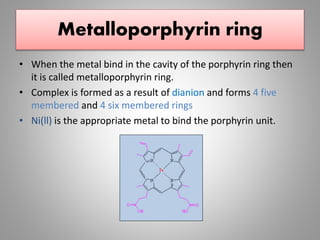
Metalloporphyrin ring
• When the metal bind in the cavity of the porphyrin ring then
it is called metalloporphyrin ring.
• Complex is formed as a result of dianion and forms 4 five
membered and 4 six membered rings
• Ni(ll) is the appropriate metal to bind the porphyrin unit.
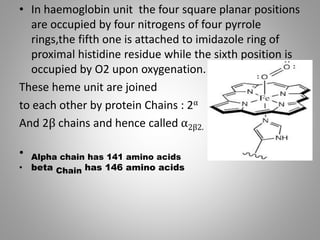
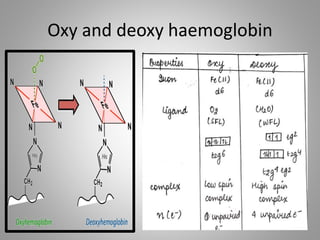
• In haemoglobin unit the four square planar positions
are occupied by four nitrogens of four pyrrole
rings,the fifth one is attached to imidazole ring of
proximal histidine residue while the sixth position is
occupied by O2 upon oxygenation.
These heme unit are joined
to each other by protein Chains : 2α
And 2β chains and hence called α2β2.
• Alpha chain has 141 amino acids
• beta Chain has 146 amino acids
Oxy and deoxy haemoglobin
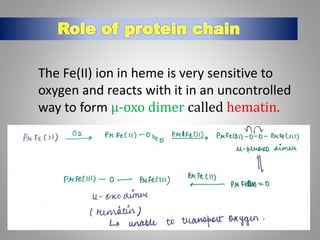
The Fe(II) ion in heme is very sensitive to
oxygen and reacts with it in an uncontrolled
way to form μ-oxo dimer called hematin.
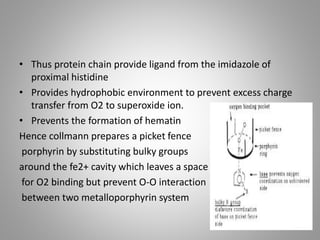
• Thus protein chain provide ligand from the imidazole of
proximal histidine
• Provides hydrophobic environment to prevent excess charge
transfer from O2 to superoxide ion.
• Prevents the formation of hematin
Hence collmann prepares a picket fence
porphyrin by substituting bulky groups
around the fe2+ cavity which leaves a space
for O2 binding but prevent O-O interaction
between two metalloporphyrin system
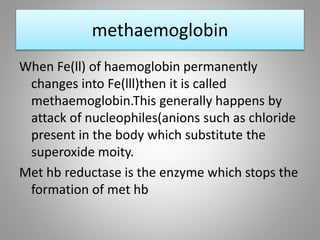
methaemoglobin
When Fe(ll) of haemoglobin permanently
changes into Fe(lll)then it is called
methaemoglobin.This generally happens by
attack of nucleophiles(anions such as chloride
present in the body which substitute the
superoxide moity.
Met hb reductase is the enzyme which stops the
formation of met hb
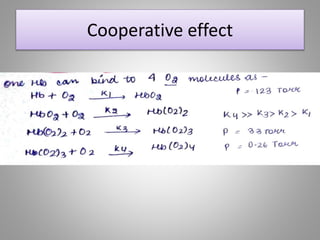
Cooperative effect
The addition of one O2 molecule to the heme group facilitates
the addition of other successive incoming O2 molecules is
called cooperative effect.
When hb is oxygenate then due to strong field of oxygen
ligand fe(ll) becomes low spin affinity its CFSE increases due
to which its radius decreases
Initially fe(ll) was having radius 0.78 A which was lager enough
to fit into the cavity of the porphyrin ring and when this
cooperative effect happened the size of fe(ll) decreases by
0.17A and its fits in the cavity due to this pulling of the
protein chain,the salt bridge breaks which make its more
flexible for the incoming O2 to bind the haemoglobin
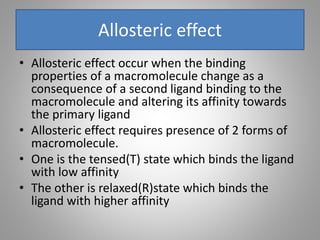
Allosteric effect
• Allosteric effect occur when the binding
properties of a macromolecule change as a
consequence of a second ligand binding to the
macromolecule and altering its affinity towards
the primary ligand
• Allosteric effect requires presence of 2 forms of
macromolecule.
• One is the tensed(T) state which binds the ligand
with low affinity
• The other is relaxed(R)state which binds the
ligand with higher affinity
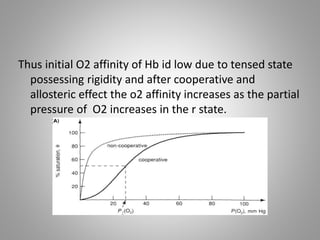
Thus initial O2 affinity of Hb id low due to tensed state
possessing rigidity and after cooperative and
allosteric effect the o2 affinity increases as the partial
pressure of O2 increases in the r state.
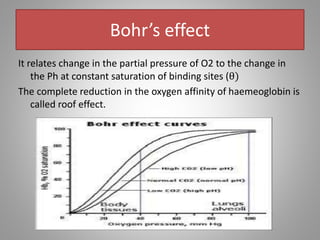
Bohr’s effect
It relates change in the partial pressure of O2 to the change in
the Ph at constant saturation of binding sites (θ)
The complete reduction in the oxygen affinity of haemeoglobin is
called roof effect.
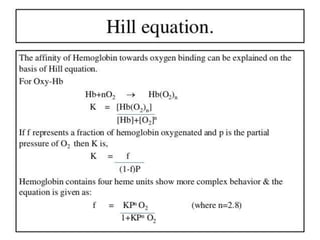
Hill equation
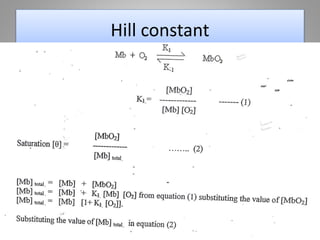
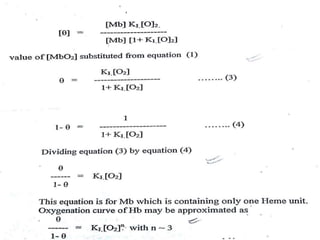
Hill constant
Binding of other ligands
• Two types of ligands bind with hb other than
O2
Competetive ligands
• Like CO which bind with haemoglobin in a linear fashion and its affinity is
250 time more than for oxygen and forms carboxyhaemoglobin which
decrease O2 level in blood and the sufferer die of suffocation
Allosteric ligands
• Some ligands like 2,3 bisphosphoglycerate help in delivering O2 even at
lower o2 tension
Varities of HAEMOGLOBIN
• Normal adult-haemeglobin A with 2α and 2β
chains
• Hemoglobin a2 with 2α and 2δ chains
• Hb S :sickle cell haemoglobin
• Hb c
• Fetal hb-2α and 2γ chains, has more affinity
to oxygen and disappear in 2-3 months after
birth.
Genetics and Mutations
• Hemoglobin consist of large number of a amino acids.
• The sequence of these amino acids determine the
chemical properties of the protein.
• Mutations in the genes for the hemoglobin protein in
the species result in hemoglobin variants many of
which doesn’t cause any disease, however some
mutations can cause hereditary diseases called
hemoglobinpathies.
• A separate set of disease called thalassemias involves
unproduction of normal hemoglobin.
• All these diseases produce anameia.
Role in Disease
• Hemoglobin deficiency can be caused either
by a decreased amount of hemoglobin
molecules as in anemia or by decreased ability
of each molecule to bind oxygen at same
partial pressure of oxygen.
• Iron deficiency can cause RBC to be
hypochromic and microcytic.
• Accelerated breakdown of RBC can cause
complete renal failure.
Sickle cell
disease
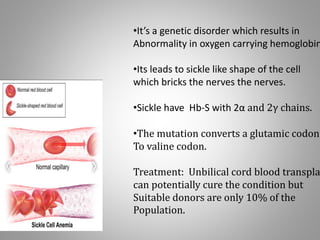
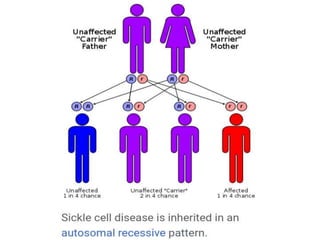
•It’s a genetic disorder which results in
Abnormality in oxygen carrying hemoglobin
•Its leads to sickle like shape of the cell
which bricks the nerves the nerves.
•Sickle have Hb-S with 2α and 2γ chains.
•The mutation converts a glutamic codon
To valine codon.
Treatment: Unbilical cord blood transpla
can potentially cure the condition but
Suitable donors are only 10% of the
Population.
References
(1)Bioinorganic chemistry,by prof.R.K.SHARMA,dept.of
chemistry.
(2)Gene mutations in human haemoglobin. Sickle cell
haemoglobin.Ingram V.M.,medical research council
unit,cavendish laboratory,university of
cambridge,NATURE
PUBLICATIONS,vol.180,Aug.17,1957.
(3)Principles of bioinorganic chemistry,by stephen
J.LIPPARD & Jeremy M.BERG
(4)Biochemistry: Donald voet and Judith G.voet.
(5)Bionorganic chemistry book by rosette M.Roat-
malone.

Haemoglobin

  • 1.
    TWINKLE M.Sc. CHEMISTRY Department ofChemistry University of Delhi
  • 2.
    It is thebinding of an oxygen molecule to a specific functional protein for storage or transport in vivo. The binding of oxygen is reversible and non- enzymatic. What is oxygen binding?
  • 3.
    What is HAEMOGLOBIN? •Iron containing metalloporphyrin present in RBC of all vertebrates and some invertebrates. • Haemoglobin: heme+ globin .i.e. heme group embedded in the globin chain. • Found in leguminous plant nodules,some invertebrates like snails and all vertebrates except cytostomata fish.
  • 4.
    Research history • Discoveredby hunefeld in 1840 • 1851:otto funke grew haemoglobin crystals by diluting RBC using pure water and alcohol as solvents and followed by slow evaporation. • 1959:perutz determined the molecular structure of haemoglobin and shared noble prize 1962 with J.C. kendrews. • Role of haemoglobin in blood was elucidated by french physiologist claude bernard.
  • 5.
    The first one…. •The first protein to be crystallised in (1849) • The first protein with a physiological purpose of O2 transport (1864) • One of the first protein whose molecular weight was established (1830) • One of the first protein whose tertiary and quaternary structures were determined by crystallography.(1960)
  • 6.
    Site of synthesis •Heme part is synthesised in a series of steps in mitochondria and cytosol of immature RBC. • Globin part is synthesised by ribosomes in cytosol. • Production of Hb happens in reticulocyte in the bone marrow.
  • 7.
    Structural aspects each Hbmolecule is a tetramer of four heme units bound to the globin part. HEME GROUP: • Contains heterocyclic ring containing 4 nitrogrn atoms • Fe(ll) at its center. • Attached to proximal histidine unit.
  • 8.
    Porphyrin ring • Naturalligand having macrocyclic ring. • Is completely conjugate with 22 pi electrons. • Four pyrrole rings are joined to each other via methine bridges. • Is intensely coloured due to ∏ to ∏* transition • It has 3 types of hydrogen atoms due to Anisotropic effect of this macrocyclic ring.
  • 9.
    Metalloporphyrin ring • Whenthe metal bind in the cavity of the porphyrin ring then it is called metalloporphyrin ring. • Complex is formed as a result of dianion and forms 4 five membered and 4 six membered rings • Ni(ll) is the appropriate metal to bind the porphyrin unit.
  • 10.
    • In haemoglobinunit the four square planar positions are occupied by four nitrogens of four pyrrole rings,the fifth one is attached to imidazole ring of proximal histidine residue while the sixth position is occupied by O2 upon oxygenation. These heme unit are joined to each other by protein Chains : 2α And 2β chains and hence called α2β2. • Alpha chain has 141 amino acids • beta Chain has 146 amino acids
  • 11.
    Oxy and deoxyhaemoglobin
  • 12.
    The Fe(II) ionin heme is very sensitive to oxygen and reacts with it in an uncontrolled way to form μ-oxo dimer called hematin.
  • 13.
    • Thus proteinchain provide ligand from the imidazole of proximal histidine • Provides hydrophobic environment to prevent excess charge transfer from O2 to superoxide ion. • Prevents the formation of hematin Hence collmann prepares a picket fence porphyrin by substituting bulky groups around the fe2+ cavity which leaves a space for O2 binding but prevent O-O interaction between two metalloporphyrin system
  • 14.
    methaemoglobin When Fe(ll) ofhaemoglobin permanently changes into Fe(lll)then it is called methaemoglobin.This generally happens by attack of nucleophiles(anions such as chloride present in the body which substitute the superoxide moity. Met hb reductase is the enzyme which stops the formation of met hb
  • 15.
  • 16.
    The addition ofone O2 molecule to the heme group facilitates the addition of other successive incoming O2 molecules is called cooperative effect. When hb is oxygenate then due to strong field of oxygen ligand fe(ll) becomes low spin affinity its CFSE increases due to which its radius decreases Initially fe(ll) was having radius 0.78 A which was lager enough to fit into the cavity of the porphyrin ring and when this cooperative effect happened the size of fe(ll) decreases by 0.17A and its fits in the cavity due to this pulling of the protein chain,the salt bridge breaks which make its more flexible for the incoming O2 to bind the haemoglobin
  • 17.
    Allosteric effect • Allostericeffect occur when the binding properties of a macromolecule change as a consequence of a second ligand binding to the macromolecule and altering its affinity towards the primary ligand • Allosteric effect requires presence of 2 forms of macromolecule. • One is the tensed(T) state which binds the ligand with low affinity • The other is relaxed(R)state which binds the ligand with higher affinity
  • 18.
    Thus initial O2affinity of Hb id low due to tensed state possessing rigidity and after cooperative and allosteric effect the o2 affinity increases as the partial pressure of O2 increases in the r state.
  • 19.
    Bohr’s effect It relateschange in the partial pressure of O2 to the change in the Ph at constant saturation of binding sites (θ) The complete reduction in the oxygen affinity of haemeoglobin is called roof effect.
  • 20.
  • 21.
  • 23.
    Binding of otherligands • Two types of ligands bind with hb other than O2 Competetive ligands • Like CO which bind with haemoglobin in a linear fashion and its affinity is 250 time more than for oxygen and forms carboxyhaemoglobin which decrease O2 level in blood and the sufferer die of suffocation Allosteric ligands • Some ligands like 2,3 bisphosphoglycerate help in delivering O2 even at lower o2 tension
  • 24.
    Varities of HAEMOGLOBIN •Normal adult-haemeglobin A with 2α and 2β chains • Hemoglobin a2 with 2α and 2δ chains • Hb S :sickle cell haemoglobin • Hb c • Fetal hb-2α and 2γ chains, has more affinity to oxygen and disappear in 2-3 months after birth.
  • 25.
    Genetics and Mutations •Hemoglobin consist of large number of a amino acids. • The sequence of these amino acids determine the chemical properties of the protein. • Mutations in the genes for the hemoglobin protein in the species result in hemoglobin variants many of which doesn’t cause any disease, however some mutations can cause hereditary diseases called hemoglobinpathies. • A separate set of disease called thalassemias involves unproduction of normal hemoglobin. • All these diseases produce anameia.
  • 26.
    Role in Disease •Hemoglobin deficiency can be caused either by a decreased amount of hemoglobin molecules as in anemia or by decreased ability of each molecule to bind oxygen at same partial pressure of oxygen. • Iron deficiency can cause RBC to be hypochromic and microcytic. • Accelerated breakdown of RBC can cause complete renal failure.
  • 27.
  • 28.
    •It’s a geneticdisorder which results in Abnormality in oxygen carrying hemoglobin •Its leads to sickle like shape of the cell which bricks the nerves the nerves. •Sickle have Hb-S with 2α and 2γ chains. •The mutation converts a glutamic codon To valine codon. Treatment: Unbilical cord blood transpla can potentially cure the condition but Suitable donors are only 10% of the Population.
  • 31.
    References (1)Bioinorganic chemistry,by prof.R.K.SHARMA,dept.of chemistry. (2)Genemutations in human haemoglobin. Sickle cell haemoglobin.Ingram V.M.,medical research council unit,cavendish laboratory,university of cambridge,NATURE PUBLICATIONS,vol.180,Aug.17,1957. (3)Principles of bioinorganic chemistry,by stephen J.LIPPARD & Jeremy M.BERG (4)Biochemistry: Donald voet and Judith G.voet. (5)Bionorganic chemistry book by rosette M.Roat- malone.