Downloaded 30 times
![IOSR Journal of Mechanical and Civil Engineering (IOSR-JMCE)
e-ISSN: 2278-1684,p-ISSN: 2320-334X, Volume 9, Issue 2 (Sep. - Oct. 2013), PP 58-62
www.iosrjournals.org
www.iosrjournals.org 58 | Page
Statistical Methods for Construction Delay Analysis
Ashwini Arun Salunkhe1
, Rahul S. Patil2
1
Post Graduate Student, Department of Civil Engineering, Padmashree Dr. D.Y.Patil Institute of Engineering &
Technology. Pimpri, Pune (M.S.)
2
Assistant Professor, Department of Civil Engineering, Padmashree Dr. D.Y.Patil Institute of Engineering &
Technology. Pimpri, Pune (M.S.)
Abstract: The occurrence of delay is common in most construction projects, due to various reasons
and causes before or during construction phase. As the delay impact on time and cost overrun,
analyzing of these delay(s) makes easy to give responsibility to concern party. This helps to avoid or
minimize delays in future work. Numerous analytical methods are available for analyzing these
impacts and selection of proper method depends upon: statistical data available, time available,
limitation of method and money available for analyzing. However, information of activities which are
responsible for project delay and their magnitude provides the baseline for investing the cause and
assessing the responsibility for project delay. This paper reviews research methodology suggested for
assessing construction delay factors by analytical methods as well as with the help of computerized
schedule analysis methods. The purpose of this study is to review various analytical & computerized
schedule analysis methods for analysis of construction delay factor.
Keywords: Analytical methods, Construction, CPM, Delay, Schedule.
I. INTRODUCTION
The delay analysis involves not only calculation of delay time but also identification of causes.
Therefore, such an analysis becomes a basis for financial calculations which determines the penalties or other
damages that shall be assigned to the parties responsible for delay. Schedule delays must be analyzed so that to
appoint responsibility for the duration of the delay among the project parties (owner, contractor, and/or third
party). There are various method exists for analysis of delay in project activities or project schedule. However,
different analysis methods will provide different results for the same circumstances depending on the time and
resources available for the analysis and accessibility of project documentation.
Analysis of construction project delay has become a common practice in project life cycle . There are
numerous methods and computerized analysis methods available in construction management literature, which
are considered for assessing the impact of project delays due to various factors. These methods could certainly
provide an impact of delay on project performance. The assessment of this performance in terms of delay
becomes valuable for both parties for litigation and responsibility. It is helpful in calculating the damages and
penalties as well as the amount of time party has been impacted.
II. IMPORTANCE OF THE STUDY
Several factors cause the overall delay in the construction project within contractor‟s liability and
owner‟s liability. It is mostly seen that delay problems are cause of dispute, negotiation, lawsuit, total desertion,
litigation and abandonment. The parties included in contract through claims agree on the additional capital and
extra time linked with construction delay. The consequences of delay are different for different parties [8].
The common results of delay are late completion of project, increased cost, and low quality of work, loss of
productivity, third party claims, conflicts abandonment or termination of contract. When projects are delayed,
the extension of project completion time invite to the additional cost. This results in conflicts between parties
(owner, contractor and/or third party), in regards‟ to file claims for extra compensation or extra time to complete
a project. To recover the damages caused by delays, the parties responsible for the occurrence should be
identified. Most of the time more than one party is responsible for project delay therefore multiple delays may
occur concurrently. Hence, it is important to study & analyze causes of construction delay, as the services
provided by infrastructure projects serve input for other sectors and cost overrun in these project lead to an
increase in capital output ratio for the entire economy.
III. LITERATURE REVIEW
Bubshait et al. (1998), compared three delay analysis methodologies, those are As-planned schedule
delay analysis, As-built schedule analysis and Modified As-built schedule delay analysis. Also, an analysis](https://image.slidesharecdn.com/h0925862-150116000028-conversion-gate02/85/Statistical-Methods-for-Construction-Delay-Analysis-1-320.jpg)
![IOSR Journal of Mechanical and Civil Engineering (IOSR-JMCE)
e-ISSN: 2278-1684,p-ISSN: 2320-334X, Volume 9, Issue 2 (Sep. - Oct. 2013), PP 58-62
www.iosrjournals.org
www.iosrjournals.org 58 | Page
Statistical Methods for Construction Delay Analysis
Ashwini Arun Salunkhe1
, Rahul S. Patil2
1
Post Graduate Student, Department of Civil Engineering, Padmashree Dr. D.Y.Patil Institute of Engineering &
Technology. Pimpri, Pune (M.S.)
2
Assistant Professor, Department of Civil Engineering, Padmashree Dr. D.Y.Patil Institute of Engineering &
Technology. Pimpri, Pune (M.S.)
Abstract: The occurrence of delay is common in most construction projects, due to various reasons
and causes before or during construction phase. As the delay impact on time and cost overrun,
analyzing of these delay(s) makes easy to give responsibility to concern party. This helps to avoid or
minimize delays in future work. Numerous analytical methods are available for analyzing these
impacts and selection of proper method depends upon: statistical data available, time available,
limitation of method and money available for analyzing. However, information of activities which are
responsible for project delay and their magnitude provides the baseline for investing the cause and
assessing the responsibility for project delay. This paper reviews research methodology suggested for
assessing construction delay factors by analytical methods as well as with the help of computerized
schedule analysis methods. The purpose of this study is to review various analytical & computerized
schedule analysis methods for analysis of construction delay factor.
Keywords: Analytical methods, Construction, CPM, Delay, Schedule.
I. INTRODUCTION
The delay analysis involves not only calculation of delay time but also identification of causes.
Therefore, such an analysis becomes a basis for financial calculations which determines the penalties or other
damages that shall be assigned to the parties responsible for delay. Schedule delays must be analyzed so that to
appoint responsibility for the duration of the delay among the project parties (owner, contractor, and/or third
party). There are various method exists for analysis of delay in project activities or project schedule. However,
different analysis methods will provide different results for the same circumstances depending on the time and
resources available for the analysis and accessibility of project documentation.
Analysis of construction project delay has become a common practice in project life cycle . There are
numerous methods and computerized analysis methods available in construction management literature, which
are considered for assessing the impact of project delays due to various factors. These methods could certainly
provide an impact of delay on project performance. The assessment of this performance in terms of delay
becomes valuable for both parties for litigation and responsibility. It is helpful in calculating the damages and
penalties as well as the amount of time party has been impacted.
II. IMPORTANCE OF THE STUDY
Several factors cause the overall delay in the construction project within contractor‟s liability and
owner‟s liability. It is mostly seen that delay problems are cause of dispute, negotiation, lawsuit, total desertion,
litigation and abandonment. The parties included in contract through claims agree on the additional capital and
extra time linked with construction delay. The consequences of delay are different for different parties [8].
The common results of delay are late completion of project, increased cost, and low quality of work, loss of
productivity, third party claims, conflicts abandonment or termination of contract. When projects are delayed,
the extension of project completion time invite to the additional cost. This results in conflicts between parties
(owner, contractor and/or third party), in regards‟ to file claims for extra compensation or extra time to complete
a project. To recover the damages caused by delays, the parties responsible for the occurrence should be
identified. Most of the time more than one party is responsible for project delay therefore multiple delays may
occur concurrently. Hence, it is important to study & analyze causes of construction delay, as the services
provided by infrastructure projects serve input for other sectors and cost overrun in these project lead to an
increase in capital output ratio for the entire economy.
III. LITERATURE REVIEW
Bubshait et al. (1998), compared three delay analysis methodologies, those are As-planned schedule
delay analysis, As-built schedule analysis and Modified As-built schedule delay analysis. Also, an analysis](https://image.slidesharecdn.com/h0925862-150116000028-conversion-gate02/75/Statistical-Methods-for-Construction-Delay-Analysis-1-2048.jpg)
![Statistical Methods for Construction Delay Analysis
www.iosrjournals.org 59 | Page
through critical path method (CPM) performed on genuine construction activities. These procedures used to
measure schedule delay impact on construction progress. The results of this study conclude that only one
method may not be used universally over another in all situations.
Tommy, Fung and Tung (2006) studied the construction delays in Hong Kong. They distributed the
questionnaire to 272 civil construction practitioners in Hong Kong, and calculated mean score (MS) for each
cause of delay. The result of survey showed six out of ten of most significant causes of construction delay
(unforeseen ground conditions, poor site management and supervision, client variation, inexperienced
contractor, low speed in co-ordination and seeking approval of concern authorities, inadequate contractor
resources).
According to Aibinu and Odeyinka (2006), there is no difference among the different delay factors and
none singly contribute to a large percentage of the problem. In this research analysis of quantitative data from
completed projects from that 44 factors were identified and contributed to overall delays, in which Pareto
analysis revealed that 88% of the factors were responsible for 90% of the overall delays.
Finke (1999) paper showed how critical path method schedules can be employed in structured and consistent
manner to resolve compensable delay issues. According to study the window analysis technique is most realistic
and most reasonable accurate option. Compensable delay analyses, determine the recoverable cost of delay by a
contractor [2].
Kim et al. (2005), used a new methodology for delay analysis called “delay analysis method using
delay section” (DAMUDS). This method is based on critical path method (CPM) and contemporaneous period
analysis (CPA). The paper shows an analysis through three delay analysis methods, that are “what if” method,
“but for” method and CPA method. It provides more specific results in analyzing and apportioning schedule
delays as compare to CPM and CPA.
Jonathan et al. (2001), invented a method for computing activity delays which uses set of equations and
these equations are easily coded into a computer program. The method gives advantage of speedy access of
project delay information and activity contribution. The method also provides objective base for assessing
responsibilities of delays. For further improvement and automation in construction delays, the method can be
integrated to any system.
Hegazy T. and Zhang K (2005), introduced a modified window approach computerized with daily
assessment of delays to produce accurate and repeatable results. The proposed approach analyzes the day by day
fluctuation in critical path along project duration. The proposed approach is workable for small and medium size
projects being implemented on a spreadsheet.
IV. ANALYTICAL METHODS
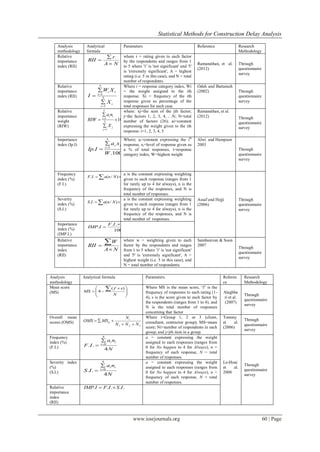
Table 1- Analytical Expression used for various studies reported in literature
Analysis
methodology
Analytical formula Parameters Reference Research
Methodology
Importance Index
(I)
I =
aixi
3
4
𝑖=1
Where, I = importance index; ai =
constant expressing the weight of the ith
response, xi = frequency of the ith
response given as a percentage of the
total response for each cause; i =
response category index.
Assaf et.al. 1995
Through
questionnaire
survey
Rank Correlation
coefficient (ρ)
)1(
61
2
2
NN
D
Where, D = difference between ranks
given by one party and the rank given by
another party for an individual cause and
N= Number of cause
Relative
importance index
(RII) NA
w
RII
where w = weighting given to each factor
by the respondents and ranges from 1 to
5 where '1' is 'not significant' and '5' is
'extremely significant', A = highest
weight (i.e. 5 in this case), and N = total
number of respondents.
Ramanathan,
et al. (2012)
Through
questionnaire
survey](https://image.slidesharecdn.com/h0925862-150116000028-conversion-gate02/85/Statistical-Methods-for-Construction-Delay-Analysis-2-320.jpg)
![Statistical Methods for Construction Delay Analysis
www.iosrjournals.org 61 | Page
V. COMPUTERIZED SCHEDULE DELAY ANALYSIS METHODS
The occurrence of delay is common in most construction projects, due to various reasons and causes
before or during construction phase. The delay analysis involves not only calculation of delay time but also
identification of causes of occurrence. In construction research of delay analysis, researcher makes an effort to
determine causes of delay(s) and remedial measures are performed in schedules to incorporate updated duration
and new project time. Although many delay analysis methodologies have been discovered, but still the time
consuming condition doesn‟t changed. This shows that the analysis itself involves complicated nature and it is
necessary to simplified it by a computerized approach.
VI. AS-PLANNED AND AS-BUILT SCHEDULE DELAY ANALYSIS METHOD
As-planned Method measures the contractor‟s planned or intended performance. Under this method the
scope of the changed work is reviewed to determine where and how the revisions should be incorporated in the
schedule. As-built schedule is basically the comparison of what was planned to what actually occurred, this
method is also known as Traditional Method (Budshait and Cunningham, 1998).
VII. WHAT-IF AND BUT-FOR METHOD
The what-if method accepts as-planned schedule as its baseline. In this method delay credited to one
side is added to the as-planned schedule and resulted delay on project duration is calculated. Same process is
performed for other side (Kim et al 2005).
The but-for method accepts as-built schedule as its baseline. This method subtracts the delay credited
to the owner from the as-built schedule. The time difference between the as-built schedule and bu-for schedule
is the compensable delay (Kim et al 2005).
VIII. ISOLATED COLLAPSED BUT-FOR (ICBF) METHOD
This method uses as-planned and as-built schedule to indentify delay events. The documents provided
in file format and converting into a compatible format is very important to process a computerized analysis
program. As built schedule reflects the actual project records of start and finish time of events. ICBF method
uses the as-built schedule to determine the causes of schedule delays. This computerized program rapidly and
schematically analyzes schedule delay, classifies delay liability and finds results (Yang et al. 2011).
IX. CONTEMPORANEOUS PERIOD ANALYSIS METHOD (CPA)
The CPA method breaks the construction period into discrete time increments and examines the effects
of the delays [11]. CPA method is also called as windows delay analysis method. This method breaks project
into a no. of sequential periods called windows and analyses delays that occurred in each window successively
[13].
Window analysis method is based on critical path method, which is consisting of scheduled activities
and progress analysis. The analysis takes first as-planned schedule and contemporaneous site information
showing as-built events from project start up to the end of respective window then each window is analyzed
separately.
X. CONCLUSION
The critical review undertaken in this paper covers analytical and computerized schedule analysis
methods for studying effect of construction delay factors. There are various methods suggested in literature that
are acceptable for deciding the importance of delay factors. Each study has its analytical approach which gives
unique results. These results are derived from questionnaire data. Various statistical methods like Rank
Correlation Coefficient, Relative Importance Index (RII), Important Index, Frequency Index (FI), Severity Index
(SI) and Mean Score (MS) have been determined to analyze the impact of delay factors on project performance.
The delay analysis methodology presented in this study gives comparison of methods which are used in
construction sector for computing impact of delay and the computerized approach helps to improve efficiency in
maximizing project performance.
REFERENCES
[1] Aibinu, A. A., and Odeyinka, H. A. (2006). “Construction delays and their causative factors in Nigeria”. J. Constr. Eng. and Mgmt.,
(ASCE), 132(7), 667-677.
[2] Alaghbari, W., Kadir, M.R.A., Salim, A., and Ernawati (2007) „The significant factors causing delay of building construction
projects in Malaysia‟, Engineering, Construction and Architectural Management, 14 (2), 192-206.
[3] Alwi, S., and Hampson, K. (2003). “Identifying the important causes of delays in building construction projects”. The 9th East
Asia-Pacific conference on structural eng. and constr., Bali, Indonesia.
[4] Assaf, S. A., Al-Khalif, M., and Al-Hazmi, M. (1995). “Causes of delay in large building construction projects”. J. Mgmt. Eng.,
11(2), 45-50.](https://image.slidesharecdn.com/h0925862-150116000028-conversion-gate02/85/Statistical-Methods-for-Construction-Delay-Analysis-4-320.jpg)
![Statistical Methods for Construction Delay Analysis
www.iosrjournals.org 62 | Page
[5] Assaf, S. A., and Al-hejji S. (2006). “Causes of delay in large construction projects”. International J. Project Mgmt., Science Direct,
24, 349-357.
[6] Bubshait, A. A. and Cunningham, M. J. (1998). “Comparision of delay analysis methodologies”. J. Constr. Eng. Mgmt., ASCE,
124(4), 315-322.
[7] Finke, M. R. (1999). “Window analysis of compensable delays”. J. Constr. Eng. and Mgmt., ASCE, 125(2), 96-100.
[8] Haseeb, M., Xinhai-Lu, Bibi, A., Dyian, M., and Rabbani, W., (2011). “Problems of projects and effects of delays in the
construction industry of Pakistan”. Australian Journal of Business and Mgmt. Research, 1(5), 41-50.
[9] Hegazy, T., Zhang, K. (2005). “Daily windows delay analysis”. J. Constr. Eng. and Mgmt., ASCE, 131(5), 505-512.
[10] Jonathan, J. S., Cheung, S. D., David, A. (2001).”Construction delay computation method”. Journal of Construction Engineering
and Management, 127, 60-65.
[11] Kim, Y., Kim, K., and Shin, D. (2005). “Delays analysis method using delay section”. J. Constr. Eng. And Mgmt., ASCE, 131(11),
1155-1164.
[12] Le-Hoai, L., Lee, Y. D., and Lee, J. Y. (2008). “Delay and cost overruns in Vietnam large construction projects: A comparison with
other selected countries”. KSCE Journal of Civil Eng., 12(6), 367-377.
[13] Menesi, W. (2007). “Construction delay analysis under multiple baseline updates”. A Thesis Report University of Waterloo, Canada
MA, 2007.
[14] Odeh, A.M. and Battaineh H (2002). “Causes of construction delay: traditional contracts”, International Journal of project
Management, 20 (1), 67-73.
[15] Ramanathan, C., and Narayanan, S. P., and Idrus, A. B. (2012). “Construction delays causing risks on time and cost-a critical
review”. Australian J. Constr. Economics and Bldg., 12(1), 37-57.
[16] Sambasivan, M. and Soon, Y.W. (2007) „Causes and effects of delays in Malaysian construction industry‟, International Journal of
Project Management, 25 (5), 517-526.
[17] Tommy, Y., Fung, W. H., and Tung, C. F. (2006). “Construction delays in Hong Kong civil engineering projects”. J. Constr. Eng.
and Mgmt., ASCE, 132(6), 636-649.
[18] Yang, J., Tsai, M., (2011). “Computerizing ICBF method for schedule delay analysis”. J. Constr. Eng. and Mgmt., ASCE, 137(8),
583-591.](https://image.slidesharecdn.com/h0925862-150116000028-conversion-gate02/85/Statistical-Methods-for-Construction-Delay-Analysis-5-320.jpg)

The paper reviews various statistical and computerized methods for analyzing delays in construction projects, highlighting the significance of understanding the causes and impacts of these delays to assign responsibility and mitigate future issues. It discusses the necessity of selecting appropriate analysis techniques based on the available data and resources, as well as the role of such analyses in determining financial impacts, penalties, and project performance. The study emphasizes that multiple methodologies exist, each providing unique insights, making it essential to choose the right method for accurate delay assessment.


