Architecture and Planning Department
Dawood University of
Engineering and Technology
NAME : AZKAR ALI
ID : D-15-AR-10
PRESENTION TILE : INTERNAL FINISHES
TEACHER : SIR FURQAN
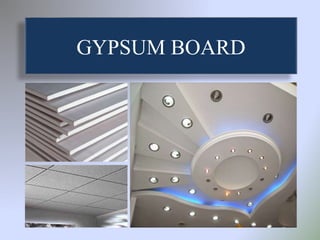
GYPSUM BOARD
INTRODUCTION
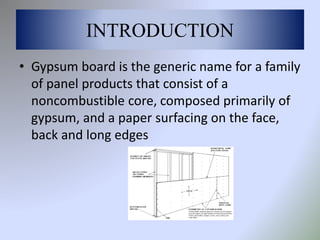
• Gypsum board is the generic name for a family
of panel products that consist of a
noncombustible core, composed primarily of
gypsum, and a paper surfacing on the face,
back and long edges
USES OF GYPSUM BOARD
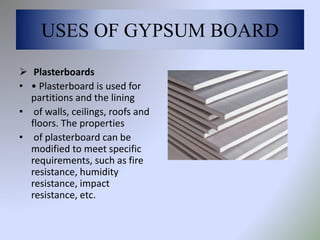
 Plasterboards
• • Plasterboard is used for
partitions and the lining
• of walls, ceilings, roofs and
floors. The properties
• of plasterboard can be
modified to meet specific
requirements, such as fire
resistance, humidity
resistance, impact
resistance, etc.
ADVANTAGES
• Gypsum board walls and ceilings have a
number of outstanding advantages:
• Ease of installation
• Fire resistance
• Sound isolation
• Durability
• Economy
• Versatility
–Ease of
installation
• Gypsum board building
systems are easy to install
for several reasons.
Gypsum board panels are
relatively large compared
to other materials. They
come in 48- and 54-inch
wide sheets and in
lengths of 8, 10, or 12
feet, so they quickly cover
large wall and ceiling
areas.
–Fire
resistance
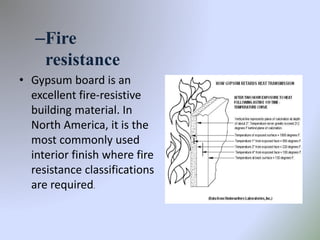
• Gypsum board is an
excellent fire-resistive
building material. In
North America, it is the
most commonly used
interior finish where fire
resistance classifications
are required.
–Sound isolation
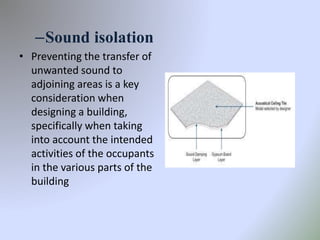
• Preventing the transfer of
unwanted sound to
adjoining areas is a key
consideration when
designing a building,
specifically when taking
into account the intended
activities of the occupants
in the various parts of the
building
–Durability
• Gypsum board is used to construct strong, high
quality walls and ceilings that offer excellent
dimensional stability and durability. Surfaces created
using gypsum board are easily decorated and
refinished.
–Versatility
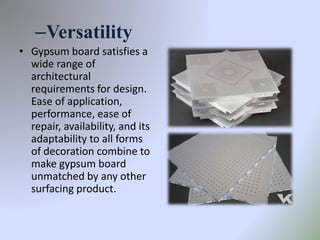
• Gypsum board satisfies a
wide range of
architectural
requirements for design.
Ease of application,
performance, ease of
repair, availability, and its
adaptability to all forms
of decoration combine to
make gypsum board
unmatched by any other
surfacing product.
TYPES OF GYPSUM BOARD
• Standard Gypsum Board
• Gypsum Board Channel
• Gypsum Board Starch
• Gypsum Ceiling Boards
Standard Gypsum Board
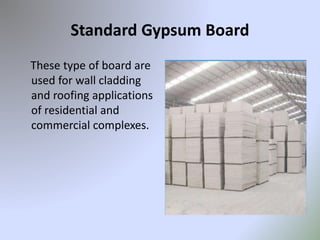
These type of board are
used for wall cladding
and roofing applications
of residential and
commercial complexes.
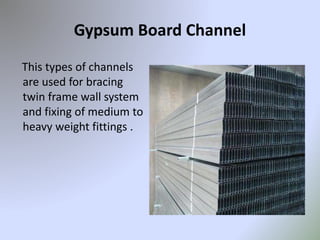
Gypsum Board Channel
This types of channels
are used for bracing
twin frame wall system
and fixing of medium to
heavy weight fittings .
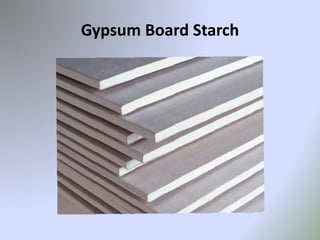
Gypsum Board Starch
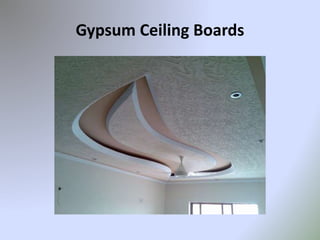
Gypsum Ceiling Boards
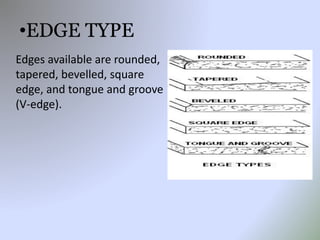
•EDGE TYPE
Edges available are rounded,
tapered, bevelled, square
edge, and tongue and groove
(V-edge).
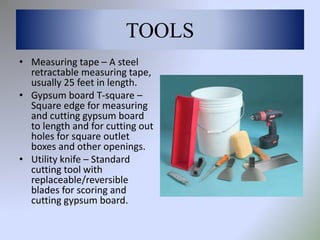
TOOLS
• Measuring tape – A steel
retractable measuring tape,
usually 25 feet in length.
• Gypsum board T-square –
Square edge for measuring
and cutting gypsum board
to length and for cutting out
holes for square outlet
boxes and other openings.
• Utility knife – Standard
cutting tool with
replaceable/reversible
blades for scoring and
cutting gypsum board.
• Hammer – Drives nails through gypsum board into wood
framing.
• Keyhole saw – Small triangular saw for cutting out holes for
outlet boxes, pipes, and other penetrations.
• Rasp – A tool for smoothing rough edges of wallboard after it
has been scored and snapped.
• Assorted trowels and taping knives – Bladed tools for applying
and smoothing tape and joint compound over joints and
fastener heads.
• Mud tray – Box to contain joint compound while finishing
joints and fastener heads.
• Sanding pole – Tool that enables sanding walls from floor to
ceiling and standard height ceilings without the use of a
ladder.
• Screw gun – Power tool that drives all types of gypsum board
screws through gypsum board and into framing or substrate.
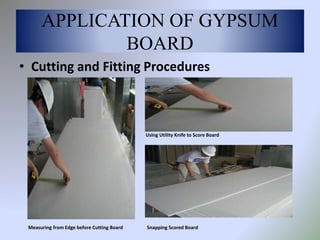
• Cutting and Fitting Procedures
APPLICATION OF GYPSUM
BOARD
Measuring from Edge before Cutting Board
Using Utility Knife to Score Board
Snapping Scored Board
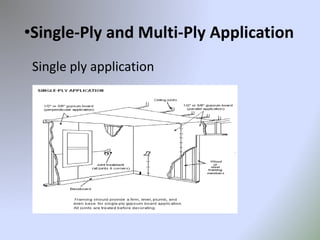
•Single-Ply and Multi-Ply Application
Single ply application
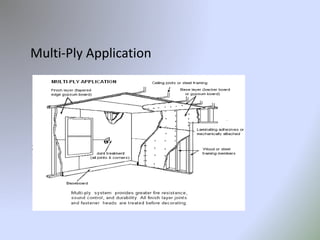
Multi-Ply Application
THANK YOU

Gypsum Board(internal finish)

  • 1.
    Architecture and PlanningDepartment Dawood University of Engineering and Technology NAME : AZKAR ALI ID : D-15-AR-10 PRESENTION TILE : INTERNAL FINISHES TEACHER : SIR FURQAN
  • 2.
  • 3.
    INTRODUCTION • Gypsum boardis the generic name for a family of panel products that consist of a noncombustible core, composed primarily of gypsum, and a paper surfacing on the face, back and long edges
  • 4.
    USES OF GYPSUMBOARD  Plasterboards • • Plasterboard is used for partitions and the lining • of walls, ceilings, roofs and floors. The properties • of plasterboard can be modified to meet specific requirements, such as fire resistance, humidity resistance, impact resistance, etc.
  • 5.
    ADVANTAGES • Gypsum boardwalls and ceilings have a number of outstanding advantages: • Ease of installation • Fire resistance • Sound isolation • Durability • Economy • Versatility
  • 6.
    –Ease of installation • Gypsumboard building systems are easy to install for several reasons. Gypsum board panels are relatively large compared to other materials. They come in 48- and 54-inch wide sheets and in lengths of 8, 10, or 12 feet, so they quickly cover large wall and ceiling areas.
  • 7.
    –Fire resistance • Gypsum boardis an excellent fire-resistive building material. In North America, it is the most commonly used interior finish where fire resistance classifications are required.
  • 8.
    –Sound isolation • Preventingthe transfer of unwanted sound to adjoining areas is a key consideration when designing a building, specifically when taking into account the intended activities of the occupants in the various parts of the building
  • 9.
    –Durability • Gypsum boardis used to construct strong, high quality walls and ceilings that offer excellent dimensional stability and durability. Surfaces created using gypsum board are easily decorated and refinished.
  • 10.
    –Versatility • Gypsum boardsatisfies a wide range of architectural requirements for design. Ease of application, performance, ease of repair, availability, and its adaptability to all forms of decoration combine to make gypsum board unmatched by any other surfacing product.
  • 11.
    TYPES OF GYPSUMBOARD • Standard Gypsum Board • Gypsum Board Channel • Gypsum Board Starch • Gypsum Ceiling Boards
  • 12.
    Standard Gypsum Board Thesetype of board are used for wall cladding and roofing applications of residential and commercial complexes.
  • 13.
    Gypsum Board Channel Thistypes of channels are used for bracing twin frame wall system and fixing of medium to heavy weight fittings .
  • 14.
  • 15.
  • 16.
    •EDGE TYPE Edges availableare rounded, tapered, bevelled, square edge, and tongue and groove (V-edge).
  • 17.
    TOOLS • Measuring tape– A steel retractable measuring tape, usually 25 feet in length. • Gypsum board T-square – Square edge for measuring and cutting gypsum board to length and for cutting out holes for square outlet boxes and other openings. • Utility knife – Standard cutting tool with replaceable/reversible blades for scoring and cutting gypsum board.
  • 18.
    • Hammer –Drives nails through gypsum board into wood framing. • Keyhole saw – Small triangular saw for cutting out holes for outlet boxes, pipes, and other penetrations. • Rasp – A tool for smoothing rough edges of wallboard after it has been scored and snapped. • Assorted trowels and taping knives – Bladed tools for applying and smoothing tape and joint compound over joints and fastener heads. • Mud tray – Box to contain joint compound while finishing joints and fastener heads. • Sanding pole – Tool that enables sanding walls from floor to ceiling and standard height ceilings without the use of a ladder. • Screw gun – Power tool that drives all types of gypsum board screws through gypsum board and into framing or substrate.
  • 19.
    • Cutting andFitting Procedures APPLICATION OF GYPSUM BOARD Measuring from Edge before Cutting Board Using Utility Knife to Score Board Snapping Scored Board
  • 20.
    •Single-Ply and Multi-PlyApplication Single ply application
  • 21.
  • 22.