Civil Engineering Department
Student Name : Hanad AbdiSalam Isak
ID: 1381
Presentation Tile: Gypsum Board
Faculty Dean: Engineer Ahmed Fu,ad
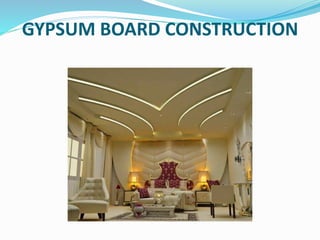
GYPSUM BOARD CONSTRUCTION
Overview
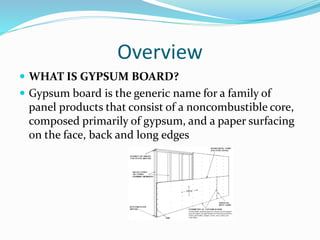
 WHAT IS GYPSUM BOARD?
 Gypsum board is the generic name for a family of
panel products that consist of a noncombustible core,
composed primarily of gypsum, and a paper surfacing
on the face, back and long edges
Advantages of Gypsum Board Construction
 Gypsum board walls and ceilings have a number of
outstanding advantages:
 Ease of installation
 Fire resistance
 Sound isolation
 Durability
 Economy
 Versatility
 Ease of installation
 Gypsum board building systems are easy to install
for several reasons. Gypsum board panels are
relatively large compared to other materials. They
come in 48- and 54-inch wide sheets and in
lengths of 8, 10, or 12 feet, so they quickly cover
large wall and ceiling areas.
 Fire resistance
 Gypsum board is an excellent fire-resistive
building material. In North America, it is the most
commonly used interior finish where fire
resistance classifications are required.
 Sound isolation
 Preventing the transfer of unwanted sound to
adjoining areas is a key consideration when
designing a building, specifically when taking into
account the intended activities of the occupants in
the various parts of the building
 Durability
 Gypsum board is used to construct strong, high
quality walls and ceilings that offer excellent
dimensional stability and durability. Surfaces
created using gypsum board are easily decorated
and refinished.
 Economy
 Gypsum board is readily available and easy to
apply. It is an inexpensive wall surfacing material
that provides a fire resistant interior finish.
Gypsum board building systems can generally be
installed at significantly lower labor costs than
most alternate systems.
 Versatility
 Gypsum board satisfies a wide range of
architectural requirements for design. Ease of
application, performance, ease of repair,
availability, and its adaptability to all forms of
decoration combine to make gypsum board
unmatched by any other surfacing product.
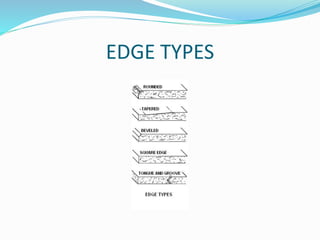
EDGE TYPES
END

Gypsum board Introduction

  • 1.
    Civil Engineering Department StudentName : Hanad AbdiSalam Isak ID: 1381 Presentation Tile: Gypsum Board Faculty Dean: Engineer Ahmed Fu,ad
  • 2.
  • 3.
    Overview  WHAT ISGYPSUM BOARD?  Gypsum board is the generic name for a family of panel products that consist of a noncombustible core, composed primarily of gypsum, and a paper surfacing on the face, back and long edges
  • 4.
    Advantages of GypsumBoard Construction  Gypsum board walls and ceilings have a number of outstanding advantages:  Ease of installation  Fire resistance  Sound isolation  Durability  Economy  Versatility
  • 5.
     Ease ofinstallation  Gypsum board building systems are easy to install for several reasons. Gypsum board panels are relatively large compared to other materials. They come in 48- and 54-inch wide sheets and in lengths of 8, 10, or 12 feet, so they quickly cover large wall and ceiling areas.
  • 6.
     Fire resistance Gypsum board is an excellent fire-resistive building material. In North America, it is the most commonly used interior finish where fire resistance classifications are required.
  • 7.
     Sound isolation Preventing the transfer of unwanted sound to adjoining areas is a key consideration when designing a building, specifically when taking into account the intended activities of the occupants in the various parts of the building
  • 8.
     Durability  Gypsumboard is used to construct strong, high quality walls and ceilings that offer excellent dimensional stability and durability. Surfaces created using gypsum board are easily decorated and refinished.
  • 9.
     Economy  Gypsumboard is readily available and easy to apply. It is an inexpensive wall surfacing material that provides a fire resistant interior finish. Gypsum board building systems can generally be installed at significantly lower labor costs than most alternate systems.
  • 10.
     Versatility  Gypsumboard satisfies a wide range of architectural requirements for design. Ease of application, performance, ease of repair, availability, and its adaptability to all forms of decoration combine to make gypsum board unmatched by any other surfacing product.
  • 11.
  • 12.