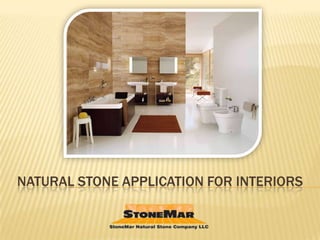
NATURAL STONE APPLICATION FOR INTERIORS
OVERVIEW

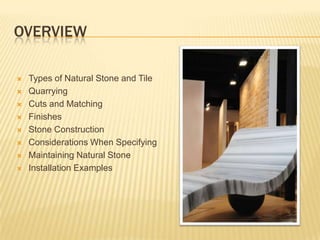
   Types of Natural Stone and Tile
   Quarrying
   Cuts and Matching
   Finishes
   Stone Construction
   Considerations When Specifying
   Maintaining Natural Stone
   Installation Examples
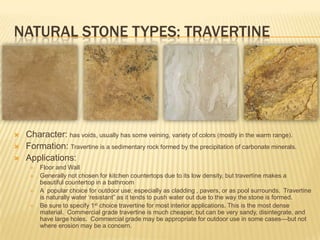
NATURAL STONE TYPES: TRAVERTINE


   Character: has voids, usually has some veining, variety of colors (mostly in the warm range).
   Formation: Travertine is a sedimentary rock formed by the precipitation of carbonate minerals.
   Applications:
        Floor and Wall
        Generally not chosen for kitchen countertops due to its low density, but travertine makes a
         beautiful countertop in a bathroom
        A popular choice for outdoor use; especially as cladding , pavers, or as pool surrounds. Travertine
         is naturally water „resistant” as it tends to push water out due to the way the stone is formed.
        Be sure to specify 1st choice travertine for most interior applications. This is the most dense
         material. Commercial grade travertine is much cheaper, but can be very sandy, disintegrate, and
         have large holes. Commercial grade may be appropriate for outdoor use in some cases—but not
         where erosion may be a concern.
NATURAL STONE TYPES: LIMESTONE


   Character: often has visible fossils embedded within, some color variety.
   Formation: Limestone is a sedimentary rock composed of different crystal forms of calcium
    carbonate. Most grains in limestone are skeletal fragments of marine organisms
   Application
        Floor and wall
        Not generally chosen for countertops due to its porosity and tendency to stain-- limestone is
         suitable for bathroom countertops, however.
        Not generally chosen for outdoor use for the same reasons, but it can be used with proper sealing
        Some limestones must be sealed from the front AND the back before installation to prevent the
         setting materials from staining the stone.
NATURAL STONE TYPES: MARBLE


   Character: Marble often has distinct veining with a wide variety of colors.
   Formation: Marble is a metamorphic crystalline rock formed when limestone has additional heat
    and pressure applied to it by the earth‟s crust, causing the stone to re-crystallize.
   Applications:
        Floor and Wall
        Countertops—occasionally. It is a popular material for bathroom countertops. It Can be too
         delicate for kitchen (depending on how the client will use it) New Sealing Products have made
         marble a more popular choice for interior countertops in recent years.
        Not usually a good choice for outdoor applications. Can be used in a sandblasted or other highly
         textured finish, but usually not preferred for countertops in outdoor kitchens or in wet areas.
NATURAL STONE TYPES: GRANITE


   Character: often has “busy” visual texture in a variety of colors.
   Formation: Granite is a plutonic igneous rock having visibly crystalline texture; generally composed
    of feldspar and mica and quartz
   Applications:
        Floor and wall: sometimes this is a desired look, but it can be very busy
        Countertops: the hardness of the stone makes granite the most popular choice for both kitchen and
         bathroom countertops.
        Suitable for any outdoor applications (be careful to choose the right finish) and exterior cladding
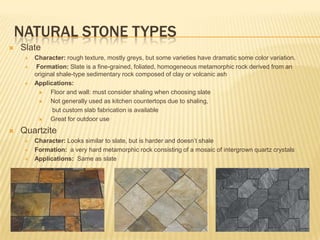
NATURAL STONE TYPES
   Slate
       Character: rough texture, mostly greys, but some varieties have dramatic some color variation.
       Formation: Slate is a fine-grained, foliated, homogeneous metamorphic rock derived from an
        original shale-type sedimentary rock composed of clay or volcanic ash
       Applications:
             Floor and wall: must consider shaling when choosing slate
             Not generally used as kitchen countertops due to shaling,
               but custom slab fabrication is available
             Great for outdoor use
   Quartzite
       Character: Looks similar to slate, but is harder and doesn‟t shale
       Formation: a very hard metamorphic rock consisting of a mosaic of intergrown quartz crystals
       Applications: Same as slate
NATURAL STONE TYPES
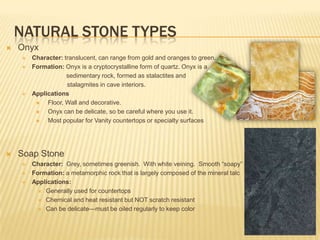
   Onyx
       Character: translucent, can range from gold and oranges to green.
       Formation: Onyx is a cryptocrystalline form of quartz. Onyx is a
                    sedimentary rock, formed as stalactites and
                    stalagmites in cave interiors.
       Applications
            Floor, Wall and decorative.
            Onyx can be delicate, so be careful where you use it.
            Most popular for Vanity countertops or specialty surfaces


   Soap Stone
       Character: Grey, sometimes greenish. With white veining. Smooth “soapy” feel
       Formation: a metamorphic rock that is largely composed of the mineral talc
       Applications:
           Generally used for countertops

           Chemical and heat resistant but NOT scratch resistant

           Can be delicate—must be oiled regularly to keep color
STONE PRODUCTION
   Sourcing
        Natural stone comes from quarries world-
         wide.
        Certain stones are available only in certain
         parts of the world.
        Italy, Spain, and Turkey are major exporters
         of different types of natural stone
   Quarries
        After a deposit of a desired stone is
         discovered, engineers design a quarry plan
        Stone is excavated using drilling and
         blasting techniques
             Long tunnels are drilled vertically
             Explosives are inserted and detonated
             Large boulders are removed and
               processed into useable tile and slabs
               at the factories
        Let‟s watch a quarry blast!

   Factories
        Large blocks from the blast are either cut
         into specialty items like sinks, bathtubs, etc,
         or cut into large slabs which are then planed
         and cut into tiles
        Factories have specially calibrated
         machinery to make 90 degree corners and
         straight cuts. Be sure when purchasing that
         tile is properly calibrated!
        How Granite is sourced and produced
CUT TYPES AND MATCHING
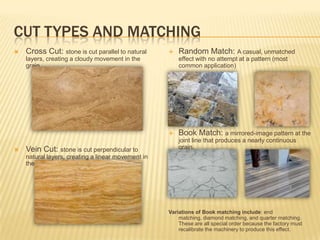
   Cross Cut: stone is cut parallel to natural        Random Match: A casual, unmatched
    layers, creating a cloudy movement in the           effect with no attempt at a pattern (most
    grain                                               common application)


                                                       Book Match: a mirrored-image pattern at the
                                                        joint line that produces a nearly continuous
   Vein Cut: stone is cut perpendicular to             grain.
    natural layers, creating a linear movement in
    the grain


                                                    Variations of Book matching include: end
                                                        matching, diamond matching, and quarter matching.
                                                        These are all special order because the factory must
                                                        recalibrate the machinery to produce this effect.
NATURAL STONE FINISHES
   Polished: A glossy surface finish that brings out the full color and character of the stone. The finest and
    smoothest             finish available in stone, characterized by a high luster and strong reflection of light.
   Honed: This is a process to remove the saw marks/scratches left by the saw. This gives a softer, matte
    appearance            to the stone.
   Honed and Filled: Before Travertine is honed, the natural holes are often filled with colored cement or resin
    to       create a smooth surface
   Brushed: This process is done with a wire brush to make the stone have a soft or velvet feel to it. This
    process               enhances and deepens the colors as well. Sometimes called “leather‟ finish.
   Tumbled: A special finish obtained by rotating pre-cut pieces of stone in a tumbler. This process produces a
    very     rustic look with rough edges and rounded corners.
   Sand Blasted: This is accomplished by exposing the surface to a high pressure jet of sand that leaves the
             material slightly scratched on the surface. This finish is often used outside because it is non-skid.
   Flamed: A stone that has been thermally treated, creating a reddish-yellow color with uneven rough surface.
   Saw-Cut: This is the result when the stone is cut; the gang saw used leaves marks/scratches on the surface.
   Bush Hammered: A finish that creates a rugged surface full of little grazes that becomes non-slippery, also
    giving the stone a lighter shade.
   Split: Tile has a flat back with an uneven front surface, which offers a look like protruding bricks from the wall.
   Chiseled: A hand-made finish with deep textured line that could go in one or more directions. Can be rough
    or fine.
   Antiqued: Special machines that look like industrial washing machines are used to treat the pieces with
    abrasive elements (sand, shot blast) while a cylinder revolves. In a short time the impact on the stones with the
    abrasives produces an effect similar to aging caused by use and wear.
   Acid Washed: Stone is treated with a special acid to create a slightly textured finish—this is popular in
    shower                areas, especially in stone shower trays. Can also be used to remove a polished finish from
    stone.

   Imitations of these finishes are often available in man-made and engineered surfaces, as
TYPES OF STONE CONSTRUCTION
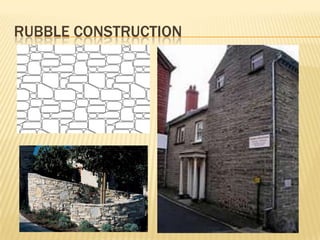
   Rubble
       Stones are used as they are, or roughly shaped and laid with wide joints.
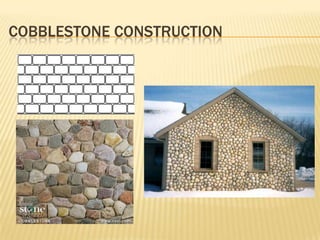
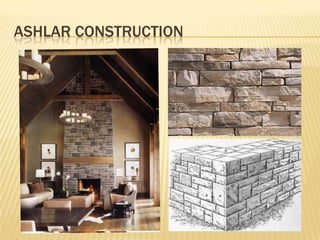
   Cobblestone
       Cobblestones are laid in horizontal rows with decorative mortar treatment to the
        horizontal and vertical joints.
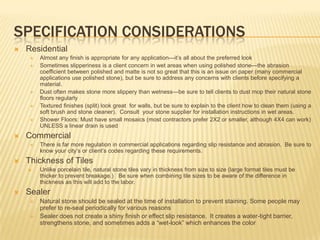
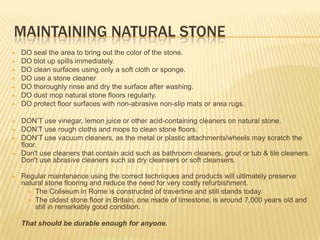
   Ashlar
       Quarried stone is sawn to a particular size and the blocks fit closely together
RUBBLE CONSTRUCTION
COBBLESTONE CONSTRUCTION
ASHLAR CONSTRUCTION
TYPES OF STONE WALLS
       Structural
        - footing needed
        - coursed or non-coursed
        - filled with mortar
        - minimum 10” thick


       Decorative
            - footings still needed
            - coursed or uncoursed
            - fill with mortar
            - metal ties fasten decorative
               to structural wall
FOOTINGS FOR STONE WALLS
METAL TIE SYSTEM FOR DECORATIVE STONE WALLS


                 Barnes Foundation
                 on Ben Franklin Parkway
SPECIFICATION CONSIDERATIONS
   Residential
        Almost any finish is appropriate for any application—it‟s all about the preferred look
        Sometimes slipperiness is a client concern in wet areas when using polished stone—the abrasion
         coefficient between polished and matte is not so great that this is an issue on paper (many commercial
         applications use polished stone), but be sure to address any concerns with clients before specifying a
         material.
        Dust often makes stone more slippery than wetness—be sure to tell clients to dust mop their natural stone
         floors regularly
        Textured finishes (split) look great for walls, but be sure to explain to the client how to clean them (using a
         soft brush and stone cleaner). Consult your stone supplier for installation instructions in wet areas.
        Shower Floors: Must have small mosaics (most contractors prefer 2X2 or smaller, although 4X4 can work)
         UNLESS a linear drain is used
   Commercial
        There is far more regulation in commercial applications regarding slip resistance and abrasion. Be sure to
         know your city‟s or client‟s codes regarding these requirements.
   Thickness of Tiles
        Unlike porcelain tile, natural stone tiles vary in thickness from size to size (large format tiles must be
         thicker to prevent breakage.) Be sure when combining tile sizes to be aware of the difference in
         thickness as this will add to the labor.
   Sealer
        Natural stone should be sealed at the time of installation to prevent staining. Some people may
         prefer to re-seal periodically for various reasons
        Sealer does not create a shiny finish or effect slip resistance. It creates a water-tight barrier,
         strengthens stone, and sometimes adds a “wet-look” which enhances the color
MAINTAINING NATURAL STONE
   DO seal the area to bring out the color of the stone.
   DO blot up spills immediately.
   DO clean surfaces using only a soft cloth or sponge.
   DO use a stone cleaner
   DO thoroughly rinse and dry the surface after washing.
   DO dust mop natural stone floors regularly.
   DO protect floor surfaces with non-abrasive non-slip mats or area rugs.

   DON‟T use vinegar, lemon juice or other acid-containing cleaners on natural stone.
   DON‟T use rough cloths and mops to clean stone floors.
   DON‟T use vacuum cleaners, as the metal or plastic attachments/wheels may scratch the
    floor.
   Don't use cleaners that contain acid such as bathroom cleaners, grout or tub & tile cleaners.
    Don't use abrasive cleaners such as dry cleansers or soft cleansers.

   Regular maintenance using the correct techniques and products will ultimately preserve
    natural stone flooring and reduce the need for very costly refurbishment.
       The Coliseum in Rome is constructed of travertine and still stands today.
       The oldest stone floor in Britain, one made of limestone, is around 7,000 years old and
        still in remarkably good condition.

    That should be durable enough for anyone.
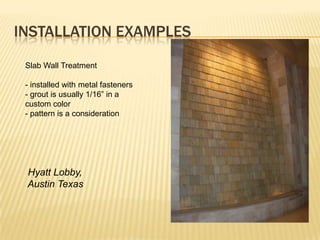
INSTALLATION EXAMPLES
 Slab Wall Treatment

 - installed with metal fasteners
 - grout is usually 1/16” in a
 custom color
 - pattern is a consideration


 Hyatt Lobby,
 Austin Texas
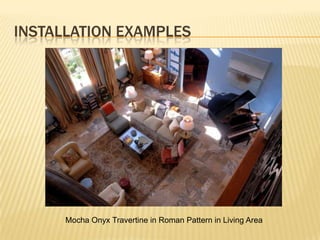
INSTALLATION EXAMPLES


      Mocha Onyx Travertine in Roman Pattern in Living Area
INSTALLATION EXAMPLES


         Travertine Roman Pattern in a Restaurant
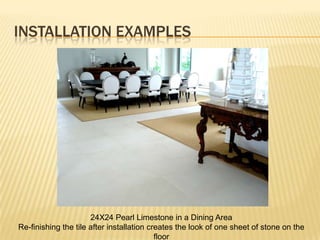
INSTALLATION EXAMPLES


                      24X24 Pearl Limestone in a Dining Area
Re-finishing the tile after installation creates the look of one sheet of stone on the
                                           floor
INSTALLATION EXAMPLES


   Silver Ivory Travertine in a High-End Retail Store (Coach, Verizon
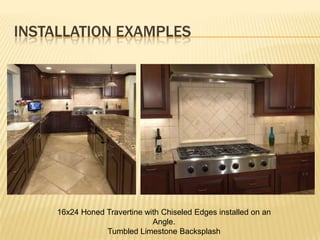
INSTALLATION EXAMPLES


     16x24 Honed Travertine with Chiseled Edges installed on an
                              Angle.
                 Tumbled Limestone Backsplash
INSTALLATION EXAMPLES


       Mocha Onyx Travertine Roman Pattern and Steps in a
                            Restaurant
    (Madison Café, Riverton NJ. Design by Wendy Holden, ASID)
INSTALLATION EXAMPLES


      Saw Cut Travertine Exterior Cladding (El Salvador)
INSTALLATION EXAMPLES


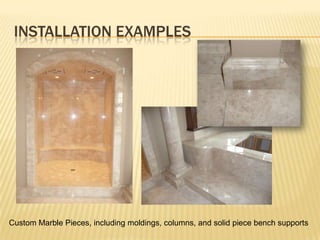
Custom Marble Pieces, including moldings, columns, and solid piece bench supports
INSTALLATION EXAMPLES


     Custom Travertine Shower Tray with Split-face Accent Wall
INSTALLATION EXAMPLES


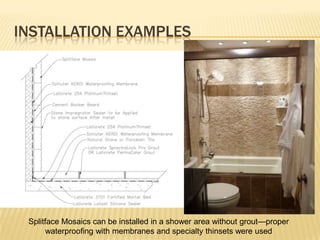
 Splitface Mosaics can be installed in a shower area without grout—proper
       waterproofing with membranes and specialty thinsets were used
INSTALLATION EXAMPLES


 Usually Shower Floors MUST have 4x4 or Smaller Mosaics (Due to Sloping)
       A Specialty Drain will Allow for Large tiles and ADA Accessibility
INSTALLATION EXAMPLES


      This Vertical Accent was Created for Practical Reasons:
                       Can you Guess Why?
FOR YOUR INFORMATION
   www.stonemar.com
       holly@stonemar.com

 www.marble-institute.com
 www.laticrete.com/architects.aspx

 www.natural-stone-database.com

 www.architonic.com

Natural Stone Application for Interiors

  • 1.
  • 2.
    OVERVIEW  Types of Natural Stone and Tile  Quarrying  Cuts and Matching  Finishes  Stone Construction  Considerations When Specifying  Maintaining Natural Stone  Installation Examples
  • 3.
    NATURAL STONE TYPES:TRAVERTINE  Character: has voids, usually has some veining, variety of colors (mostly in the warm range).  Formation: Travertine is a sedimentary rock formed by the precipitation of carbonate minerals.  Applications:  Floor and Wall  Generally not chosen for kitchen countertops due to its low density, but travertine makes a beautiful countertop in a bathroom  A popular choice for outdoor use; especially as cladding , pavers, or as pool surrounds. Travertine is naturally water „resistant” as it tends to push water out due to the way the stone is formed.  Be sure to specify 1st choice travertine for most interior applications. This is the most dense material. Commercial grade travertine is much cheaper, but can be very sandy, disintegrate, and have large holes. Commercial grade may be appropriate for outdoor use in some cases—but not where erosion may be a concern.
  • 4.
    NATURAL STONE TYPES:LIMESTONE  Character: often has visible fossils embedded within, some color variety.  Formation: Limestone is a sedimentary rock composed of different crystal forms of calcium carbonate. Most grains in limestone are skeletal fragments of marine organisms  Application  Floor and wall  Not generally chosen for countertops due to its porosity and tendency to stain-- limestone is suitable for bathroom countertops, however.  Not generally chosen for outdoor use for the same reasons, but it can be used with proper sealing  Some limestones must be sealed from the front AND the back before installation to prevent the setting materials from staining the stone.
  • 5.
    NATURAL STONE TYPES:MARBLE  Character: Marble often has distinct veining with a wide variety of colors.  Formation: Marble is a metamorphic crystalline rock formed when limestone has additional heat and pressure applied to it by the earth‟s crust, causing the stone to re-crystallize.  Applications:  Floor and Wall  Countertops—occasionally. It is a popular material for bathroom countertops. It Can be too delicate for kitchen (depending on how the client will use it) New Sealing Products have made marble a more popular choice for interior countertops in recent years.  Not usually a good choice for outdoor applications. Can be used in a sandblasted or other highly textured finish, but usually not preferred for countertops in outdoor kitchens or in wet areas.
  • 6.
    NATURAL STONE TYPES:GRANITE  Character: often has “busy” visual texture in a variety of colors.  Formation: Granite is a plutonic igneous rock having visibly crystalline texture; generally composed of feldspar and mica and quartz  Applications:  Floor and wall: sometimes this is a desired look, but it can be very busy  Countertops: the hardness of the stone makes granite the most popular choice for both kitchen and bathroom countertops.  Suitable for any outdoor applications (be careful to choose the right finish) and exterior cladding
  • 7.
    NATURAL STONE TYPES  Slate  Character: rough texture, mostly greys, but some varieties have dramatic some color variation.  Formation: Slate is a fine-grained, foliated, homogeneous metamorphic rock derived from an original shale-type sedimentary rock composed of clay or volcanic ash  Applications:  Floor and wall: must consider shaling when choosing slate  Not generally used as kitchen countertops due to shaling, but custom slab fabrication is available  Great for outdoor use  Quartzite  Character: Looks similar to slate, but is harder and doesn‟t shale  Formation: a very hard metamorphic rock consisting of a mosaic of intergrown quartz crystals  Applications: Same as slate
  • 8.
    NATURAL STONE TYPES  Onyx  Character: translucent, can range from gold and oranges to green.  Formation: Onyx is a cryptocrystalline form of quartz. Onyx is a sedimentary rock, formed as stalactites and stalagmites in cave interiors.  Applications  Floor, Wall and decorative.  Onyx can be delicate, so be careful where you use it.  Most popular for Vanity countertops or specialty surfaces  Soap Stone  Character: Grey, sometimes greenish. With white veining. Smooth “soapy” feel  Formation: a metamorphic rock that is largely composed of the mineral talc  Applications:  Generally used for countertops  Chemical and heat resistant but NOT scratch resistant  Can be delicate—must be oiled regularly to keep color
  • 9.
    STONE PRODUCTION  Sourcing  Natural stone comes from quarries world- wide.  Certain stones are available only in certain parts of the world.  Italy, Spain, and Turkey are major exporters of different types of natural stone  Quarries  After a deposit of a desired stone is discovered, engineers design a quarry plan  Stone is excavated using drilling and blasting techniques  Long tunnels are drilled vertically  Explosives are inserted and detonated  Large boulders are removed and processed into useable tile and slabs at the factories  Let‟s watch a quarry blast!  Factories  Large blocks from the blast are either cut into specialty items like sinks, bathtubs, etc, or cut into large slabs which are then planed and cut into tiles  Factories have specially calibrated machinery to make 90 degree corners and straight cuts. Be sure when purchasing that tile is properly calibrated!  How Granite is sourced and produced
  • 10.
    CUT TYPES ANDMATCHING  Cross Cut: stone is cut parallel to natural  Random Match: A casual, unmatched layers, creating a cloudy movement in the effect with no attempt at a pattern (most grain common application)  Book Match: a mirrored-image pattern at the joint line that produces a nearly continuous  Vein Cut: stone is cut perpendicular to grain. natural layers, creating a linear movement in the grain Variations of Book matching include: end matching, diamond matching, and quarter matching. These are all special order because the factory must recalibrate the machinery to produce this effect.
  • 11.
    NATURAL STONE FINISHES  Polished: A glossy surface finish that brings out the full color and character of the stone. The finest and smoothest finish available in stone, characterized by a high luster and strong reflection of light.  Honed: This is a process to remove the saw marks/scratches left by the saw. This gives a softer, matte appearance to the stone.  Honed and Filled: Before Travertine is honed, the natural holes are often filled with colored cement or resin to create a smooth surface  Brushed: This process is done with a wire brush to make the stone have a soft or velvet feel to it. This process enhances and deepens the colors as well. Sometimes called “leather‟ finish.  Tumbled: A special finish obtained by rotating pre-cut pieces of stone in a tumbler. This process produces a very rustic look with rough edges and rounded corners.  Sand Blasted: This is accomplished by exposing the surface to a high pressure jet of sand that leaves the material slightly scratched on the surface. This finish is often used outside because it is non-skid.  Flamed: A stone that has been thermally treated, creating a reddish-yellow color with uneven rough surface.  Saw-Cut: This is the result when the stone is cut; the gang saw used leaves marks/scratches on the surface.  Bush Hammered: A finish that creates a rugged surface full of little grazes that becomes non-slippery, also giving the stone a lighter shade.  Split: Tile has a flat back with an uneven front surface, which offers a look like protruding bricks from the wall.  Chiseled: A hand-made finish with deep textured line that could go in one or more directions. Can be rough or fine.  Antiqued: Special machines that look like industrial washing machines are used to treat the pieces with abrasive elements (sand, shot blast) while a cylinder revolves. In a short time the impact on the stones with the abrasives produces an effect similar to aging caused by use and wear.  Acid Washed: Stone is treated with a special acid to create a slightly textured finish—this is popular in shower areas, especially in stone shower trays. Can also be used to remove a polished finish from stone.  Imitations of these finishes are often available in man-made and engineered surfaces, as
  • 12.
    TYPES OF STONECONSTRUCTION  Rubble  Stones are used as they are, or roughly shaped and laid with wide joints.  Cobblestone  Cobblestones are laid in horizontal rows with decorative mortar treatment to the horizontal and vertical joints.  Ashlar  Quarried stone is sawn to a particular size and the blocks fit closely together
  • 13.
  • 14.
  • 15.
  • 16.
    TYPES OF STONEWALLS  Structural  - footing needed  - coursed or non-coursed  - filled with mortar  - minimum 10” thick  Decorative  - footings still needed  - coursed or uncoursed  - fill with mortar  - metal ties fasten decorative to structural wall
  • 17.
  • 18.
    METAL TIE SYSTEMFOR DECORATIVE STONE WALLS Barnes Foundation on Ben Franklin Parkway
  • 19.
    SPECIFICATION CONSIDERATIONS  Residential  Almost any finish is appropriate for any application—it‟s all about the preferred look  Sometimes slipperiness is a client concern in wet areas when using polished stone—the abrasion coefficient between polished and matte is not so great that this is an issue on paper (many commercial applications use polished stone), but be sure to address any concerns with clients before specifying a material.  Dust often makes stone more slippery than wetness—be sure to tell clients to dust mop their natural stone floors regularly  Textured finishes (split) look great for walls, but be sure to explain to the client how to clean them (using a soft brush and stone cleaner). Consult your stone supplier for installation instructions in wet areas.  Shower Floors: Must have small mosaics (most contractors prefer 2X2 or smaller, although 4X4 can work) UNLESS a linear drain is used  Commercial  There is far more regulation in commercial applications regarding slip resistance and abrasion. Be sure to know your city‟s or client‟s codes regarding these requirements.  Thickness of Tiles  Unlike porcelain tile, natural stone tiles vary in thickness from size to size (large format tiles must be thicker to prevent breakage.) Be sure when combining tile sizes to be aware of the difference in thickness as this will add to the labor.  Sealer  Natural stone should be sealed at the time of installation to prevent staining. Some people may prefer to re-seal periodically for various reasons  Sealer does not create a shiny finish or effect slip resistance. It creates a water-tight barrier, strengthens stone, and sometimes adds a “wet-look” which enhances the color
  • 20.
    MAINTAINING NATURAL STONE  DO seal the area to bring out the color of the stone.  DO blot up spills immediately.  DO clean surfaces using only a soft cloth or sponge.  DO use a stone cleaner  DO thoroughly rinse and dry the surface after washing.  DO dust mop natural stone floors regularly.  DO protect floor surfaces with non-abrasive non-slip mats or area rugs.  DON‟T use vinegar, lemon juice or other acid-containing cleaners on natural stone.  DON‟T use rough cloths and mops to clean stone floors.  DON‟T use vacuum cleaners, as the metal or plastic attachments/wheels may scratch the floor.  Don't use cleaners that contain acid such as bathroom cleaners, grout or tub & tile cleaners. Don't use abrasive cleaners such as dry cleansers or soft cleansers.  Regular maintenance using the correct techniques and products will ultimately preserve natural stone flooring and reduce the need for very costly refurbishment.  The Coliseum in Rome is constructed of travertine and still stands today.  The oldest stone floor in Britain, one made of limestone, is around 7,000 years old and still in remarkably good condition. That should be durable enough for anyone.
  • 21.
  • 22.
    INSTALLATION EXAMPLES SlabWall Treatment - installed with metal fasteners - grout is usually 1/16” in a custom color - pattern is a consideration Hyatt Lobby, Austin Texas
  • 23.
    INSTALLATION EXAMPLES Mocha Onyx Travertine in Roman Pattern in Living Area
  • 24.
    INSTALLATION EXAMPLES Travertine Roman Pattern in a Restaurant
  • 25.
    INSTALLATION EXAMPLES 24X24 Pearl Limestone in a Dining Area Re-finishing the tile after installation creates the look of one sheet of stone on the floor
  • 26.
    INSTALLATION EXAMPLES Silver Ivory Travertine in a High-End Retail Store (Coach, Verizon
  • 27.
    INSTALLATION EXAMPLES 16x24 Honed Travertine with Chiseled Edges installed on an Angle. Tumbled Limestone Backsplash
  • 28.
    INSTALLATION EXAMPLES Mocha Onyx Travertine Roman Pattern and Steps in a Restaurant (Madison Café, Riverton NJ. Design by Wendy Holden, ASID)
  • 29.
    INSTALLATION EXAMPLES Saw Cut Travertine Exterior Cladding (El Salvador)
  • 30.
    INSTALLATION EXAMPLES Custom MarblePieces, including moldings, columns, and solid piece bench supports
  • 31.
    INSTALLATION EXAMPLES Custom Travertine Shower Tray with Split-face Accent Wall
  • 32.
    INSTALLATION EXAMPLES SplitfaceMosaics can be installed in a shower area without grout—proper waterproofing with membranes and specialty thinsets were used
  • 33.
    INSTALLATION EXAMPLES UsuallyShower Floors MUST have 4x4 or Smaller Mosaics (Due to Sloping) A Specialty Drain will Allow for Large tiles and ADA Accessibility
  • 34.
    INSTALLATION EXAMPLES This Vertical Accent was Created for Practical Reasons: Can you Guess Why?
  • 35.
    FOR YOUR INFORMATION  www.stonemar.com  holly@stonemar.com  www.marble-institute.com  www.laticrete.com/architects.aspx  www.natural-stone-database.com  www.architonic.com