

Is it time for an
       ‘Inquiry Make-Over’?
  …enter Guided Inquiry
Session 2 workshop

Cairns Diocese
Curriculum Conference                    LYN HAY
Library Strand          School of Information Studies
13 March 2010                Charles Sturt University
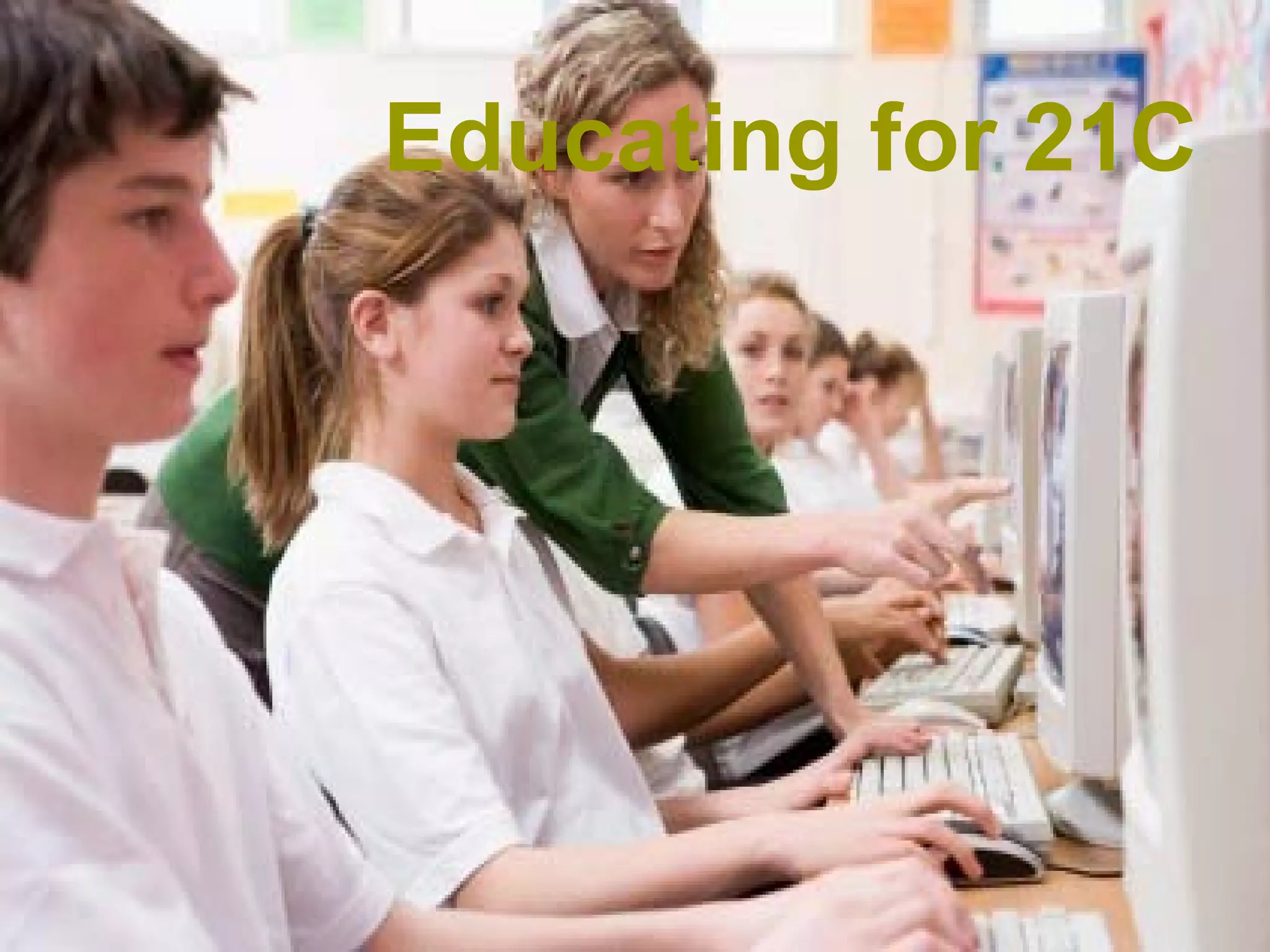
Educating for 21C
Educating for 21C
  How to we educate our students to meet the high levels of
   literacy in the technological workplace?
  How do we prepare our students to navigate and make sense
   of the global information environment?
  How do we enable our students to draw on the knowledge
   and wisdom of the past while using the technology of the
   present to advance new discoveries for the future?
  How do we prepare our students to think for themselves,
   make good decisions, develop expertise, and learn through
   life?
  Many teachers are turning to inquiry learning in subjects
   across the curriculum to meet the challenge of educating
   their students for lifelong learning
Inquiry learning
 Is an approach to learning whereby students find and use a variety
  of sources of information and ideas to increase their understanding
  of a problem, topic or issue
 It requires more than simply answering questions or getting a right
  answer
 It espouses investigation, exploration, search, quest, research,
  pursuit and study
 Inquiry does not stand alone; it engages, interests and challenges
  students to connect their world within the curriculum
 It is often an individual pursuit
 Can be enhanced by being part of a community of learning
 Without some guidance, inquiry learning can be daunting
 Inquiry is not an add-on to the curriculum, it is a way of learning
  content, skills and values within the curriculum through inquiry
Learning in the school library
 Students actively engage with diverse and often
  conflicting sources of information and ideas to
 discover new ones, to build new understandings,
     and to develop personal viewpoints and
                   perspectives.
                   KNOWLEDGE OUTCOME
         --------------------------------------------------------------
 It is underpinned by stimulating encounters with
   information – encounters which capture their
  interest and attention, and which motivate and
                direct their ongoing inquiry.
              INFORMATION FOUNDATION
                                                           (Todd 2008)
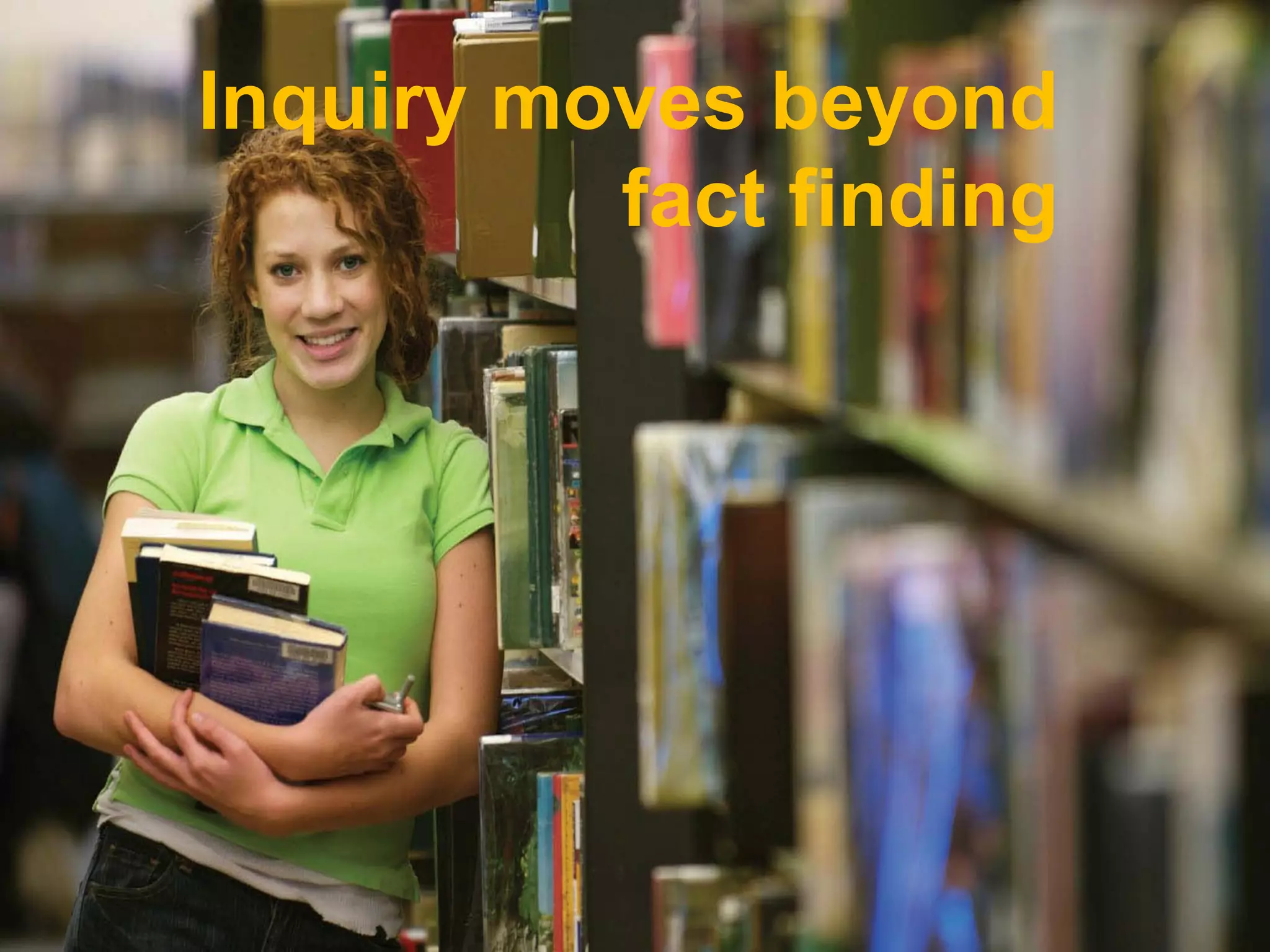
Inquiry moves beyond
          fact finding
Inquiry moves beyond
               fact finding
Raises standard of research assignments to
  higher level by:

   Drawing on life experiences
   Learning from a wide range of sources
   Forming deep understanding
   Gaining sense of accomplishment
   Developing competence and expertise
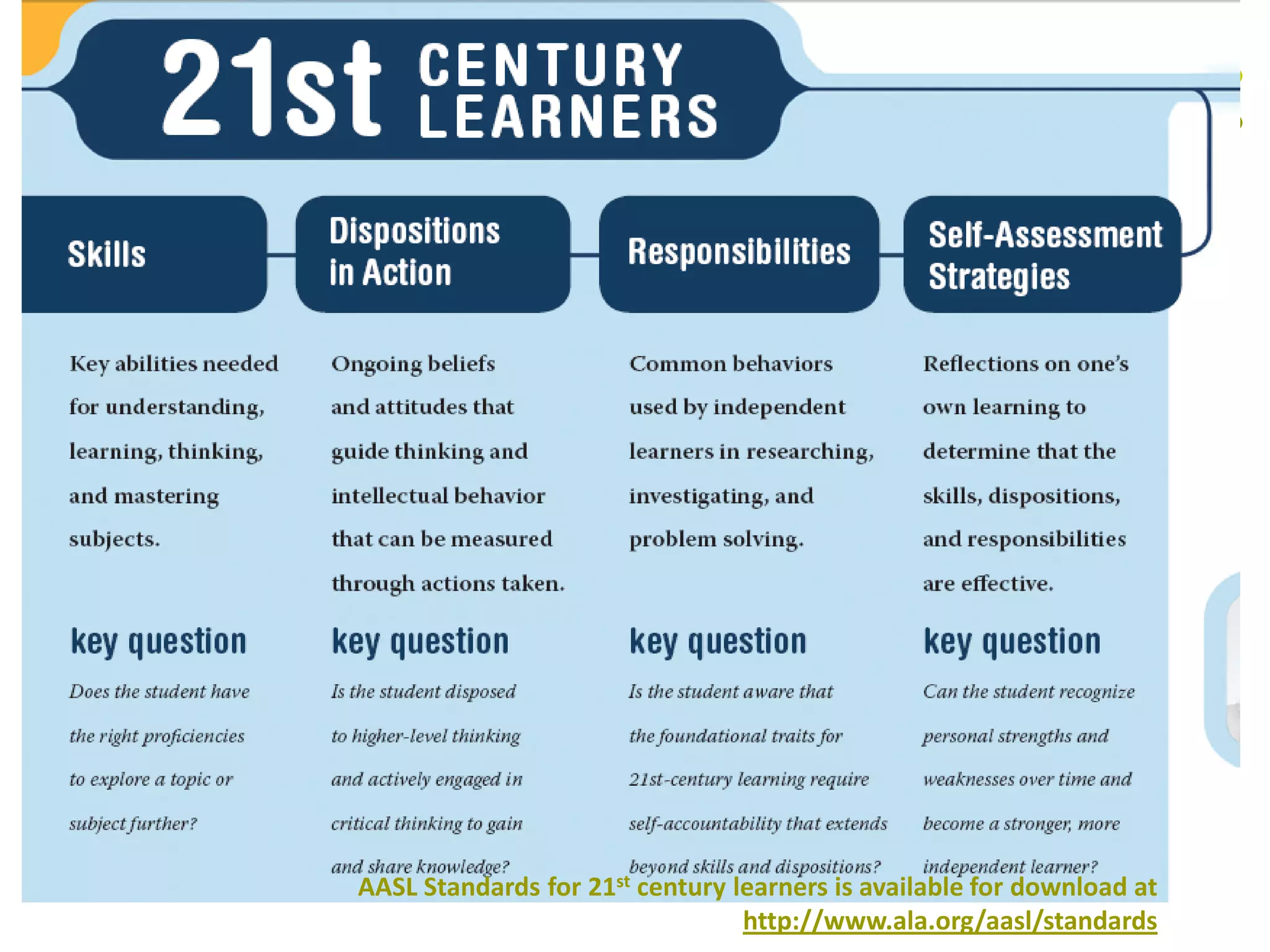
AASL Standards for 21st century learners is available for download at
                                 http://www.ala.org/aasl/standards
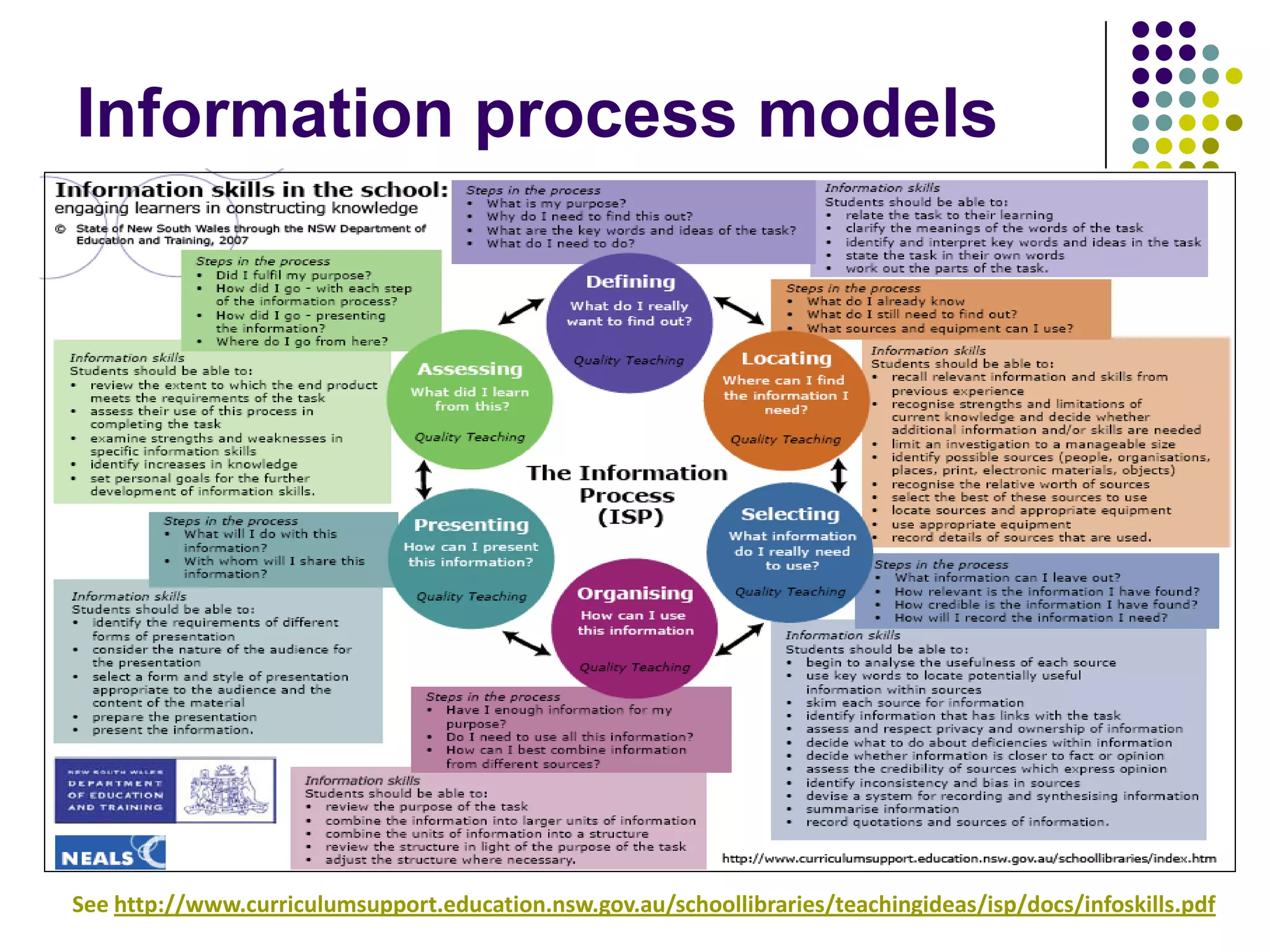
Information process models


See http://www.curriculumsupport.education.nsw.gov.au/schoollibraries/teachingideas/isp/docs/infoskills.pdf
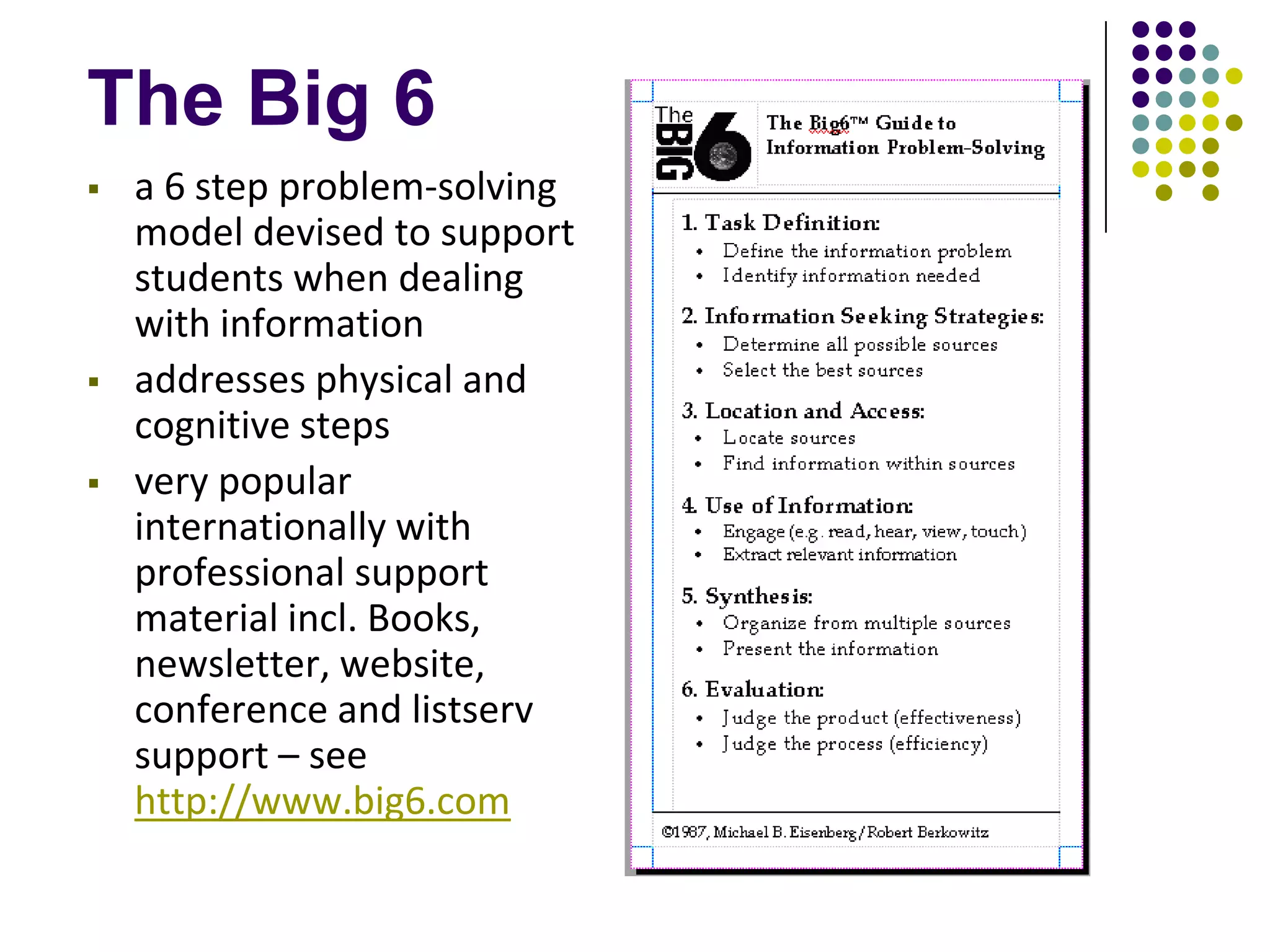
The Big 6
   a 6 step problem-solving
    model devised to support
    students when dealing
    with information
   addresses physical and
    cognitive steps
   very popular
    internationally with
    professional support
    material incl. Books,
    newsletter, website,
    conference and listserv
    support – see
    http://www.big6.com
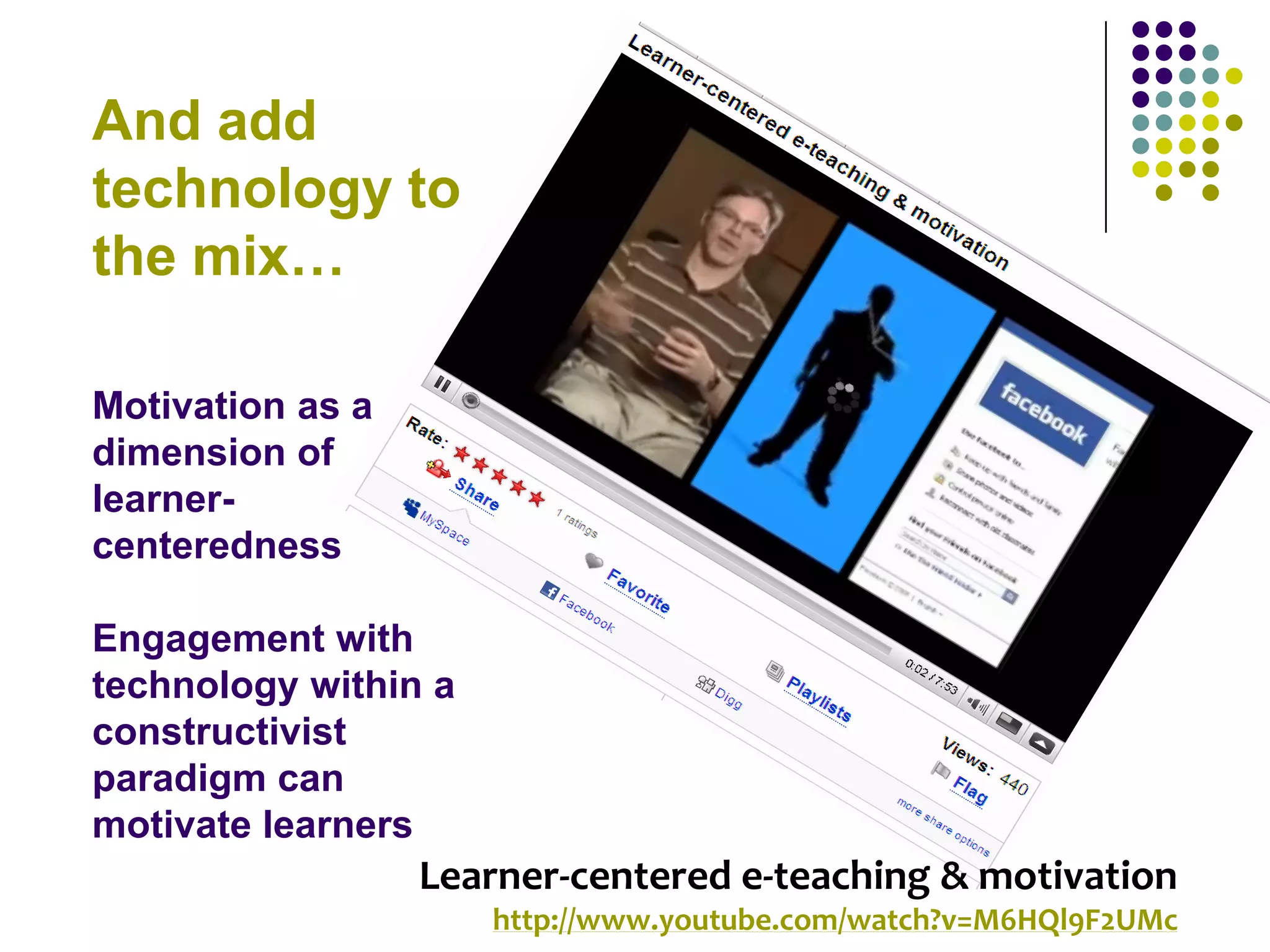
And add
technology to
the mix…

Motivation as a
dimension of
learner-
centeredness

Engagement with
technology within a
constructivist
paradigm can
motivate learners
                  Learner-centered e-teaching & motivation
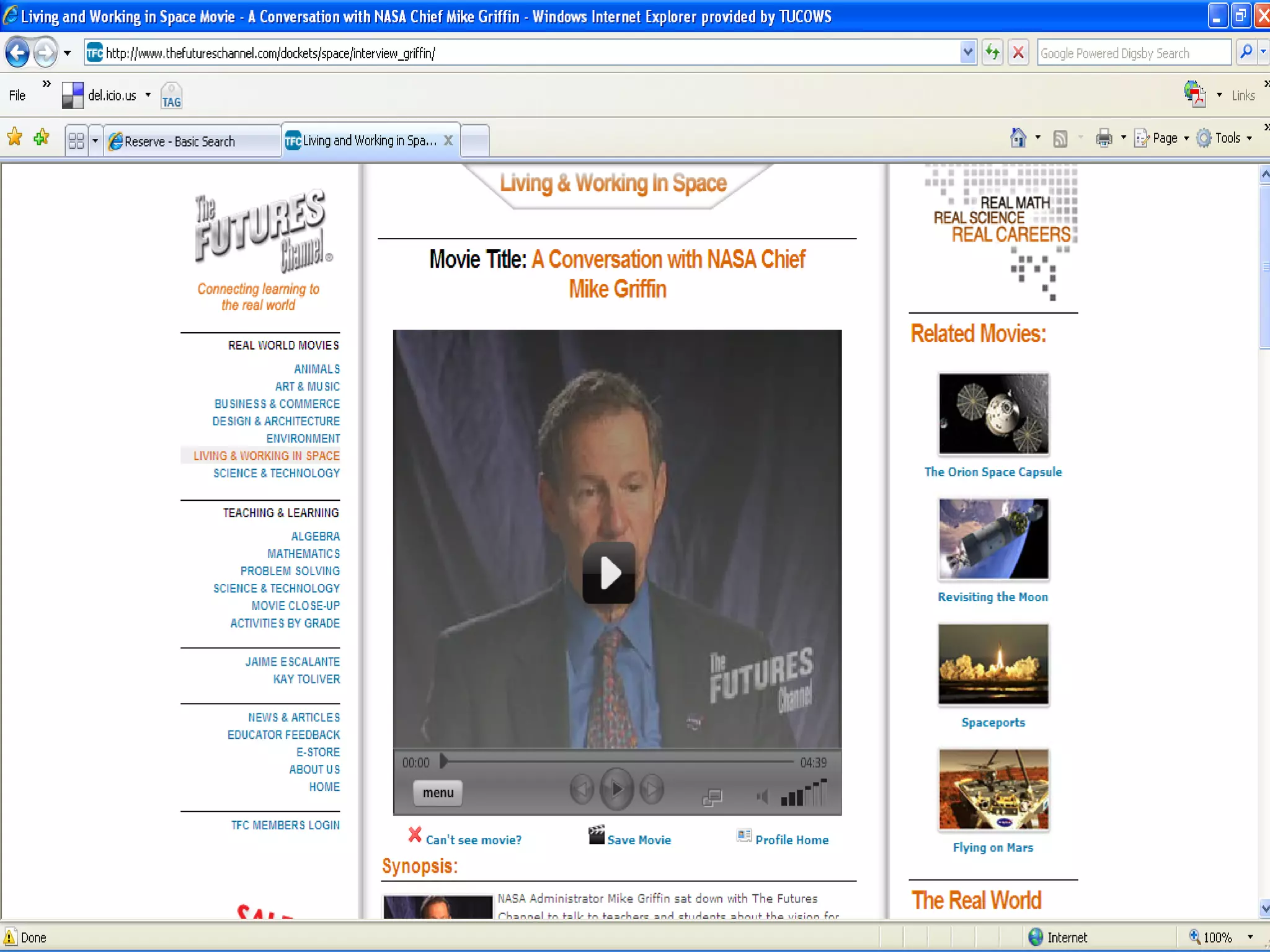
                      http://www.youtube.com/watch?v=M6HQl9F2UMc
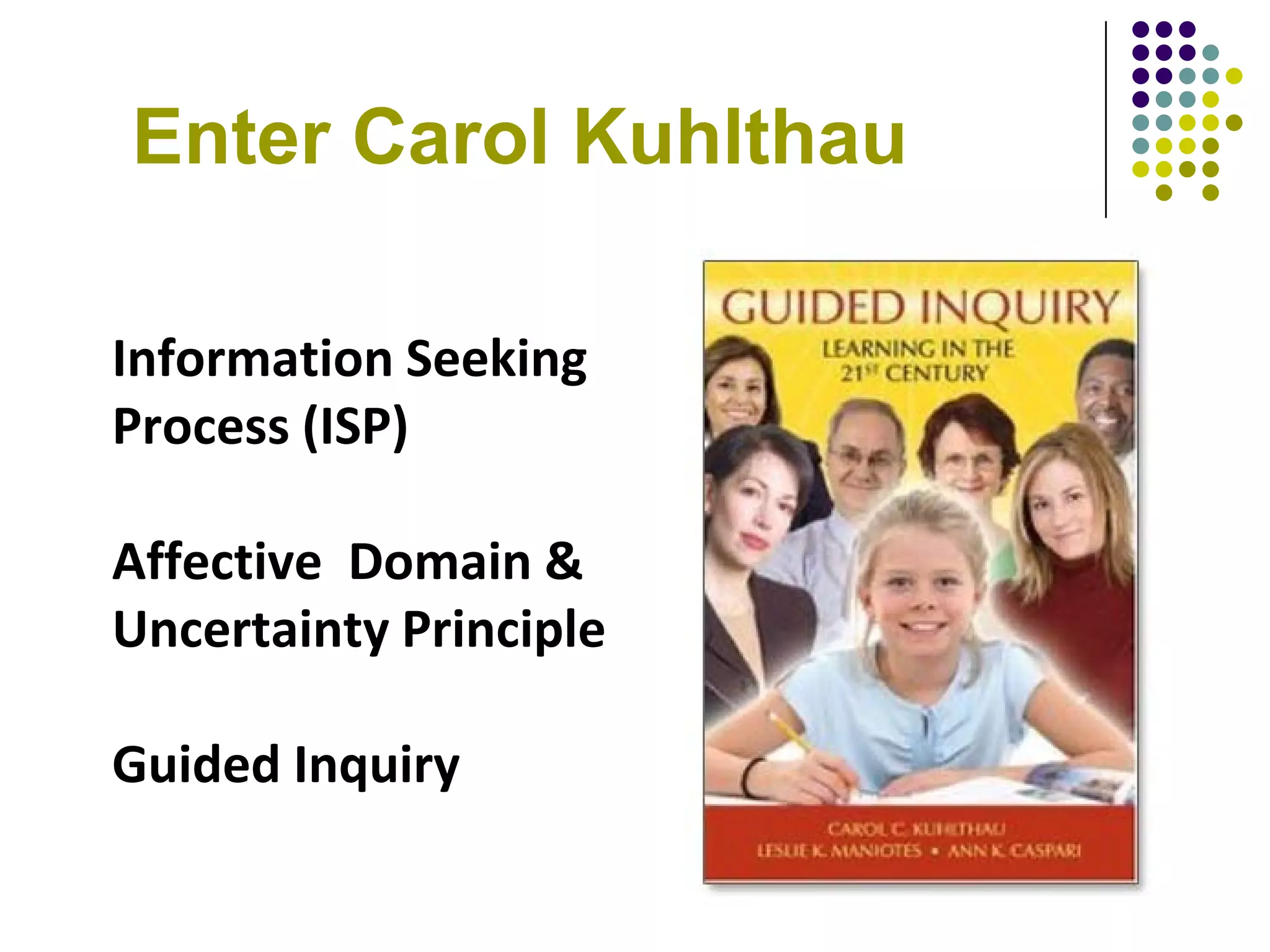
Enter Carol Kuhlthau

Information Seeking
Process (ISP)

Affective Domain &
Uncertainty Principle

Guided Inquiry
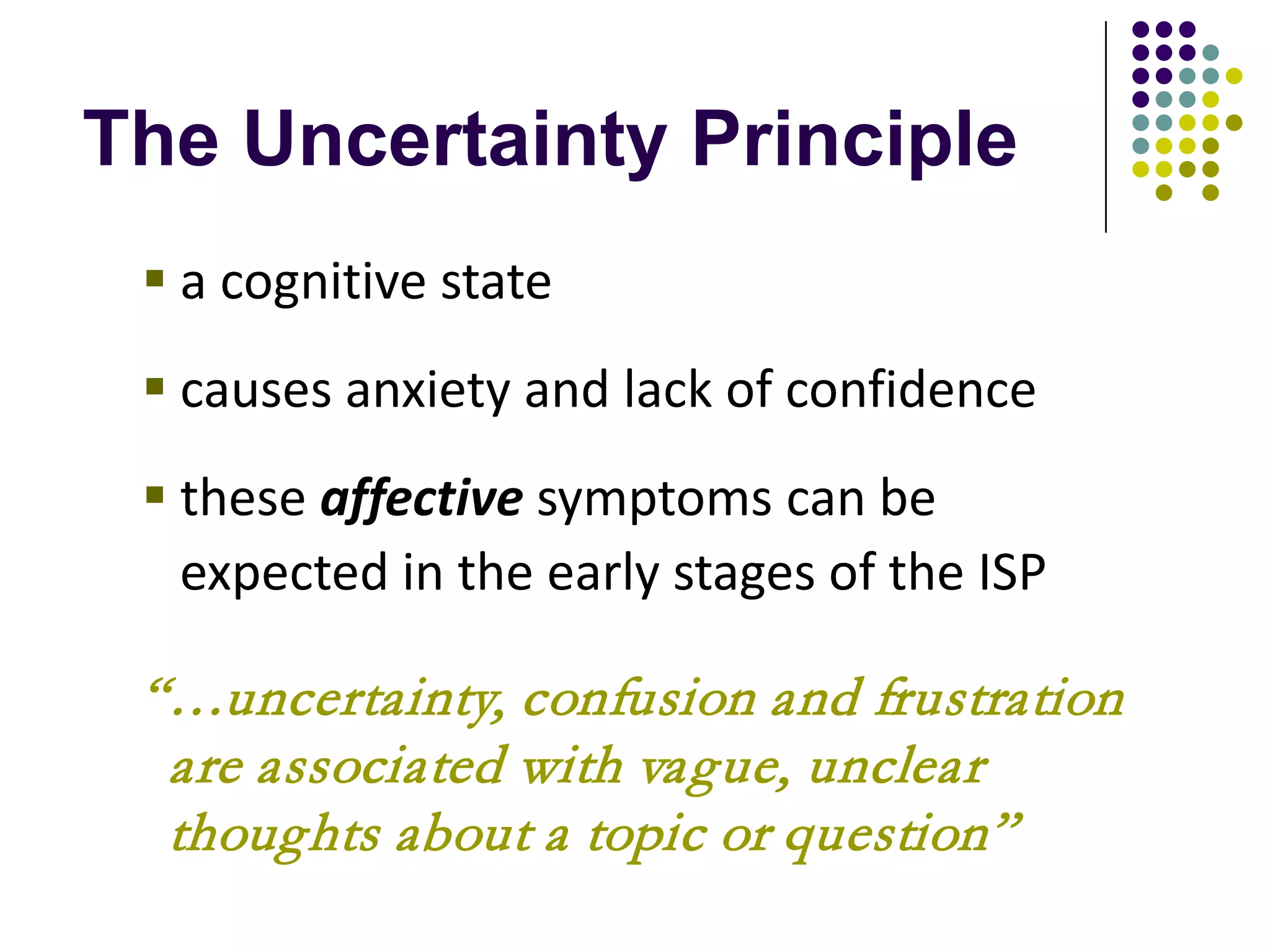
The Uncertainty Principle
  a cognitive state
  causes anxiety and lack of confidence
  these affective symptoms can be
   expected in the early stages of the ISP

 “…uncertainty, confusion and frustration
  are associated with vague, unclear
  thoughts about a topic or question”
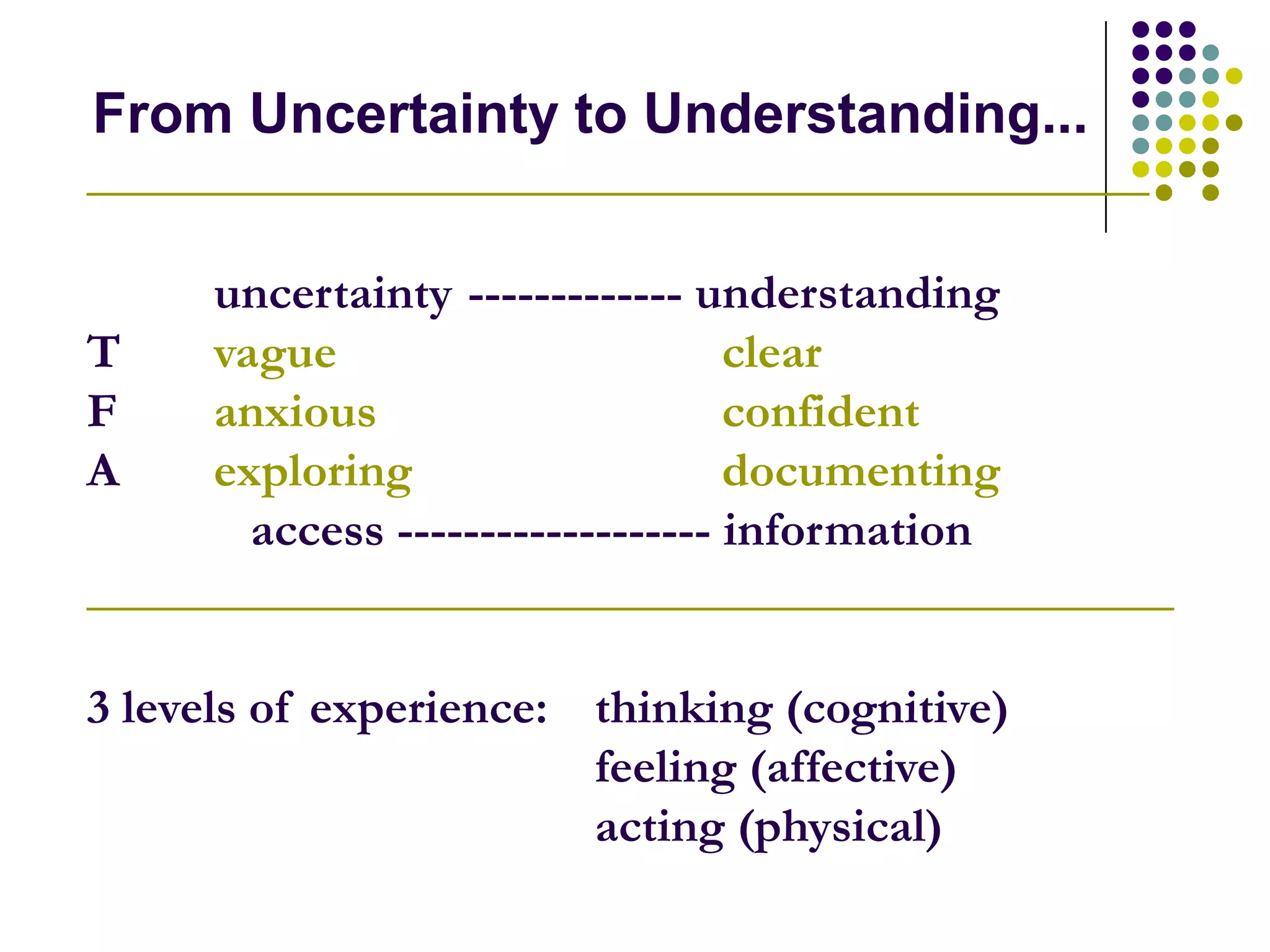
From Uncertainty to Understanding...
___________________________________________

     uncertainty ------------- understanding
T    vague                        clear
F    anxious                      confident
A    exploring                    documenting
       access ------------------- information
____________________________________________

3 levels of experience: thinking (cognitive)
                        feeling (affective)
                        acting (physical)
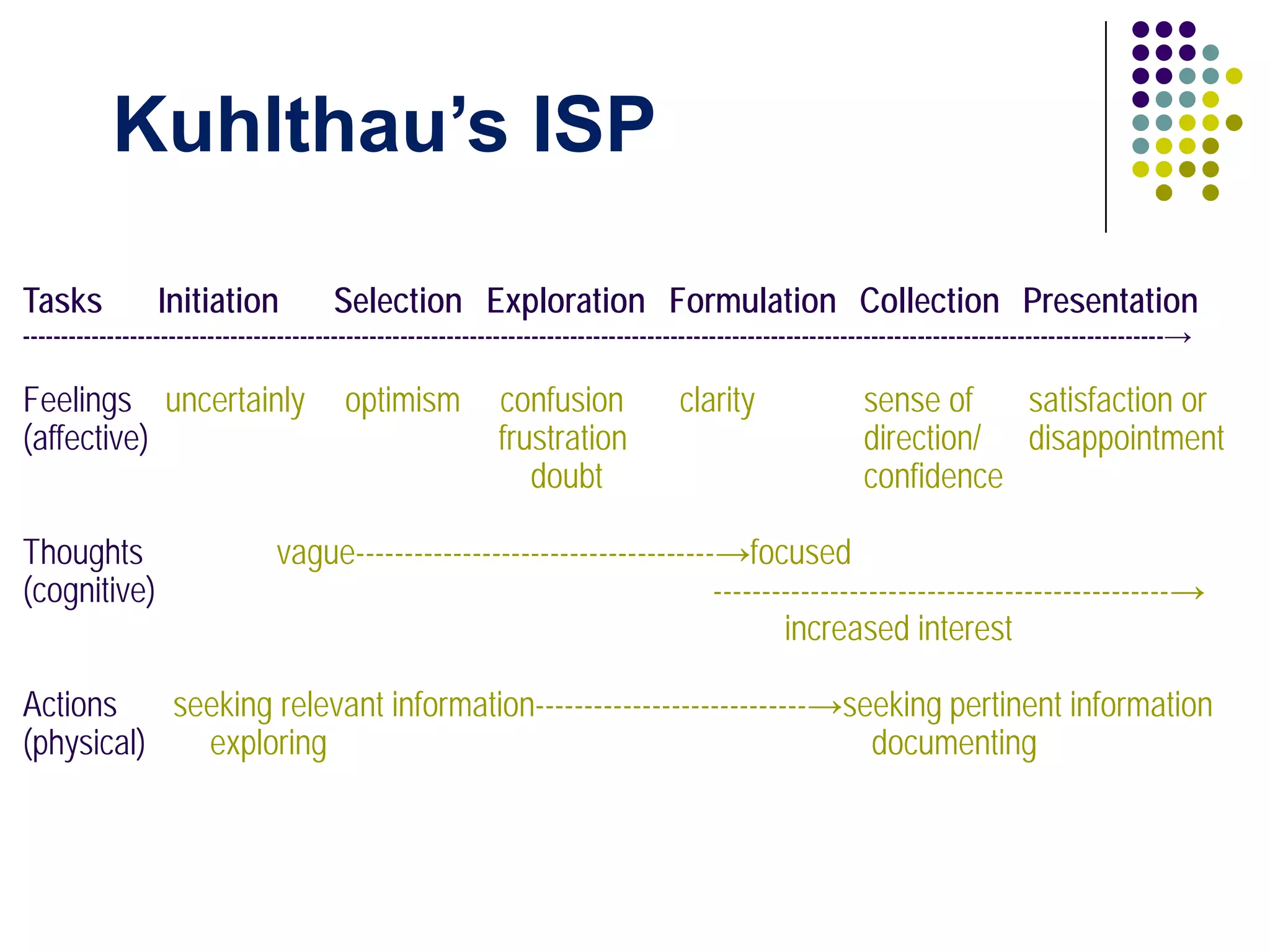
Kuhlthau’s ISP

Tasks            Initiation            Selection Exploration Formulation Collection Presentation
----------------------------------------------------------------------------------------------------------------------------------------------------→

Feelings uncertainly                     optimism           confusion              clarity                 sense of   satisfaction or
(affective)                                                 frustration                                    direction/ disappointment
                                                               doubt                                       confidence

Thoughts                        vague-------------------------------------→focused
(cognitive)                                                               -----------------------------------------------→
                                                                                 increased interest

Actions    seeking relevant information----------------------------→seeking pertinent information
(physical)   exploring                                                documenting
The Uncertainty Principle
“As knowledge states shift to more clearly
 focused thoughts, a parallel shift occurs
 in feelings of increased confidence.

 Uncertainty due to a lack of understanding,
 a gap in meaning, or a limited construct
 initiates the process of information
 seeking.”
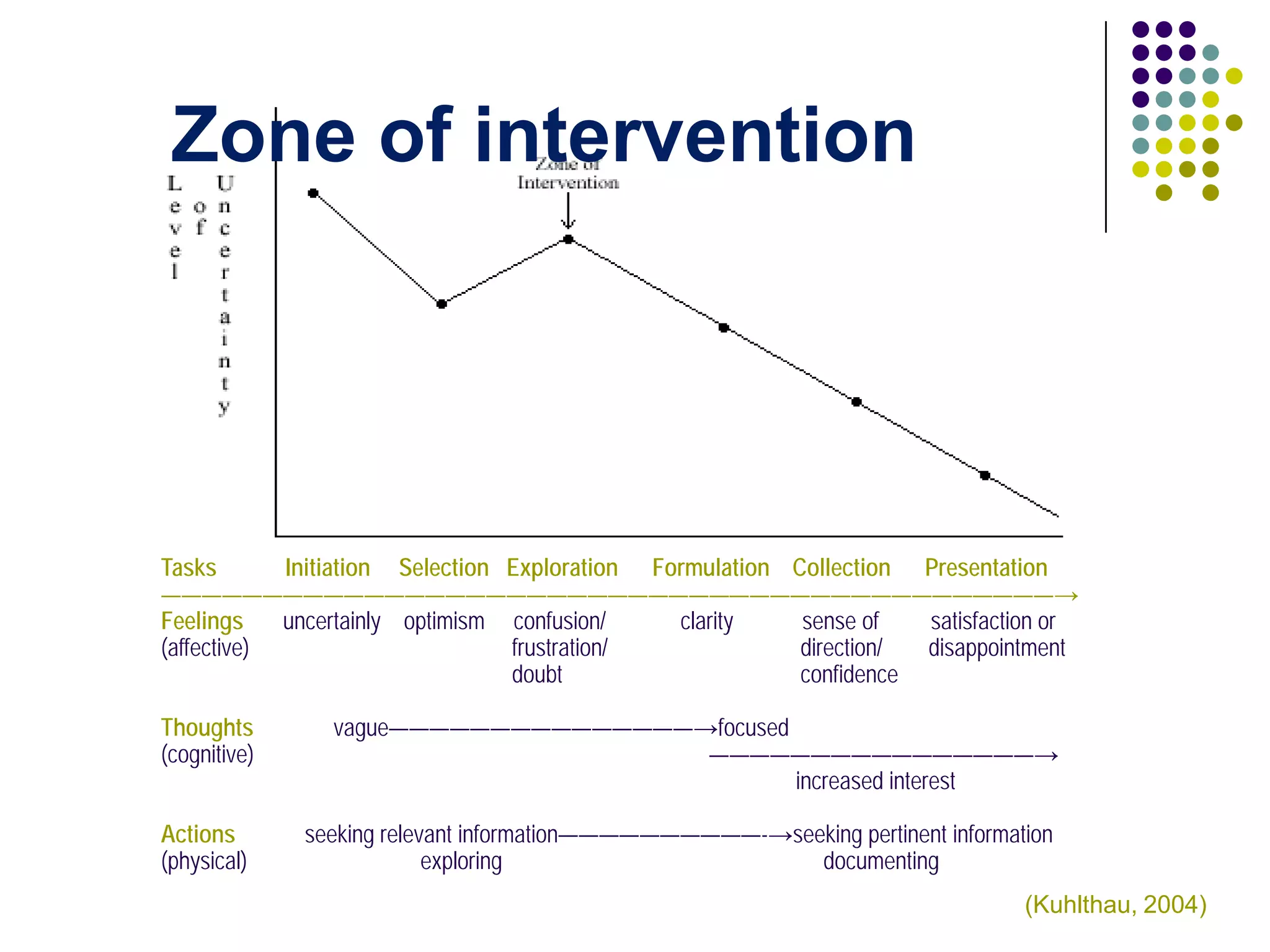
Zone of intervention


Tasks       Initiation Selection Exploration Formulation Collection Presentation
————————————————————————————————————————————→
Feelings    uncertainly optimism confusion/    clarity    sense of   satisfaction or
(affective)                      frustration/             direction/ disappointment
                                 doubt                    confidence

Thoughts        vague———————————————→focused
(cognitive)                          ————————————————→
                                             increased interest

Actions       seeking relevant information——————————-→seeking pertinent information
(physical)                 exploring                     documenting
                                                                                (Kuhlthau, 2004)
Implications of Kuhlthau's ISP
 Learning is an individual process, even
  though the same information process
  model is used
 Knowledge is constructed based on past
  experience
 TL/teacher must develop expertise in
  dealing with individual student's affective
  concerns when completing information
  tasks
What we now know....
   No matter how many times we use an
    information process, a certain level of
    uncertainty will always affect student's
    completion of information tasks when
    encountering new or 'unique' information

   TL/teacher must employ range of
    strategies during learning process to assist
    students to cope with the uncertainty
    principle
Introducing Guided Inquiry....
“The information age calls for transforming
  schools to meet new challenges”
 Guided Inquiry is a new learning and
  instructional model
 Occurs in a collaborative learning
  environment led by an instructional team
 Learning from a variety of sources
 Inquiry process for deep understanding
  'unique' information
Guided Inquiry...
“... is carefully planned, closely
 supervised targeted intervention(s )of
 an instructional team of school
 librarians and teachers to guide
 students through curriculum based
 inquiry units that build deep
 knowledge and deep understanding
 of a curriculum topic, and gradually
 lead towards independent learning.”
                                CISSL, Guided Inquiry (2009)
           http://cissl.scils.rutgers.edu/guided_inquiry.html
Guided inquiry
   Constuctivist approach to learning: staged,
    guided
   Develops students’ competence with learning
    from a variety of sources; goal is deep
    knowledge
   Students are not ‘abandoned’ in the research
    process
   Focus on deep learning, competence,
    mastery, and self empowerment
   Build on strategies in Beyond Bird Units book
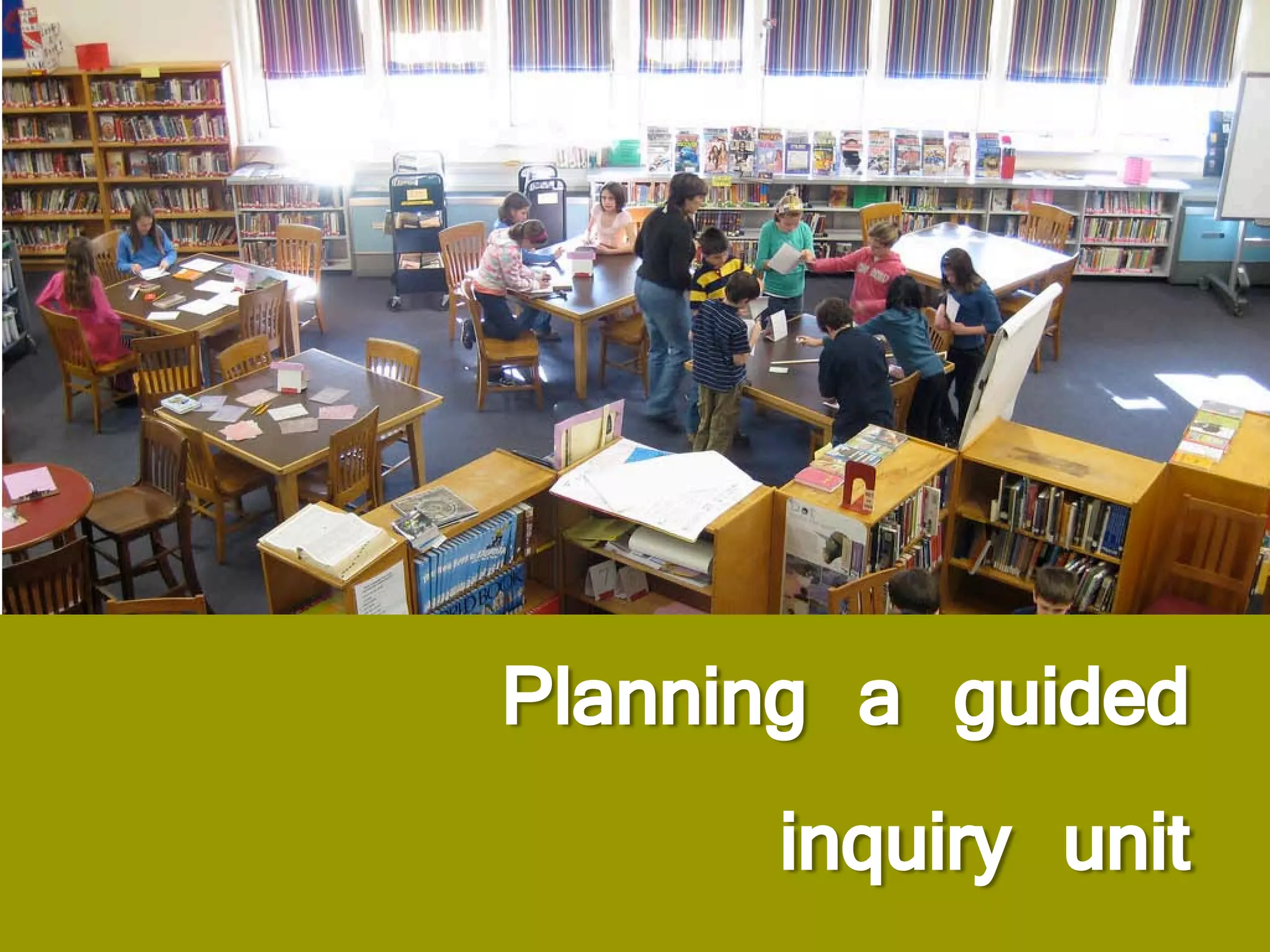
Planning a guided
       inquiry unit
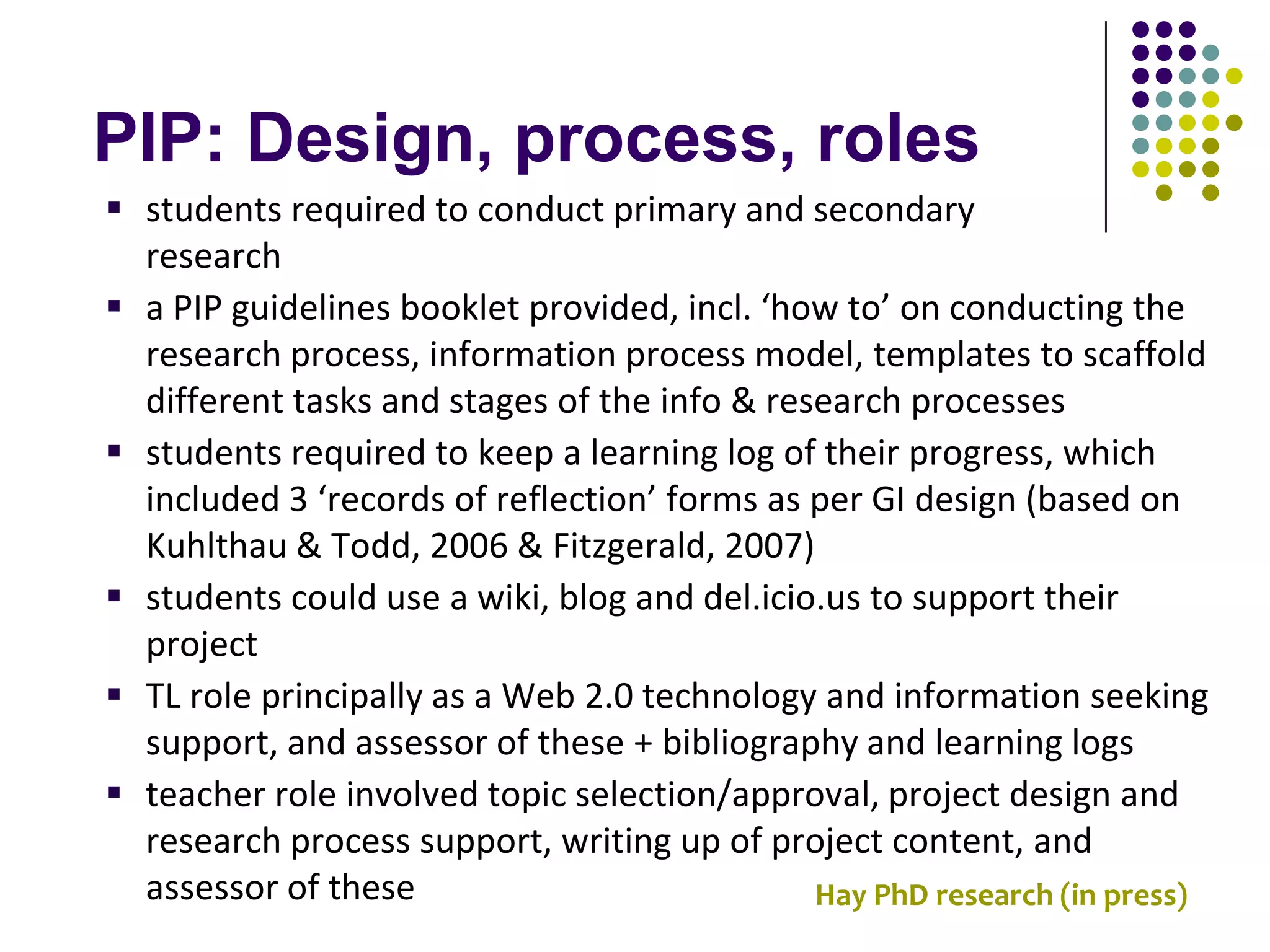
PIP: Design, process, roles
 students required to conduct primary and secondary
  research
 a PIP guidelines booklet provided, incl. ‘how to’ on conducting the
  research process, information process model, templates to scaffold
  different tasks and stages of the info & research processes
 students required to keep a learning log of their progress, which
  included 3 ‘records of reflection’ forms as per GI design (based on
  Kuhlthau & Todd, 2006 & Fitzgerald, 2007)
 students could use a wiki, blog and del.icio.us to support their
  project
 TL role principally as a Web 2.0 technology and information seeking
  support, and assessor of these + bibliography and learning logs
 teacher role involved topic selection/approval, project design and
  research process support, writing up of project content, and
  assessor of these                           Hay PhD research (in press)
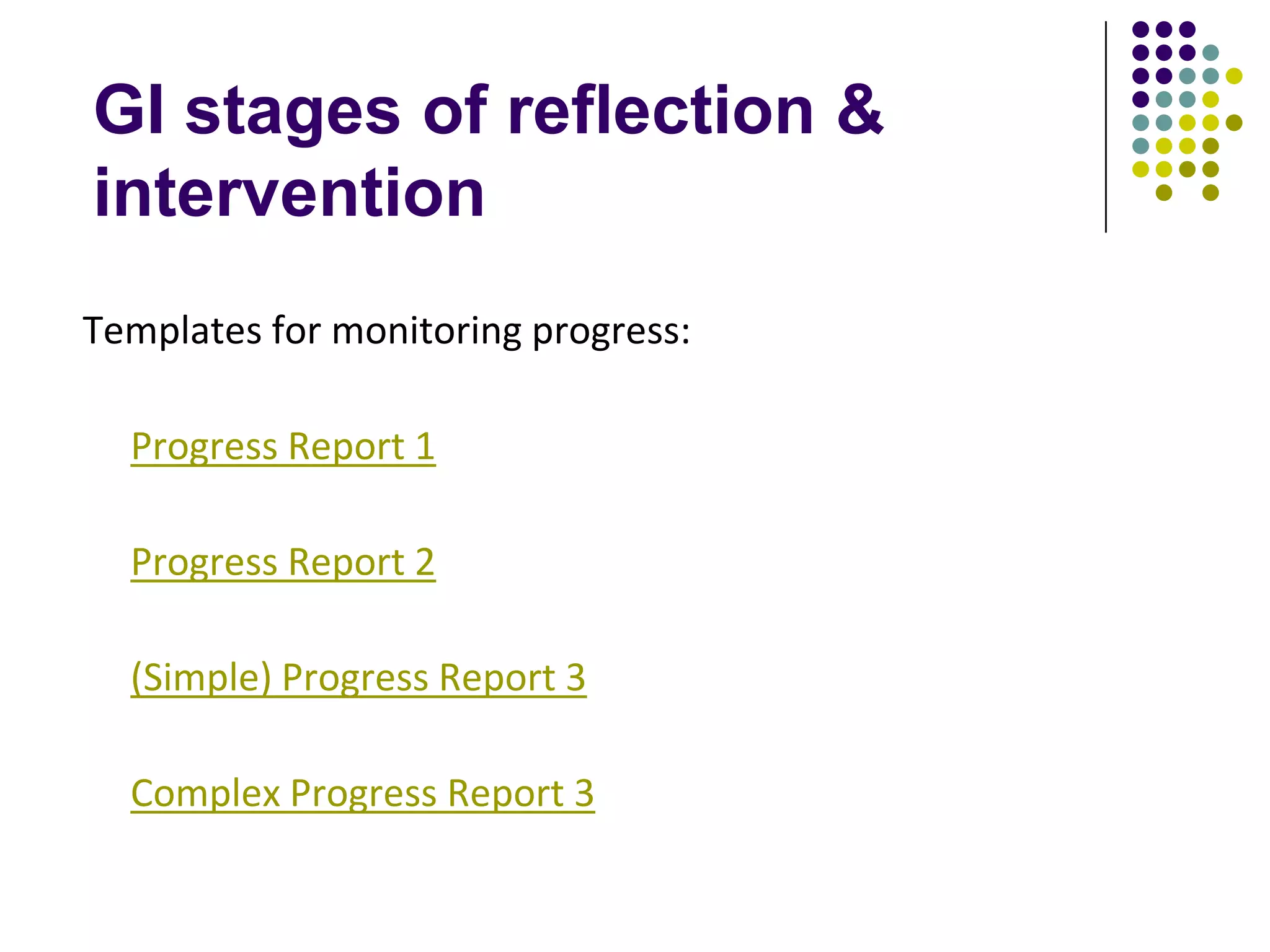
GI stages of reflection &
intervention
Templates for monitoring progress:

  Progress Report 1

  Progress Report 2

  (Simple) Progress Report 3

  Complex Progress Report 3
Implications and
recommendations
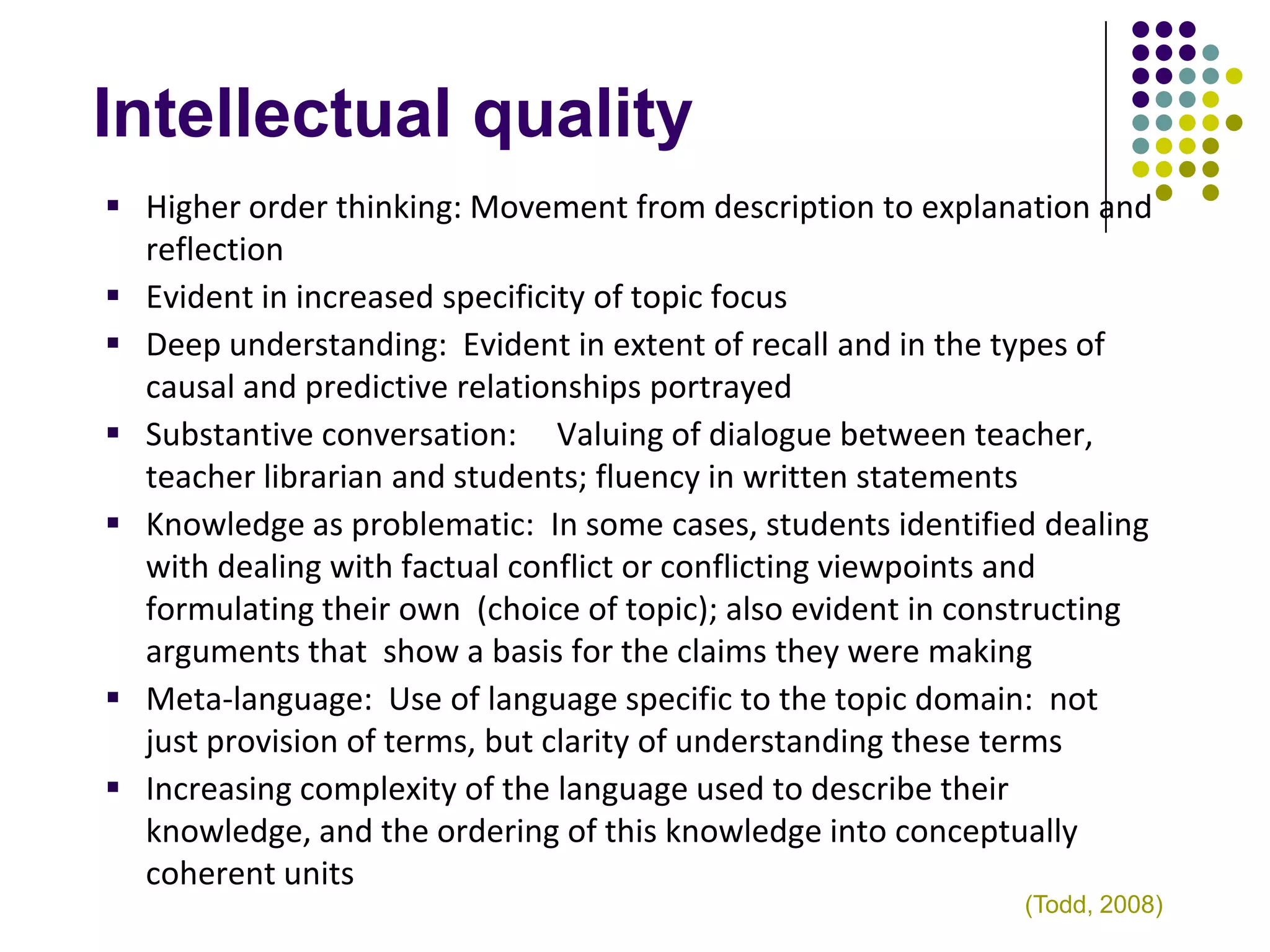
Intellectual quality
 Higher order thinking: Movement from description to explanation and
  reflection
 Evident in increased specificity of topic focus
 Deep understanding: Evident in extent of recall and in the types of
  causal and predictive relationships portrayed
 Substantive conversation: Valuing of dialogue between teacher,
  teacher librarian and students; fluency in written statements
 Knowledge as problematic: In some cases, students identified dealing
  with dealing with factual conflict or conflicting viewpoints and
  formulating their own (choice of topic); also evident in constructing
  arguments that show a basis for the claims they were making
 Meta-language: Use of language specific to the topic domain: not
  just provision of terms, but clarity of understanding these terms
 Increasing complexity of the language used to describe their
  knowledge, and the ordering of this knowledge into conceptually
  coherent units
                                                              (Todd, 2008)
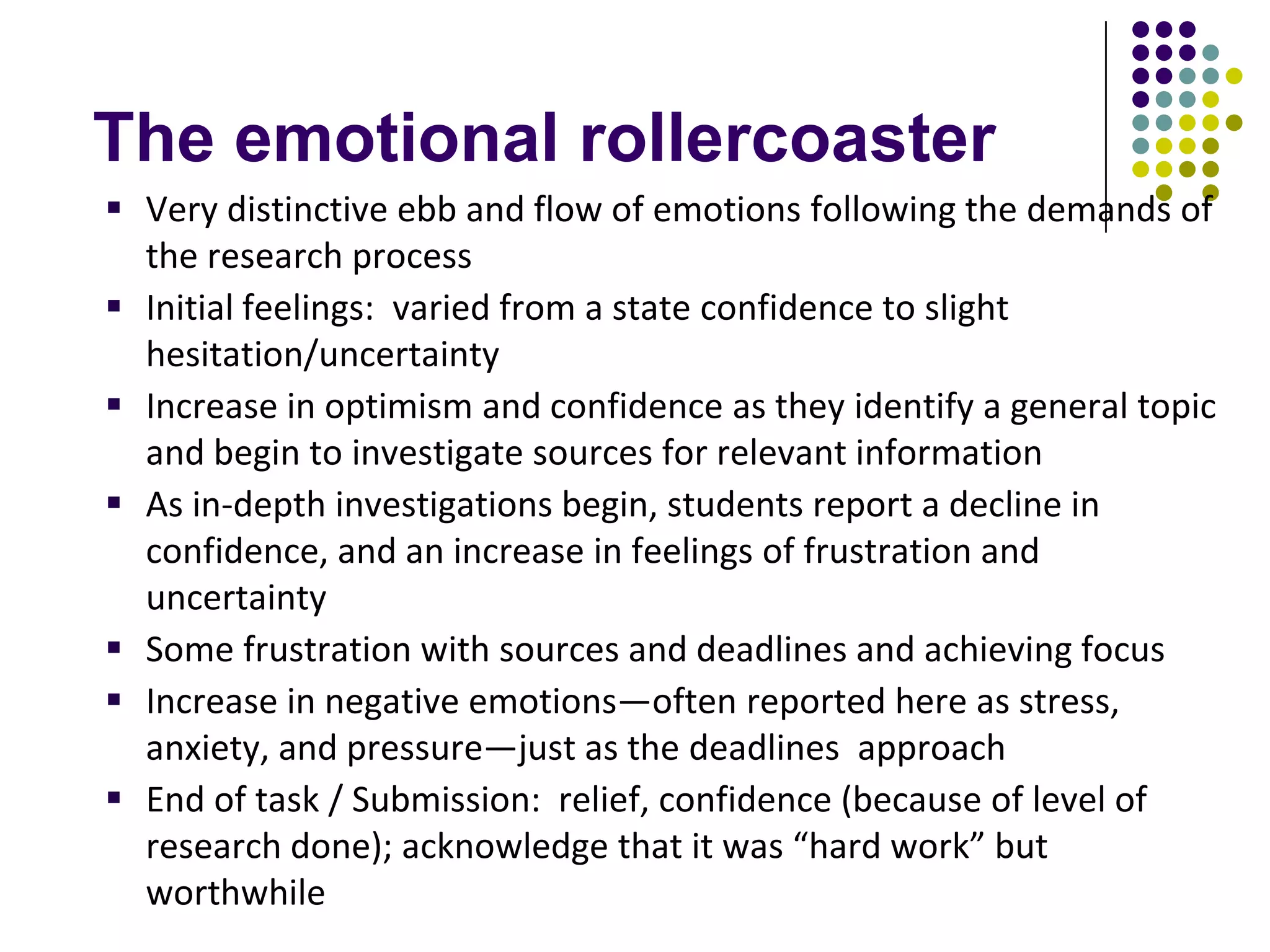
The emotional rollercoaster
 Very distinctive ebb and flow of emotions following the demands of
  the research process
 Initial feelings: varied from a state confidence to slight
  hesitation/uncertainty
 Increase in optimism and confidence as they identify a general topic
  and begin to investigate sources for relevant information
 As in-depth investigations begin, students report a decline in
  confidence, and an increase in feelings of frustration and
  uncertainty
 Some frustration with sources and deadlines and achieving focus
 Increase in negative emotions—often reported here as stress,
  anxiety, and pressure—just as the deadlines approach
 End of task / Submission: relief, confidence (because of level of
  research done); acknowledge that it was “hard work” but
  worthwhile
Enablers of learning
 Instructional intervention: providing the intellectual scaffolds
  for connecting with, interacting with and utilizing information
3 kinds of scaffolds valued by students:
 Reception Scaffolds: assist learners in garnering information from
   the diverse sources; direct the learner's attention to what is
   important, and to help them organise and record what they
   perceive. (Perceive structure in information)
 Transformation Scaffolds: assist learners in transforming the
   information they've received into some other form. This involves
   imposing structure on information.
 Production Scaffolds: assist learners in actually producing
   something observable that conveys the complexity and richness of
   what they have learned.
         Guided inquiry: is not abandonment, need to model
                    the process and provide feedback
Is it time for an
       ‘Inquiry Make-Over’?
  …enter Guided Inquiry
Session 2 workshop

Cairns Diocese
Curriculum Conference                    LYN HAY
Library Strand          School of Information Studies
13 March 2010                Charles Sturt University
See http://www.sybasigns.com.au/
 for great information process model
posters for your library and classrooms
References
Hay, L. (in press). Using Web 2.0 technologies to support student learning through the
   guided inquiry process. Unpublished PhD thesis, Faculty of Education, Charles Sturt University.

Kuhlthau, C. C. (2004). Seeking meaning: A process approach to library and information services (2nd
   ed.). Westport, Conn.: Libraries Unlimited.

Kuhlthau, C. C., Caspari, A. K., & Maniotes, L. K. (2007). Guided inquiry: Learning in the 21st century.
   Westport, Conn.: Libraries Unlimited.

Loertscher, D. V., Koechlin, C., & Zwaan, S. (2005). Ban those bird units!: 15 models for teaching and
   learning in information-rich and technology-rich environments. Salt Lake City, Utah: Hi Willow
   Research and Publishing.

NSW Department of Education and Training. (2007). Information skills in the school: engaging learners
   in constructing knowledge, NSW Department of Education and Training,
Sydney. Retrieved from
   http://www.curriculumsupport.education.nsw.gov.au/schoollibraries/teachingideas/isp/docs/infosk
   ills.pdf

Todd, R. J. (2008). Meaningful learning through inquiry: The lights come on. Keynote Address presented
   at the SLAV 'Evidence to Action: Re-Imagining Learning' Conference, 19 June, Melbourne, Vic.
   retrieved from
   http://www.slav.schools.net.au/downloads/08pastpapers/29possibilities/todd_keynote.pps

Cairns Conference Guided Inquiry workshop

  • 1.
    Is it timefor an ‘Inquiry Make-Over’? …enter Guided Inquiry Session 2 workshop Cairns Diocese Curriculum Conference LYN HAY Library Strand School of Information Studies 13 March 2010 Charles Sturt University
  • 2.
  • 3.
    Educating for 21C  How to we educate our students to meet the high levels of literacy in the technological workplace?  How do we prepare our students to navigate and make sense of the global information environment?  How do we enable our students to draw on the knowledge and wisdom of the past while using the technology of the present to advance new discoveries for the future?  How do we prepare our students to think for themselves, make good decisions, develop expertise, and learn through life?  Many teachers are turning to inquiry learning in subjects across the curriculum to meet the challenge of educating their students for lifelong learning
  • 5.
    Inquiry learning  Isan approach to learning whereby students find and use a variety of sources of information and ideas to increase their understanding of a problem, topic or issue  It requires more than simply answering questions or getting a right answer  It espouses investigation, exploration, search, quest, research, pursuit and study  Inquiry does not stand alone; it engages, interests and challenges students to connect their world within the curriculum  It is often an individual pursuit  Can be enhanced by being part of a community of learning  Without some guidance, inquiry learning can be daunting  Inquiry is not an add-on to the curriculum, it is a way of learning content, skills and values within the curriculum through inquiry
  • 6.
    Learning in theschool library Students actively engage with diverse and often conflicting sources of information and ideas to discover new ones, to build new understandings, and to develop personal viewpoints and perspectives. KNOWLEDGE OUTCOME -------------------------------------------------------------- It is underpinned by stimulating encounters with information – encounters which capture their interest and attention, and which motivate and direct their ongoing inquiry. INFORMATION FOUNDATION (Todd 2008)
  • 7.
  • 8.
    Inquiry moves beyond fact finding Raises standard of research assignments to higher level by:  Drawing on life experiences  Learning from a wide range of sources  Forming deep understanding  Gaining sense of accomplishment  Developing competence and expertise
  • 9.
    AASL Standards for21st century learners is available for download at http://www.ala.org/aasl/standards
  • 10.
    Information process models Seehttp://www.curriculumsupport.education.nsw.gov.au/schoollibraries/teachingideas/isp/docs/infoskills.pdf
  • 11.
    The Big 6  a 6 step problem-solving model devised to support students when dealing with information  addresses physical and cognitive steps  very popular internationally with professional support material incl. Books, newsletter, website, conference and listserv support – see http://www.big6.com
  • 12.
    And add technology to themix… Motivation as a dimension of learner- centeredness Engagement with technology within a constructivist paradigm can motivate learners Learner-centered e-teaching & motivation http://www.youtube.com/watch?v=M6HQl9F2UMc
  • 13.
    Enter Carol Kuhlthau InformationSeeking Process (ISP) Affective Domain & Uncertainty Principle Guided Inquiry
  • 14.
    The Uncertainty Principle  a cognitive state  causes anxiety and lack of confidence  these affective symptoms can be expected in the early stages of the ISP “…uncertainty, confusion and frustration are associated with vague, unclear thoughts about a topic or question”
  • 15.
    From Uncertainty toUnderstanding... ___________________________________________ uncertainty ------------- understanding T vague clear F anxious confident A exploring documenting access ------------------- information ____________________________________________ 3 levels of experience: thinking (cognitive) feeling (affective) acting (physical)
  • 16.
    Kuhlthau’s ISP Tasks Initiation Selection Exploration Formulation Collection Presentation ----------------------------------------------------------------------------------------------------------------------------------------------------→ Feelings uncertainly optimism confusion clarity sense of satisfaction or (affective) frustration direction/ disappointment doubt confidence Thoughts vague-------------------------------------→focused (cognitive) -----------------------------------------------→ increased interest Actions seeking relevant information----------------------------→seeking pertinent information (physical) exploring documenting
  • 17.
    The Uncertainty Principle “Asknowledge states shift to more clearly focused thoughts, a parallel shift occurs in feelings of increased confidence. Uncertainty due to a lack of understanding, a gap in meaning, or a limited construct initiates the process of information seeking.”
  • 18.
    Zone of intervention Tasks Initiation Selection Exploration Formulation Collection Presentation ————————————————————————————————————————————→ Feelings uncertainly optimism confusion/ clarity sense of satisfaction or (affective) frustration/ direction/ disappointment doubt confidence Thoughts vague———————————————→focused (cognitive) ————————————————→ increased interest Actions seeking relevant information——————————-→seeking pertinent information (physical) exploring documenting (Kuhlthau, 2004)
  • 19.
    Implications of Kuhlthau'sISP  Learning is an individual process, even though the same information process model is used  Knowledge is constructed based on past experience  TL/teacher must develop expertise in dealing with individual student's affective concerns when completing information tasks
  • 20.
    What we nowknow....  No matter how many times we use an information process, a certain level of uncertainty will always affect student's completion of information tasks when encountering new or 'unique' information  TL/teacher must employ range of strategies during learning process to assist students to cope with the uncertainty principle
  • 21.
    Introducing Guided Inquiry.... “Theinformation age calls for transforming schools to meet new challenges”  Guided Inquiry is a new learning and instructional model  Occurs in a collaborative learning environment led by an instructional team  Learning from a variety of sources  Inquiry process for deep understanding 'unique' information
  • 22.
    Guided Inquiry... “... iscarefully planned, closely supervised targeted intervention(s )of an instructional team of school librarians and teachers to guide students through curriculum based inquiry units that build deep knowledge and deep understanding of a curriculum topic, and gradually lead towards independent learning.” CISSL, Guided Inquiry (2009) http://cissl.scils.rutgers.edu/guided_inquiry.html
  • 23.
    Guided inquiry  Constuctivist approach to learning: staged, guided  Develops students’ competence with learning from a variety of sources; goal is deep knowledge  Students are not ‘abandoned’ in the research process  Focus on deep learning, competence, mastery, and self empowerment  Build on strategies in Beyond Bird Units book
  • 24.
    Planning a guided inquiry unit
  • 25.
    PIP: Design, process,roles  students required to conduct primary and secondary research  a PIP guidelines booklet provided, incl. ‘how to’ on conducting the research process, information process model, templates to scaffold different tasks and stages of the info & research processes  students required to keep a learning log of their progress, which included 3 ‘records of reflection’ forms as per GI design (based on Kuhlthau & Todd, 2006 & Fitzgerald, 2007)  students could use a wiki, blog and del.icio.us to support their project  TL role principally as a Web 2.0 technology and information seeking support, and assessor of these + bibliography and learning logs  teacher role involved topic selection/approval, project design and research process support, writing up of project content, and assessor of these Hay PhD research (in press)
  • 26.
    GI stages ofreflection & intervention Templates for monitoring progress: Progress Report 1 Progress Report 2 (Simple) Progress Report 3 Complex Progress Report 3
  • 27.
  • 28.
    Intellectual quality  Higherorder thinking: Movement from description to explanation and reflection  Evident in increased specificity of topic focus  Deep understanding: Evident in extent of recall and in the types of causal and predictive relationships portrayed  Substantive conversation: Valuing of dialogue between teacher, teacher librarian and students; fluency in written statements  Knowledge as problematic: In some cases, students identified dealing with dealing with factual conflict or conflicting viewpoints and formulating their own (choice of topic); also evident in constructing arguments that show a basis for the claims they were making  Meta-language: Use of language specific to the topic domain: not just provision of terms, but clarity of understanding these terms  Increasing complexity of the language used to describe their knowledge, and the ordering of this knowledge into conceptually coherent units (Todd, 2008)
  • 29.
    The emotional rollercoaster Very distinctive ebb and flow of emotions following the demands of the research process  Initial feelings: varied from a state confidence to slight hesitation/uncertainty  Increase in optimism and confidence as they identify a general topic and begin to investigate sources for relevant information  As in-depth investigations begin, students report a decline in confidence, and an increase in feelings of frustration and uncertainty  Some frustration with sources and deadlines and achieving focus  Increase in negative emotions—often reported here as stress, anxiety, and pressure—just as the deadlines approach  End of task / Submission: relief, confidence (because of level of research done); acknowledge that it was “hard work” but worthwhile
  • 30.
    Enablers of learning Instructional intervention: providing the intellectual scaffolds for connecting with, interacting with and utilizing information 3 kinds of scaffolds valued by students:  Reception Scaffolds: assist learners in garnering information from the diverse sources; direct the learner's attention to what is important, and to help them organise and record what they perceive. (Perceive structure in information)  Transformation Scaffolds: assist learners in transforming the information they've received into some other form. This involves imposing structure on information.  Production Scaffolds: assist learners in actually producing something observable that conveys the complexity and richness of what they have learned. Guided inquiry: is not abandonment, need to model the process and provide feedback
  • 31.
    Is it timefor an ‘Inquiry Make-Over’? …enter Guided Inquiry Session 2 workshop Cairns Diocese Curriculum Conference LYN HAY Library Strand School of Information Studies 13 March 2010 Charles Sturt University
  • 32.
    See http://www.sybasigns.com.au/ forgreat information process model posters for your library and classrooms
  • 33.
    References Hay, L. (inpress). Using Web 2.0 technologies to support student learning through the guided inquiry process. Unpublished PhD thesis, Faculty of Education, Charles Sturt University. Kuhlthau, C. C. (2004). Seeking meaning: A process approach to library and information services (2nd ed.). Westport, Conn.: Libraries Unlimited. Kuhlthau, C. C., Caspari, A. K., & Maniotes, L. K. (2007). Guided inquiry: Learning in the 21st century. Westport, Conn.: Libraries Unlimited. Loertscher, D. V., Koechlin, C., & Zwaan, S. (2005). Ban those bird units!: 15 models for teaching and learning in information-rich and technology-rich environments. Salt Lake City, Utah: Hi Willow Research and Publishing. NSW Department of Education and Training. (2007). Information skills in the school: engaging learners in constructing knowledge, NSW Department of Education and Training, Sydney. Retrieved from http://www.curriculumsupport.education.nsw.gov.au/schoollibraries/teachingideas/isp/docs/infosk ills.pdf Todd, R. J. (2008). Meaningful learning through inquiry: The lights come on. Keynote Address presented at the SLAV 'Evidence to Action: Re-Imagining Learning' Conference, 19 June, Melbourne, Vic. retrieved from http://www.slav.schools.net.au/downloads/08pastpapers/29possibilities/todd_keynote.pps