




Information Literacy
through Inquiry
Using problem-based learning in
information literacy instruction


Alan Carbery,
Waterford Institute of Technology
Students usually approach their research without
regard to the library’s structure or the way
that library segments different resources into different
areas of its web site. (CIBER, 2008)


                          Students lack
                                      ability to
                          evaluate information
IAKT syndrome occurs when higher level students assume 
they have little to gain from IL instruction.


 ‘One way to deal with IAKT 
 syndrome is to challenge 
 the students to 
 demonstrate their expertise’
 (Bell, 2007, p. 100).
“There is increasing evidence that
supports the belief that active,
experimental education
experiences are more
transferable than passive, lecture-
based instruction” (Hsieh & Knight, 2008)
IL instruction is the key to the success of PBL. Students
need to develop their information need in
order to work on the problem presented (Breen & Fallon,
2005).


Students involved in PBL require more IL
skills than those studying in more traditional learning
environments (Dodd, 2007)
Classes taught using the modified PBL
approach tended to generatefar more
student participation and
engagement than traditional lectures
(Munro, 2006).
The most rewarding feature of engaging in a PBL session
is having
        the opportunity to interact with
students in a more dynamic environment
(Kenney, 2008)
Can problem-based      learning be used in one-
shot, 60 minute information literacy
instruction sessions to create an active,
student-centred learning experience?
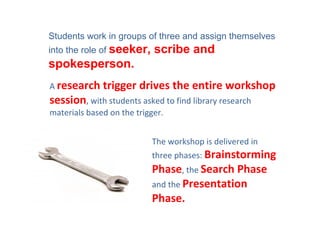
Students work in groups of three and assign themselves
into the role of seeker,    scribe and
spokesperson.
A research trigger drives the entire workshop 
session, with students asked to find library research 
materials based on the trigger.


                           The workshop is delivered in 
                           three phases: Brainstorming 
                           Phase, the Search Phase 
                           and the Presentation 
                           Phase.
98.5% rated the workshop session as excellent, or
very good.


94% enjoyed getting involved
in the group-based
workshop activities.
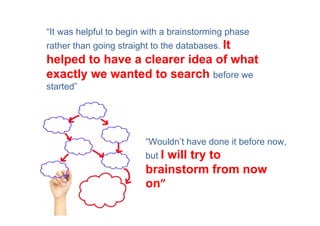
“It was helpful to begin with a brainstorming phase
rather than going straight to the databases. It
helped to have a clearer idea of what
exactly we wanted to search before we
started”


                         “Wouldn’t have done it before now,
                         but I
                             will try to
                         brainstorm from now
                         on”
I clearly noticed a shift in most of the students’ thought
processes from hazy,
                 abstract and
uncertainty, towards some clearer idea
of the topic at hand.
“The large amount
              of information was
overwhelming at times, but we soon worked at
refining our search”


“There were often difficulties
with the amount of
results found, but we were
instructed appropriately how to
narrow this down”
Using classroom time on active learning group
exercises allows the teacher to become a facilitator
for learning and to provide directed
attention to students and groups on an
as-needed basis (Mitchell & Hiatt, 2010).
I can’t try and predict the problems students will face;
they must face the search difficulties
and I’ll be there to guide them to
overcoming these issues.
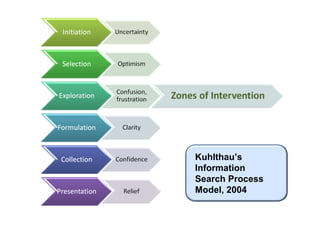
Kuhlthau’s
Information
Search Process
Model, 2004
Guided inquiry is planned, targeted, supervised intervention
throughout the inquiry process... Guided
                                inquiry
provides essential intervention at critical
points in the inquiry process that fosters deep
personal learning’ (Kuhlthau, 2010, pp. 4).
“It was audible and visible when they
started to achieve results. You could almost
see a lifting in the room” (Peer Observer 2).


       breakthrough
“There were
moments” (Peer Observer 1).
Transformative Learning is about discovering
the context of ideas and the belief
systems that shape the way we think about their
sources, nature, and consequences, and on
imagining alternative perspectives
(Mezirow, 1997).
“It’s good to see how other people searched
and what was the best way to research the area”


           students hear that their
“I think that until
peers had the same problems or issues,
rather than us librarians saying it, that there’s a real
difference there. The
                  presentation phase can
be really, really useful.” (Peer Observer 1)
I find the Presentation phase really useful to revisit
important IL concepts. Students
                             themselves
actually report on the importance of
keyword choice in their searches.


                          The presentation phase feels
                          like a reflective     stage.
Curve Balls
“I think one class   a week should be given over to
this”


                        “Because it’s nursing, would
                        the research advisor
                        need to have, or have
                        someone with him with,
                        nursing knowledge?”
The most challenging aspect of incorporating PBL into
one’s teaching repertoire is taking   on the role of
guide, facilitator, or tutor. As the learning
activity becomes user-centred, the librarian must
step aside to allow the students to take
responsibility for their own learning
(Kenney, 2008, p. 390).
“What’s needed in a PBL classroom is trust. Actually
trusting the students enough to let go;
to let them take the time to look at this, and to
believe and trust that they’ll actually
focus in on what you want them to” (Peer Observer
1)
“International students
struggled at times” (Peer
Observer 1).


“There’s a demand on instructors to be perceptive towards
group dynamics, and maybe display      emotional
intelligence in reading the group & comfort
levels of certain individuals” (Peer Observer 2).
Time is definitely a factor. I would say that the
experience of the facilitator would be very
important to keep within the parameters and being aware
of the limitations (Peer Observer 2)
“Perhaps if   the trigger itself was linked to a
project, and then you were able to tie in and actually
demonstrably show, based on evidence, how it
actually worked in practice” Peer-observer 2.
Process, not product


                Interventions guide
                personal threshold
                concepts, and assessment is
                at the point of instruction.

                POGIL, not PBL?
We’re in a highly
energised room.       There is lots
of chatter and discussion on-
going.

I definitely think that the use of
PBL has created a
                more
dynamic, exciting,
creative and interactive
session for these students.
Alan Carbery
Waterford Institute of
Technology


E: acarbery@wit.ie
Twitter: @acarbery

Slideshare:
www.slideshare.net/acarber
y
Bell, S. J. (2007)’Stop IAKT syndrome with student live search demos’, Reference Services Review, 35 (1), pp. 98‐108.
Breen, E. and Fallon, H. (2005)  ‘Developing student information literacy to support project and problem‐based learning’, in Barrett, T. and 
MacLabhrainn, I., (eds) Handbook of enquiry and problem‐based learning: Irish case studies and international perspectives. Galway: Centre for 
Excellence in Teaching and Learning, NUI Galway and AISHE, pp. 179‐188.
CIBER (2008) Information behaviour of the researcher of the future, UCL, London. Available at: 
http://www.ucl.ac.uk/infostudies/research/ciber/downloads/ggexecutive.pdf (Accessed 2 April 2012).
Dodd, L. (2007) 'The impact of problem‐based learning on the information behavior and literacy of veterinary medicine students at University 
College Dublin', The Journal of Academic Librarianship, Vol. 33, No. 2, pp. 206‐216.
Hsieh, C. and Knight, L. (2008) 'Problem‐Based Learning for Engineering Students: An Evidence‐Based Comparative Study', The Journal of Academic 
Librarianship, Vol. 34, No. 1, pp. 25‐30.
Kenney, B. F. (2008) 'Revitalizing the One‐Shot Instruction Session Using Problem‐Based Learning', Reference & User Services Quarterly, Vol. 47, No. 
4, pp. 386‐391.
Kuhlthau, C.C. (2004) Seeking meaning: a process approach to library and information services, 2nd ed., Connecticut, Libraries Unlimited.
Kuhlthau, C.C. (2010)  ‘Guided inquiry: school libraries in the 21st century’, School Libraries Worldwide, 16 (1), pp 1‐12.

Mezirow, J. (1997) ‘Transformative learning: theory to practice’, New Directions for Adult and Continuing Education, (74), pp. 5‐12.

Mitchell, E. and Hiatt, D. (2010) 'Using POGIL Techniques in an Information Literacy Curriculum', The Journal of Academic Librarianship, Vol. 36, No. 
6, pp. 539‐542.
Munro, K. (2006) ‘Modified problem‐based library instruction: a simple, reusable instruction design’, College & Undergraduate Libraries, 13 (3), pp. 
53‐61.
Images:
All Images obtained under Creative Commons License:
Slides 1, 2, 8, 17, 21, 27, 34 available from http://www.sxc.hu using keywords rubric, graduates, question mark, direction, problem and beginning.
Slides 3, 4, 6, 7, 10,13,14,15,16,20,22, 26,29,30,31, 32 available from http://www.freedigitalphotos.net using keywords bored, student, solution, 
innovation, spanner, like, brainstorm, journal, search, intervention, butterfly, idea, difficult, time, mark, and process.
Slide 25 image available from Flickr http://www.flickr.com/photos/karlequin/200427012/
Slide 28 image available from Flickr http://www.flickr.com/photos/grrphoto/246147199/
Slide 33 image available from Flickr http://www.flickr.com/photos/bazik/395792175/

Carbery - Information literacy through inquiry: using problem-based learning in information literacy instruction