Chapter 5 discusses the process of designing lesson plans for multigrade teaching, emphasizing its importance for effective instruction and student engagement. It outlines key components of lesson design, including learning objectives, content, experiences, and assessment strategies tailored to diverse student needs. The chapter aims to equip new multigrade teachers with practical approaches to create structured and adaptable lesson plans to foster a productive learning environment.
INTENDED LEARNING
OUTCOMES
At theend of the chapter you should be able
to:
Explain the importance of preparing lesson
designs;
Identify different steps in various formats
in lesson designing; and
Create lesson designs using different
formats as applied in Multigrade teaching.
Read the storybelow depicting two new multi
grade teachers engage in a conversation .
Teacher 1: I’m terrified of my new teaching assignments
in a multigrade class. I’m feeling overwhelmed by the
tasks that lie ahead of me.
Teacher 2: I’m feeling exactly the same way . Despite
my positive internship experiences. I am not sure in
my to handle the vast responsibilities of being a
multigrade teacher, particularly in the creation of
lesson designs.
Teacher 1: I don’t think I’m very good at lesson
designing.
Teacher 2: I’m curious, what exactly is a lesson design
in a multigrade class? Is it going to make it easier for
me to start teaching?
5.
1. Describe thedilemma of the two new
multigrade teachers.
2. What is your feeling about their dilemma ?
3. If you were the multigrade teachers, what
are your perspective towards multigrade
teaching in general, and lesson designing , in
particular?
4. What would make easier for you to begin
teaching in multigrade class?
6.
A lesson designingis a blue print for the
teacher or a template for facilitating a lesson.
It is the major pillar of the educational
structure and the center of learning
(Mastropieri & Scruggs, 2007).
According to Nesai and Heidari, 2014, it
contains the objectives (what students in
each grade level should learn), how the
objectives will be fulfilled (the method of
delivery and procedure), and a methodology
to assess how well the objectives were met
(assessment). One of the most important
aspects of the educational process is the
lesson design or plan.
7.
A multigrade lessondesign consists of details
pertaining to the lessons, the outcomes that will be
addressed by grade levels, the methods that will
be used which involved differentiation and
groupings, and the materials and activities that will
be included to engage and assess the students.
Lesson deigning is at the heart of effective
teaching. It is a creative process that allows the
teacher to map out curriculum goals into skills and
tasks ( Posner, 2003). It ensures continuity of
learning and the integration of skills and
knowledge across the multigrade curriculum.
Further, it serves as a tool for evaluation for
instructional approaches utilized. In other words ,
careful lesson designing leads to an effective
Multigrade learning environment.
8.
Benefits of EffectiveLesson Designing
It organizes the thoughts of the teacher and coordinates his/
her ideas well which facilitates good teaching and learning. It
equips the teacher with the general outlines of the goals and
the resources needed to achieve them.
Because the activities and materials are prepared and properly
sequenced, it saves energy for both the teacher and the
students. As a results, it completes expected tasks for both
students and teachers and develops a sense of order among
learners.
It allows the teacher to spend less time in class flipping
through the textbook, worrying about what to do next, or
rushing to make photocopies. To encourage students to
participate in activities, time is being maximized.
It improves achievement and increases the likelihood of
providing meaningful learning experiences to students.
It gives the teacher confidence to teach hence, facilitates happy
and productive learning.
9.
Multigrade teachers mustplan
meticulously. Lesson designs,
curriculum guides, budget of work,
and timetables are planning
materials that assist teachers in
preparing ahead of time to ensure
that all essential competencies are
covered. Lesson planning for
multigrade teachers should be
flexible and imaginative.
A new multigradeteacher frequently
struggles on how to construct lesson designs
for the unique multigrade setup.
These are his or her common questions:
How shall I prepare lesson design in a
multigrade setting?
What grade level will be my focus?
How shall I integrate the cognitive,
psychomotor and affective domains in a
holistic plan?
With two or three grade levels in a class,
can I finish my lesson within the time
provided?
What will my lesson design look like?
12.
1. As amultigrade teacher, how
will you create holistic lesson
designs that connect to the
diversity of your students’ life
experiences?
2. What elements might make
it easier for you to start
teaching?
13.
In a mutigradeclassroom,
a teacher’s day is filled with
planning. Effective teachers
devote time to creating lesson
designs as part of their job.
These are the questions to
consider in preparing
Multigrade lesson design.
14.
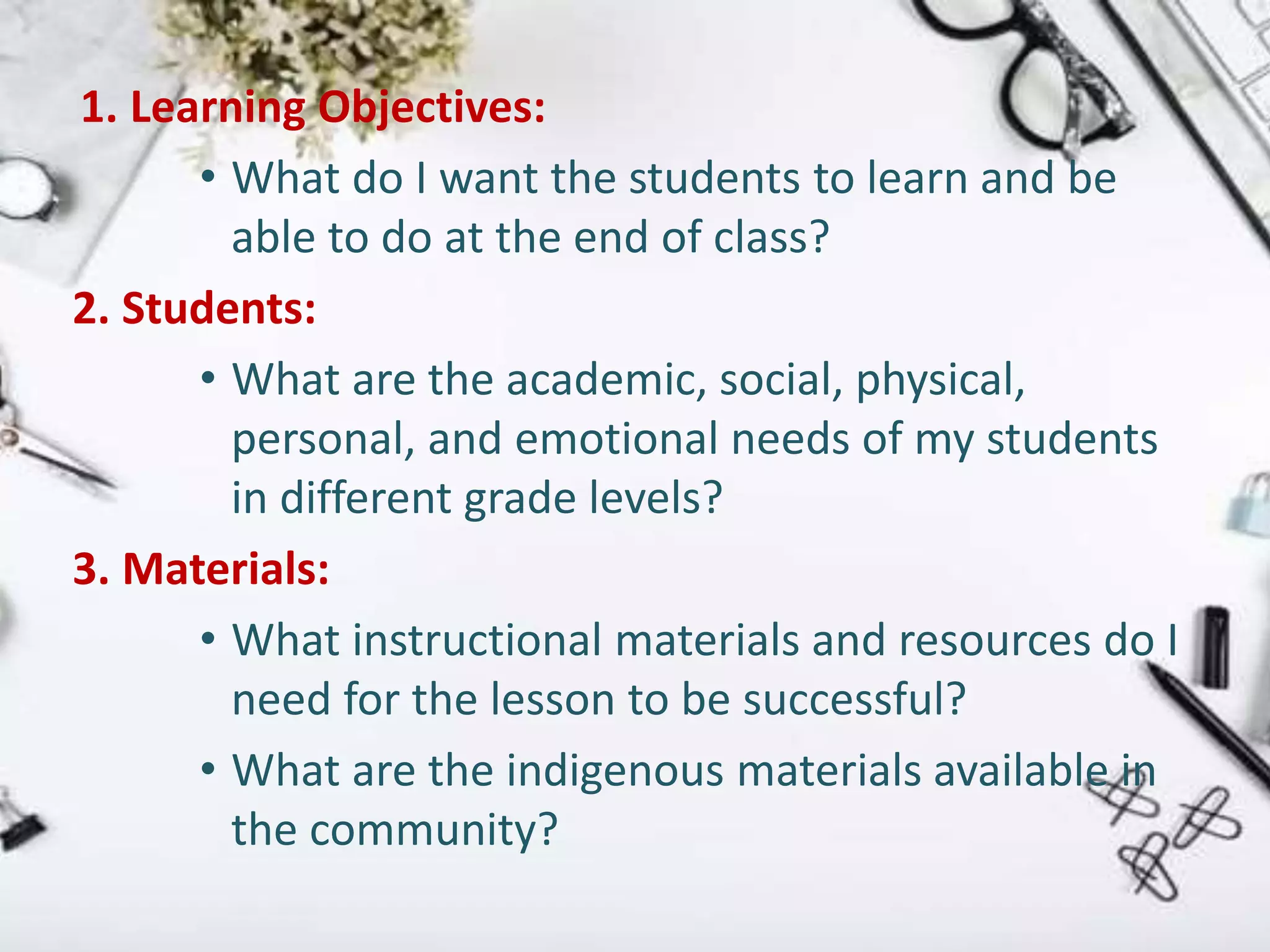
1. Learning Objectives:
•What do I want the students to learn and be
able to do at the end of class?
2. Students:
• What are the academic, social, physical,
personal, and emotional needs of my students
in different grade levels?
3. Materials:
• What instructional materials and resources do I
need for the lesson to be successful?
• What are the indigenous materials available in
the community?
15.
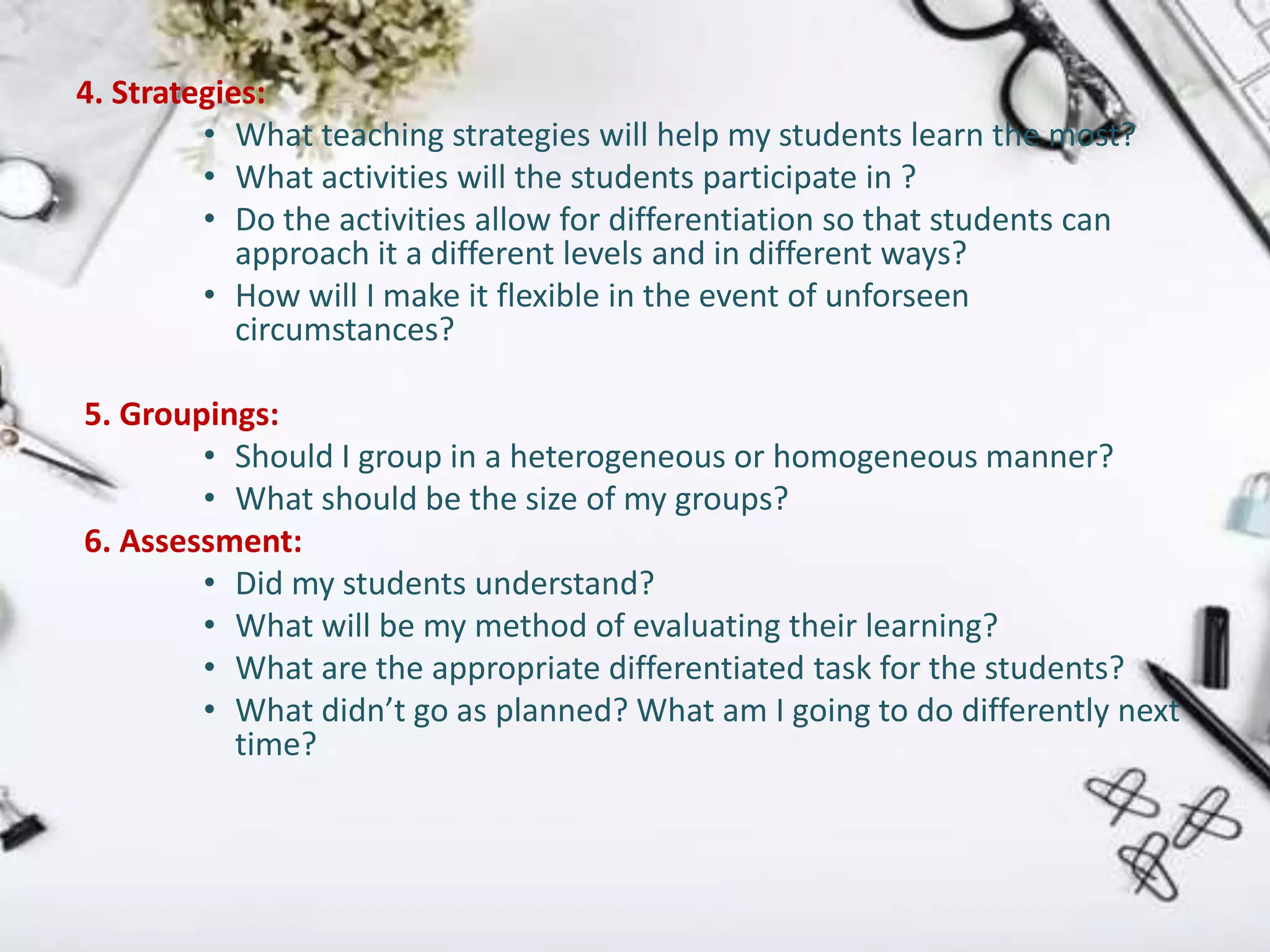
4. Strategies:
• Whatteaching strategies will help my students learn the most?
• What activities will the students participate in ?
• Do the activities allow for differentiation so that students can
approach it a different levels and in different ways?
• How will I make it flexible in the event of unforseen
circumstances?
5. Groupings:
• Should I group in a heterogeneous or homogeneous manner?
• What should be the size of my groups?
6. Assessment:
• Did my students understand?
• What will be my method of evaluating their learning?
• What are the appropriate differentiated task for the students?
• What didn’t go as planned? What am I going to do differently next
time?
16.
Parts of aLesson Design
I. Intended Learning Outcomes
Before the teacher begins planning,
he/she must first determine the lesson’s
objectives. The Intended Learning Outcomes
are statements that outline what the learner
will eventually be able to demonstrate
(cognitive, affective and psychomotor ) as a
result of the learning engagement.
17.
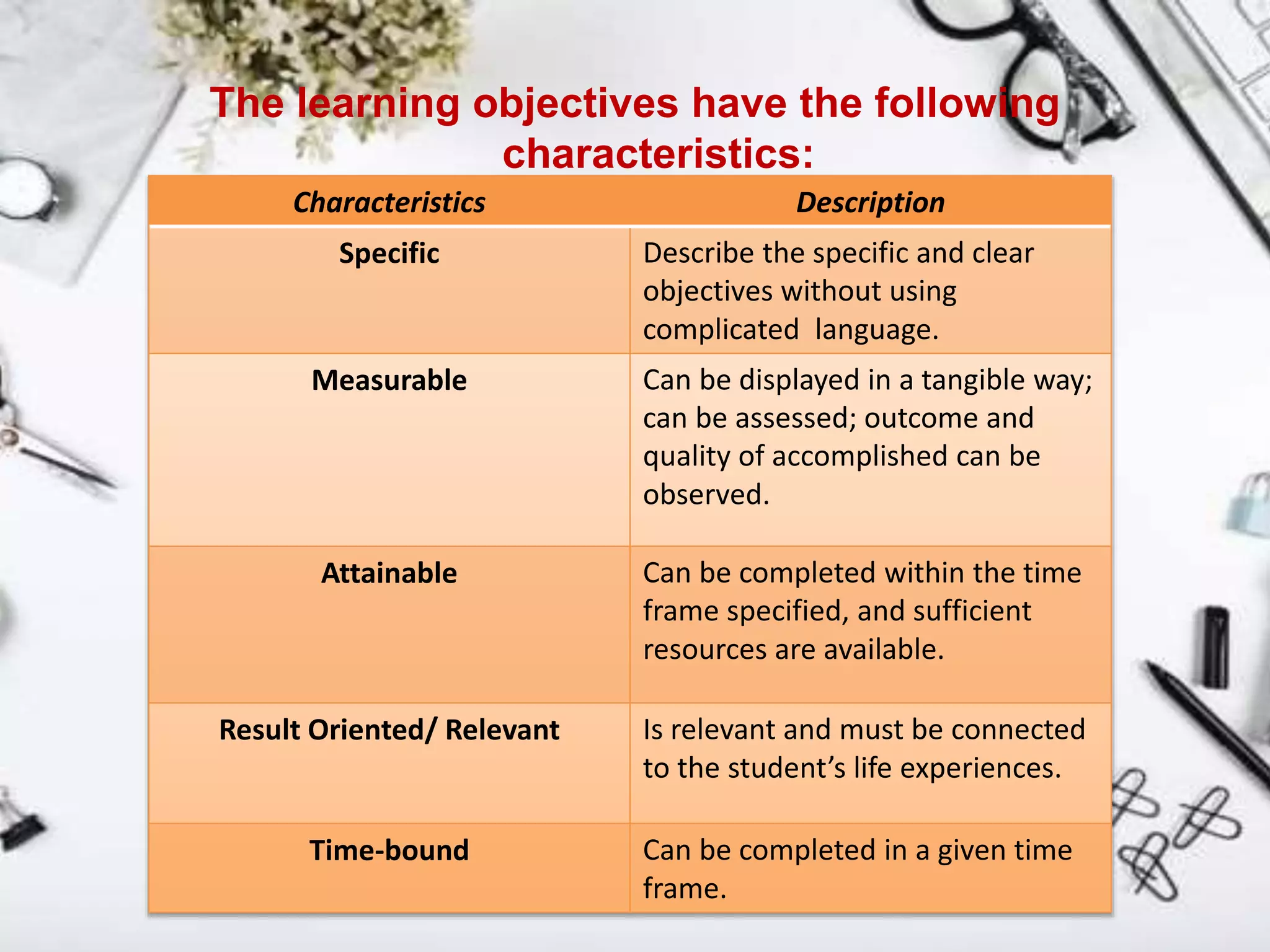
The learning objectiveshave the following
characteristics:
Characteristics Description
Specific Describe the specific and clear
objectives without using
complicated language.
Measurable Can be displayed in a tangible way;
can be assessed; outcome and
quality of accomplished can be
observed.
Attainable Can be completed within the time
frame specified, and sufficient
resources are available.
Result Oriented/ Relevant Is relevant and must be connected
to the student’s life experiences.
Time-bound Can be completed in a given time
frame.
18.
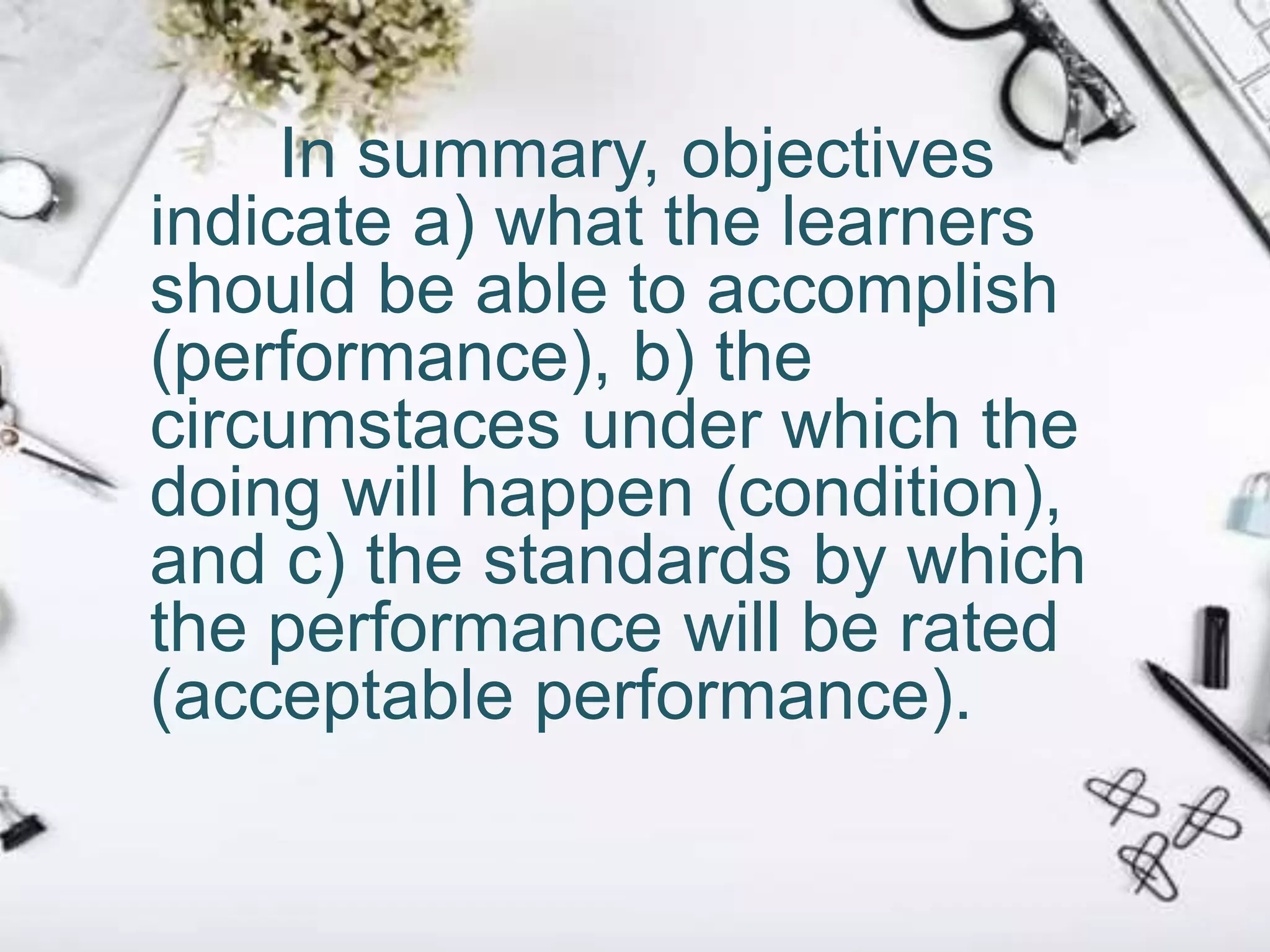
In summary, objectives
indicatea) what the learners
should be able to accomplish
(performance), b) the
circumstaces under which the
doing will happen (condition),
and c) the standards by which
the performance will be rated
(acceptable performance).
19.
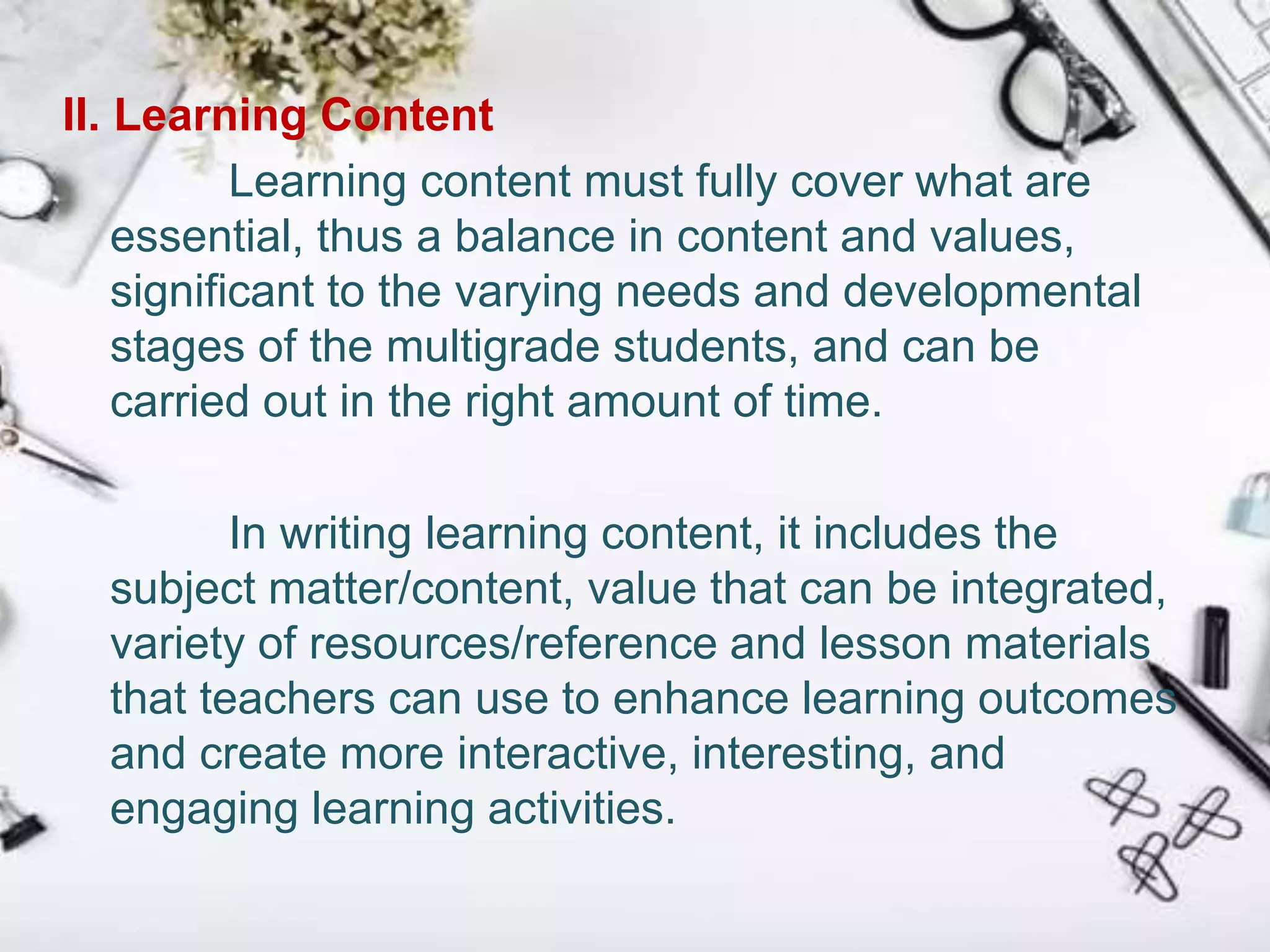
II. Learning Content
Learningcontent must fully cover what are
essential, thus a balance in content and values,
significant to the varying needs and developmental
stages of the multigrade students, and can be
carried out in the right amount of time.
In writing learning content, it includes the
subject matter/content, value that can be integrated,
variety of resources/reference and lesson materials
that teachers can use to enhance learning outcomes
and create more interactive, interesting, and
engaging learning activities.
20.
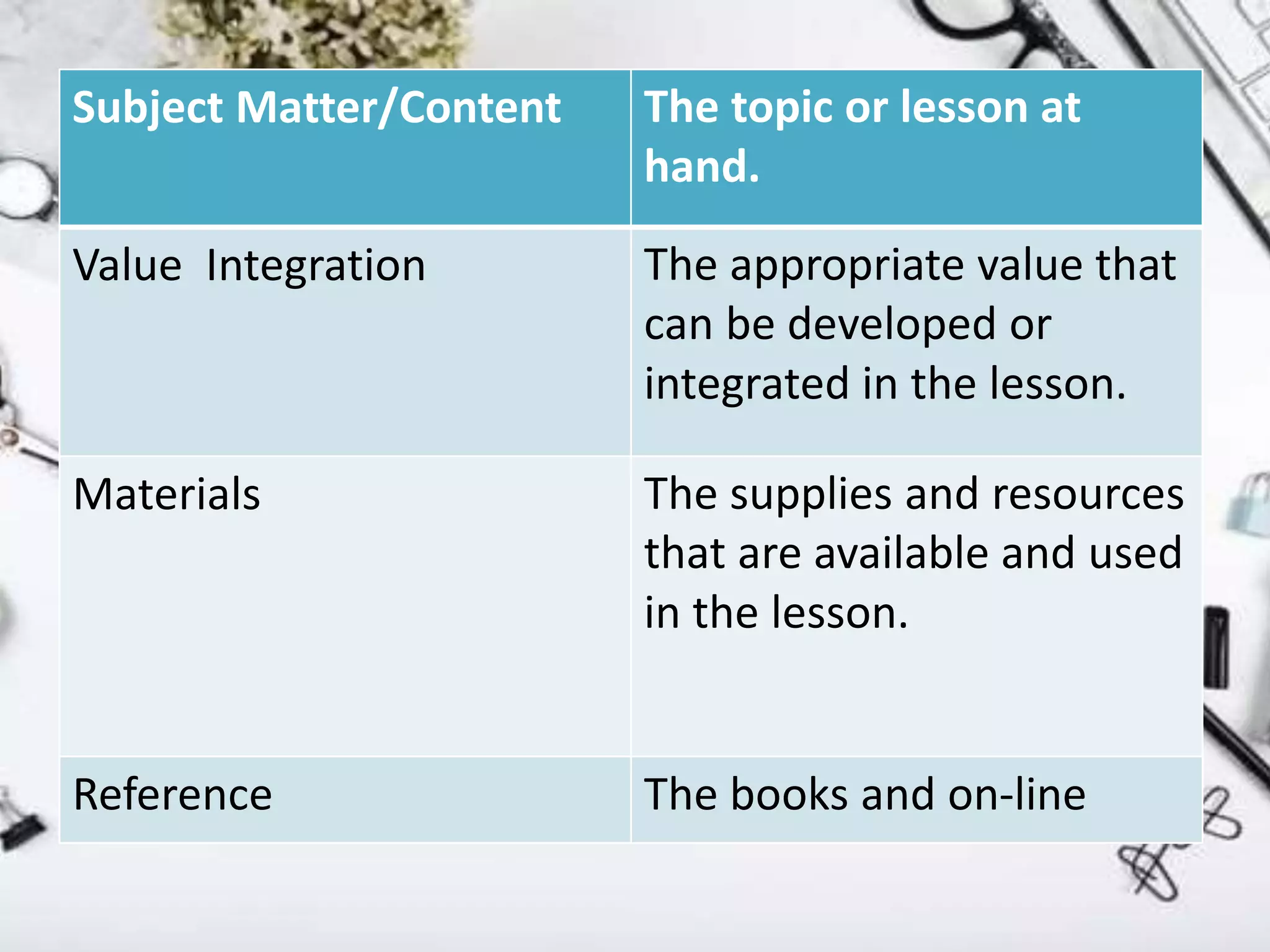
Subject Matter/Content Thetopic or lesson at
hand.
Value Integration The appropriate value that
can be developed or
integrated in the lesson.
Materials The supplies and resources
that are available and used
in the lesson.
Reference The books and on-line
21.
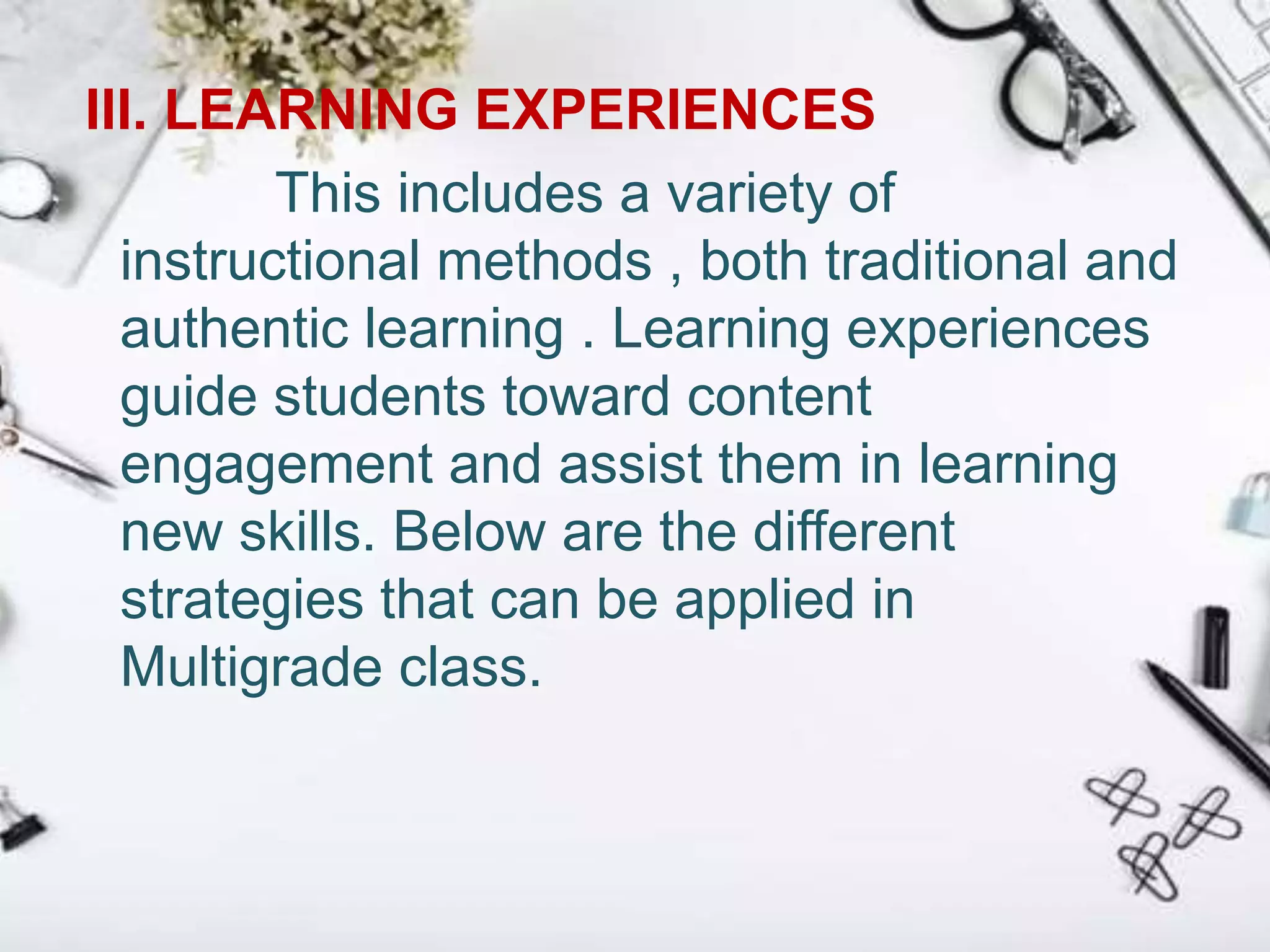
III. LEARNING EXPERIENCES
Thisincludes a variety of
instructional methods , both traditional and
authentic learning . Learning experiences
guide students toward content
engagement and assist them in learning
new skills. Below are the different
strategies that can be applied in
Multigrade class.
22.
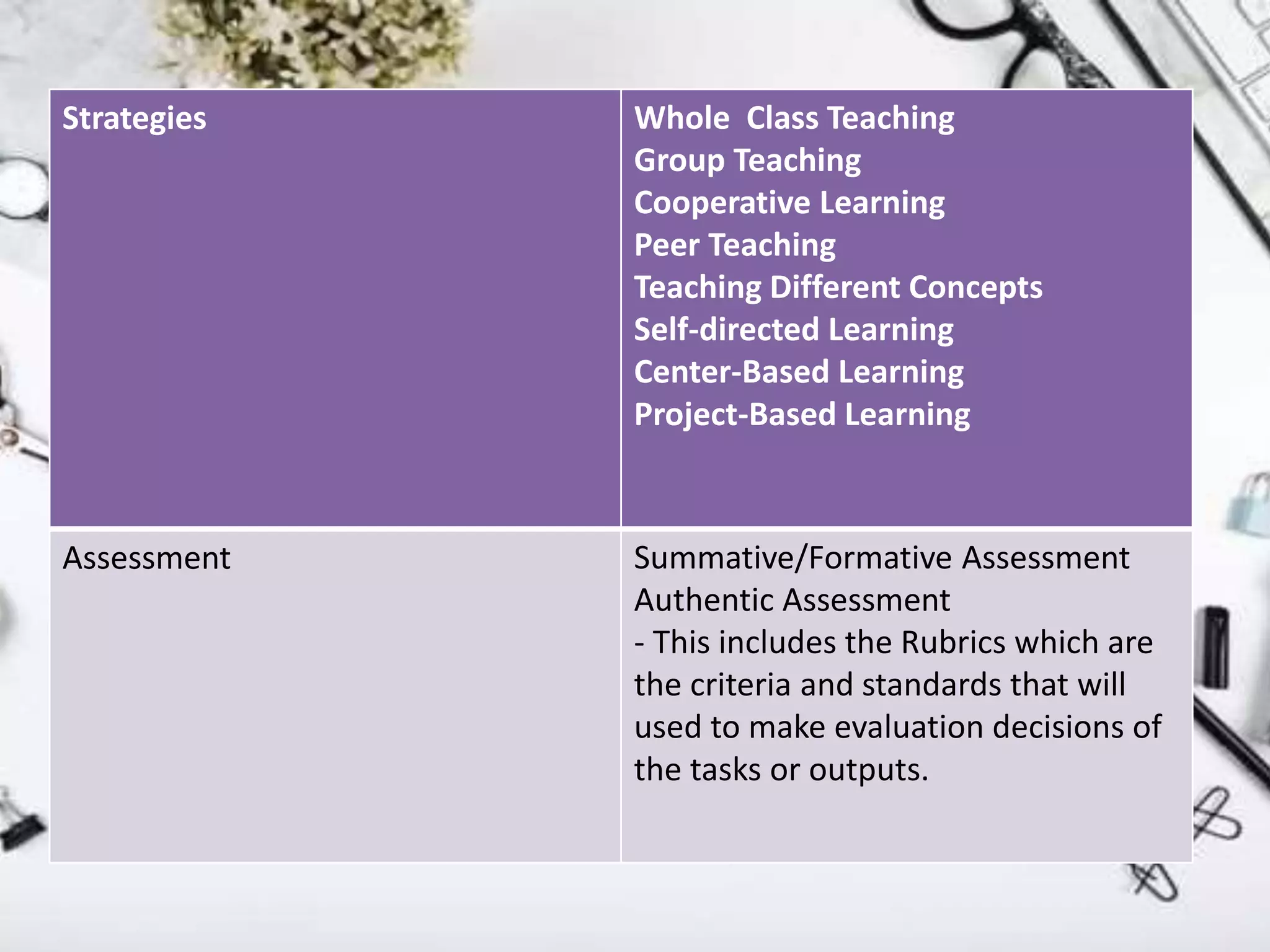
Strategies Whole ClassTeaching
Group Teaching
Cooperative Learning
Peer Teaching
Teaching Different Concepts
Self-directed Learning
Center-Based Learning
Project-Based Learning
Assessment Summative/Formative Assessment
Authentic Assessment
- This includes the Rubrics which are
the criteria and standards that will
used to make evaluation decisions of
the tasks or outputs.
23.
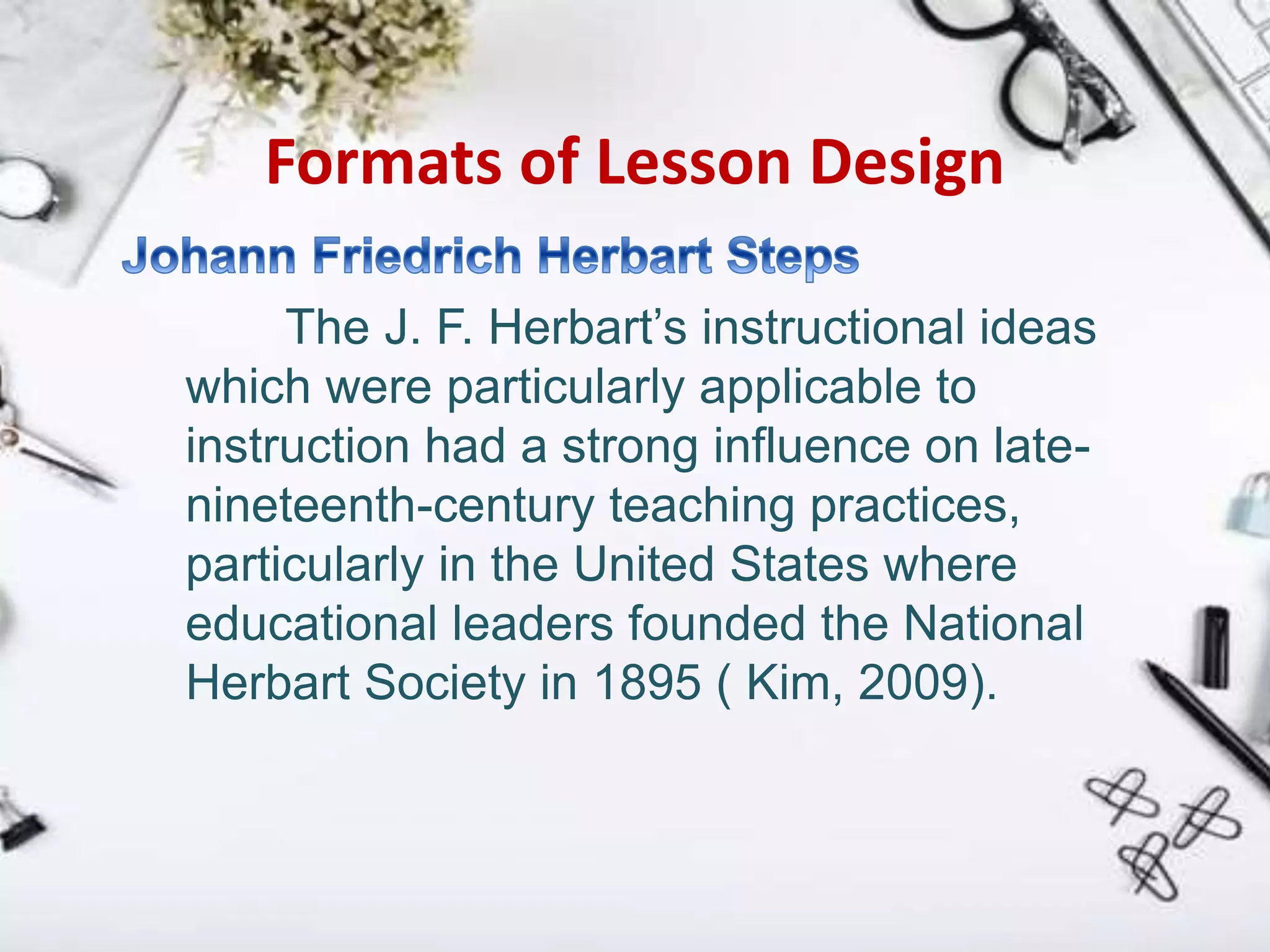
Formats of LessonDesign
The J. F. Herbart’s instructional ideas
which were particularly applicable to
instruction had a strong influence on late-
nineteenth-century teaching practices,
particularly in the United States where
educational leaders founded the National
Herbart Society in 1895 ( Kim, 2009).
24.
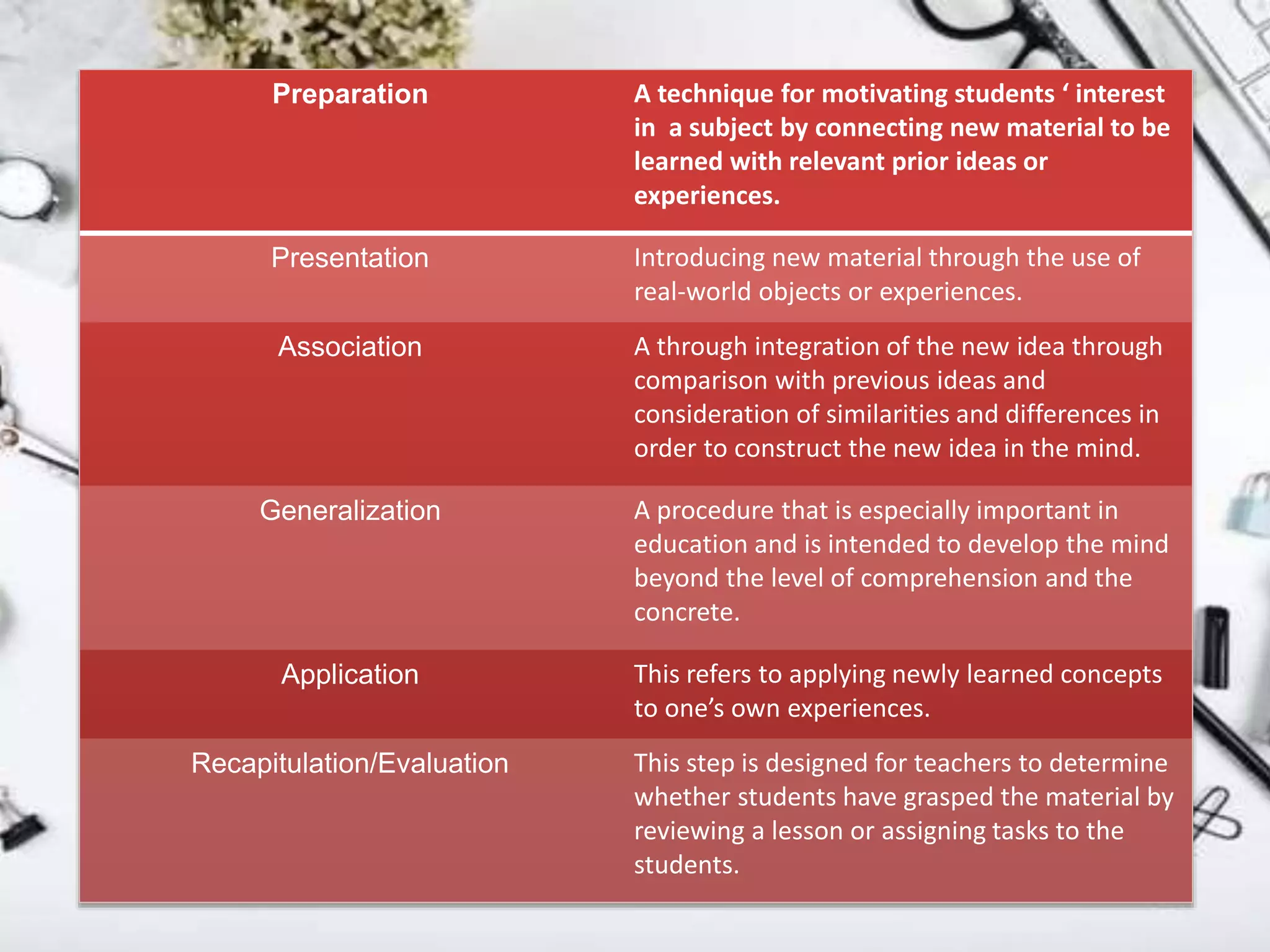
Preparation A techniquefor motivating students ‘ interest
in a subject by connecting new material to be
learned with relevant prior ideas or
experiences.
Presentation Introducing new material through the use of
real-world objects or experiences.
Association A through integration of the new idea through
comparison with previous ideas and
consideration of similarities and differences in
order to construct the new idea in the mind.
Generalization A procedure that is especially important in
education and is intended to develop the mind
beyond the level of comprehension and the
concrete.
Application This refers to applying newly learned concepts
to one’s own experiences.
Recapitulation/Evaluation This step is designed for teachers to determine
whether students have grasped the material by
reviewing a lesson or assigning tasks to the
students.
25.
This four-phase structureis
based on Kolb’s Experiential
Learning Theory, which aims to
educate students holistically.
Learning is the process by which
knowledge is created by
transforming experience ( Kolb,
1984).
26.
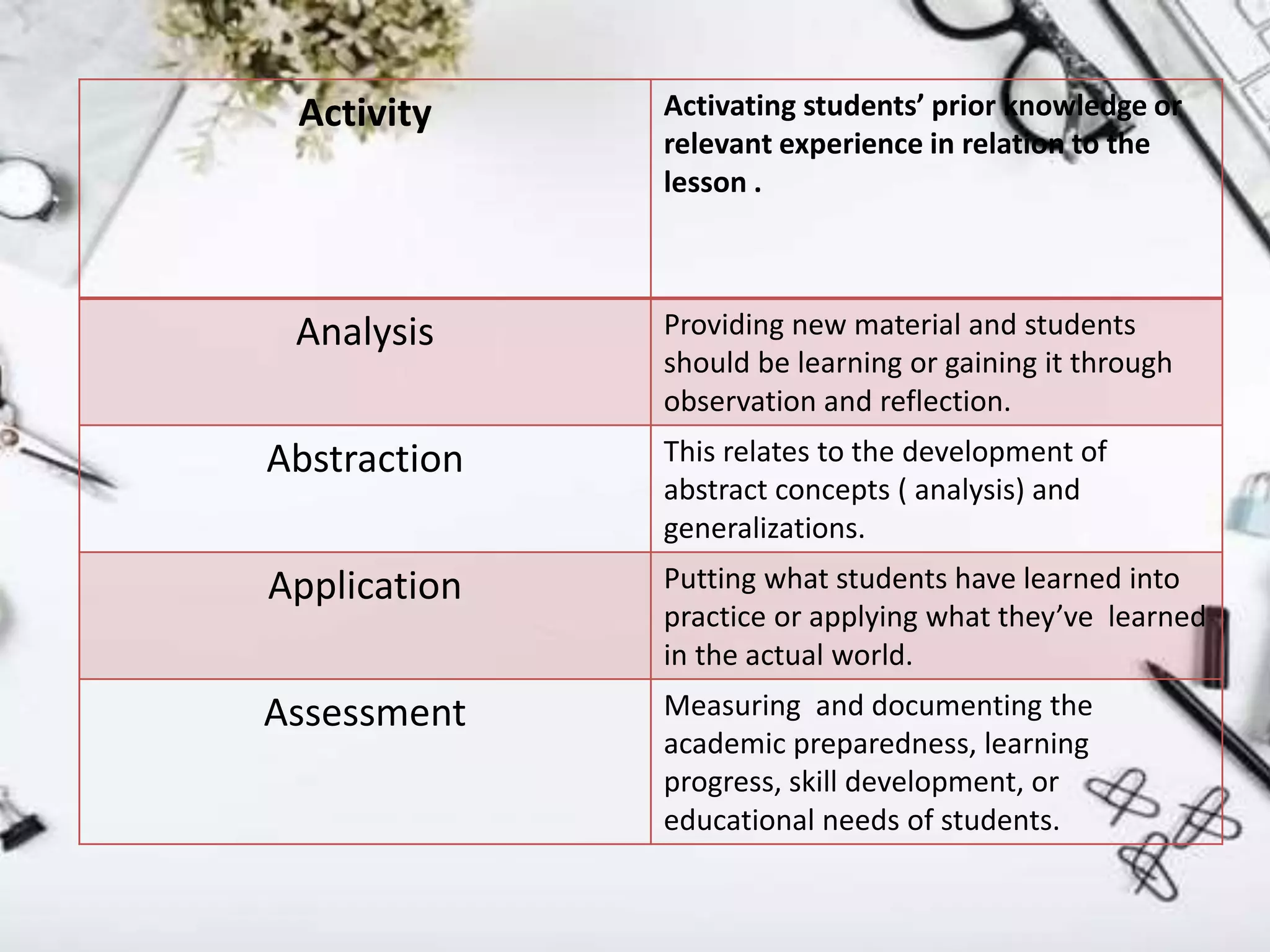
Activity Activating students’prior knowledge or
relevant experience in relation to the
lesson .
Analysis Providing new material and students
should be learning or gaining it through
observation and reflection.
Abstraction This relates to the development of
abstract concepts ( analysis) and
generalizations.
Application Putting what students have learned into
practice or applying what they’ve learned
in the actual world.
Assessment Measuring and documenting the
academic preparedness, learning
progress, skill development, or
educational needs of students.
27.
This format refersto the
three fundamental steps in
supporting teaching and
learning.
28.
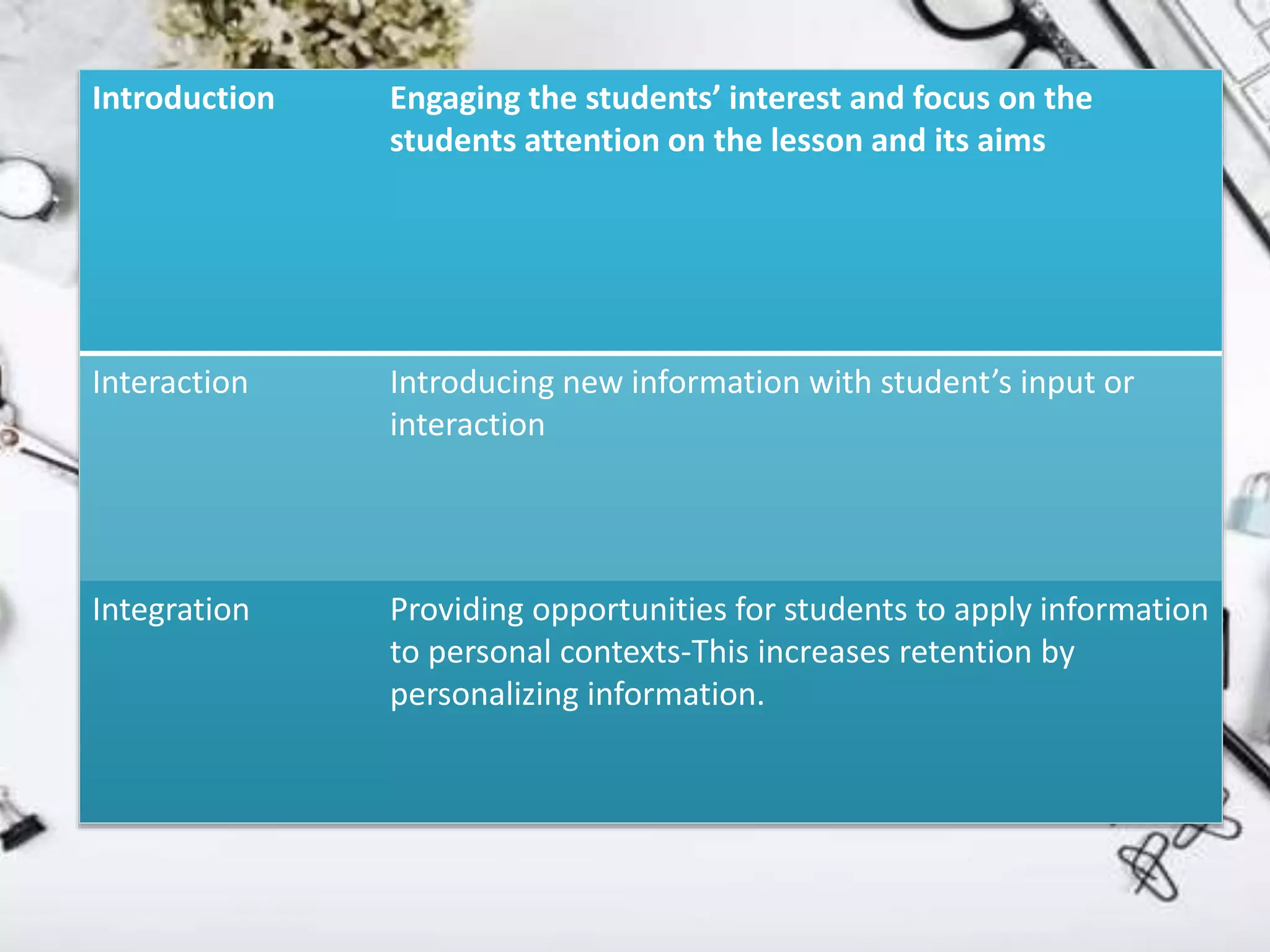
Introduction Engaging thestudents’ interest and focus on the
students attention on the lesson and its aims
Interaction Introducing new information with student’s input or
interaction
Integration Providing opportunities for students to apply information
to personal contexts-This increases retention by
personalizing information.
29.
This well knownteaching
structure includes the progressive
stages of learning which guides
the teaching of units, lessons or
programs particularly in science
and mathematics.
30.
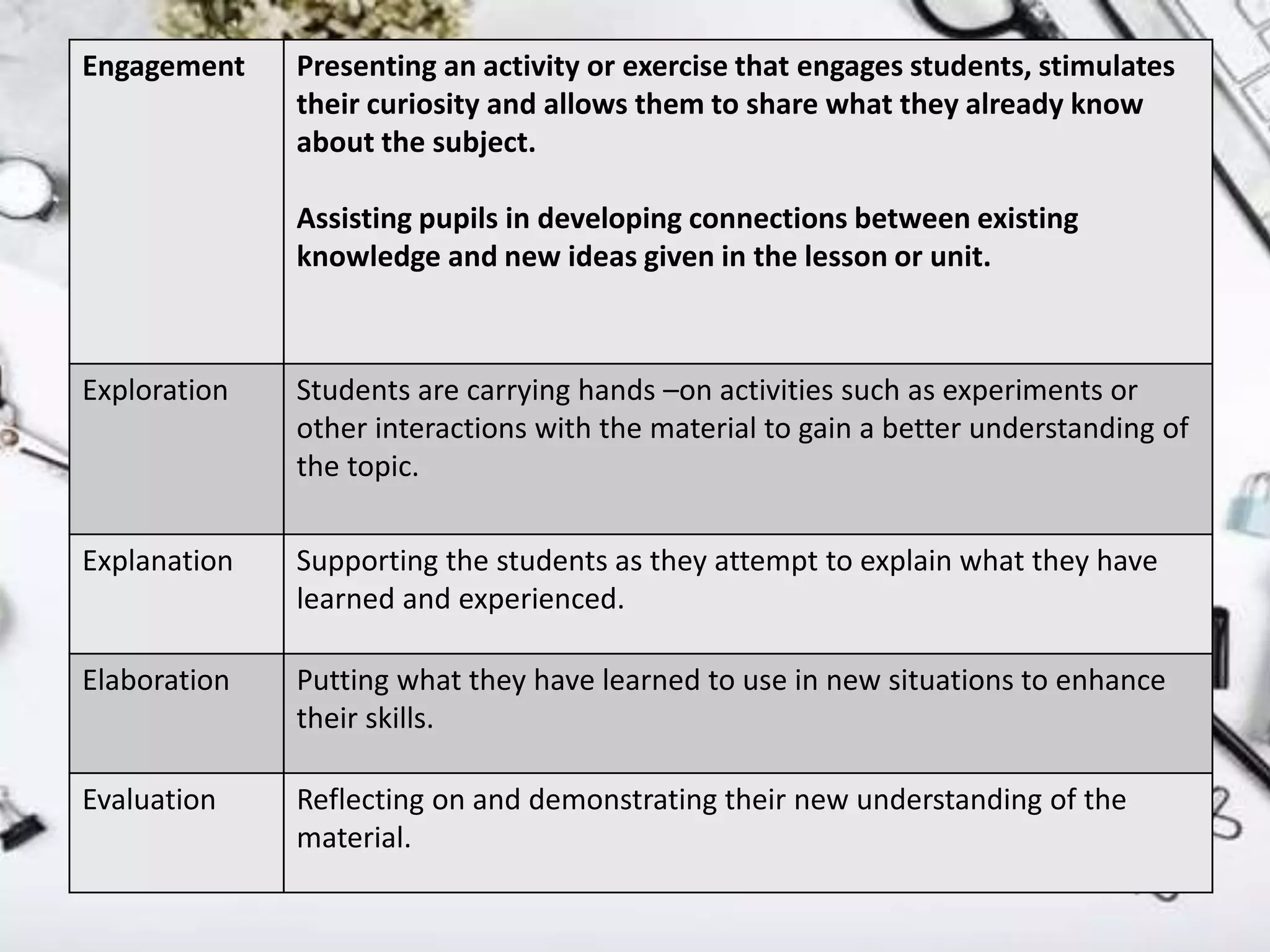
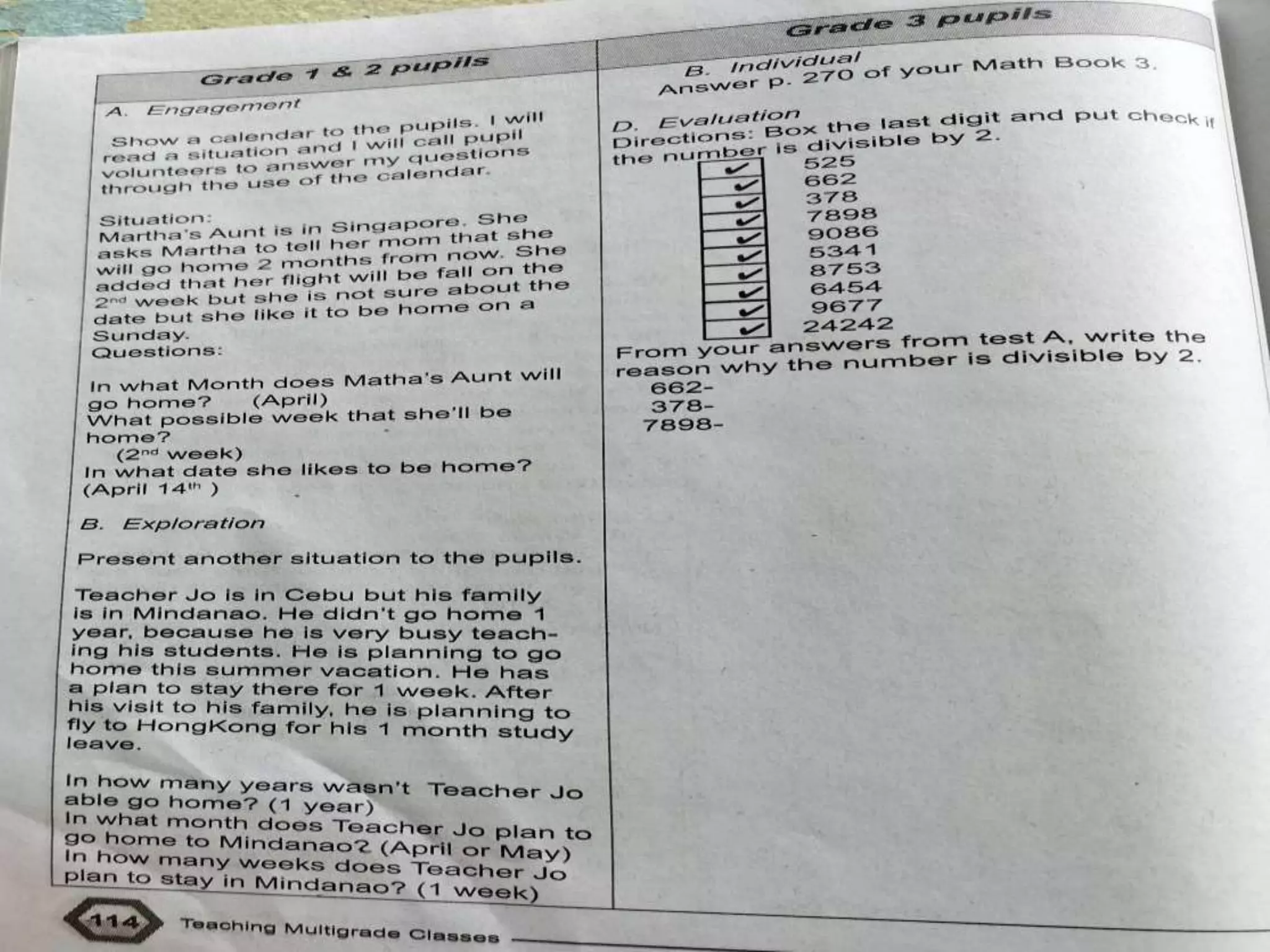
Engagement Presenting anactivity or exercise that engages students, stimulates
their curiosity and allows them to share what they already know
about the subject.
Assisting pupils in developing connections between existing
knowledge and new ideas given in the lesson or unit.
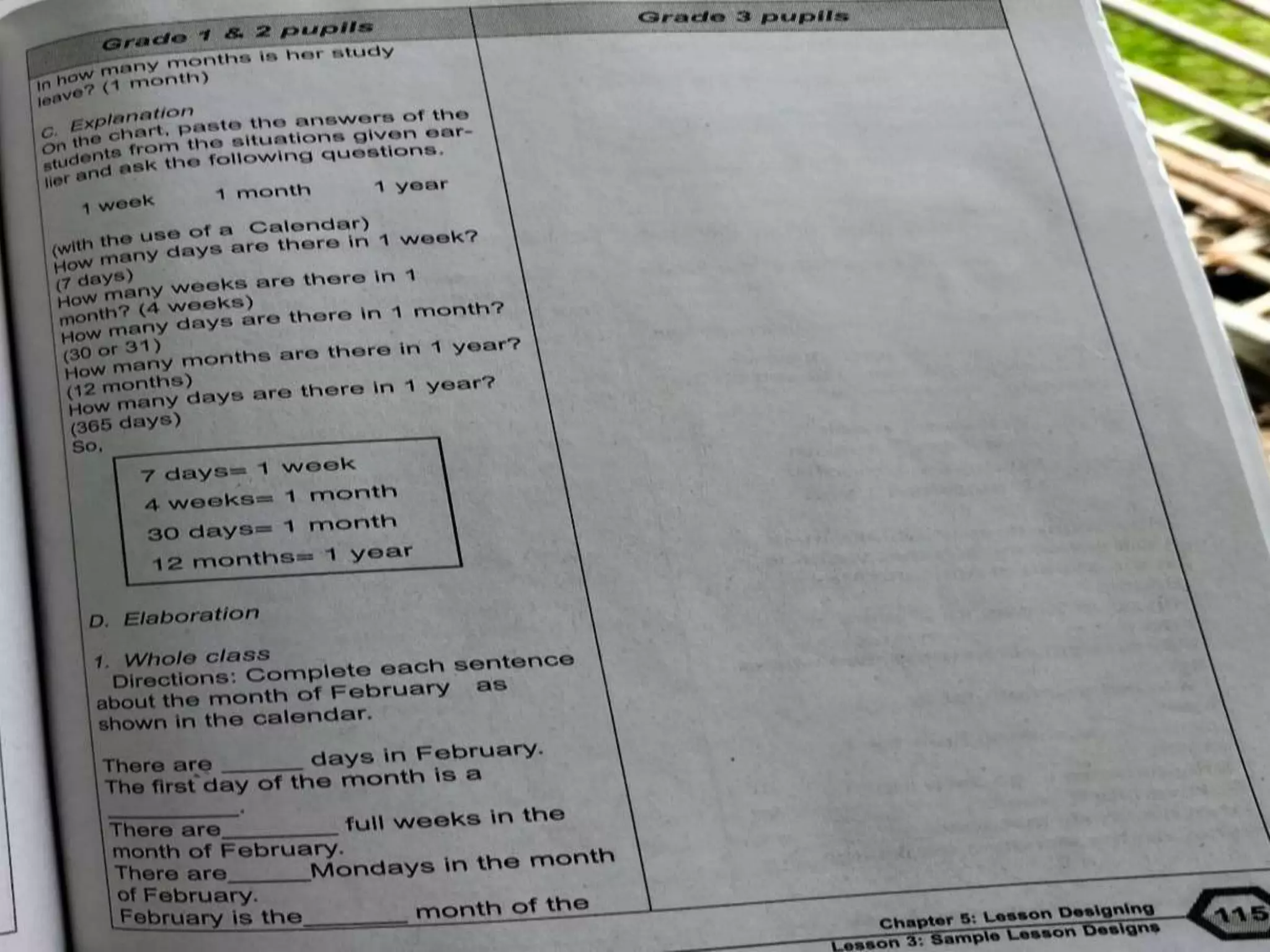
Exploration Students are carrying hands –on activities such as experiments or
other interactions with the material to gain a better understanding of
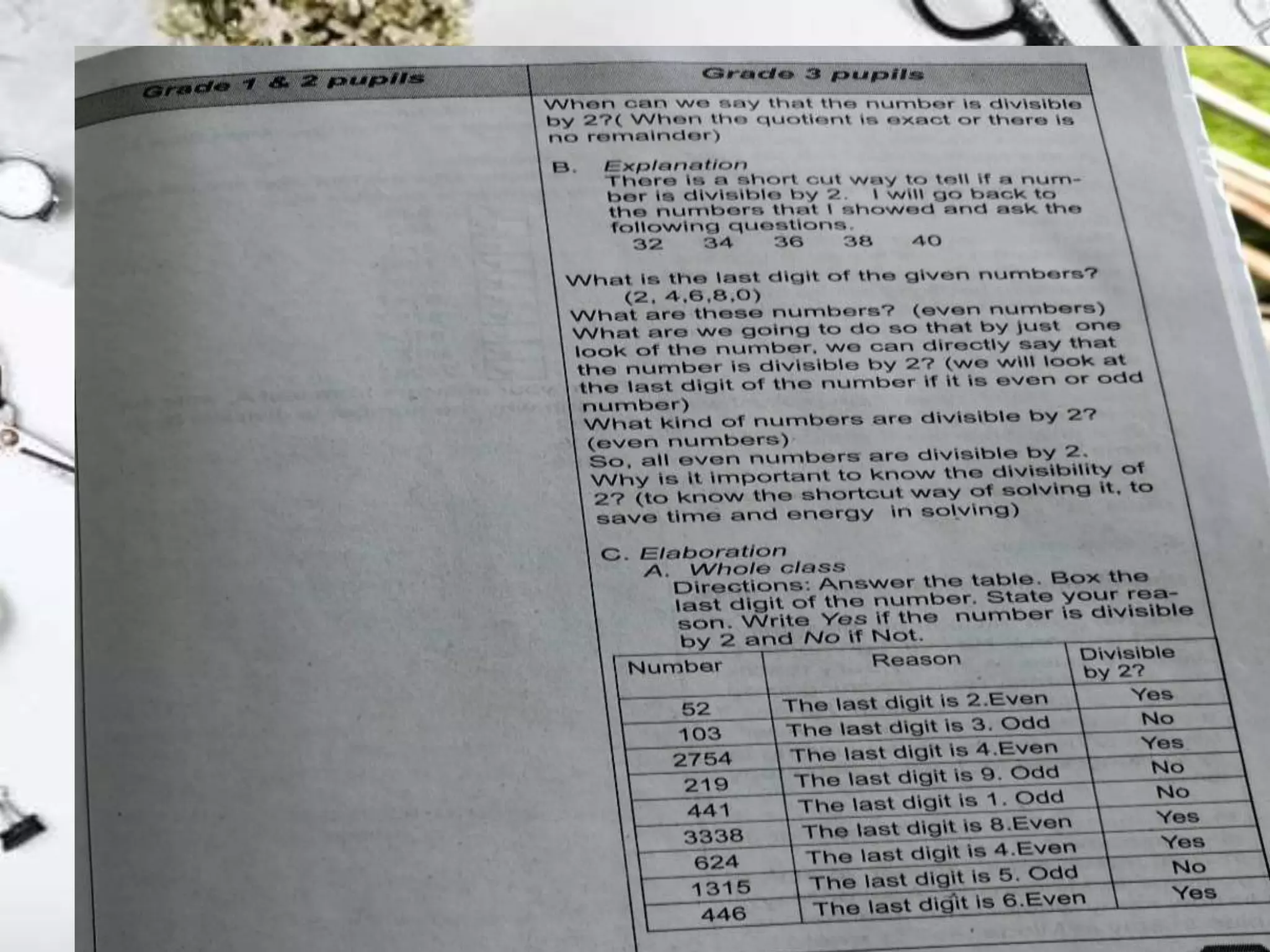
the topic.
Explanation Supporting the students as they attempt to explain what they have
learned and experienced.
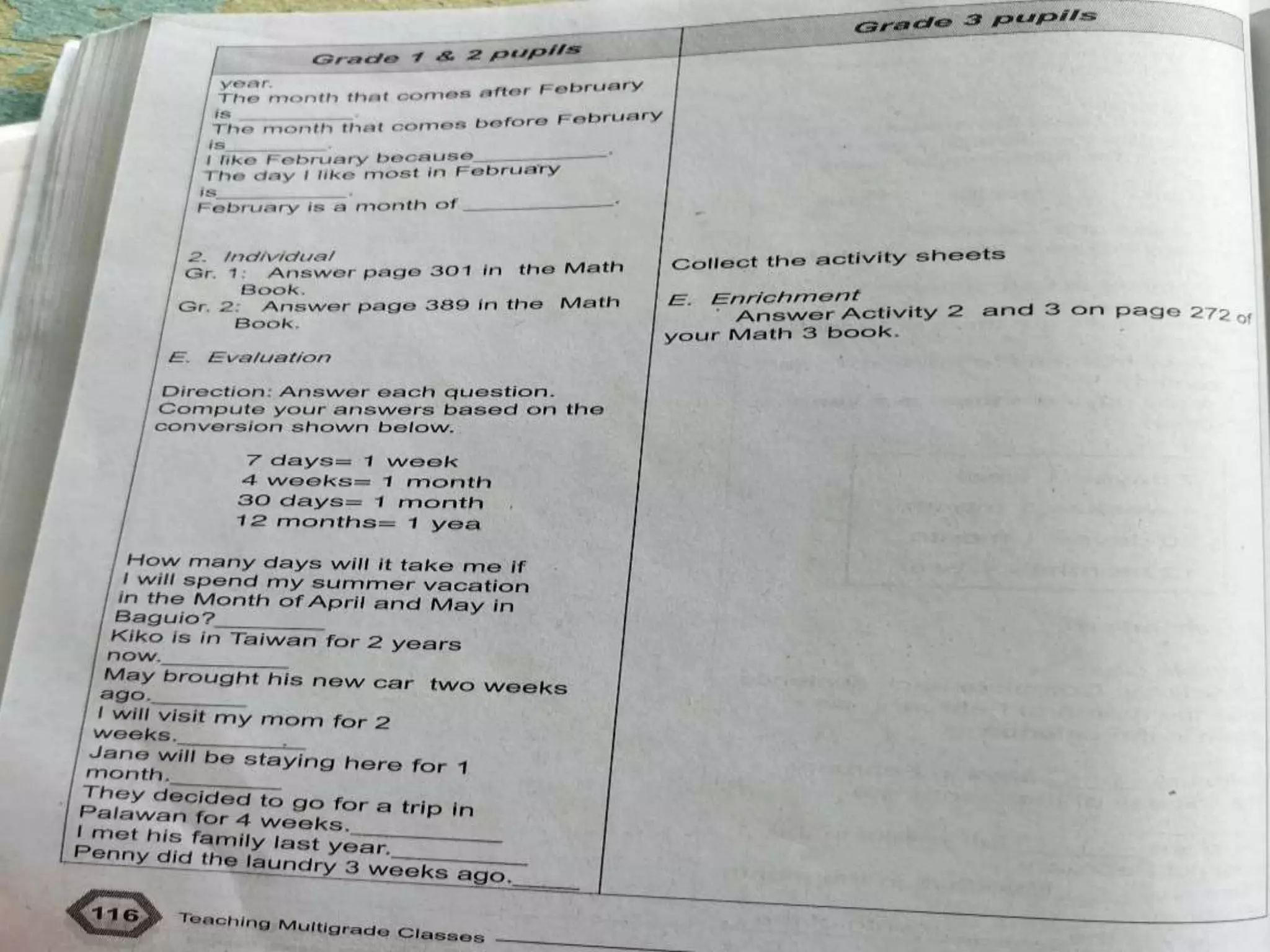
Elaboration Putting what they have learned to use in new situations to enhance
their skills.
Evaluation Reflecting on and demonstrating their new understanding of the
material.
31.
This four-step formatis
appropriate for skill
acquisition is physical
education, music and art.
32.
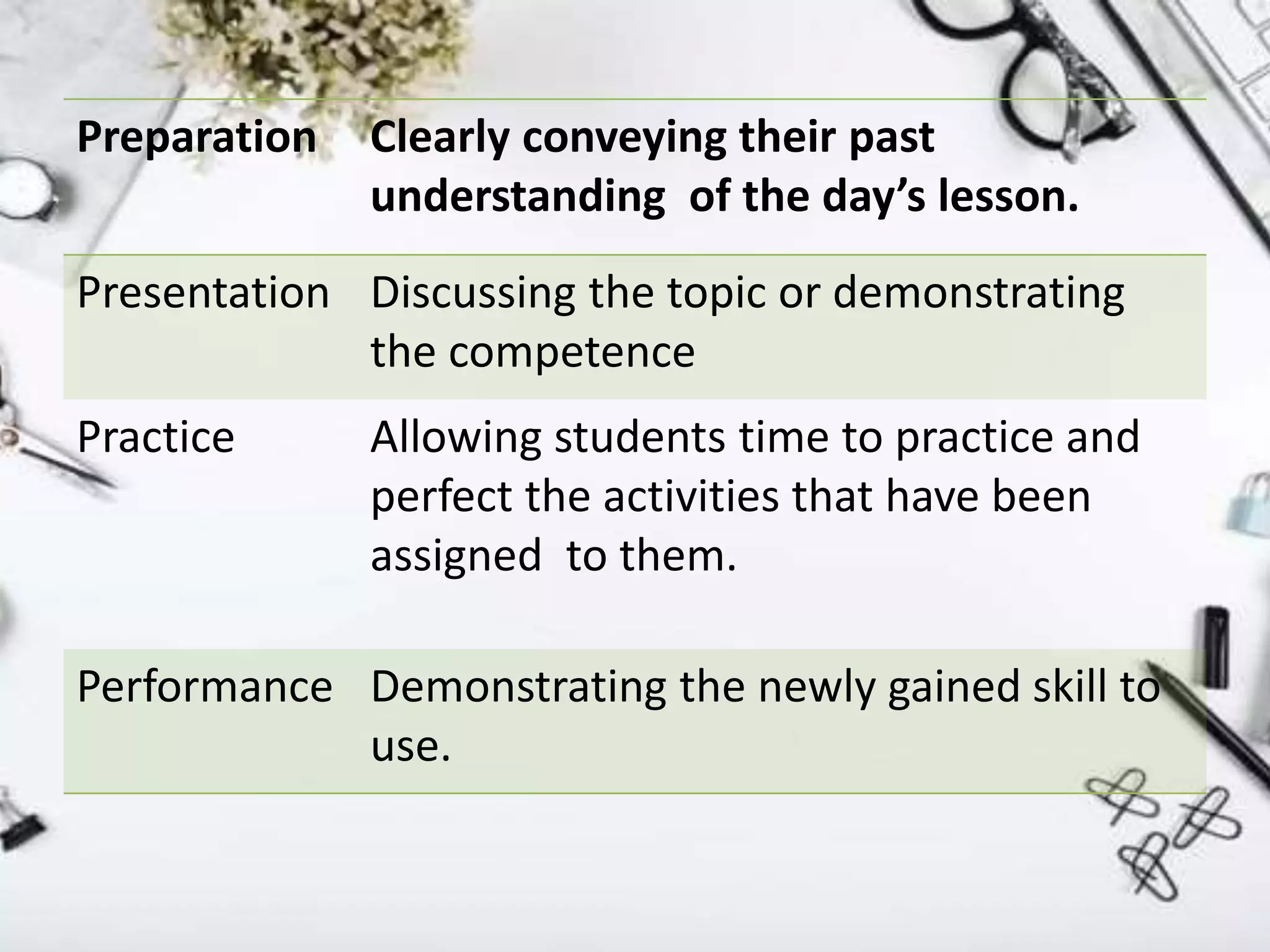
Preparation Clearly conveyingtheir past
understanding of the day’s lesson.
Presentation Discussing the topic or demonstrating
the competence
Practice Allowing students time to practice and
perfect the activities that have been
assigned to them.
Performance Demonstrating the newly gained skill to
use.
• The formatof lesson designs in multigrade
class varies by country as it does with all
planning. Many schools districts in the
Philippines give daily lesson plans, while
others enable teachers to create with their
own structure.
• All the lesson design are learner centred
using the senses and multiple intelligences
dynamically engaging and relating to the
diverse of learners experiences.