DR.R.RUPA
ASSOCIATE PROFESSOR
SCMS SCHOOL OF TECHNOLOGY AND
MANAGEMENT
COCHIN
GST IN INDIA: AN
OVERVIEW
INTRODUCTION
 Tax policies play an important role on the economy.
 The main source of revenue for government of India is from tax.
 Direct and indirect taxes are the two main source of tax revenue.
 The indirect tax system is currently mired in multi-layered taxes
levied by the Centre and state governments at different stages of
the supply chain such as excise duty, octroi, central sales tax
(CST) and value-added tax (VAT), among others.
 First Indirect Tax Reform occurred in India when the Modified
Value Added Tax (MODVAT) was introduced for selected
commodities in 1986 to replace the Central Excise Duty. The
other reforms are the introduction of service tax in 1994,
decision to introduce VAT in 1999, introduction of Constitution
Amendment Bill on GST in 2011.
GOODS AND SERVICE TAX
 GST is most ambitious and biggest tax reform plan,
which aims to stitch together a common market by
dismantling fiscal barriers between states.
 It is a single national uniform tax levied across India on
all goods and services.
 In GST, all the indirect taxes will be subsumed under a
single regime.
 The GST taxation laws will put an end to multiple taxes
which are levied on different products, starting from the
source of manufacturing to reaching the end consumer.
 GST works on the fundamental Principle of “One
Country One Tax”.
TIMELINE OF GST
 GST was first mooted by Dr Manmohan Singh in the
mid-1990s
 The GST was recommended by the Kelkar Task Force on
FRBM act in 2005
 In 2011, the Constitution (115th Amendment) Bill was
introduced in Parliament to enable the levy of GST.
 In December 2014, the Constitution (122nd Amendment)
Bill was introduced in Lok Sabha.
 The Bill was passed by Lok Sabha in May 2015 and
referred to a Select Committee of Rajya Sabha for
examination.
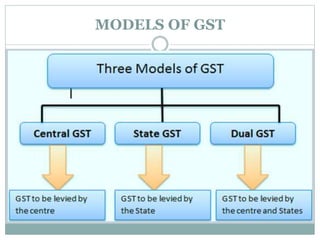
MODELS OF GST
ADVANTAGES OF GST
 GST is structured to simplify the current indirect system by removing multiple
taxes. It creates India as a single market.
 It taxes goods and services at the same rates so many disputes are eliminated
on tax matter.
 GST will be levied only at the final destination of consumption based on VAT
principle and not at various points (from manufacturing to retail outlets). This
will help in removing economic distortions and bring about development of a
common national market.
 The procedural cost is reduced due to uniform accounting namely, CGST,
SGST, IGST have to be maintained for all types of taxes.
 The reduced tax burden on companies will reduce production cost making
exporters more competitive at national and international level.
 More business entities including unorganized will come under the tax system
thus widening the tax base. This may lead to better and more tax revenue
collections.
 Many businesses create depots and go downs in different states simply
because there is a difference in tax rates. Now that GST will come, this
difference between states will vanish. It would help to remove the tax
difference as a bias, thereby helping businesses.
DISADVANTAGES OF GST
 There will be dual control on every business by Central and State
Government. So compliance cost will go up.
 All credit will be available on from online connectivity with GST
Network. Hence, small businesses may find it difficult to use the
system
 VAT and service tax on some products may become higher than the
current levels.
 States may lose autonomy to change their tax rates.
 Manufacturing states would lose big revenue
 Service sector may oppose because they have to register in every state
with central and state government. So every business at all India level
will have around 60 registrations while they are having just one today.
Moreover their rates will also go up.
 Retail business may oppose because their taxes will go up and they will
also have to deal with Central Government now in addition to States.
 GSTN may not work optimally for quite some time.
CHALLENGES
 In addition to the passage of the Bill, it is also imperative to
have a robust country-wide IT network and infrastructure
to make the implementation seamless. The IT network
work is still in progress. The most important issue on which
consensus eludes states and the Centre is regarding the
states. States also fear that they will suffer heavy revenue
losses.
 There are certain state specific issues. For example,
Maharashtra, earns more than 13,000 crore annually from
octroi. Gujarat, on the other hand, earns about 5,000 crore
from the CST. Agrarian states such as Punjab and Haryana
earn more than 2,000 crore from purchase tax. Each of
these states fears that they will lose these revenues once
these levies get subsumed under GST.
THANK YOU
READ FULL TEXT
AT:
International
Education and
Research Journal,
Volume 3,
Issue 2,
February 2017,
Page No. 88-89.
www.ierj.in

Gst in india

  • 1.
    DR.R.RUPA ASSOCIATE PROFESSOR SCMS SCHOOLOF TECHNOLOGY AND MANAGEMENT COCHIN GST IN INDIA: AN OVERVIEW
  • 2.
    INTRODUCTION  Tax policiesplay an important role on the economy.  The main source of revenue for government of India is from tax.  Direct and indirect taxes are the two main source of tax revenue.  The indirect tax system is currently mired in multi-layered taxes levied by the Centre and state governments at different stages of the supply chain such as excise duty, octroi, central sales tax (CST) and value-added tax (VAT), among others.  First Indirect Tax Reform occurred in India when the Modified Value Added Tax (MODVAT) was introduced for selected commodities in 1986 to replace the Central Excise Duty. The other reforms are the introduction of service tax in 1994, decision to introduce VAT in 1999, introduction of Constitution Amendment Bill on GST in 2011.
  • 3.
    GOODS AND SERVICETAX  GST is most ambitious and biggest tax reform plan, which aims to stitch together a common market by dismantling fiscal barriers between states.  It is a single national uniform tax levied across India on all goods and services.  In GST, all the indirect taxes will be subsumed under a single regime.  The GST taxation laws will put an end to multiple taxes which are levied on different products, starting from the source of manufacturing to reaching the end consumer.  GST works on the fundamental Principle of “One Country One Tax”.
  • 4.
    TIMELINE OF GST GST was first mooted by Dr Manmohan Singh in the mid-1990s  The GST was recommended by the Kelkar Task Force on FRBM act in 2005  In 2011, the Constitution (115th Amendment) Bill was introduced in Parliament to enable the levy of GST.  In December 2014, the Constitution (122nd Amendment) Bill was introduced in Lok Sabha.  The Bill was passed by Lok Sabha in May 2015 and referred to a Select Committee of Rajya Sabha for examination.
  • 5.
  • 6.
    ADVANTAGES OF GST GST is structured to simplify the current indirect system by removing multiple taxes. It creates India as a single market.  It taxes goods and services at the same rates so many disputes are eliminated on tax matter.  GST will be levied only at the final destination of consumption based on VAT principle and not at various points (from manufacturing to retail outlets). This will help in removing economic distortions and bring about development of a common national market.  The procedural cost is reduced due to uniform accounting namely, CGST, SGST, IGST have to be maintained for all types of taxes.  The reduced tax burden on companies will reduce production cost making exporters more competitive at national and international level.  More business entities including unorganized will come under the tax system thus widening the tax base. This may lead to better and more tax revenue collections.  Many businesses create depots and go downs in different states simply because there is a difference in tax rates. Now that GST will come, this difference between states will vanish. It would help to remove the tax difference as a bias, thereby helping businesses.
  • 7.
    DISADVANTAGES OF GST There will be dual control on every business by Central and State Government. So compliance cost will go up.  All credit will be available on from online connectivity with GST Network. Hence, small businesses may find it difficult to use the system  VAT and service tax on some products may become higher than the current levels.  States may lose autonomy to change their tax rates.  Manufacturing states would lose big revenue  Service sector may oppose because they have to register in every state with central and state government. So every business at all India level will have around 60 registrations while they are having just one today. Moreover their rates will also go up.  Retail business may oppose because their taxes will go up and they will also have to deal with Central Government now in addition to States.  GSTN may not work optimally for quite some time.
  • 8.
    CHALLENGES  In additionto the passage of the Bill, it is also imperative to have a robust country-wide IT network and infrastructure to make the implementation seamless. The IT network work is still in progress. The most important issue on which consensus eludes states and the Centre is regarding the states. States also fear that they will suffer heavy revenue losses.  There are certain state specific issues. For example, Maharashtra, earns more than 13,000 crore annually from octroi. Gujarat, on the other hand, earns about 5,000 crore from the CST. Agrarian states such as Punjab and Haryana earn more than 2,000 crore from purchase tax. Each of these states fears that they will lose these revenues once these levies get subsumed under GST.
  • 10.
    THANK YOU READ FULLTEXT AT: International Education and Research Journal, Volume 3, Issue 2, February 2017, Page No. 88-89. www.ierj.in