MSPM’S
DEOGIRI INSTITUTEOF ENGINEERINGAND MANAGEMENT STUDIES,
AURANGABAD.
Department of Basic Science and Humanities
SUB-Menter Mentee
Power Point Presentation on
Gst
Submitted by
Vaishnav Dattatrya Waghmare
FE4 (Mech.) Roll No. 1444
CONTENT
 Introduction
 History
 Tax Structure in India
 Past Tax System
 Value Added Tax(VAT)
 Model of GST
 Advantages & Disadvantages
 Impact of GST
 Conclusion
Introduction
‘G’-Goods
‘S’-Services
‘T’-Tax
 Goods and Services Tax (GST) is a comprehensive tax on manufacture, sale and consumption of goods and
service at a national level.
 GST is a tax on goods and services with value addition at each stage.
 GST will include many state and central level indirect taxes.
 It overcomes drawback present tax system.
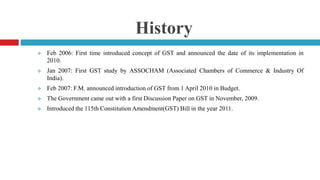
History
 Feb 2006: First time introduced concept of GST and announced the date of its implementation in
2010.
 Jan 2007: First GST study by ASSOCHAM (Associated Chambers of Commerce & Industry Of
India).
 Feb 2007: F.M. announced introduction of GST from 1 April 2010 in Budget.
 The Government came out with a first Discussion Paper on GST in November, 2009.
 Introduced the 115th Constitution Amendment(GST) Bill in the year 2011.
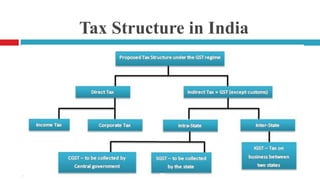
Tax Structure in India
Past Tax System
 Tax Cascading (Tax on Tax)
 Complexity
 Taxation on Manufacturing Level
 Exclusion Of services
 Tax Evasion
 Corruption
(VAT)
Value Added Tax
 Implemented in April-1/2005
 It is replacement to complex Sales Tax.
 It overcomes a cascading Effect of Tax.
 It applied on “Value Added Portion” in sales price.
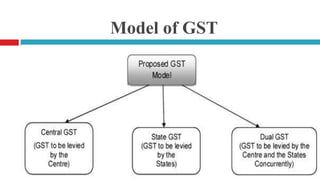
Model of GST
Advantages of GST
 GST eliminates the cascading effect of tax.
 Higher threshold for registration.
 Composition scheme for small businesses.
 Simple and easy online procedure.
 The number of compliances is lesser.
 Defined treatment for E-commerce operators.
 Improved efficiency of logistics.
 Unorganized sector is regulated under GST.
Disadvantages of GST
 Increased costs due to software purchase
 Being GST-compliant
 GST will mean an increase in operational costs
 GST came into effect in the middle of the financial year
 GST is an online taxation system
 SMEs will have a higher tax burden
Positive Impact of GST
 Increase in Foreign Investment- With GST, India is now a unified market and the foreign investment
has increased in India. The implementation of Goods & Services tax puts India in the line of international
tax standards, making it easier for Indian businesses to sell in the global market.
 Fewer Tax- GST has two constituents: The central GST and the State GST. The Central GST will replace
- Service Tax, Central Excise Duty, and Custom Duty etc. The State GST will replace - State VAT, Central
Sales Tax, Tax on Advertisements, Luxury Tax, Purchase Tax, Entertainment Tax etc.
 Reduce the cost of doing business- GST has changed VAT all over India. Now we do not need to pay
different amounts of taxes in different states. It is one tax system for all states of India and so we have
already got rid of various taxes and duties on our businesses.
 Transparency- The tax administration has started working corruption free. Also enabling sales invoices
to show the tax applied has resulted in transparency.
Negative Impact of GST
 Dual Control - GST is being referred to as a single taxation system but in reality it is a dual tax because both
the state and centre both will collect separate tax on a single transaction of sale and service.
 Incumbent increase of the cost of some commodities - The tax rate has been increased for many products,
thus increasing their costs.
 Some sector are at a loss- Sectors like Textile, Media, Pharma, Dairy Products, IT and Telecom are bearing
the brunt of a higher tax. Also the price of commodities has increased like jewellery, mobile phones and
credit cards.
 Real Estate Market affected - Economists are of the opinion that GST in India has already had a negative
impact on the real estate market. It has added up to 8 percent to the cost of new homes and reduced demand
by about 12 percent.
Conclusion
 GST being a dynamic & comprehensive legislation which shall replace most of the Indirect Taxes Of
Our Country.
 Since it is a major indirect tax reform in India, there would be new legislation and procedures.
 For GST to be effective there should be identical GST laws/procedures across states as well as the
centre.
 GST is the best example of cooperative federalism.
 Together we will take India to new heights of progress.
 In Nutshell , it is a biggest tax reform till date in our country.
Gst.

Gst.

  • 1.
    MSPM’S DEOGIRI INSTITUTEOF ENGINEERINGANDMANAGEMENT STUDIES, AURANGABAD. Department of Basic Science and Humanities SUB-Menter Mentee Power Point Presentation on Gst Submitted by Vaishnav Dattatrya Waghmare FE4 (Mech.) Roll No. 1444
  • 2.
    CONTENT  Introduction  History Tax Structure in India  Past Tax System  Value Added Tax(VAT)  Model of GST  Advantages & Disadvantages  Impact of GST  Conclusion
  • 3.
    Introduction ‘G’-Goods ‘S’-Services ‘T’-Tax  Goods andServices Tax (GST) is a comprehensive tax on manufacture, sale and consumption of goods and service at a national level.  GST is a tax on goods and services with value addition at each stage.  GST will include many state and central level indirect taxes.  It overcomes drawback present tax system.
  • 4.
    History  Feb 2006:First time introduced concept of GST and announced the date of its implementation in 2010.  Jan 2007: First GST study by ASSOCHAM (Associated Chambers of Commerce & Industry Of India).  Feb 2007: F.M. announced introduction of GST from 1 April 2010 in Budget.  The Government came out with a first Discussion Paper on GST in November, 2009.  Introduced the 115th Constitution Amendment(GST) Bill in the year 2011.
  • 5.
  • 6.
    Past Tax System Tax Cascading (Tax on Tax)  Complexity  Taxation on Manufacturing Level  Exclusion Of services  Tax Evasion  Corruption
  • 7.
    (VAT) Value Added Tax Implemented in April-1/2005  It is replacement to complex Sales Tax.  It overcomes a cascading Effect of Tax.  It applied on “Value Added Portion” in sales price.
  • 8.
  • 9.
    Advantages of GST GST eliminates the cascading effect of tax.  Higher threshold for registration.  Composition scheme for small businesses.  Simple and easy online procedure.  The number of compliances is lesser.  Defined treatment for E-commerce operators.  Improved efficiency of logistics.  Unorganized sector is regulated under GST.
  • 10.
    Disadvantages of GST Increased costs due to software purchase  Being GST-compliant  GST will mean an increase in operational costs  GST came into effect in the middle of the financial year  GST is an online taxation system  SMEs will have a higher tax burden
  • 11.
    Positive Impact ofGST  Increase in Foreign Investment- With GST, India is now a unified market and the foreign investment has increased in India. The implementation of Goods & Services tax puts India in the line of international tax standards, making it easier for Indian businesses to sell in the global market.  Fewer Tax- GST has two constituents: The central GST and the State GST. The Central GST will replace - Service Tax, Central Excise Duty, and Custom Duty etc. The State GST will replace - State VAT, Central Sales Tax, Tax on Advertisements, Luxury Tax, Purchase Tax, Entertainment Tax etc.  Reduce the cost of doing business- GST has changed VAT all over India. Now we do not need to pay different amounts of taxes in different states. It is one tax system for all states of India and so we have already got rid of various taxes and duties on our businesses.  Transparency- The tax administration has started working corruption free. Also enabling sales invoices to show the tax applied has resulted in transparency.
  • 12.
    Negative Impact ofGST  Dual Control - GST is being referred to as a single taxation system but in reality it is a dual tax because both the state and centre both will collect separate tax on a single transaction of sale and service.  Incumbent increase of the cost of some commodities - The tax rate has been increased for many products, thus increasing their costs.  Some sector are at a loss- Sectors like Textile, Media, Pharma, Dairy Products, IT and Telecom are bearing the brunt of a higher tax. Also the price of commodities has increased like jewellery, mobile phones and credit cards.  Real Estate Market affected - Economists are of the opinion that GST in India has already had a negative impact on the real estate market. It has added up to 8 percent to the cost of new homes and reduced demand by about 12 percent.
  • 13.
    Conclusion  GST beinga dynamic & comprehensive legislation which shall replace most of the Indirect Taxes Of Our Country.  Since it is a major indirect tax reform in India, there would be new legislation and procedures.  For GST to be effective there should be identical GST laws/procedures across states as well as the centre.  GST is the best example of cooperative federalism.  Together we will take India to new heights of progress.  In Nutshell , it is a biggest tax reform till date in our country.